Aldol Condensation Experiment: A Complete Procedure Guide | Thực tập cơ bản | Trường Đại học Bách Khoa Hà Nội
Aldol condensations are important reactions in organic chemistry, asthey are a reliable tool to form carbon-carbon bonds . Tài liệu giúp bạn tham khảo, ôn tập và đạt kết quả cao. Mời đọc đón xem!
Môn: Thực tập cơ bản 331 tài liệu
Trường: Đại học Bách Khoa Hà Nội 5.6 K tài liệu
Tác giả:






Preview text:
Q3-1
Preparatory Problems (Practical) English (Official) A Simple Aldol Condensation Chemicals: Chemical State & Properties Comment GHS Statements Acetone Liquid, b.p. 56.08 °C, Flammable H225, H319, H336; MW 58.08 g/mol, P210, P240, P241, P242, 𝜌0.784 g/mL P305+P351+P338 Cinnamaldehyde Liquid, H315, H315, H317, MW 132.16 g/mol, H319, H335; P261, P264, 𝜌1.05 g/mL P271, P280, P302+P352, P305+P351+P338 Ethanol (EtOH) Liquid, b.p. 78.2 °C, Flammable H225, H319; P210, P233, MW 46.07 g/mol P240, P241, P242, P305, P351+P338 Ethyl acetate (EtOAc) Liquid, b.p. 77.1 °C, Flammable H225, H319, H336; MW 88.11 g/mol P210, P233, P240, P305+P351+P338, P403+P235 Hexane Liquid, b.p. 68.73 °C, Flammable H225, H304, H315, H336, MW 86.18 g/mol H361f, H373, H411; P201, P210, P273, P301+P310, P303+P361+P353, P331 Sodium hydroxide Solid, Corrosive H290, H314; P234, P260, (NaOH) MW 40.00 g/mol P280, P303+P361+P355, P304+P340+P310, P305+P351+P338 Water (de-ionized) Liquid, b.p. 100 °C, Not a hazardous sub- MW 18.02 g/mol stance or mixture accord- ing to Regulation (EC) No. 1272/2008 Q3-2 PreparatoryProblems(Practical) English(Official) GlasswareandEquipment: Item Count Ice-waterbath 1 Round-bottomflask,100mL 2 Laboratorystand 1 Clamp 3
Corkring(forround-bottomflasks) 2 Magneticstirbar 2 Measuringcylinder,20mL 2 Measuringcylinder,50mL 1 GlassPasteurpipette 5 RubberbulbforPasteurpipette 1 Glassrod 1 Volumetricpipette,5mL 1 Volumetricpipette,1mL 1 Pipetteballoon 1 Magneticstirbarremover 1 Büchnerfunnel 1 Filterpaper 2
Suctionflaskwithrubberadapterandvacuumhosetovacuumsupply 1
Refluxcondenserwith2waterhosesforcooling 1 Hotplatewithmagneticstirring 1 Waterbath 1 TLCchamber 1 Vialforsamples 3 TLCcapillary 2 TLCplate(ca. 10cmx4cm) 1 Tweezers 1 Pencil 1 Feltpen(waterproof) 1 Ruler 1 Spatula 1 Thermometer 1 UVlamp 1(sharedamongstudents) Q3-3
Preparatory Problems (Practical) English (Official) Introduction:
Aldol condensations are important reactions in organic chemistry, as they are a reliable tool to form
carbon-carbon bonds. The resulting 𝛽-hydroxy aldehydes or ketones (aldehyde and alcohol functional-
ities serve as the reaction’s namesakes) and 𝛼,𝛽-unsaturated aldehydes or ketones (after elimination of
water) are found in many natural products and pharmaceuticals, while also allowing for further transfor-
mation to more complex molecules. In this task, you will carry out the aldol condensation of two simple molecules. Procedure:
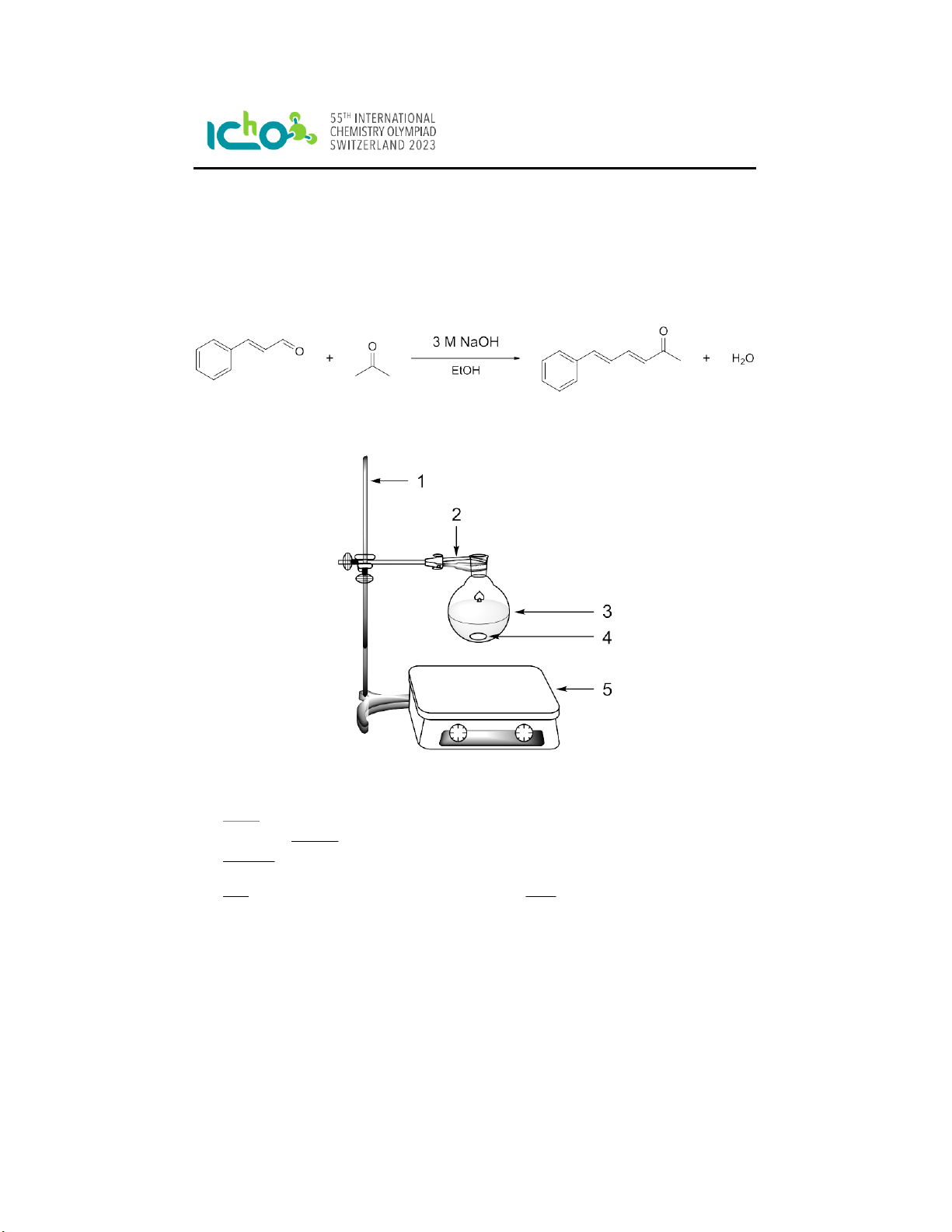
Figure 1: 1 = laboratory stand, 2 = clamp, 3 = round-bottom flask, 4 = magnetic stir bar, 5 =
hotplate with magnetic stirring.
1. Clamp a 100 mL round-bottom flask to the stand and add a stir bar.
2. In this flask, dissolve cinnamaldehyde (1.3 mL) in ethanol (20 mL).
3. Set aside a small sample (1 drop) of cinnamaldehyde in a vial for thin layer chromatography (TLC)
analysis (to be carried out later).
4. Cool the ethanol (EtOH) bottle in an ice-water bath and store it in this bath throughout the prepa- ration. Q3-4
Preparatory Problems (Practical) English (Official)
5. While stirring, add acetone (0.74 mL) to the cinnamaldehyde solution.
6. Add an aqueous NaOH solution (20 mL, 3 M solution) using a measuring cylinder.
7. Stir for 20 minutes at room temperature to allow complete precipitation of the product.
8. Meanwhile, prepare a mixture of cold ethanol and de-ionized water in a 1:2 ratio (total 50 mL).
9. Add this solution to the reaction mixture to stop the reaction.
10. Stop the stirring and remove the stir bar with the magnetic stir bar remover.
11. Set up a vacuum filtration apparatus according to the general procedure given in the Appendix
(Section A) and filter the crude product.
12. Wash the solid collected on the Büchner funnel thoroughly with cold ethanol (ca. 10 mL).
13. Let air suck through the precipitate for 3 minutes to dry the product. Disconnect the vacuum
source. Use the spatula to transfer the crude product to a fresh 100 mL round-bottom flask.
14. Wash both the suction flask and the Büchner funnel first with ethanol and then with water.
15. Analyze the crude product by TLC (thin layer chromatography):
(a) Take the vial set aside with 1 drop of cinnamaldehyde (see above, step 3) and prepare a dilute
solution by adding 1 mL of EtOAc. Prepare a separate dilute solution of your crude product in
another vial (small spatula tip in 1 mL of EtOAc).
(b) Perform the TLC analysis according to the general scheme provided in the Appendix, section
B (“starting material” = cinnamaldehyde), using a mixture of hexane and EtOAc in a 97:3 ratio as the eluent.
(c) After developing and drying the TLC plate, visualize it under the UV lamp. With a pencil, gently circle all the visible spots. Q3-5
Preparatory Problems (Practical) English (Official)
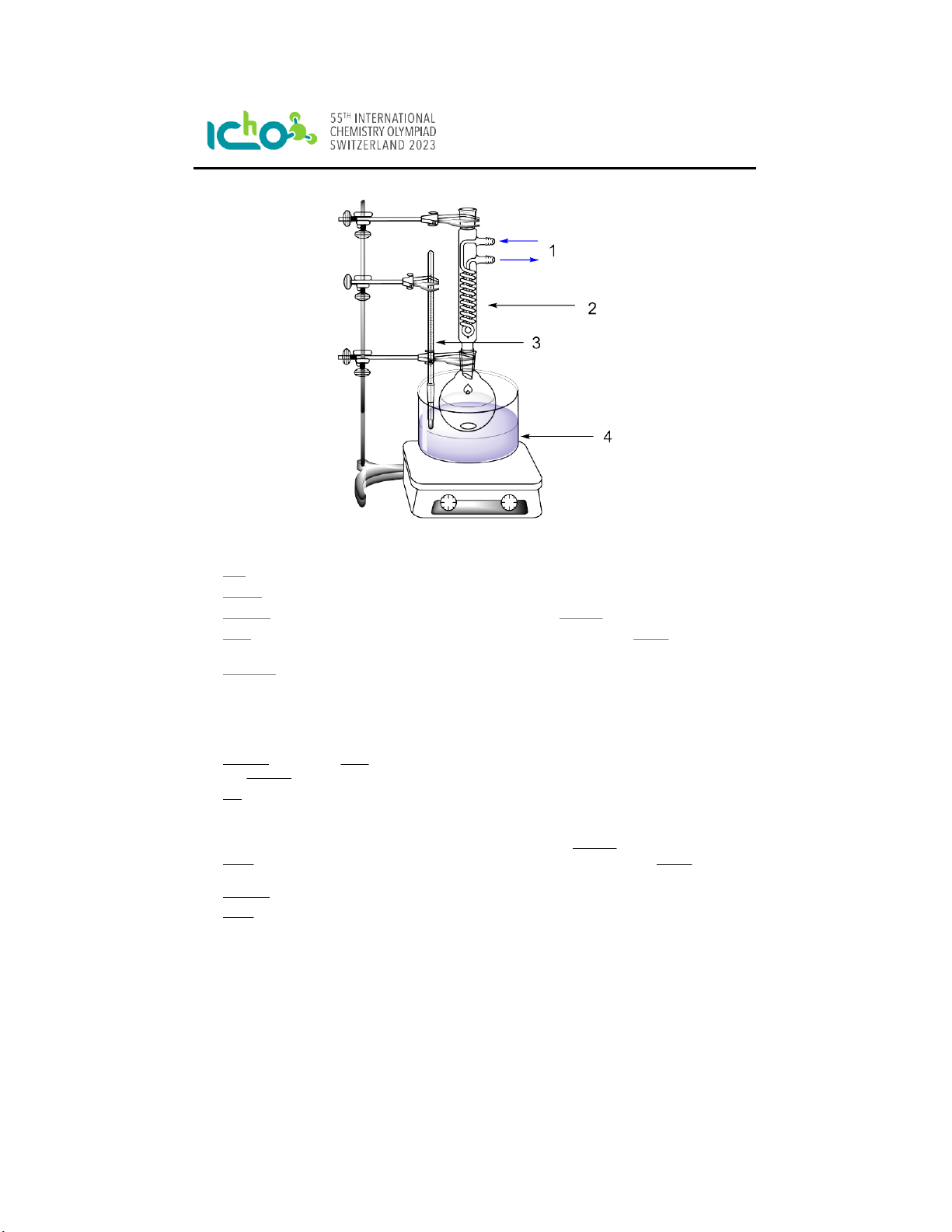
Figure 2: 1 = cooling water, 2 = reflux condenser, 3 = thermometer, 4 = water bath.
16. Add ethanol (40 mL) and a stir bar to the flask containing the crude product while stirring.
17. Attach a reflux condenser to the round-bottom flask.
18. Connect the condenser through hoses to a water source and turn on the cooling water.
19. Heat the mixture to the boiling point of EtOH (78 °C) using a water bath. Insert a thermometer
into the water bath to control its temperature.
20. Continue the slow addition of EtOH until the solid is completely dissolved (note: dissolving sub-
stances may take some time; therefore, add the solvent portionwise and wait until the mixture
boils between additions). Once the solid is completely dissolved, slowly add water with a Pasteur
pipette until a precipitate starts to appear. Wait between additions of water until the mixture boils
again. Once the precipitate persists, add just enough EtOH to dissolve it again (ca. 5 mL). This may take some time.
21. Turn off the stirring, raise the flask above the water bath by adjusting the position of the clamp,
and turn off the cooling water.
22. Let the flask cool down to room temperature without disturbance. Crystallization of the product
should be observed. If not, you may scratch the side of the flask with a glass rod to induce crystal- lization.
23. After the suspension of crystals has reached room temperature, remove the reflux condenser and
place the flask into an ice-water bath to complete crystallization (make sure to clamp the flask to the stand).
24. Remove the stir bar with a magnetic stir bar remover.
25. Filter the recrystallized product by suction filtration according to the general procedure given in the Q3-6
Preparatory Problems (Practical) English (Official)
Appendix (Section A) and wash the crystals collected on the Büchner funnel with a small amount of cold ethanol.
26. Let air suck through the crystals for 2-3 minutes. Disconnect the vacuum source. Let the purified
product air-dry for at least 15 minutes.
27. Repeat the TLC analysis (as described in step 15) with your recrystallized product.
28. Transfer the recrystallized product into a vial with a spatula. Label the vial “Final product”. Questions:
1. Based on the TLC analysis of the crude product, were impurities present? Choose the correct an- swer. □yes □no
2. Based on the TLC analysis of the recrystallized product, were impurities present? Choose the cor- rect answer. □yes □no
3. Calculate the theoretical product yield (mass, in grams) based on the amount of cinnamaldehyde used in the experiment.
4. In the above reaction, 6 equivalents of NaOH have been added in relation to the starting materials
cinnamaldehyde and acetone. Would the reaction work, in principle, also with 3 equivalents of
NaOH? Choose the correct answer. □yes □no
5. In the above aldol condensation, an initial C−C bond-forming step leading to an ‘aldol’ (i.e. a 𝛽-
hydroxy ketone) intermediate is followed by an elimination of H2O, which affords the final (isolated)
product. Draw the structure of the 𝛽-hydroxy ketone intermediate.
Tài liệu liên quan:
-
Báo cáo Thực Tập Cơ Bản: Linh Kiện và IC Trong Mạch Điện | Thực tập cơ bản | Trường Đại học Bách khoa Hà Nội
41 21 -
Báo cáo Thực Tập Cơ Bản: Thiết Kế Mạch Điện Tử | Thực tập cơ bản | Trường Đại học Bách khoa Hà Nội
35 18 -
Báo cáo về Chủ nghĩa Xã hội Khoa học và Vai trò của C. Mác - Ph. Ăngghen | Thực tập cơ bản | Trường Đại học Bách khoa Hà Nội
40 20 -
Báo cáo Thực Tập Cơ Bản: Thiết Kế Mạch Đếm Thuận 0-9 Bằng Altium | Thực tập cơ bản | Trường Đại học Bách khoa Hà Nội
35 18 -
Báo cáo thực tập Mạch khuếch đại âm tần - Điện tử | Thực tập cơ bản | Trường Đại học Bách khoa Hà Nội
38 19