Analysis of Industry and Market Trends | Lập kế hoạch kinh doanh | Trường Đại học Kiến trúc Đà Nẵng
Overview of the historical development of the industry. Tài liệu được sưu tầm và soạn thảo dưới dạng file PDF với mục đích hỗ trợ học tập và tham khảo. Nội dung tài liệu được trình bày rõ ràng, dễ tiếp cận, phù hợp cho việc ôn tập và củng cố kiến thức trong quá trình học đại học. Đây sẽ là nguồn tư liệu hữu ích giúp các bạn sinh viên chuẩn bị tốt hơn cho các buổi học, đồng thời mở rộng thêm hiểu biết về môn học. Hy vọng tài liệu này sẽ mang lại nhiều giá trị và hỗ trợ các bạn trong hành trình học tập. Mời bạn đọc cùng tham khảo!
Môn: Lập kế hoạch kinh doanh ( KTD) 66 tài liệu
Trường: Trường Đại học Kiến trúc Đà Nẵng 322 tài liệu
Tác giả:

Preview text:
Homework 2 The Industry
1. Explain the nature of the industry.
Overview of the historical development of the industry.
Note any special events, governmental action, or economic events that have
altered the industry in the last ten years. Don’t make a laundry list; note the most important events only.
Provide industry data such as market size, growth trends, and competitive
strength of major firms in the industry.
Are there seasonal fluctuations in demand?
Address the importance and impact of strategic issues such as: ease of entry
and exit, ability to achieve economies of scale, cyclical nature of the economy or sales cycle, etc.
What are industry trends regarding the use of technology?
How does the future look for the entire industry?
Are there any international issues? Are companies moving offshore? Are
international competitors coming into the industry?....
2. Who could compete with you by offering either a competitive product or by
offering a substitute for your product?
3. What is the current state of the art in the industry?
How does your product/service reflect this current state or exceed it?
What do you need: what will you do to succeed in your chosen market?
What are the current applications of your product/service?
What are the potential applications of your product/service? Markets
1. What market research have you conducted or found about your customer?
Detail either the sources of your information or how you deduced it.
2. Who are the potential buyers for your products?
Describe the customer according to any of the following or any combination: demographics. psychographics. sociologically. geographics.
3. How many potential customers are there? What percentage can you realistically capture?
This is critically important to the justification of the financial forecasts that will follow. 4. Why do they buy?
What is their primary purchase criterion: price, quality, availability, convenience, or...?
Are there price tiers in the target market?
What features do they seek? What benefits do they want?
Do they have a preference as to how and where they buy? How strong is it? How will you change it?
5. What are the potential annual purchases?
How do the customers decide to buy? How often do they buy? What is the buying cycle?
Is there seasonality to your market?
Is demand tied to any other product/service, i.e. online music sales to MP3 player sales? 6. What do they buy?
Price--how much will changes in price affect your customers’ purchases? Important to know in advance.
Quality--will they pay more for better quality?
Image-- is brand name important? Are customers brand loyal?... 7. Describe the overall market
Does the research show a profitable market for your business, product/service?
(Remember size or lack of service to a market does not automatically imply
opportunity. No one may be serving that market for a reason.)
Location and size, in number of customers and sales dollars. Is the market growing? Growth rate, trends.
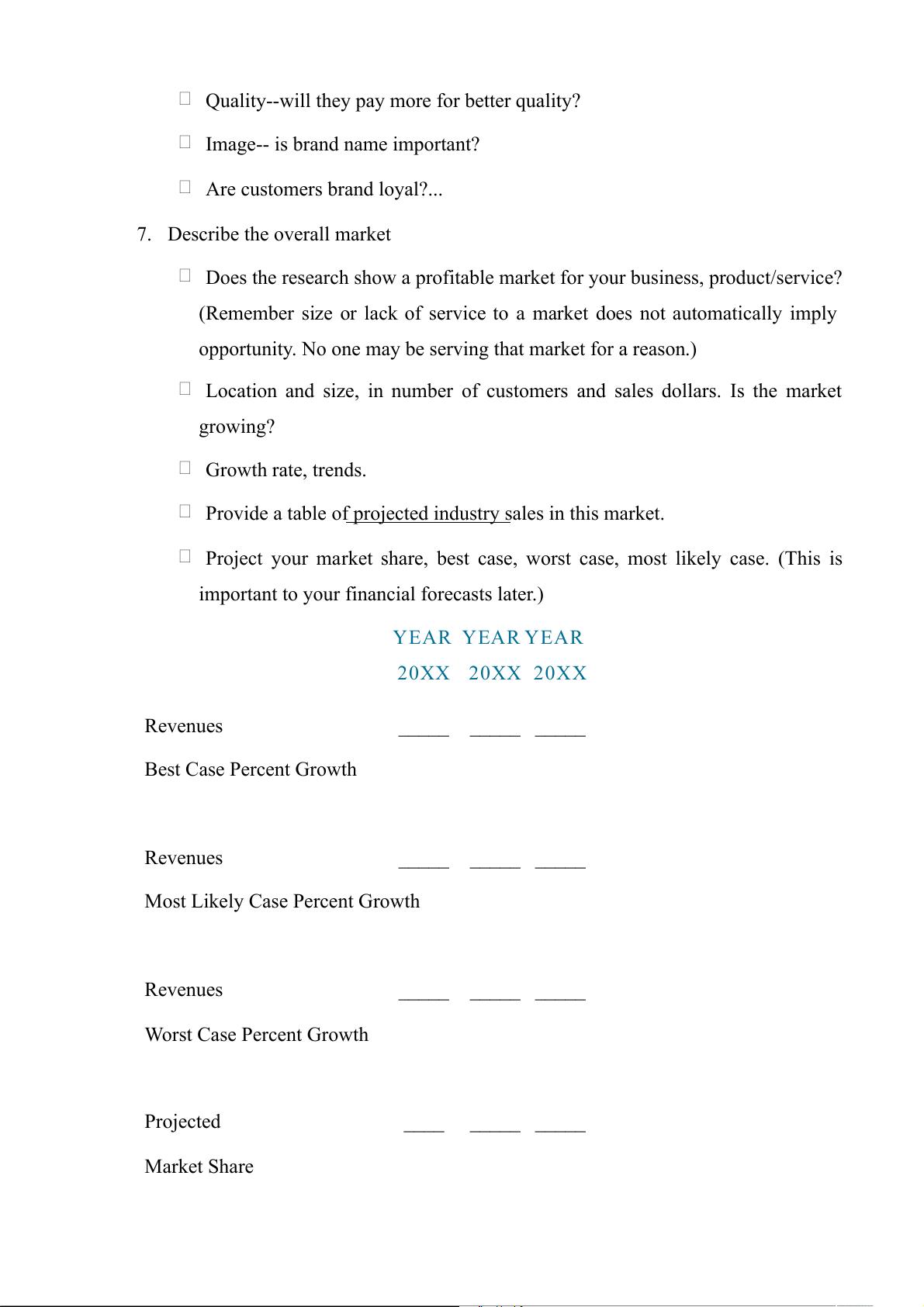
Provide a table of projected industry sales in this market.
Project your market share, best case, worst case, most likely case. (This is
important to your financial forecasts later.) YEAR YEAR YEAR 20XX 20XX 20XX Revenues _____ _____ _____ Best Case Percent Growth Revenues _____ _____ _____
Most Likely Case Percent Growth Revenues _____ _____ _____ Worst Case Percent Growth Projected ____ _____ _____ Market Share Market Trends
1. How might the economy affect sales of your product/service?
What is the economic forecast for your geographic area for the next year, the next five years?
2. How might government programs, policies, or legislation affect your industry, business, or product/service?
3. How might technological factors affect your product/service sales?
4. What social/cultural factors might impact your sales?
Changing demographics of market segment: aging, moving, increasing/decreasing incomes.
Changing social structure, i.e., increase in single working parents, might
result in an increased need for quick, inexpensive prepared meals that can be heated and eaten. Changing values.
5. How will you track these trends? How will you continually evaluate customer needs?
Tài liệu liên quan:
-
Kế hoạch tổ chức workshop định hướng nghề nghiệp” | Lập kế hoạch kinh doanh | Trường Đại học Kiến trúc Đà Nẵng
13 7 -
Kế hoạch sản xuất và vận hành sản phẩm Bath Bomb | Lập kế hoạch kinh doanh | Trường Đại học Kiến trúc Đà Nẵng
14 7 -
So Sánh Kế Hoạch Kinh Doanh - Nhóm Handmade | Lập kế hoạch kinh doanh | Trường Đại học Kiến trúc Đà Nẵng
15 8 -
Phân tích Doanh nghiệp - Thiết kế và Đánh giá Sản phẩm Mới | Lập kế hoạch kinh doanh | Trường Đại học Kiến trúc Đà Nẵng
15 8