Bài giảng Công nghệ vật liệu cấu trúc nano | Trường Cao đẳng Công nghệ Và Quản trị Sonadezi
Bài giảng Công nghệ vật liệu cấu trúc nano | Trường Cao đẳng Công nghệ Và Quản trị Sonadezi. Tài liệu được sưu tầm giúp bạn tham khảo, ôn tập và đạt kết quả cao. Mời bạn đọc đón xem.
Môn: Công nghệ vật liệu 4 tài liệu
Trường: Trường Cao đẳng Công nghệ Và Quản trị Sonadezi 34 tài liệu
Tác giả:










Preview text:
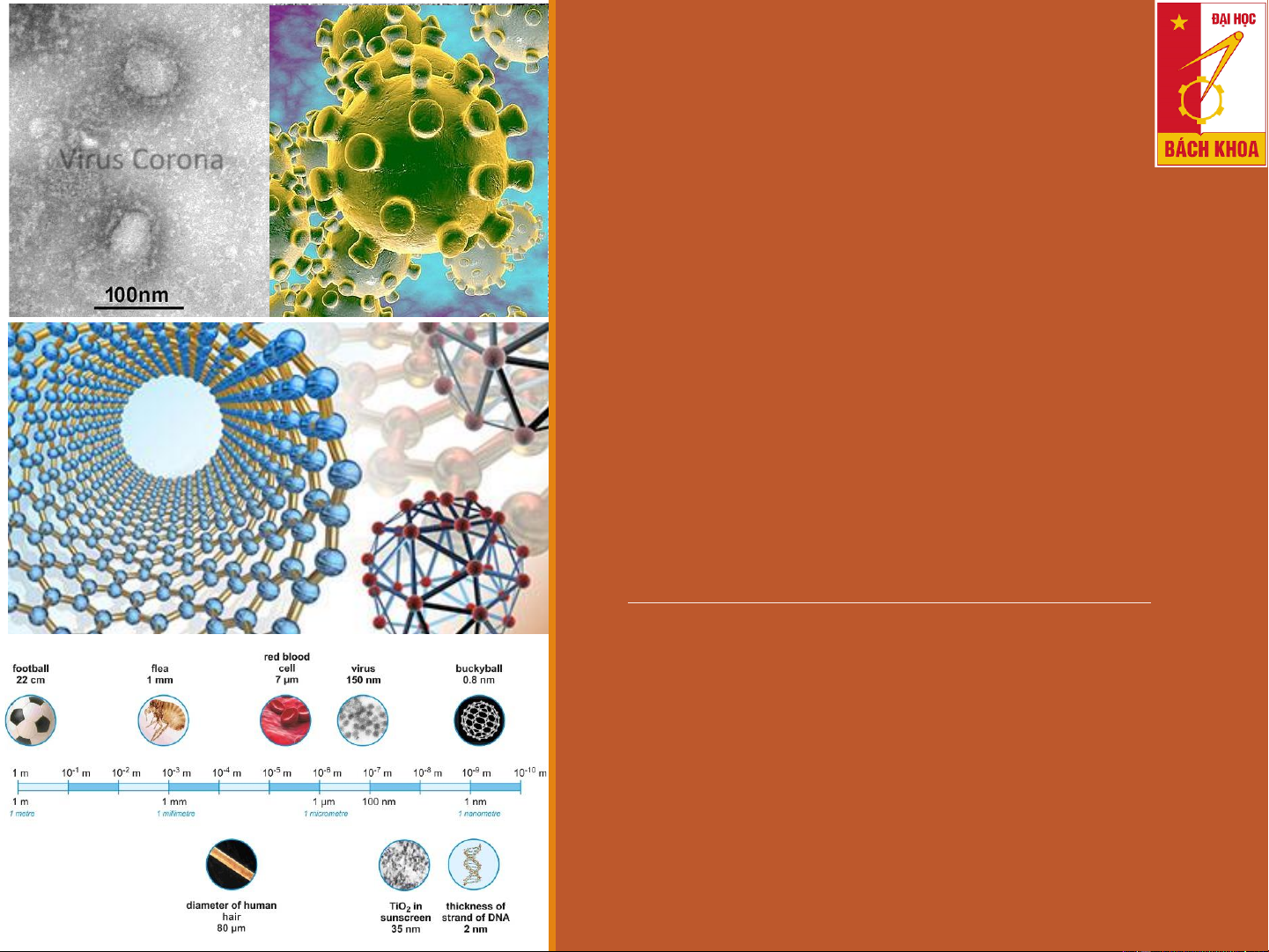
Virus Corona
CÔNG NGHỆ VẬT LIỆU CẤU TRÚC NANO
P G S . L ê T h á i H ù n g
V i ệ n K h o a h ọ c v à K ỹ t h u ậ t v ậ t l i ệ u
E m a i l : h u n g . l e t h a i @ h u s t . e d u . v n 1
GIỚI THIỆU MÔN HỌC 1. THÔNG TIN CHUNG Tên học phần:
Công nghệ vật liệu cấu trúc nano
(Nanostructured materials processing technology) Mã số học phần: MSE3131 Khối lượng: 3(2-1-1-6) - Lý thuyết: 30 tiết - Bài tập/BTL: 15 tiết - Thí nghiệm: 15 tiết
Học phần tiên quyết: -
MSE2011: Nhập môn về KH và KT vật liệu
Học phần học trước: -
MSE2020: Nhiệt động học vật liệu -
MSE2023: Sự hình thành tổ chức tế vi
Học phần song hành: - MSE3120: vật liệu nano Mô tả học phần
Giới thiệu chung về vật liệu nano, các tính chất và ứng dụng. Các phương pháp từ trên xuống (TOP-
DOWN): nghiền năng lượng cao, biến dạng dẻo mãnh liệt, phương pháp phun và các phương pháp
khác như: quang khắc, nguội nhanh, nổ dây, ngưng tụ khí…; Các phương pháp từ dưới lên (BOTTOM –
UP) gồm các phương pháp hóa học như: CVD, phương pháp cháy, sol-gel…, các phương pháp vật lý
như: PVD, phún xạ và các phương pháp hóa - lý khác như: lắng đọng nhiệt phun phủ, mạ điện, laser,
bốc bay…. Ứng dụng các phương pháp này trong chế tạo các vật liệu như: nano hạt, dây, ống, màng mỏng và nano compozit CĐR được đánh Tỷ Điểm thành phần
Phương pháp đánh giá cụ thể Mô tả giá trọng [1] [2] [3] [4] [5]
A1. Điểm quá trình (*) Đánh giá quá trình 30%
A1.1. Thi giữa kỳ, Bài tập, điểm danh Thi viết/thuyết trình M1.1; M1.2; M1.3; 30% M2.1; M2.2 A1.2. Thí nghiệm Báo cáo và đi thí M3.1; M3.2 nghiệm đầy đủ A2. Điểm cuối kỳ A2.1. Thi cuối kỳ Thi viết/Thuyết trình M2.1 – M2.3 70% 2
GIỚI THIỆU MÔN HỌC
2. KẾ HOẠCH GIẢNG DẠY
Hoạt động dạy và Tuần Nội dung CĐR học phần Bài đánh giá học 1 Giới thiệu chung: M1.1 M1.3 Giảng bài; A1.1 - Khái niệm - Tính chất - Ứng dụng 2-5
Phần 1: Các phương pháp Top-Down M2.1 M2.3 Giảng bài; A1.1
1.1. Ứng dụng các phương pháp trong chế tạo vật Bài tập A1.2
liệu nano hạt, nano dây, ống, màng mỏng, nano A2.1 compozit
1.2. Phương pháp biến dạng dẻo mãnh liệt (SPD, ARB…) 6-7
1.2. Phương pháp nghiền năng lượng cao – kết M2.1 M2.3 Giảng bài, Bài tập A1.1 khối bột nano tinh thể A1.2 A2.1 8
1.3. Phương pháp phun, SPS, giới thiệu một số M2.1 M2.3 Giảng bài; A1.1
phương pháp khác: nguội nhanh, nổ dây… Bài tập A1.2 TN1 A2.1 9 Kiểm tra giữa kỳ 3
GIỚI THIỆU MÔN HỌC
2. KẾ HOẠCH GIẢNG DẠY
Hoạt động dạy và Tuần Nội dung CĐR học phần Bài đánh giá học 10-11
Phần 2: Các phương pháp Bottom-up M2.1 M2.3 Giảng bài A1.1 2.1. Phương pháp hóa học Giao topic để thuyết A1.2 2.1.1. Phương pháp cháy trình, Bài tập A2.1 2.1.2. Phương pháp sol Thí nghiệm -gel (TN2) 12
2.1.3. Phương pháp lắng đọng hơi hóa học (CVD) M2.1 M2.3 Giảng bài; Bài tập A1.2
2.1.4. Các phương pháp khác: lắng đọng nhiệt A1.3
phun phủ, mạ điện, khử sinh học A2.1 13
2.2. Phương pháp lắng đọng hơi vật lý M2.1 M2.3 Giảng bài; Bài tập A1.2
2.2.1. Phương pháp bốc bay (evaporation) A1.2
2.2.2. Phương pháp phún xạ (sputtering) A2.1 14
2.2.3. Các phương pháp vật lý khác: hồ quang M2.1 M2.3 Giảng bài; A1.1 Plassma, laser, bốc bay Thí nghiệm A1.2 15
Tổng kết và ôn tập thi cuối kỳ A2.1 4 GIỚI THIỆU CHUNG
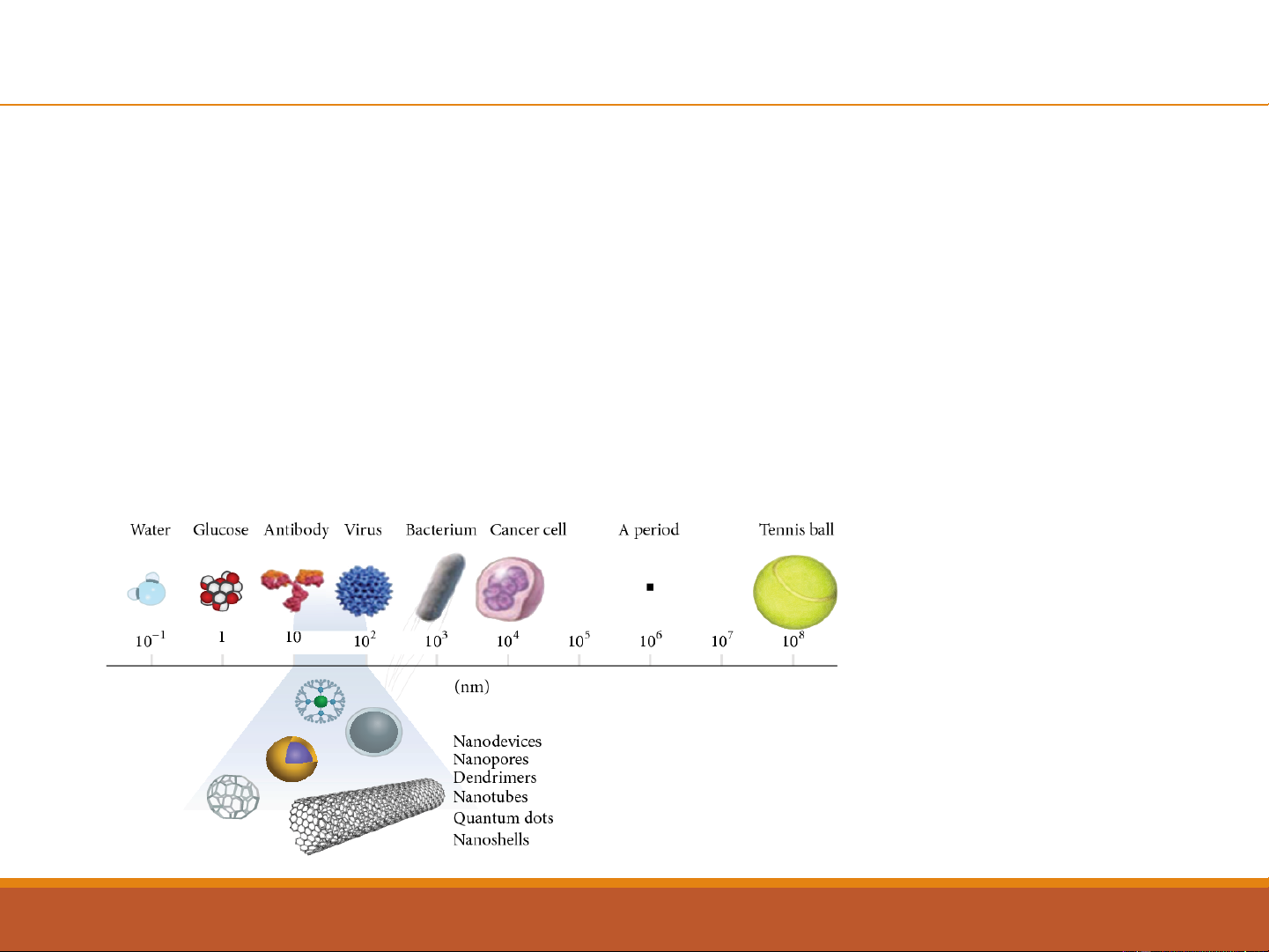
• Khái niệm vật liệu nano: Là loại vật liệu có cấu trúc các hạt, các sợi, các ống, các
tấm mỏng,...có kích thước đặc trưng khoảng từ 1 nanômét đến 100 nanômét. 5 GIỚI THIỆU CHUNG
• Để hiểu rõ khái niệm vật liệu nano, cần biết hai khái niệm có liên quan là khoa học
nano (nanoscience) và công nghệ nano (nanotechnology). “Nhà vật lý Richard
Feynman (1918-1988), Nobel Vật lý 1965”.
1. Khoa học nano là ngành khoa học nghiên cứu về các hiện tượng và sự can thiệp
(manipulation) vào vật liệu tại các quy mô nguyên tử, phân tử và đại phân tử. Tại các
quy mô đó, tính chất của vật liệu khác hẳn với tính chất của chúng tại các quy mô lớn hơn.
2. Công nghệ nano là việc thiết kế, phân tích đặc trưng, chế tạo và ứng dụng các cấu
trúc, thiết bị, và hệ thống bằng việc điều khiển hình dáng và kích thước trên quy mô nano mét.
Đối tượng chung của khoa học nano và
công nghệ nano chính là vật liệu nano 6 GIỚI THIỆU CHUNG
LỊCH SỬ PHÁT TRIỂN VẬT LIỆU NANO
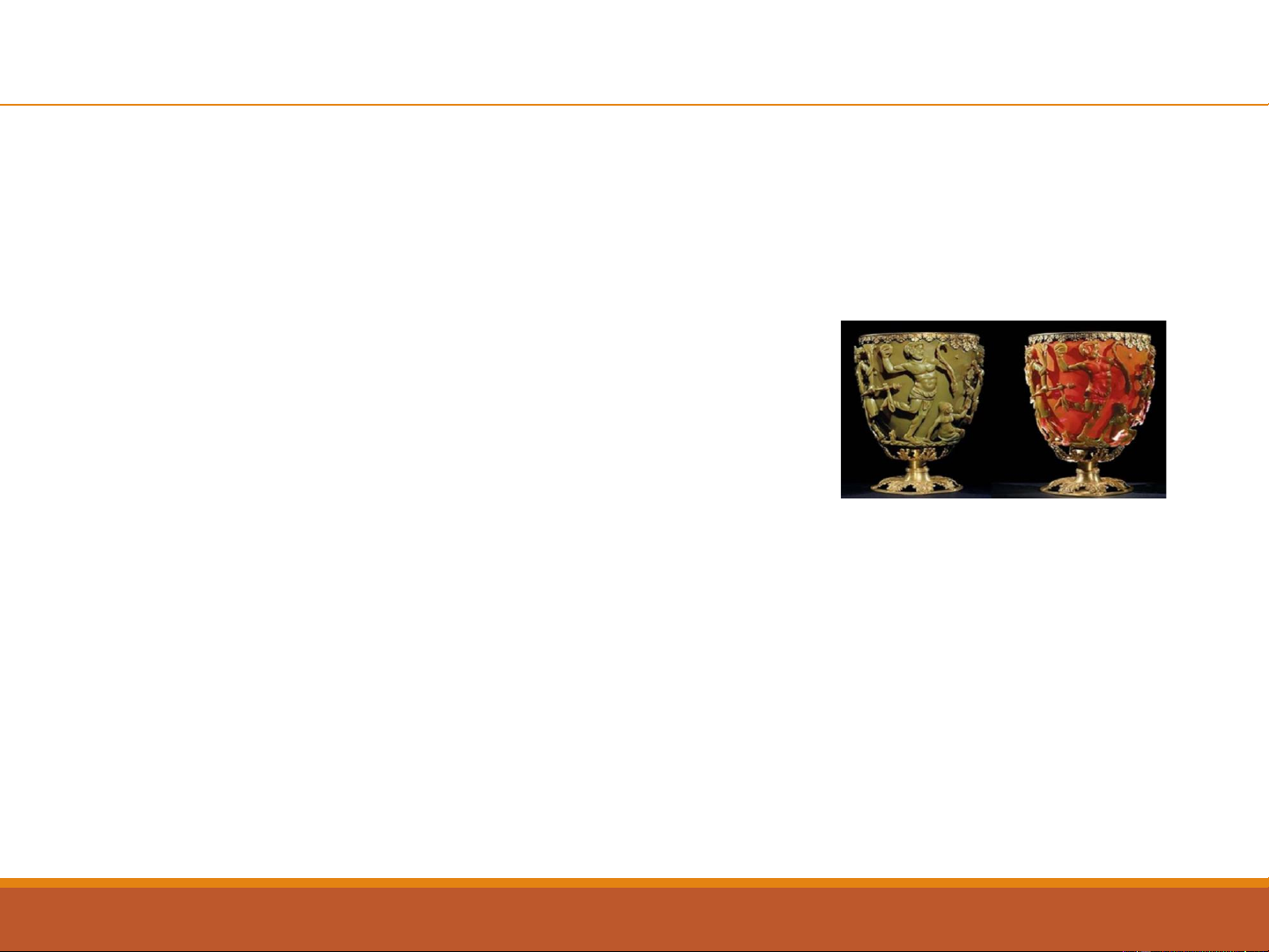
• Thể kỷ thứ 5 sau công nguyên: xuất phát từ
chiếc ly bí ẩn “Lycurgus Cup”
• 1908 khái niệm nano xuất hiện khi để chỉ các
vi sinh vật rất nhỏ (200nm)
• 1959 – Đặt nền móng đầu tiên cho công nghệ
nano – Dr. Richard Feynman người Mỹ
• 1981 phát triển kính hiển vi (scanning
tunneling microscope) có thể nhìn thấy nguyên
tử riêng biệt → công nghệ nano bắt đầu phát triển. Lycurgus Cup
• Việt Nam: 1997 – tại hội nghị Vật lý chất rắn
GS.VS Nguyễn Văn Hiệu phát động nghiên
cứu vê nano → đến nay có nhiều Viện, PTN, nghiên cứu nano
“There's Plenty of Room at the Bottom”
By Richard Feyman in 1959 7 GIỚI THIỆU CHUNG
MỘT SỐ KHÁI NIỆM VỀ VẬT LIỆU NANO
- The prefx, nano-, is derived from the Greek word nannos, meaning “very
short man.” The International Organization for Standardization (ISO) has
defined nanomaterial (NM) as a material with any external dimension in the
nanoscale or having internal structure or surface structure in the nanoscale
and nanoparticle (NP) as a nano-object with all three external dimensions in the nanoscale (1–100 nm).
- The term “NM” usually refers to materials with external dimensions or an
internal structure, measured in nanoscale exhibiting additional or different unique properties.
- NMs can exhibit unique optical, mechanical, magnetic, conductive, and
sportive properties different than the same chemical substances in a larger size 8 GIỚI THIỆU CHUNG
Nanoscale: size range from approximately 1–100 nm [3]. The “approximately”
is assumed to be applicable for both the lower and upper limits of
the definition, and size can refer to all three dimensions (OECD; [4]). A
feature characterized by dimensions of the order of 100 nm or less [5]. Having
one or more dimensions of the order of 100 nm or less [6]. Nanoscale
technology refers to our ability to utilize our understanding of nanoscale
science to fabricate products with new properties and capabilities. To fully
realize the possibilities, it becomes crucial to understand quantum interactions
at the nanoscale; to be able to see nanoscale structures; and to be able
to form, manipulate, and even connect nanostructures.
Nanoscience: study, discovery, and understanding of matter in the nanoscale,
where size- and structure-dependent properties and phenomena, as
distinct from those associated with individual atoms or molecules or with
bulk materials, can emerge [3]. The study of phenomena and manipulation
of materials at atomic, molecular and macromolecular scales, where the properties differ signifcantly from those at a larger scale [7]. 9 GIỚI THIỆU CHUNG
Nanomaterial: material with any external dimension in the nanoscale or
having internal structure or surface structure in the nanoscale [2]. An insoluble or biopersistant and intentionally manufactured material with one
or more external dimensions, or an internal structure, on the scale from 1
to 100 nm [8]. A natural, incidental or manufactured material containing
particles, in an unbound state or as an aggregate or as an agglomerate, where
for 50% or more of the particles in the number size distribution, one or more
external dimensions is in the size range of 1–100 nm [9]. Natural or manufactured
active substance or nonactive substance containing particles, in an unbound state or as an aggregate or as an agglomerate and where, for 50%
or more of the particles in the number size distribution, one or more external
dimensions is in the size range 1–100 nm [10].
Nano-object: material with one, two, or three external dimensions in the
nanoscale. Material confined in one, two, or three dimensions at the nanoscale (OECD; [4]). Nano-object with all three external dimensions in the nanoscale [2].
Nanoparticle: nano-object with all three external dimensions in the nanoscale. If the lengths of the longest and the shortest axes of the nano-object
differ signifcantly (typically by more than three times) the terms nanorod
or nanoplate are intended to be used instead of the term NP. 10 GIỚI THIỆU CHUNG
• Nanofiber: nano-object with two similar external dimensions in the nanoscale
and the third signifcantly larger [2]. A discrete entity which has
three dimensions of the order of 100 nm or less [5]. A particle with one or
more dimensions at the nanoscale [6].
• Nanostructure: composition of interrelated constituent parts, in which one
or more of those parts is a nanoscale region. Having an internal or surface
structure at the nanoscale (OECD; [4]). Any structure that is composed of
discrete functional parts, either internally or at the surface, many of which
have one or more dimensions of the order of 100 nm or less [5].
• Nanostructured material: a material having internal nanostructure or surface
nanostructure. Materials whose structural elements (clusters, crystallites, or
molecules) have dimensions in the 1–100 nm range [11].
• Nanocomposite: multiphase structure in which at least one of the phases has
at least one dimension in the nanoscale [3]. 11 GIỚI THIỆU CHUNG
PHÂN LOẠI VẬT LIỆU NANO
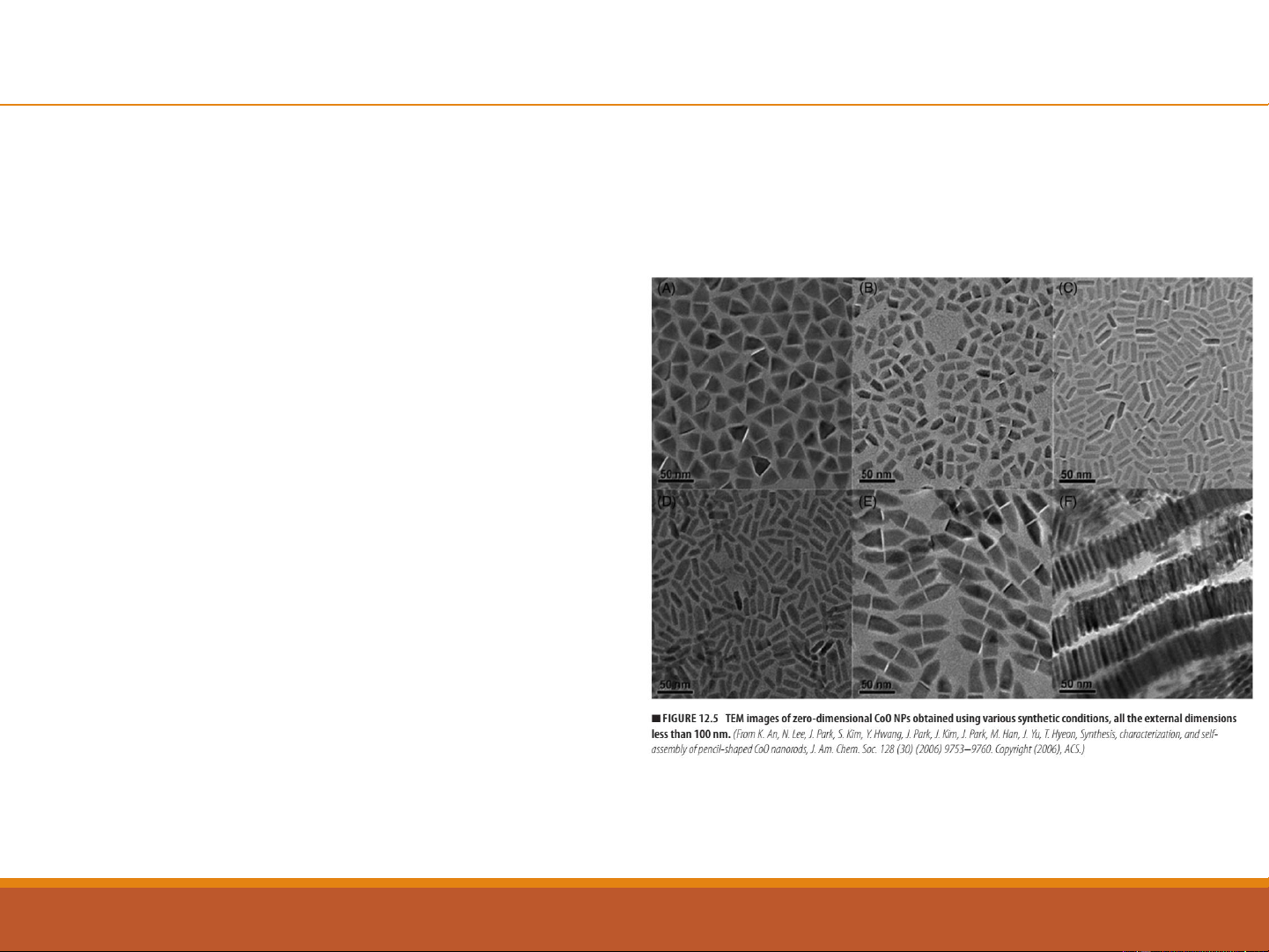
• Zero-dimensional nanoparticles (0D-
NPs) include atomic clusters, flaments,
and cluster assemblies (Fig). These
materials have all features or dimensions
less than 100 nm, their length equals the
width. Generally, 0D-NPs can be: (1)
amorphous or crystalline, (2) single
crystalline or polycrystalline, (3) single- or multichemical elements, and (4)
exhibit various shapes and forms. 3D
nanostructures could be obtained in the
form of uniform and heterogeneous arrays of 0D-NPs. These materials exhibit various shapes and exist
individually or incorporated in a matrix
as metallic, ceramic or polymeric forms. 12 GIỚI THIỆU CHUNG
PHÂN LOẠI VẬT LIỆU NANO
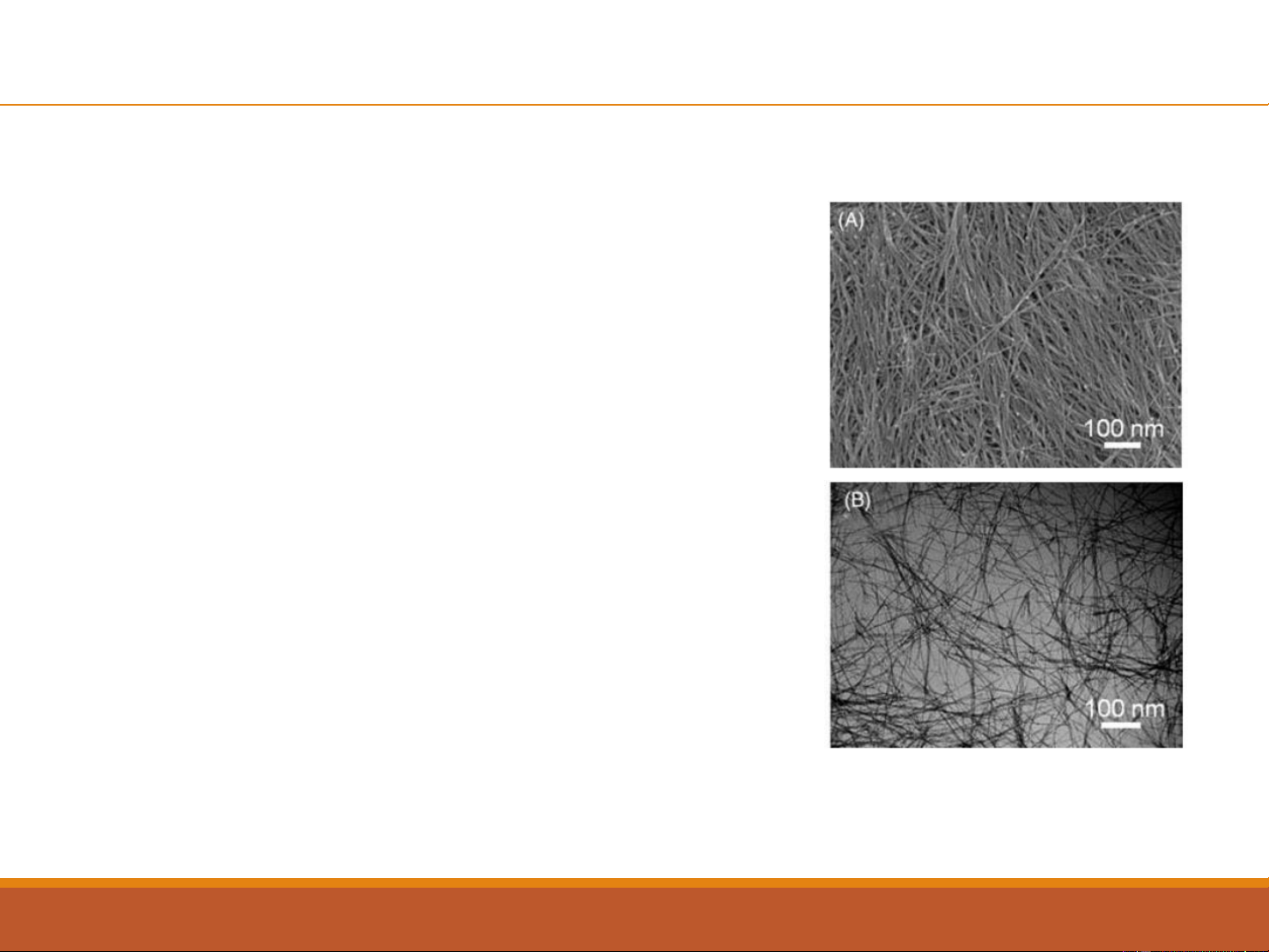
• 1D NMs are typically nanorods, nanowires,
nanotubes, and nanofibers (Fig). Typically,
two dimensions of 1D nanostructures are in
nanometer, their length is larger than the
width. Electrons are confined within two
dimensions and hence the electrons cannot
move freely in this system. Like 0D-NPs, 1D
nanostructures can be (1) amorphous or
crystalline (2) single or polycrystalline, (3)
metallic, ceramic, or polymeric and these
NMs include the circuitry of computer chips
and hard coatings on eyeglasses. Thin films of
1D nanostructures can be deposited in a
controlled manner and should be of only one
atom thick and they are so-called monolayer.
A) SEM image of 1D CeO2 nanowires, B) TEM image of
two dimensions (diameter) of 1D CeO2 nanostructures
are less than 100nmX.-F.YU et al 2015 13 GIỚI THIỆU CHUNG
PHÂN LOẠI VẬT LIỆU NANO
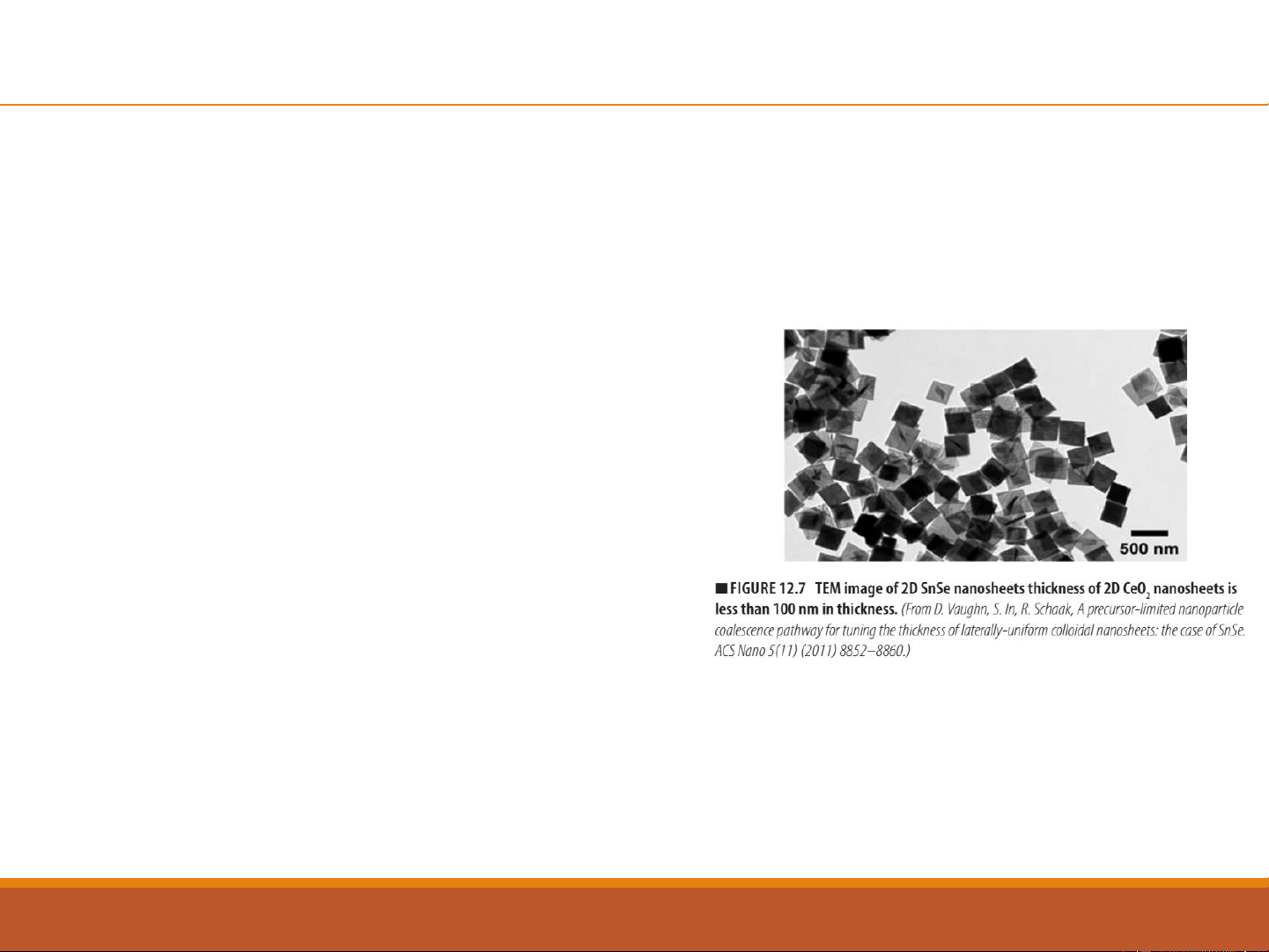
• 2D NMs include nanosheets, nanofilms and nanoribbons (ultrafine-grained overlayers or
buried layers) (Fig. 12.7). Free particles with
large aspect ratio, with dimensions in the
nanoscale range, are also considered as 2D NMs.
In this system, electrons are confined within one
dimension, indicating electrons cannot move
freely within the associated dimension. Similar to
0D and 1D nanostructures, 2D can also be (1)
amorphous or crystalline, and (2) composed of
metallic, ceramic or polymeric matrixes. 2D
nanostructures are promising for applications,
including sensors, electronics/optoelectronics, and
biomedicine. The atomic thickness offers them a high mechanical flexibility and optical
transparency, which makes them a promising
material for the fabrication of electronic and optoelectronic devices. 14 GIỚI THIỆU CHUNG
PHÂN LOẠI VẬT LIỆU NANO
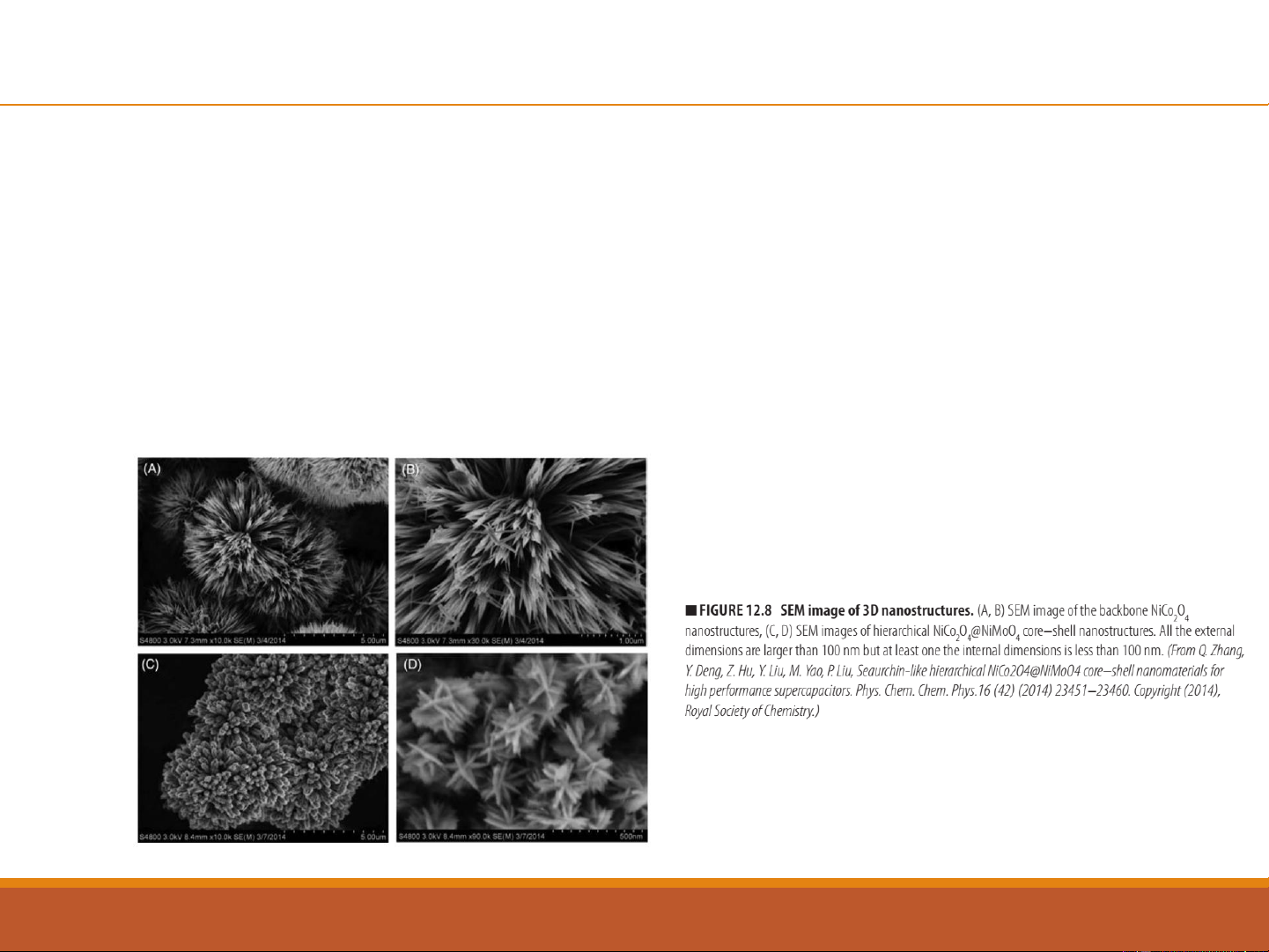
• 3D NMs include nanophase materials consisting of equiaxed nanometer
sized grains (Fig. 12.8). 3D nanostructures are not confined to the nanoscale in all dimensions and they are generally known as bulk NMs. 3D
NMs have three arbitrary dimensions beyond 100 nm. In 3D NMs, the
electrons are fully delocalized indicating all electrons will move freely within all dimensions. 15 GIỚI THIỆU CHUNG
TÍNH CHẤT VẬT LIỆU NANO
Tính chất thú vị của vật liệu nano bắt nguồn từ kích thước của chúng rất nhỏ bé
có thể so sánh với các kích thước tới hạn của nhiều tính chất hóa lí của vật liệu.
Tính chất của vật liệu nano nằm giữa tính chất lượng tử của nguyên tử và tính
chất khối của vật liệu. Đối với vật liệu khối, độ dài tới hạn của các tính chất rất
nhỏ so với độ lớn của vật liệu, nhưng đối với vật liệu nano thì điều đó không
đúng nên các tính chất khác lạ bắt đầu từ nguyên nhân này.
• Hiệu ứng kích thước • Hiệu ứng bề mặt • Hiệu ứng lượng tử • Hiệu ứng Plasmon 16 GIỚI THIỆU CHUNG
TÍNH CHẤT VẬT LIỆU NANO
• Hiệu ứng kích thước nghĩa là khi kích thước của vật liệu giảm sẽ kéo theo
tính chất chuyển động của điện tử thay đổi, xuất hiện các hiệu ứng lượng tử.
• Hiệu ứng bề mặt khi vật liệu có kích thước nm, số các nguyên tử nằm trên
bề mặt sẽ chiếm tỷ lệ đáng kể so với tổng số nguyên tử
• Hiệu ứng lượng tử khi các hiệu ứng vật lý không tuân theo các định luật
vật lý thông thường mà bị lượng tử hóa
• Hiệu ứng Plasmon là tính chất kết hợp các dao động tập thể của các điện
tử tự do trong các hạt nano kim loại với sự kích thích của ánh sáng tới 17 GIỚI THIỆU CHUNG
ỨNG DỤNG CỦA VẬT LIỆU NANO
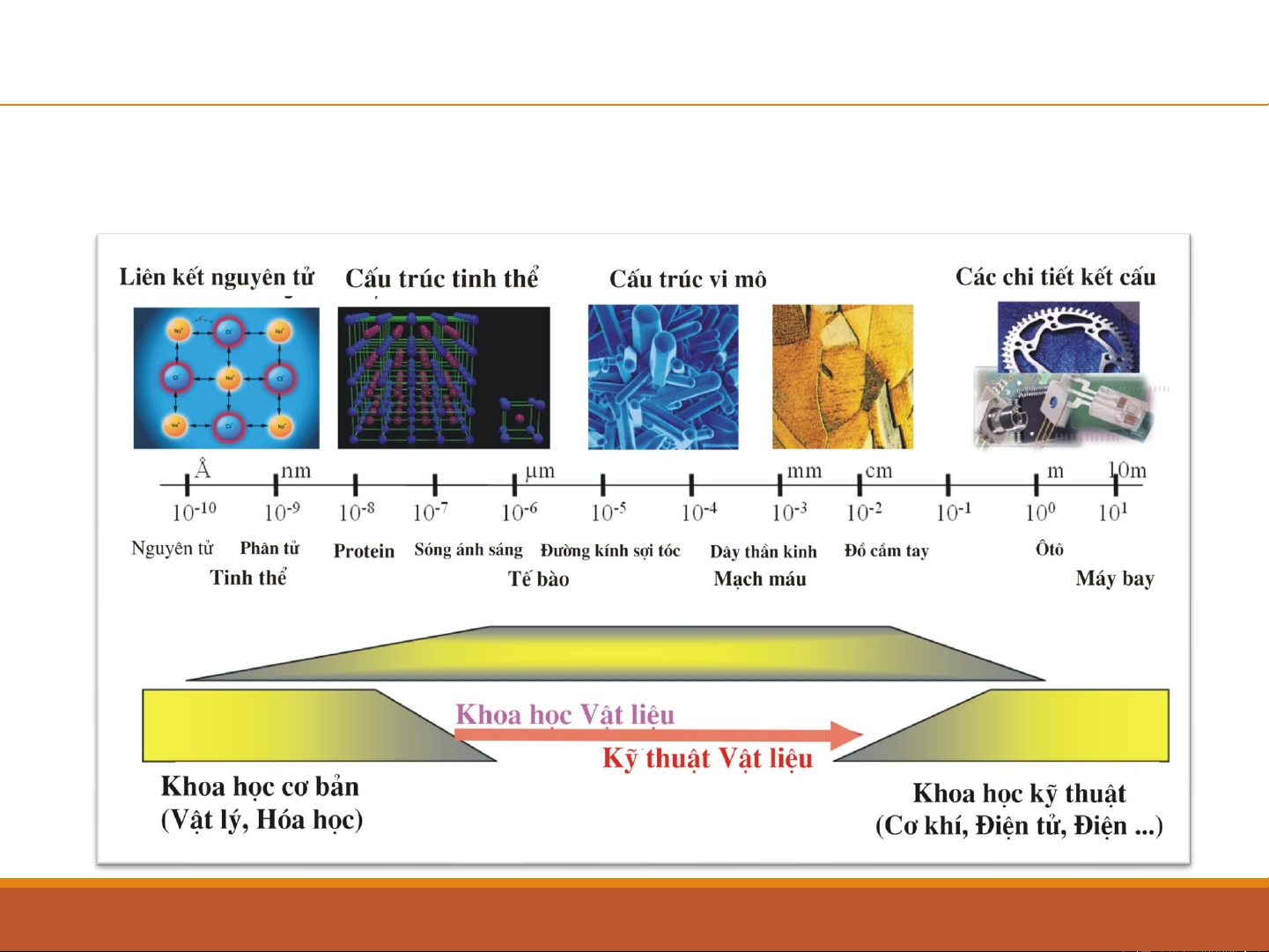
Bạn có thể tưởng tượng đường kính 1 sợi tóc người vào khoảng 15 µm, gấp 1000 lần vật liệu
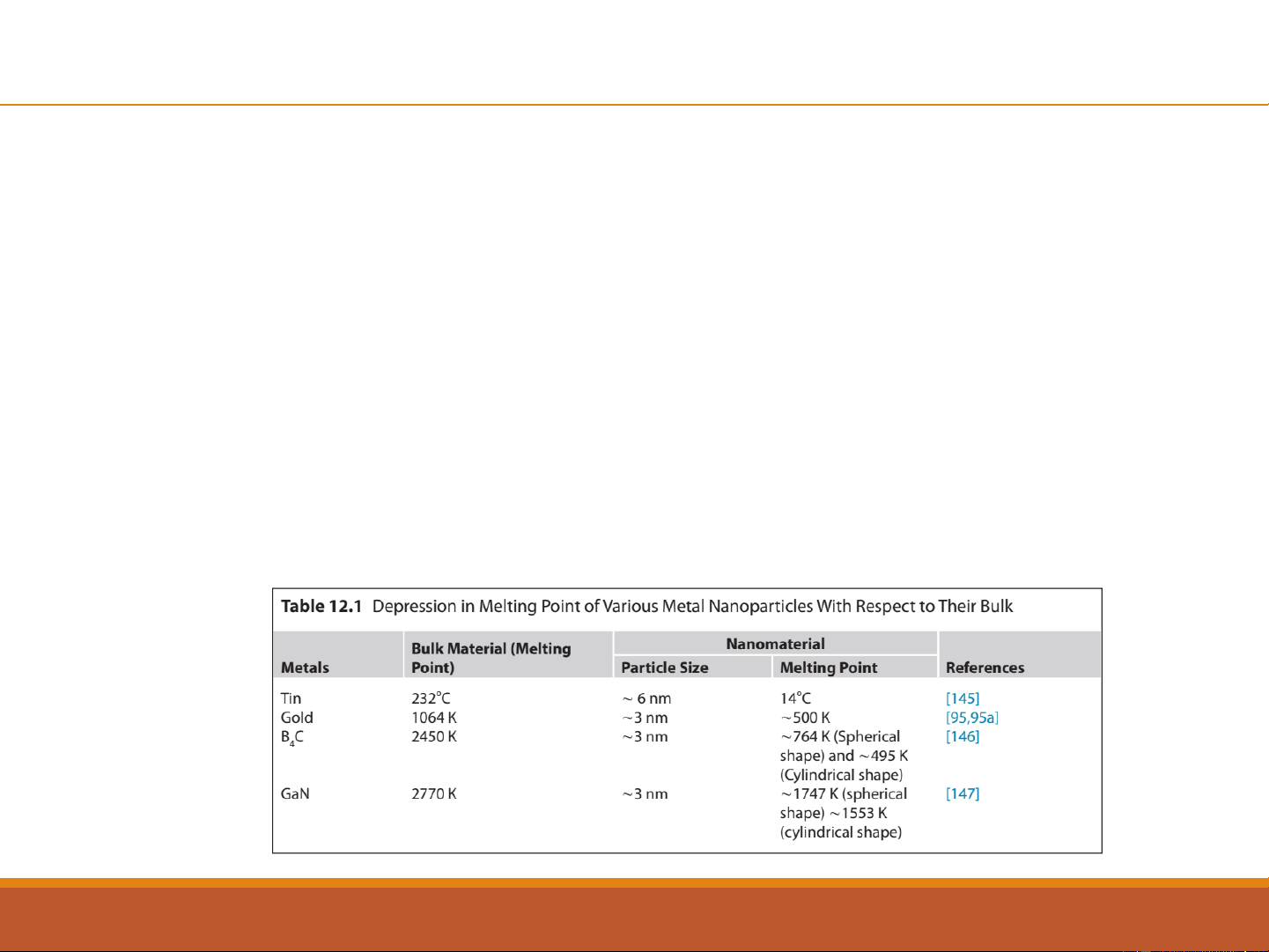
có kích thước 15 nm. Và do có kích thước cực kỳ nhỏ, diện tích bề mặt của một đơn vị cực
kỳ lớn, nên vật liệu nano có những tính chất “khác thường”, điển hình như bán dẫn (các linh
kiện điện tử có khả năng thay đổi độ dẫn điện khi có tác động từ tác nhân bên ngoài như ánh
sáng, nhiệt độ), khả năng đổi màu (dung dịch vàng (gold) ở kích thước 10-20 nm có màu đỏ,
2-5 nm có màu vàng và > 20 nm có màu tím, do khả năng hấp thụ và khuếch tán ánh sáng bị
thay đổi), biến đổi từ tính (bạch kim (platinum) ở trạng thái cơ bản không có từ tính, nhưng
hạt nano bạch kim có từ tính giống kim loại sắt) [3]. Nhưng phổ biến và được ứng dụng rộng
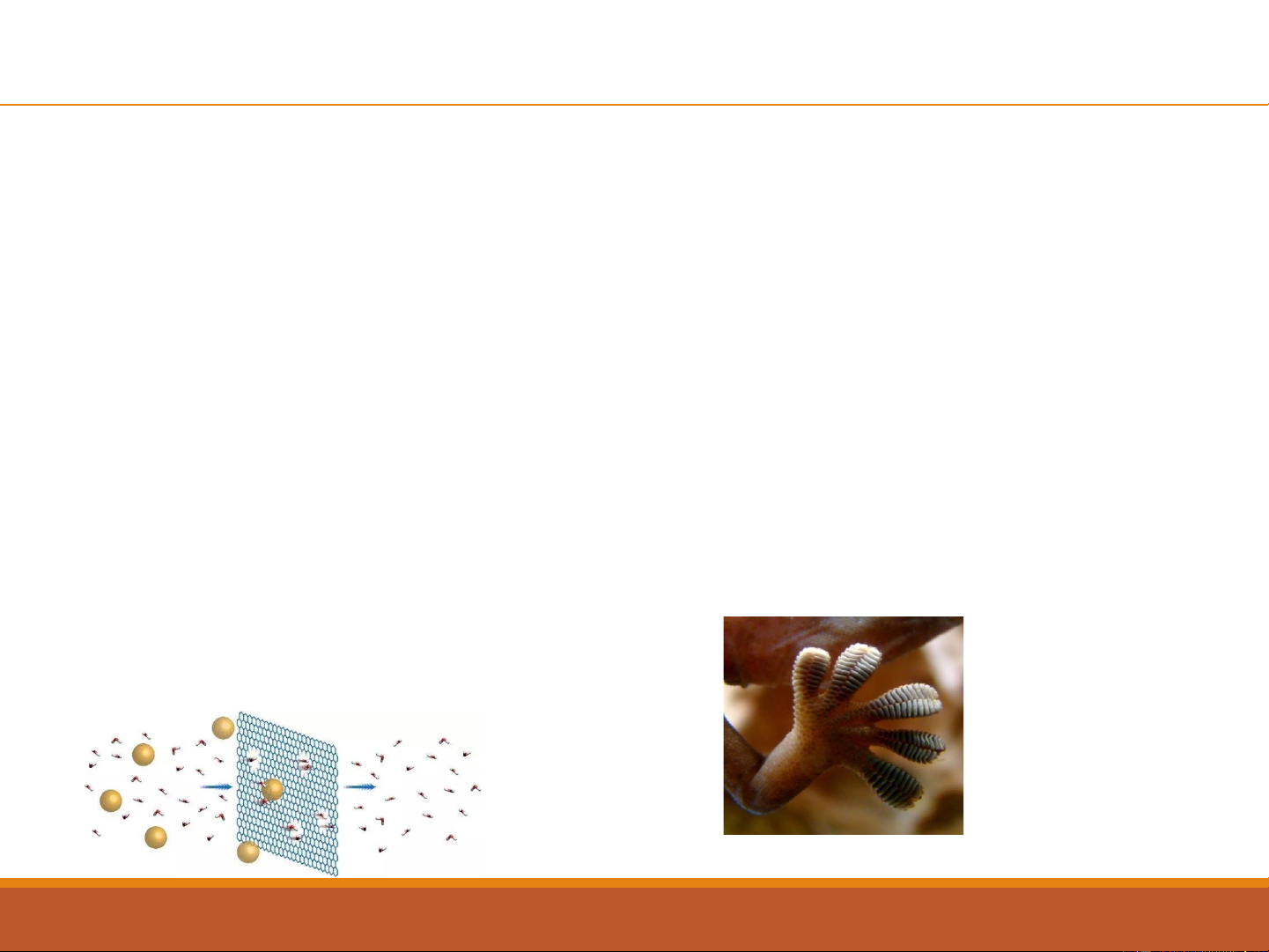
rãi là tính chất cơ học, khả năng kết dính được gia tăng đáng kể khi vật chất trở nên nhỏ lại.
Nguyên nhân là do lực liên kết phân tử van der Waals (liên kết yếu nhất trong các loại liên
kết hóa học) tuy yếu nhưng với số lượng hạt nano cực kỳ lớn, lực này trở nên áp đảo, giúp
kết dính mọi loại vật chất với nhau [3]. - 500.000 sợi “vi lông”
• Màng graphene biến nước biển thành - Chiều dài khoảng 30-130 nước uống µm
- “siêu vi lông” với kích thước 200-500 nm Màng lọc sẽ giữ lại - Liên kết van der Waals các phân tử muối,
gấp 600 lần so với vật liệu chỉ cho phân tử thông thường nước đi qua. 18 GIỚI THIỆU CHUNG
ỨNG DỤNG CỦA VẬT LIỆU NANO In our life 1. LED for display 2. PV film 3. Self-cleaning window 4. Temperature control fabrics 5. Health Monitoring clothes 6. CNT chair 7. Biocompatible materials 8. Nano-particle paint 9. Smart window 10. Data memory 11. CNT fuel cells 12. Nano-engineered cochlear
The nanotechnology is changing our life, but not enough.
Energy crisis, environmental problem, health monitoring, Artifical joints 19 GIỚI THIỆU CHUNG
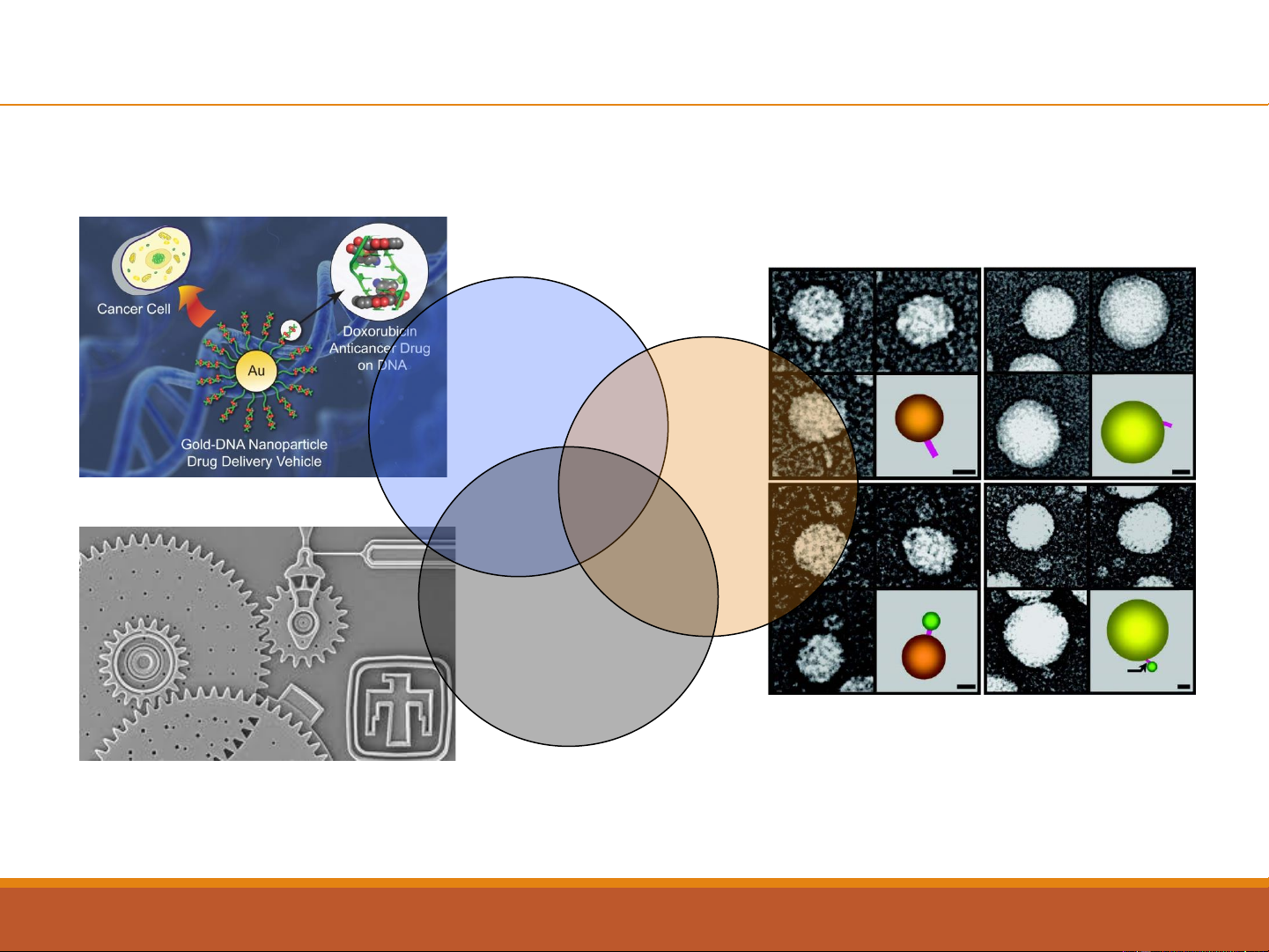
ỨNG DỤNG CỦA VẬT LIỆU NANO Protein TEM image Biology & Medicine Physics & Nano drug delivery Nano Chemistry & Materials Mechanics & Electronics Nano mechanics 20
Tài liệu liên quan:
-
Chương 2. Công nghệ sản xuất sản phẩm da giầy - Bài giảng môn Công nghệ vật liệu | Trường Cao đẳng Công nghệ Và Quản trị Sonadezi
25 13 -
Chương 1 Vật liệu da giầy - Bài giảng môn Công nghệ vật liệu | Trường Cao đẳng Công nghệ Và Quản trị Sonadezi
25 13 -
Tóm tắt lý thuyết Công nghệ vật liệu trong y sinh học | Trường Cao đẳng Công nghệ Và Quản trị Sonadezi
362 181