Bài giảng Đạo đức hành nghề dược môn Dược học | Trường Đại Học Y Dược Thái Bình
Bài giảng Đạo đức hành nghề dược môn Dược học | Trường Đại Học Y Dược Thái Bình. Tài liệu được sưu tầm giúp bạn tham khảo, ôn tập và đạt kết quả cao. Mời bạn đọc đón xem.
Môn: Dược học(ytb) 11 tài liệu
Trường: Trường Đại Học Y Dược Thái Bình 216 tài liệu
Tác giả:












Preview text:
ĐẠO ĐỨC HÀNH NGHỀ DƯỢC PHARMACY ETHICS
TS DS HUỲNH LỜI (huynhloi@bdu.edu.vn)
VIỆN ĐÀO TẠO VÀ NGHIÊN CỨU DƯỢC HỌC – ĐH BÌNH DƯƠNG 2024 1 MỤC TIÊU MÔN HỌC
• Sinh viên khái niệm được thuật ngữ trong lĩnh vực Attitude
đạo đức và luật • Skill
Sinh viên khái quát được lịch sử, các nguyên lý, các lời
thề liên quan ngành dược
• Sinh viên thực hiện được tìm kiếm tài liệu, làm báo Knowledge
cáo liên quan đến môn học
• Sinh viên ứng dụng được các vấn đề đạo đức trong
cuộc sống, giúp nâng cao năng lực, uy tín nghề nghiệp Nội dung môn học 1.
Đại cương về đạo đức hành nghề Dược/ Overview of Pharmacy Ethics 2.
Các trường hợp liên quan đến đạo đức, đạo đức trong văn học và đạo đức trong tục ngữ và ca dao 3.
Các thuật ngữ / Glossary 4.
Lịch sử Y Dược Việt Nam/ History of medicine and pharmacy in Vietnam 5. TUỆ TĨNH THIỀN SƯ 6.
HẢI THƯỢNG LÃN ÔNG 7.
Đạo đức trong tôn giáo / Ethics in religion 8.
Quyền con người / Human Rights 9.
Các lời thề trong y dược / Medcal and pharmacy oaths 10.
Đạo đức trong nghiên cứu khoa học / Ethics in scientific research 11.
Đạo đức trong kinh doanh sinh dược / ethics in biopharmaceutics 12.
Hành vi đạo đức trong giao tiếp với bệnh nhân / ethical behavior when communicating with patients Phần 1 Nội dung (Content)
1. Định nghĩa về đạo đức học (definition)
Challenges and Opportunities
ĐẠI CƯƠNG VỀ ĐẠO ĐỨC HÀNH NGHỀ DƯỢC
2. Definition of Pharmacy ethics
13. Challenges in Pharmacy Law and 3. Career in Pharmacy Ethics in Global Health
OVERVIEW OF PHARMACY ETHICS
4. The four principles in medical ethics
14. Ethical challenges of pharmacy
5. Human essential values practices
6. The dynamics of the health care
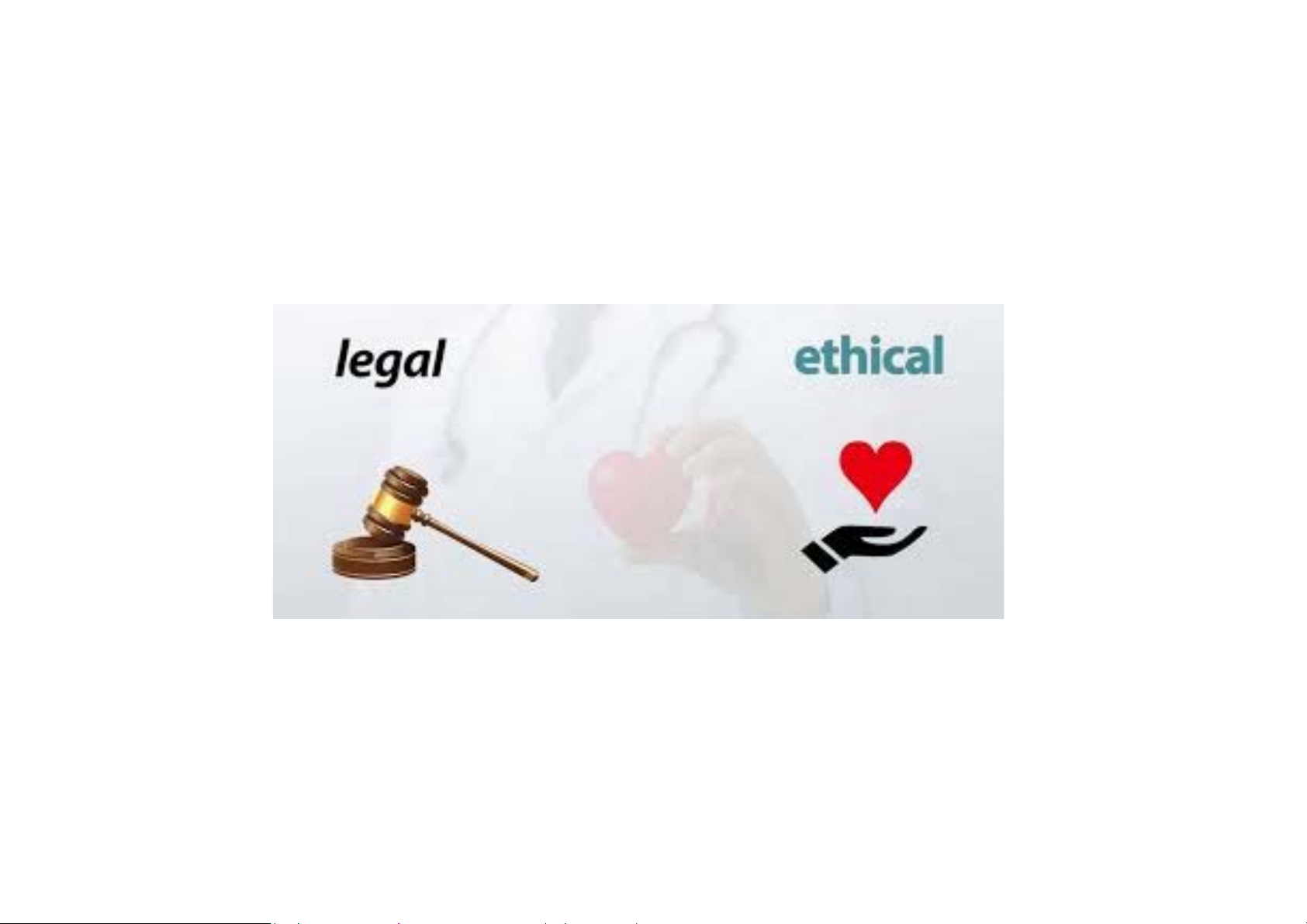
15. Ethics, Morals, and Values process 16. Ethics and Laws 7. Important applications to an
17. Morality, Ethics and Law
acceptable standard of patient care 18. Ethics and Law
8. The responsibilities of a pharmacist 19. Law vs Moral
9. Four Questions of Ethical Position 20. Ethics and Law
10. The Five-Step Model for decision- 21. Law making process
22. An ethical framework for the
11. Pharmacy Ethics Related to the
responsibilities of pharmacists when Covid-19
selling complementary medicines
12. The Globalization of Healthcare: TS DS Huỳnh Lời 1 2 The Symbols of Pharmacy The Symbols of Pharmacy – Snake •
WHO's emblem was chosen by the First World Health Assembly in 1948. – Bowl of Hygieia
The emblem consists of the United Nations symbol surmounted by a staff •
Representations of the Greek goddess Hygeia,
with a snake coiling round it. •
The staff with the snake has long been a symbol of medicine and the
daughter of Asculepius, god of medicine, and his
medical profession. It originates from the story of Asclepius, who was
revered by the ancient Greeks as a god of healing and whose cult involved
frequent companion on healing missions.
the use of snakes. Asclepius, incidentally, was so successful at saving
lives that, the legend goes, Hades the god of the underworld complained
about him to the supreme god Zeus who, fearing that the healer might
make humans immortal, killed Asclepius with a thunderbolt Stieb, Ernst W. (1962)
https://www.who.int/about/policies/publishing/logo 3 4 The Symbols of Pharmacy
1. ĐỊNH NGHĨA VỀ ĐẠO ĐỨC HỌC (DEFINITION) – The Rx sign • R
– “ethics” to the 8th century BC, to the epic poems of Homer and Hesiod. For Homer, êthos
x has been referred to as the "real symbol of pharmacy (if there is
such a thing), determining precisely the place of the calling among
((êthos, Zyoz; with a Z = êta) meant “stable,” “lair,” (hang ổ) and “hole” (lỗ); for Hesiod, it
the healing professions," on the basis of its appearance for centuries
"at the top of each and everyone of the prescriptions written by
meant a “hostel” (nhà trọ) for Man. Broadly speaking, êthos refers to the place where
physicians for their patients in order to be filled by a pharmacist."
animals take shelter, and in a later derivation of meaning in its application to Mankind to
The Rx sign has been associated historically-without much validity-
with the very similar sign of the Roman god of gods, Jupiter (Zeus to
“the place from where the acts sprout (nảy mầm),” that is the human interiority
the Greeks), as well as the astrological sign for the planet Jupiter and
the alchemical symbol for tin. Equally tenuous are connections made
– Ethos could be written with a short first vowel (éthos, eyoz; with a e = epsilon), meaning
between the Rx and the mystical Egyptian "Eye of Horus." Five
“habit” or “custom.”
hundred years ago, as today, Rx at the top of prescriptions
designated an abbreviation for the directive "Recipe: Take thou!“
– Moral: The Latin language had only one term – mos (genitive: moris) – meaning “habit,”
Here we see the Rx sign coupled with various alchemical symbols
“custom,” “character,” and “rule,” to translate either the ancient êthos or the more recent
which themselves are finding favor among some pharmacists
searching for distinctive devices to incorporate into the designs of éthos. their pharmacies
– Ethics or morals, both justifiably considered synonyms Henk ten Have. 2016 Stieb, Ernst W. (1962) 5 6
1. ĐỊNH NGHĨA VỀ ĐẠO ĐỨC HỌC (DEFINITION)
1. ĐỊNH NGHĨA VỀ ĐẠO ĐỨC HỌC (DEFINITION)
– Ehics (đạo đức) is a branch of philosophy that seeks to determine the correct application
– As contrasted with ethics, morals (đạo đức, luân lý, lượng tâm) are
of moral notions such as good and bad and right and wrong or a theory of the application
specific beliefs, behaviors, and ways of being derived from doing ethics.
or nature of such notions
One’s morals are judged to be good or bad through systematic ethical
– Ethics is a branch of philosophy that used to study ideal human behavior and ideal ways of being analysis.
– As a philosophical discipline of study, ethics is a systematic approach to understanding,
– ‘Ethics’ comes from the Greek ēthos, CHARACTER, and ‘morality’ from the
analyzing, and distinguishing matters of right and wrong, good and bad, and admirable
Latin mores, which refers to character or to custom and habit.
and deplorable as they relate to the well-being of and the relationships among sentient beings.
– “personal morality” and “professional ethics.”
– Ethical determinations are applied through the use of formal theories, approaches, and
– The terms ethics and morals using interchangeably
codes of conduct, such as codes that are developed for professions and religions Forcehimes, A. T. (2017)
https://www.britannica.com (02‐02‐2024). 7 Forcehimes, A. T. (2017) 8
2. Definition of Pharmacy ethics
2. Definition of Pharmacy ethics
– Pharmacy ethics is a system of moral principles that affects
– Pharmacy ethics refers to the ethical standards (behavior considered right,
appropriate, and desirable) for the practice of pharmacy. The primary role of
how pharmacists make decisions related to pharmacy practice.
pharmacists in healthcare is to ensure that medicines are used in the safest and
It is concerned with what is good for individuals and society as most effective manner
a whole, and has been described as a moral philosophy.
– Pharmacists are unusual in that they occupy a space between healthcare and
business in that they provide medicines prescribed by healthcare providers and
– Pharmacy ethics encompasses (bao gồm) a reasonably well-
at the same time run a business with the purpose of making a profit from the sale
established definition by national and international professional of medication.
organizations which have largely defined it through codes of – Ethical challenges: •
Moral obligations: benefit, respecting the self-autonomy, informed consent, act with ethics.
honesty and integrity, non-discriminatory (for patient); respecting the values of
colleagues, seeking justice in the way health resources, promoting, preserving, and
– it is vitally important to have moral reasoning skills to balance
improving the health of the population.
personal values with principles of professional ethics to be able •
Food supplements, cosmetics, and slimming substances, tobacco •
Professional sides >< commercial sides
to make ethical and reasonable decisions in pharmacy practice
H. ten Have and M. do C. Patrão Neves (2021), Al‐Qudah, R. A. 2019 9 10 Pharmacist 3. Career in Pharmacy
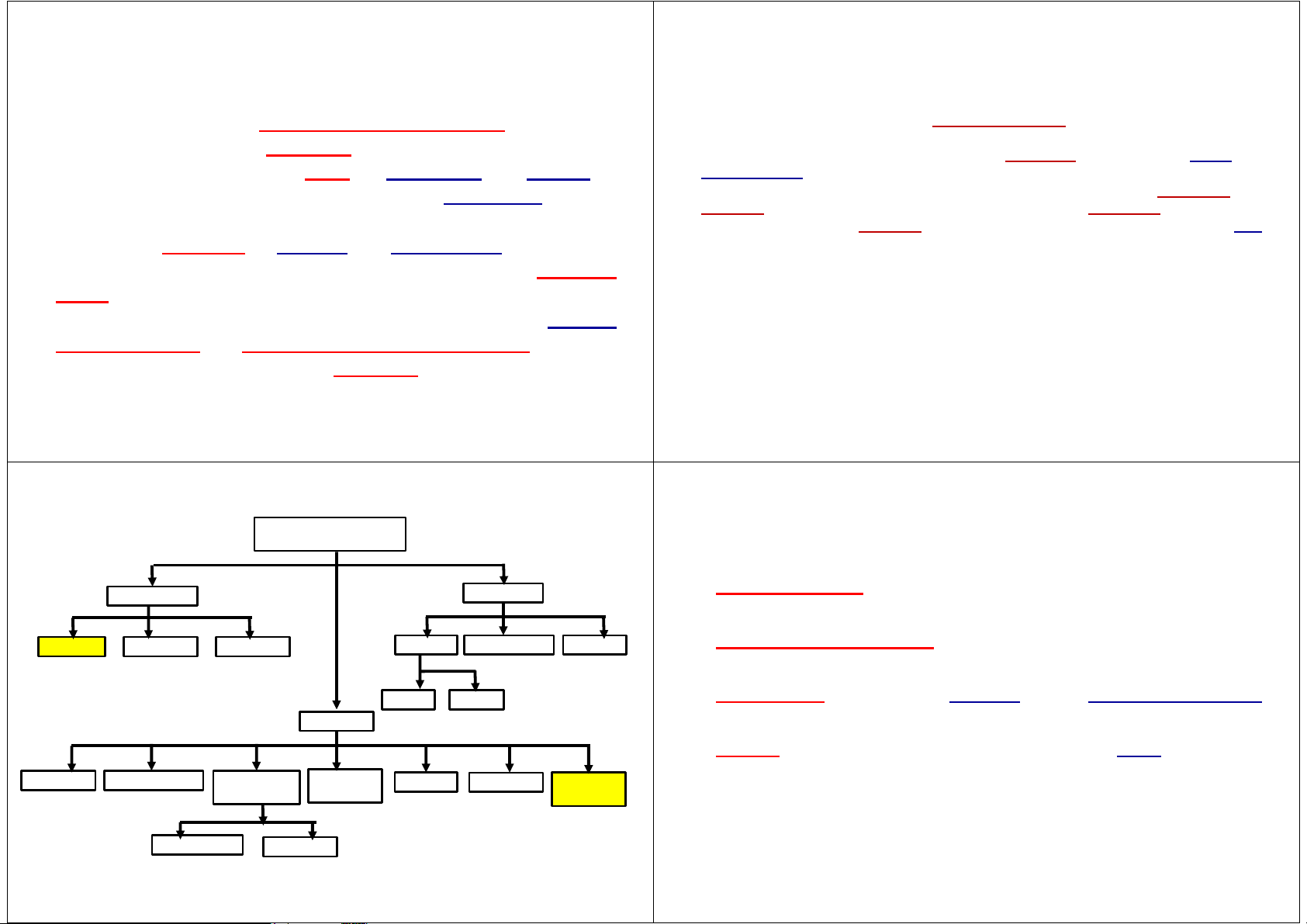
(Job opportunity/ Work area
4. The four principles in medical ethics
1. Non-maleficence; avoiding the causation of harm, do no harm, Practice settings Other settings non nocere.
2. Respect for autonomy; to respect the decision-making Community Hospital Clinical Academics Clinical research Regulatory
capacities of autonomous persons.
3. Beneficence; providing benefits and balancing benefits Teaching Research Industry
against risks and costs.
4. Justice; distributing benefits, risks and costs fairly. Production Quality Assurance Research & Quality Packaging Regulatory Sales and Development Control Marketing 100 Careers in Pharmacy
Dessing, R. P., & Flameling, J. (2003). Bulk drug (APIs) 11 Formulation
https://pharmacy.uconn.edu/100‐careers‐in‐pharmacy/ 12 5. Human essential values
6. The dynamics of the health care process 1.
Sociality. Human beings are social beings. People cannot be considered as separate from their social
environment. Everyone imagines to be born rather than created, and that it is natural to have parents, friends and relatives. 2.
Rationality (hợp lý) and practical reason. Human beings are living beings that use reasoning. A person
acts from his reason and has no metaphysical (siêu hình) connections or mission. 3.
Compassion. (trắc ẩn). Human beings have feelings for others: self-interest is not the only motivation
for human behavior. According to Nussbaum, compassion is the basic social emotion and
characteristic for human life and functioning. 4.
Self-determination. (Quyền tự quyết) A human being is capable of pursuing one’s personal objectives and well-being. 5.
Justice. In society ‘justice as fairness’ means a ‘fair chance’ for everyone. Inequalities are only
acceptable if they result from an open and interchangeable position and results in benefits for the
least advantaged persons in society. This concept of justice is strictly political and is not inspired by
any religious or supernatural ‘principle’. 6.
Equality. Although human beings are all different, society should treat them as equal in providing
them equal opportunities to develop their capabilities.
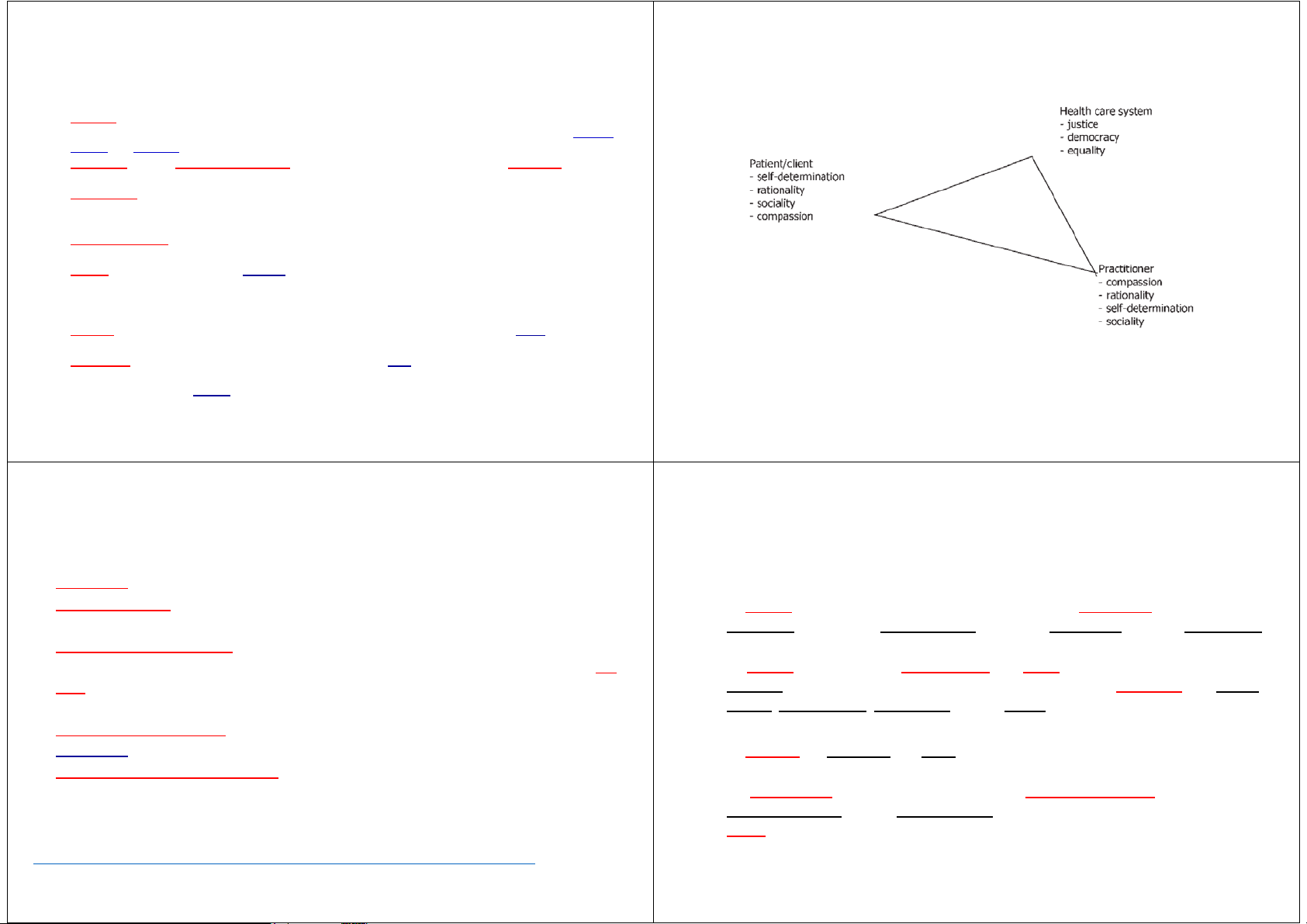
– Our ethical and political values-based approach places the relationship between practitioner and patient –both (as 7.
Democracy. In a society everyone should be able to have a vote. A mature democracy, however, is not
human beings) rational, social, compassionate and capable of self-determination – in the context of the health care
just a one man one vote system. It stimulates participation of citizens at many levels of public life and
system (with justice, democracy and equality as its characteristics)
enables people to take private decisions with respect to their personal interests and vision. 13
Dessing, R. P., & Flameling, J. (2003). 14
Dessing, R. P., & Flameling, J. (2003).
7. Important applications to an acceptable standard of patient care
8. The responsibilities of a pharmacist
– Prescribing: Which vaccine, Which medicines – Consumer
– Clinical evaluation: What clinical markers establish the base level of patient evaluation for •
To identify the consumer’s health and wellbeing as their first priority, and to utilize the
use of vaccines and/or medicines? vulnerable patients, documentation systems
knowledge and provide compassionate care in an appropriate and in a professional
– Preparation and dispensing: How will access to vaccines and medicines for COVID-19 manner.
treatment, Will the pharmacist workforce be effectively trained and utilized, How will off- •
To respect the consumer’s independence and rights and that assist them in making
label prescribing and utilization of unapproved/unsubstantiated treatments be managed
informed decisions about their health. This might include respecting the dignity, by pharmacists?
privacy, confidentiality, individuality and the choice of the consumer.
– Counselling and Advising: What authoritative and clinically substantiated source of – Community information •
To maintain the reputation and belief that the public has placed on the profession and
– Monitoring and Pharmacovigilance: What patient-specific monitoring must be in place,
refrain from abusing this trust and the respect.
Should there be a national and/or pharmacovigilance system, Are there any ‘black box’ •
To acknowledge (thừa nhận) their place in a broad community, including their warnings
professional role and the responsibilities to control and to supply pharmaceutical
goods for optimal health outcomes.
UNESC0 CHAIR IN BIOETHICS, International Pharmacy Panel, Ethical Guidelines for Pharmacy, 2020 Zahbi M (2022) 16
https://www.fip.org/files/content/priority‐areas/coronavirus/mo‐resources/United_Nations/version_1.0_PharmacistEthicalGuidelinesUNESCOPanel_FIP.pdf (18‐2‐2024) 15
8. The responsibilities of a pharmacist
9. Four Questions of Ethical Position – Profession
Four fundamental questions must be answered in order for •
To commit to the development and the enhancement of the profession by becoming involved in such type
of the activities like training staff, teaching, being a preceptor or mentor for the students, interns or
someone to take a complete and systematic ethical position.
colleagues, participating in initiatives to develop the profession and to demonstrate positive leadership. •
To keep up-to-date with
1. What Are the Source, Meaning, and Justification of Ethical
knowledge of pharmacy practice with lifelong learning and the self-development to
maintain the professional competence and personal health to continue practicing. Claims? •
To practice only when their professional independence, judgment and the integrity remains upheld, and to
manage situations with a conflict of interest appropriately.
2. What Kinds of Acts Are Right? – Business •
To conduct the business practices of pharmacy in an ethical and in a professional manner with the
3. How Do Rules Apply to Specific Situations?
consumer’s best interest in mind and due respect to the colleagues and the reputation of the profession.
4. What Ought to Be Done in Specific Cases?
– Other health professionals •
To work in cooperation and collaboration with the other healthcare professionals to achieve the optimal
health outcomes for the consumers Zahbi M (2022) 17 18 Robert M. Veatch. 2008
9. Four Questions of Ethical Position
9. Four Questions of Ethical Position
1. What Are the Source, Meaning, and Justification of Ethical Claims? 3. How Do Rules Apply to Specific
The levels of Ethical analysis
Terms Signaling Normative Evaluations Situations?
Metaethics: source, meaning, justification of ethical claims
Verbs: want, desire, prefer, should, or ought •
The situationalist is more willing to reassess
Nouns: benefit, harm, duty, responsibility, right, or obligation
(đánh giá lại) the rules on a case-by-case
Adjectives: good and bad, right and wrong, responsible, fitting, and the like basis.
Normative ethics: Principles, Virtues and Values
Characteristics of Moral Evaluations: ultimate (tối thượng), universality (All
4. What Ought to Be Done in Specific
persons ought to agree), must treat the good of everyone alike (no special Cases? Rules and Rights consideration) •
Solving the problem of what ought to be done
2. What Kinds of Acts Are Right?
in a specifi c case also requires a great deal of
information beyond what is moral. It requires Specific cases • Consequentialism
considerable empirical data. •
Deontological or “Duty-Based” Ethics (Kantism) •
E.g. Electroencephalogram may be important •
Other Issues of Normative Ethics: beneficence, nonmaleficence, respecting
for the definition of death. Basic religious and
autonomy, avoiding killing, veracity (thành thật), and fidelity (trung thành)
philosophical beliefs may be critical for
resolving some cases in health care ethics 19 Robert M. Veatch. 2008 20 Robert M. Veatch. 2008
10. The Five‐Step Model for decision‐making process
10. The Five‐Step Model for decision‐making process
1. Respond to the “sense” or feeling that something is wrong.
1. Respond to the “sense” or feeling that something is wrong.
2. Gather information/make an assessment
3. Identify the ethical problem/consider a moral diagnosis.
2. Gather information/make an assessment 4. Seek a resolution.
5. Work with others to determine a course of action.
3. Identify the ethical problem/consider a moral diagnosis. 4. Seek a resolution.
5. Work with others to determine a course of action. Robert M. Veatch. 2008 21 Robert M. Veatch. 2008 22
10. The Five‐Step Model for decision‐making process
10. The Five‐Step Model for decision‐making process
Roger Lucas, 70 tuổi, được đưa vào phòng ICU từ sàn phẫu thuật với tình trạng có vẻ như
Một bệnh nhân xuất huyết không bao giờ nên dùng heparin. Không nói gì với y tá, bác sĩ
tắc mạch phổi. Ông Lucas đã bị gãy xương đùi và đang chờ phẫu thuật vào sáng hôm sau
Fowler bước sang bên và thấy octreotide đang truyền cho ông Lucas trong khi lẽ ra ông
thì ông bị khó thở, thở nhanh và nhịp tim nhanh. Cùng lúc, BN khác, ông Ronald London,
phải nhận heparin. Và, hai cái tên đã được đổi trên nhãn. Trong sự vội vã và bối rối xung
được đưa vào phòng bên cạnh trong tình trạng khẩn cấp không kém. Ông London, 60 tuổi,
quanh việc tiếp nhận bệnh nhân và tính chất nguy kịch của cả hai bệnh nhân, IV đã được
có tiền sử xơ gan. Ông London bị giãn tĩnh mạch thực quản. Helen Fowler, Pharm.D., là
dán nhãn không hợp. Rõ ràng không ai kiểm tra tên thuốc trước khi treo chúng vì trong
người Giám Sát Dược ca tối cho sáu đơn vị chăm sóc đặc biệt trong bệnh viện. Cô và hai
mỗi trường hợp, tên và số phòng của bệnh nhân đều chính xác. Bác sĩ Fowler biết rằng
dược sĩ khác làm việc điên cuồng để đáp ứng tất cả các đơn đặt hàng thuốc tiêm tĩnh mạch
và dung dịch tiêm truyền từ các đơn vị chăm sóc đặc biệt. Tiến sĩ Fowler tiến hành kiểm tra
nguy cơ tử vong cao ở những bệnh nhân bị giãn tĩnh mạch thực quản, vì vậy việc lộn
và thấy ông London đã qua đời. Nhóm mật mã vẫn đang thu thập thiết bị của họ khi Tiến sĩ
heparin có thể không liên quan gì đến cái chết của ông London, nhưng bà biết rằng một
Fowler đến đơn vị. “Thật đáng tiếc,” Fowler nói với người y tá và tiến hành khám nghiệm
bệnh nhân như vậy không nên nhận. heparin.
tử thi để gia đình ông London có thể dành chút thời gian cho ông trước khi thi thể ông
Tiến sĩ Fowler tin rằng bước tiếp theo nên dừng octreotide IV và thông báo cho nhà thuốc
được chuyển đến nhà xác. Sau đó, bác sĩ Fowler nhận thấy nhãn trên túi IV trong thùng
để gửi đúng loại thuốc cho ông Lucas. Cô nghĩ mình phải nói với bác sĩ Janice Mann, bác
rác, chiếc túi đựng ống IV mà y tá vừa lấy ra khỏi tay ông London. Tiến sĩ Fowler đã bị sốc
sĩ điều trị tích cực đang điều trị cho cả hai bệnh nhân, nhưng lại sợ phải làm như vậy vì bác
khi thấy túi IV rỗng chứa heparin, chứ không phải octreotide (use for acromegaly and
sĩ Mann không chấp nhận những sai sót. Tuy nhiên, bác sĩ Mann cần biết để điều chỉnh
thyrotrophinomas, carcinoid syndrome, persistent diarrhea, small intestinal fistulas) mà lẽ
cách điều trị cho ông Lucas. Sau đó là vấn đề của gia đình ông London. Tiến sĩ Fowler ra ông phải nhận.
không chắc chắn rằng họ có cần được thông báo về lỗi này hay không. Robert M. Veatch. 2008 23 Robert M. Veatch. 2008 24
11. Pharmacy Ethics Related to the Covid‐19
12. The Globalization of Healthcare: Challenges and Opportunities 1.
Hydroxychloroquine presented a very serious challenge including the hoarding by both – Opportunities
physicians and some patients of that very important medicine for patients who use it for •
Information Exchange: Globalization approved indication •
Collaborative Healthcare 2.
Important issue arising in the hospitals surplus to the challenges presented by seriously ill
patients, they were shortages of critical drugs like muscular blocking agents (depolarizing •
Advocacy (Vận động) for Global Health Equity: international organizations
neuromuscular blocking agents (eg, succinylcholine) and nondepolarizing neuromuscular – Challenges
blocking agents (eg, rocuronium, vecuronium, atracurium, cisatracurium, mivacurium)), some •
Diverse Regulatory Frameworks: Each nation has its own set of laws,
narcotic analgesic agents and other drugs – a big ethical issue.
regulations, and standards 3.
This raises questions around: •
Medication Availability and Accessibility: supply chains, shortages and 1. Drug shortages 2. Role of the industry
struggles to provide essential medications, 3.
Role of the distributors •
Cultural and Ethical Sensitivities: respecting cultural beliefs, patient 4.
Role of pharmacists in managing the issue of drug shortages. (In many instances decisions about substitute
autonomy, and informed consent. Balance between adhering to their
drugs to be used instead of the drugs in short supply had to be made quickly).
professional ethics and respecting local customs and values
UNESC0 CHAIR IN BIOETHICS, International Pharmacy Panel, Ethical Guidelines for Pharmacy, 2020
https://iimtu.edu.in/blog/pharmacy‐law‐and‐ethics‐in‐global‐health‐challenges‐and‐opportunities/ 26
https://www.fip.org/files/content/priority‐areas/coronavirus/mo‐resources/United_Nations/version_1.0_PharmacistEthicalGuidelinesUNESCOPanel_FIP.pdf (18‐2‐2024) 25
13. Challenges in Pharmacy Law and Ethics in Global Health
14. Ethical challenges of pharmacy practics
– Cross-Border Practice: legal challenges related to licensure,
– Professional practice •
Pharmacy practice and consultation
credentialing, and liability. • Professionalism
– Drug Importation and Exportation: drug safety, quality, and • Providing medications • Medication errors counterfeit drugs • Confict of interest
– Informed Consent: vary across cultures
– Professonal communications with • Patients
– Ethical Drug Pricing and Access: essential medications are • Physicians priced out of reach • Colleagues
– Regulations and policies
– Pandemic Response: The COVID-19 • Insurance regulations •
Confict between ethics and regulations •
Regulations of of drug distribution companies
https://iimtu.edu.in/blog/pharmacy‐law‐and‐ethics‐in‐global‐health‐challenges‐and‐opportunities/
Pharmacy Law and Ethics in Global Health: Challenges and Opportunities, 27
https://iimtu.edu.in/blog/pharmacy‐law‐and‐ethics‐in‐global‐health‐challenges‐and‐opportunities/ 28 15. Ethics, Morals, and Values 15. Ethics, Morals, and Values – You Be the Judge – Focus On Ethics •
Phil là kỹ thuật viên dược được khách hàng hỏi về thuốc Plan B®,
được dùng làm thuốc tránh thai ngày hôm sau. Bởi vì Phil tin rằng việc •
Ethics are standards of behavior developed as a result of society’s
sử dụng thuốc vào buổi sáng để ngăn ngừa thụ thai là sai lầm nên anh
ấy mô tả tất cả các loại tác dụng phụ nghiêm trọng và nói rằng chúng
concept of right and wrong.
xảy ra với hầu hết những người dùng thuốc. Kết quả là, bệnh nhân gọi
cho bác sĩ của mình, người này sau đó gọi cho hiệu thuốc và nói
– Focus On Moral Values
chuyện với dược sĩ, kể cho anh ta những gì Phil đã nói và yêu cầu giải
thích. Theo đánh giá của bạn, hành động của Phil có đúng về mặt đạo •
Moral values consist of one’s personal concept of right and wrong,
đức không? Bạn nghĩ những loại hậu quả pháp lý nào có thể chờ đợi
formed through the influence of family, culture, and society.
Phil do những tuyên bố sai lầm của anh ấy về thuốc Plan B? Jahangir Moini (2009)‐ 29 Jahangir Moini (2009)‐ 30 16. Ethics and Laws 16. Ethics and Laws
– Ethics and law are the different forms of rules by which humans
– Ethics and law are the different forms of rules by which humans
are expected to behave themselves in the society.
are expected to behave themselves in the society.
– Ethics represents internal system of controls,
– Ethics represents internal system of controls,
– Law refers to an external mechanism of control.
– Law refers to an external mechanism of control.
– Both these controls ar essential for optimal behavior, which
– Both these controls ar essential for optimal behavior, which
includes seeking and dispensing treatment.
includes seeking and dispensing treatment. Gundugurti, P. R., 2022 31 Gundugurti, P. R., 2022 32 17. Morality, Ethics and Law 18. Ethics and Law
– Morality refers to a set of deeply held, widely shared, and relatively stable values within a
– In comparing ethics and law, it is important to understand the purposes, standards, and
community.
penalties that relate to each.
– Ethics as a philosophical enterprise involves the study of values, and the justification for
– Law is designed to protect society and help it to function efficiently by imposing civil or
right and good actions, as represented by the classic works of Aristotle (virtue ethics),
criminal penalties if laws are violated. In medicine, the law is designed to protect the
Kant (duty-based ethics), and Bentham and Mill (utilitarian and consequentialist ethics).
rights of all individuals, be they patients, practitioners, or employees. Law enforcement
Applied ethics, in contrast, is the use of ethics principles (e.g., respect for autonomy,
may include fines, imprisonment, or sometimes both.
beneficence, and nonmaleficence, justice) in actual situations, such as in professional
– Ethics are designed to assure adherence to standards while also serving to raise
and clinical life.
competence levels to build values. In the United States, the Medicare system was
– Law is comprised of concrete duties established by governments that are necessary for
established with the intention of providing fair and ethical medical treatment for the
maintaining social order and resolving disputes, as well as for distributing social
elderly and the disabled. Ethical penalties include suspension from medical societies,
resources according to what people need or deserve (xứng đáng).
decided by one’s own medical peers (đồng nghiệp). Horner, J. (2003). 33 J. Moini. 2009 34 19. Law vs Moral 20. Ethics and Law BASIS FOR COMPARISON LAW ETHICS
– Law and morals are two normative discourses (i.e., discourses
refers to a systematic body of rules that governs
a branch of moral philosophy that Meaning
the whole society and the actions of its individual guides people about the basic human
on how things ought to be) of human action well established members. conduct. What is it?
Set of rules and regulations Set of guidelines
Individual, Legal and Professional since ancient times. Governed By Government norms Expression
Expressed and published in writing. They are abstract.
– Morals are prior to the law, more extensive, and more Violation
punishment like imprisonment or fine or both. no punishment
Law is created with an intent to maintain social
Ethics are made to help people to
demanding and it is morality that grounds and justifies the law Objective
order and peace in the society and provide
decide what is right or wrong and
protection to all the citizens. how to act. Binding Law has a legal binding.
Ethics do not have a binding nature. H. ten Have et al. 2021
https://keydifferences.com/difference‐between‐law‐and‐ethics.html Henk ten Have 2021 36 21. Law 21. Law – Role of Law – Sources of law •
Law includes statutes (quy chế), rules, and regulations that govern • Primary sources
people, behaviors, relationships, and interactions with society and with
The Constitution/ Hiến pháp
Common Law / Luật chung (by the courts)
governments. Law provides order for the resolution of conflicts
Customary Law/ Luật tục
between individuals, corporations, states, and other entities.
Legislation/ Pháp luật •
The goal of law is to protect the health, safety, and welfare of individual
Case Law/ Law Reports/ Án lệ/Báo cáo pháp luật
citizens. Law provides guidelines for resolutions of disputes in a fair • Secondary sources and safe manner. Textbooks/ Sách
Encyclopaedias/ Bách khoa toàn thư •
Always growing and evolving to meet the changes, challenges, and
Dictionaries/ Từ điển
constantly occurring shift s of society.
Loose-leaf Publications/ Ấn phẩm rời rạc
Journal Articles/ bài báo tạp chí
https://libguides.uwc.ac.za/c.php?g=1134936&p=8286463 J. Moini. 2009 37 38 21. Law 21. Law –Divisions of Law – Divisions of Law
• Criminal Law (hình sự) •
Criminal Law (hình sự)
Criminal law is concerned with violations against society based on
criminal statutes or codes. • Civil Law (dân sự)
Monetary fines, imprisonment, or even death •
Contract Law (hợp đồng)
Criminal law involves crimes against the state
E.g.: Drug Abuse and Trafficking. Drug abuse and trafficking involve
the illegal possession, distribution, and sale of drugs J. Moini. 2009 39 J. Moini. 2009 40 21. Law 21. Law – Divisions of Law
– Mark đã làm việc tại một hiệu thuốc bán lẻ được 17 năm. Anh ấy là • Civil Law (dân sự)
một kỹ thuật viên cấp cao và là người đáng tin cậy trong công việc.
Civil wrongs are often called torts. A tort (tra tấn) is an injury to a person – physical or
non-physical – by another person.
Cách đây khoảng một năm, vợ anh qua đời khiến anh rất suy sụp.
Torts may include cases of assault (tấn công) (in general, the threat of violence),
Tuần trước, anh ấy đã mắc sai lầm khi pha chế hai loại thuốc. Dược
battery (tấn công) (contact in a manner that may cause bodily harm), fraud (gian
lận), libel (phỉ bang), negligence (thiếu trách nhiệm), slander (vu khống), theft (trộm) ,
sĩ phát hiện ra việc anh ta đã không thực hiện chế độ chăm sóc hợp
trespassing (xâm phạm), and even wrongful death.
Most civil law cases against health-care workers are for malpractice (professional
lý khi làm việc. Anh ta nói với Mark rằng đây là một trường hợp sơ
misconduct or negligence) or negligence (thiếu trách nhiệm) (failure to exercise
suất và hành động pháp lý có thể xảy ra do lỗi của anh ta. Mark đáp
reasonable care). Penalties in civil law are almost completely monetary,
E.g. racial violence, such as physical assaults, homicides, verbal or written threats
lại một cách thô lỗ và thậm chí còn xô đẩy dược sĩ. • Contract Law
– Theo đánh giá của bạn, hậu quả có thể xảy ra đối với Mark là gì khi
Contract law pertains to agreements between two or more parties. In a contract, each of
the concerned parties makes agreements to do or not to do certain things. Contracts
tính đến toàn bộ tình huống của anh ấy? Anh ta có thể bị buộc tội gì
are legally binding exchanges of promises (lời hứa).
vì bạo lực thể xác với dược sĩ? J. Moini. 2009 41 J. Moini. 2009 42
22. An ethical framework for the responsibilities of References
pharmacists when selling complementary medicines 1.
Henk ten Have. 2016. Encyclopedia of Global Bioethics. Springer International Publishing
The framework identifies the following responsibilities of pharmacists 2.
Al-Qudah, R. A., Tuza, O., Tawfiek, H., Chaar, B., & Basheti, I. A. (2019). Community pharmacy ethical practice in
Jordan: assessing attitude, needs and barriers. Pharmacy Practice (Granada), 17(1).
selling complementary medicines: 3.
Dessing, R. P., & Flameling, J. (2003). Ethics in pharmacy: a new definition of responsibility. Pharmacy World and Science, 25, 3-10.
(1) pharmacists should provide evidence-based recommendations to 4.
UNESC0 CHAIR IN BIOETHICS, International Pharmacy Panel, Ethical Guidelines for Pharmacy, 2020,
consumers regarding complementary medicines,
https://www.fip.org (18-2-2024) 5.
Zahbi M (2022) Brief Note on Ethics in Pharmacy. Pharm Anal Chem. 7:150.
(2) pharmacists should train all staff in a pharmacy to ensure that they provide 6.
Robert M. Veatch_ Amy Haddad -( 2008) Case Studies in Pharmacy Ethics, Second Edition Oxford University Press
evidence-based recommendations regarding complementary medicines 7.
https://iimtu.edu.in/blog/pharmacy-law-and-ethics-in-global-health-challenges-and-opportunities/
and refer to a pharmacist when required, 8.
Jahangir Moini (2009)- Law and Ethics for Pharmacy Technicians-Cengage Learning 9.
Gundugurti, P. R., Bhattacharyya, R., Kondepi, S., Chakraborty, K., & Mukherjee, A. (2022). Ethics and Law. Indian
(3) when providing advice, pharmacists should provide sufficient information
journal of psychiatry, 64(Suppl 1), S7–S15. https://doi.org/10.4103/indianjpsychiatry.indianjpsychiatry_726_21
for consumers to make informed decisions, 10.
Horner, J. (2003). Morality, ethics, and law: Introductory concepts. In Seminars in speech and language (Vol. 24, No.
04, pp. 263-274). Copyright© 2003 by Thieme Medical Publishers, Inc., 333 Seventh Avenue, New York, NY 10001,
(4) pharmacists should setup the pharmacy so that consumers are offered
USA. Tel.:+ 1 (212) 584-4662.
advice from a pharmacist when purchasing complementary medicines; 11.
Henk ten Have 2021 - Dictionary of Global Bioethics. Springer
pharmacists need to be available to provide that advice, and 12.
https://libguides.uwc.ac.za/c.php?g=1134936&p=8286463
(5) pharmacists must be vigilant for complementary medicine harm and
intervene if risk of harm is significant.
Popattia, A. S., & La Caze, A. (2020). 43 44 Phần 2
CÁC TRƯỜNG HỢP LIÊN QUAN ĐẾN ĐẠO ĐỨC, ĐẠO ĐỨC
TRONG VĂN HỌC VÀ ĐẠO ĐỨC TRONG TỤC NGỮ VÀ CA DAO
CASES INVOLVING ETHICS, ETHICS IN LITERATURE AND
ETHICAL PROVERBS AND FOLKS 1 2 Vụ án VN Pharma
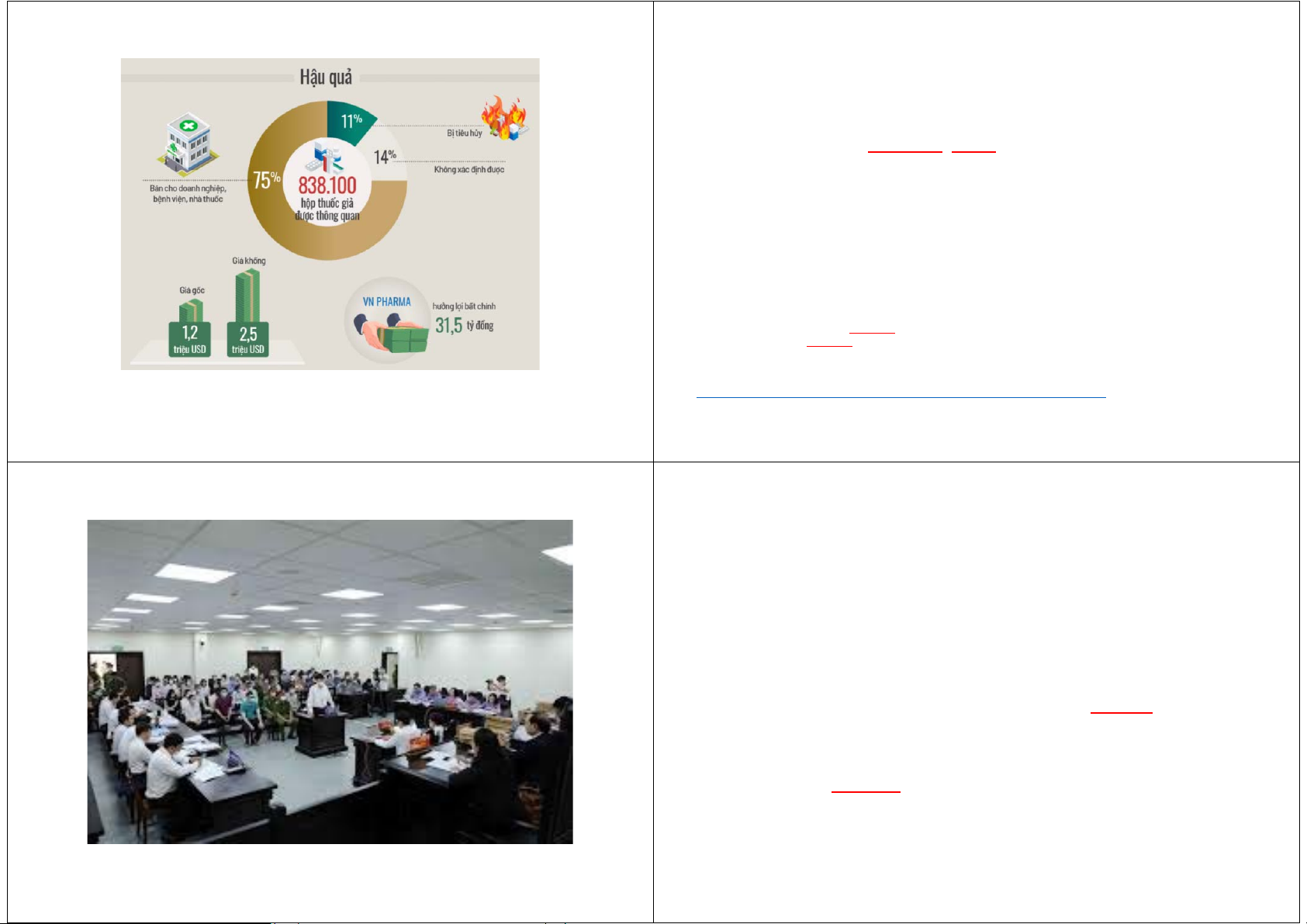
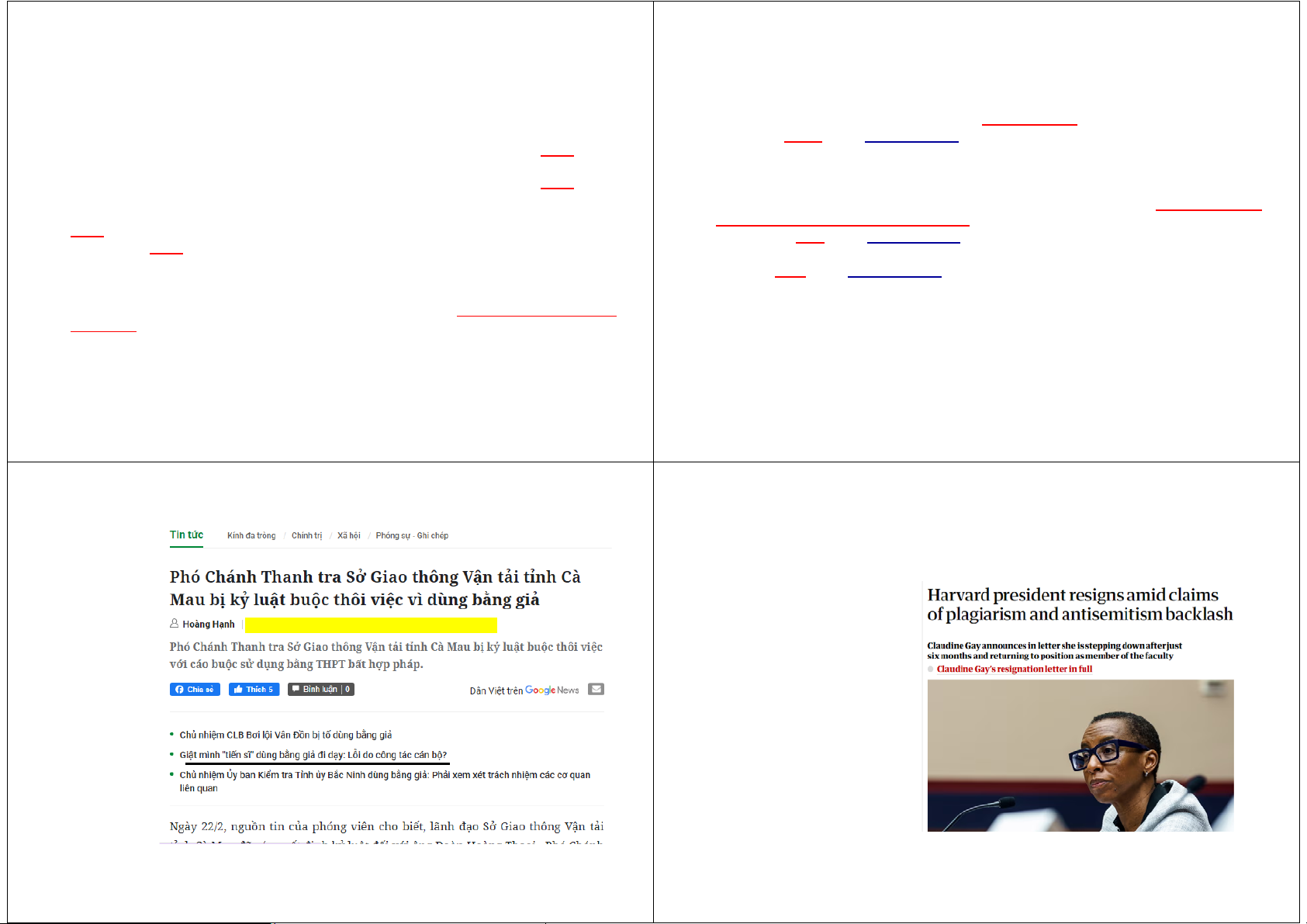
– Mức án cụ thể đối với 12 bị cáo (sơ thẩm) 2019 1.
Võ Mạnh Cường (cựu Giám đốc Công ty H&C) 1978 : 20 năm tù. 2.
Nguyễn Minh Hùng (cựu Tổng Giám đốc VN Pharma) 1978: 17 năm tù. 3.
Ngô Anh Quốc (cựu Phó Tổng Giám đốc VN Pharma): 11 năm tù, cộng bản án 5 năm tù của TAND
cấp cao tại Hà Nội về tội đưa hối lộ, hình phạt tổng hợp với bị cáo Quốc là 16 năm tù. 4.
Nguyễn Trí Nhật (cựu Phó Tổng Giám đốc VN Pharma): 12 năm tù. 5.
Phạm Văn Thông (dược sĩ): 5 năm tù. 6.
Phan Cẩm Loan (cựu Phó Trưởng phòng xuất nhập khẩu VN Pharma): 7 năm tù. 7.
Bùi Ngọc Duy (cựu Trưởng phòng nghiên cứu và phát triển VN Pharma): 6 năm tù. 8.
Phạm Anh Kiệt (cựu Tổng Giám Đốc Công ty TNHH một thành viên Dược Sài Gòn): 3 năm tù. 9.
Hoàng Trúc Vy (cựu nhân viên phòng nghiên cứu và phát triển VN Pharma): 3 năm tù cho hưởng án treo.
10. Phan Xuân Thiện (nguyên Phó Tổng Giám đốc VN Pharma): 7 năm tù.
11. Lê Vũ Phương (nguyên Kế toán trưởng VN Pharma): 5 năm tù.
12. Phạm Quỳnh Trang (nguyên nhân viên công ty H&C): 4 năm tù.
Pháp luật cũng cấm các bị cáo đảm nhiệm chức vụ hoặc làm các nghề liên quan đến y tế trong vòng 5
năm kể từ ngày chấp hành xong hình phạt tù. 3
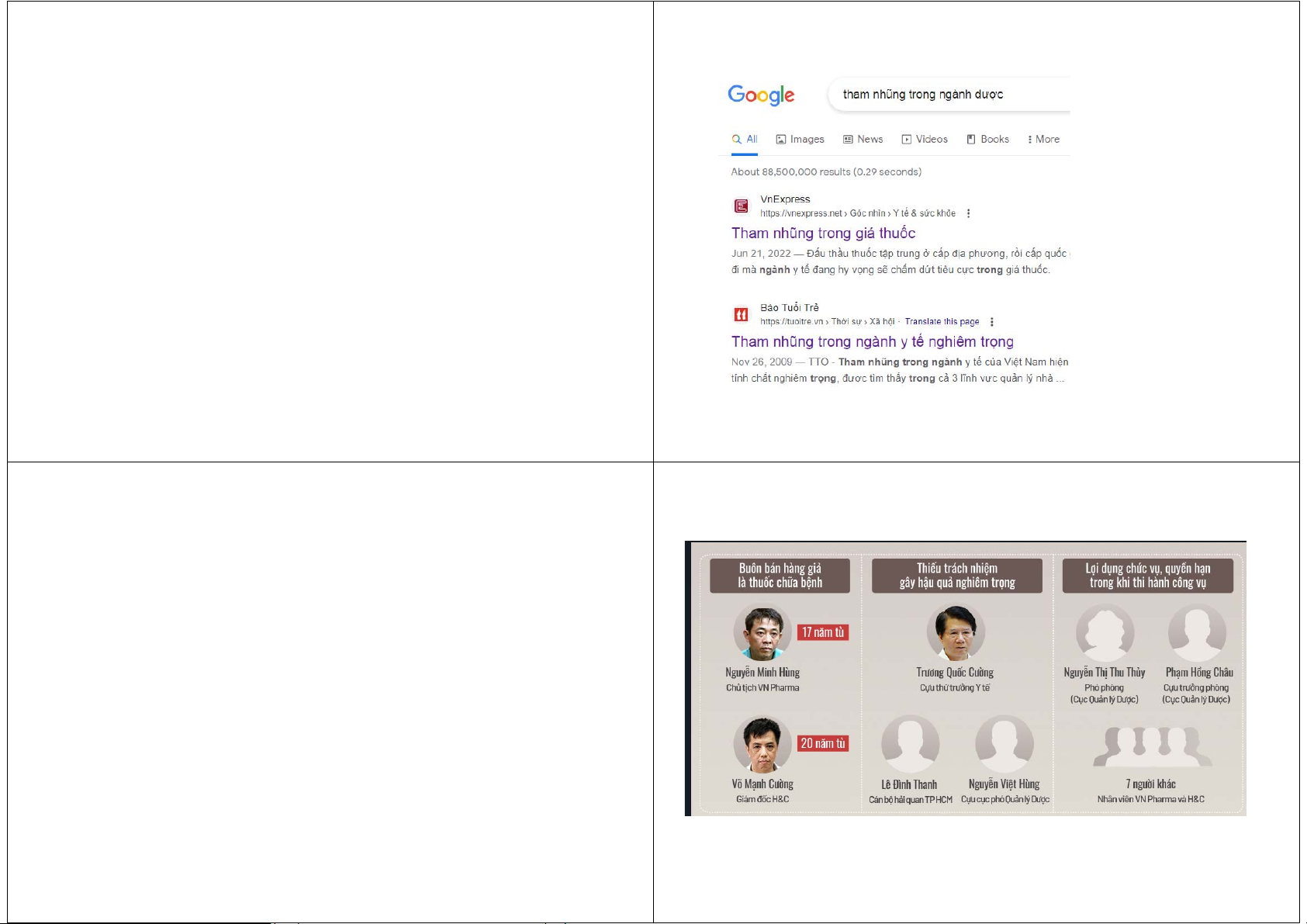
https://vnexpress.net/vu‐an‐vn‐pharma‐lien‐quan‐nhung‐quan‐chuc‐nao‐4449367.html 4
https://nhandan.vn/tuyen‐phat‐cac‐bi‐cao‐trong‐vu‐buon‐thuoc‐ung‐thu‐gia‐tai‐vn‐pharma‐post372630.html Vụ án VN Pharma
– 10 BỊ CÁO ĐỒNG LOẠT KHÁNG CÁO (phúc thẩm 30/09/2022)
– Tổng các bị cáo trong vụ VN Pharma 1.
Trương Quốc Cường, (1961), cựu thứ trưởng,: 4 năm tù về tội "Thiếu trách nhiệm gây hậu quả nghiêm trọng“ , 4
năm xuống còn 3 năm tù. nộp thêm 500 triệu (giai đoạn sơ thẩm đã nộp 1,8 tỉ) và nộp hơn 50 giấy khen, bằng khen, huân chương... 2.
Ngô Anh Quốc (SN 1984), (cựu phó tổng giám đốc VN Pharma), 16 năm tù 3.
Nguyễn Trí Nhật (cựu phó tổng giám đốc VN Pharma), 12 năm tù 4.
Phan Cẩm Loan (SN 1973), 7 năm tù 5.
Lê Thị Vũ Phương (SN 1982), (nguyên kế toán trưởng VN Pharma) 5 năm tù 6.
Phạm Anh Kiệt (SN 1963), (cựu phó trưởng phòng xuất nhập khẩu VN Pharma) 14 năm xuống còn 13 năm tù 7.
Phạm Quỳnh Trang (SN 1980), (nguyên nhân viên Công ty H&C). 4 năm tù 8.
Nguyễn Thị Quyết (SN 1983), 9.
Phạm Hồng Châu (SN 1957), (nguyên trưởng phòng Đăng ký thuốc thuộc Cục Quản lý Dược) 4 năm
10. Nguyễn Thị Thu Thủy (SN 1976), 4 năm
11. Nguyễn Việt Hùng (SN 1956). cựu Cục phó Quản lý Dược) 3 năm tù
12. Lê Đình Thanh (cựu cán bộ hải quan TP HCM) bị tuyên phạt 2 năm tù
13. Nguyễn Minh Hùng, 1978, 30 năm tù
14. Võ Mạnh Cường 30 năm tù
https://vnexpress.net/vu‐an‐vn‐pharma‐lien‐quan‐nhung‐
https://tuoitre.vn/vu‐vn‐pharma‐bac‐khang‐cao‐y‐an‐so‐tham‐voi‐cac‐bi‐cao‐20200519214324625.htm
quan‐chuc‐nao‐4449367.html 5
https://tuoitre.vn/nop‐them‐nua‐ti‐dong‐cuu‐thu‐truong‐y‐te‐duoc‐giam‐1‐nam‐tu‐20220930102431831.htm (truy cập 25‐2‐2024) 6
Vụ án tại CT Dược Cửu Long
– Năm 2005, dịch cúm A (H5N1) diễn biến phức tạp, ừ tháng 2 - 4/2006, Công ty Dược Cửu
Long đã nhập 520kg nguyên liệu Oseltamivir với giá 9,1 triệu USD của Công ty Mambo
(Singapore). Doanh nghiệp này đã thanh toán 5,25 triệu USD cho bên bán, còn lại 3,84
triệu USD (tương đương hơn 61 tỷ đồng) được trả chậm 6 tháng kể từ ngày nhận hàng
– Quyết định số 92/QĐ-BYT ngày 11/1/2008, thực hiện kế hoạch dự trữ thuốc Tamiflu và
sản xuất thuốc Oseltamivir phòng, chống dịch cúm A(H5N1), trên cơ sở thông báo giá
thành sản xuất thuốc Oseltamivir của Bộ Tài chính, Bộ Y tế giao kế hoạch và đặt hàng
Công ty Cổ phần Dược phẩm Cửu Long sản xuất thuốc Oseltamivir. Quá trình thực hiện
kế hoạch sản xuất thuốc, Công ty CPDP Cửu Long được giảm giá mua nguyên liệu
nhưng với động cơ vụ lợi, Lương Văn Hóa đã lợi dụng, chức vụ quyền hạn chỉ đạo
Nguyễn Văn Thanh Hải hạch toán trái nguyên tắc kế toán; chỉ đạo Ngô Hữu Hiếu Nghĩa
lập thư giãn nợ để che giấu việc kiểm tra, thanh tra; đồng thời chỉ đạo Nguyễn Văn Thanh
Hải, Ngô Hữu Hiếu Nghĩa hợp thức hồ sơ thanh toán che giấu nhằm giữ lại số tiền giảm
giá mua nguyên liệu 3,848 triệu USD (tương đương hơn 61 tỷ đồng) để sử dụng, gây thiệt
hại cho ngân sách Nhà nước.
https://baotintuc.vn/phap‐luat/nguyen‐thu‐truong‐bo‐y‐te‐truong‐quoc‐cuong‐thieu‐trach‐nhiem‐cho‐nhap‐148‐ty‐dong‐thuoc‐gia‐
https://baoquangninh.vn/vu‐an‐cuu‐thu‐truong‐cao‐minh‐quang‐mot‐bi‐cao‐chet‐do‐benh‐man‐tinh‐ 8 20220512115027027.htm 7
3213985.html#:~:text=Cao%20Minh%20Quang%20(sinh%20n%C4%83m,3.
Vụ án Công ty dược phẩm Cửu Long
Vụ án Công ty dược phẩm Cửu Long
Ngày 27-3, TAND cấp cao tại Hà Nội mở phiên tòa xét xử phúc thẩm, xét đơn kháng cáo của
các bị cáo trong vụ án "thiếu trách nhiệm gây hậu quả nghiêm trọng" xảy ra tại Bộ Y tế,
Công ty dược phẩm Cửu Long và các đơn vị liên quan. 1.
Cao Minh Quang, Cựu Thứ trưởng Y tế, 1956, 30 tháng tù, hưởng án treo, tự nguyện khắc phục 1,5 tỷ đồng. 2.
Lương Văn Hoá, 1957, cựu Tổng Giám đốc Công ty Cổ phần Dược phẩm Cửu Long, đã tử vong (6-3-
2023 )trước khi phiên tòa phúc thẩm diễn ra, Nguyên nhân tử vong do viêm phổi sốc nhiễm khuẩn,
suy đa tạng, ung thư biểu mô di căn hạch theo dõi nguồn gốc từ phổi. 9 năm tù. 3.
Nguyễn Văn Thanh Hải - sinh năm 1967, cựu Kế toán trưởng CTDCL, 5 năm tù 4.
Ngô Hữu Hiếu Nghĩa, sinh năm 1952, cựu Giám đốc Chi nhánh Thành phố Hồ Chí Minh, kiêm Giám
đốc điều hành phòng xuất nhập khẩu thuộc Công ty Cổ phần Dược phẩm Cửu Long), 5 năm tù. 5.
Nguyễn Việt Hùng, (sinh năm 1956, cựu Phó Cục trưởng Cục Quản lý Dược, Bộ Y tế). 6.
Dương Huy Liệu - sinh năm 1948, cựu Vụ trưởng Vụ Kế hoạch Tài chính Bộ Y tế, 7.
Nguyễn Nam Liên (sinh năm 1970, cựu Phó Vụ trưởng Vụ Kế hoạch Tài chính Bộ Y tế, Phó Trưởng
ban quản lý thực hiện kế hoạch phòng, chống dịch cúm A (H5N1) Bộ Y tế), 15 tháng tù 8.
Phạm Thị Minh Nga (sinh năm 1972, chuyên viên Vụ Kế hoạch Tài chính Bộ Y tế, cựu Kế toán trưởng
Ban quản lý thực hiện kế hoạch phòng, chống dịch cúm A (H5N1) Bộ Y tế), 9.
Nguyễn Thanh Tòng (sinh năm 1959, cựu Phó Tổng Giám đốc Công ty Cổ phần Dược phẩm Cửu
Long), trước khi diễn ra phiên tòa, đã chết do mắc bệnh mãn tính.
https://tienphong.vn/cuu‐thu‐truong‐bo‐y‐te‐cao‐minh‐quang‐chong‐gay‐di‐tap‐tenh‐den‐toa‐post1487988.tpo 9
https://tuoitre.vn/cuu‐chu‐tich‐duoc‐pham‐cuu‐long‐chet‐truoc‐ngay‐xu‐phuc‐tham‐do‐bi‐benh‐20230327164342031.htm 10 Đại án Kit test Việt Á Đại án Kit test Việt Á
– Nâng khống giá kit test, lấy tiền hối lộ quan chức 1.
Phan Quốc Việt 29 năm tù, “hoàn toàn vì lợi ích chung của đất nước.” 2.
Nguyễn Thanh Long (nhận 2,25 triệu USD) 18 năm tù; •
Theo cáo buộc, sau khi chiếm dụng kết quả nghiên cứu đề tài kit test 3.
Chu Ngọc Anh cựu Bộ trưởng Bộ KH-CN , 200.000 USD, 3 năm tù. 4.
Phạm Công Tạc (cựu Thứ trưởng Bộ KH-CN), cùng bị tuyên 3 năm tù.
vốn thuộc sở hữu nhà nước, Công ty Việt Á sản xuất hơn 8,7 triệu kit 5.
Phạm Duy Tuyến, cựu Giám đốc CDC Hải Dương (nhận 27 tỉ đồng) 13 năm tù;
test, nâng khống giá rồi bán cho các cơ sở y tế trên khắp cả nước, qua 6.
Trịnh Thanh Hùng, cựu Phó vụ trưởng thuộc Bộ KH-CN (nhận 350.000 USD) 14 năm tù; 7.
Nguyễn Minh Tuấn, cựu Vụ trưởng thuộc Bộ Y tế (nhận 300.000 USD) 8 năm tù;
đó thu lợi bất chính hơn 1.235 tỉ đồng. Tính riêng tại 19 tỉnh, thành mà 8.
Nguyễn Huỳnh, cựu thư ký của bị cáo Nguyễn Thanh Long (nhận 4 tỉ đồng) 9 năm tù; 9.
Nguyễn Nam Liên, cựu Vụ trưởng thuộc Bộ Y tế (nhận 100.000 USD) 7 năm tù.
vụ án này xét xử, số tiền thiệt hại tại các cơ sở y tế sử dụng ngân sách 10.
Nguyễn Văn Trịnh, cựu Trợ lý Phó thủ tướng, bị tuyên 4 năm tù;
để mua kit test là hơn 402 tỉ đồng. Để thuận lợi trong việc cấp phép và 11.
Phạm Xuân Thăng, cựu Bí thư Tỉnh ủy Hải Dương, 5 năm tù; 12.
Phạm Mạnh Cường, cựu Giám đốc Sở Y tế tỉnh Hải Dương, 4 năm tù.
phân phối kit test, bị cáo Phan Quốc Việt, Tổng giám đốc Công ty Việt 13.
Nguyễn Thành Danh, cựu Giám đốc Trung tâm Kiểm soát bệnh tật (CDC) tỉnh Bình Dương, miễn trách nhiệm hình sự
Á, chi tới hơn 106 tỉ đồng hối lộ quan chức các bộ, ngành, địa
– 25 bị cáo còn lại bị tuyên một trong các tội đưa hối lộ, vi phạm quy định đấu thầu gây hậu quả nghiêm trọng hoặc lợi
dụng ảnh hưởng đối với người có chức vụ, quyền hạn để trục lợi. Những bị cáo này chịu mức án thấp nhất là 24 tháng phương...
tù nhưng cho hưởng án treo, cao nhất 15 năm tù.
– Tính riêng tại 19 tỉnh, thành mà vụ án này xét xử, số tiền thiệt hại tại các cơ sở y tế sử dụng ngân sách để mua kit test
là hơn 402 tỉ đồng
https://thanhnien.vn/vu‐kit‐test‐viet‐a‐37‐38‐bi‐cao‐duoc‐tuyen‐an‐duoi‐khung‐truy‐to‐ 11 185240112235522518.htm 12
Đại án Kit test Việt Á – liên quan HVQY
Đại án Kit test Việt Á – liên quan BYT 1.
Vũ Đình Hiệp 1986 , Bình dương, (Phó Tổng Giám đốc Công ty Việt Á) bị đề nghị từ 6-7 năm tù, 1.
Nguyễn Thanh Long- Cựu Bộ trưởng Y tế, Tội Nhận hối lộ
chi hơn 7,1 tỷ đồng cho các cá nhân thuộc Học viện Quân y 2.
Phạm Duy Tuyến - Cựu giám đốc CDC Hải Dương, Tội Nhận hối lộ 2.
Nguyễn Văn Hiệu, 1967, TP. Hà Nội, (cựu Đại tá, Trưởng phòng Trang bị - Vật tư, HVQY) từ 7-8 3.
Nguyễn Minh Tuấn - Cựu vụ trưởng thuộc Bộ Y tế, Tội Nhận hối lộ
năm tù, 3,5 tỷ đồng 4.
Nguyễn Huỳnh - Cựu phó phòng QL giá thuốc, Cục QLD, BYT, Tội Nhận hối lộ 3.
Ngô Anh Tuấn , 1980, TP. Hà Nội, (cựu Thiếu tá, Trưởng phòng Trang bị - Vật tư, HVQY) từ 3-5 5.
Nguyễn Nam Liên - Cựu vụ trưởng Kế hoạch Tài chính, Bộ Y tế, Tội Nhận hối lộ
năm tù, 1 tỷ đồng 6.
Ngụy Thị Hậu - Phó phòng Tài chính kế toán, CDC tỉnh Bắc Giang, Tội Vi phạm quy 4.
Lê Trường Minh 1982, TP. Hà Nội , (cựu Thiếu tá, Trưởng Ban Hóa dược, Phòng Trang bị - Vật tư,
định đấu thầu gây hậu quả nghiêm trọng
HVQY) từ 6-7 năm tù. 7.
Nguyễn Văn Định - Cựu giám đốc CDC tỉnh Nghệ An 5.
Hồ Anh Sơn (HVQY), 1976, Hà nội, Thượng tá, Phó Giám đốc, HVQY , Viện nghiên cứu y dược 8.
Nguyễn Thị Hồng Thắm - Cựu kế toán trưởng, CDC tỉnh Nghệ An
học quân sự, trong việc nghiệm thu đề tài lần một là cơ sở tiên quyết để Việt Á được Bộ Y tế cấp 9.
Lâm Văn Tuấn - Cựu giám đốc CDC tỉnh Bắc Giang
phép. 11-13 năm tù, 2,4 tỷ đồng. Được mặc quân phục 30 năm là một điều “đầy vinh dự tự hào,”
10. Nguyễn Mạnh Cường - Cựu kế toán trưởng CDC tỉnh Hải Dương
song vì sai phạm của bị cáo đã làm ảnh hưởng uy tín người Quân y. bày tỏ sự hối hận và xin lỗi
các đồng nghiệp, các thầy giáo đã dẫn dắt mình và các sinh viên, nghiên cứu sinh mình đang
11. Tiêu Quốc Cường - Cựu kế toán trưởng, cựu Phó phòng Kế hoạch Tài chính, CDC tỉnh
hướng dẫn làm luận án tiến sĩ nhưng bị ngắt quãng vì bị cáo bị bắt giam. Bình Dương 6.
Trịnh Thanh Hùng, 1966, Hà nội, Phó Vụ trưởng Vụ KH&CN các ngành kinh tế - kỹ thuật, Bộ
12. Nguyễn Thành Danh - Cựu giám đốc CDC tỉnh Bình Dương
KH&CN; bị đề nghị 15 năm tù "vô tình vấp phải sai phạm",
13. Trần Thanh Phong - Cựu phó phòng Tài chính Kế toán, CDC tỉnh Bình Dương
14. Lê Thị Hồng Xuyên - Cựu nhân viên CDC tỉnh Bình Dương
https://tapchitoaan.vn/cac‐bi‐cao‐trong‐vu‐viet‐a‐xin‐giam‐nhe‐hinh‐phat10016.html 13
https://tapchitoaan.vn/xet‐xu‐3‐cuu‐uy‐vien‐trung‐uong‐cung‐35‐bi‐can‐trong‐dai‐an‐viet‐a10043.html 14
https://tapchitoaan.vn/toa‐an‐quan‐su‐thu‐do‐xet‐xu‐nhom‐nguyen‐si‐quan‐hoc‐vien‐quan‐y‐trong‐vu‐viet‐a10003.html
Harvard president resigns amid claims of plagiarism (đạo văn)
and antisemitism (bài Do Thái) backlash (phản ứng dữ dội) Ngày 22/2, nguồn
– Claudine Gay, the president of tin của phóng
Harvard University, has resigned amid viên cho biết,
pressure over her response to lãnh đạo Sở Giao
thứ năm, ngày 22/02/2024 12:48 PM (GMT+7)
questions about antisemitism at US
thông Vận tải tỉnh
colleges and allegations that she has Cà Mau đã có
plagiarized some of her academic work. quyết định kỷ luật đối với ông – In her resignation letter, Gay
announced that she will be returning Đoàn Hoàng
to her position as a member of the Thoại - Phó faculty. Chánh Thanh tra
“As I now return to the faculty, and to của Sở này bằng
the scholarship and teaching that are hình thức buộc
the lifeblood of what we do, I pledge to thôi việc, vì sử
continue working alongside you to build dụng bằng tốt
the community we all deserve,” she nghiệp THPT wrote không hợp pháp. 15
https://www.theguardian.com/education/2024/jan/02/harvard‐president‐claudine‐gay‐resigns 16
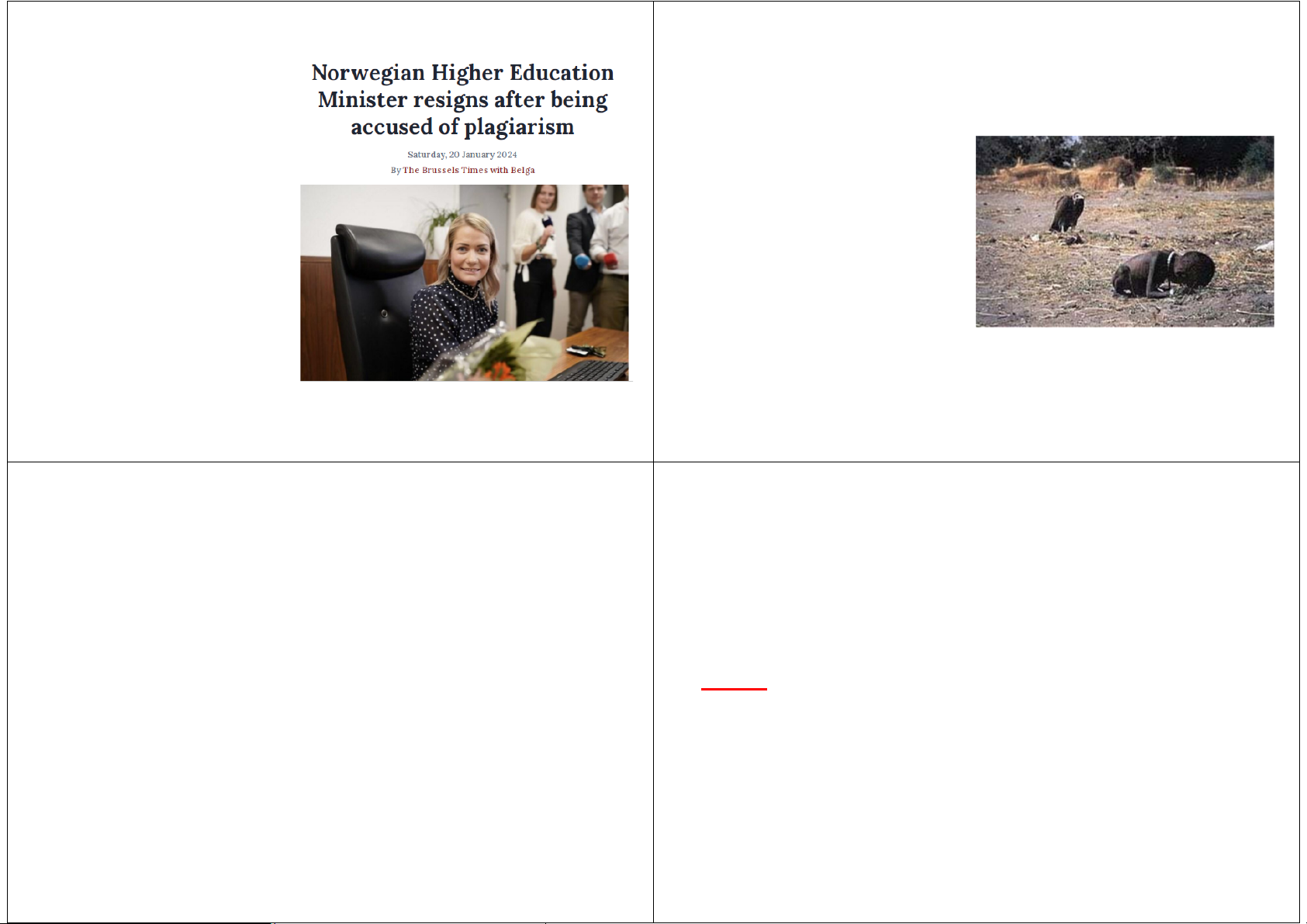
The Vulture (kền kền) and the Little Girl – Norway’s Higher Education
– The Vulture and the Little Girl, is a photograph by
Minister resigned on Friday
Kevin Carter which first appeared in The New York
after being accused of copying,
Times on 26 March 1993. It is a photograph of a frail
famine-stricken boy, initially believed to be a girl, who
errors included, from other
had collapsed in the foreground with a hooded vulture
students’ work in her master’s
eyeing him from nearby. The child was reported to be dissertation.
attempting to reach a United Nations feeding centre
“I have made a terrible mistake,”
about a half mile away in Ayod, Sudan (now South
Sandra Borch said during an
Sudan), in March 1993, and to have survived the
emergency press conference. “I
incident. The picture won the Pulitzer Prize for Feature
Photography award in 1994. Carter took his own life used texts from other
four months after winning the prize.
dissertations without providing
– Four months after being awarded the Pulitzer Prize for
any citations, and for that, I am
Feature Photography, Carter died of suicide by carbon
sorry,” she confessed.
monoxide poisoning on 27 July 1994 at age 33
https://www.brusselstimes.com/885752/norwegian‐higher‐education‐minister‐resigns‐after‐being‐accused‐of‐plagiarism 17 18
The Vulture (kền kền) and the Little Girl Case 1
– I'm really, really sorry. The pain of life overrides the joy to the point that joy does not exist.
– Vào ngày 10 tháng 4 năm 2010, một dược sĩ 59 tuổi đã nhận tội
…depressed … without phone … money for rent … money for child support … money for debts …
trước tòa án liên bang ở New Hampshire về việc phân phối trái
money!!! … I am haunted by the vivid memories of killings & corpses & anger & pain … of
phép và ghi nhãn sai các chất bị kiểm soát. Cựu dược sĩ quản
starving or wounded children, of trigger-happy madmen, often police, of killer executioners … I
lý Wal-Mart đã cố tình phân phát thuốc Bảng III, bao gồm
have gone to join Ken if I am that lucky.
Vicodin (hydrocodone và acetaminophen), cho một cá nhân
– Tôi thật sự thật sự rất tiếc. Nỗi đau cuộc đời lấn át niềm vui đến mức niềm vui không còn tồn tại.
trong bốn lần riêng biệt vào năm 2005 và 2006 mà không có
…chán nản … không có điện thoại … tiền thuê nhà … tiền nuôi con … tiền nợ … tiền!!! … Tôi bị
ám ảnh bởi những ký ức sống động về những vụ giết chóc & xác chết & giận dữ & đau đớn… về
đơn thuốc hợp lệ. Sau khi bị kết án, dược sĩ đã tự nguyện giao
những đứa trẻ chết đói hoặc bị thương, về những kẻ điên cuồng kích động, thường là cảnh sát,
lại giấy phép của mình cho nhà nước. Anh ta có thể phải đối
về những kẻ hành quyết sát nhân… Tôi đã đến tham gia cùng Ken nếu tôi may mắn như vậy.
mặt với án tù lên tới 5 năm vì phân phối thuốc trái phép và 1
– — Kevin Carter, [Suicide letter]
năm vì ghi sai nhãn hiệu. Anh ta bị kết án 14 tháng trong trại cải tạo liên bang.
https://www.uspharmacist.com/article/rogue‐pharmacists 19 20 Case 2 Case 3
– Vào ngày 7 tháng 7 năm 2010, hai dược sĩ là chủ sở hữu của
– Vào ngày 14 tháng 1 năm 2010, một dược sĩ 44 tuổi bị bắt tại
Nhà thuốc Patterson Family Pharmacy ở Sacramento,
Citronelle, Alabama vì tội bán và phân phối các chất bị kiểm
California, đã thừa nhận đã phân phối các chất được kiểm soát
soát. Anh ta bị chặn lại khi đang rời khỏi hiệu thuốc nơi anh ta
theo Bảng III và IV hơn 2.000 lần. Đây là những đơn thuốc trên
đang làm việc. Vào thời điểm bị bắt, anh ta đang tàng trữ 1.000
Internet không có giá trị vì không tồn tại mối quan hệ giữa bệnh
viên hydrocodone và 1.400 mL xi-rô codeine. Anh ta bị nghi ngờ
nhân và bác sĩ. Các dược sĩ đồng ý trả 500.000 USD tiền phạt
ăn cắp ít nhất 4.000 chất bị kiểm soát và 2.000 mL xi-rô codeine dân sự
https://www.uspharmacist.com/article/rogue‐pharmacists
https://www.uspharmacist.com/article/rogue‐pharmacists 21 22 Analysis of cases
Đạo đức trong Truyện Kiều
– Những trường hợp được báo cáo ở đây chỉ là phần nổi của tảng băng chìm. Hàng trăm
– Thúy Kiều gặp gỡ, tương tư Kim Trọng
sự việc tương tự khác có thể được tìm thấy trên khắp các phương tiện truyền thông.
– Thúy Kiều bán mình cứu cha: hi sinh tình riêng cho đạo hiếu
Thật là một tình huống đáng xấu hổ khi ngay cả một số ít trong số 270.000 dược sĩ đang
làm việc ở Hoa Kỳ cũng bị đưa lên mặt báo vì thực hiện các hành vi bất hợp pháp và phi
– Dùng dao nhọn sát thân, lòng trinh nữ giữ mình tiết lớn
đạo đức. Họ khiến những người còn lại trong chúng ta trông khá tồi tệ. Để vượt qua áp
– Ý thức lẽ mọn của Thúy Kiều trước Hoạn Thư: Thúy Kiều chấp
lực tiêu cực này, mỗi dược sĩ trung thực, chăm chỉ nên làm mọi thứ có thể để đảm bảo
nhận chế độ đa thê
rằng tất cả bệnh nhân đều được điều trị bằng các dịch vụ tối ưu và để dược sĩ biết rằng
– Thúy Kiều tự trầm ở sông Tiền Đường: không chấp nhận sự ô
họ đã được đối xử một cách tôn trọng, hữu ích và trung thực. Chúng ta có thể khắc phục
nhục vì “giết chồng mà lại lấy chồng”
một số quả táo xấu làm hỏng thùng, nhưng mỗi dược sĩ phải nỗ lực để đảm bảo bệnh
– Thúy Kiều từ chối cuộc sống vợ chồng với Kim Trọng: mặc
nhân không đọc những tin tức truyền thông này như phản ánh nghề nghiệp nói chung
cảm về phẩm giá trinh tiết
https://www.uspharmacist.com/article/rogue‐pharmacists
– Nỗi nhớ nhà của đứa con theo đạo hiếu 23 HỒ THỊ THU HƯƠNG. 2016 24
Tài liệu liên quan:
-
Sách tài liệu Dược học - The Japanese Pharmacopoeia | Trường Đại Học Y Dược Thái Bình
30 15 -
Báo cáo thực tập độc chất_vi nhựa pr
30 15 -

Thuốc Lợi Tiểu - Chương 12: Cơ Chế, Chỉ Định và Tác Dụng môn Dược học | Trường Đại Học Y Dược Thái Bình
57 29 -

Đề Trắc Nghiệm Hóa Dược môn Dược học | Trường Đại Học Y Dược Thái Bình
61 31