BÀI GIẢNG MÔN HỌC RƯỢU BIA NƯỚC GK
BÀI GIẢNG MÔN HỌC RƯỢU BIA NƯỚC GK
Môn: Marketing quốc tế 135 tài liệu
Trường: Trường Đại học Kinh Tế Quốc Dân 8.9 K tài liệu
Tác giả:











Preview text:
NIH Public Access Author Manuscript
Neurogastroenterol Motil. Author manuscript; available in PMC 2008 September 15. NIH-PA Author Manuscript
Published in final edited form as:
Neurogastroenterol Motil. 2008 May ; 20(5): 505–511. doi:10.1111/j.1365-2982.2007.01074.x.
Comparison of breath testing with fructose and high fructose corn
syrups in health and IBS
S. M. Skoog, A. E. Bharucha, and A. R. Zinsmeister
Division of Gastroenterology and Hepatology (SMS, AEB) and Division of Biostatistics (ARZ), Mayo Clinic
College of Medicine, Rochester, MN, USA Abstract
Although incomplete fructose absorption has been implicated to cause gastrointestinal symptoms,
foods containing high fructose corn syrup (HFCS) contain glucose. Glucose increases fructose
absorption in healthy subjects. Our hypothesis was that fructose intolerance is less prevalent after NIH-PA Author Manuscript
HFCS consumption compared to fructose alone in healthy subjects and irritable bowel syndrome
(IBS). Breath hydrogen levels and gastrointestinal symptoms were assessed after 40 g of fructose
(12% solution) prepared either in water or as HFCS, administered in double-blind randomized order
on 2 days in 20 healthy subjects and 30 patients with IBS. Gastrointestinal symptoms were recorded
on 100-mm Visual Analogue Scales. Breath hydrogen excretion was more frequently abnormal (P
< 0.01) after fructose (68%) than HFCS (26%) in controls and patients. Fructose intolerance (i.e.
abnormal breath test and symptoms) was more prevalent after fructose than HFCS in healthy subjects
(25% vs 0%, P = 0.002) and patients (40% vs 7%, P = 0.062). Scores for several symptoms (e.g.
bloating r = 0.35) were correlated (P ≤ 0.01) to peak breath hydrogen excretion after fructose but not
HFCS; in the fructose group, this association did not differ between healthy subjects and patients.
Symptoms were not significantly different after fructose compared to HFCS. Fructose intolerance is
more prevalent with fructose alone than with HFCS in health and in IBS. The prevalence of fructose
intolerance is not significantly different between health and IBS. Current methods for identifying
fructose intolerance should be modified to more closely reproduce fructose ingestion in daily life. Keywords
bloating; fructose intolerance; functional bowel disorder; high fructose corn syrup; irritable bowel NIH-PA Author Manuscript syndrome BACKGROUND
The introduction of high fructose corn syrups (HFCS) as alternative sweeteners to sucrose in
the 1960s resulted in a dramatic increase in the monosaccharide form of fructose in the US
food supply.1 HFCS became, and remain, widely used as sweeteners in beverages, dairy
products, canned, baked and processed foods worldwide.2
Fructose monosaccharide is absorbed by carriermediated facilitated diffusion, an energy-
independent process. The fructose carrier is a member of the glucose transport (GLUT) family
of genes encoding for facilitative sugar transporters and is referred to as GLUT 53 and the rate
of fructose absorption is between that of mannose and glucose.4 Sucrose is cleaved to glucose
Address for correspondence Adil E. Bharucha MD, Clinical and Enteric Neuroscience Translational and Epidemiological Research
Program (CENTER), Mayo Clinic, 200 First St. S.W., Rochester, MN 55905, USA. Tel: +1 507 538 5854; fax: +1 507 538 5820; e-mail: bharucha.adil@mayo.edu. Skoog et al. Page 2
and fructose by sucrase, an enzyme located in the brush border of small intestine enterocytes.
For unclear reasons, the absorptive capacity for fructose derived from sucrose exceeds that of NIH-PA Author Manuscript
fructose monosaccharide. Unabsorbed fructose is fermented by colonic bacteria producing
short-chain fatty acids, hydrogen, carbon dioxide and trace gases. Hydrogen must be excreted
in breath and flatus and/or consumed by colonic bacteria as it cannot be metabolized by humans.
A rise in breath hydrogen (and/or methane) following substrate ingestion is the basis for
detecting incomplete fructose absorption and estimating fructose absorptive capacity. The
absorptive capacity for fructose in healthy individuals ranged from less than 5 g to greater than
50 g5 and was both dose and concentration dependent.5,6
Fructose intolerance is diagnosed when gastrointestinal symptoms accompany a positive breath
test. The amount and concentration of fructose used to detect incomplete absorption by breath-
testing has varied among studies. The frequency of incomplete fructose absorption increases
as the dose and concentration increase. Up to 50% of healthy subjects incompletely absorbed
25 g fructose (10%) and up to 80% incompletely absorbed 50 g.5–7 Increasing the
concentration from 10% to 20% increased the frequency of incomplete absorption from 37.5%
to 71.4%.6 In uncontrolled studies, the prevalence of incomplete fructose absorption (25 g)
was higher in patients with functional bowel disorders, i.e. 36–75%8–11 compared to the
prevalence (i.e. 0–50%) reported in healthy subjects.5–7 Although it has been suggested that
fructose intolerance causes gastrointestinal symptoms in some patients,11 the only controlled NIH-PA Author Manuscript
study did not demonstrate a higher prevalence of incomplete fructose absorption and
gastrointestinal symptoms in irritable bowel syndrome (IBS).10 Moreover, glucose greatly
facilitates fructose absorption in health;5,7,12,13 and both natural and processed dietary
sources of fructose usually contain glucose. FDA Regulation 21, Section 184.1866 requires
‘HFCS’ to represent the two fractions HFCS-42 and HFCS-55. Although the name suggests
otherwise, glucose is the predominant sugar in HFCS-42 (42% fructose, 53% glucose and 5%
oligosaccharides).14 HFCS-55 (42% glucose, 55% fructose and 3% oligosaccharides) contains
a small excess of fructose.14 Thus, breath testing with pure fructose may not reflect fructose
ingestion under normal circumstances. Because glucose increases fructose absorption,5,7,12,
13 breath testing with fructose alone may overestimate the true prevalence of incomplete
fructose absorption in controls and IBS.
Our hypothesis was that fructose intolerance (i.e. positive hydrogen breath test and
gastrointestinal symptoms) would occur more frequently with pure fructose compared to
fructose provided as HFCS in healthy subjects and in IBS. METHODS NIH-PA Author Manuscript
This was a double-blind, randomized, crossover study comparing symptoms and fructose
absorption after fructose alone to HFCS. The study was approved by and all the procedures
followed were in accordance with ethical standards of the Mayo Clinic Institutional Review Board. Subjects
Twenty healthy subjects were recruited by public advertisement and 30 patients with a
functional bowel disorder were recruited from our outpatient practice. All participants had an
interview and a physical examination prior to enrolment, and patients underwent appropriate
investigations to exclude organic disease.15 Exclusion criteria for healthy subjects and patients
included significant cardiovascular, respiratory, neurological, psychiatric, or endocrine
disease; anxiety or depression as assessed by the Hospital Anxiety and Depression
Questionnaire;16 medications likely to affect gastrointestinal motility (e.g. opiates,
anticholinergic agents, adrenergic agents and calcium channel blockers); and abdominal
surgery (other than appendectomy, cholecystectomy, or hernia repair). In addition, subjects
Neurogastroenterol Motil. Author manuscript; available in PMC 2008 September 15. Skoog et al. Page 3
who used antibiotics at any time during a 2-month period before the study were excluded. A
validated questionnaire was used to exclude IBS, functional bloating, diarrhoea, or constipation NIH-PA Author Manuscript
in controls.17 Subjects were reimbursed for participating in this study. Breath tests
Subjects were asked to abstain from pastas, legumes, dairy, fruits, fruit juices and products
containing HFCS or fructose along with tobacco products and to limit caffeinated beverages
(i.e. two per day) for 24 h prior to breath tests. Mints and chewing gum were also not permitted
during the 12-h fasting period before the test for both study days. After mouth rinsing with an
antibacterial mouthwash, subjects were randomized, in a double-blind fashion, to one of two
sugar solutions [i.e. 40 g of fructose in 330 mL of tap water (12%) or 40 g of fructose as 95 g
HFCS-55 (77% dry weight) in tap water to total 600 cc (12%)] provided in identical, covered,
opaque containers with a straw. The randomization sequence was generated by the study
biostatistician (ARZ) and provided to the pharmacy. These fructose concentrations
approximate that of cola sweetened with HFCS-55 (some colas are sweetened with sucrose).
Subjects were not informed of the volumes of these solutions and neither subjects nor study
personnel administering the test were allowed to hold the container. Subjects were asked to
consume solutions within 10 min and to remain sedentary during the study.
Breath samples were collected every 30 min after the test meal for 3 h after the sugar solution NIH-PA Author Manuscript
was given and analysed for hydrogen concentration. End expiratory breath samples were
collected in a modified (Haldane-Priestley) bag (Quintron, Milwaukee, WI, USA). A 20 mL
sample of air was withdrawn from the bag and injected into a gas chromatography analyser
(Quinn Torn Microlyzer Self Correcting Model SC; Quintron) for detecting breath hydrogen
levels. Correction factors were used to correct for CO2 and dead space using industry standards.
Incomplete fructose absorption was defined as a rise in breath hydrogen of ≥20 ppm over the
baseline value, which is highly specific for identifying carbohydrate malabsorption.18 Symptoms
Symptoms were recorded on separate 100-mm Visual Analog Scales (VAS) for each symptom
(i.e. abdominal bloating, flatulence, nausea and abdominal pain) at baseline and every 30 min
after the test meal for 3 h.11 These symptom scores were summarized by adding values for
each symptom over 3 h. A 10-mm increase in symptom scores for any symptom over baseline
was considered abnormal. Because baseline symptom scores averaged <5, the 10-mm absolute
increase is greater than the 10% change considered abnormal in previous studies.19,20 Subjects
also recorded the consistency of every bowel movement during the 3-h postmeal period on a
Bristol scale.8 The same procedure was repeated with the other sugar solution 2–7 days later. NIH-PA Author Manuscript Statistical analysis
The prevalence of an abnormal breath hydrogen response after fructose vs HFCS were
compared separately in controls and in IBS by McNemar’s test for paired discrete data. The
area under the curve (AUC) for hydrogen breath excretion after fructose and HFCS were
compared by paired t-tests or signed-rank tests. The relationship between symptoms and the
breath hydrogen response was analysed by Spearman’s correlation coefficient. The Breslow–
Day test was used to compare the association (i.e. between symptoms and a positive breath
test) between health and IBS. Statistical analyses were carried out using the SAS software
package (SAS Institute, Cary, NC, USA).
The sample size of 20 controls and 30 patients was expected to provide 10 discordant pairs of
controls and 16 discordant pairs of patients using conservative estimates based on previous
studies. The null hypothesis was that the discordant pairs would be equally split between those
intolerant to fructose and not HFCS vs the reverse (intolerant to HFCS and not fructose). This
Neurogastroenterol Motil. Author manuscript; available in PMC 2008 September 15. Skoog et al. Page 4
hypothesis was tested separately in patients and controls using McNemar’s test (applying the
exact binomial distribution). Due to the discreteness of the binomial distribution, conservative NIH-PA Author Manuscript
twosided α-levels were necessary to select the rejection regions (degree of imbalance) in the
anticipated number of discordant pairs for each subject group. For example, there was 81%
power to reject the null hypothesis if the true proportion of fructose intolerant but not HFCS
intolerant pairs was 0.92 or greater (reject the null at an α-level of 0.021). Similarly, there was
82% power if the true proportion of fructose intolerant but not HFCS intolerant pairs is 0.86 or greater (α = 0.021). RESULTS
Clinical and demographic features
All subjects completed both breath tests. Age, but not gender or BMI, was associated (P <
0.01) with subject group (healthy subjects vs patients) (Table 1). Patients had symptoms of
diarrhoea predominant IBS (n = 12), constipation-predominant IBS (n = 4), alternating IBS
(n = 10), or functional diarrhoea (n = 4).21 In addition, 22 patients reported significant abdominal bloating. Hydrogen breath tests
After fructose, an abnormal breath hydrogen response was observed in 13 of 20 (65%) healthy NIH-PA Author Manuscript
subjects and in 21 of 30 (70%) patients (Table 1). In contrast to fructose, an abnormal breath
hydrogen response was less frequently (P < 0.01) observed after HFCS [i.e. in four of 20 (20%)
healthy subjects and in nine of 30 (30%) IBS patients]. Among subjects who had an abnormal
breath test for fructose and HFCS, breath hydrogen peaks were observed 125 ± 12 min (mean
± SEM) after HFCS and 102 ± 9 min after fructose (P = 0.125 by sign test).
Four of 13 healthy subjects and nine of 21 patients who had incomplete fructose absorption
after fructose alone also had abnormal breath hydrogen responses after HFCS. No subjects had
the combination of an abnormal breath hydrogen response after HFCS and a normal breath
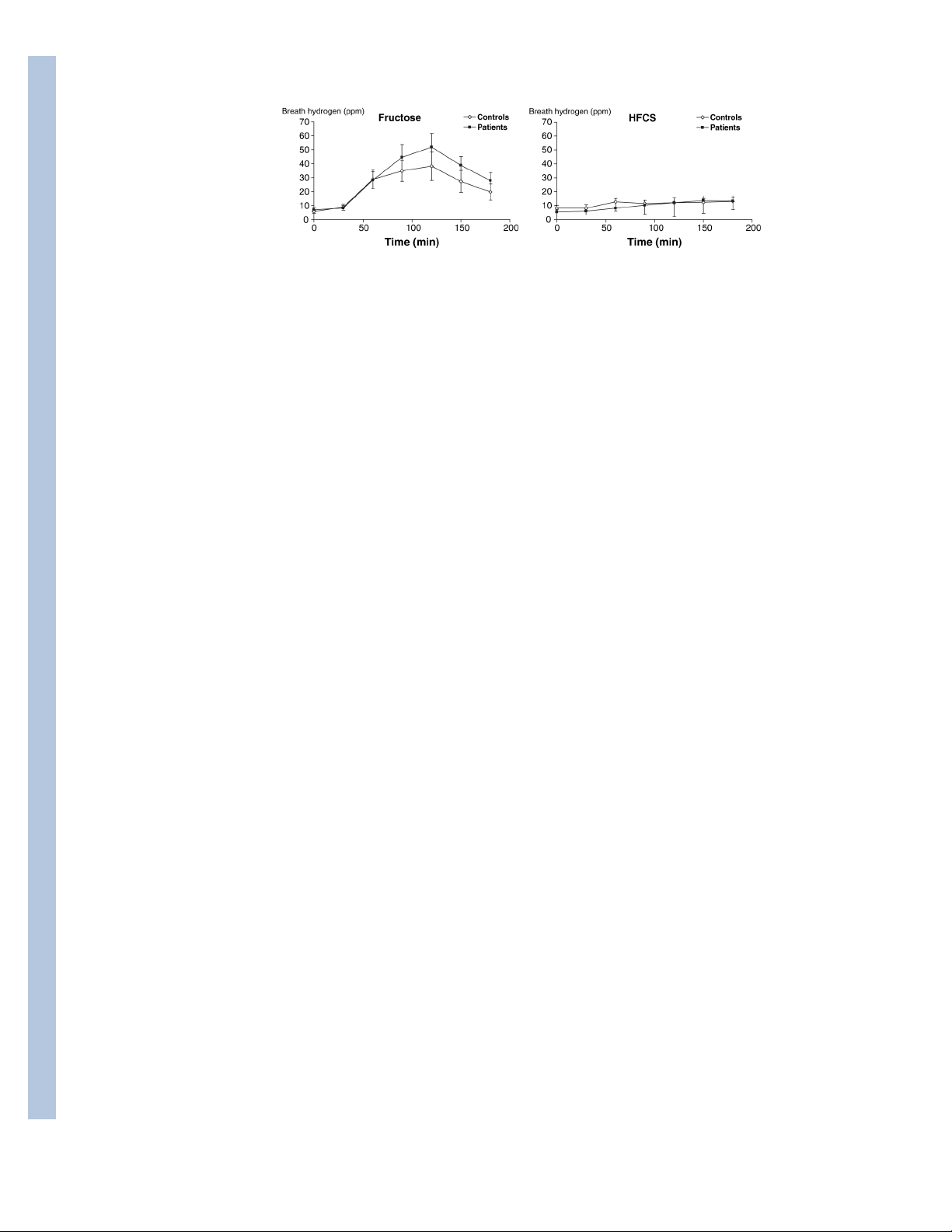
hydrogen response after fructose alone. Breath hydrogen responses (i.e. peak and AUC) after
fructose and HFCS were not different between health and IBS (Fig. 1). The order of testing
(i.e. fructose first vs HFCS first) did not affect the results of breath hydrogen tests. Symptoms
Baseline symptom scores (i.e. prior to sugars) averaged <5 for each symptom and were not
significantly different between study days (data not shown). After sugar ingestion, overall
symptom scores were not significantly different between fructose and HFCS or between NIH-PA Author Manuscript
healthy subjects and patients (Table 2). Seven of 20 healthy subjects (35%) and 15 of 30 patients
(50%) had one or more symptoms (i.e. a ≥10-mm increase in symptom scores over baseline)
during a fructose hydrogen breath test, but only two healthy subjects (10%) and only 14 of 30
patients (47%) had one or more symptoms during a HFCS breath test (Table 3). Bloating was
the most common symptom after fructose alone.
Taken together, five healthy subjects (25%) and 12 patients (40%) had fructose intolerance as
defined by symptoms and an abnormal breath hydrogen response (Table 3). Thus, the odds
ratio for an abnormal symptom response to fructose in those with an abnormal breath hydrogen
response relative to those with a normal breath hydrogen response was somewhat higher in
patients (OR, 2.67; 95% CI, 0.52–13.66) than in controls (OR, 1.56; 95% CI, 0.21–11.37), but
this was not statistically significant (P = 0.68). No healthy subjects and only two patients (7%)
were intolerant to HFCS (P = 0.72). However, intolerance was more prevalent after fructose
than after HFCS in patients (P = 0.002) and to a lesser extent in controls (P = 0.062). As there
Neurogastroenterol Motil. Author manuscript; available in PMC 2008 September 15. Skoog et al. Page 5
were no controls and only two patients intolerant to HFCS, a comparison of the homogeneity
of the intolerance response between controls and patients could not be tested. NIH-PA Author Manuscript
Symptom scores for bloating (r = 0.36, P = 0.01), flatulence (r = 0.43, P = 0.002), and pain
(r = 0.36, P = 0.01) but not nausea were related to peak breath hydrogen excretion after fructose;
this association was not different between health and IBS. In contrast, symptom scores were
not correlated with peak breath hydrogen excretion after HFCS.
Four subjects had bowel movements during the 3-h study. Of these four subjects, two had
bowel movements on both study days. The two other subjects had bowel movements after
fructose or HFCS on one study day only. DISCUSSION
Previous studies observed incomplete absorption after 50 g of fructose in 37.5%, 58% and 80%
of healthy subjects and after a lower threshold (i.e. 25 g) in 36–75% of patients with IBS.5,6,
8,9,11 Confirming these studies, our data demonstrate that a majority of healthy subjects (i.e.
65%) and patients with functional bowel symptoms (i.e. 70%) incompletely absorbed (40 g)
fructose when ingested alone.5–7 In contrast, a lower proportion of healthy subjects (i.e. 20%)
and patients (i.e. 30%) incompletely absorbed (40 g) fructose provided as HFCS, which is
generally used to sweeten processed foods rather than fructose alone. Moreover, the prevalence NIH-PA Author Manuscript
of incomplete fructose absorption after fructose alone or after HFCS was not significantly
different between healthy subjects and IBS. Taken together, these findings suggest that breath
testing as commonly practiced (i.e. 25 g or more of pure fructose) may overestimate the
prevalence of incomplete fructose absorption in daily life. Perhaps, a smaller test dose (e.g. 10
g) of fructose or HFCS-55 instead of fructose will provide a more specific measure of
incomplete fructose absorption, but even HFCS may overestimate the prevalence of incomplete
fructose absorption intolerance because HFCS are usually ingested with other foods that
contain glucose and may also enhance fructose absorption. Both sugar solutions contained 40
g of fructose, approximating the fructose content of two cans of cola (closer to 44 g). The
HFCS-55 study solution used in this study provided an excess (as compared to glucose) of 9.5
g fructose as a 12% solution, mimicking the ingestion of two cans of cola sweetened with
HFCS-55 consumed in isolation. While ingestion of 40 g of fructose provided as HFCS may
be commonplace in the diet of some individuals, it is extremely unlikely that 40 g of fructose
in isolation would be consumed unintentionally. We speculate that the prevalence of
incomplete fructose absorption with the other commonly used fraction of HFCS (i.e. HFCS-42)
is even lower because it contains an excess of glucose and should be completely absorbed.
Among subjects with an abnormal breath hydrogen test, breath hydrogen excretion peaked at NIH-PA Author Manuscript
approximately 2 h after the substrate was administered. Indeed, only four of 47 abnormal breath
tests were characterized by peak breath hydrogen excretion at 60 min and in only one subject,
a control, was peak breath hydrogen excretion observed at 30 min. Although peak breath
hydrogen excretion earlier than 60 min after substrate ingestion may be due to small intestinal
bacterial overgrowth,22 this healthy subject also had normal fasting breath hydrogen excretion,
arguing against bacterial overgrowth. It is less widely recognized that early breath hydrogen
peak excretion may reflect rapid orocecal transit.23 We did not measure breath methane
excretion as only a small proportion of subjects (i.e. 4% in a recent study) exclusively produce methane.11
On the basis of uncontrolled studies, it has been suggested that incomplete fructose absorption
is more common (i.e. 36–75%) in patients with functional bowel disorders,8–11 than in healthy
subjects (i.e. 0–50%).5–7 However, our data confirm the findings of the only previous
controlled study,10 which demonstrated that intolerance for a variety of sugars [i.e. lactose (50
Neurogastroenterol Motil. Author manuscript; available in PMC 2008 September 15. Skoog et al. Page 6
g), fructose (25 g), sorbitol (5 g), fructose plus sorbitol (25 + 5 g) and sucrose (50 g)] is not
more prevalent in IBS than in health. Despite these findings, it is conceivable that fructose NIH-PA Author Manuscript
intolerance may contribute to gastrointestinal symptoms in a minority of patients with IBS.
After ingestion of fructose alone, symptoms were correlated to peak breath hydrogen excretion
as suggested previously.8 Symptoms may be caused by intestinal distention due to osmotic
effects of fructose and/or by colonic distention, secondary to colonic bacterial fermentation of
incompletely absorbed sugars. Visceral hypersensitivity may also explain symptoms after
ingestion of fructose in IBS. However, in a previous study, symptoms after ingestion of fructose
—sorbitol were not associated with increased perception of jejunal balloon distention.24
Symptoms were not correlated to breath hydrogen excretion after HFCS, suggesting they are
not attributable to colonic fermentation, but may have been due to other factors such as volume.
Glucose increases fructose absorption5,7,12,13 presumably by solvent drag and passive
diffusion.12,25–27 The extent to which glucose increases fructose absorption depends on the
proportion of glucose relative to fructose.5 An equimolar dose of glucose normalized fructose
absorption in healthy subjects5,13 and glucose at one-half the fructose dose decreased the
prevalence of incomplete absorption by over 50%.5 In addition, it is conceivable that glucose
delays gastric emptying, thereby facilitating fructose absorption.28
In summary, our data demonstrate that fructose intolerance is more prevalent after fructose NIH-PA Author Manuscript
alone than after HFCS in health and IBS. The prevalence of fructose intolerance is not
significantly different between health and IBS. ACKNOWLEDGMENTS
This study was supported in part by a Clinical Research Grant from the American College of Gastroenterology (SMS),
USPHS NIH Grant R01 DK068055 (AEB), and by the General Clinical Research Center grant RR00585 from the
National Institutes of Health in support of the Physiology Laboratory and Patient Care Cores. None of the authors
have a conflict of interest. We thank Ms Ann Westphal for excellent secretarial support, the Mayo Clinic Research
Pharmacy, and the nursing staff of the General Clinical Research Center. REFERENCES
1. Park YK, Yetley EA. Intakes and food sources of fructose in the United States. Am J Clin Nutr
1993;58:737S–47S. [PubMed: 8213605]
2. Vuilleumier S. Worldwide production of high-fructose syrup and crystalline fructose. Am J Clin Nutr
1993;58:733S–6S. [PubMed: 8213604]
3. Wasserman D, Hoekstra JH, Tolia V, et al. Molecular analysis of the fructose transporter gene (GLUT5)
in isolated fructose malabsorption. J Clin Invest 1996;98:2398–402. [PubMed: 8941659] NIH-PA Author Manuscript
4. Holdsworth CD, Dawson AM. Absorption of fructose in man. Proc Soc Exp Biol Med 1965;118:142– 5. [PubMed: 14254528]
5. Rumessen JJ, Gudmand-Hoyer E. Absorption capacity of fructose in healthy adults. Comparison with
sucrose and its constituent monosaccharides. Gut 1986;27:1161–8. [PubMed: 3781328]
6. Ravich WJ, Bayless TM, Thomas M. Fructose: incomplete intestinal absorption in humans.
Gastroenterology 1983;84:26–9. [PubMed: 6847852]
7. Truswell AS, Seach JM, Thorburn AW. Incomplete absorption of pure fructose in healthy subjects and
the facilitating effect of glucose. Am J Clin Nutr 1988;48:1424–30. [PubMed: 3202090]
8. Rumessen JJ, Gudmand-Hoyer E. Functional bowel disease: malabsorption and abdominal distress
after ingestion of fructose, sorbitol, and fructose-sorbitol mixtures. Gastroenterology 1988;95:694– 700. [PubMed: 3396816]
9. Fernandez-Banares F, Esteve-Pardo M, Humbert P, de Leon R, Llovet JM, Gassull MA. Role of
fructose-sorbitol malabsorption in the irritable bowel syndrome [comment]. Gastroenterology
1991;101:1453–4. [PubMed: 1936820]
Neurogastroenterol Motil. Author manuscript; available in PMC 2008 September 15. Skoog et al. Page 7
10. Fernandez-Banares F, Esteve-Pardo M, de Leon R, et al. Sugar malabsorption in functional bowel
disease: clinical implications. Am J Gastroenterol 1993;88:2044–50. [PubMed: 8249972] NIH-PA Author Manuscript
11. Choi YK, Johlin FC Jr, Summers RW, Jackson M, Rao SS. Fructose intolerance: an under-recognized
problem. Am J Gastroenterol 2003;98:1348–53. [PubMed: 12818280]
12. Holdsworth CD, Dawson AM. The absorption of monosaccharides in man. Clin Sci 1964;27:371–9. [PubMed: 14236773]
13. Kneepkens CM, Vonk RJ, Fernandes J. Incomplete intestinal absorption of fructose. Arch Dis Child
1984;59:735–8. [PubMed: 6476870]
14. Hanover LM, White JS. Manufacturing, composition, and applications of fructose. Am J Clin Nutr
1993;58:724S–32S. [PubMed: 8213603]
15. Drossman DA, Camilleri M, Mayer EA, Whitehead WE. AGA technical review on irritable bowel
syndrome. Gastroenterology 2002;123:2108–31. [PubMed: 12454866]
16. Zigmond A, Snaith R. The Hospital Anxiety and Depression Scale. Acta Psychiatr Scand
1982;67:361–70. [PubMed: 6880820]
17. Bharucha AE, Locke GR, Seide B, Zinsmeister AR. A new questionnaire for constipation and fecal
incontinence. Aliment Pharmacol Ther 2004;20:355–64. [PubMed: 15274673]
18. Strocchi A, Corazza G, Ellis CJ, Gasbarrini G, Levitt MD. Detection of malabsorption of low doses
of carbohydrate: accuracy of various breath H2 criteria [see comment]. Gastroenterology
1993;105:1404–10. [PubMed: 8224644]
19. Bardhan KD, Bodemar G, Geldof H, et al. A double-blind, randomized, placebo-controlled dose- NIH-PA Author Manuscript
ranging study to evaluate the efficacy of alosetron in the treatment of irritable bowel syndrome.
Aliment Pharmacol Ther 2000;14:23–34. [PubMed: 10632642]
20. Design of Treatment Trials Committee. Irvine EJ, Whitehead WE, Chey WD, et al. Design of
treatment trials for functional gastrointestinal disorders. Gastroenterology 2006;130:1538–51. [PubMed: 16678567]
21. Thompson WG, Longstreth GF, Drossman DA, Heaton KW, Irvine EJ, Muller-Lissner SA. Functional
bowel disorders and functional abdominal pain. Gut 1999;45:1143–7.
22. Romagnuolo J, Schiller D, Bailey RJ. Using breath tests wisely in a gastroenterology practice: an
evidence-based review of indications and pitfalls in interpretation. Am J Gastroenterol
2002;97:1113–26. [PubMed: 12014715]
23. Summers RW, Johlin FC Jr. Fructose intolerance is due to rapid orocecal transit and not small bowel
bacterial overgrowth. Gastroenterology 2001;120:A–1369.
24. Evans PR, Piesse C, Bak YT, Kellow JE. Fructose-sorbitol malabsorption and symptom provocation
in irritable bowel syndrome: relationship to enteric hypersensitivity and dysmotility. Scand J
Gastroenterol 1998;33:1158–63. [PubMed: 9867093]
25. Fine KD, Santa Ana CA, Porter JL, Fordtran JS. Mechanism by which glucose stimulates the passive
absorption of small solutes by the human jejunum in vivo. Gastroenterology 1994;107:389–95. [PubMed: 8039615]
26. Hoekstra JH, van den Aker JH. Facilitating effect of amino acids on fructose and sorbitol absorption NIH-PA Author Manuscript
in children. J Pediatr Gastroenterol Nutr 1996;23:118–24. [PubMed: 8856576]
27. Shi X, Schedl HP, Summers RM, et al. Fructose transport mechanisms in humans. Gastroenterology
1997;113:1171–9. [PubMed: 9322512]
28. Elias E, Gibson GJ, Greenwood LF, Hunt JN, Tripp JH. The slowing of gastric emptying by
monosaccharides and disaccharides in test meals. J Physiol 1968;194:317–26. [PubMed: 5639356]
Neurogastroenterol Motil. Author manuscript; available in PMC 2008 September 15. Skoog et al. Page 8 NIH-PA Author Manuscript Figure 1.
Comparison of breath hydrogen excretion after fructose (left panel) and high fructose corn
syrup (HFCS; right panel) in healthy volunteers and patients. Breath hydrogen excretion was
not significantly different between healthy volunteers and patients. NIH-PA Author Manuscript NIH-PA Author Manuscript
Neurogastroenterol Motil. Author manuscript; available in PMC 2008 September 15. Skoog et al. Page 9 Table 1 Demographic characteristics NIH-PA Author Manuscript Controls Patients Variable (n = 20) (n = 30) Age (years) (mean ± SE) 28 ± 3 41 ± 2 Number of females 14 (60) 21 (60) BMI (kg m-2) (mean ± SE) 24 ± 1 26 ± 1 Breath hydroge response Abnormal – fructose 13 (65) 21 (70) Abnormal – HFC 4 (20) 9 (30)
Abnormal – fructose and HFCS 4 (20) 9 (30) Normal – fructose HFCS 7 (35) 9 (30) Symptoms after fructose Flatulence 4 (20) 9 (30) Bloating 5 (25) 10 (33) Nausea 2 (10) 8 (27) Abdominal pain 2 (10) 9 (30) Symptoms after HFCS Flatulence 2 (10) 6 (20) Bloating 1 (5); 10 (33) Nausea 0 8 (27) Abdominal pain 0 9 (30)
All values except age and BMI are N (%) of group total. HFCS, high fructose corn syrup; BMI, body mass index. NIH-PA Author Manuscript NIH-PA Author Manuscript
Neurogastroenterol Motil. Author manuscript; available in PMC 2008 September 15. Skoog et al. Page 10 0 (0, 13.0) 10.0 (0, 56) NIH-PA Author Manuscript HFCS 0 (0, 18.0) 14.5 (0, 55) Pain F 0 (0, 19.0) 6.0 (0, 38) HFCS 9.5 (0, 31.0) 13.0 (1, 74) Flatulence F NIH-PA Author Manuscript HFCS 0 (0, 9.0) 7.5 (0, 40) Table 2 0 (0, 13.0) 13.0 (0, 29) Nausea F 0 (0, 14.0) 15.0 (0, 98) HFCS NIH-PA Author Manuscript 3.5(0, 30.5) 18.0 (1, 87) Bloating F
Comparison of symptoms after fructose and HFCS in controls and IBS
Values represent the cumulative symptom score recorded at six time points over 3 h (i.e. maximum = 400). F, fructose; HFCS, high fructose corn syrup; IBS, irritable bowel syndrome.
Median (IQR) Visual Analog Scales scores (mm) Healthy subjects Patients
Neurogastroenterol Motil. Author manuscript; available in PMC 2008 September 15. Skoog et al. Page 11 Table 3
Comparison of symptoms and breath hydrogen responses in controls and IBS NIH-PA Author Manuscript Controls Patients Variable (n = 20) (n = 30) Normal fructose breath test 7 (35) 9 (30) Number with symptoms 2/7 (28) 3/9 (33) Abnormal fructose breath test 13 (65) 21 (70) Number with symptoms 5/13 (38) 12/21 (57) Normal HFCS breath test 16 (80) 21 (70) Number with symptoms 2/16 (12) 12/21 (57) Abnormal HFCS breath test 4 (20) 9 (30) Number with symptoms 0/4 (0) 2/9 (22)
Values in parenthesis are in percentage. IBS, irritable bowel syndrome; HFCS, high fructose corn syrup. NIH-PA Author Manuscript NIH-PA Author Manuscript
Neurogastroenterol Motil. Author manuscript; available in PMC 2008 September 15.