Business Suite Overview: Standard Software & System Layers | Logistics | Trường Đại học Kinh tế, Đại học Quốc gia Hà Nội
Business Suite is composed of various business software applications. They enable companies to plan and execute processes while saving on operating costs and, atthe same time, tapping into newbusiness opportunities. TheSAPBusiness Suite applications are based on the SAP NetWeaver platform and support the best-practice methods of all branches. Tài liệu được sưu tầm và soạn thảo dưới dạng file PDF để gửi tới các bạn cùng tham khảo, ôn tập đầy đủ kiến thức, chuẩn bị cho các buổi học thật tốt. Mời bạn đọc đón xem!
Môn: Logistics 61 tài liệu
Trường: Trường Đại học Kinh tế, Đại học Quốc gia Hà Nội 491 tài liệu
Tác giả:

Preview text:
Chapter2 SAPBusiness Suite
SAP Business Suite is composed of various business software applications. They
enable companies to plan and execute processes while saving on operating costs
and, at the same time, tapping into new business opportunities. The SAP Business
Suite applications are based on the SAP NetWeaver platform and support the
best-practice methods of all branches. In addition, the suite provides integrated
business applications and functions from the realms of finance, controlling, human
resources,assetsmanagement,production, purchasing, productdevelopment, market-
ing, distribution, service, supply chain management and IT management.
2.1 SAPBusiness SuiteasStandardSoftware
The term standard software refers to a group of programs that can be used to
process and resolve a series of similar tasks. These programs can generally be
adapted to fit user-specific needs through targeted configuration, or customizing.
Configuration inthis sense meansthat process steps,process chains and individual
functions—as reusable parts of process steps—can be influenced by entering
configuration data (usually in several database tables).
Standard software can aid in preventing normal processes, such as invoice
verification or transport planning, from having to be covered by the functions of
individualprograms.Individualsoftwareoftenleadstofragmentedsystemsthatare
difficult to maintain, and also causes a great deal of integration work and complex
data exchange efforts. Examples of standard software include the Microsoft Office
package, which contains programs for word processing, address administration,
presentation generation, etc., and SAP Business Suite, with its functional compo-
nents mentioned at the start of this chapter.
Standard software canfrequently beimplementedin businesses at amuchlower
price than individual software. The complex, bug-riddenand priceysoftware deve-
lopment process has already been taken care of by standard software producers,
such that the respective programs can be directly procured and installed. The
J. Kappauf et al., LogisticCoreOperationswithSAP, 9
DOI 10.1007/978-3-642-18204-4_2, # Springer-Verlag Berlin Heidelberg 2011 10 2 SAP Business Suite
implementation project for new software can be directly targeted at configuring
processes, generating master files, training users and transitioning from any pre-
viouslyused software.Due tothe fact that manyusers arealready working with the
samestandardsoftware,agreat dealofexperiencehasflowedintoitsdevelopment
andoptimization,fromwhichnewcustomer’sprofit. Inaddition,standardsolutions
are regularly updated and often offer 24/7 maintenance service.
A company’s decision to implement standard or individual software in a new
information system must be well thought out, and depends on a few prerequisites.
Standard software is flexible and frequently offers several advantages, such as
a long-term guarantee of functional improvements by the producer or adaptability
to changing business processes. On the other hand, the disadvantage is that the
standardsoftwaremightonlycontain50–80% ofthedesiredfunctions,withtherest
having to be added via other products or individual extensions.
Whether or not these advantages apply in individual cases depends on the
technical and organizational prerequisites: One criterion is whether the IT infra-
structure of a company is outdated or no longer maintainable. An outdated system
can often be replaced in the process of introducing standard software. Usually,
however, parts of the IT infrastructure must continue to run and be linked to a new
solution. In such cases, it could be that the standard software offers no suitable
interface, such that either elaborate supplementary programs are required or the
use of individual solutions becomes necessary. From an organizational standpoint,
the standard software should at least cover the majority of a company’s needs.
A further, often very important criterion is the willingness of a company to
invest in a uniform software platform with the aim of gaining cost and infrastruc-
tureadvantages with a harmonious IT system throughout all corporate and applica- tion areas.
2.2 LayerModelsandComponentsofanSAPSystem
An SAP system such as SAP Business Suite can be divided into three layers: • Technical hardware layer • Technical software layer
• Application component layer
In this chapter, we will present the two primary software layers of the SAP
system that bring to life business processes within a company—with a special eye to logistics.
• The applicationplatformSAPNetWeaver
This layer includes the central system (kernel) and the application server (AS),
which are necessary to operate all SAP applications. SAP NetWeaver is
described in more detail in the Sect. 2.3.
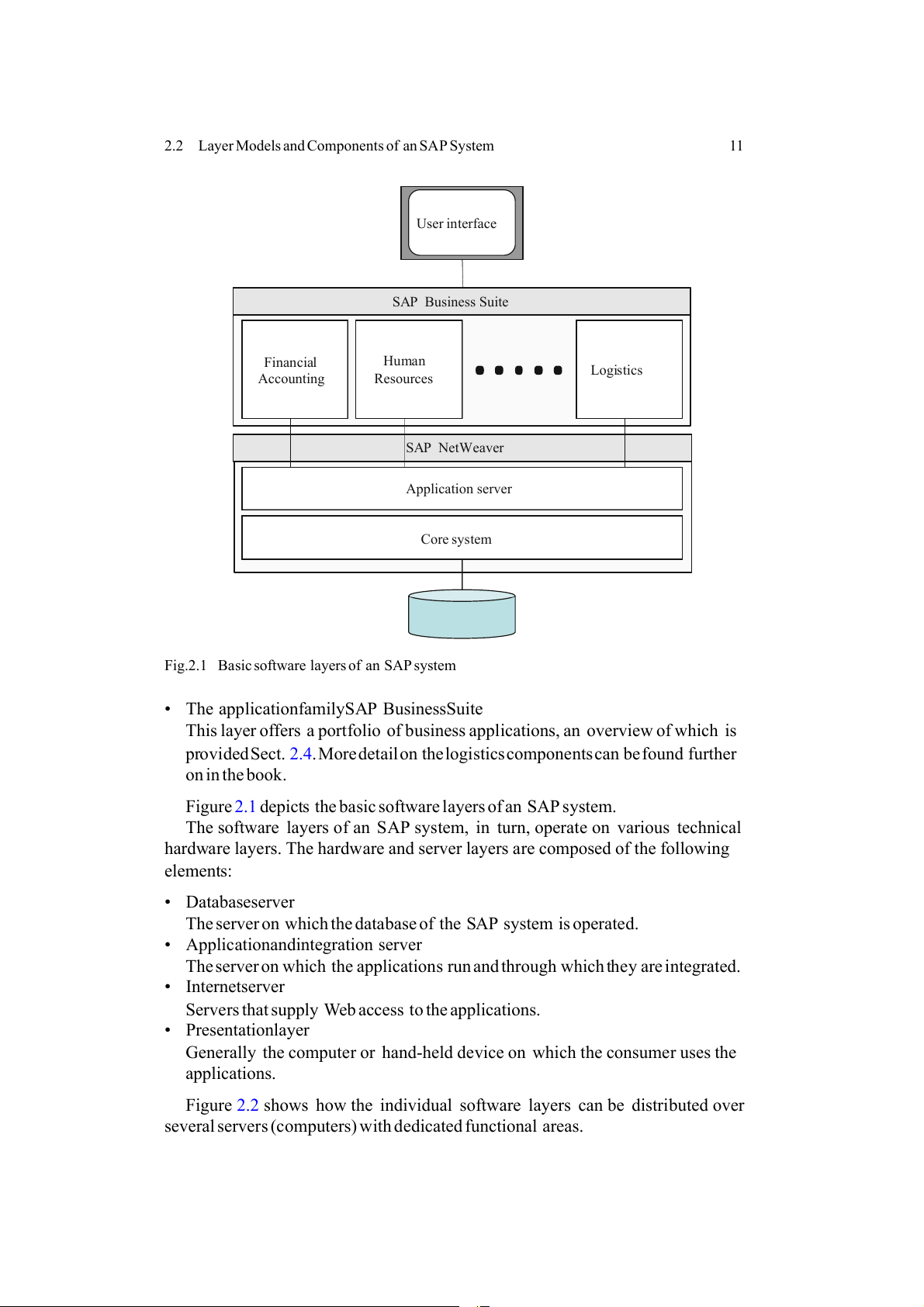
2.2 Layer Models and Components of an SAP System 11 User interface SAP Business Suite Financial Human Logistics Accounting Resources SAP NetWeaver Application server Core system
Fig.2.1 Basic software layers of an SAP system
• The applicationfamilySAP BusinessSuite
This layer offers a portfolio of business applications, an overview of which is
providedSect. 2.4.Moredetailon thelogisticscomponentscan befound further on in the book.
Figure 2.1 depicts the basic software layers of an SAP system.
The software layers of an SAP system, in turn, operate on various technical
hardware layers. The hardware and server layers are composed of the following elements: • Databaseserver
The server on which the database of the SAP system is operated.
• Applicationandintegration server
The server on which the applications run and through which they are integrated. • Internetserver
Servers that supply Web access to the applications. • Presentationlayer
Generally the computer or hand-held device on which the consumer uses the applications.
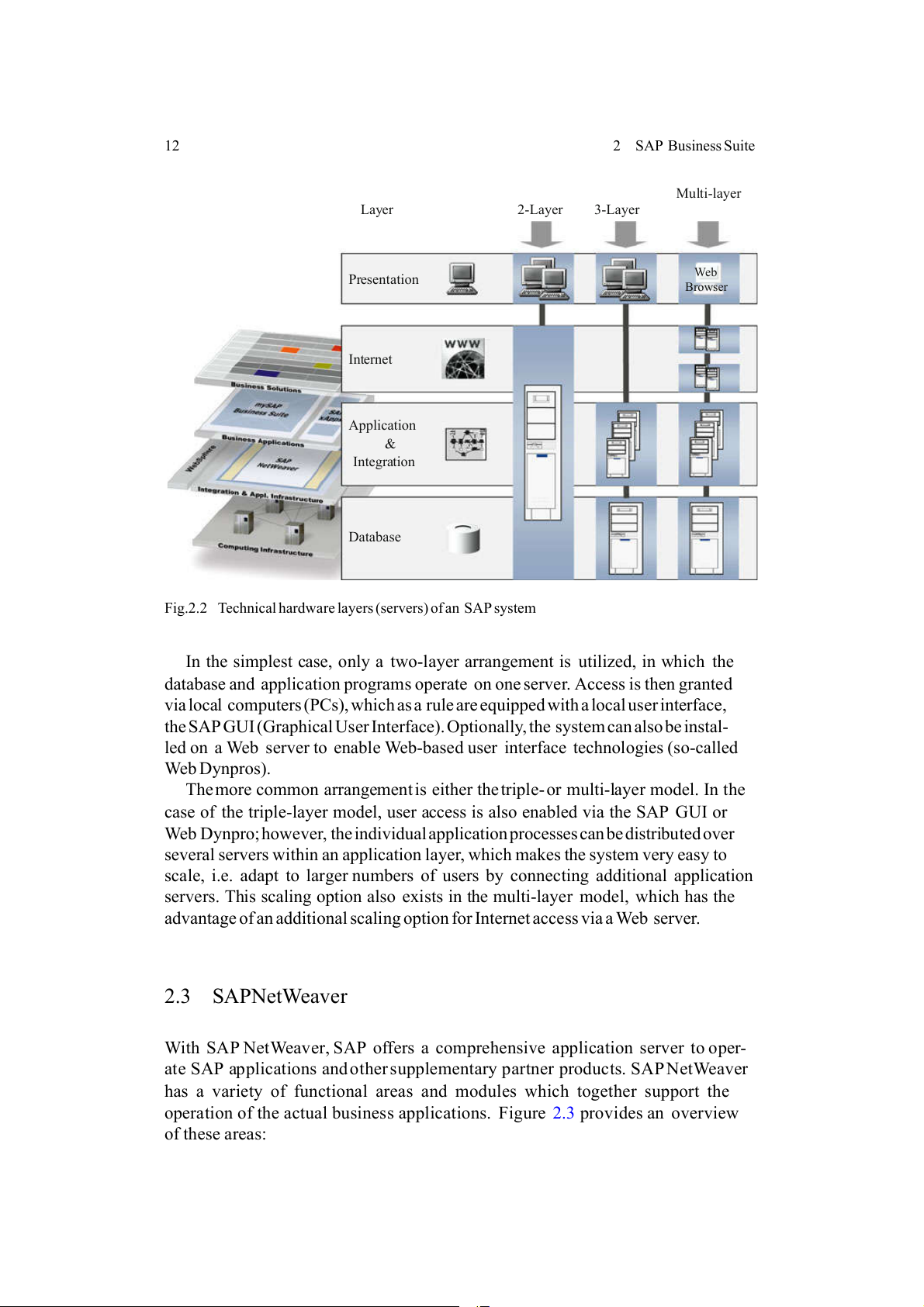
Figure 2.2 shows how the individual software layers can be distributed over
several servers (computers) with dedicated functional areas. 12 2 SAP Business Suite Multi-layer Layer 2-Layer 3-Layer Presentation Web Browser Internet Application & Integration Database
Fig.2.2 Technical hardware layers (servers) of an SAP system
In the simplest case, only a two-layer arrangement is utilized, in which the
database and application programs operate on one server. Access is then granted
via local computers (PCs), which as a rule are equipped with a local user interface,
the SAP GUI (Graphical User Interface). Optionally, the system can also be instal-
led on a Web server to enable Web-based user interface technologies (so-called Web Dynpros).
Themore common arrangementis either thetriple-or multi-layer model. In the
case of the triple-layer model, user access is also enabled via the SAP GUI or
Web Dynpro;however, theindividualapplicationprocessescanbedistributedover
several servers within an application layer, which makes the system very easy to
scale, i.e. adapt to larger numbers of users by connecting additional application
servers. This scaling option also exists in the multi-layer model, which has the
advantage of an additional scaling option for Internet access via a Web server. 2.3 SAPNetWeaver
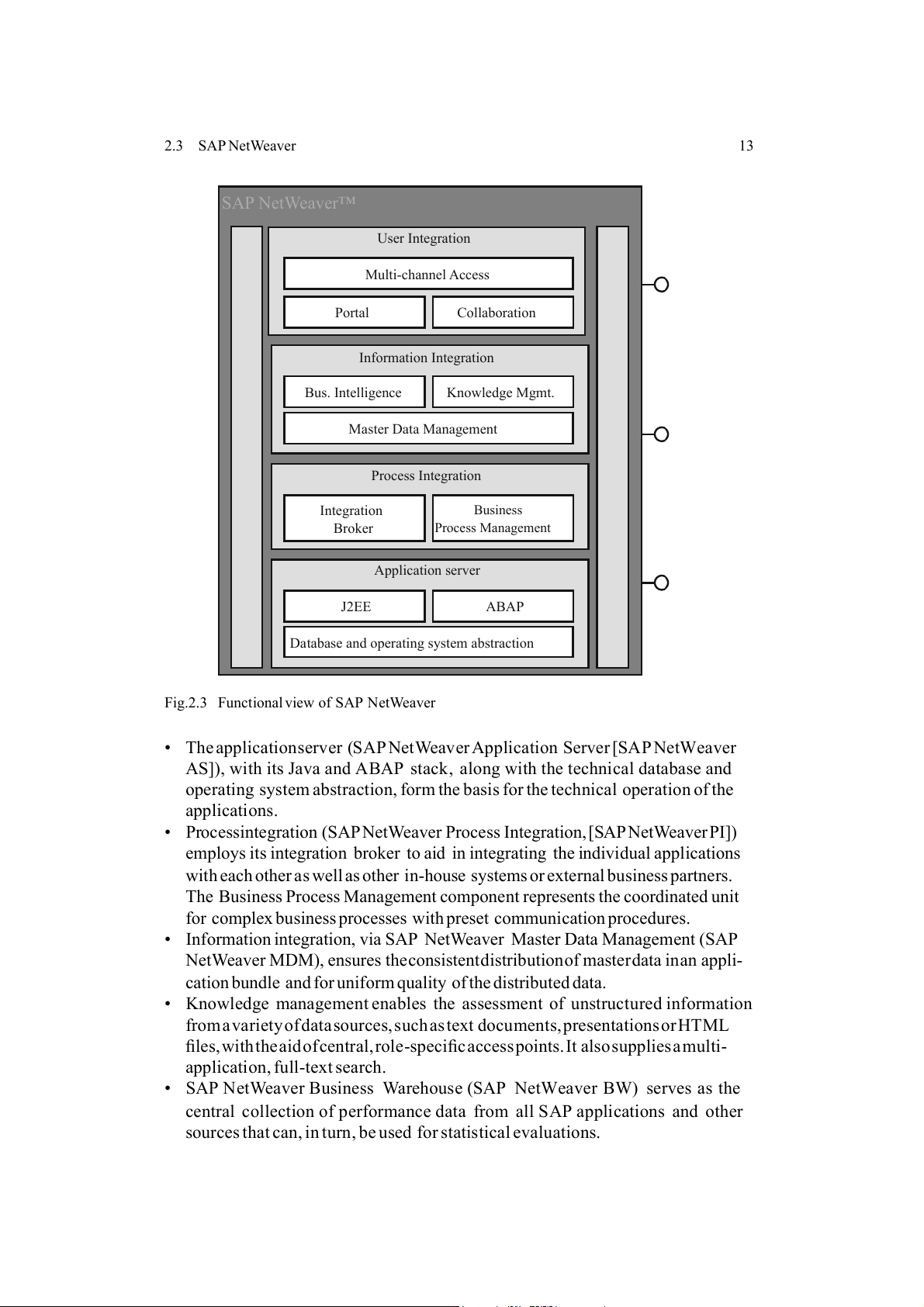
With SAP NetWeaver, SAP offers a comprehensive application server to oper-
ate SAP applications andothersupplementary partner products. SAPNetWeaver
has a variety of functional areas and modules which together support the
operation of the actual business applications. Figure 2.3 provides an overview of these areas: 2.3 SAP NetWeaver 13 SAP NetWeaver™ User Integration Multi-channel Access Portal Collaboration ther O Technologies Information Integration ork L i ew f Bus. Intelligence Knowledge Mgmt. e C ram ycl Master Data Management e Ma na ebsphere g pplication F Process Integration e W m ent Integration Business posite A Broker Process Management om C Application server J2EE ABAP .net
Database and operating system abstraction
Fig.2.3 Functional view of SAP NetWeaver
• The applicationserver (SAP NetWeaver Application Server [SAP NetWeaver
AS]), with its Java and ABAP stack, along with the technical database and
operating system abstraction, form the basis for the technical operation of the applications.
• Processintegration (SAPNetWeaver Process Integration,[SAPNetWeaverPI])
employs its integration broker to aid in integrating the individual applications
with each other as well as other in-house systems or external business partners.
The Business Process Management component represents the coordinated unit
for complex business processes with preset communication procedures.
• Information integration, via SAP NetWeaver Master Data Management (SAP
NetWeaver MDM), ensures theconsistentdistributionof masterdata inan appli-
cation bundle and for uniform quality of the distributed data.
• Knowledge management enables the assessment of unstructured information
fromavarietyofdatasources,suchastext documents,presentationsorHTML
files,withtheaidofcentral,role-specificaccesspoints.It alsosuppliesamulti- application, full-text search.
• SAP NetWeaver Business Warehouse (SAP NetWeaver BW) serves as the
central collection of performance data from all SAP applications and other
sources that can, in turn, be used for statistical evaluations. 14 2 SAP Business Suite
• User integrationprovidesusersofapplicationcomponentswithacentralaccess
point and a homogenous depiction of the application context from various
applications (including non-SAP applications). Via the user integration and the
portal, collaboration scenarios can also be processed.
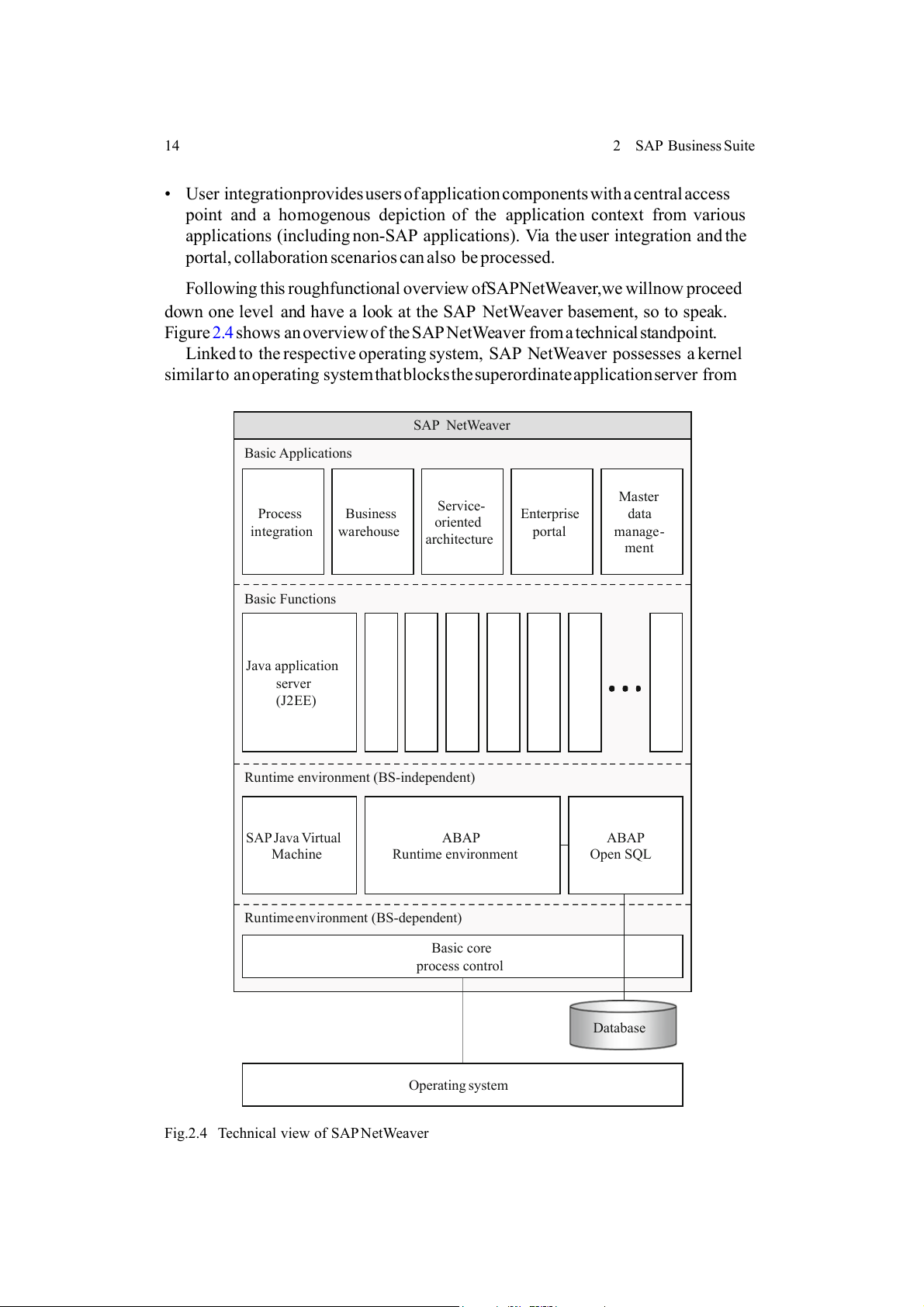
Following this roughfunctional overview ofSAPNetWeaver,we willnow proceed
down one level and have a look at the SAP NetWeaver basement, so to speak.
Figure 2.4 shows anoverviewof theSAPNetWeaver fromatechnicalstandpoint.
Linked to the respective operating system, SAP NetWeaver possesses a kernel
similarto anoperating systemthatblocksthesuperordinateapplicationserver from SAP NetWeaver Basic Applications Master Process Business Service- Enterprise data oriented integration warehouse architecture portal manage- ment Basic Functions ent ent ent Java application server unication anagem anagem (J2EE) orkflow m W P developm rint control uthorization m A P A om B C ock m A L ystem S
Runtime environment (BS-independent) SAP Java Virtual ABAP ABAP Machine Runtime environment Open SQL
Runtime environment (BS-dependent) Basic core process control Database Operating system
Fig.2.4 Technical view of SAP NetWeaver 2.3 SAP NetWeaver 15
thequirksof thehardware andoperating system, thusharmonizing operation of the application server.
One important advantage to the harmonization of the IT system landscape is an
improved maintainability of the applications, which no longer need to worry about
therespective release-specific “peculiarities” oftheoperating systemand database.
With the ABAP and Java runtime environments, SAP NetWeaver serves as the
basis ofalmost allSAP applications, whichcan thusbe runina homogenous envi-
ronment. ABAP is SAP’s own programming language, which began as a reporting
language similar to COBOL. ABAP has been further developed into a high-
performance, object-oriented programming tool that is especially suited for the
development of business process applications due to its language constructs. An
efficient runtime control enables independence of all application processes, such
that a faulty program will have no effect on other programs. Advantages ofABAP
Manyprogrammersturnuptheir nosesat ABAP,yetthefactthatSAPsystems
are built on SAP’s own programming language conveys several advantages:
On onehand,SAP,and thusthe user,hascompletecontrolovertheextent of
the language and implementation,which guaranteesa highdegreeof quality.
On the other hand, the source text of the complete ABAP-based application
and base system is provided along with the software, such that your company
has access to all of the possibilities of expanding it to your needs. Program
code enhancements can be easily incorporated in a controlled manner
via so-called enhancement spots, without the danger of collision with SAP
maintenance releasesand corrections.
In Java applications, the main complaint for a long time was a lack of process
decoupling of JavaEnterprise applications,i.e.ifaprogramranuncontrolled, itcould
pulldowntheentireapplicationserver.SAP workedon thisproblemaswell,generating
its own runtime environment for Java, the Java Virtual Machine, which provides for
the independenceofJavaprocessesastheyoccurintheABAPenvironment.
CertificationAccording toJavaEE 1.5
Version 7.1 of SAP NetWeaver Application Server Java is completely certi-
fied according to Java EE 1.5.
2.3.1 ApplicationSupportvia SAP NetWeaver
SAPNetWeaverattachesAS (applicationsupport)functionstotheOS-independent
ABAP and Java runtime environments, which provide uniform basic functions for
the entire Business Suite (see Fig. 2.4): 16 2 SAP Business Suite • Transactionconcept
The transaction concept in the SAP system makes sure that business opera-
tions belonging together are also consistently saved together. If, for example, an
invoice isgenerated from acustomerorder, not onlyshould thecomplete invoice
be saved, but the order itself should consistently show the respective status.
• Processcontrol, workprocesses,loaddistribution
Theprocess controldistributesprocessor capacitytothe individual users running
application programs on an application server. In addition, it makes sure that
users who have just logged on and newly invoked processes start on the server with the lowest load. • Lockconcept
Thelockconcept prevents morethan oneperson frommakingchangestoa single
business object at the same time (without knowledge of each other’s activity).
For instance, this function would prevent an employee in Dallas from editing
a customer order while another employee in Portland is canceling that same
order. If someone is working on an object in edit mode, other users who attempt
to access the process receive a message and can only access it in view mode. In
some newer transactions, a further concept with so-called optimistic locks is
employed,whichallowsmorethan oneperson toaccesscertainpartsoftheobject.
• User managementand authorization control
Via a comprehensive role and authorization concept, you can precisely define
whichusersorusergroupscan display,editorrun certain objects andprocesses.
A call center employee, for example, is allowed to generate new orders and
invoices but not to correct invoices because this is not part of that person’s sphere of authority. • Printmanagement
Printers can be centrally managed within an SAP system. Printer queues are
provided and enable efficient processing of printer jobs from various applica-
tions.Theprint managementalso includestheintegrationof Adobe(Interactive) Forms.
• Communicationandservice-orientedarchitecture
Technicalcommunicationwithinthesystem viaapplicationinterfaces(application-
to-application, or A2A) is available here, as is communication with business
partners via standard interfaces (business-to-business, or B2B).
A service-oriented architecture (SOA) is also available, which is part of the pro-
cessintegration.Themajority ofSAPapplicationsareequippedwithWebservices,
such that simple communication is possible. The services are pre-defined on the
application object level; that is, they fulfill business operation functions (such as
generation ofa customerorder). Furthercommunication processes are provided by fax and e-mail integration. • Workflow
SAP NetWeaver comes with a complete workflow control that is used exten-
sively in the applications. This workflow control can be configured in a variety
of ways and integrated into the Office functions of the SAP system. 2.3 SAP NetWeaver 17
• Developmentenvironment andCorrectionandTransportSystem
A complete ABAP and Java development environment is integrated into SAP
NetWeaver,which makesit especially easy,particularlyin thecaseofABAP, to
expand the system and implement current processes.
The Correction and Transport System enables you to easily import completed
developmentsandsettingsor corrections performed bySAPinto other SAP systems
and adapt them to the coding status of the respective system.
2.3.2 Three SignificantConceptsofSAP Systems
Three significant components that concern the basic functions and applications of
SAPNetWeaveraswellastheSAP BusinessSuite aretheclientconcept, theability
to establish organizations, and the adaptation of the systems to customer-specific
business processes (called Customizingand the ImplementationGuidein the SAP system).
The clientin an SAP system is a concept for the comprehensive logical separa-
tion of various work areas within the system. Technically speaking, a client is the
first key field of every application database table. When a user logs into an SAP
system,heorshealwaysentersaclientnumber(000–999).Forthis,theuser hasto
bedefinedinthatparticularclient.Aftera successfullogin,theuseronlyhas access
tothedata and processes present in thatclient. Data ofotherclients isnot accessible
(it can neither be displayed nor edited). This enables separately operating organi-
zationstoworkparallel toone anotherintheir own clientareas withina singleSAP
system without influencingone another (but a maximum of 150 clients per system
is recommended for performance reasons). Via integration processes, data transfer
can also take place between clients.
Thus, the client is a strict, organizational separating criterion for users working
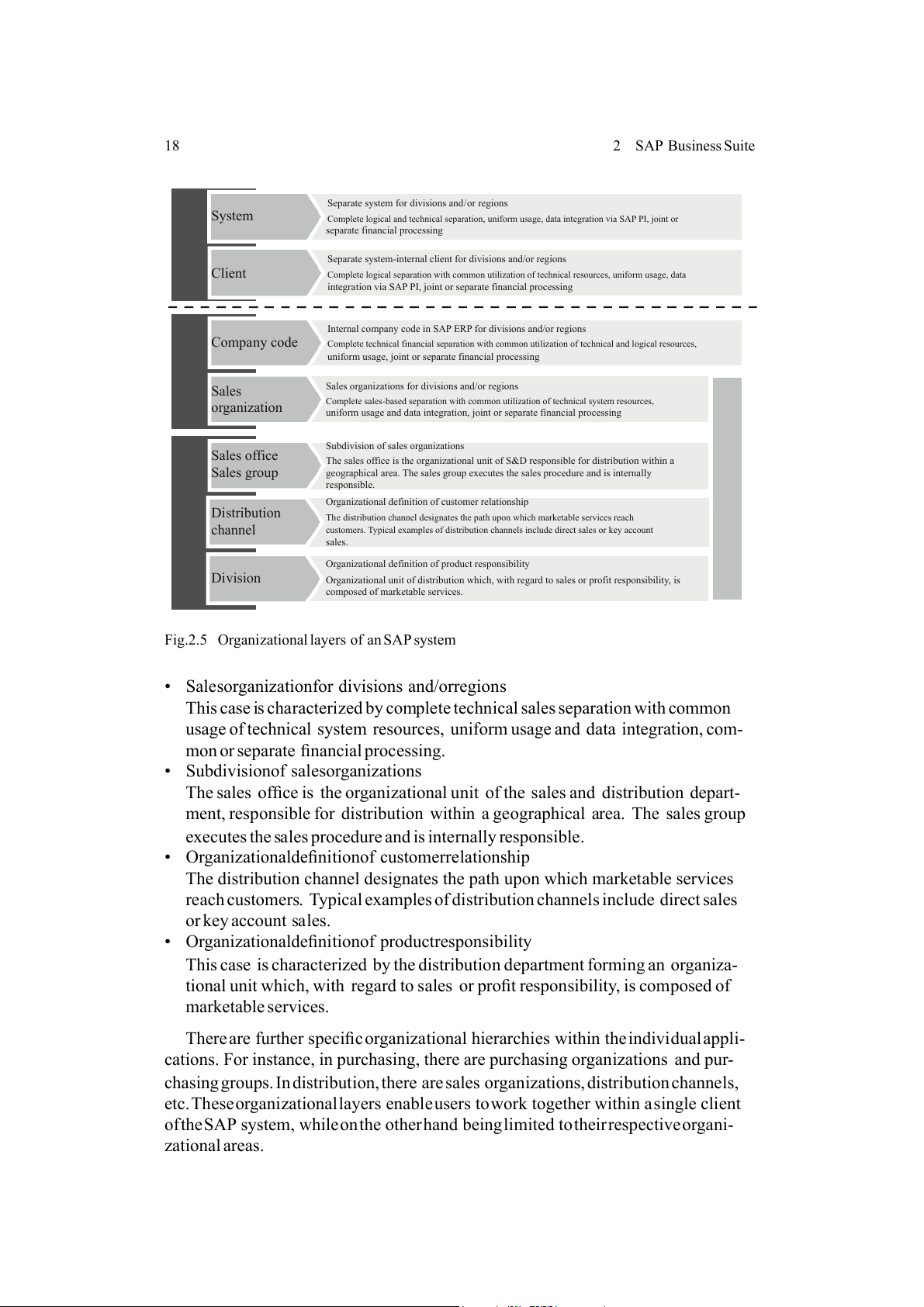
independently on an SAP system. Figure 2.5 displays the technical criteria System and Client.
For users working in separate organizations within the same company, further
organizational layers are available that are developed in the applications:
• Separatesystems forcorporate subsidiariesand/or regions
Such acaseischaracterizedby completelogicalandtechnicalsystem separation,
uniform usage, data integration via SAP NetWeaver PI, common or separate technicalfinancialprocessing.
• Separatesystem-internal clientsforcorporatesubsidiariesand/or regions
Thiscase ischaracterized bycompletelogicalseparation with common usageof
technicalsystem resources,uniform usage,dataintegration viaSAP NetWeaver
PI, and common or separate financial processing.
• Internal companycodefor corporatesubsidiaries and/orregions
This case is characterized by complete technical financial separation with a
common use of technical system and logistics resources, uniform usage, and
common or separate financial processing. 18 2 SAP Business Suite
Separate system for divisions and/or regions System
Complete logical and technical separation, uniform usage, data integration via SAP PI, joint or separate financial processing eparation
Separate system-internal client for divisions and/or regions Client Technical S
Complete logical separation with common utilization of technical resources, uniform usage, data
integration via SAP PI, joint or separate financial processing
Internal company code in SAP ERP for divisions and/or regions Company code
Complete technical financial separation with common utilization of technical and logical resources,
uniform usage, joint or separate financial processing ogical L eparation
Sales organizations for divisions and/or regions Sales S
Complete sales-based separation with common utilization of technical system resources, organization
uniform usage and data integration, joint or separate financial processing
Subdivision of sales organizations Sales office
The sales office is the organizational unit of S&D responsible for distribution within a Sales group
geographical area. The sales group executes the sales procedure and is internally responsible. istribution
Organizational definition of customer relationship Distribution
The distribution channel designates the path upon which marketable services reach ple: D channel
customers. Typical examples of distribution channels include direct sales or key account xam ubordinate rganization sales. E S O
Organizational definition of product responsibility Division
Organizational unit of distribution which, with regard to sales or profit responsibility, is
composed of marketable services.
Fig.2.5 Organizational layers of an SAP system
• Salesorganizationfor divisions and/orregions
This case is characterized by complete technical sales separation with common
usage of technical system resources, uniform usage and data integration, com-
mon or separate financial processing.
• Subdivisionof salesorganizations
The sales office is the organizational unit of the sales and distribution depart-
ment, responsible for distribution within a geographical area. The sales group
executes the sales procedure and is internally responsible.
• Organizationaldefinitionof customerrelationship
The distribution channel designates the path upon which marketable services
reach customers. Typical examples of distribution channels include direct sales or key account sales.
• Organizationaldefinitionof productresponsibility
This case is characterized by the distribution department forming an organiza-
tional unit which, with regard to sales or profit responsibility, is composed of marketable services.
Thereare further specificorganizational hierarchies within theindividualappli-
cations. For instance, in purchasing, there are purchasing organizations and pur-
chasinggroups.Indistribution,there aresales organizations,distributionchannels,
etc.Theseorganizationallayers enableusers towork together within asingle client
oftheSAP system, whileonthe otherhand beinglimited totheirrespectiveorgani- zational areas. 2.3 SAP NetWeaver 19
(Example: Apurchaserfrom Chicagois notauthorized tocreate ordersfor St. Louis
and, of course, cannot generate an annual balance sheet in Financial Accounting.)
As explained above, configuration capability is an extremely important feature
of business software. In the SAP system, this configurability is known as Customi-
zingorImplementation Guide.Thelatterisdividedinto theindividual configuration
areas according to functional aspects. Using Customizing (which is really configu-
ration and not changing the system coding), you can, for instance, very precisely
control which processes within the Business Suite can be performed and how the
individual process steps are composed.
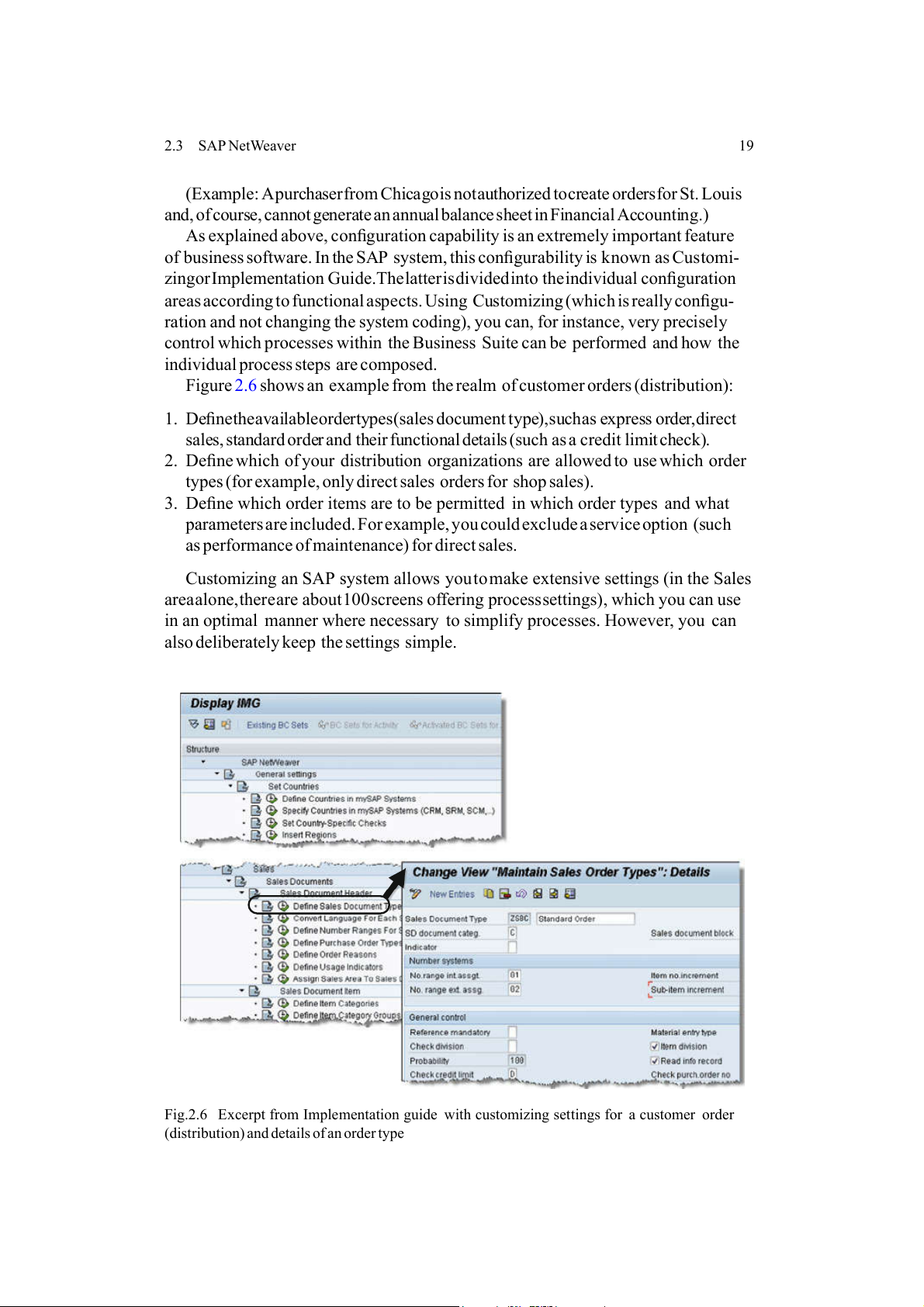
Figure 2.6 shows an example from the realm of customer orders (distribution):
1. Definetheavailableordertypes(sales document type),suchas express order,direct
sales, standard order and their functional details (such as a credit limit check).
2. Define which of your distribution organizations are allowed to use which order
types (for example, only direct sales orders for shop sales).
3. Define which order items are to be permitted in which order types and what
parametersareincluded.Forexample,youcouldexcludeaserviceoption (such
as performance of maintenance) for direct sales.
Customizing an SAP system allows youtomake extensive settings (in the Sales
areaalone,thereare about100screens offering processsettings), which you can use
in an optimal manner where necessary to simplify processes. However, you can
also deliberately keep the settings simple.
Fig.2.6 Excerpt from Implementation guide with customizing settings for a customer order
(distribution) and details of an order type 20 2 SAP Business Suite 2.3.3 ApplicationComponents
SAP NetWeaver Process Integration (SAP NetWeaver PI) is responsible for data
exchange (interoperability) within a system environment as well as with external business partners. DefinitionofInteroperability
Interoperability is the ability of two or more system components to exchange and utilize information.
With the aid of this data exchange, you can go beyond individual applications,
profiting from the functions of the integrated environment, yet still keep overall operating costs low.
SAP NetWeaver PI provides the following major interoperability functions:
• A2AandB2Bintegrationwithinandbetweenapplicationsystemsand businesspartners
Business-to-business and application-to-application scenarios can be expanded
across all messaging technologies and product limits. This includes integration
with Microsoft BizTalk and IBM WebSphere servers. Using communication-
specific adapters, SAP NetWeaver PI can be employed for EDI communication in
thevariousconventionalformats(EDIFACT, ANSI,X.12,ODETTE, VDA,etc.).
• Interoperabilityof Webservices
SAP NetWeaver PI provides for the interoperability of corporate applications
and Web services with external components, in order to enable service-oriented solutions.
• Service-orientedarchitecture
TheEnterprise ServiceRepositorywas introduced as an extension of interoper-
ability with Web services. It contains Web service interfaces to all SAP appli-
cations. These Web services are defined on a business semantics level—that is,
they possess a granularity that corresponds to access in the realm of business
processing (e.g. creating a customer order). • BusinessProcess Management
SAP NetWeaver PI enables the definition and control of complex business
processes that require repeated communication between business partners.
As an additional function, SAP NetWeaver PI offers the administration of
heterogeneous system environments (e.g. using the System Landscape Directory)
and the management of the coexistence of various portals, whereby two portals are
logically joined in order to combine content from an SAP NetWeaver portal and non-SAP portal technology.
SAPNetWeaverBusiness Warehouse (SAP NetWeaverBW) isa company-wide
data warehouse that collects and stores data from a large variety of sources and
makes it available in InfoProviderfor the analysis of corporate performance data. 2.3 SAP NetWeaver 21
Nowadays, the integration of various source systems in a single enterprise data
warehouse such as SAP NetWeaver BW poses one of the greatest challenges. Due
to the sometimes extremely heterogeneous system environments, not only do
various technical platforms need to be connected, but you also have to watch out
for any divergent semantics of master and transaction data, in which case, by the
way, it is wise to consolidate data in order to facilitate analysis. In addition, an
enterprise data warehouse should provide flexible structures and layers, to enable
quickresponse to new companydevelopmentsthatoftenoccur as aresult ofaltera-
tions to business objectives, fusions and takeovers.
SAP NetWeaver BW covers these basic features and also offers a very high
degree of performance, including the option of memory-managed data storage (via
the Business Accelerator). Through integrated presentation tools (e.g. Business
Explorer, BEx) and the evaluation and display functions of SAP BusinessObjects,
SAP NetWeaver BW provides every user in an enterprise with an overview of
required performance data precisely tailored to his or her purposes.
Employing SAP NetWeaver Business Warehouse presents several advantages:
• Less complexity, improved flexibility and very flexible data modeling
• The integration of large, complex and heterogeneous system environments with
data integration across the entire enterprise
• Enables operational reporting with the aid of real-time data acquisition
SAP NetWeaver Master Data Management (SAP NetWeaver MDM) offers
central master data processing within a complex integrated network. For this pur-
pose, the software makes sure that important master data, such as business partner
data or product master data, are only entered into the system once and then con-
sistently distributed among all systems. This results in a high degree of data
quality, as the data is not corrupted by duplicates or incorrect spelling. With SAP
BusinessObjectstools, suchasDataServices,Data QualityandDataIntegrator, the
laborious process of master data comparison and completion is made considerably
easier.Typicalmasterdataerrors thatmust be eliminatedfor anefficient andfault-
free process include, for example:
• Spelling mistakes: GorgeMillerinstead of GeorgeMiller
• Missing data: Palo Alto without a ZIP code
• Incorrect format: telephone number without a hyphen, 1234567instead of 123-4567
• Incorrect codes: currency code CANinstead of CDNfor Canadian dollars
• Duplication: double master data entries, G. Smithand GeorgeSmith
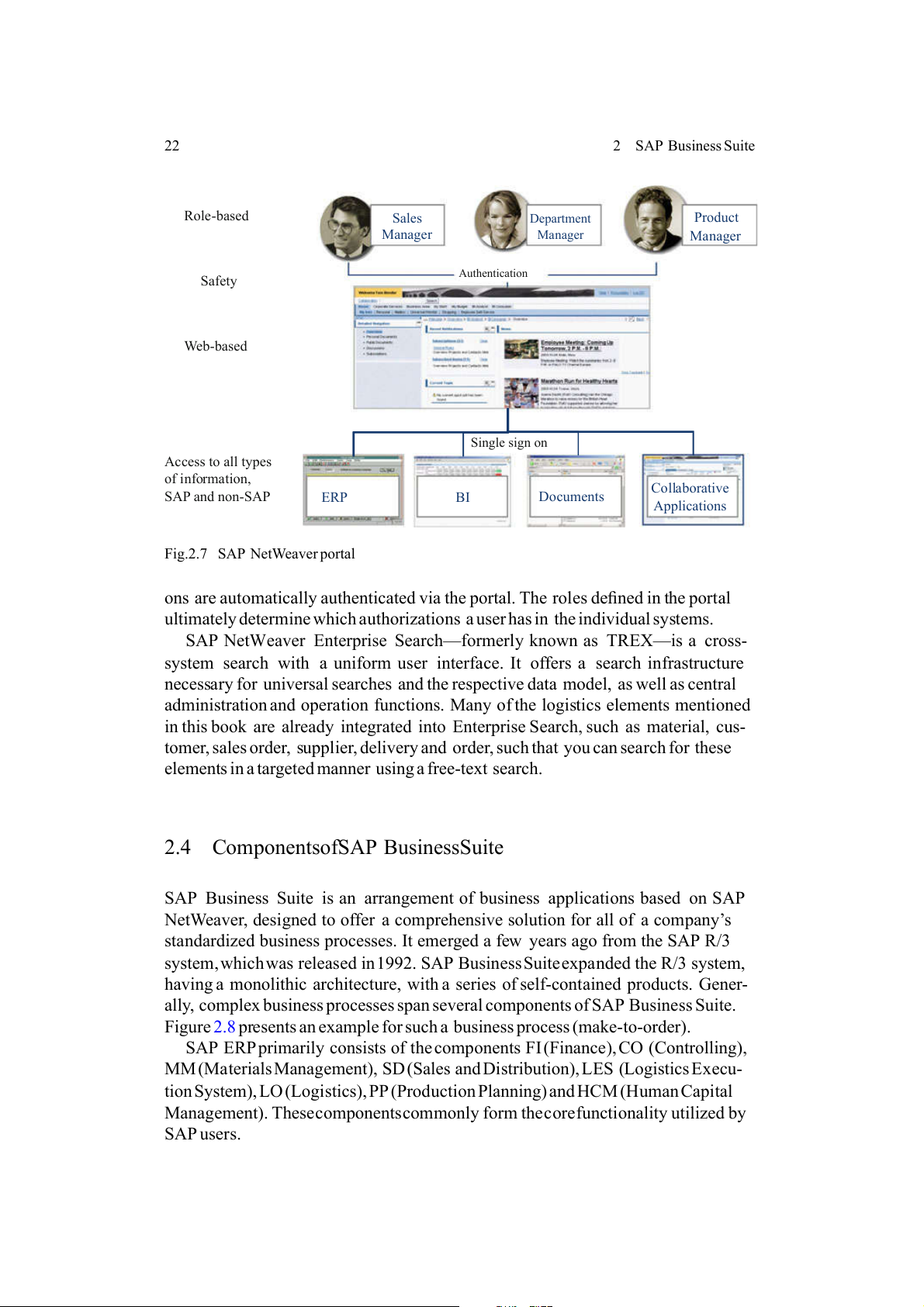
SAP NetWeaver Portal provides the user-based integration of all necessary
information for the respective user in a single work environment (see Fig. 2.7).
It includes access to the business processes in the SAP environment necessary to
the user as well as evaluations from the Business Warehouse, Internet access to
business-relatedcontent,documentsfrom Office applicationsand applications from
third-party providers. Access to the various systems is ensured by a single sign-on
logic (SSO), in which logging into the portal once suffices, and all subsequent sign- 22 2 SAP Business Suite Role-based Sales Department Product Manager Manager Manager Safety Authentication Web-based Single sign on Access to all types of information, Collaborative SAP and non-SAP ERP BI Documents Applications Fig.2.7 SAP NetWeaver portal
ons are automatically authenticated via the portal. The roles defined in the portal
ultimately determine which authorizations a user has in the individual systems.
SAP NetWeaver Enterprise Search—formerly known as TREX—is a cross-
system search with a uniform user interface. It offers a search infrastructure
necessary for universal searches and the respective data model, as well as central
administration and operation functions. Many of the logistics elements mentioned
in this book are already integrated into Enterprise Search, such as material, cus-
tomer, sales order, supplier, delivery and order, such that you can search for these
elements in a targeted manner using a free-text search.
2.4 ComponentsofSAP BusinessSuite
SAP Business Suite is an arrangement of business applications based on SAP
NetWeaver, designed to offer a comprehensive solution for all of a company’s
standardized business processes. It emerged a few years ago from the SAP R/3
system,whichwas released in1992. SAP BusinessSuiteexpanded the R/3 system,
having a monolithic architecture, with a series of self-contained products. Gener-
ally, complex business processes span several components of SAP Business Suite.
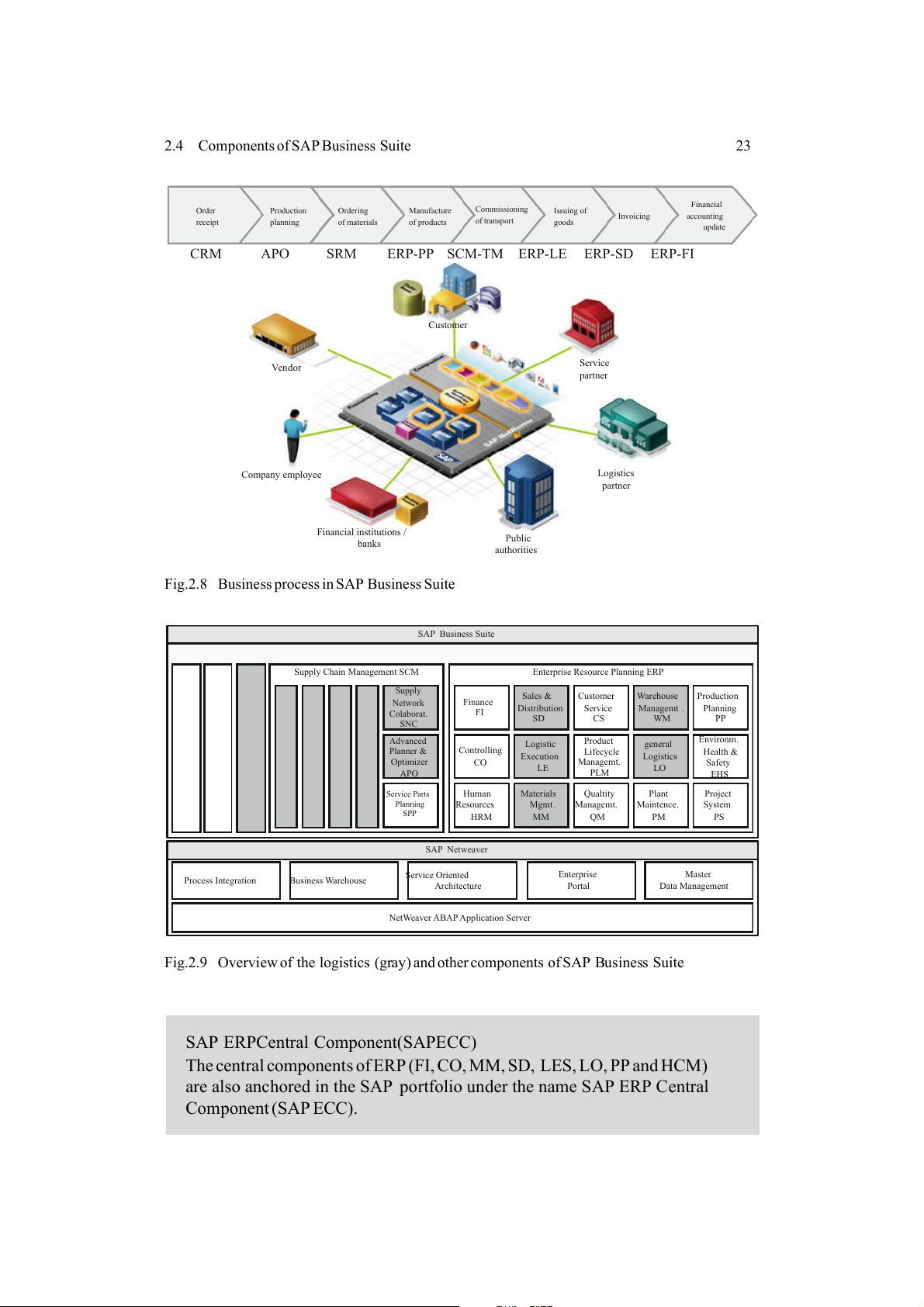
Figure 2.8 presents an example for such a business process (make-to-order).
SAP ERPprimarily consists of thecomponents FI(Finance),CO (Controlling),
MM(MaterialsManagement), SD(Sales andDistribution),LES (LogisticsExecu-
tion System), LO (Logistics), PP (Production Planning) and HCM (Human Capital
Management). Thesecomponentscommonly form thecorefunctionality utilized by SAP users.
2.4 Components of SAP Business Suite 23 Financial Order Production Ordering Manufacture Commissioning Issuing of Invoicing accounting receipt planning of materials of products of transport goods update CRM APO SRM ERP-PP SCM-TM ERP-LE ERP-SD ERP-FI Customer Service Vendor partner Company employee Logistics partner Financial institutions / Public banks authorities
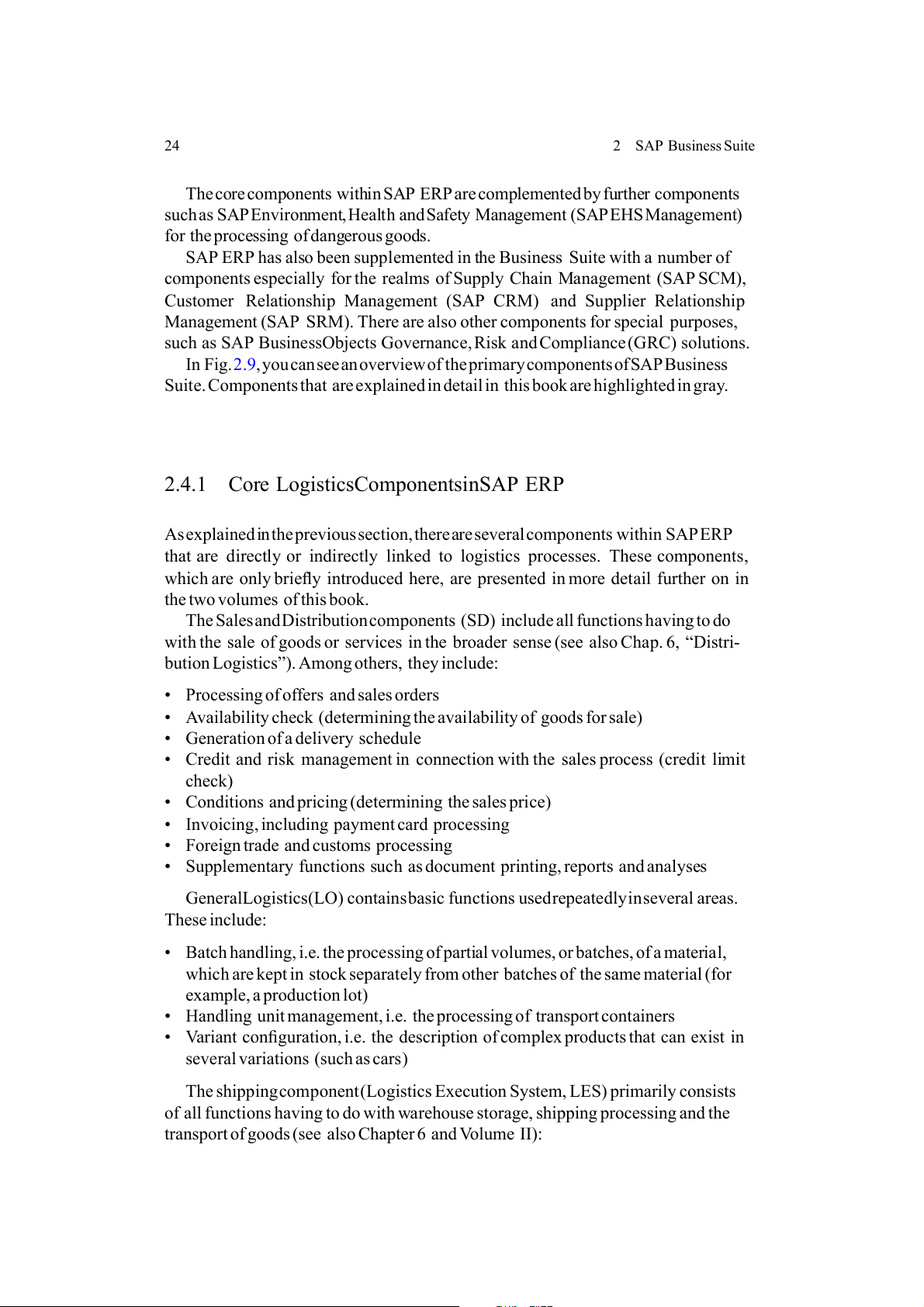
Fig.2.8 Business process in SAP Business Suite SAP Business Suite Supply Chain Management SCM
Enterprise Resource Planning ERP ent ent Supply Sales & Customer Warehouse Production t. Network Finance M II Distribution Service Managemt . Planning Colaborat. FI nagem nagem M SD CS WM PP SNC ent T ervices anagem ent E Advanced Environm. M M S M Logistic Product general R R T W Planner & Controlling Lifecycle Health & C S rade S G nagem E nagem Execution Logistics Optimizer CO Managemt. Safety LE LO elationship Ma Infrastructure A elationship Ma arehouse M APO PLM EHS loba T er R G vent Ma Service Parts E uto-ID Human Materials Qualtity Plant Project ransport Ma A Planning T Resources Mgmt . Managemt. Maintence. System ustom upplier R xtended W SPP C S E HRM MM QM PM PS SAP Netweaver Service Oriented Enterprise Master Process Integration Business Warehouse Architecture Portal Data Management
NetWeaver ABAP Application Server
Fig.2.9 Overview of the logistics (gray) and other components of SAP Business Suite
SAP ERPCentral Component(SAPECC)
The central components of ERP (FI, CO, MM, SD, LES, LO, PP and HCM)
are also anchored in the SAP portfolio under the name SAP ERP Central Component (SAP ECC). 24 2 SAP Business Suite
Thecorecomponents withinSAP ERParecomplementedbyfurther components
suchas SAPEnvironment,Health andSafety Management (SAPEHSManagement)
for the processing of dangerous goods.
SAP ERP has also been supplemented in the Business Suite with a number of
components especially for the realms of Supply Chain Management (SAP SCM),
Customer Relationship Management (SAP CRM) and Supplier Relationship
Management (SAP SRM). There are also other components for special purposes,
such as SAP BusinessObjects Governance,Risk andCompliance(GRC) solutions.
In Fig.2.9,youcanseeanoverviewof theprimarycomponentsofSAPBusiness
Suite. Components that are explained in detail in this book are highlighted in gray.
2.4.1 Core LogisticsComponentsinSAP ERP
Asexplainedintheprevioussection,thereareseveralcomponents within SAPERP
that are directly or indirectly linked to logistics processes. These components,
which are only briefly introduced here, are presented in more detail further on in the two volumes of this book.
The SalesandDistributioncomponents (SD) include all functions having to do
with the sale of goods or services in the broader sense (see also Chap. 6, “Distri-
bution Logistics”). Among others, they include:
• Processing of offers and sales orders
• Availability check (determining the availability of goods for sale)
• Generation of a delivery schedule
• Credit and risk management in connection with the sales process (credit limit check)
• Conditions and pricing (determining the sales price)
• Invoicing, including payment card processing
• Foreign trade and customs processing
• Supplementary functions such as document printing, reports and analyses
GeneralLogistics(LO) containsbasic functions usedrepeatedlyinseveral areas. These include:
• Batch handling, i.e. the processing of partial volumes, or batches, of a material,
which are kept in stock separately from other batches of the same material (for example, a production lot)
• Handling unit management, i.e. the processing of transport containers
• Variant configuration, i.e. the description of complex products that can exist in
several variations (such as cars)
The shippingcomponent(Logistics Execution System, LES) primarily consists
of all functions having to do with warehouse storage, shipping processing and the
transport of goods (see also Chapter 6 and Volume II):
2.4 Components of SAP Business Suite 25
• Goods receipt process for delivered goods
• Central and decentral warehouse management (Warehouse Management, WM)
with the optimization of procedures in the warehouse (Task and Resource
Management) and the management of yards (Yard Management)
• Shipping preparation, shipping document generation and the goods-issue
process for goods to be shipped out
• Transport preparation and processing, including freight charge calculation
• Delivery management for regular delivery routes from the distribution center
to various customers (Direct Store Delivery).
Materials Management (MM) focuses on products that must be managed,
procured or paid (see also Chap. 4 “Procurement Logistics”):
• Purchasing functions such as the processing of orders and order purchase requisitions
• Inventory management of materials, including materials evaluation for prepar-
ing the balance sheet and material price changes
• Invoice verification for received goods and service invoices
• Taking of inventory to determine and correct stock
• Material master data management
These four logistics components—SD, LO, LES and MM—are strongly inte-
grated within SAP ERP and thus enable effective logistics workflow.
2.4.2 OtherLogisticsComponentsinSAPERP
In addition to the central logistics components mentioned above, we would
alsolike to presentthosecomponents thathavea somewhat moreindirect connec-
tion to logistics. Further in this book, we will only discuss these components in passing:
• Production Planning and Control (Production Planning, PP) includes rough
sales and production planning, actual production planning including capacity
and requirements planning, production orders, kanban processing, make-to-
stock production, make-to-order production and assembly processing. It also
covers production planning for process industries.
• Maintenance(Enterprise Asset Management, EAM) deals with technical facili-
ties and equipment (plant, machines, vehicles, etc.) that have to be maintained
on a regular basis. It supports planned as well as unplanned maintenance and
repair measures. Mobile scenarios with hand-held devices are also available.
• Quality Management(QM) includes functions for quality planning, testing and
control, in addition to auditing management, the generation and maintenance of
quality certificates and the maintenance of test equipment. In the process, you
canmanageinspectionlots, recordtestresultsanderrors,and performsampling management tasks. 26 2 SAP Business Suite
• ProductLifecycleManagement (PLM) offersallfunctionsnecessaryforproduct
planning, design and its engineering tasks, product data distribution, the pro-
cessing of product and recipe data and the respective audits.
• With the Project System (PS), you can generate and administer projects. This
component allows you to manage project flow with its task structures and
scheduling, as well as project resources and costs.
• The components for the realm of Environment,HealthandSafetyManagement
(SAP EHS Management) provide a variety of functions within the context of
safety. Not only are product safety and hazardous materials management and
testing covered, but also waste management, job safety and industrial medicine.
• The components for CustomerService(CS) enable you to establish a customer
interfacewith an interaction center for other ERPcomponents(such asSalesand
Distribution, Service, and Maintenance) in order to facilitate the execution of
individual processes in cooperation with customer service representatives and customers themselves.
• SAP for Retail has a wide scope of retail-specific functions including, for
instance,point ofsale ordirect storedelivery.Inmanycases,theretailfunctions
are tailored to a very high turnover, since that is where a large number of
transactions in the sales and end-consumer area are carried out.
Allofthe componentscited enableeither anexpansionof logistics processesinto
neighboring application areas or a branch-specific shaping of logistics processes.
2.4.3 SAP SupplyChainManagement(SAPSCM)
SAP Supply Chain Management (SAP SCM) complements SAP ERP with impor-
tant components offering planning-based as well as execution-based functions for
logistics processes.The components mentionedonlybriefly herewillbe examined
in more detail in a subsequent chapter:
• SAP Extended Warehouse Management (SAP EWM) is the functionally very
extensive successor to the SAP ERP component Warehouse Management
(WM). It can be employed as a stand-alone system for complete warehouse
management,includingall contiguous processes (see alsoVolumeII, Chapter3,
“Warehouse Logistics and Inventory Management”).
• SAP Transportation Management (SAP TM) offers complete transportation
processing,fromorderacceptance, transportationplanning andsub-contracting,
to invoicing customers and service providers. It can be operated as a stand-alone
system and was also conceived for use by logistics service providers (see also
Volume II, Chapter 2, “Transport Logistics”).
• SAPEvent Management is a tool with which processes can be tracked in several
ways (such as transport tracking) and critical conditions in a process can be
2.4 Components of SAP Business Suite 27
actively determined and reported to users. SAP Event Management can be
configured and used for all status management and tracking tasks (see also
Volume II, Chapter 5, “Controlling and Reporting”).
• SAPAuto-IDInfrastructure (SAPAII)integratesRFIDtechnologyintobusiness
processes. It allows users to establish a bridge between RFID readers and
business processes in the application (see also Volume II, Chapter 5).
Another important component is SAP Advanced Planning &Optimization (SAP
APO). It offers a series of functional areas that focus on long- or medium-term
as well as operative planning in an enterprise:
• SupplyChainMonitoring serves to monitor the logistics chain.
• SupplyChainCollaboration enablescollaborationwithsuppliersandcustomers.
• Demand Planning(DP)allows medium-termplanning ofrequirements basedon
a prognosis for demand of your company’s products on the market.
• Supply Network Planning (SNP) integrates the areas of Procurement, Produc-
tion, Distribution and Transport. It thus enables tactical planning decisions and
those pertaining to procurement sources based on a global model.
• GlobalAvailabilityCheck(Available-to-Promise)(Global Available-to-Promise,
gATP) allows product-availability checks on a global basis. It also supports
product substitutions and place-of-delivery substitutions (see also Volume II, Chapter 2).
• Transportation Planning (Transportation Planning and Vehicle Scheduling,
TP/VS) enables optimal intermodal planning for incoming and outgoing deli-
veries. The actual transportation processing, however, takes place in ERP (see also Volume II, Chapter 2).
The optimization and planning functions of SAP APO can contribute greatly to
improving efficiency, especially in larger companies with divided logistics.
2.4.4 SAP CustomerRelationshipManagement (SAP CRM)
SAPCustomerRelationshipManagement (SAP CRM) is a comprehensive solution
tothe managementof yourcustomerrelationships. Itsupports allcustomer-oriented
business divisions, from marketing to sales to service, and even customer interac-
tion channels, such as the Interaction Center, the Internet and mobile clients.
2.4.5 SAP SupplierRelationshipManagement (SAP SRM)
SAPSupplier Relationship Management (SAP SRM) is a solution that enables the
strategic planning and central control of relationships between a company and its
suppliers. It allows very close connections between suppliers and the purchasing 28 2 SAP Business Suite
process of a firm, with the goal of making the procurement processes simpler and
more effective. SAP SRM supports processes such as ordering, source determi-
nation, the generation of invoices and credit memos, supplier qualification and Supplier Self-Services.
2.4.6 SAP BusinessObjects GlobalTradeServices
SAP BusinessObjects Global Trade Services is a subcomponent of SAP
BusinessObjects Governance, Risk and Compliance (GRC) Solutions. With SAP
BusinessObjects Global Trade Services, you can automate international trade
processes and manage business partners and documents while making sure that
your company is in observance of continually changing international laws. You
will find details on this component in Volume II, Chapter 4, “Trade Formalities—
Governance, Risk, Compliance”.
2.4.7 OtherNon-logisticsComponentsof SAPERP
Thefollowingcomponents arealso part of SAP ERP and,for the sakeof complete-
ness, will only be briefly mentioned below:
• Financing and Invoicing (FI) includes G/L accounting, accounts payable,
accounts receivable, bank accounting and assets accounting.
• Cost Accounting (Controlling, CO) provides components for general cost
accounting, product cost accounting, and profitability and market segment analysis, among other topics.
• Business Planning and Control (Strategic Enterprise Management, SEM)
supports such functions as business consolidation, business planning and simu-
lation and profit center accounting.
• Human Resources Management (Human Capital Management, HCM) enables
you to execute processes in the realms of human resources management, labor
time management, payroll accounting, event management, personnel develop- ment and cost planning.
In many cases, thesecomponentsserveas the financial backbone ofthelogistics
process. For instance, FI and CO are frequently the first components implemented
in an enterprise when the utilization of SAP logistics solutions is planned.
Tài liệu liên quan:
-
Giáo trình logistic về quản trị logistics
7 4 -

Chương 3 Đóng gói và vân chuyển - Mối quan hệ giữa đóng gói và vận chuyển trong logistics môn Logistics | Trường Đại học Kinh tế, Đại học Quốc gia Hà Nội
31 16 -
Yếu Tố: Các Quy Định Mà Tổ Chức Tuân Thủ môn logistics | Trường Đại học Kinh tế, Đại học Quốc gia Hà Nội
27 14 -
Mối liên hệ giữa Logistics và Vận tải đa phương thức môn Logistics | Trường Đại học Kinh tế, Đại học Quốc gia Hà Nội
38 19 -
E-Business & E-Commerce: Managing eCustomer Relationships | Logistics | Trường Đại học Kinh tế, Đại học Quốc gia Hà Nội
38 19