Chap 1 - Intro to Management môn Principle of Management | Trường Đại học Quốc tế, Đại học Quốc gia Thành phố Hồ Chí Minh
Organization: a group of people working together in a structured & coordinated fashion to achieve a set of goals. Tài liệu giúp bạn tham khảo, ôn tập và đạt kết quả cao. Mời đọc đón xem!
Môn: Principles of Management 314 tài liệu
Trường: Trường Đại học Quốc tế, Đại học Quốc gia Thành phố Hồ Chí Minh 2 K tài liệu
Tác giả:












Preview text:
Chap 1. Intro Management 1. Intro
Organization: a group of people working together in a structured & coordinated
fashion to achieve a set of goals.
Ex: Vinamilk, a hospital, a university
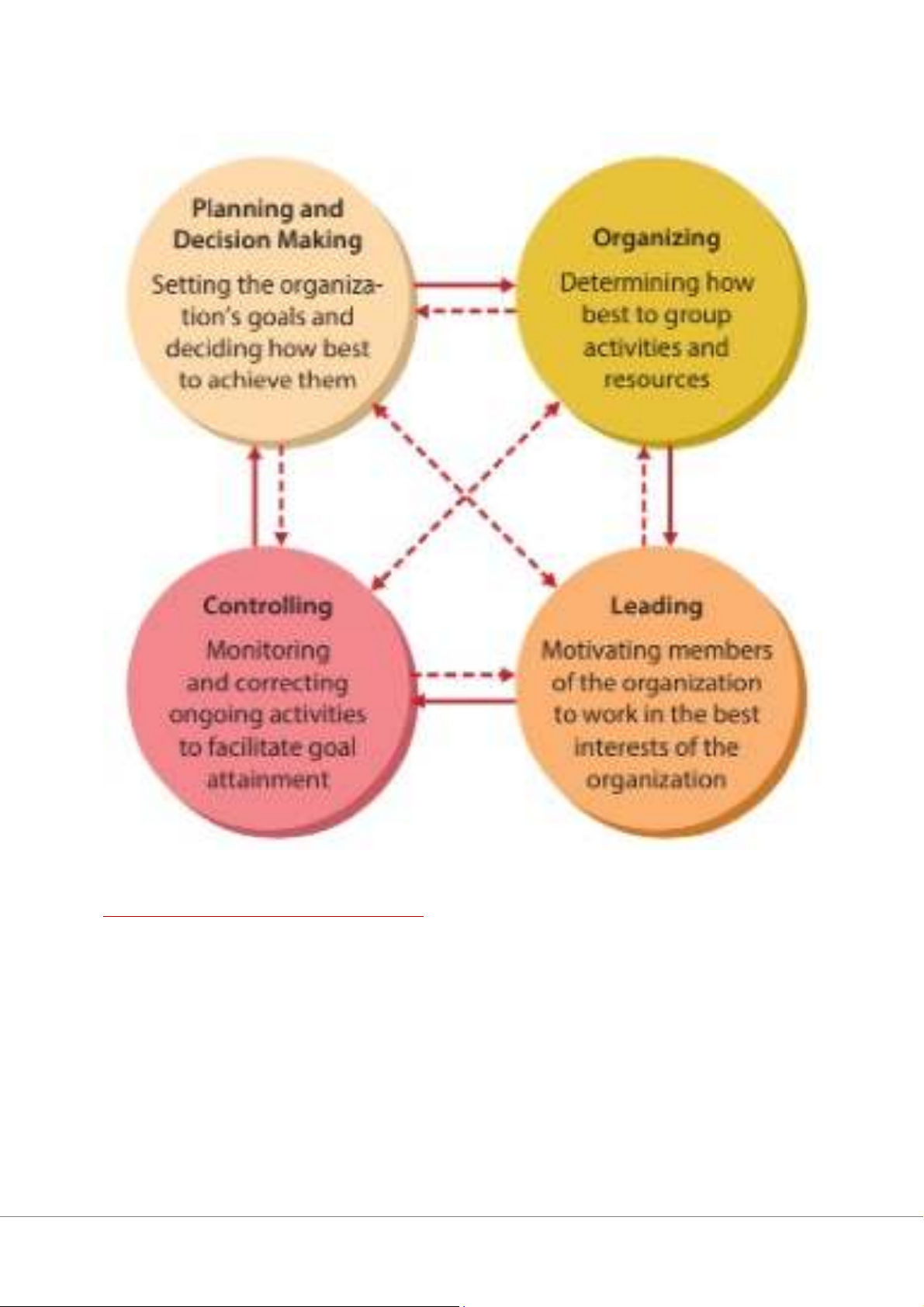
Management: a set of acts (including planning & decision making, organizing,
leading & controlling) directed at an organization’s resources (human, financial,
physical & information) wth the aim of achieving organizational goals in an
efficient and effective manner.
Ex: organizing employees into departments (HR, Marketing, Production)
Manager: someone whose primary responsibility is to carry out the management
process. The role of manager is to carry out organizational goals in an efficient & effective manner.
+ efficient: using resources wisely in a cost – effective way
+ effective: making the right decisions and successfully implementing them
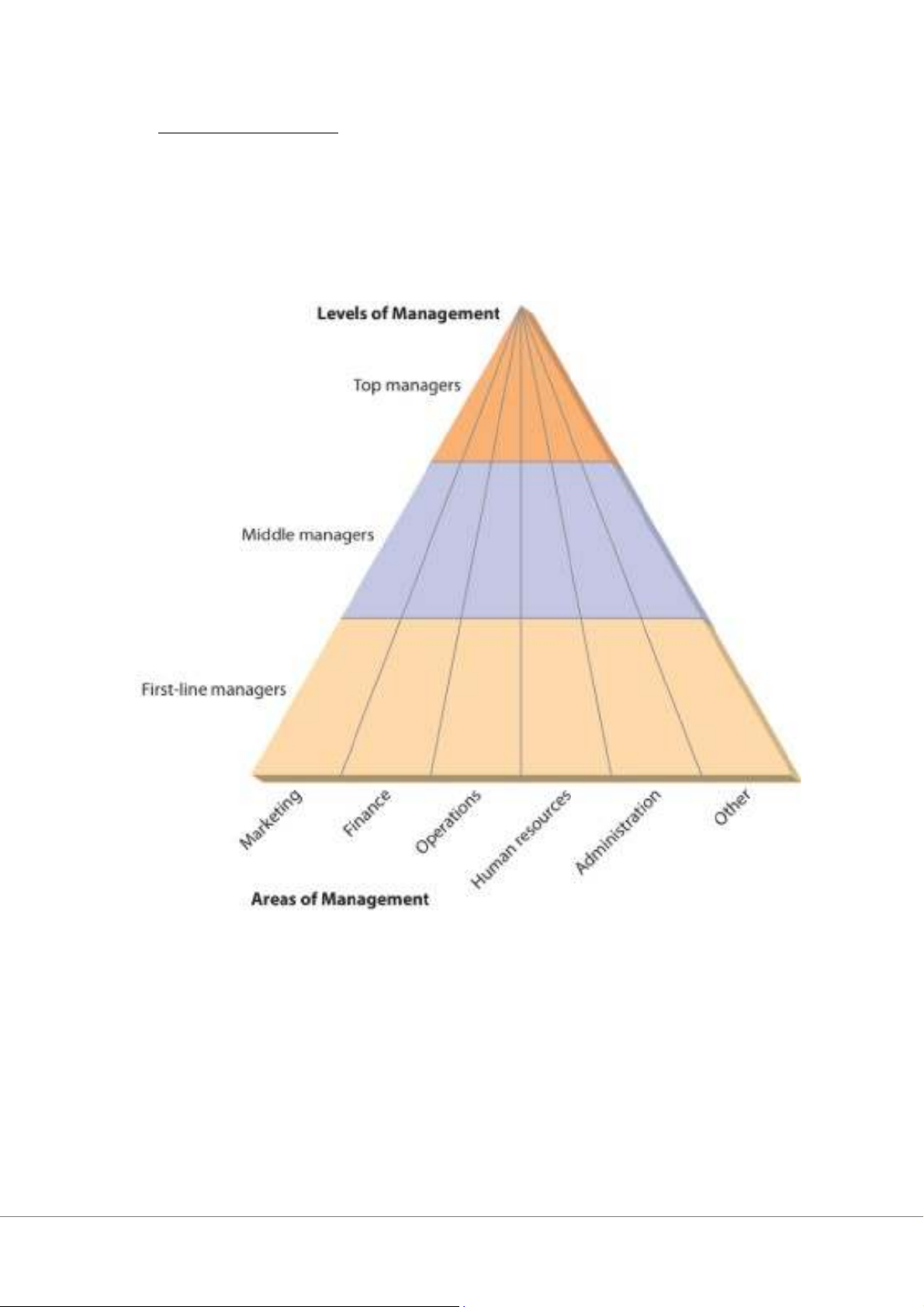
Ex: CEO, department manager, store manager a. Kinds of managers Levels of management: T
op managers => decide what to do
- Executives who manage the overall organization
- Create the organization’s goals, overall strategy & operating policies
Ex: CEO (Chief Executive Officer) of Vinamilk; president of a university, etc. Middle managers
=> decide how to do it
- Implement the policies & plans developed by top manager
- Supervise & coordinate the acts of lower-level managers
Ex: Marketing manager, HR manager, etc. First-line managers
=> make sure it gets done
- Supervise & coordinate the acts of operating employees
- Spend a large proportion of their time supervising the work of their subordinates
Ex: Sales supervisor in a retail store, etc.
b. Managing in different areas of the organization
Marketing managers: getting pp to buy products/services
Financial management: managing financial resources; accounting, cash management & investment.
Operations managers: producing goods/services
Human resource managers: Hiring & developing employees, recruiting,
training & development, compensation
Administrative managers: Generalist that have basic familiarity wth all functional areas of management
Specialist managers: Public relations, R&D and other unique areas.
2. Basic management functions
Planning: setting goals
Decision making: Part of the planning process that involves selecting a course of
action from a set of alternatives.
Organizing: arranging resources
Leading: motivating employees.
Controlling: monitoring performance.
3, Fundamental management skills
Technical skills: job-related skills (kỹ năng liên quan tới công việc)
Interpersonal skills: working wth pp
Conceptual skills: abstract thinking (tư duy trừu tượng)
Diagnostic skills: identifying probs
Communication skills: sending & revieving ìnormation
Decision-making skills: choosing solutions
Time management skills: prioritizing and delegating work (ưu tiên và phân công công việc)
The science of Management
The art of Management
Rational, systematic, objective
Intuition, experience and personal approach judgment
(cách tiếp cận hợp lý, có hệ thống và (trực giác, kinh nghiệm và khả năng khách quan) phán đoán cá nhân)
4, The importance of theory & history a, Why theory?
- A theory is a conceptual framework for organizing knowledge and providing a blueprint for action
- Management theories are grounded in reality
- Most managers develop and refine their own theories of how they should run
their organizations and manage the behavior of their employees. b, Why history?
- Understanding the historical context of management provides a
sense of heritage and can help managers avoid the mistakes of others.
5, The evaluation of management
- Most managers today recognize the importance of history and theory in their
work. For instance, knowing the origins of their organization and the kinds of
practices that have led to success—or failure—can be an indispensable tool in
managing the contemporary organization.
- The practice of management can be traced back thousands of years. In spite of
this history, the serious study of management did not begin until the nineteenth century.
a, The historical context of management
Robert Owen (1771-1858), a British industrialist and reformer. Recognized
the importance of an organization’s human resources & expressed concern
for the personal welfare of workers
Charles Babbage (1792-1871), an English mathematician. Focused on
efficiencies of production through division of labor & advocated the
application of mathematics to management probs.
b, The classical management perspective
- Early in the twentieth century, the preliminary ideas and writings of these and
other managers and theorists converged with the emergence and evolution of large-
scale businesses and management practices.
- The first important ideas to emerge are now called the classical management
perspective, which consists of two distinct branches: scientific management and administrative management.
- Scientific management: Concerned wth improving the performance of individuals workers
- Some of the earliest advocates of scientific management included Frederick W.
Taylor (1856–1915), Frank Gilbreth (1868–1924), Lillian Gilbreth (1878–1972), and Henry Gantt (1861–1919).
Frederick W. Taylor (1856–1915) => scientific management, efficiency of workers
- replaced old work method wth scientifically based work methods
- eliminated “soldering”, where employees deliberately worked at a pace slower than their capabilities
- studied & redesigned jobs, introduced rest periods to reduce fatigue &
implemented picework pay systems
- Administrative management: Focuses on managing the total organization.
- The primary contributors to administrative management were Henri Fayol
(1841–1925), Lyndall Urwick (1891–1983), and Max Weber (1864–1920).
Henri Fayol (1841–1925): identified the specific management functions of
process (planning, organizing, leading and controlling)
Lyndall Urwick (1891–1983): integrated scientific management wth the
work of other administrative management theorists
Max Weber (1864–1920): his theory of bureaucracy is based on a rational
set of guidelines for structuring organizations in the most efficient manner - Contributions:
+ many management techniques and approaches that are still relevant today.
+ focused attention on management as a meaningful field of study - Limitations:
+ more appropriate for use in stable, simple organizations rather than the
changing and complex organizations of today
+ proposed universal guidelines that do not fit every organization
+ slighted the role of the individual in organizations
c, The behavioral management perspective
- Even though many early writers recognized the role of individuals, their focus
tended to be on how managers could control and standardize the behavior of their employees.
- In contrast, the behavioral management perspective placed much more
emphasis on individual attitudes, behaviors and group processes and recognized
the importance of behavioral processes in the workplace.
Hugo Munsterberg (1863-1916): advocated applying psychological
concepts to employee selection & motivation
Mary Parker Follet (1868-1933): recognized the importance of human behavior in the workplace
The Hawthorne Studies (1927-1932):
+ a series of studies conducted near Chicago at Western Electric’s Hawthorne plant
+ the research, originally spondored by General Electric, was conducted by Elton Mayo and his associates.
- Illumination study: lighting adjustments affected the productivity of both
control and experimental groups of employees - Group study:
+ a piecework incentive pay plan caused workers to establish informal levels of individual output.
+ overproducing workers were labeled “rate busters”
+ underproducing workers were considered “chiselers”
- Interview program: confirmed the importance of human behavior in the workplace.
- The human relations movement proposed that workers respond primarily to the
social context of the workplace, including social conditioning, group norms, and interpersonal dynamics.
- A basic assumption of the human relations movement was that the manager’s
concern for workers would lead to increased satisfaction, which would in turn
result in improved performance.
- Two writers who helped advance the human relations movement were Abraham
Maslow (1908–1970) and Douglas McGregor (1906–1964).
Abraham Maslow (1908–1970): advanced a theory suggesting that
employees are motivated by a hierarchy of needs that they seek to satisfy
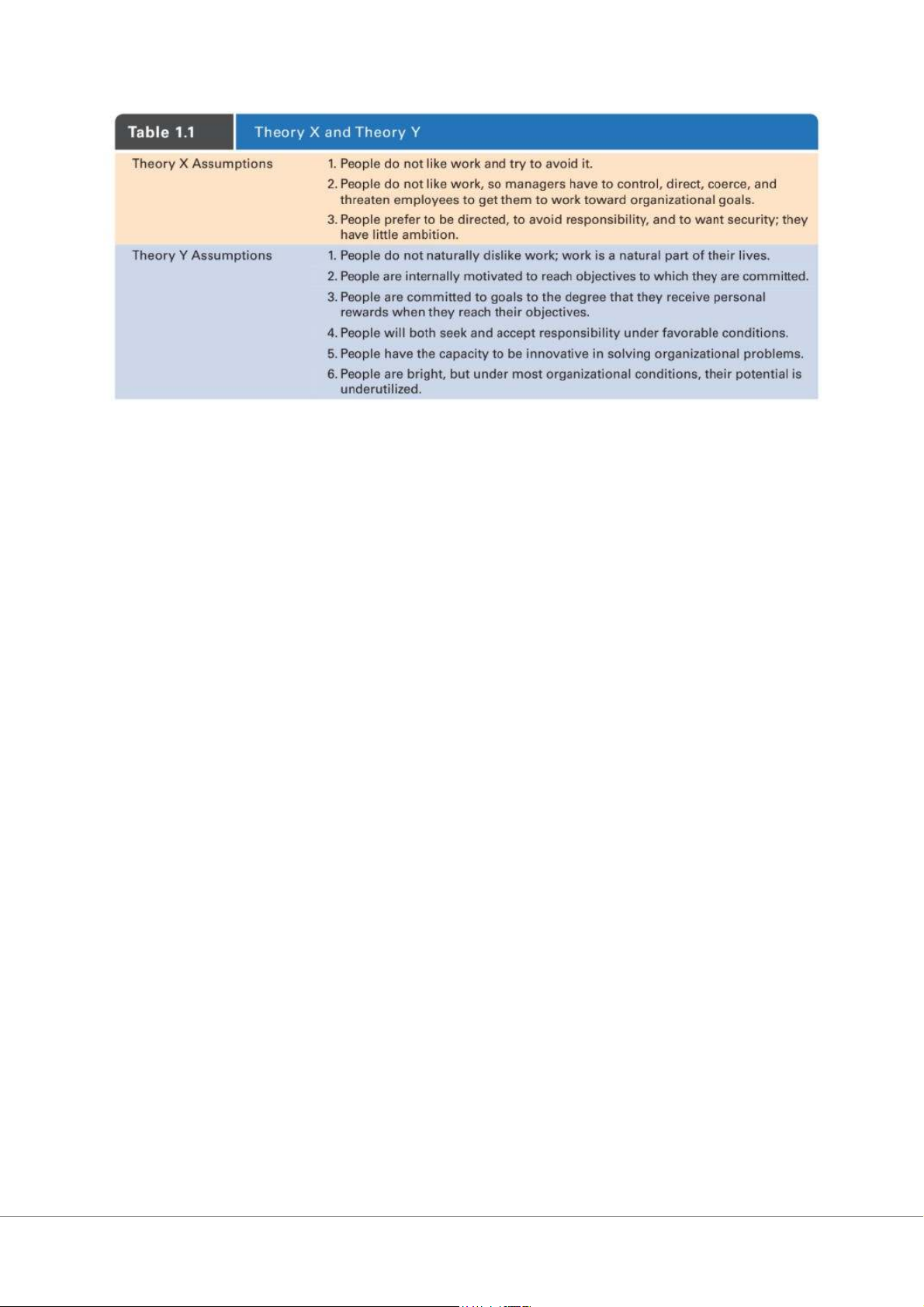
Douglas McGregor (1906–1964): proposed Theory X 7 Y concepts of
managerial beliefs about people and work
oTheory X: a pessimistic and negative view of workers and is
consistent with the views of scientific management.
oTheory Y: a positive view of workers, it represents the assumptions
made by human relations advocates make
Theory X and Theory Y is one
- Current behavioral perspectives on management, known as organizational
behavior, acknowledge that human behavior in organizations is much more
complex than the human relationists realized.
- Organizational behavior takes a holistic view of behavior and addresses
individual, group, and organization processes. These processes are major elements
in contemporary management theory.
- Important topics in this field include: + job satisfaction + stress + motivation + leadership + group dynamics + organizational politics + interpersonal conflict
+ the structure and design of organizations - Contributions:
+ the importance of behavioral process are more likely to be recognized by managers
+ managers are more likely to view employees as valuable resources instead of mere tools - Limitations:
+ the complexity of individuals makes behavior difficult to predict
+ it not always accepted/understood by practicing managers.
d, The quantitative management perspective
Quantitative management perspective:
+ applies quantitative technique to management
+ helped Allied forces manage logistical probs during World War II
+ focuses on decision making, cost-effectiveness, mathematical models and
use of computers to solve quantitative probs.
6, Contemporary management perspectives
- It is important to recognize that the classical, behavioral, and quantitative
approaches to management are not necessarily contradictory or mutually exclusive.
Even though each of the three perspectives makes very different assumptions and
predictions and focuses on different things, each can also complement the others.
- Indeed, a complete understanding of management requires an appreciation of all
three perspectives. The systems and contingency perspectives can help us integrate
these earlier approaches and enlarge our understanding of all three.
a, The systems perspective
System: an interrelated set of elements functioning as a whole. Includes
inputs, transformation, processes, outputs and feedback
Open system: an organizational system that interacts wth its environment
Closed system: a system that does not interact wth its environment.
Subsystems: a system within another system, such as the relationship btw
marketing, productions and finance function Aspect Classical Behavioral Focus + Organization structure
+ People, behavior, attitudes and
+ Efficiency, productivity and motivation discipline
+ Personal & group relationships + Work & process are more within an organization important than pp
View of employees + Humans are viewed as tools/labor + Human beings are a valuable
+ Workers are employed primarily resource for the salary
+ Work is not just for money, but also
for social & psychological needs Main content + Scientific management + Human relations movement + Administrative management
+ Motivation, leadership and group + Bureaucracy dynamics + Organizational behavior Representative + Frederick W. Taylor
+ Elton Mayo (Hawthorne Studies) + Henri Fayol + Abraham Maslow + Max Weber
+ Douglas McGregor (Theory X, Y) Advans
+ Increase productivity & efficiency
+ Increase job satisfaction and
+ Laying the foundation for modern motivation governance
+ Improves long-term morale and performance Limitation
+ Little attention is paid to human
+ Human behavior is complex and needs and emotions difficult to predict + Suitable for stable, simple
+ Difficult to apply uniformly across organization all organizations
In 7 skills, each level of management has 3 skills that are necessary, and why do you think so?
We have 3 levels of management: first-line managers, middle managers and top managers. -First-line managers:
+ Technical skills: b/c first-line managers work directly wth
employees and must understand specific tasks and work procedures.
+ Interpersonal skills: they need to motivate employees, handle
conflicts, and maintain good working relationships.
+ Communication skills: they must clearly communicate instructions
from top management and report performance back -Middle managers:
+ Conceptual skills: middle managers need to understand
organizational goals and translate strategies into departmental plans.
+ Decision-making skills: they frequently choose among alternatives
to solve problems and implement policies.
+ Interpersonal skills: they coordinate with both top managers and
first-line managers across departments. -Top managers:
+ Conceptual skills: top managers must see the organization as a
whole and understand the relationship between the organization and its environment.
+ Decision-making skills: they make strategic decisions that affect the entire organization.
+ Time management skills: they must prioritize important tasks and
delegate effectively due to heavy workloads.
Tài liệu liên quan:
-

CHAP 1: Introduction to Management Concepts and Functions môn Principles of Management | Trường Đại học Quốc tế, Đại học Quốc gia Thành phố Hồ Chí Minh
1 1 -
Guidelines for group’s assignments: Analysing management issues of a FDI company based inVietnam môn Principles of Management | Trường Đại học Quốc tế, Đại học Quốc gia Thành phố Hồ Chí Minh
1 1 -
Financial Planning to Achieve 300m VND Goal in 3 Years môn Principles of Management | Trường Đại học Quốc tế, Đại học Quốc gia Thành phố Hồ Chí Minh
1 1 -
A Case Study in Fast Fashion Success môn Principles of Management | Trường Đại học Quốc tế, Đại học Quốc gia Thành phố Hồ Chí Minh
1 1 -
Chap 16 Hierarchy of Needs Theory and Applications môn Principles of Management | Trường Đại học Quốc tế, Đại học Quốc gia Thành phố Hồ Chí Minh
1 1