Chap 16 Motivation Theories and Job Design môn Principles of Management | Trường Đại học Quốc tế, Đại học Quốc gia Thành phố Hồ Chí Minh
Motivationare forces within one-self that responsible for thepersisten ce of effort expended at work. Tài liệu giúp bạn tham khảo, ôn tập và đạt kết quả cao. Mời đọc đón xem!
Môn: Principles of Management 314 tài liệu
Trường: Trường Đại học Quốc tế, Đại học Quốc gia Thành phố Hồ Chí Minh 2 K tài liệu
Tác giả:







Preview text:
Chap 16: Motivation I. Motivation and need
Motivation are forces within one-self that responsible for the persisten ce of effort expended at work.
A highly motivated person works hard at a job while an unmotivated pers on does not.
One of the most important managerial responsibilities is to create conditi
ons under which others feel constantly inspired to work hard
1. Maslow’s hierarchy of needs
Maslow’s is used to meet employee’s needs. Self- actualization needs
are served by creative and challenging work, and job autonomy; Esteem n
eeds are served by respect, responsibility and recognition. Social, safety,
and physiological needs are served with the work environment, such as p
ositive interactions, compensation and benefits.
Maslow uses two principles to describe how these needs affect human behavior:
The deficit principle states that a satisfied need is not a motivator of behavior.
‒People are expected to act in ways that satisfy needs, for which a “deficit” exists.
The progression principle states that the need at one level does
not become activated until the next-lower-level need is satisfied.
‒People are expected to advance step by step up the hierarchy.
‒This progression principle ends at the level of self-actualization.
According to the theory, the need to self-actualize can never be fully met.
The more the needs for self-actualization are satisfied, the stronger they are supposed to grow.
2. ERG theory (by Clayton Alderfer):
a. Existence needs: the desires for physiological and material well-being.
b. Relatedness needs: the desires for satisfying interpersonal relationships.
c. Growth needs: the desires for psychological growth.
ERG theory suggests the various needs can influence behavior at any given ti me.
It applies the frustration-regression principle, a satisfied need can influen
ce behavior when a higher-level need cannot be satisfied.
‒Workers who are stuck in repetitive jobs that offer limited opportunities fo
r promotion will be frustrated trying to satisfy Growth needs. Their respon
se is to refocus attention on getting better work conditions and benefits to
further fulfill their Existence needs.
‒Existence and relatedness needs are similar to the lower-order needs in Maslow’s hierarchy.
‒Growth needs are essentially the higher-order needs in Maslow’s hierarchy.
‒ERG theory doesn’t accept the progression principle: needs can
influence individual behavior at any given time.
3. Two-factor theory-Herzberg : These two factors affect people in differ ent ways.
a. Satisfier factors: factors that motivate staff to work. They are linked
with job satisfaction. They are found in the job content, like job challenge, r
ecognition for work, a sense of responsibility, the opportunity for advancem ent and growth.
→ Making improvements in these factors can make people more motiv ated.
b. Hygiene factors: factors that demotivate staff to work. They are linked
with job dissatisfaction. That is, job dissatisfaction goes up as hygiene qualit
y goes down. Hygiene factors are found in the job environment, like workin
g conditions, interpersonal relations, organizational policies and administra tion, and compensation.
→ Making improvements in these factors can make people less dissatisfied at work.
4. Acquired needs theory-David McClelland
‒People acquire needs over time as a result of life experiences.
‒Each need can be linked with a distinct set of work preferences.
→ Managers to understand these needs to create work environments respon sive to them.
→ The successful management is likely to possess a high need for social pow
er that is greater than a strong need for affiliation.
a. Need for achievement: the desire to do something better, to solve probl
ems, or to master a task. People with a high need for achievement like to pu
t their competencies to work; they take moderate risks in order to achieve the goals.
‒The work preferences: individual responsibility, achievable but challengin
g goals, and feedback on performance.
b. Need for power: the desire to control other people, to influence their beh
avior or to be responsible for them. People with a high need for power are
motivated to behave in ways that have a clear impact.
‒The work preferences: being in control and being recognized for this respo nsibility.
‒The need for personal power is exploitative and involves manipulation for
the pure sake of personal gratification.
‒The need for social power involves the use of power in a socially responsib
le way, that is directed toward group objectives rather than personal gains.
c. Need for affiliation: the desire to establish and maintain friendly relations
with others. People with a high need for affiliation seek social approval and
satisfying interpersonal relationships.
‒The work preferences: working with people and offer opportunities for soc ial approval.
‒The need for affiliation limits someone’s ability to make decisions → ma
nagerial effectiveness gets lost. II.
Process Theories of Motivation
‒How people make choices to work hard or not ‒Choices are based on: Individual preferences Available rewards Possible work outcomes
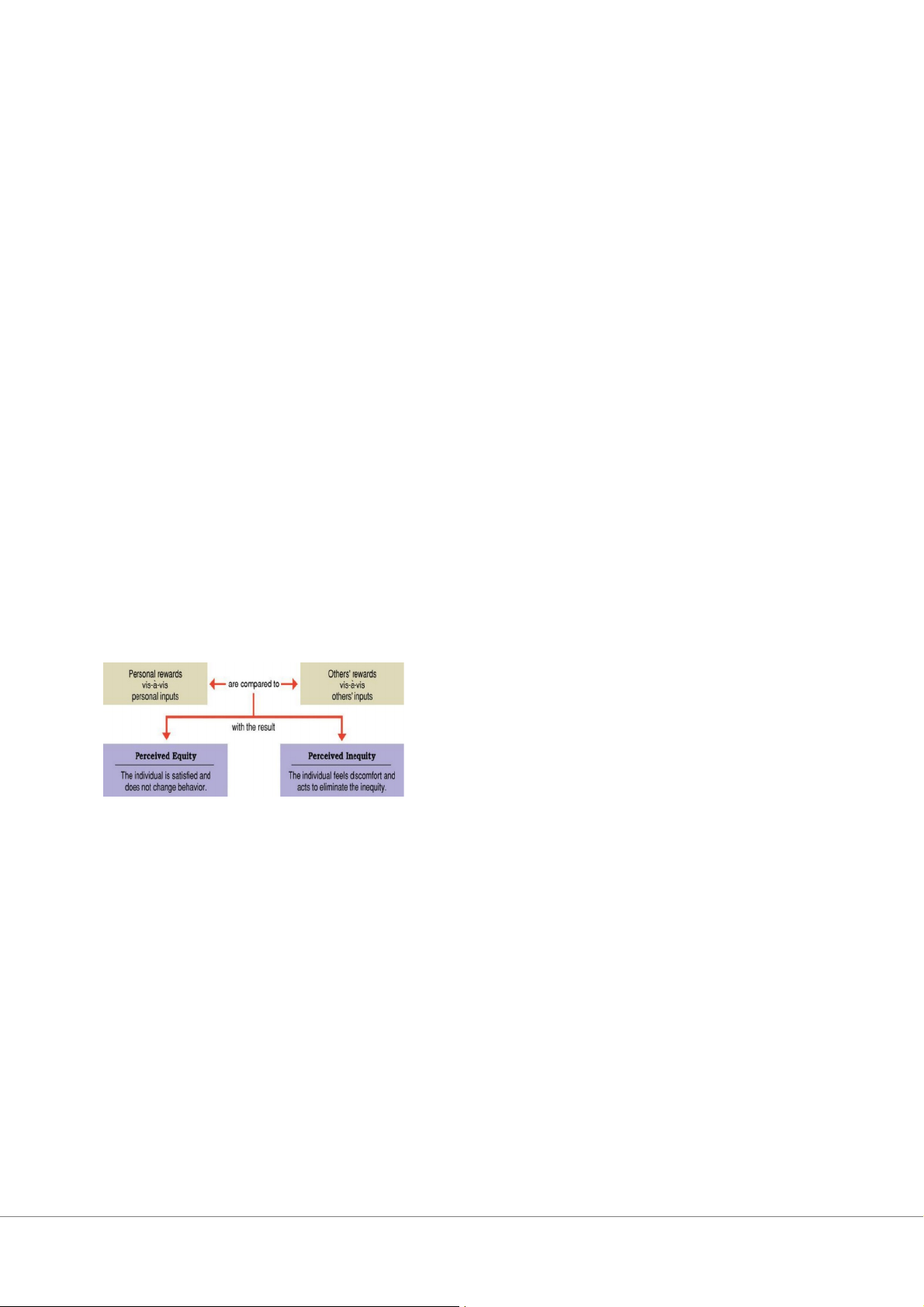
1. Equity Theory by Stacy Adam: The theory suggests that being unfairly
treated makes people uncomfortable. Then, they are likely to be motivated to
eliminate the discomfort and restore a sense of perceived equity. → They are
motivated to eliminate the discomfort and restore a sense of perceived equity t o the situation.
Equity and Social Comparison
People compare their outcomes-to-inputs ratio to the outcomes-
to-inputs ratio of another person (a referent).
Outcomes are what an individual receives from work (pay,
benefits, job security, advancement opportunities, interesting work experiences).
Inputs are the qualifications an individual possesses and the
contribution (education, experience, special skills and training,
the quality and quantity of work completed, and a positive attitude and loyalty).
Equity comparisons can result in “Perceived inequities” and “Perceived equities”
Equity Dynamics: 2 types of inequity:
‒Over-reward (or positive) inequity occurs when an individual
perceives that he or she is receiving more than what is fair. → Benevolents
‒Under-reward (or negative) inequity occurs when an individual
perceives that he or she is receiving less than what is fair. → Entitleds
A key point in the equity theory is that people behave according to their perceptions.
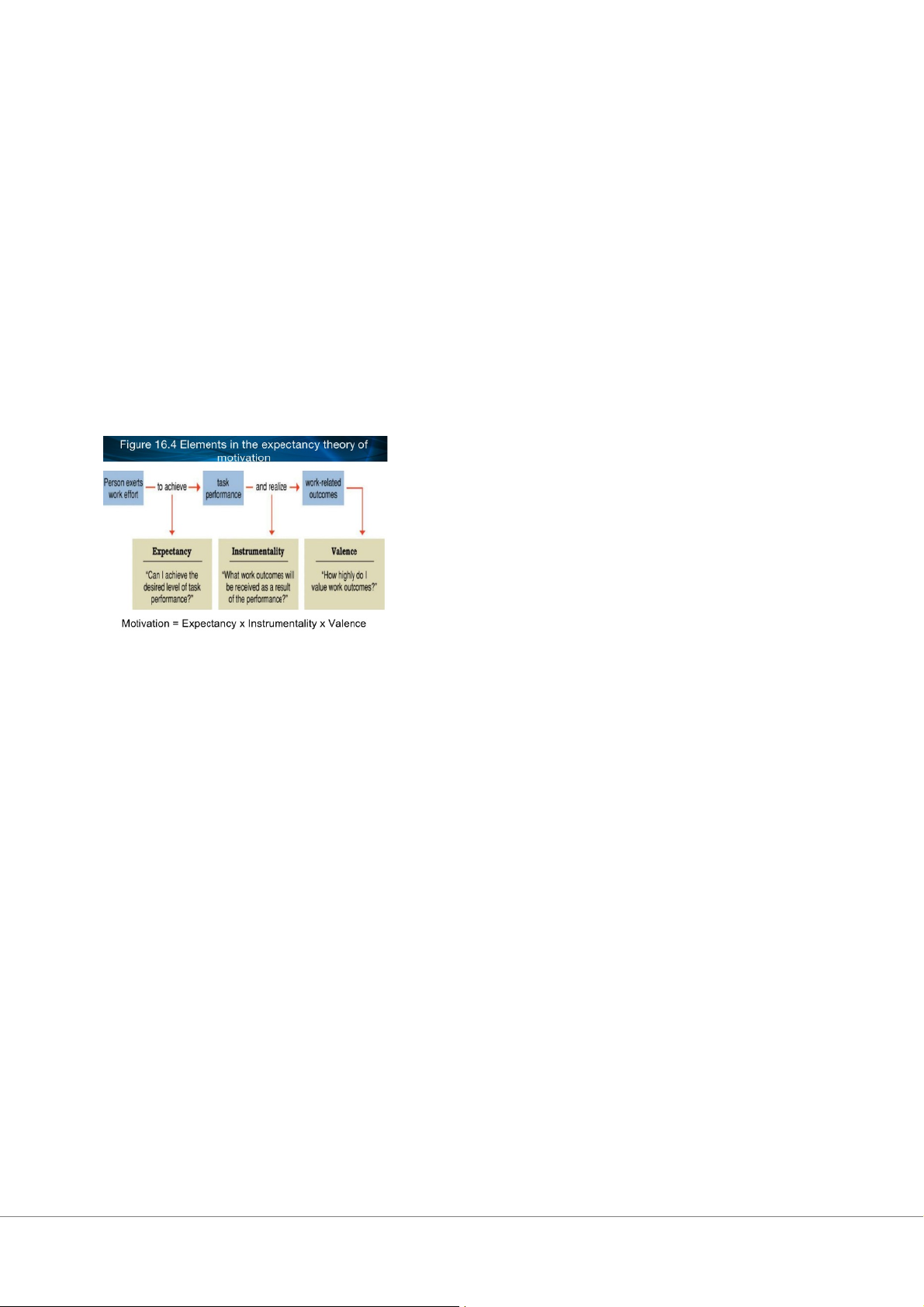
2. Expectancy theory- Victor Vroom: What determines the
willingness of an individual to work hard at tasks important to the
organization? → motivation depends on the relationships between three expectancy factors:
a. Expectancy—a belief that working hard will result in a desired performa
nce being achieved (effort-performance expectancy).
b. Instrumentality—a belief that successful performance will be followed
by rewards and other work-related outcomes (performance-outcome ex pectancy).
c. Valence—the value a person perceive the possible rewards and other w ork-related outcomes
In expectancy theory, motivation (M), expectancy (E), instrumentality (I), and valenc
e (V) are related to one another in a multiplicative fashion: M = E x I x V.
Managerial implications of expectancy theory
‒To Maximize expectancy requires belief in abilities and performance. Manage
rs can foster positive expectancies by selecting suitable workers, providing tr
aining and development, and providing necessary resources.
‒To maximize instrumentality, managers should establish a connection bet
ween performance and work outcomes by clearly outlining high performance
rewards and allocating them fairly and performance-contingently.
‒To maximize valence, high performance outcomes are highly valued by ind
ividuals, and managers can enhance communication with subordinates to id entify crucial employee needs.
3. Goal-setting theory- Edwin Locke
‒Motivations are created through the goals we set for ourselves. Task goals
can be highly motivating if they are properly set and well managed.
‒Motivational effects of task goals: provide direction to people in
their work, clarify performance expectations, establish a frame of
reference for feedback, provide a foundation for behavioral self- management
‒How to set highly motivated goal: set specific goals, set
challenging goals: realistic and attainable, build goal acceptance
and commitment, clarify goal priorities: expectations are clear as to
which goals should be accomplished first, why, provide feedback on
goal accomplishment: people know how well they are doing with
respect to goal accomplishment, reward goal accomplishment:
reward people for doing what they set out to do
4. Self-Efficacy Theory- Albert Bandura
‒Self-efficacy refers to a belief that she or he can perform a specific task.
When people believe themselves to be capable, they will set higher goals f
or themselves, be more motivated to work hard at these goals.
‒There is a link between self-efficacy theory elements of expectancy theory a nd goal-setting theory.
With respect to expectancy theory, a person with higher self-efficacy wil
l have greater expectancy that he or she can achieve a high level of task performance.
With respect to goal-setting theory, a person with higher self-efficacy is
more willing to set challenging goals.
In terms of expectancy and goal setting, managers who help create feeli
ngs of self-efficacy in others should boost their motivation to work. III. Reinforcement Theory
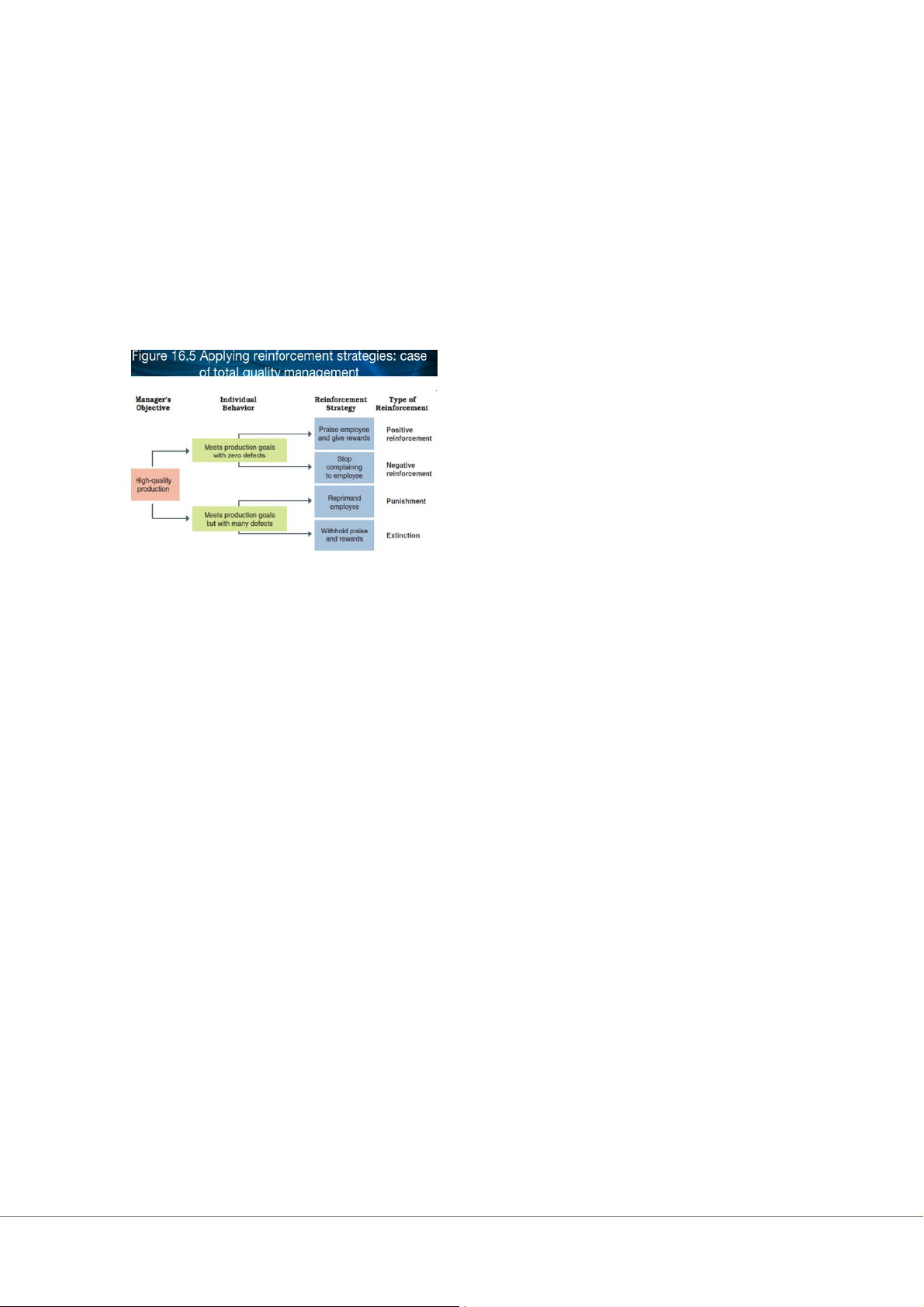
Reinforcement theory considers behavior is influenced by external environmenta l consequences.
The basic (fundamental) premises of reinforcement theory are based on the law of
effect - behavior that results in a pleasant outcome is likely to be repeated.
Operant conditioning is the control of behavior by manipulating its consequences.
Positive reinforcement increases the frequency of desirable behavior by making a pleasant outcome.
Negative reinforcement increases the frequency of desirable behavior, but
by making the avoidance of an unpleasant outcome.
Punishment decreases undesirable behavior by making an unpleasant cons equence.
Extinction decreases the frequency of undesirable behavior, by making the r
emoval of a pleasant consequence.
-Positive and negative reinforcement strategies strengthen desirable behavior.
-Punishment and extinction strategies weaken or eliminate undesirable behav iors. IV.
Motivation and Job Design
‒Job design is the process of arranging tasks for individuals and groups so tha
t satisfaction and performance “fit” between task requirements and peopl
e’s needs. The alternatives range from job simplification to job enrichment.
‒Job simplification standardizes work procedures and employs people in wel l- defined tasks.
The logic of job simplification is :Because the jobs don’t require complex skills, wo
rkers should be easier and quicker to train, less difficult to supervise, and easy to re place if they leave.
=>The structured and repetitive tasks can cause productivity to go down
(unhappy workers do poor work), costs to go up (lack of satisfaction causes absenteeism and turnover).
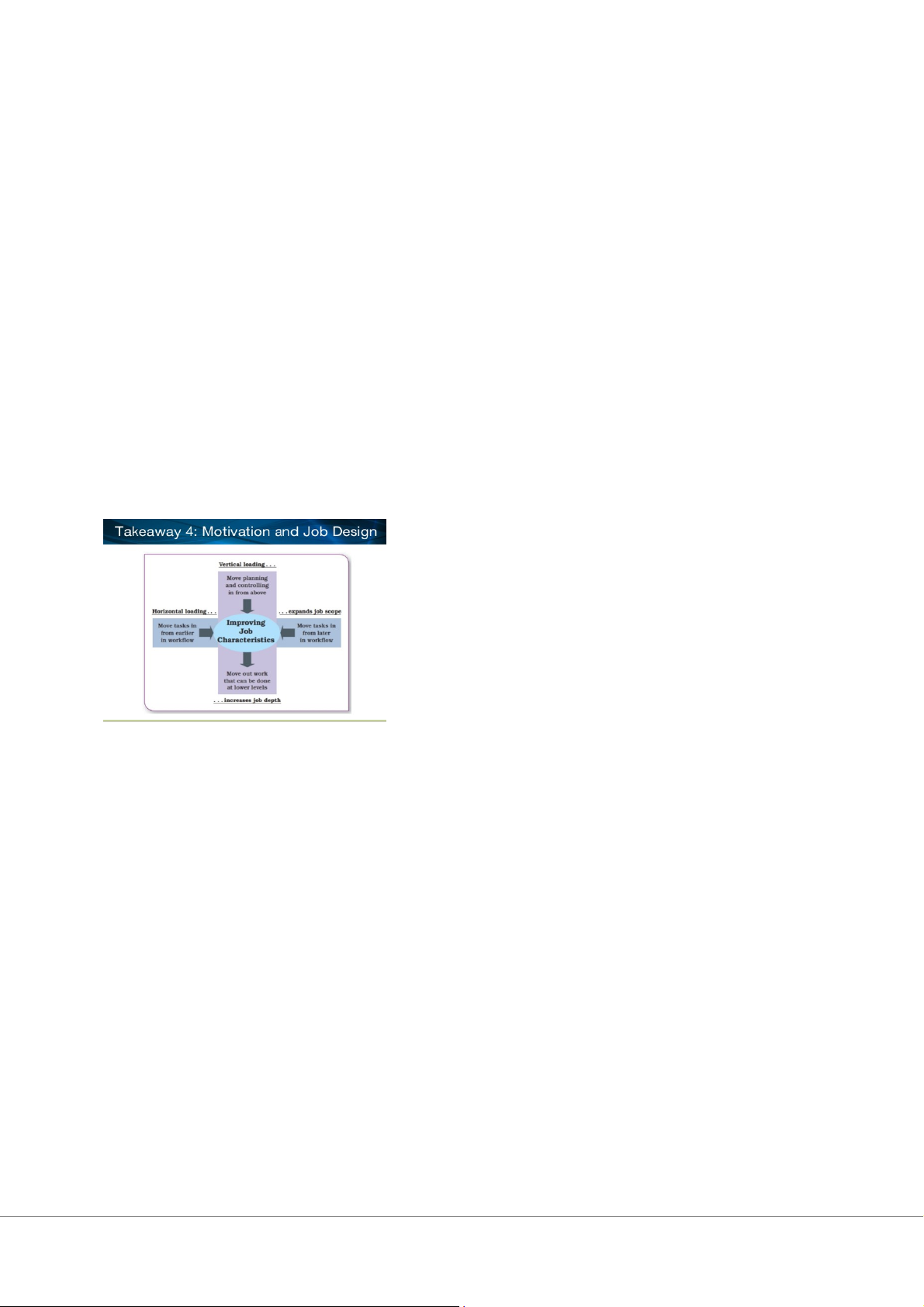
‒Job rotation gives workers more variety by shifting them between jobs. → V ertical loading.
‒Job enlargement combines into one job two or more tasks. → Horizontal lo ading
‒Job enrichment expands job content and increases duties, giving employee
s more responsibilities. → Vertical loading.
‒Automation: the total mechanization of a job, where robots are being
used to perform tasks previously done by humans.
‒Job characteristic model: focuses on the extent to which these five
characteristics are present or absent in a job:
1. Skill variety: the degree to which a job requires a variety of different
activities to carry out the work.
2. Task identity: the degree to which the job requires completion of a
“whole” and identifiable piece of work.
3. Task significance: the degree to which the job has a substantial impact on the lives or work of others.
4. Autonomy: the degree to which the job gives the individual freedom, independence, and discretion.
5. Feedback from the job itself: the degree to which work activities result in
individual obtaining clear information on their performance.
‒Alternative Work Schedules: ‒Flexible working hours
Any work schedule that gives employees some choice in the pattern of their d aily work hours
Core time — all employees must be at work
Flextime — allows employees to schedule around personal and family respon sibilities
A compressed workweek allows a full-time job to be completed in less than fi ve days. ‒Job sharing
One full-time job is split between two or more persons
Potential advantages of job sharing: organizations benefit by employing tale
nted people who are unable/unwilling to commit full-time ‒Telecommuting
A work arrangement that allows a portion of scheduled work hours to be com pleted outside of the office Hoteling Virtual offices
Tài liệu liên quan:
-

CHAP 1: Introduction to Management Concepts and Functions môn Principles of Management | Trường Đại học Quốc tế, Đại học Quốc gia Thành phố Hồ Chí Minh
19 10 -

Guidelines for group’s assignments: Analysing management issues of a FDI company based inVietnam môn Principles of Management | Trường Đại học Quốc tế, Đại học Quốc gia Thành phố Hồ Chí Minh
17 9 -
Financial Planning to Achieve 300m VND Goal in 3 Years môn Principles of Management | Trường Đại học Quốc tế, Đại học Quốc gia Thành phố Hồ Chí Minh
17 9 -

A Case Study in Fast Fashion Success môn Principles of Management | Trường Đại học Quốc tế, Đại học Quốc gia Thành phố Hồ Chí Minh
16 8 -

Chap 16 Hierarchy of Needs Theory and Applications môn Principles of Management | Trường Đại học Quốc tế, Đại học Quốc gia Thành phố Hồ Chí Minh
17 9