Chap 9 Understanding Control Mechanisms môn Principle of Management | Trường Đại học Quốc tế, Đại học Quốc gia Thành phố Hồ Chí Minh
DEFINITION: Controlling is the process of evaluating performance and implementing measures to achieve intended outcomes.Controlling ensures that activities are executed correctly, efficiently. Tài liệu giúp bạn tham khảo, ôn tập và đạt kết quả cao. Mời đọc đón xem!
Môn: Principles of Management 314 tài liệu
Trường: Trường Đại học Quốc tế, Đại học Quốc gia Thành phố Hồ Chí Minh 2 K tài liệu
Tác giả:






Preview text:
CHAP 9 -
DEFINITION: Controlling is the process of evaluating performance and implementing
measures to achieve intended outcomes.Controlling ensures that activities are
executed correctly, efficiently, and at the appropriate time. It plays a vital role in
aligning performance with established plans while coordinating organizational
achievements in a goal-oriented manner. Additionally, it ensures adherence to
organizational policies and procedures. -
BENEFIT: One significant advantage of effective control is fostering organizational
learning. For instance, the after-action review process, initially developed by the U.S.
The Army, has been widely adopted in various corporate environments.
=> EXAMPLE: A hospital uses a control system to monitor the response time of medical
teams during emergency situations. After each case, they hold evaluation meetings to
identify lessons learned and refine their procedures. This not only ensures operations align
with plans but also fosters organizational learning, enhancing the overall quality of care. -
EXPLAIN: Figure 9.1 illustrates the role of controlling within the broader framework
of management functions. Planning establishes objectives and allocates necessary
resources. Organizing integrates human and material resources into effective
working arrangements. Leading motivates individuals to maximize the use of these
resources. Controlling ensures that tasks are performed correctly, efficiently, and at
the appropriate time. It aligns performance with predefined plans, coordinates
organizational achievements toward desired goals, and ensures compliance with
established policies and procedures. TYPE OF CONTROLS -
FEEDFORWARD CONTROL: DEFINITION: Feedforward control ensures that plans
are properly set and resources are appropriately allocated prior to the
commencement of work. They ensure that goals are well-defined, appropriate
guidelines are set, and adequate resources are allocated to achieve the desired
outcomes. GOAL: The primary objective is to prevent issues from arising by
addressing a crucial yet frequently overlooked question: "What preparations are
necessary before initiating the work?"
=> EXAMPLE: At McDonald’s, preliminary control over food ingredients is a crucial
component of its quality management program. The company mandates that its suppliers of
hamburger buns adhere to precise standards, including factors such as texture and color
consistency. Additionally, even in international markets, McDonald’s invests significant effort
in cultivating local suppliers capable of delivering reliable quality. -
CONCURRENT CONTROL: DEFINITION: Concurrent control emphasizes
monitoring and managing activities as they occur during the work process. They
ensure that tasks are carried out in alignment with the established plan, which can
also be understood as control achieved through direct oversight. GOAL: The purpose
of concurrent controls is to address issues as they arise.
=> EXAMPLE: In the Hyundai case, operations are continuously monitored, and real-time
business intelligence is gathered using advanced information systems. This enables
managers to promptly identify and address any issues within the manufacturing process. -
FEEDBACK CONTROL: DEFINITION: Feedback control occurs following the
completion of an action, emphasizing the evaluation of final outcomes rather than the
processes or inputs involved. Its objectives are to address issues that have already
arisen and to implement measures to prevent similar problems in the future( GOAL).
=> EXAMPLE: restaurants frequently inquire about customers' satisfaction with their meals
after they have been consumed; course evaluations provide instructors with feedback on
their performance after the course concludes; and budget summaries highlight cost overruns
once a project has been finalized. While such feedback cannot rectify past mistakes, it
serves as a valuable tool for making improvements in the future. INTERNAL AND EXTERNAL CONTROL -
INTERNAL CONTROL enables motivated individuals and teams to demonstrate
self-discipline in meeting job expectations.
+SELF CONTROL: DEFINITION: Self-control refers to an internal mechanism of regulation,
where individuals rely on self-discipline to meet their professional and personal
responsibilities. EXAMPLE: An example of self-control in the workplace could be an
employee managing their time effectively to complete a project on schedule without needing
reminders from their supervisor. In personal life, self-control is demonstrated when someone
maintains discipline, such as adhering to a healthy diet to achieve their fitness goals. These
examples illustrate how self-control plays a crucial role in meeting both professional and
personal expectations through internal discipline. -
EXTERNAL CONTROL: is implemented through direct supervision and the
application of structured administrative systems.
+BUREAUCRATIC CONTROL: DEFINITION: Bureaucratic control shapes behavior by
utilizing mechanisms such as authority, established policies, standardized procedures,
detailed job descriptions, budgetary constraints, and routine supervision. EXAMPLE: An
example of bureaucratic control in an organization is when a company implements specific
policies and procedures to guide employees in their work. For instance, a bank may require
employees to follow a strict approval process before granting loans, or a manufacturing plant
may rely on detailed job descriptions and predetermined budgets to ensure production
efficiency. Elements such as managerial authority and daily supervision also help ensure that
all activities are carried out in compliance with established rules and standards.
+CLAN CONTROL: Clan control shapes behavior by leveraging the norms and expectations
established within the organization's culture.EXAMPLE: For example, in a typical college
classroom or campus setting, clan control is evident in students' choice of attire, language
use, and behavior both in class and during leisure activities. Their actions often align with the
expectations of the peer groups they associate with. Similarly, in organizations, clan control
affects team members and workgroups, encouraging them to adopt shared behavioral patterns.
+MARKET CONTROL: Market control refers to the impact of market competition on shaping
the behavior of organizations and their members. EXAMPLE: For instance, the increasing
focus on green products and sustainable practices serves as a clear example. When a
company like Wal-Mart gains positive attention for its stated goal of eventually powering all
its stores with renewable energy, competitors feel the pressure to adapt. They must modify
their practices to avoid losing a competitive edge in public perception. In this context, the
familiar phrase “keeping up with the competition” effectively illustrates the practical
application of market control dynamics. STEP OF THE CONTROL PROCESS
Step 1 - Establish objectives & standards
Output standards measure actual outcomes or performance results in term of quantity, quality, cost, or time
Businesses use many output standards such as : earnings per share, sales growth, market
share, quantity & quality of production, costs incurred, service or delivery time, & error rates...
Input standards measure work efforts that go into a performance tasks. These are common
in situations where outputs are difficult or expensive to measure
Measuring inputs does not mean the outputs are achieved
Step 2 - Measure actual performance
It is the point where output standards & input standards are used to carefully document results
Performance measurements must be accurate enough to spot significant differences
between what is really taking place & what was originally planned
Step 3 - Compare results with objectives & standards
The control equation: Need for Action = Desired Performance -Actual Performance
What is constitutes “ desired performance “ ? ● Engineering comparisons
● Historical comparisons : where past experience becomes the baseline for evaluating current performance
● Relative comparisons : benchmark performance against that being achieved by other
pp, work units, or organizations
Step 4 - Take corrective action
Management by exception focuses attention on substantial differences between actual & desired performance
Managers should be alert of 2 types of exceptions :
● A problem situation where actual performance is less than what was desired →
corrective action can restore performance to the desired level
● An opportunity situation where actual performance turns out higher than what was
desired → continue or increase the high level of accomplishment in the future PROJECT MANAGEMENT -
Projects are unique, one-time endeavors composed of multiple interrelated tasks that
need to be executed in the correct sequence and within budget constraints. -
Project management ensures that all activities necessary for project completion are
effectively planned and executed on schedule. -
Project management involves overseeing the comprehensive planning, supervision,
and coordination of projects. The role of a project manager is to ensure that a project
is thoroughly planned and executed in alignment with the plan—meeting deadlines,
staying within budget, and achieving the defined objectives.
+A Gantt chart visually represents the timeline and scheduling of tasks involved in
completing a project. =>FIGURE: A Gantt chart provides a visual overview of the tasks
required for a project, allowing for easy progress tracking across different time intervals. It
also aids in organizing events or activities to ensure timely completion, enabling subsequent
tasks to build upon them effectively. For instance, one of the most significant challenges in
projects arises when delays in the initial phases impact later stages.
+CPM/PERT integrates the critical path method with the program evaluation and review
technique to enhance project planning and control. => FIGURE: The application of
CPM/PERT techniques enables project managers to monitor tasks, ensuring they are
executed in the correct order and within the planned time frame. Examining the network
diagram, one can easily calculate and track the duration of each activity. The sequence of
tasks from start to finish that requires the most time is identified as the critical path. This path
determines the shortest possible duration for completing the entire project, provided all
activities proceed as scheduled. In this example, the critical path is calculated to take 38
days. EXAMPLE: A residential construction project could use CPM/PERT to identify the critical path:
1. Complete architectural drawings (10 days).
2. Obtain building permits (15 days). 3. Prepare the site (5 days).
4. Lay the foundation (10 days).
5. Construct the structure (20 days).
6. Finish interior work (15 days).
● CPM: Calculates the total time needed to complete the project and identifies critical
tasks that, if delayed, would impact the entire timeline.
● PERT: Uses optimistic, pessimistic, and realistic time estimates to predict the
duration of each task and the overall project.
Example: If the task "Lay the foundation" is delayed by 5 days, CPM/PERT would determine
its effect on the entire project timeline and related tasks.
INVENTORY CONTROL: -Inventory control ensures that stock levels are maintained at a
size sufficient to meet immediate requirements without exceeding what is necessary.
-If there is a shortage, customers will remember and rarely return but go to competitors. If
there is a surplus, inventory cost is high (food, electronic devices).
-The economic order quantity (EOQ) method involves placing new orders when inventory
reaches predefined thresholds.
-Just-in-time (JIT) scheduling ensures that materials are delivered to workstations precisely when they are needed for use.
EXAMPLE: A clothing store applies inventory control to ensure it only stocks a sufficient
number of winter jackets based on forecasted customer demand during the cold season.
When inventory levels drop to a predefined minimum, the store places new orders with
suppliers to avoid stockouts while preventing overstocking.
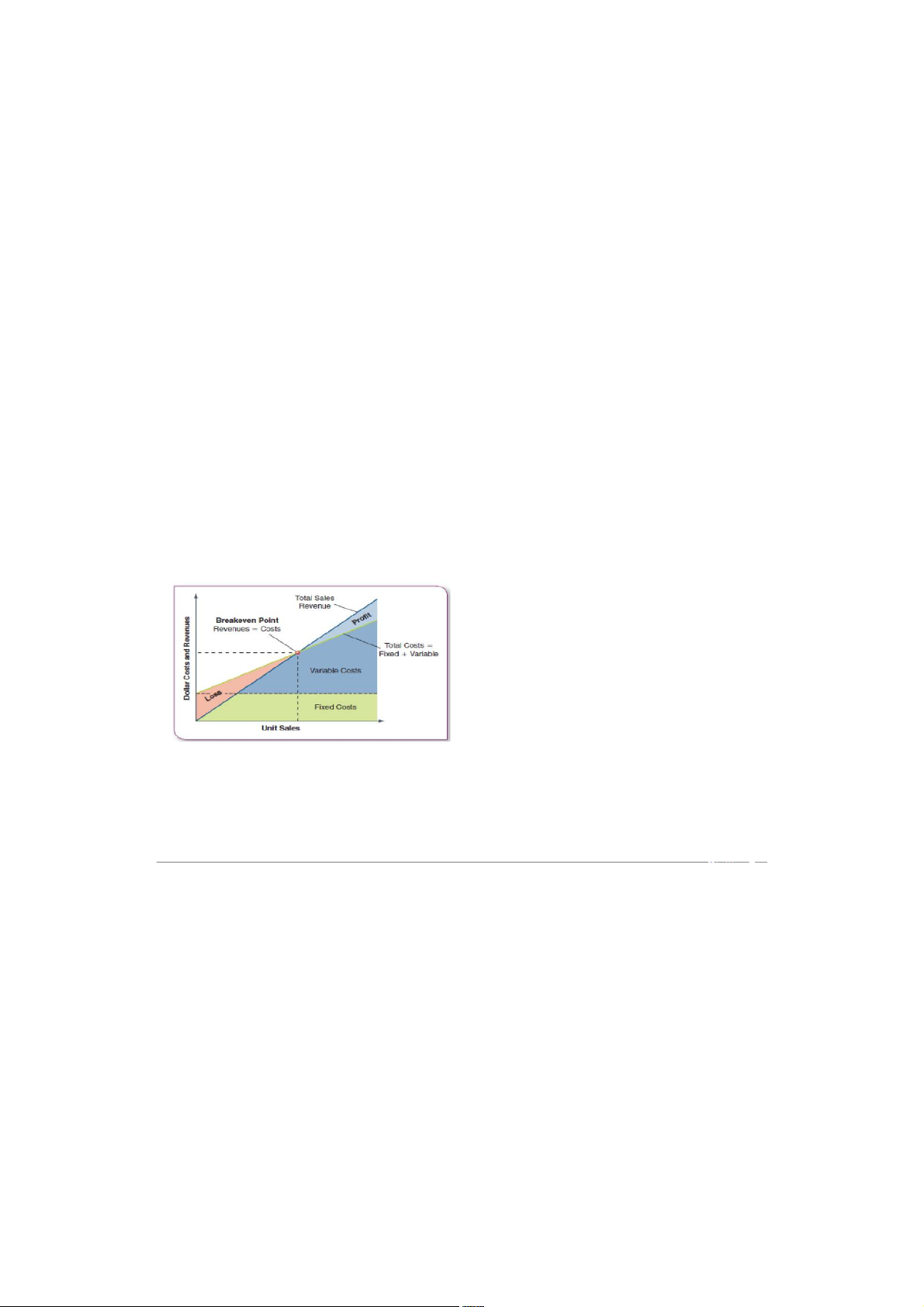
BREAKEVEN ANALYSIS: The breakeven point is reached when total revenues are exactly equal to total costs.
-Breakeven analysis involves conducting what-if scenarios to evaluate outcomes under
varying revenue and cost conditions.
-Figure 9.4 illustrates that the breakeven point
is reached when total revenues are exactly
equal to total costs. It can also be understood
as the point where losses stop, and profits
start. The breakeven point is calculated using the following formula:
Breakeven Point = Fixed Costs / (Price - Variable Costs)
FINANCIAL CONTROL: A balance sheet provides a snapshot of an organization's assets
and liabilities at a specific moment in time.
An income statement details the profits or losses of an organization for a particular period. -
Liquidity: Assesses an organization’s capacity to fulfill short-term obligations. A
higher ratio is preferable, indicating a greater level of assets compared to liabilities. -
Leverage: Evaluates the extent of debt utilization. A lower ratio is desirable,
signifying minimal reliance on debt and a stronger asset base. -
Asset Management: Measures the efficiency of utilizing assets and inventory. A
higher ratio is advantageous, reflecting greater sales in relation to assets and inventory. -
Profitability: Examines the organization’s ability to generate revenues that exceed
costs. A higher ratio is favorable, demonstrating strong net income relative to sales, assets, and equity.
BALANCED SCORECARD: A balanced scorecard evaluates organizational performance
across four key dimensions: financial outcomes, customer service, internal processes, and innovation and learning.
Creating a balanced scorecard for an organization starts with defining its mission and
vision—clarifying what the organization aims to become and how it wishes to be perceived by key stakeholders.
Key dimensions for establishing scorecard objectives and metrics:
● Financial Performance: Typical objectives include survival, success, and growth.
Metrics may include cash flow, sales growth, operating income, market share
expansion, and return on equity.
● Customer Satisfaction: Objectives might involve offering innovative products and
ensuring responsive supply chains. Metrics could include the percentage of sales
from new products and the percentage of on-time deliveries.
● Internal Process Improvement: Goals often focus on achieving manufacturing
excellence, enhancing design productivity, and introducing new products. Metrics
may involve cycle times, engineering efficiency, and the time required to bring new products to market.
● Innovation and Learning: Objectives may emphasize technological leadership and
speed to market. Metrics can include the time needed to develop new technologies
and the time for new product introductions compared to competitors.
Tài liệu liên quan:
-
CHAP 1: Introduction to Management Concepts and Functions môn Principles of Management | Trường Đại học Quốc tế, Đại học Quốc gia Thành phố Hồ Chí Minh
6 3 -
Guidelines for group’s assignments: Analysing management issues of a FDI company based inVietnam môn Principles of Management | Trường Đại học Quốc tế, Đại học Quốc gia Thành phố Hồ Chí Minh
6 3 -
Financial Planning to Achieve 300m VND Goal in 3 Years môn Principles of Management | Trường Đại học Quốc tế, Đại học Quốc gia Thành phố Hồ Chí Minh
6 3 -
A Case Study in Fast Fashion Success môn Principles of Management | Trường Đại học Quốc tế, Đại học Quốc gia Thành phố Hồ Chí Minh
6 3 -
Chap 16 Hierarchy of Needs Theory and Applications môn Principles of Management | Trường Đại học Quốc tế, Đại học Quốc gia Thành phố Hồ Chí Minh
7 4