Chapter 1 - Introduction to Corporate Governance Notes môn Principles of Management | Trường Đại học Quốc tế, Đại học Quốc gia Thành phố Hồ Chí Minh
Definition: The process that the amount of stock on the market increases as reduces the proportional of ownership right in each share. VD: Company has 1 million shares availabldecided to issue more shares about 500,000. Tài liệu giúp bạn tham khảo, ôn tập và đạt kết quả cao. Mời đọc đón xem!
Môn: Principles of Management 314 tài liệu
Trường: Trường Đại học Quốc tế, Đại học Quốc gia Thành phố Hồ Chí Minh 2 K tài liệu
Tác giả:









Preview text:
CHAPTER I: INTRODUCTION TO CORPORATE GOVERNANCE I. Why corporate governance: - Position in company:
1. BOM: Board of Management (represent CEO, CFO)
2. BOD: Board of Director (shareholders interest)
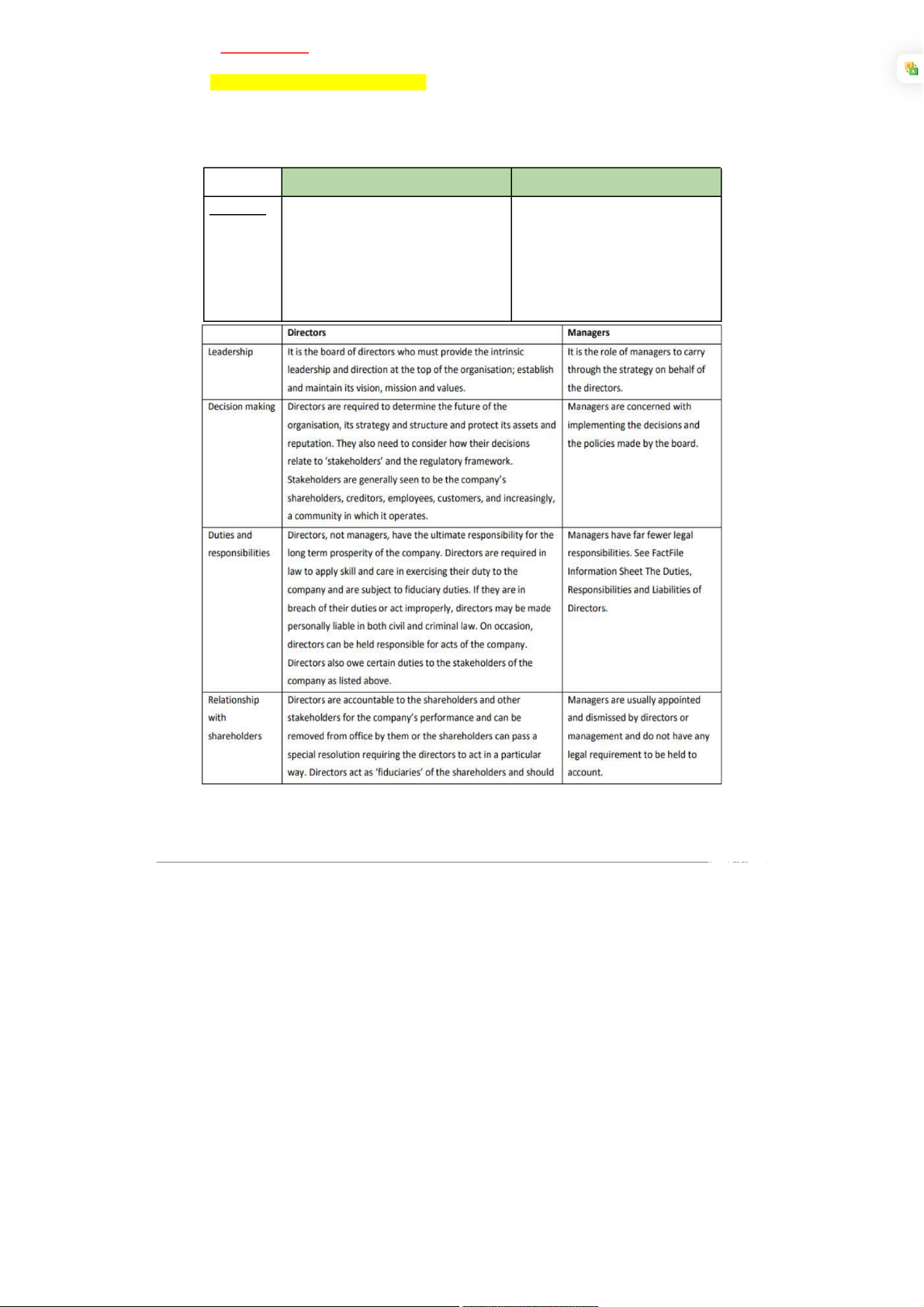
- Differences between BOD & BOM: BOD BOM Definition
Governing body company typically A corporate structure responsible for
elected or appointed by shareholders to company’s day-to-day operations & oversee company activities
and provides organizational leadership.
management, set strategy and protect Ensure company goal and
shareholder & stakeholder interests objectives met with managing
resources, coordinate activities and making strategic desicion
CHAPTER I: INTRODUCTION TO CORPORATE GOVERNANCE
- Stock dilution (Pha loãng cổ phiếu):
1. Definition: The process that the amount of stock on the market
increases as reduces the proportional of ownership right in each share.
VD: Company has 1 million shares availabldecided to issue more
shares about 500,000 in which making the total shares up to
1,500,000. By this, each shareholders will receive a smaller portion
(assume each shareholders has 1/1,000,000 but now they even have
1/1,500,000, compared to the past which their right would be threaten even more) 2. Reason appears:
- Raise more funds by issues new shares: In the purpose of
expanding operations, repay debt. There are some methods for
issue new shares such as issue individually (private, public
trading) or company can issue shares to current shareholder →
This will ensure ownership ration remain the same with the new market shares
- Transfer convertible bond to common stock: Some creditor want
to convert bond to common stock which means the liability
corporation reduce (Transfer liability to source of funds)
- M&A: Expand operation can made re-divided or issue sharee
because of new policy from M&A 3. Consequences:
- Impact on firm value: Issue new shares help corporations
increase the number of shareholders. However, this will lead to
incontrolable charge because every shareholder would have
their incentives and role and different thinking, strategies.
- Impact on the trading market: Issue new shares will increase the
supply shares on the market but would make a pressure for the
seller. (Vì số lượng cp nhiều nên bán ra giá rẻ, gây áp lực cho
bán và bên mua ko thể đáp ứng kịp) → Mất cân bằng thị trường.
- Stock bailing out (Bán tháo cổ phiếu): The processs of short sell some
stock despite the condition of current stocks. Mostly this scenario happens in
the short-term and is stable after the stock price reaches the lowest value
that anyone cannot sell again.
1. The process of stock bailing out which make the herding behavior for
others investors to short sell at the same time which trajectory the
value and stock price decrease gradually.
CHAPTER I: INTRODUCTION TO CORPORATE GOVERNANCE 2. Reason why this happens:
- Bad news from company listed on the stock exchange such as
bad debt, insolvency circumstances, accumulated loss revenue by the time
- Herding behavior (Tâm lý bầy đàn): Tự giải thích
- Economic bubble: The scenario which the financial asset such
as stock, real estate,... reach to the highest price by speculative
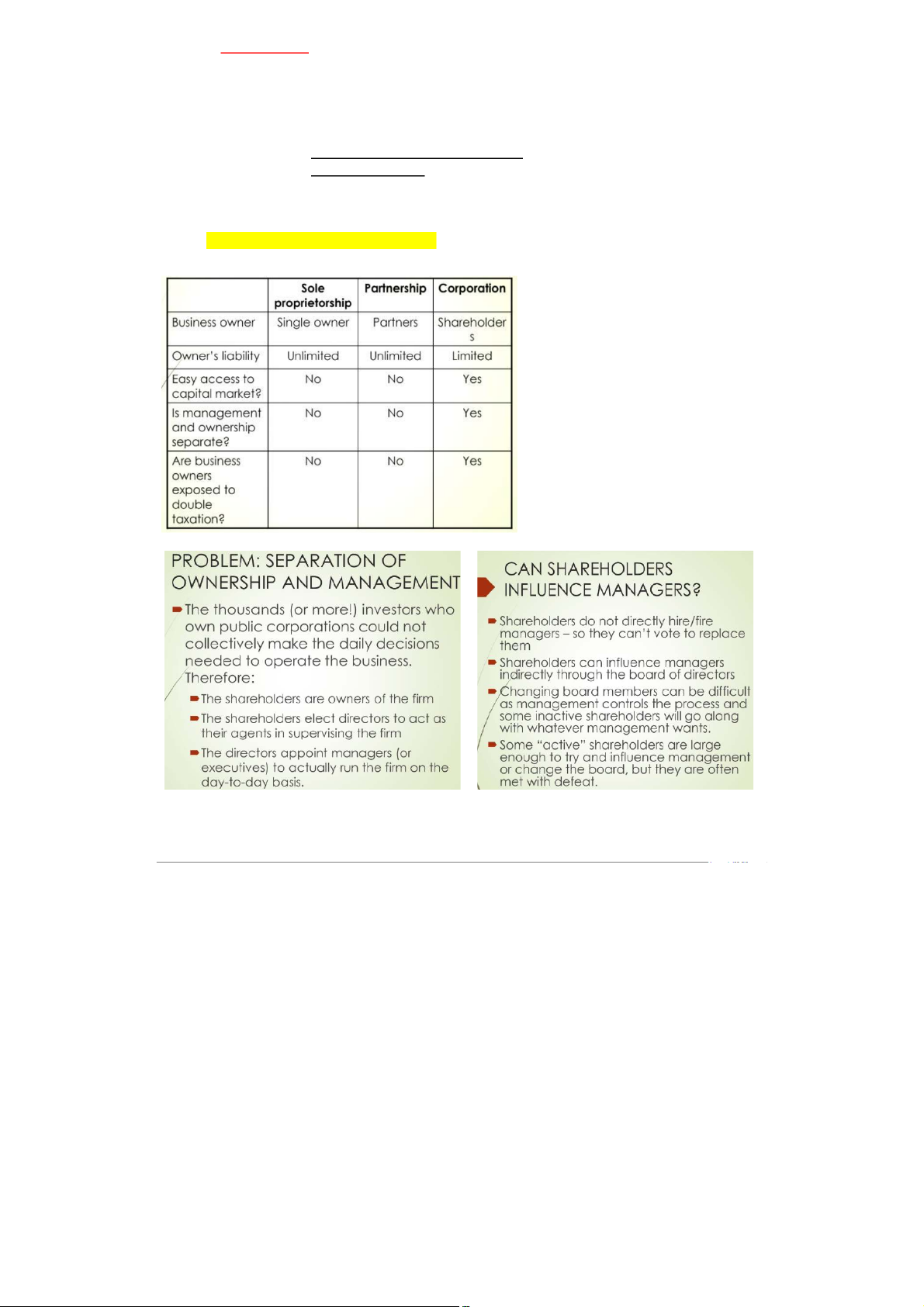
behavior or highest expectation from investor II. Form of business ownership:
- There are 3 types of business ownership: + Corporation: Structure established by law to allow different parties to contribute capital, expertise and labor for maximum benefit for all parties.
CHAPTER I: INTRODUCTION TO CORPORATE GOVERNANCE III. Principal-agent problem:
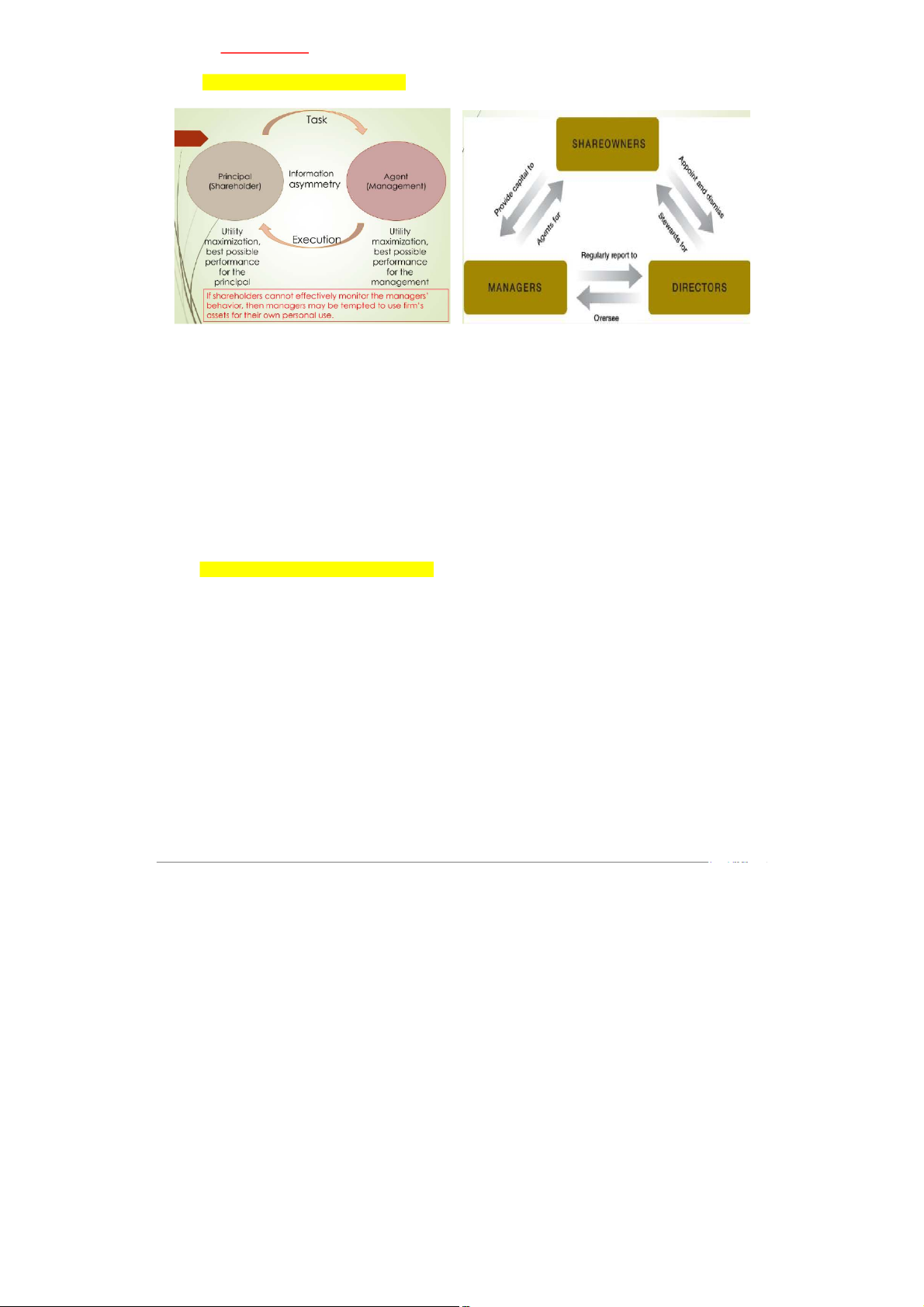
PAP: The conflict between principal and agent
- Active shareholder: Engage in the firm’s decision, direct, and control the
manager to employ the decision
- Inactive shareholder: Focus on the risk and return, and don’t make
everyday decisions for the company. They will not know many information much about the company
- Management: Work on behalf of the shareholder.
→ To minimize the cost of agency, the BOD will hire the BOM (board of
management) to control and manage, monitor the activities of the firm.
→ There will be an annual meeting for shareholder (such as content key ratio, profit and KPI of company)
Solution for principal agent problem:
- Solution 1: Incentive: Align executive incentive with shareholder desires
(Đưa thêm bản quản lý, quản trị)
1. VD: ESOP (Give employee stock option)
- Solution 3: Create an incentive salary, reward or even stock reward (so that
the management can also be a shareholder) for management annually in
order to encourage the effort of management to reach the same goal of MNC
(Yêu cầu CEO và ban quản lý nắm giữ cổ phần trong công ty để họ có
động lực gia tăng giá trị doanh nghiệp, vì khi công ty phát triển, họ cũng được hưởng lợi)
- Solution 4: Dismissal and penalty for those management who do not
follow the rules. However, this would cause for other shareholders a
CHAPTER I: INTRODUCTION TO CORPORATE GOVERNANCE
backward effect and even they can resell their stocks for avoidance. The best
solution which can be is replacing (can be voting, legal recourse if something
distransparancy) annually shareholder for 3 quarters and management for 2
years. This can filter the management and choose the best management. If
the company can select the best management so they can keep them forever
Ví dụ: Yêu cầu CEO nắm giữ ít nhất 5% – 10% cổ phần của công ty.
There will be a conflict between the external and internal employees. Sales
employee has the KPI 200M but this year they exceed their KPI (300M). The sale
employee wants to reserve 100M to the next year. However, the audit (external)
does not allow to reserve and must comply the following rules. There will be a conflict between them - Solution 2: Monitor
CHAPTER I: INTRODUCTION TO CORPORATE GOVERNANCE
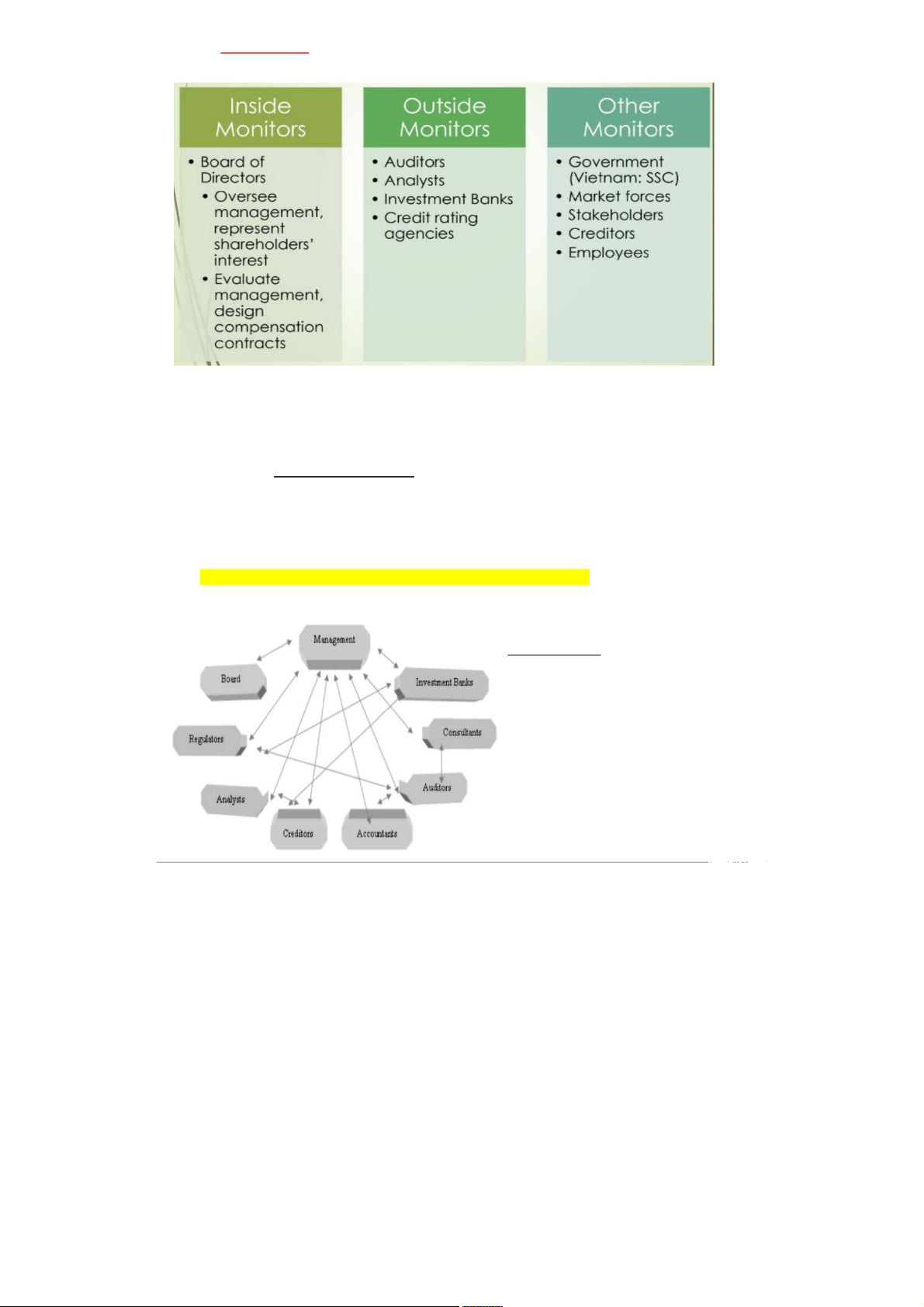
*Mechanism for manager to manage BOD:
- What is differences role external audit in public company with the company not listed:
+ The audit public listed company would be more value because the
financial statement, public information would be public
+ In the private company: If you buy the car, the car on the name behalf
of the company. So the private company can be use it as deductible
expense (depreciation expense) to deduct the tax
*The role of bank monitor: Company need loan from bank. The bank will evaluate
the financial statement from the company and giving the credit assessment whether
it should repay. They can evaluate the ability the to repaid the loan
IV. Interlinking relationship among business participants: Why the start-up inflates
(Thổi phồng) the stock price: - Reason 1: To attract the investors for funding. This usually strong happens when star-up or bankruptcy company need money to raise their capital in order to make business. However, the company that go to bankruptcy
CHAPTER I: INTRODUCTION TO CORPORATE GOVERNANCE
will have less chance for funding because (1) the investor afraid to fund due
to insolvency when paying dividends (2) the credit rating of company not fully
credibility so that every bank cannot to lend
- Reason 2: To examine the value of current stock price in selection: If the
stock price are more higher than other stock price: và trường hợp còn lại có
thể đưa thêm → IPO hoặc M&A
* Why do they have so many positions to manage the management but still
have the scandal of CG? Because every position has incentives. Such as auditor.. (giải thích sau này)
V. 4 PILLARS OF CORPORATE GOVERNANCE: - Accountability:
1. Ensure management accountable to board
2. Enssure board also accountable to shareholders - Fairness (Công bằng):
1. Protect shareholder right (such as the agency cost can be happened)
2. Treat all minority shareholders and major equally
- Transparency (Trung thực):
1. Ensure information, material matters disclosure including financial
situation, performance, ownership and CG with consider transparency
2. Timely, accurately and compete
- Responsibility (Trách nhiệm):
1. Encourage cooperation between compnay and stakeholders creating
wealth, jobs and economic sustainability
2. Guarantee for all the rights of shareholder VI. REASONS FOR CG IMPORTANT:
- Some well-governance company perform In commercial term would result:
1. Increase access to external financing 2. Lowest cost of capital
3. Improved operational performance
4. Higher firm valuation and share performance
5. Reduce risk corporate crises and scandals - External fund:
1. Raising fund by going to bank 2. Issue stock and bond
- Company has well perform (Good CG) → High value asset → All the shares
can be sold out → lower cost *EXTERNAL FINANCING:
- External financing: The resources for company to raising fund on the third
party transaction. There are 2 way which can financing which is debt
CHAPTER I: INTRODUCTION TO CORPORATE GOVERNANCE
financing (they can borrow from banks, financial institutions with offered
interest rate) or equity financing (raising fund with venture fund, privatization fund or individual investors)
- Global investor → Want to diversify portfolio → Face the risk such as
transparency, different regulatory, different culture, ability to repay the profit or debt
- In contrast, good CG systems attract investment global investors because
the willingness of international and domestic investors explore and commit to
developing markets comes with demand for information and disclosure *LOWEST COST OF CAPITAL:
- A well goood CG (Be more transparency): Less uncertainty, less risk → It
can be raising fund at lowest cost
- Even disclosure all information → It can have lowest cost
- Company should improved governance → Reduce agency problem, attract more capital
*IMPROVED OPERATIONAL PERFORMANCE:
- Elective corporate governance adds value by improving companies
performance through more efficient management and better asset allocation
1. Manager, director and shareholder likely to make more informed, quicker and better decision
2. High quality CG streamlines business processes better operating performance, lower cost
3. A Harvard/Wharton survey found that U.S.-based firms with better
governance have faster sales growth and were more profitable than their peers
4. The ABN/AMRO study showed that Brazilian firms with above-average
CG had Returns on Equities (ROEs) that were 45% higher and net
margins that were 76% higher than those with below-average governance practices.
*HIGHER FIRM VALUATION AND SHARE PERFORMANCE
- Premium = Good will (This mean company want to engage M&A activities, it
would be higher price, the investor would willing to buy at that price
- Goodwill: The intangible asset (can be the intrinsic value of a company or
copyright, franchising, brand name, relationship partner, strong labor force,
AI and technology advancement,...) in the balance sheet when there are an
M&A between merger company to being merged company. The goodwill can
also reflect how powerful value that company going to M&A paid to merge.
CHAPTER I: INTRODUCTION TO CORPORATE GOVERNANCE
The good will would not depreciate but impairment if the actual value
company downgrade. When the actuall company was lower than the
previous recording book, the gap would recorded as expense in financial statement
- How can interpret the goodwill: Related to M&A where the third party is
willing to buy. The good will would be the adjusted between asset and other
asset which create the profit in that margin (Book value and market value)
*REDUCED RISK OF CORPORATE CRISES AND SCANDALS: Company with
good CG practices have effective risk management system which more likely to
cope with corporate crises and scandals than those not have
VII. Environment CG in Vietnam (Same merchanism in China) - State-owned private:
- 1975-1986: No private company and company law, a command economy
(Socialist economy) → Tat ca tai san deu thuoc ve nha nuoc, khong co tu
nhan. There are also regulation strictly in trading (such as trade clothes to take meat is prohibited)
- 1986: Change the new: Command economy banned, build more sector in market economy
- 1992: VN government began “equitization” (vốn hóa/cổ phần hóa), large
number SOE transform shareholding companies and limited liability
- Equitization: Not the same as listing (nowaday), nhà nước đang thoái vốn
chính mình, chia cổ phần của mình cho các tư nhân (bán cho cán bộ nhân viên của họ
- Biggest disadvantage from private state company: They woud not need
to listed out because they have their own sources (They do not need to raise other corporation) *Biggest CG problems in VN:
- The loan which corporation lend from government which is the taxable income
- In 2016, Vietnam still home to substantial state sector and state-led
economy: Government keep 57% stake in equitized firm
1. Unconditional backing from government (From government, they
have more conditional background (such as capital, land, guarantee
the money for bankruptcy, tax incentives, it can give reschedule for the
loan, debt forgiveness): Tức là doanh nghiệp nhà nước được chính
phủ hỗ trợ tài chính với chính sách ko kèm theo đk rõ ràng dẫn đến
CHAPTER I: INTRODUCTION TO CORPORATE GOVERNANCE
tình trạng doanh nghiệp ko cần hoạt động hiệu quả vẫn có thể tồn tại
và ko áp lực cạnh tranh và đổi mới vì luôn có sự bảo vệ từ nhà nước
→ CONSEQUENCE: Méo mó thị trường, làm tư nhân khó cạnh tranh công bằng
2. Enterprise monopoly: Ví dụ như các cty nhà nước độc quyền là điện
lực, viễn thông, xăng dầu, nước, khoáng sản và thường chính phủ có
thể tự đặt giá như ý mình
3. Exploiting “ask and grant” norm: Các doanh nghiệp liên quan tới
nhà nước, cơ quan chính phủ để có thể xin giấy phép, ưu đãi về tài
chính và tài nguyên và giành lợi thế kinh doanh một cách rõ ràng và nhanh chóng.
→ CONSEQUENCE: Tạo ra sự bất cân xứng giữa các doanh nghiệp,
ko minh bạch, tạo điều kiện cho tham nhũng, lạm quyền.
4. Preferential acess to country’s scarcest business resources
(credit and land): Tiếp cận ưu tiên đến các nguồn lực khan hiếm
của đất nước (tín dụng và đất đai): Các doanh nghiệp nhà nước
hoặc doanh nghiệp có "quan hệ" thường được: Ưu tiên vay vốn với lãi
suất thấp từ các ngân hàng nhà nước và được cấp đất hoặc thuê đất
với giá rẻ, trong khi các doanh nghiệp tư nhân phải trả giá cao hơn
hoặc không được tiếp cận
● Điều này khiến doanh nghiệp tư nhân gặp khó khăn trong mở rộng hoạt động vì: ○ Khó tiếp cận vốn
○ Thiếu mặt bằng để xây dựng cơ sở sản xuất hoặc kinh doan Kết quả:
Các doanh nghiệp nhà nước tiếp tục duy trì lợi thế không công bằng
Ngăn cản sự phát triển của khu vực tư nhân và nền kinh tế nói chung
- State sector has highest ICOR (Incremental Capital Output Ratio) of all ownership forms:
1. No pressure to operate efficiently: Ko tối ưu hóa chi phí và cũng cả tiến
hiệu quả vì có chống lưng nhà nước → Phí nguồn lực, gimar cạnh tranh
2. Too “diversified” into non-core biz: Nhiều doanh nghiieepj nhà nước ko
tập trung cốt lõi lĩnh vực kinh doanh mà mở sang những lĩnh vực ko
liên quan khác → Cạnh tranh khốc liệt hơn vì miếng bánh kinh
doanh ngày càng nhỏ, ko chuyên môn cap
3. CG practices complicated by the large no. of government institutions
involved; limited transparency not only to the public but also b/w 4. these institutions
CHAPTER I: INTRODUCTION TO CORPORATE GOVERNANCE
5. A number of industries (Ministry of Planning & Investment) carry out
functions in SOEs that involve both the exercise of ownership rights
and regulation: Một số ngành vừa là sở hữu và là điều tiết → Xảy ra agency cost
*ICOR: Tỷ lệ vốn trên đầu ra: Đo lường hiệu quả sử dụng vốn doanh nghiệp và
cho biết bao nhiêu đơn vị vốn để tạo ra đơn vị tăng trưởng trong GDP
- ICOR thấp → Hiệu quả sử dụng vốn cao (ít vốn nhưng tạo ra nhiều tăng trưởng)
- ICOR cao → Hiệu quả sử dụng vốn thấp (cần nhiều vốn để tạo ra cùng một mức tăng trưởng).
Tài liệu liên quan:
-
CHAP 1: Introduction to Management Concepts and Functions môn Principles of Management | Trường Đại học Quốc tế, Đại học Quốc gia Thành phố Hồ Chí Minh
16 8 -
Guidelines for group’s assignments: Analysing management issues of a FDI company based inVietnam môn Principles of Management | Trường Đại học Quốc tế, Đại học Quốc gia Thành phố Hồ Chí Minh
15 8 -
Financial Planning to Achieve 300m VND Goal in 3 Years môn Principles of Management | Trường Đại học Quốc tế, Đại học Quốc gia Thành phố Hồ Chí Minh
13 7 -

A Case Study in Fast Fashion Success môn Principles of Management | Trường Đại học Quốc tế, Đại học Quốc gia Thành phố Hồ Chí Minh
15 8 -
Chap 16 Hierarchy of Needs Theory and Applications môn Principles of Management | Trường Đại học Quốc tế, Đại học Quốc gia Thành phố Hồ Chí Minh
16 8