CHAPTER 1: Key Elements in Management and Organizational Success môn Principle of Management | Trường Đại học Quốc tế, Đại học Quốc gia Thành phố Hồ Chí Minh
There are 6 elements are critically considered across industries: talent, technology, globalization, ethics, diversity and careers. Tài liệu giúp bạn tham khảo, ôn tập và đạt kết quả cao. Mời đọc đón xem!
Môn: Principles of Management 314 tài liệu
Trường: Trường Đại học Quốc tế, Đại học Quốc gia Thành phố Hồ Chí Minh 2 K tài liệu
Tác giả:






Preview text:
CHAPTER 1: Takeaway 1:
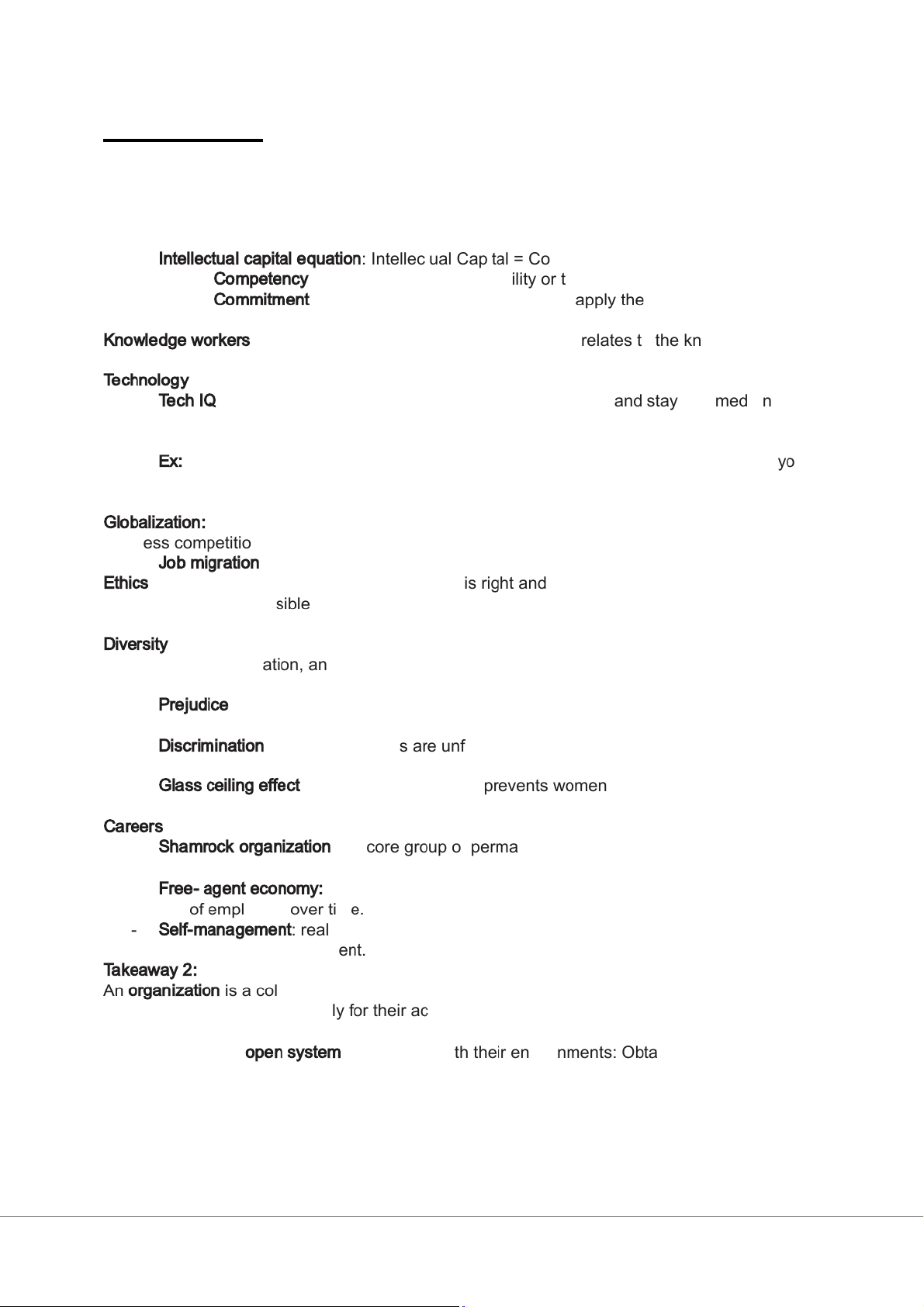
There are 6 elements are critically considered across industries: talent, technology, globalization, ethics, diversity and careers
Talent: human resource is one of the advantages that every company want to achieve. Talented
people are able to deliver efficient outcomes in competing with rivals. -
: Intellectual Capital = Competency x Commitment.
is your advantage, your ability or talent that needed for your job
is your willingness to work hard, to apply them to your tasks.
Both are required to meet career needs and performance requirements.
: persons whose minds are critical assets. It relates to the knowledge, the
information you acquire and your mindset. : -
: your ability to use technology in all your life aspects and stay informed on the
latest technological developments. High TechIQ is important, because it helps adapting quickly to new innovations. -
LinkedIn.com as online career sites used by job hunters and employers. Filling your
online profile with the right key words. Employers use special software to scan online
profiles for indicators of real job skills and experiences that fit their needs.
indicates worldwide interdependence of resource flows, product markets, and
business competition that characterizes our economy. -
, the shifting of jobs from one country to another.
: set of moral standards for what behavior is right and what is wrong. It depends on
individual being responsible for conducting right ethical business at all levels. Leaders are
supposed to conduct things right so that their followers can follow.
: a group of workers or a workforce that have differences in gender, age, race, ethnicity,
religion, sexual orientation, and ablebodiedness. Since society is diverse, the way we deal with
diversity in the workplace is an issue. Some major problems are: -
: the holding of negative, irrational opinions and attitudes regarding members of diverse populations. -
: minority members are unfairly treated and denied the full benefits of organizational membership. -
: an invisible barrier that prevents women and minorities from rising
above a certain level regarding organizational responsibility. : -
is a core group of permanent, full-time employees, freelancers and part-time staff. -
you can change jobs often and work on flexible contracts with a mix of employers over time. -
: realistically assess yourself, make constructive changes, and manage your personal development. An
is a collection of people working together to achieve a common purpose. Its
members perform tasks not only for their accomplishment but also for the final goal of the organization. Organization as an
that interact with their environments: Obtaining resource
inputs—people, information, resources, and capital—and transforming them into outputs in the
form of finished goods and services for customers. -
: measures the quantity and quality of outputs relative to the cost of inputs. -
is an output measure of task or goal accomplishment. -
is an input measure of the resource costs against goal accomplishment. There are :
- Focus on valuing human capital: work settings that create the knowledge, experience,
and commitment of all members.
- Demise of “command-and-control”: instead of “do as I say”, managers treat people with respect.
- Emphasis on teamwork: Organizations are driven by teamwork that consists of talents for creative problem solving.
- Preeminence of technology: New developments change the way organizations operate and how people work.
- Importance of networking: members are networked for intense, real-time communication and coordination.
- New workforce expectations: A new generation is less tolerant of hierarchy, more
informal, attentive to performance merit, and concerned for work–life balance.
- Priorities on sustainability: more attention to natural resources and understanding how
work affects human well-being.
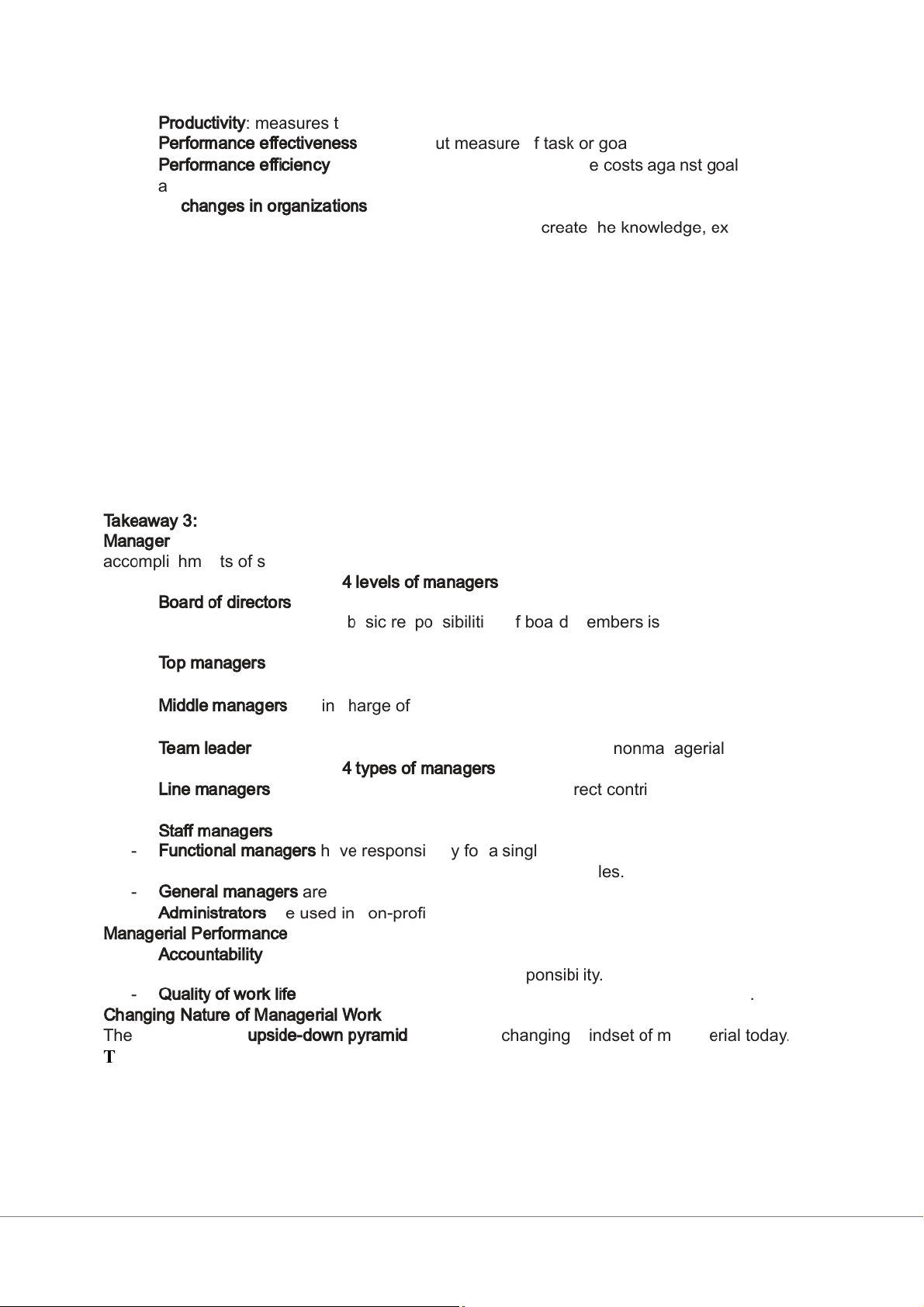
: supports, supervises, and helps motivate the work efforts and performance
accomplishments of staff, followers, team members.
If classifying by levels, we have . -
whose members are elected by stockholders to represent their
ownership interests. The basic responsibilities of board members is to make sure that
the organization is always being run right -
are an executive team that reports to the board and is responsible for the
performance of an organization as a whole . -
are in charge of relatively large departments consisting of several smaller work units. -
is in charge of a small work group composed of nonmanagerial staff.
If classifying by levels, we have . -
are responsible for work that makes a direct contribution to the organization’s outputs. -
use technical expertise to advise and support line workers. -
have responsibility for a single area of activity such as finance,
marketing, production, human resources, accounting, or sales. -
are responsible for activities covering many functional areas. - are used in non-profit org. -
is the requirement of one person to answer to a higher authority for
performance results in his or her area of work responsibility. -
(QWL) indicating the quality of staff experience with their job. The concept of the
fits with the changing mindset of managerial today.
Takeaway 4: these are the 4 basic functions of a manager
- Planning: is the process of setting performance objectives and determining what actions
should be taken to accomplish them. Through planning, a manager identifies desired
results and ways to achieve them. -
Organizing: Once plans are set, they must be implemented. The process of assigning
tasks, allocating resources, and coordinating the activities to accomplish plans. -
Leading: is the process of arousing people’s enthusiasm and motivating their efforts to
work hard to accomplish objectives. Managers build commitments, encourage activities
and influencing others to do their work. -
Controlling: is the process of measuring performance, comparing results to objectives,
and taking corrective action as needed. Managers control by staying in contact with
people as they work, gathering and interpreting measurements and make constructive changes. Managerial Roles
Mintzberg identified a set of 10 roles commonly filled by managers: -
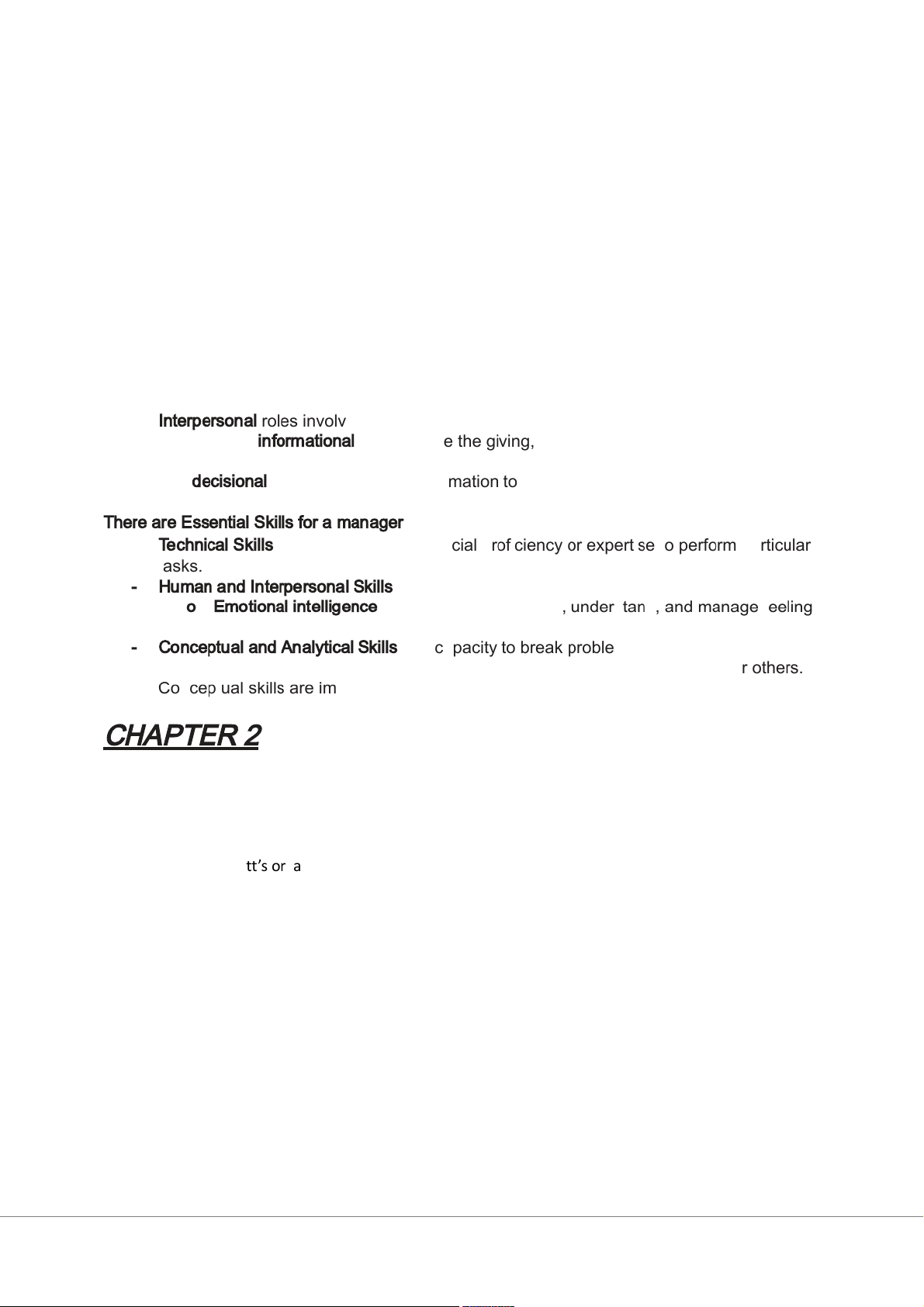
roles involve interactions with people inside and outside of org. - A manager’s
roles involve the giving, receiving, and analyzing of information. - The
roles involve using information to make decisions to solve problems or address opportunities. -
: the ability to use a special proficiency or expertise to perform particular
tasks. Technical skills are very important at job entry and early career levels.
: the ability to work well in cooperation with others.
: how well you recognize, understand, and manage feelings
while interacting and dealing with others.
: the capacity to break problems into parts, see the
relations between the parts, and recognize the implications of each problem for others.
Conceptual skills are important in high levels of management.
1. Classical management approaches a. Scientific management b. Administrative principles c. Bureaucratic organization
2. Behavioral Management Approaches
a. Follett’s organizations as communities b. The Hawthorne studies
c. Maslow’s theory of human needs
d. McGregor’s Theory X and Theory Y
e. Argyris’s theory of adult personality
3. Modern Management Foundations
a. Quantitative analysis and tools b. Organization as systems c. Contingency thinking d. Quality management
e. Knowledge management and organizational learning f. Evidence-based management
CLASSICAL MANAGEMENT APPROACHES: assumes that people are rational in taking opportunities to
achieve personal and monetary gain
I. Sciencetific management: emphasizes careful selection and training of workers and supervisory support.
It comes with 4 guiding principles:
- A “science” that includes rules of motion, standardized work implements, and proper working conditions.
- Carefully selection of workers with the right abilities.
- Carefully training workers to do the job and proper incentives to cooperate with job “science.”
- Supporting workers by planning and by smoothing the jobs.
Motion study means reducing a task to its basic physical motions. It is encourage that wasted activities
in a task should be eliminated in order to improve efficiency
Insights from scientific management approach: - Advances of job design,
- Work standards, and incentive wage plans. II. Administrative Principles
Fayol identifies the five “rules” of management:
1. Foresight—to complete a plan for the future
2. Organization—to provide and allocate resources to implement the plan
3. Command—to lead and evaluate workers to get the best work
4. Coordination—to fit diverse efforts and to ensure information is shared and problems are solved
5. Control—to make sure things happen according to plan and to take necessary corrective action
The foundation for the 4 functions of management
Principles to guide managers including:
- Scalar chain principle—a clear and unbroken line of communication from the top to the bottom
in the organization. So that information can be shared and transparency of a business is secured
- Unity of command principle—each person should receive orders from only one boss in order to
avoid confusion and power overlapping
- Unity of direction principle—one person should be in charge of all activities that have the same performance objective
III. Bureaucratic Organization: a rational and efficient form of organization founded on logic, order, and
legitimate authority. His ideas developed after noticing organizations performed poorly since people
holding positions of authority not because of their capabilities, but because of their “privileged”
social status. So according to Weber’s approach, people with ability will take authority and be in
charge. A whole organization will be run based on a hierarchy structure where managers give out
order to their lower level and then it is passed on to the subordinates.
The characteristics of bureaucratic organization are:
- Clear division of labor: Jobs are well defined, and workers become highly skilled at performing them
- Clear hierarchy of authority: Authority and responsibility are well defined for each position, and
employees know who they report to
- Formal rules and procedures: established written guidelines and written files are kept for historical record
- Impersonality: Rules and procedures are impartially and uniformly applied, with no one receiving special treatment
- Careers based on merit: Workers are selected and promoted on ability, competency, and performance
BEHAVIORAL MANAGEMENT APPROACHES: assume that people are social and self-actualizing,
responding to group pressures, and searching for personal fulfillment.
- Follett’s notion of organizations as communities - The Hawthorne studies
- Maslow’s theory of human needs - Douglas McGregor - Chris Argyris
I. Follett’s Organizations as Communities
Organizations as “communities”: managers and workers labor in harmony without one party dominating
the other, and with the freedom reconcile conflicts and differences, the respect for the experience and
knowledge of workers, warned against the dangers of too much hierarchy
Based on Follet’s study, there are insights that are still helpful:
- Emphasis on employee ownership in order to enhance their commitment
- Business problems involve a variety of factors that are in relationship to one another
- And private profits should always be considered vis-a-vis the public good: ethics and CSR
II. The Hawthorne Studies: people’s feelings, attitudes, and relationships with coworkers affected their
work, and that groups were important influences on individuals
Social setting and human relation affect productivity: pleasant social interactions with one another and
received special attention that made employees feel important
Members would restrict their output to avoid the displeasure of the group -> groups have strong
negative/ positive influences on individual productivity
Hawthorne effect: the tendency of people who are singled out for special attention to perform as
anticipated because of expectations created by the situation
III. Maslow’s Theory of Human Needs
Maslow’s theory is based on two underlying principles:
- Deficit principle—a satisfied need is not a motivator of behavior. It means people act to satisfy
“desired” needs, a deficit
- Progression principle—a need at any level is activated only when the next-lower-level need is satisfied
IV. McGregor’s Theory X and Theory Y
managers holding Theory X assumes that those who work for them generally dislike work, lack ambition,
are irresponsible, are resistant to change, and prefer to be led rather than to lead
Theory Y assumes that manager believes people are willing to work, capable of self-control, willing to
accept responsibility, imaginative and creative, and capable of self-direction
V. Argyris’s Theory of Adult Personality
Managers who treat people positively and as responsible adults will achieve the highest productivity.
Theory is contradict to the classical management approaches:
- In scientific management, people will work more efficiently as tasks become simpler and better
defined. Argyris believes that this limits opportunities for self-actualization
- In Weber’s bureaucracy, people work in a clear hierarchy of authority. Argyris worries that this
creates dependent, passive workers
- In Fayol’s administrative principles, the concept of unity of direction assumes that efficiency will
increase when a person’s work is planned and directed by a supervisor. Argyris suggests that this
creates conditions for psychological failure. MODERN MANAGEMENT FOUNDATIONS
I. Quantitative Analysis and Tools
Managers mine data in order to make decisions --> analytics: the systematic analysis of large databases
to solve problems and make informed decisions. Organizations as Systems
One company achieves great things by combining resources and the contributions of many individuals to achieve a common purpose.
Subsystems are formed which are interrelated to each other
High performance occurs only when each subsystem both performs its tasks well and works well in cooperation with others II. Contingency Thinking
Contingency thinking matches responses with problems and opportunities specific to different people and settings
The contingency perspective tries to help managers understand situational differences and
respond to them in ways that fit their characteristics. III. Quality Management
TQM makes quality principles part of the organization’s strategic objectives, applying them to all aspects
of operations. TQM approaches begin with the total quality commitment applies to every subsystem in an organization
Measure and control the quality of the whole open system from the inputs to outputs as well as
the feedback which contributes to the improvement of input resources
Continuous improvement: always looking for new ways to improve on current performance.
ISO certification is a global quality benchmark that businesses want to achieve in order to define their quality level
IV. Knowledge Management and Organizational Learning
Knowledge management describes the processes through which organizations use information
technology to develop, organize, and share knowledge to achieve performance success
Intellectual assets such as patent, intellectual property rights, trade secrets, etc. need to be well
managed and continually enhanced
A learning organization is the one that people, values, and systems continuously change and improve its
performance based upon experience
Help all members to learn through information sharing, teamwork, empowerment, and participation. V. Evidence-Based Management
Evidence-based management means making management decisions based on what really works rather
than on things that sound good but lack of empirical proof. Four sources of information:
- Practitioner expertise and judgment: knowledge and past experience
- Evidence from the local context
- Critical evaluation of the best available evidence
- Perspectives of those people who might be affected by the decision
Tài liệu liên quan:
-

CHAP 1: Introduction to Management Concepts and Functions môn Principles of Management | Trường Đại học Quốc tế, Đại học Quốc gia Thành phố Hồ Chí Minh
8 4 -

Guidelines for group’s assignments: Analysing management issues of a FDI company based inVietnam môn Principles of Management | Trường Đại học Quốc tế, Đại học Quốc gia Thành phố Hồ Chí Minh
8 4 -
Financial Planning to Achieve 300m VND Goal in 3 Years môn Principles of Management | Trường Đại học Quốc tế, Đại học Quốc gia Thành phố Hồ Chí Minh
9 5 -

A Case Study in Fast Fashion Success môn Principles of Management | Trường Đại học Quốc tế, Đại học Quốc gia Thành phố Hồ Chí Minh
9 5 -
Chap 16 Hierarchy of Needs Theory and Applications môn Principles of Management | Trường Đại học Quốc tế, Đại học Quốc gia Thành phố Hồ Chí Minh
10 5