CHAPTER 1 Understanding the Manager’s Job môn Principle of Management | Trường Đại học Quốc tế, Đại học Quốc gia Thành phố Hồ Chí Minh
ncluding: profit (Netflix, Starbucks, and Facebook), the discovery of knowledge (the University of Nebraska or the National Science Foundation), national defense (the U.S. Navy or Marines), the coordination of various local charities (the United Way of America), or social satisfaction (a fraternity or sorority). Tài liệu giúp bạn tham khảo, ôn tập và đạt kết quả cao. Mời đọc đón xem!
Môn: Principles of Management 314 tài liệu
Trường: Trường Đại học Quốc tế, Đại học Quốc gia Thành phố Hồ Chí Minh 2 K tài liệu
Tác giả:















Preview text:
CHAPTER 1
Understanding the Manager’s Job AN INTRODUCTION TO MANAGEMENT
-An organization is a group of people working together in a structured and coordinated fashion to achieve a set of goals
+ Including: profit (Netflix, Starbucks, and Facebook), the discovery of knowledge (the University of
Nebraska or the National Science Foundation), national defense (the U.S. Navy or Marines), the
coordination of various local charities (the United Way of America), or social satisfaction (a fraternity or sorority).
+For example, Apple's organizational structure is designed to foster collaboration and
innovation. The company is organized around functional areas of expertise, such as hardware
engineering, software engineering, and marketing. This structure allows employees with deep
knowledge in their respective fields to work together to develop and launch new products.When
Apple was developing the iPhone, engineers from the hardware and software teams worked
closely together to ensure that the phone's hardware and software were compatible and well- integrated.
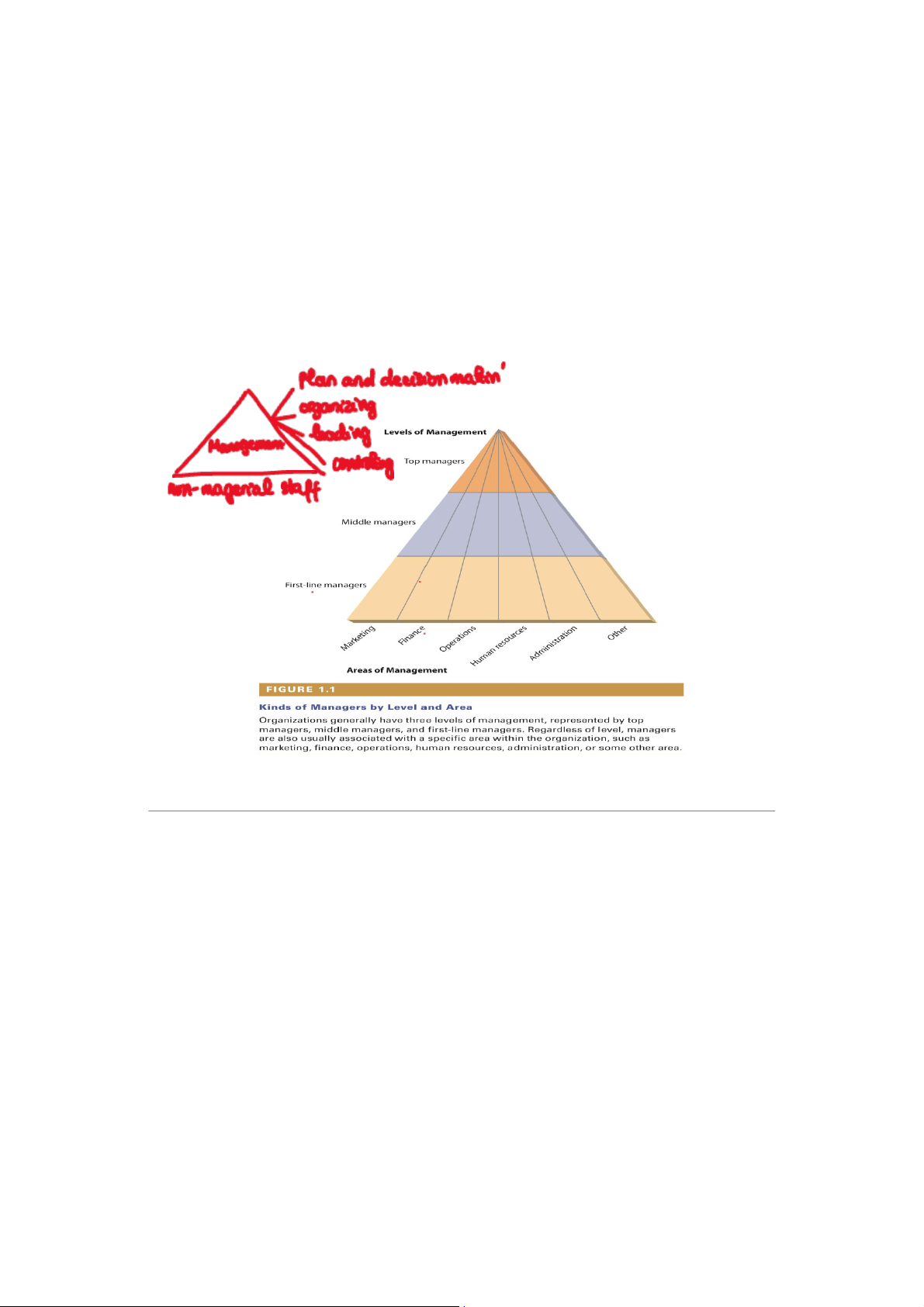
-Management can be defined as a set of activities (including planning and decision making,
organizing, leading, and controlling) directed at an organization’s resources (human, financial,
physical, and information) with the aim of achieving organizational goals in an efficient and effective manner.
-Managers are responsible for using the organization’s resources to help achieve its goals.
-MANAGERS: Someone whose primary responsibility is to carry out the management process.
The role of a manager is to carry out organizational goals in an efficient and effective manner.
+Efficient: Using resources wisely in a cost-effective way
+Effective: Making the right decisions and successfully implementing them KINDS OF MANAGERS 1. Top managers:
- Top managers make up the relatively small group of executives who manage the overall organization
- Create the organization’s goals, overall strategy, and operating policies
For example, Tim Cook (CEO of Apple).
oTitles found in this group include president, vice president (VP), and chief executive officer (CEO).
oTop managers make decisions about activities such as acquiring other companies,
investing in R&D, entering or abandoning various markets, and building new plants and office facilities.
oTop managers are responsible for creating the organization’s goals, overall
strategy, and operating policies. They also officially represent the organization to
the external environment by meeting with government officials, executives of
other organizations, and so forth. 2. Middle managers:
-Middle management is probably the largest group of managers in most organizations
oCommon middle-management titles include plant manager, operations manager, and division head.
oImplement the policies and plans developed by top managers
o Supervise and coordinate the activities of lower-level managers
For example, Aaron Abbott, a regional manager of Apple responsible for the firm’s operations in Canada, is a middle manager. 3. First-line managers: -
Supervise and coordinate the activities of operating employees
o Common titles for first-line managers are supervisor, coordinator, and office manager.
oPositions like these are often the first held by employees who enter management
from the ranks of operating personnel.
oIn contrast to top and middle managers, first-line managers typically spend a large
proportion of their time supervising the work of their subordinates.
For example, Apple Store Manager is responsible for managing a sales team at the store. They
must organize and assign tasks to sales staff, making sure everyone understands the product and
is able to advise customers professionally. BASIC MANAGEMENT FUNCTIONS 1. Planning:
Setting an organization’s goals and deciding how best to achieve them Decision Making: -
Part of the planning process that involves selecting a course of action from a set of alternatives
Planning and decision-making help managers maintain their effectiveness by
serving as guides for their future activities. In other words, the organization’s
goals and plans clearly help managers know how to allocate their time and resources.
It is important for top management because:are best aware of environmental
conditions facing their organization and are able to effectively analyze and
predict future conditions. It also requires that managers should be good decision makers.
For example, Apple brand is known for its meticulous planning and execution, which is evident in its
annual product planning process.Once the product targets are set, a cross-functional team of engineers,
designers, marketers, and supply chain experts is assembled to develop detailed plans for each product.
This rigorous planning process helps Apple to ensure that its products are well-designed, well-made, and
meet the needs of its customers. It also helps the company to avoid delays and cost overruns. 2. Organization -
Determining how activities and resources are to be grouped.
It means that when a manager has set goals and developed a workable plan, his or
her next management function is to organize people and the other resources
necessary to carry out the plan to maximize returns with minimum expenditure.
Organizing may be referred to as the process of assigning jobs/tasks, arranging
9orders/ priorities, assembling resources, and allocating resources.
It is crucial for middle-management because it allows them to effectively plan,
coordinate, and control the work of their teams. This is essential for achieving
organizational goals and objectives.
For example, Apple's organizational structure is designed to foster collaboration and innovation. The
company is organized around functional areas of expertise, such as hardware engineering, software
engineering, and marketing. This structure allows employees with deep knowledge in their respective
fields to work together to develop and launch new products.When Apple was developing the iPhone,
engineers from the hardware and software teams worked closely together to ensure that the phone's
hardware and software were compatible and well-integrated. 3. Leading -
The set of processes used to get members of the organization to work together to further the
interests of the organization.
Leading entails directing, influencing, and motivating employees to perform
essential tasks through motivation to progressively attain organizational objectives.
It becomes important for leadership to create harmony among individual efforts
to collectively work towards organizational goals.
It is essential for both middle and first-line management because it can lead to
increased productivity, improved morale, and increase revenue and allow them to
create high-performing teams that contribute to the overall success of the organization.
For example, one of the most important aspects of Apple's leadership is its focus on employee
empowerment. Apple leaders believe that the best way to get things done is to give employees the
autonomy and resources (skills and knowledge) they need to be successful in their roles which allows
them to be more creative and innovative. Thus, Apple has continued to grow and innovate, and the
company is well-positioned for continued success in the future. 4. Controlling -
Monitoring organizational progress toward goal attainment.
Measuring performance against goals and plans (Managers must monitor
progress to ensure that it is performing in such a way as to arrive at its
“destination” at the appointed time.)
Comparing results and goals
Helping correct deviations from standards. -
Controlling is crucial for first-line management because it ensures that:
Work is completed on time and to a high standard.
Resources are used efficiently.
Problems are identified and resolved quickly. Without effective control, teams
can become inefficient, unproductive, and disengaged.
For example, Apple, a large multinational technology company: To maintain a high level of customer
satisfaction with its products and services, Apple collects feedback from customers through surveys,
focus groups, and social media monitoring and follows customer satisfaction data to identify areas for
improvement. Additionally, Apple provides training and support to its employees to ensure that they are
providing excellent customer service which can lead to increased customer loyalty and sales.
MANAGING IN DIFFERENT AREAS OF THE ORGANIZATIONS
-Marketing Managers: Areas related to getting people to buy products or services
+ (be they Samsung smartphones, Subaru automobiles, Entertainment Weekly magazines, Associated
Press news reports, streaming video rentals from Netflix or Disney+, or lattes at Starbucks).
+ These areas include new product development, promotion, and distribution. Given the importance of
marketing for virtually all organizations, developing good managers in this area is critical.
-Financial managers: Areas related to financial resources; accounting, cash management, and investments
+In some businesses, especially banking and insurance, financial managers are found in large number
-Operations managers: Creating and managing the systems that creates products or services
+Typical responsibilities of operations managers include production control, inventory control, quality
control, plant layout, and site selection -
Human resource managers: Hiring and developing employees, recruiting, training and
development, compensation and benefit systems, formulating performance appraisal systems, and
discharging low-performing and problem employee
-Administrative managers: Generalist that have basic familiarity with all functional areas of management -
Specialist managers: Public relations, R&D, and other unique area
+ Public relations managers, for example, deal with the public and media for firms such as Facebook,
Instagram, and Unilever to protect and enhance the image of their organizations. R&D managers
coordinate the activities of scientists and engineers working on scientific projects in organizations such as
Google, Shell Oil, and NASA. Internal consultants are used in organizations such as Prudential Insurance
to provide specialized expert advice to operating managers. International operations are often coordinated
by specialized managers in organizations like Walmart and General Electric. The number, nature, and
importance of these specialized managers vary tremendously from one organization to another. As
contemporary organizations continue to grow in complexity and size, the number and importance of such
managers are also likely to increase. Our Tech Watch feature highlights one newly emerging management
position, the social media manager. FUNDAMENTAL MANAGEMENT SKILLS 1.Technical Skills
-Technical skills are necessary to accomplish or understand the specific kind of work done
in an organization.These managers spend much of their time training their subordinates
and answering questions about work-related problems. Effective managers know how to
perform the tasks assigned to those they supervise.
-Technical skills are especially important for first-line managers
Allowing managers to make decision allocation resources more effectively (manpower, material)
Saving time and improving work productivity: help accomplish the jobs
faster and more effectively and efficiently.
For example, Amazon is an e-commerce company that uses technical skills to provide customers
with a convenient online shopping experience. The company uses technical skills to develop
Amazon websites and applications, analyze procurement data and produce appropriate products
and automation skills to automate business processes. 2.Interpersonal Skills
- Interpersonal skills—the ability to communicate with, understand, and motivate both
individuals and groups.This is a necessary skill for all levels of management and individuals.
Managers spend considerable time interacting with people both inside and outside the organization.
As a manager climbs the organizational ladder, he or she must be able to
get along with subordinates, peers, and those at higher levels of the
organization.(To lead a team, you'll need to earn the respect of your
colleagues. To do this, you need to know how to effectively deal with people.)
Because of the multitude of roles that managers must fulfill, a manager
must also be able to work with suppliers, customers, investors, and others outside the organization.
-Microsoft: is a technology company that uses interpersonal communication skills to
develop technology solutions that help people connect with each other. The company
uses interpersonal communication skills such as:
Relationship building skills: to build relationships with customers and partners.
Customer service skills: to provide excellent customer service.
=>Thanks to these interpersonal communication skills, Microsoft has become one
of the world's leading technology companies. 3.Conceptual Skills
- Conceptual skills depend on the manager’s ability to think in the abstract. This skills are
especially important for top managers because:
Managers need the mental capacity to understand the overall workings of
the organization and its environment, to grasp how all the parts of the
organization fit together, and to view the organization in a holistic manner.
=>This ability allows them to think strategically, to see the “big picture,”
and to make broad-based decisions that serve the overall organization.
For example, Tesla is an electric car company that uses conceptual skills to develop advanced
electric cars. The company uses conceptual skills such as:
Foresight: to envision the future of transportation.
Ability to innovate: to create new and groundbreaking products.
Leadership: to inspire others to pursue your vision.
=>Thanks to these conceptual skills, Tesla has become one of the world's leading electric car companies. 4,Diagnostic Skills
-Successful managers also possess diagnostic skills that enable them to visualize the most
appropriate response to a situation.
A manager can diagnose and analyze a problem in the organization by
studying its symptoms and then developing a solution.
-A good example of the successful use of diagnostic skills in a company is the story of
Jeff Bezos, founder and CEO of Amazon. In 2000, Amazon encountered a business
downturn. Bezos used his diagnostic skills to determine that the cause of the recession
was increased competition from competitors. Thanks to Bezos' discovery, Amazon made
strategic changes to deal with competition, and the company successfully recovered. 5.Communication Skills
- Communication skills refer to the manager's abilities to both effectively convey ideas
and information to others and effectively receive ideas and information from others.
These skills enable a manager to transmit ideas to subordinates so that
they know what is expected, to coordinate work with peers and colleagues
so that they work well together, and to keep higher-level managers
informed about what is going on.
Communication skills help the manager listen to what others say and to
understand the real meaning behind emails, texts, letters, reports, and other written communication.
For example, As a "giant" of the fast food market, McDonald's is one of the first brands to feel
the pressure of using plastic in the meals they provide. And the thing that is most condemned is
the straw. In 2018, after receiving more than half a million calls of criticism from consumers in
the UK, McDonald's decided to listen to customers and completely eliminate plastic straws.
6.Decision-Making Skills
- Decision-making skills refer to the manager’s ability to correctly recognize and define
problems and opportunities and to then select an appropriate course of action to solve
problems and capitalize on opportunities.
Effective managers also have good decision-making skills. No manager
makes the right decision all the time.However, effective managers make
good decisions most of the time. And, when they do make a bad decision,
they usually recognize their mistake quickly and then make good decisions
to recover with as little cost or damage to their organization as possible.
EX: Converse shoe company was one of the iconic American brands in the 1970s and 1980s, but
became outdated for many people in the following decades. Converse filed for bankruptcy in the
early 2000s. Thanks to the decision to cooperate with many famous designers like John
Varvatos. Currently, Converse has returned to being one of the popular sneaker brands in the US.
7.Time Management Skills
- Time management skills refer to the manager’s ability to prioritize work, to work
efficiently, and to delegate work appropriately.
EX: Amazon uses time management skills to ship goods quickly and efficiently. The company
has a complex logistics system, with millions of products stored in many different locations.
Amazon uses time management skills to ensure that goods are delivered to customers quickly and on time.
THE SCIENCE AND THE ART OF MANAGEMENT
The Science of Management Many management problems and issues can be approached in ways that are
rational, logical, objective, and systematic. Managers can gather data, facts, and objective information.
They can use quantitative models and decision-making techniques to arrive at “correct” decisions. And
they need to take such a scientific approach to solving problems whenever possible, especially when they
are dealing with relatively routine and straightforward issues. When Starbucks considers entering a new
market, its managers look closely at a wide variety of objective details as they formulate their plans.
Technical, diagnostic, and decision-making skills are especially important when approaching a
management task or problem from a scientific perspective.
The Art of Management Even though managers may try to be scientific as often as possible, they must
frequently make decisions and solve problems on the basis of intuition, experience, instinct, and personal
insights. Relying heavily on conceptual, communication, interpersonal, and time management skills,
For example: a manager may have to decide among multiple courses of action that look equally attractive.
And even “objective facts” may prove to be wrong. When Starbucks was planning its first store in New
York City, market research clearly showed that New Yorkers strongly preferred drip coffee to more
exotic espresso-style coffees. After first installing more drip coffee makers and fewer espresso makers
than in their other stores, managers had to backtrack when the New Yorkers lined up clamoring for
espresso. Starbucks now introduces a standard menu and layout in all its stores, regardless of presumed
market differences, and makes necessary adjustments later.
Thus, managers must blend an element of 13
intuition and personal insight with hard data and objective facts. WHY THEORY? -
Provides a conceptual framework for organizing knowledge and providing a blueprint for action
Management theories are grounded in reality.
Most managers develop and refine their own theories of how they should run their
organizations and manage the behavior of their employees. WHY HISTORY? -
Stresses an awareness and understanding of historical developments in management -
Understanding the historical context of management provides a sense of heritage and can
help managers avoid the mistakes of others.
THE HISTORICAL CONTEXT OF MANAGEMENT
The practice of management can be traced back thousands of years. The Egyptians
used the management functions of planning, organizing, and controlling when they constructed the pyramids
•Robert Owen (1771–1858)
−Recognized the importance of an organization’s human resources and expressed concern
for the personal welfare of workers
•Charles Babbage (1792–1871)
−Focused on efficiencies of production through division of labor and advocated the
application of mathematics to management problems
CLASSICAL MANAGEMENT PERSPECTIVE
-Classical management perspective, which actually includes twoe different viewpoins: Scientific management Admindtrative management -Scientific Management:
Productivity emerged as a serious business problem during the early years of the twentieth century.
Business was expanding and capital was readily available, but labor was in short supply. Hence,
managers began to search for ways to use existing labor more efficiently.
In response to this need, experts began to focus on ways to improve the performance of individual workers.
Their work led to the development of scientific management -Adminstrative Management
Whereas scientific management deals with the jobs of individual employees, administrative
management focuses on managing the total organization
-The Classical Management Perspective Today The classical management perspective provides
many management techniques and approaches that are still relevant today
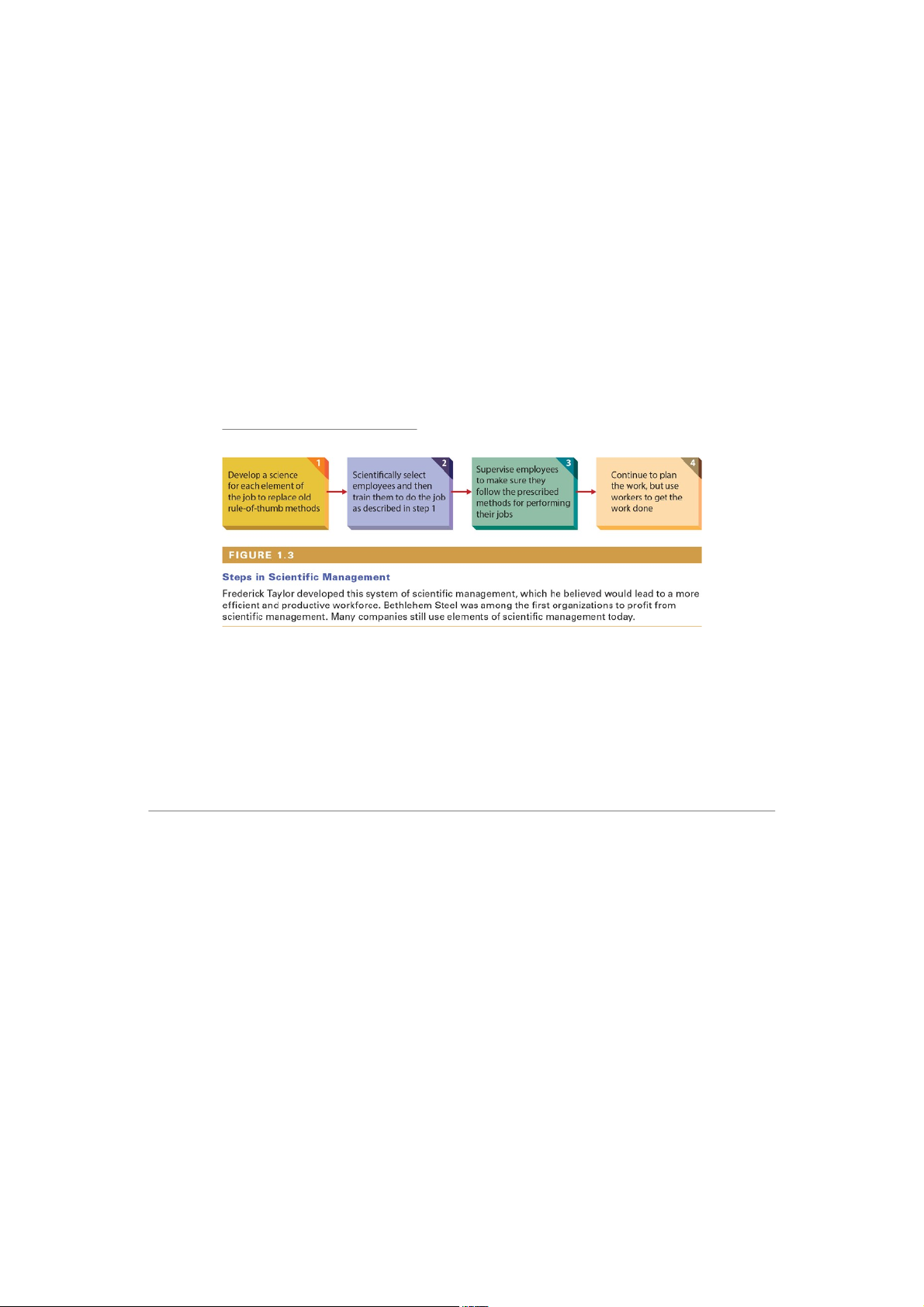
-Frederick W. Taylor (1856–1915)
oReplaced old work methods with scientifically-based work methods
oEliminated “soldiering,” where employees deliberately worked at a pace slower than their capabilities
oStudied and redesigned jobs, introduced rest periods to reduce fatigue, and implemented piecework pay systems
-Frank Gilbreth (1868–1924) and Lillian Gilbreth (1878–1972)
oPart of the scientific management movement
oBoth developed techniques and strategies for eliminating inefficiency.
Frank reduced bricklaying movements, resulting in increased output of about 200 percent
Lillian made substantive contributions to the fields of industrial psychology and personnel management
-Administrative management theorist:
-Henri Fayol (1841–1925)
oIdentified the specific management functions of planning, organizing, leading, and controlling
-Lyndall Urwick (1891–1983)
oIntegrated scientific management with the work of other administrative management theorists -Max Weber (–1920)
oHis theory of bureaucracy is based on a rational set of guidelines for structuring
organizations in the most efficient manner STEP IN SCIENTIFIC MANAGEMENTS
THE BEHAVIORAL MANAGEMENT PERSPECTIVE
•Behavioral management perspective:
−Emphasizes individual attitudes and behaviors and group processes
−Recognizing the importance of behavioral processes in the workplace.
Hugo Munsterberg (1863–1916)
-Recognized as the father of industrial psychology. He established a psychological laboratory -
Advocated applying psychological concepts to employee selection and motivation
•Mary Parker Follett (1868–1933)
−Recognized the importance of human behavior in the workplace
•Conducted at Western Electric’s Hawthorne plant •Illumination study:
−Lighting adjustments affected the productivity of both control and experimental groups of employees. •Group study:
−A piecework incentive pay plan caused workers to establish informal levels of individual output.
−Overproducing workers were labeled “rate busters.”
−Underproducing workers were considered “chiselers.” •Interview program:
−Confirmed the importance of human behavior in the workplace
•Human relations movement:
−Grew out of the Hawthorne studies
−Proposed that workers respond primarily to the social context of work, including social
conditioning, group norms, and interpersonal dynamics
−Assumed that the manager’s concern for workers would lead to increased worker
satisfaction and improved worker performance
•Abraham Maslow (1908–1970)
−Advanced a theory suggesting that employees are motivated by a hierarchy of needs that they seek to satisfy
•Douglas McGregor (1906–1964)
−Proposed Theory X and Theory Y concepts of managerial beliefs about people and work •Theory X:
−A pessimistic and negative view of workers consistent with the views of scientific management •Theory Y:
−A positive view of workers; it represents the assumptions that human relations advocates make
CONTEMPORARY BEHAVIORAL SCIENCE IN MANAGEMENT Organizational behavior: -
Contemporary field focusing on behavioral perspectives on management -
Draws on psychology, sociology, anthropology, economics, and medicine -
Takes a holistic view of behavior and addresses individual, group, and organization processes
Important organizational behavior topics: −Job satisfaction −Stress −Motivation −Leadership −Group dynamics −Organizational politics −Interpersonal conflict
−The structure and design of organizations •Contributions:
−The importance of behavioral process are more likely to be recognized by managers
−Managers are more likely to view employees as valuable resources instead of mere tools −Limitations
•The complexity of individuals makes behavior difficult to predict
•It is not always accepted or understood by practicing managers
THE QUANTITIVE MANAGEMENT PERSPECTIVE
•Quantitative management perspective:
−Applies quantitative techniques to management
−Helped Allied forces manage logistical problems during World War II
−Focuses on decision making, cost-effectiveness, mathematical models, and use of
computers to solve quantitative problems
•There are two branches of the quantitative approach: •Management science:
−Focuses specifically on the development of representative mathematical models
•Operations management:
−Concerned with helping the organization produce its products or services more efficiently •Contributions:
−Provides managers with an abundance of decision-making tools and techniques
−Increased understanding of overall organizational processes
−Particularly useful in the areas of planning and controlling −Limitations:
•Cannot fully account for individual behaviors and attitudes
•Competence needed may hinder the development of other managerial skills
•Typically require a set of assumptions that may not be realistic THE SYSTEMS PERSPECTIVE •System:
−An interrelated set of elements functioning as a whole. Includes inputs, transformation,
processes, outputs, and feedback •Open system
−An organizational system that interacts with its environment •Closed system
−A system that does not interact with its environment •Subsystems
−A system within another system, such as the relationship between marketing,
productions, and finance function •Synergy:
−Two or more subsystems working together to produce more than the total of what they might produce working alone
•For example, Disney creates licensing agreements for clothes, toys, and food when a new movie is released •Entropy:
−A normal process leading to system decline THE CONTINGENCY PERSPECTIVE
•Universal perspectives:
−Include the classical, behavioral, and quantitative approaches
−Try to identify the “one best way” to manage organizations
•Contingency perspective:
−Suggests that appropriate managerial behavior in a given situation depends on, or is
contingent on, unique elements that situation
CONTEMPORARY MANAGEMENT CHALLENGES
Globalization of product and service markets
•Increased emphasis on ethics and social responsibility
•The use of quality as the basis for competition
•The shift to a predominately service-based economy
•Meeting the challenges of a recovering economy
•An increasingly diverse workforce
•Creating new organizational structures to provide challenging, motivating, and flexible work environments
•The effects of new information technology on how work is done in organization
SUMMARY OF LEARNING OUTCOMES AND KEY POINTS
1. 1-1. Describe management and the kinds of managers found in organizations.
Management is a set of activities (planning and decision making, organizing, leading, and
controlling) directed at using an organization’s resources (human, financial, physical, and
information) to achieve organizational goals in an efficient and effective manner.
A manager is someone whose primary responsibility is to carry out the management
process within an organization.
Managers can be classified by level: top managers, middle managers, and first-line managers.
Managers can also be classified by area: marketing, finances, operations, human
resources, administration, and specialized.
2. 1-2. Explain the four basic management functions.
The basic activities of the management process include:
Planning and decision making (determining courses of action)
Organizing (coordinating activities and resources)
Leading (motivating and managing people)
Controlling (monitoring and evaluating activities)
3. 1-3. Describe the fundamental management skills and the concept of management as both science and art.
Effective managers have the following skills: technical, interpersonal, conceptual,
diagnostic, communication, decision making, and time management.
The effective practice of management requires a synthesis of science and art, a blend of
rational objectivity and intuitive insight.
1-4. Explain the importance of history and theory to managers.
Understanding the historical context can help managers avoid repeating the mistakes of others.
Theory helps managers develop and apply useful frameworks and new ways of thinking.
1-5. Explain the evolution of management thought through the classical, behavioral, and quantitative perspectives.
The classical management perspective, which paid little attention to the role of workers, had two
major branches: scientific management (concerned with improving efficiency and
work methods for individual workers) and administrative management (concerned with how
organizations themselves should be structured and arranged for efficient operations).
The behavioral management perspective, characterized by a concern for individual
and group behavior, emerged primarily as a result of the Hawthorne studies. The human relations
movement recognized the importance and potential of behavioral processes
in organizations but made many overly simplistic assumptions about those processes.
Organizational behavior, a more realistic outgrowth of the behavioral perspective, is of interest to many contemporary managers.
The quantitative management perspective, which attempts to apply quantitative techniques to
decision making and problem solving, has two components: management science and operations
management. These areas are also
of considerable importance to contemporary managers. Their contributions have been facilitated
by the tremendous increase in the use of personal computers and integrated information networks.
1-6. Discuss the key contemporary management pers- pectives represented by the systems and contingency perspectives.
• There are two relatively recent additions
to management theory that can serve
as frameworks for integrating the other perspectives: the systems perspective and the contingency perspective.
1-7. Identify the major challenges and opportunities faced by managers today.
• A variety of popular applied perspectives influence management practice today.
• Important issues and challenges facing managers include employee retention, diversity, the new
workforce, organization change, ethics and social responsibility, the importance of quality, and the
continued shift toward a service economy.
Tài liệu liên quan:
-

CHAP 1: Introduction to Management Concepts and Functions môn Principles of Management | Trường Đại học Quốc tế, Đại học Quốc gia Thành phố Hồ Chí Minh
1 1 -

Guidelines for group’s assignments: Analysing management issues of a FDI company based inVietnam môn Principles of Management | Trường Đại học Quốc tế, Đại học Quốc gia Thành phố Hồ Chí Minh
1 1 -
Financial Planning to Achieve 300m VND Goal in 3 Years môn Principles of Management | Trường Đại học Quốc tế, Đại học Quốc gia Thành phố Hồ Chí Minh
1 1 -

A Case Study in Fast Fashion Success môn Principles of Management | Trường Đại học Quốc tế, Đại học Quốc gia Thành phố Hồ Chí Minh
1 1 -

Chap 16 Hierarchy of Needs Theory and Applications môn Principles of Management | Trường Đại học Quốc tế, Đại học Quốc gia Thành phố Hồ Chí Minh
1 1