Chapter 10: Managing Employee Motivation And Performance môn Principles of Management | Trường Đại học Quốc tế, Đại học Quốc gia Thành phố Hồ Chí Minh
Individual performance is generally determined by three key factors: motivation, ability, and the work environment. Tài liệu giúp bạn tham khảo, ôn tập và đạt kết quả cao. Mời đọc đón xem!
Môn: Principles of Management 314 tài liệu
Trường: Trường Đại học Quốc tế, Đại học Quốc gia Thành phố Hồ Chí Minh 2 K tài liệu
Tác giả:















Preview text:
CHAPTER 10: MANAGING EMPLOYEE MOTIVATION AND PERFORMANCE
10-1 The nature of motivation
Motivation is the set of forces that cause people to behave in certain ways.
10-1a The Importance of Employee Motivation in the Workplace Individual Performance
Individual performance is generally determined by three key factors: motivation, ability, and the work environment.
1. Motivation – the desire to do the job
Motivation refers to how willing a person is to perform a task.
A highly motivated employee puts in more effort, shows persistence, and is more committed to
Without motivation, even capable employees may perform poorly.
Example: An employee who wants to achieve promotion will work harder and stay focused on goal
2. Ability – the capability to do the job
Ability includes skills, knowledge, experience, and talent.
Employees must have the necessary competencies to perform tasks effectively.
High motivation cannot compensate for a lack of ability.
Example: A worker may be highly motivated but will still perform poorly if they lack proper train
3. Work Environment – the resources needed to do the job
The work environment includes tools, equipment, information, support, and working conditions.
Even motivated and capable employees cannot perform well without proper resources.
A supportive environment enables employees to apply their motivation and ability effectively.
Example: A skilled employee cannot meet targets if they lack the necessary software or equipment.
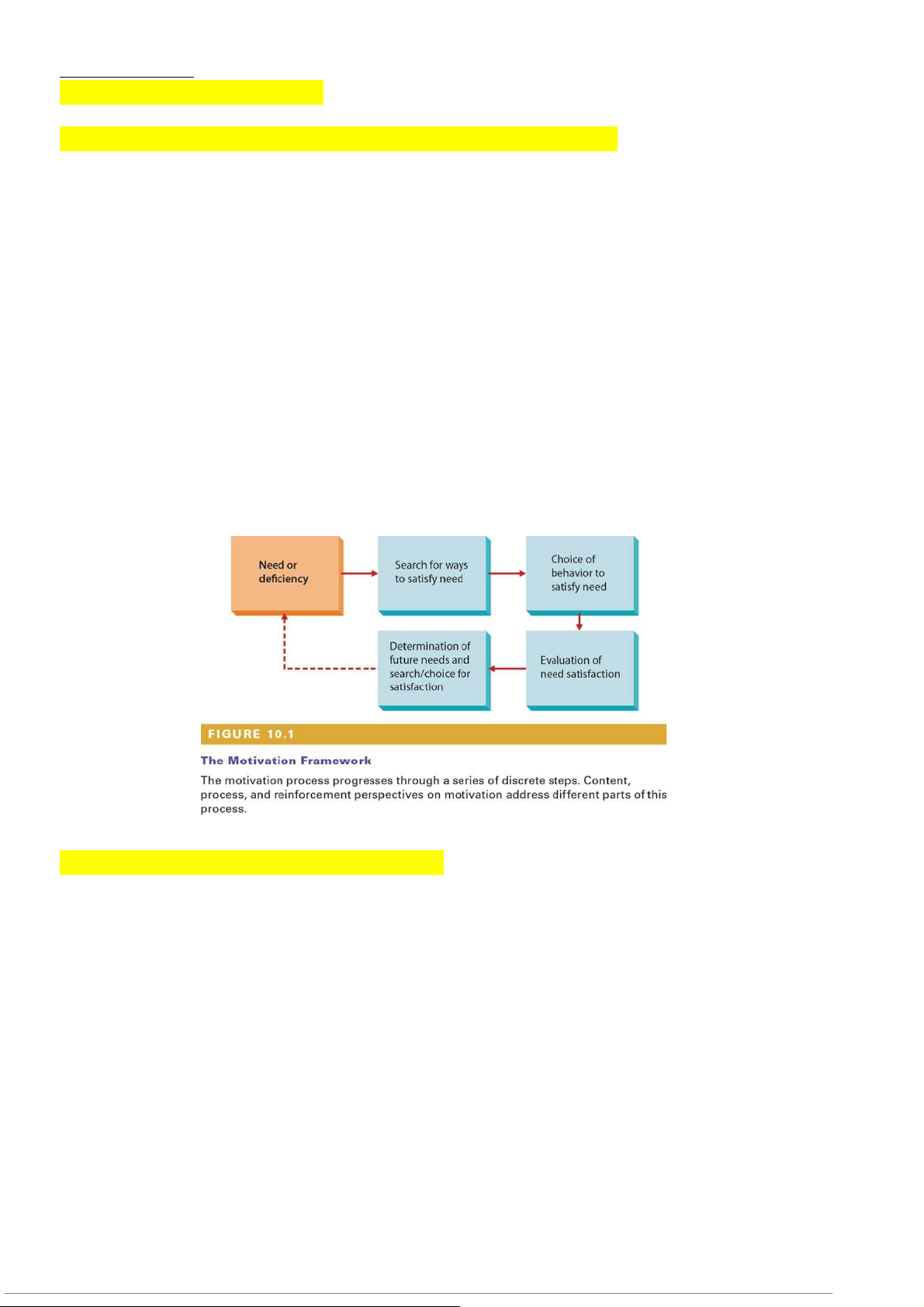
Figure 10.1 The Motivation Framework
10-1b Historical Perspectives on Motivation
Historical perspectives explain how views on employee motivation have changed over time.
They show the shift from seeing workers as motivated only by money to recognizing them as valu
contributors with social and developmental needs.
The three historical approaches to motivation Traditional approach
Key figure: Frederick Taylor (Scientific Management) Main assumption: People are motivated by money.
Employees work harder when they are paid more.
Motivation is increased through: Wages, Piece-rate pay, Financial rewards
Jobs are simplified and standardized to improve efficiency. Limitation: Treats workers like machines.
Ignores social and psychological needs.
Human relations approach Main idea:
People want to feel useful and important.
Motivation comes from: Social interaction, Recognition, A sense of belonging
Employees have strong social needs.
Supportive management and teamwork improve motivation and performance. Limitation: Overemphasizes social factors.
May ignore individual differences and performance outcomes.
Human resource approach Modern perspective Core belief:
Employees are valuable resources. Employees want to: oContribute meaningfully oDevelop their skills
oBe involved in decision-making
Motivation increases when organizations: oEmpower employees oProvide growth opportunities
oRecognize employee contributions Benefit:
Improves both individual satisfaction and organizational performance.
Which theory of motivation do you agree with most?
A. Most people are motivated by money.
B. Most people want to feel useful and contribute to something.
C. Most people are motivated because there is a need they wish to fill.
I agree most with option B.
Most people want to feel useful and contribute to something meaningful. While money is important,
usually not a strong long-term motivator. People are more motivated when they feel their work has
value, and impact. This type of motivation is more sustainable and leads to higher engagement and satisfaction at work.
If you want it shorter (for a poll or class discussion), you can use:
👉 B – Because people are motivated when they feel useful and can contribute to something meaningful.
10-2 Content Perspectives On Motivation
Content perspectives refer to an approach to motivation that tries to answer the question:
“What factors motivate people?”
This approach focuses on what motivates individuals, rather than how motivation occurs.
The main focus of content perspectives is on: Needs
Need deficiencies of individuals
The idea is that when people experience a lack or deficiency in certain needs, this creates motivati
in order to satisfy those needs.
Content perspectives of motivation include three main theories:
Maslow’s hierarchy of needs
This theory explains motivation based on different types of human needs that influence behavior.
Herzberg’s two-factor theory
This theory distinguishes between different factors related to motivation in the workplace.
McClelland’s achievement, power, and affiliation needs
This theory explains motivation in terms of three key needs: achievement, power, and affiliation.
10-2a The Needs Hierarchy Approach
Maslow’s hierarchy of needs is a content perspective on motivation.
It explains motivation by identifying what needs people have and how those needs influence behavio
Maslow suggests that people are motivated to satisfy five groups of needs in a specific order, from
level needs to higher-level needs. A need that is not yet satisfied becomes a source of motivation. Physiological Needs
Definition: Physiological needs involve attending to basic survival and biological functions.
These are the most basic needs of human beings. Without satisfying these needs, a person cannot f anything else.
Example: A worker who does not earn enough money to buy food or get proper rest will focus m
meeting these basic needs, not on career growth or recognition.
Security (Safety) Needs
Definition: Security needs involve seeking a safe physical and emotional environment.
Once physiological needs are met, people want stability and protection.
Example: An employee with a stable job contract and a safe working environment will feel more m
than someone who fears losing their job or working in unsafe conditions. Belongingness Needs
Definition: Belongingness needs involve experiencing love and affection.
At this level, people want to feel accepted and connected to others.
Example: An employee who feels included in a team and has good relationships with colleagues is
motivated than someone who feels isolated at work. Esteem Needs
Definition: Esteem needs involve having a positive self-image and receiving recognition and respect f others.
People want to feel confident, capable, and valued.
Example: When a manager praises an employee’s performance or gives a promotion, the employee’s needs are satisfied.
Self-Actualization Needs
Definition: Self-actualization means realizing one’s potential for personal growth and development.
This is the highest level of Maslow’s hierarchy.
Example: An employee who is given challenging work, opportunities to learn, and freedom to be cr
working toward self-actualization.
Contributions of Maslow’s Theory
Maslow’s theory made several important contributions:
It identified and categorized individual needs
It emphasized the importance of needs in motivation
It helped managers understand that different needs motivate people at different times
Weaknesses of Maslow’s Theory
Despite its value, the theory has limitations:
All levels of need are not always present for every individual
The ordering or importance of needs is not always the same
Cultural differences can affect how needs are ordered and which needs are most important
10-2a The ERG Theory
ERG Theory of Motivation
The ERG theory of motivation explains that people’s needs can be grouped into three categories.
These categories may overlap, meaning people can pursue more than one type of need at the same ERG stands for: Existence Needs
Meaning: Existence needs refer to the basic requirements for survival and physical well-being.
What this includes: Food, Water, Shelter, Pay and working conditions that support survival
In the workplace: Employees need adequate salary, safe working conditions, and job security to meet existence needs. Relatedness Needs
Meaning: Relatedness needs involve relationships and interactions with other people.
What this includes: Relationships with coworkers Support from supervisors
Feeling respected and accepted by others
In the workplace: Good communication, teamwork, and positive social interactions satisfy relatedness needs. Growth Needs
Meaning: Growth needs focus on personal development and realizing one’s potential.
What this includes: Learning new skills Career development
Challenging and meaningful work
In the workplace: Opportunities for training, promotion, and personal achievement help satisfy growth needs.
Frustration–Regression Element
A key feature of ERG theory is the frustration–regression principle. Explanation:
If a higher-level need (such as growth) remains unsatisfied,
the person may become frustrated,
then regress to a lower-level need,
and begin pursuing that lower-level need again.
Example: If an employee cannot achieve growth through promotion or learning, they may refocus on pay increases (existence), or
social relationships at work (relatedness).
The Two-Factor Theory (Herzberg)
Herzberg’s Two-Factor Theory explains that motivation is not a single process, but a two-stage proce
1 0 -2b Motivation as a Two-Stage Process -
Motivation becomes a two-stage process:
First, managers must ensure that hygiene factors are adequate.
Hygiene factors include: Salary, Working conditions, Company policies, Supervision and relationships
If these factors are poor or missing, employees become dissatisfied.
However, improving hygiene factors does not create motivation — it only removes dissatisfaction.
👉 In other words, salary alone cannot truly motivate employees; it only prevents complaints.
Create true motivation
Once dissatisfaction is removed, managers must focus on motivational factors.
Motivational factors include: Achievement, Recognition, Responsibility, Meaningful work, Personal growth
These factors can be increased through: Job enrichment Redesigning jobs
👉 These factors lead to real motivation, higher performance, and job satisfaction.
Criticisms of the Two-Factor Theory
Despite its influence, the theory has several criticisms:
1. Interview findings are subjective
Employees may blame external factors for dissatisfaction and credit themselves for success.
2. The sample was not representative
Herzberg’s research focused on a limited group of workers, reducing generalizability.
3. Later research has not fully supported the theory
Some studies show that factors like pay can act as both a hygiene factor and a motivator.
Summary (Exam-Friendly)
Herzberg’s Two-Factor Theory suggests that motivation requires eliminating dissatisfaction through hygi
factors and creating satisfaction through motivational factors. While the theory is useful for understan
intrinsic motivation, it has been criticized for methodological weaknesses and limited empirical suppor
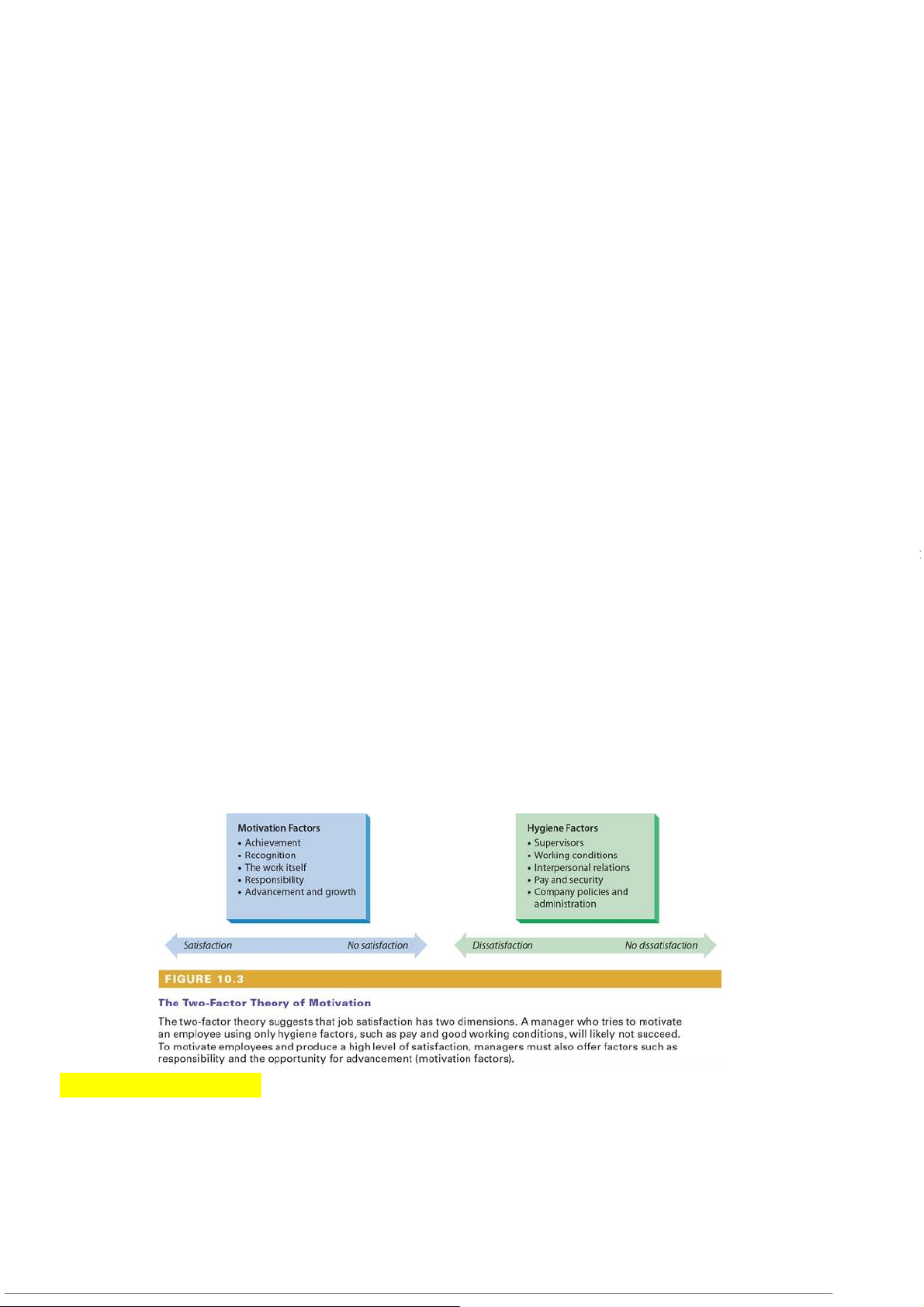
Figure 10.3 – The Two-Factor Theory of Motivation (Herzberg)
This figure shows that job satisfaction and job dissatisfaction are two separate dimensions, not opposi of the same thing.
Motivation Factors (Left side – Blue box)
These factors are related to the content of the job itself.
They determine whether an employee feels satisfied or not satisfied.
Motivation factors include: Achievement, Recognition, The work itself, Responsibility, Advancement and growth
👉 When these factors are present, employees feel satisfied and motivated.
👉 When they are absent, employees feel no satisfaction, but not necessarily dissatisfied. Key idea:
Motivation factors create positive motivation and high performance.
Hygiene Factors (Right side – Green box)
These factors are related to the work environment.
They determine whether an employee feels dissatisfied or not dissatisfied.
Hygiene factors include: Supervisors, Working conditions, Interpersonal relations, Pay and job security,
Company policies and administration
👉 When these factors are poor, employees feel dissatisfied.
👉 When they are adequate, employees feel no dissatisfaction, but they are not truly motivated. Key idea:
Hygiene factors prevent dissatisfaction, but do not create motivation.
Meaning of the Arrows in the Figure
Motivation factors move employees from no satisfaction → satisfaction
Hygiene factors move employees from dissatisfaction → no dissatisfaction ➡ This shows that:
Satisfaction ≠ Dissatisfaction
Removing dissatisfaction does not automatically create satisfaction
Overall Message of the Figure
A manager who relies only on hygiene factors such as pay and working conditions will not succes motivate employees.
To achieve high motivation and satisfaction, managers must also provide motivation factors such as
responsibility, meaningful work, and opportunities for growth.
Short exam-style summary
Herzberg’s Two-Factor Theory argues that job satisfaction and dissatisfaction are influenced by differe
factors. Hygiene factors prevent dissatisfaction, while motivation factors create true satisfaction and motivation. For
example : in a coffee shop, paying wages on time and improving working conditions removed em
dissatisfaction but did not create motivation. When the manager recognized employees’ achievements,
increased responsibility, and provided opportunities for growth, employees became more motivated and
satisfied. This example shows that hygiene factors only prevent dissatisfaction, whereas motivational f
generate true motivation, as explained by Herzberg’s Two-Factor Theory.
10-2c Individual Human Needs (McClelland)
McClelland argues that people are motivated by three learned needs.
Each individual is usually driven more strongly by one need than the others.
Need for Achievement (nAch)
Definition: The desire to accomplish a goal or task more effectively than in the past. Key characteristics:
Likes challenging but achievable goals
Prefers personal responsibility Wants feedback on performance
Real-life example: A salesperson sets a personal goal to exceed last month’s sales results, not just t
money, but to prove they can perform better than before.
Exam sentence:People with a high need for achievement are motivated by challenging goals and mea results.
Need for Affiliation (nAff)
Definition: The desire for human companionship, belonging, and acceptance. Key characteristics: Values teamwork and harmony Wants friendly relationships Avoids conflict
Real-life example:An employee prefers working in a team, enjoys group activities, and feels motivated
accepted and supported by colleagues.
Exam sentence: Individuals with a high need for affiliation are motivated by social relationships and of belonging.
Need for Power (nPow)
Definition: The desire to influence others and control one’s environment. Key characteristics: Enjoys leadership roles Wants authority and impact Likes making decisions
Real-life example: A team leader is motivated by directing others, making decisions, and influencing work is done.
Exam sentence:People with a high need for power are motivated by authority, influence, and control resources or people.
Short exam-ready summary (very useful)
McClelland’s theory states that motivation is driven by three learned needs: achievement, affiliation, a
power. Individuals are typically motivated more strongly by one dominant need, which influences the behavior at work.
Which theory of motivation argued that there are two stages in the process of motivating employees:
ensuring hygiene factors are not deficient and giving employees an opportunity to experience motivation factors?
A. Maslow’s hierarchy of needs
B. The ERG theory
C. Herzberg’s two-factor theory
D. McClelland’s human needs theory
Correct Answer: C. Herzberg’s two-factor theory
Explanation: Motivation factors are related specifically to the work content. Hygiene factors are relate
the work environment. Herzberg argued that there are two stages in the process of motivating empl
First, managers must ensure that the hygiene factors are not deficient. By providing hygiene factors
appropriate level, managers do not necessarily stimulate motivation but merely ensure that employees
“not dissatisfied.” In stage two, employees are given the opportunity to experience motivation factors
as achievement and recognition. The result is predicted to be higher levels of satisfaction and motiv
10-3 Process Perspectives (Process Perspectives on Motivation)
What are process perspectives?
Process perspectives are approaches to the study of motivation that focus on the mental processes o individuals, specifically:
Why people choose certain behaviors
What they consider before taking action
How they evaluate their level of satisfaction after achieving goals
👉 Unlike need-based theories (Maslow, Herzberg, McClelland), which answer the question “What do people need?”,
process perspectives answer the question “How do people think before and after they act?”
- Theories within Process Perspectives
(1) Expectancy Theory
Main idea: People are motivated when they believe that:
Effort leads to good performance
Good performance leads to desired rewards
👉 Simply put: “Is the effort worth it?”
Example: Employees work hard only when they believe that good performance will result in reward promotion.
(2) Porter–Lawler Extension of Expectancy Theory Main
idea: This theory extends expectancy theory by suggesting that:
Performance depends not only on effort
But also on ability and role perception
Satisfaction occurs after evaluating whether rewards are fair
👉 High performance does not always lead to satisfaction if rewards are perceived as unfair.
(3) Equity Theory
Main idea: People compare: Their inputs (effort, time)
With their outcomes (pay, rewards) And with those of others
👉 If they perceive inequity, motivation decreases.
Example: Two employees perform the same job but receive different pay; the lower-paid employee re effort.
(4) Goal-Setting Theory
Main idea: Specific and challenging but achievable goals create higher motivation than vague goals. 👉 “Do better” ❌
👉 “Increase sales by 20% in three months” ✅ Important conditions: Goals must be clear Feedback must be provided
Employees must accept the goals
Very short summary (useful for exams)
Process perspectives focus on how individuals make choices about behavior and evaluate outcomes a achieving goals.
Example: a salesperson is motivated to work harder because they believe that increased effort, comb
with ability and a supportive environment, will lead to high performance. High performance results i
rewards such as bonuses and promotion, which have high valence for the employee. Therefore, moti
strong according to expectancy theory.
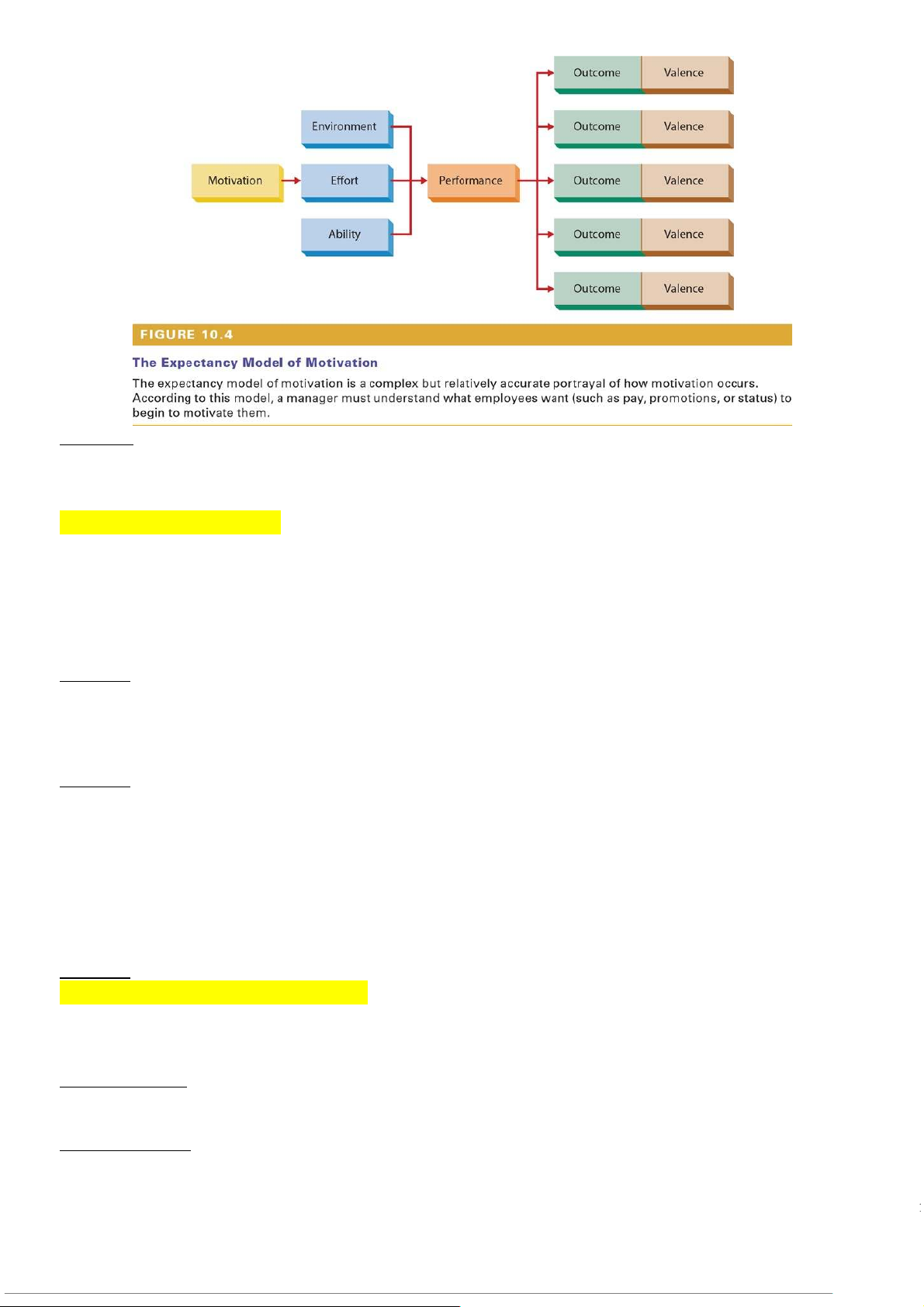
10-3a Expectancy Theory
People are motivated when they believe that effort will lead to good performance, performance will
outcomes, and those outcomes are valuable to them.
Effort-to-Performance Expectancy
The individual’s belief that increased effort will result in higher performance.
If people believe effort makes a difference, they are motivated.
If they do not believe effort leads to performance, motivation is low.
Example: An employee works harder because they believe extra effort will help them meet their sa
Performance-to-Outcome Expectancy
The individual’s belief that high performance will lead to specific outcomes or rewards.
High performance → rewards (bonus, promotion)
No link between performance and rewards → low motivation
Example: An employee believes that achieving targets will result in a bonus.
Outcomes (Consequences) are the rewards or consequences that follow performance.
Positive outcomes: bonuses, promotions, praise
Negative outcomes: penalties, criticism
Neutral outcomes: outcomes the individual does not care about
Valence is the value or attractiveness of an outcome to an individual.
Attractive outcomes → positive valence
Unattractive outcomes → negative valence
Indifferent outcomes → zero valence
Example: A cash bonus has high valence, while a simple certificate may have low or zero valence
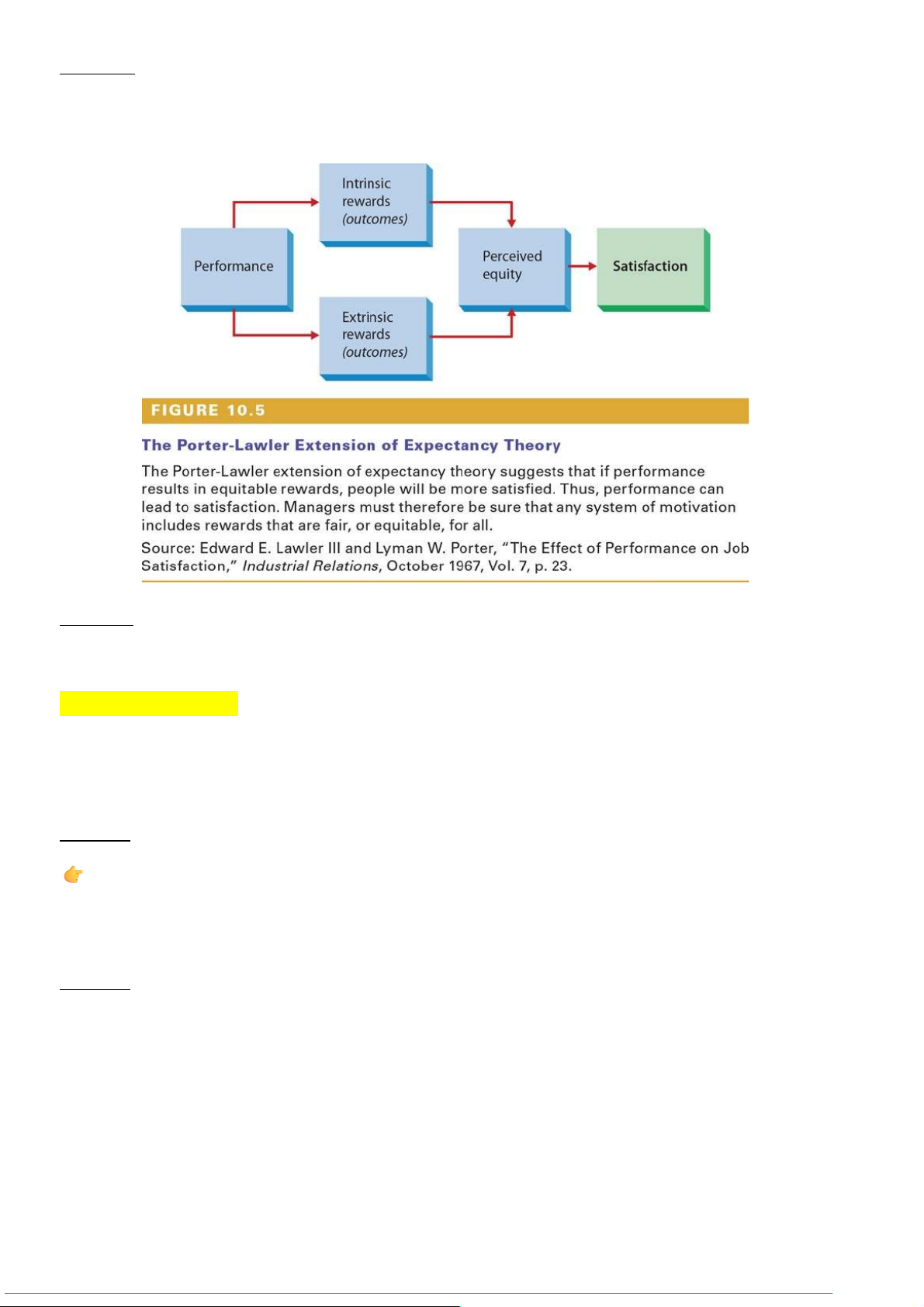
10-3a The Porter-Lawler Extension
The Porter–Lawler model extends expectancy theory by explaining how performance leads to rewards satisfaction.
High performance can lead to satisfaction only when rewards are fair and equitable. Key Assumptions
If performance results in fair and equitable rewards, people will be more satisfied.
High performance can lead to rewards and high satisfaction. Types of Rewards
Extrinsic Rewards are outcomes set and awarded by external parties, such as pay, bonuses, and promotion.
Intrinsic Rewards: are outcomes internal to the individual, such as self-esteem, pride, and a sen of accomplishment.
Example: An employee performs well at work and receives a bonus and promotion (extrinsic reward
At the same time, the employee feels proud and accomplished (intrinsic rewards).
If these rewards are perceived as fair, job satisfaction will be high. One-Sentence Summary
High performance leads to satisfaction only when both extrinsic and intrinsic rewards are perceived
Example: when a salesperson achieves high performance, they receive intrinsic rewards such as pride
sense of accomplishment, as well as extrinsic rewards such as bonuses and promotion opportunities.
rewards are perceived as fair, the employee will experience high job satisfaction. This illustrates the
Lawler extension of expectancy theory.
10-3b Equity Theory
Equity theory argues that people are motivated by perceived fairness in the relationship between wha
put into a job (inputs) and what they receive from it (outcomes), compared with others.
Inputs and Outcomes
Inputs: Time, Experience, Effort, Education, Loyalty
Outcomes: Pay, Recognition, Promotions, Social relationships, Intrinsic rewards
Example: Two employees, A and B, perform the same job and have similar experience and effort.
Employee A receives a higher salary than employee B.
👉 Employee B feels underrewarded and becomes less motivated.
Feeling Equitably Rewarded
When employees believe their input–outcome ratio is fair:
They accept the comparison as fair
They maintain their level of performance
Example: An employee who feels their pay matches their effort continues to work at the same leve
Feeling Underrewarded – Ways to Reduce Inequity
When employees feel underrewarded, they may:
1. Change inputs – work harder or slack off
2. Change outcomes – ask for a raise
3. Distort ratios – change perceptions of self or others
4. Leave the situation – quit the job
5. Choose another comparison person Feeling Overrewarded
When employees feel overrewarded, they may: Increase effort
Rationalize that they deserve the rewards Exam-Ready Example
According to equity theory, employees compare their inputs and outcomes with those of others. If t
underrewarded, they may reduce effort, demand higher pay, or leave the organization. When employe
equitably rewarded, they maintain their performance.
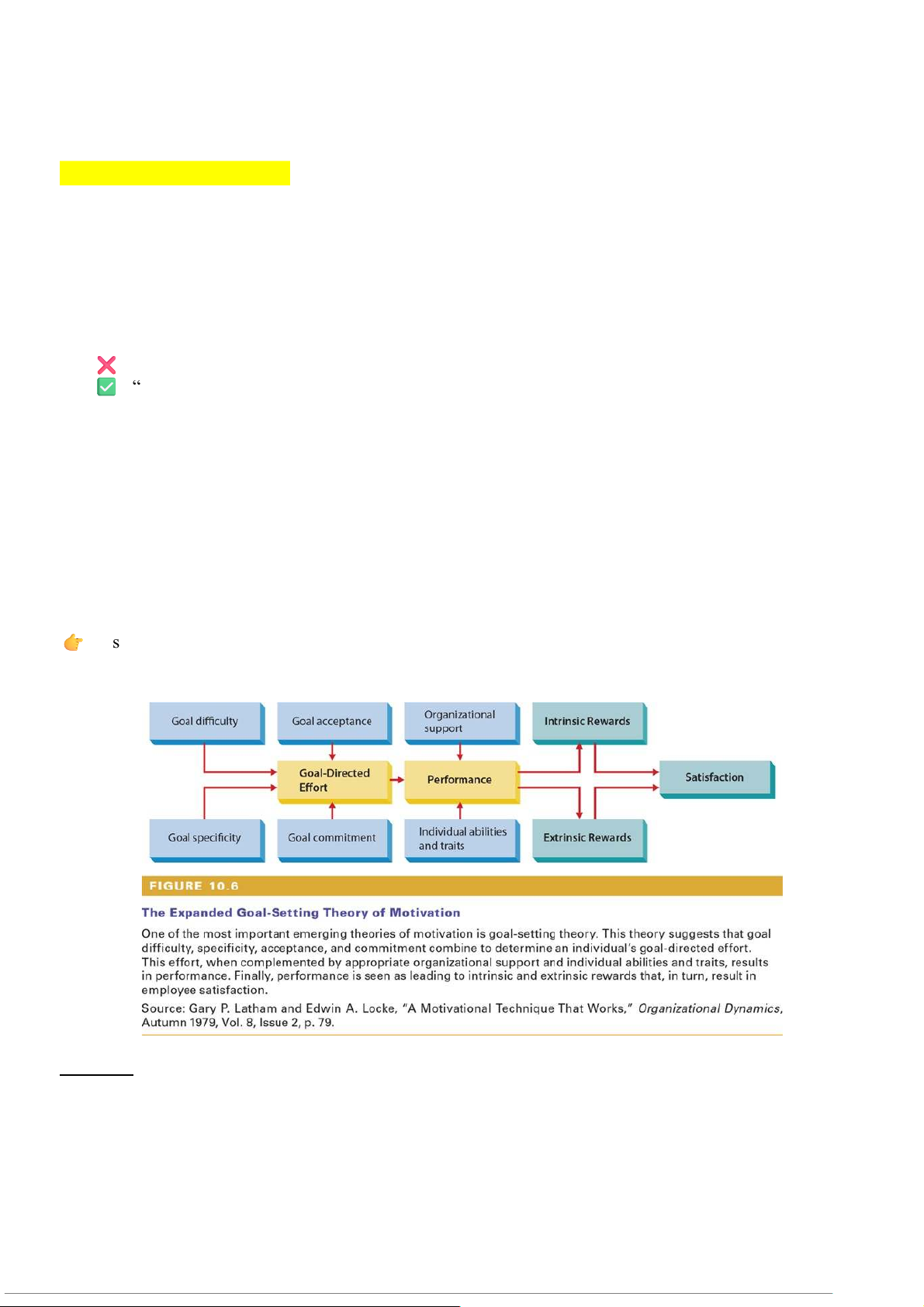
10-3c Goal-Setting Theory
Goal-Setting Theory argues that:
Behavior is a result of conscious goals and intentions
Setting goals directly influences behavior and performance in organizations
In short, people perform better when they have clear goals.
Characteristics of Effective Goals
Goal Difficulty: Goals should be challenging but achievable.
Difficult goals motivate higher performance than easy goals.
Goal Specificity: Goals should be clear and specific, not vague. ❌ “Do your best”
✅ “Increase sales by 15% in three months”
Goal Acceptance: Employees must accept the goal for it to be motivating.
If a goal is imposed and rejected, motivation will be low.
Goal Commitment Employees must be committed to achieving the goal and willing to put in effort.
Simple Example (Exam-friendly)
A manager sets a clear goal for a salesperson:
“Increase monthly sales by 20% within three months.” The goal is: Specific Challenging but achievable Accepted by the employee Supported by strong commitment
👉 As a result, the employee works harder and performance improves.
One-Sentence Summary Goal-Setting Theory states that specific and challenging goals, when accepted
supported by commitment, lead to higher performance.
Example: a salesperson is given a specific and challenging sales target that is accepted and supporte
commitment. With organizational support and personal ability, goal-directed effort leads to high
performance, resulting in intrinsic and extrinsic rewards and higher job satisfaction.
According to the Porter-Lawler extension, what is the relationship between satisfaction and performance?
A. High performance leads to high satisfaction
Porter and Lawler suggested that there may indeed be a relationship between satisfaction and performance
but that it goes in the opposite direction—that is, high performance may lead to high satisfaction.
Performance results in rewards for an individual. Some of these are extrinsic (such as pay and promotions)
others are intrinsic (such as self-esteem and accomplishment). The person evaluates the equity, or fairness,
of the rewards relative to the effort expended and the level of performance attained. If the rewards are
perceived to be equitable, the person is satisfied.
10-4 Reinforcement Theory
Reinforcement theory is an approach to motivation that argues that:
Behavior that results in rewarding consequences is likely to be repeated.
Behavior that results in punishing consequences is less likely to be repeated.
The theory focuses on the role of ,
rewards as rewards cause behavior to: Change, or Remain the s time. Simple Example
An employee performs well and receives a bonus → the behavior is repeated.
An employee violates company rules and is punished → the behavior is reduced.
One-Sentence Summary
Reinforcement theory explains motivation by showing that rewarded behavior is repeated, while punish
behavior is less likely to occur.
10-4a Kinds of Reinforcement in Organizations
Reinforcement refers to ways organizations encourage or discourage behavior by controlling its consequences.
Positive Reinforcement: Strengthening desired behavior by providing rewards or positive outcome after the behavior occurs.
Example: An employee meets sales targets and receives a bonus.
👉 The employee is likely to repeat the high-performance behavior.
Avoidance: Strengthening behavior by avoiding unpleasant consequences that would occur if the behavior were not performed.
Example: An employee completes reports on time to avoid being criticized by the manager.
👉 The behavior continues to prevent negative consequences.
Punishment: Weakening undesired behavior by applying negative or unpleasant consequences wh the behavior occurs.
Example: An employee repeatedly arrives late and receives a formal warning.
👉 The employee is less likely to arrive late again.
Extinction: Weakening undesired behavior by ignoring it or removing reinforcement. Example:
A manager ignores an employee’s attention-seeking complaints instead of responding to th
👉 Over time, the behavior decreases.
Short Exam-Ready Summary
Positive reinforcement and avoidance strengthen behavior, while punishment and extinction weaken undesired behavior. One-Sentence Takeaway
Behavior that is rewarded tends to be repeated, while behavior that is punished or ignored tends to disappear.
Benefits of Reinforcement Theory
1. Easy to understand and apply
Managers can change behavior simply by using rewards, punishment, or ignoring behavior.
2. Effective in shaping behavior quickly
Rewarded behavior is repeated, and punished behavior decreases rapidly.
3. Useful for routine and clearly defined tasks
Especially effective in sales, manufacturing, and service jobs.
4. Provides clear expectations
Employees know which behaviors will be rewarded or punished.
Drawbacks of Reinforcement Theory
1. Focuses only on observable behavior
It ignores internal thoughts, feelings, and needs of employees.
2. May reduce intrinsic motivation
Employees may work only for rewards, not because they enjoy or value the job.
3. Often effective only in the short term
When rewards stop, desired behavior may also stop.
4. Punishment can have negative side effects
Excessive punishment may cause fear, dissatisfaction, or turnover.
10-4b Providing Reinforcement in Organizations
This section explains how organizations arrange reinforcement schedules to influence employee behavior.
Fixed-Interval Schedule
Reinforcement is provided after a fixed period of time, regardless of how many times the behavior Example:
Regular weekly or monthly paychecks
Performance appraisals every quarter
Behavioral Effect: Employees tend to increase effort as the reward time approaches and reduce effort receiving the reward.
Advantages: Predictable and stable, Provides a sense of security
Disadvantages: Encourages short bursts of effort, Does not promote continuous high performance
Variable-Interval Schedule: Reinforcement is provided at unpredictable time intervals. Example
Occasional praise or feedback from a supervisor Surprise bonuses
Behavioral Effect: Employees maintain steady performance because they do not know when reinforcem will occur.
Advantages: Encourages consistent behavior, Sustains motivation over time
Disadvantages: May feel unfair, Less transparent
Fixed-Ratio Schedule: Reinforcement is provided after a fixed number of behaviors, regardless time. Example A bonus after every fifth sale
Commission based on number of contracts
Behavioral Effect: Encourages high productivity, but effort may drop after the reward is received.
Advantages: Strong link between effort and reward, Increases output quickly
Disadvantages: Can cause fatigue, Performance may fluctuate
Variable-Ratio Schedule: Reinforcement is provided after a varying number of behaviors. Example
Irregular praise from a supervisor Random performance bonuses Behavioral Effect
Creates strong and persistent motivation. Advantages
Most effective for maintaining behavior Encourages continuous effort Disadvantages May increase stress
Can appear unfair if poorly managed
10-4b Behavior Modification (OB Mod)
Organizational Behavior Modification (OB Mod) is a method of applying the principles of reinforcemen
theory in organizations to change employee behavior.
It focuses on linking specific behaviors to specific consequences. Key Ideas
Behavior is learned and can be changed.
Behaviors that are reinforced are more likely to be repeated.
Behaviors that are not reinforced or punished are less likely to continue.
Managers deliberately use rewards or consequences to shape behavior.
How OB Mod Works: Desired behavior → reinforcement → behavior is repeated
Undesired behavior → no reinforcement Example:
Situation: A company wants employees to arrive at work on time.
OB Mod application:
Desired behavior: Arriving on time
Reinforcement: Public praise or small bonus for perfect attendance
Result: Employees are more likely to arrive on time in the future.
Advantages: Clear and practical, Easy to measure behavior, Effective for routine and observable tasks
Disadvantages: Focuses only on external rewards, May ignore internal motivation, Can feel controlling overused Discussion #1
• Consider a class you have taken or a job you have held. Using that one experience, offer examples of ti
when the professor or manager used positive reinforcement, avoidance, punishment, and extinction to
manage students’ or employees’ behavior. Were there other types of reinforcement that might have worked
better? Why or why not?
Discussion #1 – Sample Answer
I will use my experience from a university class to answer this question. Positive Reinforcement
The professor used positive reinforcement by giving bonus points and verbal praise to students who
actively participated in class discussions.
This encouraged students to speak more and prepare better for each lesson. Avoidance
The professor applied avoidance by allowing students who submitted assignments on time to avoid
additional homework or penalties.
As a result, students were motivated to complete their work before the deadline. Punishment
Punishment was used when students submitted assignments late. They received grade reductions.
This reduced late submissions, but some students felt stressed or discouraged. Extinction
The professor used extinction by ignoring disruptive behavior, such as students talking during lectures
Over time, this behavior decreased because it no longer received attention.
Other Reinforcement Methods
Other types of reinforcement, such as positive reinforcement instead of punishment, might have work better.
For example, rewarding punctual submission rather than penalizing late work could create a more po learning environment. Conclusion
Overall, positive reinforcement was the most effective method because it motivated students without creating fear or stress.
Punishment was effective in controlling behavior, but it was less motivating in the long term.
10-5a Empowerment and Participation
Empowerment is the process of enabling employees to set their own work goals, make decisions
and solve problems within their authority. Advantages:
Increases motivation and job satisfaction
Encourages creativity and innovation
Improves responsibility and skill development Disadvantages:
Risk of poor decisions if employees lack experience
Requires training and trust from management
Not suitable for routine or highly controlled jobs
Participation is the process of giving employees a voice in decisions about their own work. Advantages:
Increases commitment and involvement
Improves decision quality through shared ideas Reduces resistance to change Disadvantages: Decision-making may be slower
Can create conflict among employees
Ineffective if participation is only symbolic
Short exam conclusion
Empowerment and participation can significantly increase motivation and performance. However, they
be applied carefully, with clear authority, proper training, and genuine involvement.
10-5b Alternative Forms of Work Arrangements
Compressed Work Schedule
Employees work a full 40-hour week in fewer than the traditional five days (e.g., 4 days × Advantages:
More days off → better work–life balance
Reduced commuting time and costs Higher job satisfaction Disadvantages:
Longer daily working hours → fatigue
Reduced productivity near the end of long shifts Not suitable for all jobs
Example: An employee works Monday–Thursday, 10 hours per day, and has Friday off.
“Nine-Eighty” Schedule
Employees work one normal 5-day week and one compressed 4-day week, getting one extra day of two weeks. Advantages: Regular long weekends Improved morale and motivation Maintains total working hours Disadvantages:
Scheduling complexity for managers
Possible coordination issues in teams
Longer workdays during compressed weeks Example:
An employee gets every other Friday off.
Flexible Work Schedules (Flex-time)
Employees can choose their working hours within broad organizational limits. Advantages: Better work–life balance Reduced stress Increased employee autonomy Disadvantages: Harder to coordinate teamwork
Managers may find supervision difficult
Not all roles allow flexibility
Example: An employee chooses to work from 7 a.m. to 3 p.m. instead of 9 a.m. to 5 p.m. Job Sharing
Two part-time employees share one full-time job. Advantages:
Retains skilled employees who cannot work full-time Reduces burnout
Greater flexibility for workers Disadvantages:
Requires strong communication between job sharers
Possible inconsistency in work output Higher coordination costs
Example: Two employees each work 20 hours per week in the same position.
Telecommuting (Remote Work)
Employees work part of their time offsite, usually from home. Advantages: Saves commuting time and costs
Increases flexibility and autonomy Can increase productivity Disadvantages: Social isolation Blurred work–life boundaries
Harder for managers to monitor performance
Example: An employee works from home three days a week and comes to the office two days.
Exam-Friendly Conclusion
Alternative forms of work arrangements provide greater flexibility and can improve employee satisfact
and work–life balance. However, they also create challenges in coordination, supervision, and consiste
Therefore, organizations must carefully choose arrangements that fit both job requirements and employ needs.
During the recent COVID-19 pandemic, many people worked alternative work schedules. Did you? If so, which?
A. Compressed work week B. Telecommuting
C. Flexible hours
D. No, I worked the same way as I usually do
Answer: C. Flexible hours
Explanation: I worked flexible hours during the pandemic. This allowed me to adjust my working t
better balance work and personal responsibilities, which reduced stress and improved productivity.
10-6 Reward Systems Reward System
A reward system refers to the formal and informal mechanisms by which employee performance is
evaluated, and rewarded within an organization.
Reward systems are designed to motivate employees, reinforce desired behaviors, and support organizational goals. Types of Rewards
Rewards in organizations can be divided into two main categories:
- Formal rewards: Salary and wages, Bonuses, Merit pay increases, Promotions
- Informal rewards: Verbal praise, Recognition from supervisors, Public acknowledgm of appreciation
Effects of Organizational Rewards -
Rewards motivate higher performance: Higher-level performance-based rewards motivate
employees to work harder. When employees believe that better performance leads to meaningfu
rewards, they are more likely to increase effort and productivity.
Example: Sales employees work harder when bonuses are tied directly to sales performance. - Rewards
align employee self-interest with organizational goals
Rewards help align employee self-interest with organizational goals.
Employees pursue their personal benefits (pay, promotion), while organizations pursue organizatio
objectives (profit, efficiency).
Performance-based rewards connect these two interests.
Example: A company rewards teams for meeting quality targets, encouraging employees to focus on quality. - Rewards
increase retention and organizational citizenship
Rewards foster increased retention and citizenship.
Retention: Employees are more likely to stay with the organization.
Organizational citizenship: Employees go beyond formal job duties, such as helping coworkers and supporting the organization.
Example: Employees who feel appreciated are more loyal and willing to contribute extra effort.
Importance of Reward Systems Effective reward systems: Increase motivation Improve performance Reduce turnover
Encourage positive workplace behavior
Poorly designed reward systems can lead to: Reduced motivation Perceptions of unfairness Decreased performance High employee turnover
10-6a Merit Reward Systems
1. Merit Pay refers to pay awarded to employees based on the relative value of their contributions organization.
Employees who contribute more receive greater rewards.
Pay increases are linked directly to performance rather than seniority alone.
Key idea: The greater the contribution, the greater the reward.
Example: An employee who consistently exceeds performance targets receives a higher salary increase
an employee who only meets minimum expectations.
2. Merit Pay Plan is a formal compensation system in which a meaningful portion of an employee’ pay is based on merit.
Performance evaluations determine pay increases.
Merit is typically measured using KPIs, performance appraisals, or objective results.
This system ensures that compensation is tied to individual performance rather than being distributed equally to all employees.
3. Purpose of Merit Reward Systems
Merit reward systems are designed to:
Motivate employees to perform at higher levels
Differentiate high performers from average performers
Align employee effort with organizational goals
4. Advantages of Merit Reward Systems
Encourages higher performance and productivity
Rewards employees fairly based on contributions
Helps retain high-performing employees
Strengthens the link between effort and reward
5. Disadvantages of Merit Reward Systems
Performance evaluations may be subjective
Can create perceptions of unfairness if criteria are unclear
May reduce teamwork if individual rewards are overemphasized
6. Conditions for Effectiveness
Merit pay systems work best when:
Performance criteria are clear and measurable
Evaluation processes are fair and transparent
Rewards are meaningful and valued by employees
7. Exam-Ready Summary
Merit reward systems link employee compensation to performance. Employees who contribute more to
organization receive greater rewards, which helps motivate performance and align individual goals wit organizational objectives.
10-6b Incentive Reward Systems
1. Incentive Reward Systems
Incentive reward systems are reward systems that provide additional rewards to employees based on
performance outcomes, usually beyond base salary.
These rewards can be monetary or nonmonetary and are designed to encourage higher productivity a performance.
2. Monetary Incentives
2.1 Piece-Rate Incentive Plan
A piece-rate incentive plan is a reward system in which the organization pays an employee a fixed
of money for every unit produced.
Key idea: The more units produced, the more money the employee earns.
Example: A factory worker is paid $2 for every product assembled. If the worker produces 500 un earn $1,000. Advantages:
Strong motivation to increase productivity Simple and easy to understand
Direct link between effort and reward Disadvantages: May reduce product quality Encourages speed over safety
Less suitable for complex or creative jobs
2.2 Sales Commissions Plan
A sales commission plan pays employees a percentage of the sales they generate by selling the firm products or services.
Example: A salesperson earns 10% commission on total sales. If they sell $50,000 worth of produc receive $5,000 in commission. Advantages:
Strong motivation to increase sales
Aligns employee goals with organizational revenue
Performance is easily measurable Disadvantages:
May encourage aggressive or unethical selling Income can be unstable
Less teamwork if employees compete excessively
3. Nonmonetary Incentives are rewards that do not involve direct cash payments. Examples include: Immediate, one-time rewards Days off Additional paid vacation time
Special perks (certificates, recognition, flexible hours)
Example: An employee who completes a major project early receives two extra paid vacation days. Advantages:
Cost-effective for organizations
Can improve morale and job satisfaction
Often appreciated more than small cash rewards Disadvantages:
May not motivate all employees equally
Harder to standardize and measure value
4. Purpose of Incentive Reward Systems
Incentive reward systems aim to: Increase employee motivation
Improve performance and productivity
Encourage goal-directed behavior
Reinforce desired behaviors quickly
5. Exam-Ready Summary
Incentive reward systems provide monetary and nonmonetary rewards based on specific performance
outcomes. Common forms include piece-rate pay, sales commissions, and nonmonetary incentives such
extra time off. These systems motivate employees by directly linking performance to rewards.
10-6c Team and Group Reward Systems
Team and group reward systems are compensation programs that reward employees based on collectiv
performance rather than individual performance.
These systems are designed to encourage cooperation, teamwork, and shared responsibility for organizational outcomes.
1. Gainsharing Programs are designed to share cost savings that result from productivity
improvements with employees.
When employees work more efficiently and reduce costs,
The organization shares a portion of those savings with the workforce.
Example: If a manufacturing team reduces waste and lowers production costs, part of the money sa
distributed as a bonus to employees. Advantages:
Encourages teamwork and cooperation
Motivates employees to focus on efficiency and cost control
Aligns employee behavior with organizational performance Disadvantages:
Difficult to measure individual contributions
Potential conflicts if employees feel rewards are unfairly distributed 2. Scanlon Plan
The Scanlon plan is similar to gainsharing, but the distribution of gains is weighted more heavily t employees.
Employees receive a larger share of productivity gains
Strong emphasis on employee involvement and participation
Example: If productivity improvements save the company money, a significant portion of those savin
returned directly to employees as bonuses. Advantages: Strong motivational effect
Employees feel valued and fairly rewarded
Encourages continuous improvement and innovation Disadvantages:
Higher cost to the organization
Requires transparent performance measurement systems
3. Profit-Sharing Plans provide employees with an annual bonus based on the company’s overall pro
If the company performs well financially, employees receive bonuses
If profits decline, bonuses may be reduced or eliminated
Example: At the end of the year, employees receive a bonus calculated as a percentage of the com profits. Advantages:
Aligns employee interests with long-term organizational success
Encourages loyalty and organizational commitment
Promotes a sense of ownership among employees Disadvantages:
Employees have limited control over total profits
Motivation may be weaker when profits are influenced by external factors Summary
Team and group reward systems include gainsharing programs, Scanlon plans, and profit-sharing plans
These systems reward employees based on collective outcomes such as cost savings, productivity
improvements, or organizational profits. By emphasizing group performance, they promote teamwork,
cooperation, and alignment between employee efforts and organizational goals.
10-6d Executive Compensation refers to the total pay and benefits provided to top-level manager
as CEOs, CFOs, and other senior executives. These compensation packages are designed to attract,
motivate, and retain executive talent while aligning their decisions with organizational performance.
1. Standard Forms of Executive Compensation Base Salary
A fixed annual amount paid to executives.
Provides income stability regardless of short-term performance.
Incentive Pay (Bonuses)
Additional compensation tied to performance targets.
Often based on financial results such as profits, revenue growth, or stock performance. Purpose:
To motivate executives to achieve specific short-term and medium-term goals.
2. Special Forms of Executive Compensation
Stock Option Plans
Give executives the right to buy company stock at a fixed price in the future.
Executives benefit financially if the company’s stock price rises. Purpose:
To align executives’ interests with shareholders’ interests and encourage long-term value creation. Executive Perks
Non-cash benefits provided to executives.
Examples include company cars, private jets, housing allowances, and exclusive insurance plans. Purpose:
To enhance executive satisfaction and reflect their senior status.
3. Criticism of Executive Compensation
Despite its intentions, executive compensation is often criticized for several reasons:
Excessively Large Compensation Packages
Executive pay is sometimes viewed as unreasonably high compared to company performance.
Weak Link to Long-Term Performance
Compensation may focus too much on short-term results rather than sustainable, long-term succes Earnings Gap
There is often a large pay gap between executives and average employees.
This gap can reduce employee morale and increase perceptions of unfairness.
Summary (Exam-Ready Paragraph)
Executive compensation includes base salary, incentive pay, stock option plans, and executive perks. W
these rewards aim to motivate executives and align their interests with organizational goals, they are
criticized for being excessively high, weakly linked to long-term performance, and contributing to lar
gaps between executives and regular employees.
10-6e New Approaches to Performance-Based Rewards
Organizations are increasingly adopting new approaches to performance-based rewards in order to imp
motivation, fairness, and employee commitment. - Employee Participation
Employee participation involves allowing employees to take part in deciding how rewards are distribu
When employees have a voice in reward decisions, they are more likely to perceive the system as
feel committed to organizational goals. -
Innovation in Incentive Programs
Organizations are redesigning incentive systems in more flexible and inclusive ways, including:
Offering stock options to all employees, not only top executives, so employees can benefit direct from organizational success.
Individualizing reward systems, meaning different employees may receive different incentives
based on their preferences, roles, or performance.
These innovations help ensure that rewards are more meaningful and motivating for diverse employee -
More Effective Communication
Effective reward systems require clear communication. Organizations should:
Share information about how rewards are earned
Explain how rewards are calculated and distributed
Clear communication strengthens trust, reduces misunderstandings, and helps employees understand the
between performance and rewards.
Short Summary (Exam-Ready)
New approaches to performance-based rewards emphasize employee participation, innovation in incentiv
programs, and improved communication. These approaches increase motivation, fairness, and alignment
between employee performance and organizational goals.
Tài liệu liên quan:
-

CHAP 1: Introduction to Management Concepts and Functions môn Principles of Management | Trường Đại học Quốc tế, Đại học Quốc gia Thành phố Hồ Chí Minh
15 8 -
Guidelines for group’s assignments: Analysing management issues of a FDI company based inVietnam môn Principles of Management | Trường Đại học Quốc tế, Đại học Quốc gia Thành phố Hồ Chí Minh
15 8 -
Financial Planning to Achieve 300m VND Goal in 3 Years môn Principles of Management | Trường Đại học Quốc tế, Đại học Quốc gia Thành phố Hồ Chí Minh
12 6 -
A Case Study in Fast Fashion Success môn Principles of Management | Trường Đại học Quốc tế, Đại học Quốc gia Thành phố Hồ Chí Minh
15 8 -
Chap 16 Hierarchy of Needs Theory and Applications môn Principles of Management | Trường Đại học Quốc tế, Đại học Quốc gia Thành phố Hồ Chí Minh
16 8