Chapter 11: Organizational Structures & Design môn Principle of Management | Trường Đại học Quốc tế, Đại học Quốc gia Thành phố Hồ Chí Minh
Organizing is the management step where you build a structure—think of it like drawing an outline for a project or sketching an org chart—and then place every person. Tài liệu giúp bạn tham khảo, ôn tập và đạt kết quả cao. Mời đọc đón xem!
Môn: Principles of Management 314 tài liệu
Trường: Trường Đại học Quốc tế, Đại học Quốc gia Thành phố Hồ Chí Minh 2 K tài liệu
Tác giả:
















Preview text:
Chapter 11: Organizational Structures and Design
1. Organizing as a Management Function
1. What is organization structure? - Or
ganizing (creating structures): Arranges people and resources to
work together to accomplish a goal; Divide up the work; Arrange
resources; Coordinate activities
Organizing is the management step where you build a structure—think of it
like drawing an outline for a project or sketching an org chart—and then
place every person, budget line, and piece of equipment into that outline. By
dividing up the big goal into smaller tasks, assigning people to each task,
giving them the resources they need, and ensuring they communicate and
cooperate, you create a system where everyone knows exactly what they’re
doing, when they do it, and where to go if they need help. That system is
your organizational structure, and without it, even the clearest plans remain just good ideas on paper.
Real-Life Example: A Lemonade Stand
Goal:+Sell lemonade profitably. Organizing Steps:
1. Divide Work+→ Kid #1 makes lemonade, Kid #2 handles money, Kid #3 advertises.
2. Arrange Resources+→ Pitcher, cups, table, cash box.
3. Coordinate+→ No ads until lemonade is ready, money person stays at the stand.
Without organizing?+Chaos—everyone mixes lemonade at once, cups run out, money gets lost. - Organization structure
The system of tasks, reporting relationships, and communication linkages
At its core, an organizational structure is a blueprint or framework that shows:
1. Which tasks need to be done.
2. Who will do each task.
3. How each person (or department) relates to others—who reports to whom.
4. How resources (money, equipment, information) are distributed.
In other words, it’s the “map” that tells every employee:
What they are responsible for (their role),
Who they work with (peer and supervisory relationships),
And which resources they can draw on to get their job done (budget,
materials, technology, etc.).
A clear structure makes it easier for everyone to understand their own job,
see how their work fits into the bigger picture, and know whom to approach
when they need help or information. 2. Formal structures
Formal structures (org charts, job descriptions, ofÏcial processes) tell you
who “should” do what and who “should” report to whom. -
An organization chart is a diagram describing reporting relationships
and the formal arrangement of work positions within an organization. It includes: The division Supervisory Communicati Major Levels of of work
relationships on channels subunits management
Formal structures in an organization are shown using something called an
organization chart. This is a picture or diagram that shows:
1. Who does what – how the work is divided up.
2. Who reports to whom – who is the boss or supervisor of each person.
3. How people communicate – what lines or methods are used to pass on information.
4. Main departments or teams – the major parts of the organization.
5. Different management levels – from top managers to regular staff.
Formal Structure - Everyday Example Restaurant: McDonald's
McDonald's Organizational Chart 1. Top Level:
oOwner/Franchisee+ → Oversees the entire restaurant.
oGeneral Manager (GM)+ → Runs daily operations. 2. Middle Management:
oAssistant Managers+ → Supervise shifts (open/mid/close). 3. Frontline Roles:
oCrew Trainers+ → Train new employees.
oCashiers+ → Take orders, handle payments.
oGrill Team+ → Cook burgers, fries.
oDrive-Thru Team+ → Manages drive-thru orders.
oMaintenance+ → Cleans dining area/restrooms.
How Formal Structure Works in Practice: Clear Reporting:
oCashiers report to Shift Manager → Assistant Manager → GM.
oGrill staff report to Kitchen Supervisor → GM. Standardized Rules:
oEvery Big Mac is made the same way (corporate procedures).
oEmployees follow strict hygiene/safety checklists. 3. Informal structures -
The set of unofÏcial relationships between organization members -
Social network analysis: Identifies informal structures and social
relationships in the organization
Informal structures are the real, day-to-day patterns of how people actually
talk, share information, and help each other.
What Informal Structures Are
Everyday relationships and networks that aren’t written down on an organizational chart.
Think of the coworkers you grab coffee with, the people you text or
chat with when you need a quick answer, or the friendships that
naturally develop across departments.
In other words, these are the unofÏcial lines of communication and
influence—who actually talks to whom, helps whom, and shares
information—outside of the formal “boss-and-subordinate” hierarchy.
Informal Structures - Real-Life Example
Tech Startup: A Fast-Growing Software Company
How Informal Structure Works:
While the company has a+formal org chart+(CEO → Managers →
Employees), day-to-day operations rely heavily on+unofÏcial networks:
1. Key Informal Relationships:
oThe "Go-To" Problem Solver:+ A senior developer who isn’t a
manager but helps debug issues.
oThe Coffee Break Network:+ Designers and marketers who
exchange ideas informally.
oThe Slack #random Channel:+ Where memes and off-topic chats
lead to unexpected collaborations.
2. Social Network Analysis Findings:
oHidden Influencers:+ An introverted data analyst whose insights are quietly respected.
oBottlenecks:+ A manager who hoards information, slowing down projects.
oCross-Team Bridges:+ A salesperson who casually connects
engineering with client needs. -
Potential advantages of informal structures:
Helping people accomplish their work
Overcoming limits of formal structure
Gaining access to interpersonal networks Informal learning
Why Informal Structures Can Be Helpful
1. Helps people get their work done faster
– If you need an answer quickly, you might text a friend in another
department rather than going through ofÏcial channels.
2. Fills the gaps left by formal rules
– Maybe the ofÏcial process for approving something is slow. An
informal relationship can often smooth things over so a small problem
doesn’t get stuck in red tape.
3. Opens access to a wider network
– By chatting with people outside your own team—at lunch, in
hallways, or in group chats—you learn about new resources, tips, or
expertise you wouldn’t find merely by sending a memo.
4. Encourages learning “on the fly”
– You pick up skills, tricks, and insider knowledge from colleagues in
casual conversations—knowledge that might not be included in ofÏcial training manuals. -
Potential disadvantages of informal structures:
May work against best interests of entire organization Susceptibility to rumor
May carry inaccurate information
May breed resistance to change
Diversion of work efforts from important objectives
Feeling of alienation by outsiders
Why Informal Structures Can Also Cause Trouble
1. They might work against the organization’s best interests
– For example, a tight-knit group might block outsiders or decisions
they don’t like, even if those decisions benefit the company as a whole.
2. Susceptible to rumors
– Informal networks spread news (and gossip) quickly. If someone
starts an unverified rumor, it can grow and cause confusion before the
ofÏcial facts are released.
3. May carry inaccurate or incomplete information
– Because it’s not “filtered” through ofÏcial channels, the details you
hear informally can be outdated or wrong.
4. Can breed resistance to change
– An informal clique might be comfortable with the way things are and
discourage any new policies or processes, even if those changes are necessary.
5. Diverts energy from ofÏcial objectives
– Spending too much time chatting about non-work topics or inter-
team rivalries can distract people from the goals laid out by senior management.
6. Some people feel left out
– If you’re not part of a particular informal group, you might miss out
on important tidbits of information, leading to frustration or a sense of alienation.
2. Traditional Organization Structures - Departmentalization
Groups of people with and jobs into work units or formal teams
These formal teams are linked to creating three major types of traditional organizational structures
What is Departmentalization? (Traditional Organization Structures)
Departmentalization means grouping people and their jobs into teams
based on what kind of work they do. This helps an organization run more smoothly. For example:
People who do marketing are in the Marketing Department.
People who handle money are in the Finance Department.
People who build or fix things are in the Operations Department.
These departments are formal work units—and they are the building
blocks of how a company is structured. Why It's Useful It makes it easier to: Organize tasks Assign responsibilities Communicate clearly
Improve teamwork among people doing similar jobs
1. Functional structures -
People with similar skills and performing similar tasks are grouped
together into formal work units -
Members work in their functional areas of expertise - Are not limited to businesses -
Work well for small organizations producing few products or services
What are Functional Structures?
Functional structures mean that people who do similar jobs or have
similar skills are put together in the same team or department. For example:
All the people who work with money are in the Finance Department.
All the people who deal with customers are in Customer Service.
All the people who work with computers are in IT.
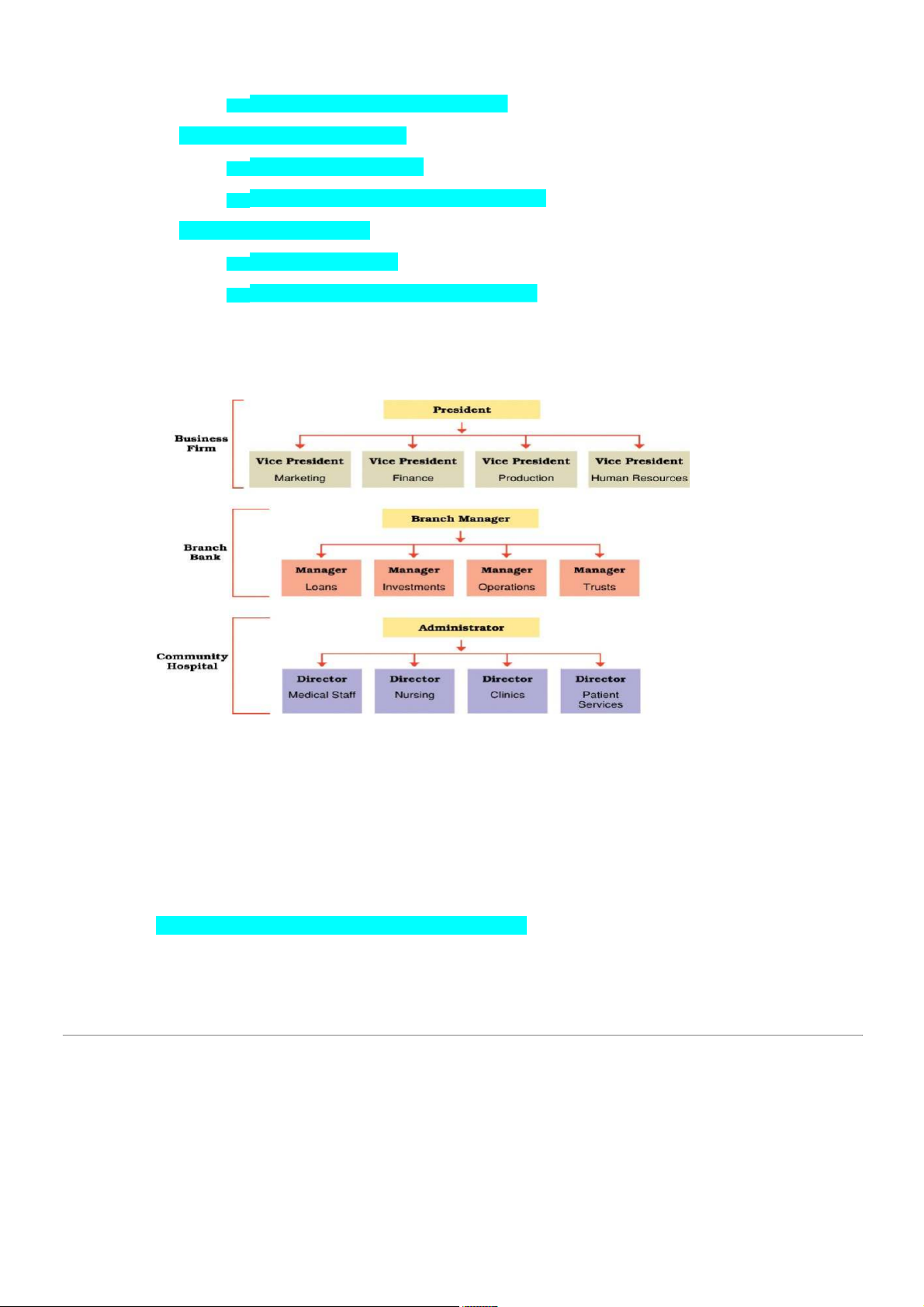
Real-Life Example 1: A Small Bakery
Departments (Functional Units):
1. Production (Baking Team) oBakers, pastry chefs
oTask: Follow recipes, bake goods
2. Sales & Customer Service oCashiers, order takers
oTask: Handle orders, serve customers 3. Purchasing/Inventory oManager, assistant
oTask: Buy flour, sugar, track supplies
Figure 11.2 Functional structures in a business, branch bank, and community hospital -
Potential advantages of functional structures: Economies of scale
Task assignments consistent with expertise and training
High-quality technical problem solving
In-depth training and skill development
Clear career paths within functions
Easy-to-Understand Advantages (Good things):
Save money by sharing tools, space, and systems (economies of scale).
People do jobs they are trained for.
It’s easy to solve technical problems.
Workers get good training and improve their skills.
People can grow their careers in their specific area (like marketing or nursing).
Potential disadvantages of functional structures: Sense of DifÏculties in Functional cooperation and Narrow view of Excessive upward pinpointing performance referral of responsibilities
chimneys problem common purpose objectives decisions break down
Simple Disadvantages (Problems to watch out for):
It can be hard to know who's responsible if something goes wrong.
Teams may only focus on their own work and not talk or cooperate well
with others (called “chimneys problem”).
People might lose the feeling of being one team.
Some people only focus on their part of the job and ignore the big picture.
Small decisions might always be sent to higher bosses, slowing things down.
2. Divisional structures -
Group together people who work on the same product or process,
serve similar customers, and/or are located in the same area or geographical region -
Common in complex organizations -
Avoid problems associated with functional structures
Divisional Structures (Easy Explanation)
People are grouped into teams based on what they work on, who their
customers are, or where they are located.
This setup is usually used in large or complex organizations.
It helps fix problems that can happen in more traditional (functional)
structures, like poor communication or slow decision-making. Example:
A company might have separate divisions for electronics, clothing, and
furniture, each with its own team handling everything from marketing to sales in that category.
Real-Life Example 1: Samsung Electronics
Divisions by Product Line:
1. Mobile Division+→ Smartphones, tablets.
2. Consumer Electronics+→ TVs, refrigerators.
3. Semiconductor Division+→ Chips for other companies.
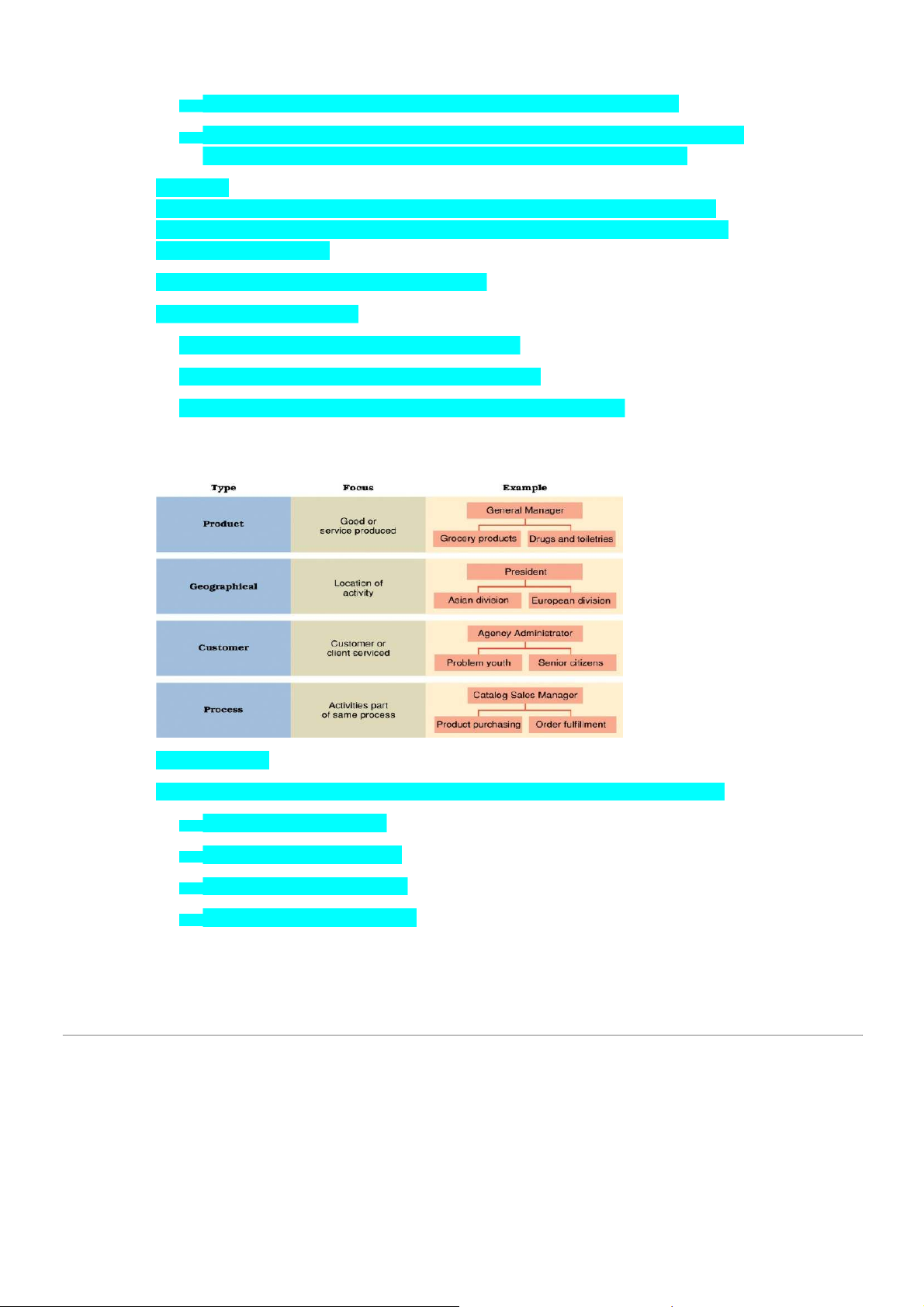
Figure 11.3 Divisional structures based on product, geography, customer, and process What It Means
Divisional structures organize people based on what they work on—like: The product they make
The location they work in
The customers they serve
Or the process they handle
Each division has its own team that focuses on that area. For example:
One team works only on grocery products
Another team works with Asian customers
Another focuses on order fulfillment -
Potential advantages of divisional structures:
More flexibility in responding to environmental changes Improved coordination
Clear points of responsibility
Expertise focused on specific customers, products, and regions Greater ease in restructuring
Easy Advantages (Good Things):
More flexible when things around the company change
Better teamwork inside each division
It’s clear who is responsible for what
Each team can become really good at serving their own customers or area
Easier to change or reorganize if needed
Potential disadvantages of divisional structures: Duplication of resources Competition and poor Emphasis on divisional and efforts across coordination across goals at expense of divisions divisions organizational goals
Simple Disadvantages (Problems to Watch Out For):
Different teams may do the same work, wasting time and money
Teams might compete or not work well together
Each division may care more about its own goals than the whole company’s success 3. Matrix structures -
Combines functional and divisional structures to gain advantages and
minimize disadvantages of each
Matrix Structures (Easy Explanation)
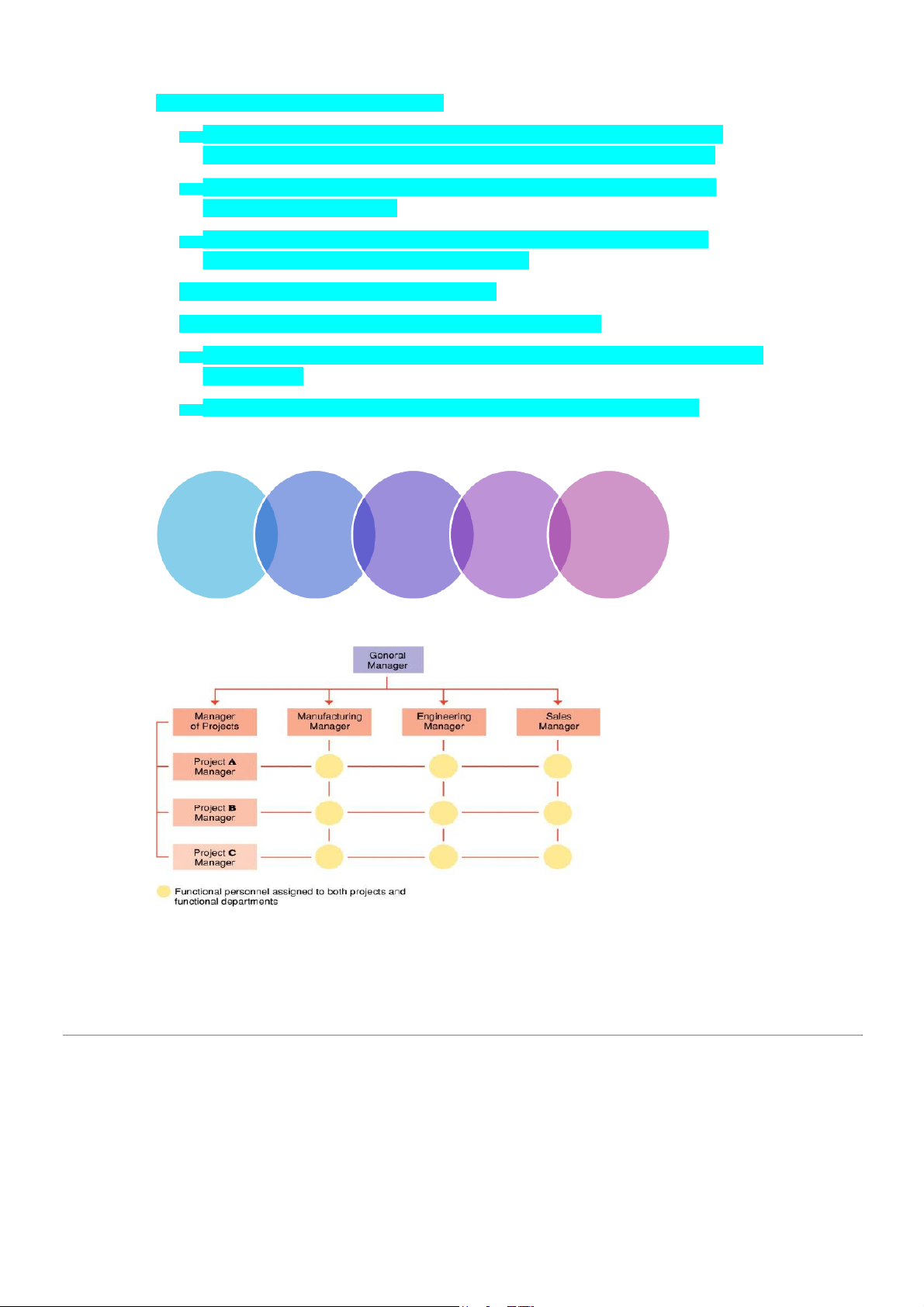
A matrix structure mixes both functional (based on job types) and
divisional (based on products, customers, or location) structures.
This helps an organization get the benefits of both systems while reducing their problems.
It is often used in manufacturing, service industries, non-profits,
professional work, and global companies.
Tech companies like Google or Microsoft
These companies often use a matrix structure where:
Employees report to both a functional manager (e.g., Head of Software Engineering)
And a project or product manager (e.g., Lead for Google Maps) - Used in: Manufacturi Service Professional Non-profit Multi-national ng industries fields sector corporations
Figure 11.4 Matrix structure in a small, multi-project business firm -
Potential advantages of matrix structures:
Better cooperation across functions Improved decision making
Increased flexibility in restructuring Better customer service
Better performance accountability Improved strategic management
Advantages (Why it’s useful):
Teams from different areas work better together
Faster and smarter decisions
Easy to adjust when things change Good customer support
Clear responsibility for results
Strong overall planning and strategy
Potential disadvantages of matrix structures: Two-boss system Increased costs Two-boss system is can create task susceptible to confusion and
Team meetings are Team may develop due to adding time consuming “groupitis ” team leaders to power struggles conflict in work structure priorities
Disadvantages (Problems it can cause):
People might have two bosses, which can cause confusion and power struggles
Teamwork takes more time, including lots of meetings
Conflicting priorities can happen
Teams might get too comfortable and resist change
Costs go up because more team leaders are needed
3. Horizontal Organization Structures 1. Team structures -
Extensively use permanent and temporary teams to solve problems,
complete special projects, and accomplish day-to-day tasks -
Often use cross-functional teams composed of members from different functional departments -
Project teams are convened for a specific task or project and disbanded once completed
Team Structures (Easy Explanation)
Organizations use teams (both long-term and short-term) to solve
problems, do special projects, and handle daily tasks.
These teams often include people from different departments (like sales, HR, engineering).
Once a project is done, the team may be disbanded. Pixar Animation Studios
How Pixar uses horizontal team structures:
Cross-functional teams include animators, writers, software engineers,
sound designers, and producers working collaboratively on each movie project.
Teams are formed specifically for each film (e.g., Toy Story, Finding
Nemo) and often disband or reshufÒe after the project is completed.
There’s minimal hierarchy—employees at all levels are encouraged to
share feedback, regardless of position.
Figure 11.5 How a team structure uses cross-functional teams for improved lateral relations -
Potential advantages of team structures:
Eliminates difÏculties with communication and decision making
Eliminate barriers between operating departments Improved morale
Greater sense of involvement and identification Increased enthusiasm for work
Improved quality and speed of decision making
Advantages (Why teams are good):
Better communication and faster decisions
Breaks down walls between departments Happier team members
People feel more involved and motivated
Higher work quality and quicker problem solving
Potential disadvantages of team structures: Effective use of time depends Conflicting loyalties among Excessive time spent in on quality of interpersonal members meetings relations, group dynamics, and team management
Disadvantages (What can go wrong):
People might feel torn between team and department
Teams can waste too much time in meetings
Success depends on how well people work together and how well the team is managed 2. Network structures -
Uses information technologies to link with networks of outside
suppliers and service contractors -
Own only core components and use strategic
alliances or outsourcing to provide other components
Network Structures (Made Easy)
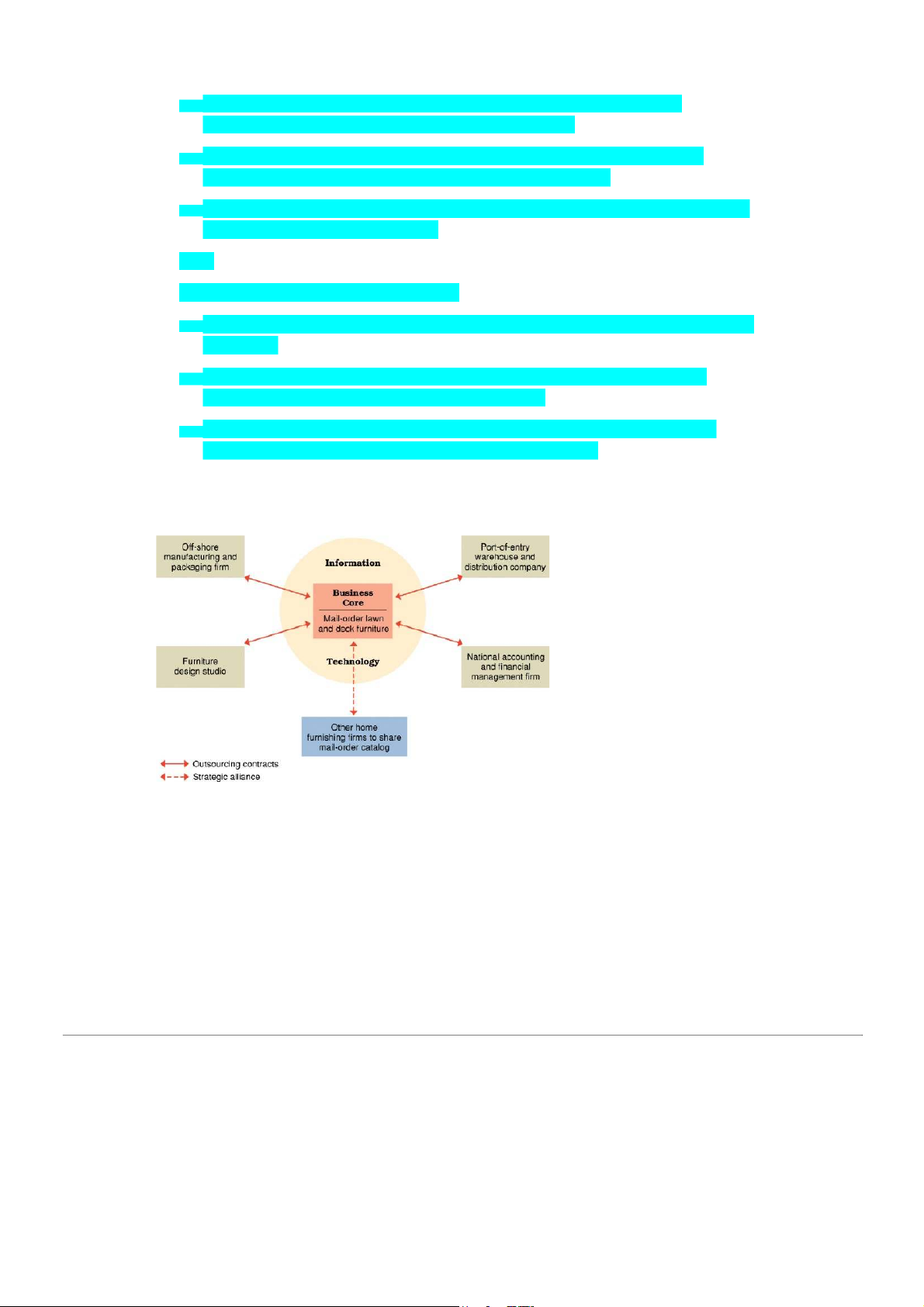
A network structure uses technology to connect with outside
companies (like suppliers or service providers).
The company keeps only its core parts (like design or customer
service) and outsources the rest to outside experts.
It’s like the company is the “brain,” and it connects with “hands” and
“legs” outside to do the work. Nike
How Nike uses a network structure:
Nike focuses on core components like product design, marketing, and branding.
It outsources manufacturing to a global network of independent
contractors and suppliers, primarily in Asia.
Uses information technology systems to coordinate with external
partners for production, logistics, and distribution.
Figure 11.6 A network structure for a Web-based retail business -
Potential advantages of network structures:
Firms can operate with fewer full-time employees and less complex internal systems
Reduced overhead costs and increased operating efÏciency
Permits operations across great distances
Advantages (Why it’s helpful):
The company can run with fewer full-time workers
Saves money and resources
Can work across far distances (great for global business)
Easier to be flexible and efÏcient -
Potential disadvantages of network structures:
Control and coordination problems may arise from network complexity
Potential loss of control over outsourced activities
Potential lack of loyalty among infrequently used contractors
Excessively aggressive outsourcing can be dangerous
Disadvantages (What can go wrong):
Hard to control and coordinate everything
Might lose control over outside work
Outside partners may not feel loyal or dedicated
Outsourcing too much can become risky or unsafe
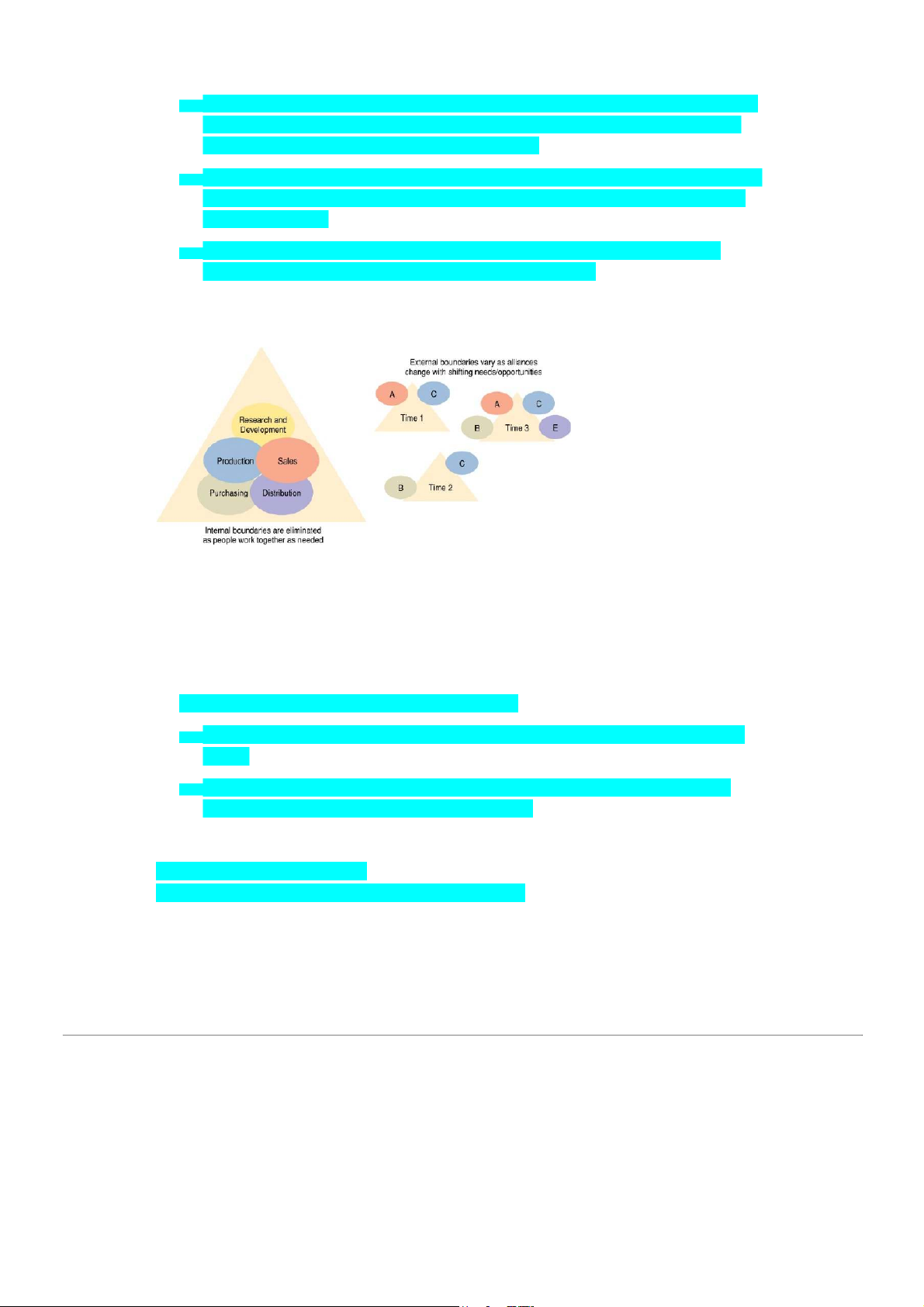
3. Boundaryless structures -
Eliminate internal boundaries among subsystems and external
boundaries with the external environment -
A combination of team and network structures, with the addition of “temporariness”
Boundaryless Structures (Simple Explanation)
These types of organizations remove walls inside the company
(between departments) and walls outside (with other companies or partners).
They mix teamwork and network-style working.
Things are often temporary — teams and partnerships change when needed.
W.L. Gore & Associates (maker of GORE-TEX)
How W.L. Gore uses a boundaryless structure:
No formal hierarchy or job titles—employees are called "associates"
and work in fluid, self-managed teams.
Teams form organically around projects, and leadership is based on
followership, not formal authority.
The company collaborates openly with outside partners and suppliers
and encourages cross-departmental innovation.
Work is project-based and temporary, with teams assembling and disbanding as needed. - Key requirements: Absence of hierarchy Empowerment of team members Technology utilization Acceptance of impermanence
What’s Needed to Work This Way:
No strict boss system (less hierarchy)
Team members have power to make decisions
Use technology to stay connected and work better
Be okay with change — nothing stays the same for long - Boundaryless organizations
Encourage creativity, quality, timeliness, flexibility, and efÏciency
Knowledge sharing is both a goal and essential component
Why Use Boundaryless Structures?
They help people be more: oCreative oFast oFlexible oEfÏcient oHigh quality
Sharing knowledge is super important here — everyone learns from each other.
How GitHub reflects a boundaryless organization:
Global, remote-first workforce: GitHub has employees and
collaborators worldwide, working across time zones without traditional
geographic or departmental boundaries.
Cross-functional, self-organizing teams: Employees collaborate across
roles like engineering, design, and customer support, forming fluid
teams based on project needs.
Open knowledge sharing: As a platform built on and for open-source
collaboration, GitHub encourages transparent communication, shared
repositories, and open feedback—core to knowledge flow.
Flexible, tech-driven structure: Uses modern communication tools and
project management systems to stay connected and efÏcient without rigid hierarchies. - Virtual organization
A special form of boundaryless organization
Operates in a shifting network of external alliances that are engaged as
needed, using IT and the Internet Virtual Organization
A special kind of boundaryless organization.
It doesn’t have a fixed structure.
It works with different outside partners, only when needed.
Uses technology and the internet to connect and work as a team, even from different places. Upwork
How Upwork operates as a virtual organization:
No central physical structure: Upwork operates almost entirely online,
connecting clients with freelancers around the world.
Dynamic, project-based alliances: Businesses form temporary working
relationships with independent contractors and agencies for specific
tasks (e.g., design, writing, programming).
Runs on IT and the Internet: All operations—communication, contracts,
payments, and project management—are handled through Upwork’s digital platform.
No permanent workforce for most tasks: The "organization" shifts
constantly based on who is hired for each project.
Figure 11.7 The boundaryless organization eliminates internal and external barriers
4. Organizational Designs -
Process of creating structures that accomplish mission and objectives -
A problem-solving activity that should be approached from a contingency perspective
Organizational Designs (Basic Explanation)
This means creating a structure for a company that helps it reach its goals.
It’s like solving a problem — you have to choose the best structure
based on the company’s unique situation.
1. Contingency in organizational design
“Contingency” just means:
There’s no one right way to design a company.
Tài liệu liên quan:
-

CHAP 1: Introduction to Management Concepts and Functions môn Principles of Management | Trường Đại học Quốc tế, Đại học Quốc gia Thành phố Hồ Chí Minh
1 1 -
Guidelines for group’s assignments: Analysing management issues of a FDI company based inVietnam môn Principles of Management | Trường Đại học Quốc tế, Đại học Quốc gia Thành phố Hồ Chí Minh
1 1 -
Financial Planning to Achieve 300m VND Goal in 3 Years môn Principles of Management | Trường Đại học Quốc tế, Đại học Quốc gia Thành phố Hồ Chí Minh
1 1 -

A Case Study in Fast Fashion Success môn Principles of Management | Trường Đại học Quốc tế, Đại học Quốc gia Thành phố Hồ Chí Minh
1 1 -
Chap 16 Hierarchy of Needs Theory and Applications môn Principles of Management | Trường Đại học Quốc tế, Đại học Quốc gia Thành phố Hồ Chí Minh
1 1