Chapter 14: Leadership Development and Power Dynamics in Management môn Principle of Management | Trường Đại học Quốc tế, Đại học Quốc gia Thành phố Hồ Chí Minh
Leadership means encouraging and motivating people to do their best so that an important goal can be reached. It’s not about forcing others — it’s about inspiring them to work hard and do well. Tài liệu giúp bạn tham khảo, ôn tập và đạt kết quả cao. Mời đọc đón xem!
Môn: Principles of Management 314 tài liệu
Trường: Trường Đại học Quốc tế, Đại học Quốc gia Thành phố Hồ Chí Minh 2 K tài liệu
Tác giả:



















Preview text:
Chapter 14: Leading and Leadership Development
1. The Nature of Leadership 1. Leadership and power -
Leadership: The process of inspiring others to work hard to accomplish important tasks
Leadership means encouraging and motivating people to do their best so
that an important goal can be reached. It’s not about forcing others — it’s
about inspiring them to work hard and do well.
Contemporary leadership challenges: Complex, ambiguous, Shorter time frames for High performance and multidimensional Scarce resources accomplishing things expectations problems
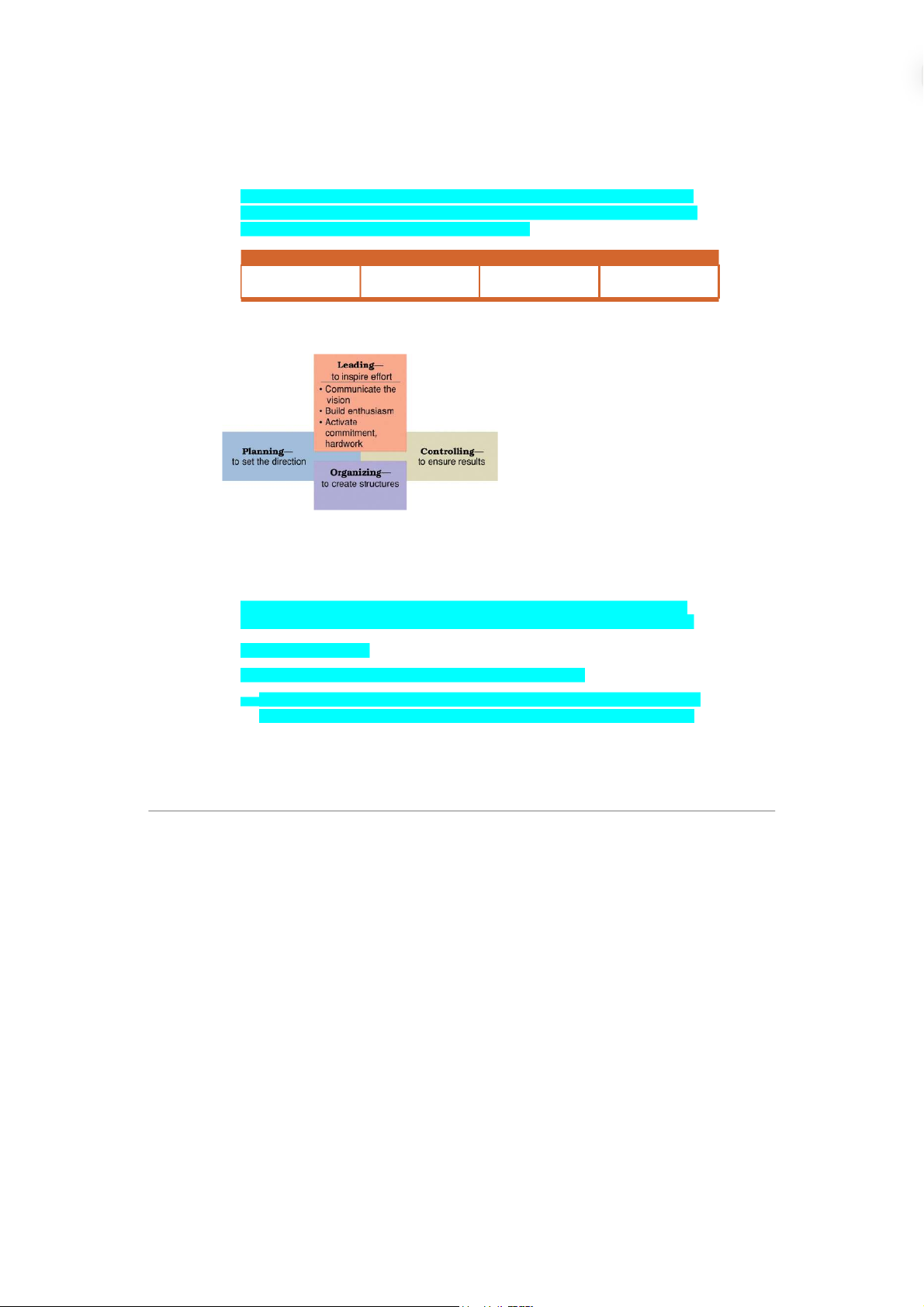
Figure 14.1 Leading viewed in relationship to the other management functions -
Power: Ability to get someone else to do something you want done or
make things happen the way you want; Power should be used to
influence and control others for the common good rather seeking to
exercise control for personal satisfaction
Power is the ability to influence or guide someone to do something. But power should be
used in a positive way — to help the team or group succeed — not just to benefit yourself. Real-Life Example:
Think about a school project with a group of students.
One student becomes the leader — they don’t boss others around, but
instead say things like, “Let’s divide the work so we all finish on time,”
or “You’re good at designing slides — why don’t you handle the visuals?”
That student is using power in a good way — not to control others
for fun, but to help everyone succeed and finish the project well. -
Two sources of managerial power: Position Personal power power -
Position power :Based on a manager’s ofÏcial status in the
organization’s hierarchy of authority - Sources of position power: R
eward power (Capability to offer something of value ); Coer
cive power (Capability to punish or withhold positive
outcomes );Legitimate power (Organizational position or status confers
the right to control those in subordinate positions )
Position power comes from someone’s ofÏcial role or job title in an
organization. This means they have authority because of the position they
hold, not just because of their personality or skills.
Sources of Position Power:
1. Reward Power – The ability to give something valuable, like a bonus, praise, or promotion.
Example: A boss gives an employee a day off for doing a great job.
2. Coercive Power – The ability to punish or take away something positive.
Example: A manager warns an employee they’ll lose a privilege (like
flexible hours) if they miss deadlines.
3. Legitimate Power – Power that comes from the ofÏcial job title or role.
Example: A teacher can assign homework because their position gives
them that authority over students. Real-Life Example:
Imagine you're working at a fast-food restaurant.
Your shift manager has position power because they are ofÏcially in charge.
oThey can reward you with a better shift (reward power).
oThey can scold or write you up for being late (coercive power).
oAnd they can assign tasks like cleaning or working the register
because it's their role (legitimate power). -
Personal power :Based on the unique personal qualities that a person
brings to the leadership situation -
Sources of personal power: Expert power (Capacity to influence others
because of one’s knowledge and skills );Referent power (Capacity to
influence others because they admire you and want to identify positively with you )
Personal power comes from who you are as a person — your skills,
experience, and how others see you. It’s not about your job title, but about
the qualities that make people respect, trust, or admire you.
Sources of Personal Power:
1. Expert Power – People listen to you because you know a lot or are really good at something.
Example: A tech-savvy friend everyone asks for help when their phone or computer breaks.
2. Referent Power – People follow you because they like you, admire you, or want to be like you.
Example: A friendly and confident classmate who others naturally look
up to and want to work with. Real-Life Example:
Imagine you're on a school project team.
One student isn’t the ofÏcial leader, but they have great ideas and
know how to use design tools — that’s expert power.
They’re also kind, confident, and supportive, so everyone wants to
work with them — that’s referent power.
2. Leadership and vision - Vision
A future that one hopes to create or achieve in order to improve upon the present state of affairs
A vision is a picture of the future — something a person or group wants to
achieve to make things better than they are now.
🟢 Example: A school principal might have a vision to make their school the
best in the district by improving learning and student support. - Visionary leadership
A leader who brings to the situation a clear and compelling sense of the
future as well as an understanding of the actions needed to get there successfully
A visionary leader has a clear idea of the future and knows how to guide others to get there.
🟢 Example: A CEO who sees that technology is the future of their company
and leads a shift toward digital services, training staff and upgrading systems. - Servant leadership Commitment to serving others
Followers more important than leader
“Other centered” not “self-centered”
Power not a “zero-sum” quantity
Focuses on empowerment, not power
A servant leader focuses on the needs of the team, not their own status or power. They put others first.
They lead by serving, not controlling.
They believe power is not limited — helping others become strong
doesn’t take away from their own strength.
🟢 Example: A team leader at work who spends time listening to everyone’s
ideas, helps coworkers with challenges, and makes sure each person feels valued. - Empowerment
The process through which managers enable and help others to gain power and achieve influence
Effective leaders empower others by providing them with: Infor mation ;
Responsibility; Authority; Trust .
Empowerment is when leaders give others the tools and confidence to lead, make decisions, and grow.
Effective leaders empower people by giving them:
Information – So they can make smart choices.
Responsibility – So they feel trusted and take ownership.
Authority – So they have the power to act.
Trust – So they feel supported.
🟢 Example: A manager lets a team member lead a client meeting. They
give them all the details, encourage them, and trust them to make decisions. That’s empowerment.
3. Leadership as service
This idea means that true leadership is about helping others succeed, not
about being “the boss.”
Leaders should think of themselves as servants who: Support their team
Make sure others have what they need
Create opportunities for others to grow
🟢 Example: A coach who cares more about their players’ progress and
teamwork than winning all the time. They support each player’s
development and confidence.
2. Leadership Traits and Behaviors 1. Leadership traits -
Important traits for leadership success: Drive;Self-
confidence;Creativity;Cognitive ability;Business
knowledge;Motivation;Flexibility;Honesty and integrity
Important Leadership Traits:
Drive – Strong desire to achieve goals
Self-confidence – Belief in your own abilities
Creativity – Thinking of new and better ways to do things
Cognitive ability – Ability to think clearly and solve problems
Business knowledge – Understanding how the organization works
Motivation – Energy and determination to lead
Flexibility – Willingness to adapt to change
Honesty and integrity – Being truthful and doing the right thing 🟢 Example:
A restaurant manager who works hard (drive), solves customer problems
quickly (cognitive ability), treats the team fairly (honesty), and adjusts to
new menu changes (flexibility) is showing great leadership traits. 2. Leadership behaviors - Leadership behavior
Leadership behavior theories focus on how leaders behave when working with followers
Leadership styles are recurring patterns of behaviors exhibited by leaders
Basic dimensions of leadership behaviors: Concern for the task to be
accomplished; Concern for the people doing the work Leadership Behaviors
These focus on how a leader acts when working with their team — not just
who they are, but what they do. 🟢 Leadership Style
This refers to a leader’s usual way of behaving. Some focus more on the
task, while others focus more on the people — good leaders often balance both. - Task concerns
Plans and defines work to be done Assigns task responsibilities Sets clear work standards Urges task completion Monitors performance results Task Concerns
These behaviors are about getting the job done: Making plans Assigning tasks Setting high standards Checking on progress
Encouraging task completion
🟢 Example: A project leader who creates a schedule, clearly divides the
work, and checks in on everyone’s progress is showing task-focused leadership. - People concerns
Acts warm and supportive toward followers
Develops social rapport with followers
Respects the feelings of followers
Is sensitive to followers’ needs Shows trust in followers People Concerns
These behaviors show care for the team’s well-being:
Being friendly and supportive
Building good relationships
Listening and respecting others’ feelings
Being sensitive to needs Showing trust
🟢 Example: A team leader who checks in on how people are feeling, helps
reduce stress, and encourages open communication is showing people- focused leadership.
Figure 14.2 Blake and Mouton’s Leadership Grid
3. Classic leadership styles
-Autocratic style :Emphasizes task over people -
Human relations style:Emphasizes people over task -
Laissez-faire style :Shows little concern for task -
Democratic style :Committed to task and people Style Focus Description Example Autocratic Task over Leader gives orders,
Boss makes all decisions people
little input from others without asking the team Human People Focus on team Manager prioritizes Relations over task happiness and employee well-being Style Focus Description Example relationships Laissez-
Faire Neither Very hands-off, little Leader lets the team guidance figure everything out Democratic Both task Leader involves others
Teacher asks students for & people in decisions input on project rules
3. Contingency Approaches to Leadership
1. Fiedler’s contingency model
Good leadership depends on a match between leadership and situational demands
Determining leadership style:Low LPC task-motivated leaders ;High LPC
relationship-motivated leaders
Leadership is part of one’s personality, and therefore relatively enduring and difÏcult to change
Leadership style must be fit to the situation
Diagnosing situational control:Quality of leader-member relations (good or
poor) ;Degree of task structure (high or low) ;Amount of position power (strong or weak)
Task oriented leaders are most successful in:Very favorable (high control)
situations ;Very unfavorable (low control) situations
Relationship-oriented leaders are most successful in:Situations of moderate control
Figure 14.3 Predictions on style-situation fit from Fiedler’s contingency leadership model
Main Idea: Leadership effectiveness depends on matching your style to the situation. Low LPC = T ask-oriented leader
High LPC = Relationship-oriented leader Best Matches:
Task leaders: Best in very good or very bad situations.
Relationship leaders: Best in moderate situations.
2. Hersey-Blanchard situational model -
Leaders adjust their styles depending on the readiness of their
followers to perform in a given situation
Readiness — how able, willing and confident followers are in performing tasks
Leaders adjust style based on follower readiness (ability,
confidence, willingness).
Figure 14.4 Leadership implications of the Hersey-Blanchard situational leadership model
Hersey-Blanchard leadership styles: -
Delegating :Low-task, low-relationship style ;Works best in high readiness-situations -
Participating :Low-task, high-relationship style ;Works best in low- to moderate-readiness situations -
Selling :High-task, high-relationship style ;Work best in moderate- to high-readiness situations -
Telling :High-task, low-relationship style ;Work best in low-readiness situations Style Tas Relationsh ip Best for... k Telling Hig
hLow Low readiness (new or unsure followers) Selling Hig hHigh Moderate readiness Participati ng Low High
Moderate to high readiness Delegating Low Low
High readiness (experienced followers) 3. Path-goal theory -
Effective leadership deals with the paths through which followers can achieve goals -
Leadership styles for dealing with path-goal relationships:Directive
leadership ;Supportive leadership;Achievement-oriented leadership; Participative leadership .
Leaders help followers achieve goals by guiding and supporting them.
Figure 14.5 Contingency relationships in House’s path-goal leadership theory - House’s leadership styles:
Directive leadership Supportive Achievement- Participative leadership leadership oriented leadership Communicate Make work
Set challenging goals Involve subordinates in expectations pleasant Expect high decision making Give directions Treat group performance levels Consult with subordinates Schedule work members as equals Emphasize Ask for subordinates’ Maintain Be friendly and continuous suggestions performance approachable improvement Use subordinates’ standards Show concern for
Display confidence in suggestions Clarify leader’s role subordinates’ well- meeting high being standards -
When to use House’s leadership styles:
Use directive leadership when job assignments are ambiguous
Use supportive leadership when worker self-confidence is low
Use participative leadership when performance incentives are poor
Use achievement-oriented leadership when task challenge is insufÏcient Style When to Use What the Leader Does
Directive Tasks are unclear Gives directions, sets standards Supportive Confidence is Builds relationships, reduces low stress Participative Motivation is low Involves team in decisions Achievement-
Oriented Task is too easy Sets high goals, inspires performance - Substitutes for leadership
Factors in the work setting that direct the work efforts without the
involvement of the leader: Follower characteristics(Ability, experience,
independence);Task characteristics(Routine, feedback);Organization
characteristics(Clarity of plans, formalized rules and procedures)
4. Leader-member exchange theory -
Not all people are treated the same by leaders in leadership situations:
“In groups” (High LMX); “Out groups” (Low LMX) -
Nature of the exchange is based on presumed characteristics by the leader -
High LMX relationship: favorable personality ;competency;compatibility -
Low LMX relationship: low competency;unfavorable personality;low compatibility
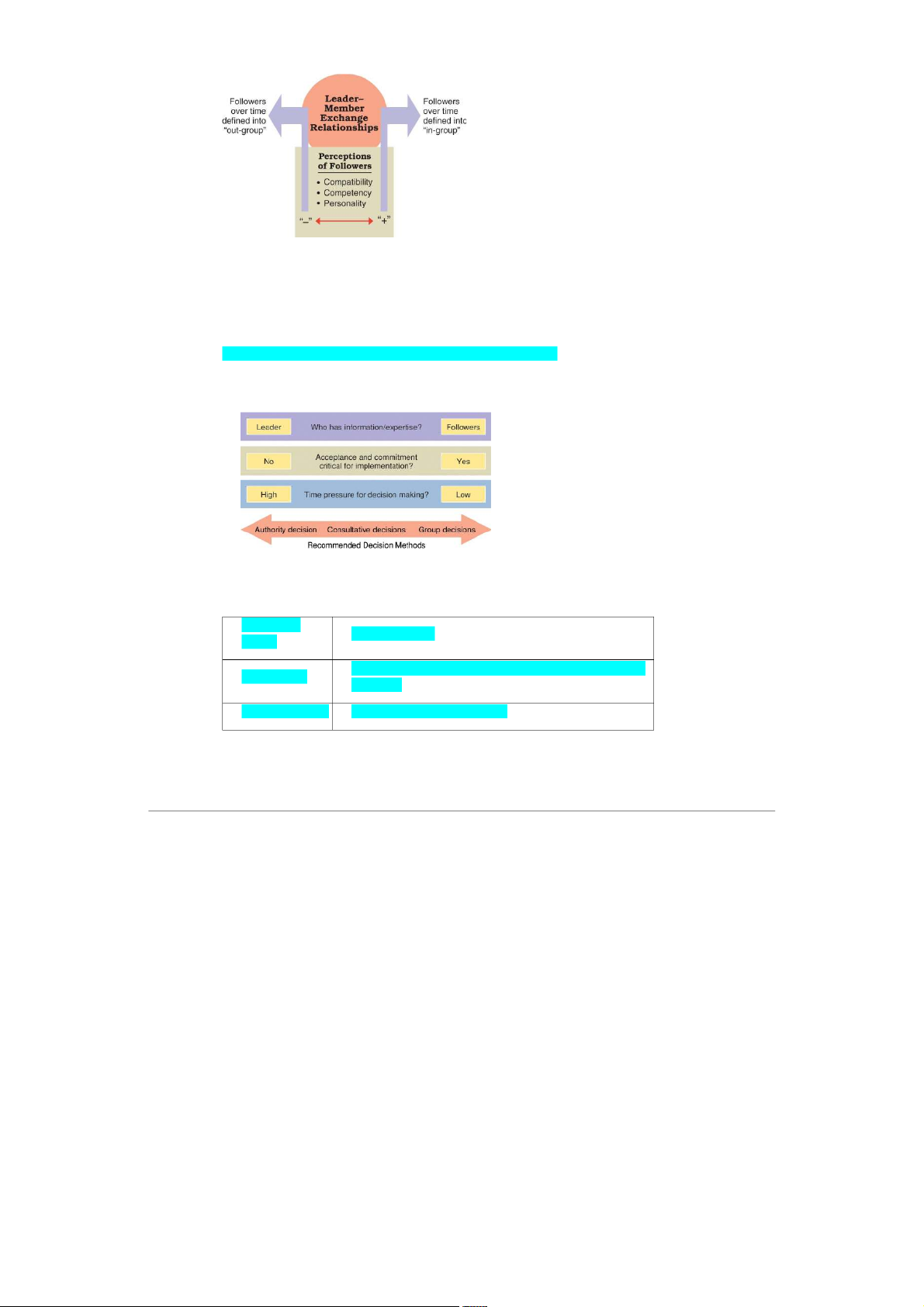
Leaders don’t treat all followers the same.
In-Group: Close, trusted, respected.
Out-Group: Less support or access.
Based on perceived compatibility, skill, and personality.
Figure 14.6 Elements of leader exchange theory
5. Vroom-Jago Leader-participation model -
Helps leaders choose the method of decision making that best fits the
nature of the problem situation -
Basic decision-making choices:Authority decision ;Consultative decision ;Group decision
Helps leaders decide how much team input is needed.
Figure 14.7 Leadership implications of Vroom-Jago leader-participation model -
Decision-making options in the Vroom-Jago leader-participation theory:
Decide alone ; Consult individually ; Consult with group ; Facilitate ; Delegate Decision Style Use When...
Authority Leader has info, little time, followers will accept decision
Consultative Some team input needed Decision Style Use When... Group
Problem is complex, acceptance is key, time is Decision available -
Contingency factors in the Vroom-Jago leader-participation theory: Decision quality Decision acceptance Decision time Who has the Importance of Time available to make information needed for
subordinate acceptance and implement the problem solving to eventual decision implementation -
According to Vroom-Jago leader-participation theory, a leader should
use authority-oriented decision methods when
The leader has greater expertise to solve a problem
The leader is confident and capable of acting alone
Others are likely to accept and implement the decision
Little or no time is available for discussion
the leader lacks sufÏcient information to solve a problem by himself/herself
the problem is unclear and help is needed to clarify the situation
acceptance of the decision and commitment by others is necessary for implementation
adequate time is available for true participation
Benefits of participative decision methods:
Potential disadvantages of participative decision methods: Help improve decision quality Lost efÏciency
Help improve decision acceptance
Not particularly useful when problems must be
Helps develop leadership potential solved immediately
4. Personal Leadership Development
1. Charismatic and transformational leadership -
Super leaders: Persons whose vision and strength of personality have
an extraordinary impact on others Super Leaders
Leaders with powerful vision and personality who deeply influence others.
Example: Nelson Mandela inspired a nation with his strength and hope
during difÏcult times. -
Charismatic leaders: Develop special leader-follower relationships and
inspire others in extraordinary ways Charismatic Leaders
They naturally attract followers through charm and energy.
Example: Steve Jobs inspired Apple employees and customers with passion and confidence. -
Transformational leader:Someone who is truly inspirational as a leader
and who arouses others to seek extraordinary performance accomplishments T ransformational Leaders
Motivate others to reach high goals and become better people.
Example: A school principal who transforms a low-performing school
into a top one by inspiring teachers and students. -
Characteristics of transformational leaders: V ision ; Charisma ; Aspiration ; Empower
ment ; Intellectual stimulation ; Integrity
Key Traits of Transformational Leaders:
Vision (clear future goals)
Charisma (personal charm)
Aspiration (high ambitions)
Empowerment (help others grow)
Intellectual stimulation (encourage new ideas)
Integrity (honest and ethical)
2. Emotional intelligence and leadership - Emotional intelligence
The ability of people to manage emotions in social relationships
Characteristics of the emotionally intelligent leader:High self-awareness
;Motivated and persistent;High social awareness;Good self
management;Good relationship management
Emotional Intelligence = Understanding and managing emotions in yourself and others.
Traits of Emotionally Intelligent Leaders:
oSelf-awareness – Know your own strengths and feelings
oMotivation – Stay committed and driven
oSocial awareness – Understand others' emotions
oSelf-management – Control emotions, stay calm
oRelationship management – Handle conflict and inspire cooperation
Example: A team leader who stays calm under pressure, listens to
employees, and handles disagreements with care.
3. Gender and leadership -
Gender similarities hypothesis:
Males and females have similar psychological properties
Men and women can be equally effective leaders
Men and women are sometimes perceived as using different styles of leadership
Women tend to use interactive leadership :A style that shares qualities with
transformational leadership ;Leaders with this style are democratic, participative, and inclusive.
Men tend to use transactional leadership
Interactive leadership provides a good fit with the demands of a diverse
workforce and the new workplace
Gender Similarities Hypothesis:
Men and women are equally capable of being effective leaders. Style Differences:
Women: Often use interactive leadership – democratic, inclusive, and
people-focused (like transformational leadership)
oExample: A female manager who asks for input from her team
and builds strong relationships.
Men: Tend to use transactional leadership – focused on tasks, roles, and performance
oExample: A male supervisor who sets clear rules and rewards or
punishes based on performance.
Interactive leadership works well in today’s diverse and team-oriented workplaces. 4. Moral leadership -
Ethical leadership that is always “good” and “right” -
All leaders are expected to maintain high ethical standards -
Long-term, sustainable success requires ethical behavior -
Integrity involves the leader’s honesty, credibility, and consistency in putting values into action -
Moral overconfidence is an overly positive view of one’s strength of character -
Authentic leadership activates positive psychological states to achieve
self awareness and positive self-regulation
Moral Leadership = Leading by doing what is right and ethical. K ey traits: High ethical standards
Integrity – Honest, trustworthy, and consistent
Authenticity – Be real and self-aware
Avoid moral overconfidence – Don't assume you're always right or better than others
Example: A business leader who refuses to lie to customers, even if it
means losing profit in the short term.
5. Drucker’s “old-fashioned” leadership -
Leadership is more than charisma; it is “good old-fashioned” hard work -
Essentials of “old-fashioned” leadership:
Defining and establishing a sense of mission
Accepting leadership as a “responsibility” rather than a rank
Surround yourself with talented people
Don’t blame others when things go wrong
Keep your integrity, earn trust
Don’t be clever, be consistent
Peter Drucker believed true leadership isn’t about fame or charisma – it’s
about hard work, values, and responsibility. Essentials: Have a clear mission
See leadership as duty, not privilege Build a strong team
Take responsibility when things go wrong Keep your integrity
Be consistent, not flashy
Example: A nonprofit leader who quietly works for years to improve the
community, without seeking personal fame.
Tài liệu liên quan:
-

CHAP 1: Introduction to Management Concepts and Functions môn Principles of Management | Trường Đại học Quốc tế, Đại học Quốc gia Thành phố Hồ Chí Minh
1 1 -

Guidelines for group’s assignments: Analysing management issues of a FDI company based inVietnam môn Principles of Management | Trường Đại học Quốc tế, Đại học Quốc gia Thành phố Hồ Chí Minh
1 1 -
Financial Planning to Achieve 300m VND Goal in 3 Years môn Principles of Management | Trường Đại học Quốc tế, Đại học Quốc gia Thành phố Hồ Chí Minh
1 1 -

A Case Study in Fast Fashion Success môn Principles of Management | Trường Đại học Quốc tế, Đại học Quốc gia Thành phố Hồ Chí Minh
1 1 -
Chap 16 Hierarchy of Needs Theory and Applications môn Principles of Management | Trường Đại học Quốc tế, Đại học Quốc gia Thành phố Hồ Chí Minh
1 1