Chapter 14: Leading and Leadership Development môn Principle of Management | Trường Đại học Quốc tế, Đại học Quốc gia Thành phố Hồ Chí Minh
Attend leadership workshops or seminars: Look for workshops or seminars that focus on leadership development. These programs often provide valuable insights, strategies, and techniques for effective leadership. Tài liệu giúp bạn tham khảo, ôn tập và đạt kết quả cao. Mời đọc đón xem!
Môn: Principles of Management 197 tài liệu
Trường: Trường Đại học Quốc tế, Đại học Quốc gia Thành phố Hồ Chí Minh 1.5 K tài liệu
Tác giả:







Preview text:
Final POM
*Thêm cảm nhận, không gạch đầu dòng, thêm định nghĩa và ví dụ và k đc chép y nguyên định nghĩa vào.
Chapter 14: Leading and Leadership Development
1) Provide activities to develop leadership skills: Leadership Traits
Question—What personal traits and characteristics are associated with leadership success?
• Drive—Successful leaders have high energy, display initiative, and are tenacious.
• Self-confidence—Successful leaders trust themselves and have confidence in their abilities.
• Creativity—Successful leaders are creative and original in their thinking.
• Cognitive ability—Successful leaders have the intelligence to integrate and interpret information.
• Job-relevant knowledge—Successful leaders know their industry and its technical foundations.
• Motivation—Successful leaders enjoy influencing others to achieve shared goals.
• Flexibility—Successful leaders adapt to fit the needs of followers and the demands of situations.
• Honesty and integrity—Successful leaders are trustworthy; they are honest, predictable, and dependable.
1. Join a club or organization: Engaging in extracurricular activities allows you to work with a team,
collaborate on projects, and take on leadership roles within the group.
2. Volunteer for leadership positions: Offer to take on leadership roles in volunteer organizations or
community groups. This will give you the opportunity to practice managing people, making decisions, and organizing events.
3. Attend leadership workshops or seminars: Look for workshops or seminars that focus on leadership
development. These programs often provide valuable insights, strategies, and techniques for effective leadership.
4. Participate in team sports: Team sports require coordination, communication, and the ability to motivate
and inspire teammates. Being part of a sports team can help you develop crucial leadership skills.
5. Take on leadership roles in academic settings: Volunteer to lead group projects or presentations in
school or college. This will allow you to practice organizing and guiding a team towards a common goal.
6. Start a small project or initiative: Identify a problem or opportunity in your community or school and take
the initiative to solve it. This could involve organizing an event, starting a fundraising campaign, or creating a new club.
7. Seek feedback and learn from it: Actively seek feedback from your peers, mentors, and supervisors. Ask
for both positive and constructive feedback to understand your strengths and areas for improvement.
8. Mentor others: Take on a mentoring role and guide someone who is less experienced or knowledgeable
in a particular area. Mentoring helps develop your coaching, communication, and leadership abilities.
9. Attend leadership conferences or summits: Look for conferences or summits focused on leadership
development. These events often feature keynote speakers, workshops, and networking opportunities with other aspiring leaders.
Remember, developing leadership skills is an ongoing process, so continue seeking opportunities
to grow, learn, and practice your leadership abilities.
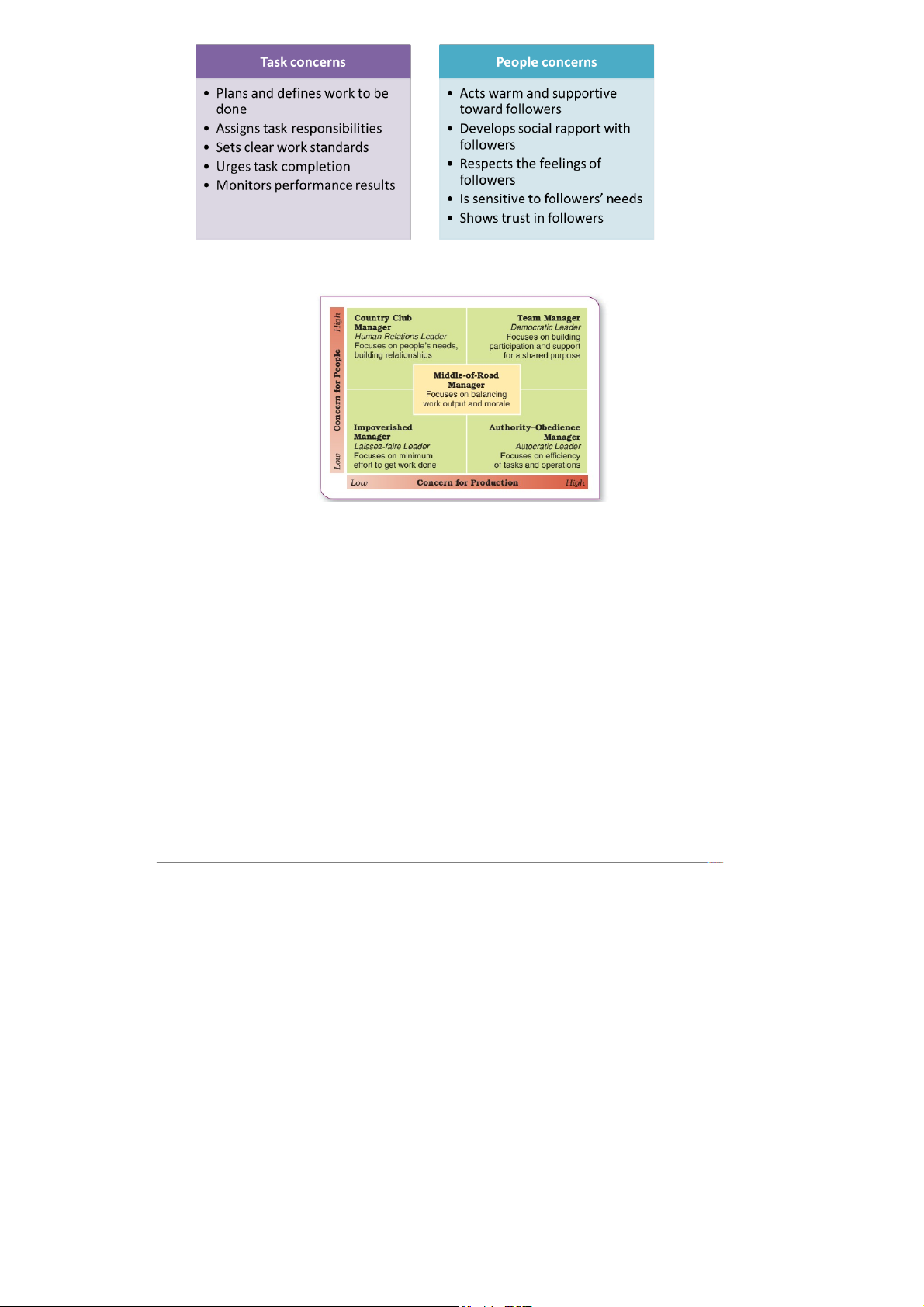
2) How can we lead others ? Two dimensions (Task space & Relation Behavior)
A leader need to remember two dimensions of leadership behavior to organize a successful team:
(1) Task space behavior (focus on working environment): concern for the task to be accomplished
(2) Relation Behavior (In the workplace, people are not machines, so leader need to understand them, if we
only focus on devising task, we will miss talent): concern for the people doing the work.
=> Need to focus on both of dimensions
3) Types of leadership styles:
There are 4 common leadership styles:
+ Autocratic Leadership: In this style, the leader makes decisions without involving the team members.
They have full control and authority over the decision-making process, often relying on their own expertise and experience.
Example: Adolf Hitler's leadership style can be characterized as authoritarian, charismatic, manipulative,
dictatorial, and rooted in extreme nationalism and racism. He centralized power, utilized propaganda, and
pursued aggressive expansionist policies. It is important to recognize the immense human suffering and
moral reprehensibility associated with Hitler and his leadership.
+ Democratic Leadership: This style involves active participation and involvement of team members in the
decision-making process. The leader seeks input, ideas, and feedback from the team before making a final decision.
Example: Tim Cook (CEO of Apple) lets the talents of everyone at Apple contribute to the company's
success. That doesn't mean that he lets other executives and managers make decisions for him. Instead,
he keeps an open mind, considers his options, and convinces other people to follow his lead.
+ Laissez-Faire Leadership: This style is characterized by a hands-off approach, where the leader provides
minimal guidance or direction to the team. Team members are given a high degree of autonomy and are
responsible for their own decision-making and problem-solving.
Example: Steve Jobs (Co Founder of Apple) was known for the way he would give instructions to the team,
and leave them to figure out the best way to fulfill his wishes. Members of his team often said they got to
use their creative skills and try new things while they worked for Jobs.
+ Human relations leadership style: Also known as the human-oriented leadership style, focuses on
building positive relationships, fostering collaboration, and promoting the well-being of team members. This
style places a strong emphasis on interpersonal skills, empathy, and creating a supportive work environment.
Example: Nelson Mandela. Mandela was a prominent South African anti-apartheid activist and the
country's first black president. He is widely admired for his inclusive and empathetic leadership approach.
Mandela prioritized building positive relationships with people from diverse backgrounds, including his
political allies and adversaries. He reached out to bridge divides and fostered reconciliation, promoting unity and understanding.
Chapter 15: Individual Behavior
1) Four types of perceptual tendencies and distortions (Khuynh hướng nhận thức)
1. Stereotypes (Khuôn mẫu):
A stereotype is a widely held, oversimplified, and generalized belief or idea about a particular group of
people or things. Stereotypes are often based on limited information, assumptions, or preconceived notions
and can be influenced by societal, cultural, or personal biases. Stereotypes can be positive, negative, or
neutral and may involve characteristics, behaviors, or traits that are attributed to a group as a whole,
without considering individual variations or complexities.
For example, the stereotype that all Asians are good at math or that all African Americans are athletic.
These stereotypes overlook the individuality and diversity within racial and ethnic groups. For example, the
stereotype that all French people are rude or all Germans are efficient. These stereotypes overlook the
diversity and uniqueness of individuals within a particular nationality. 2. Halo Effect
The Halo Effect refers to a cognitive bias where an individual's overall impression of a person influences
their judgments or perceptions about specific traits or qualities of that person. In other words, if someone
has a positive overall impression of someone, they are more likely to attribute positive qualities to that
person, even if they have limited or no evidence to support those attributions. Example
Candidate A walks into the room and immediately makes a positive first impression. They are well-dressed,
confident, and have a friendly demeanor. The interviewer's overall impression of Candidate A is highly
positive. As a result, the Halo Effect kicks in, and the interviewer begins to perceive Candidate A's specific
qualities and skills more positively than they might objectively deserve.
3. Selective perception:
Selective perception refers to the tendency of individuals to interpret or perceive information in a way that
aligns with their pre-existing beliefs, attitudes, or expectations. It involves filtering incoming information
based on personal biases, preferences, or interests, which can result in a subjective and distorted understanding of reality.
Example: Suppose two colleagues, Alex and Lisa, are assigned to work on a project together. Alex has a
positive perception of Lisa due to their previous interactions and believes she is competent and
hardworking. On the other hand, Lisa has a negative perception of Alex based on a misunderstanding they had in the past.
During the project, Alex selectively perceives Lisa's contributions as valuable and effective, focusing on her
strengths and abilities. Any mistakes or shortcomings are easily overlooked or minimized due to the positive perception.
In contrast, Lisa's selective perception leads her to primarily notice and remember instances that confirm
her negative perception of Alex. She may dismiss or downplay any positive contributions he makes,
attributing them to luck or others' assistance, while amplifying any perceived errors or weaknesses.
Despite working together on the same project, their selective perception shapes how they interpret and
evaluate each other's actions, reinforcing their existing beliefs and influencing their working relationship. 4. Projection
Projection is a psychological defense mechanism where individuals attribute their own unwanted or
unacceptable thoughts, feelings, or traits onto others. It involves attributing one's own internal experiences
to someone else, often without conscious awareness. By projecting these qualities onto others, individuals
can distance themselves from their own uncomfortable emotions or aspects of their personality.
Example: James, a college student, has a strong desire to excel academically but struggles with self-doubt
and fears of failure. However, instead of acknowledging and addressing his own insecurities, he projects them onto his roommate, Sarah.
James frequently accuses Sarah of being lazy and unmotivated, despite her consistent efforts and
achievements. He claims that Sarah is the reason for their shared living space being messy and
disorganized, even though James himself is often responsible.
In this example, James is projecting his own fears of failure and insecurities onto Sarah. By attributing
laziness and disorganization to her, he avoids confronting his own internal struggles and maintains a sense of superiority or control.
REFLECTION: Understanding perception tendencies, such as the Halo Effect and selective perception,
can highlight the inherent biases and cognitive processes that shape our understanding of the world. These
tendencies remind us that our perception of reality can be subjective and influenced by our pre-existing
beliefs, attitudes, and expectations.
By being aware of these biases, we can strive to approach information and interactions with a more open
mind, actively seeking diverse perspectives and challenging our own assumptions. Recognizing our own
tendencies towards selective perception or the Halo Effect allows us to make more objective and informed
judgments, fostering better communication, empathy, and understanding.
It is essential to remember that no single perception tendency can fully capture the complexity of human
perception and cognition. Our understanding of others and the world around us is a dynamic and ongoing
process that requires ongoing self-reflection, critical thinking, and a willingness to consider alternative viewpoints.
Ultimately, by acknowledging and addressing our perception tendencies, we can work towards a more
accurate and comprehensive understanding of ourselves, others, and the diverse realities we all inhabit.
Chapter 16: Motivation Theory and Practice 1) Motivation Theory
There are several prominent theories of motivation that seek to explain why individuals behave in certain
ways and what factors drive their behavior. Here are some key types of motivation theories:
Maslow's Hierarchy of Needs: As mentioned earlier, Abraham Maslow proposed this theory, which
suggests that individuals are motivated by a hierarchy of needs. It posits that people strive to fulfill basic
physiological needs, safety needs, social needs, esteem needs, and self-actualization needs in a hierarchical manner.
Expectancy Theory: This theory, proposed by Victor Vroom, emphasizes the importance of individual
beliefs and expectations in driving motivation. It suggests that motivation is influenced by three factors:
expectancy (belief in the likelihood of success), instrumentality (belief that performance will lead to desired
outcomes), and valence (the value placed on those outcomes).
Goal-Setting Theory: Developed by Edwin Locke, this theory suggests that setting specific and
challenging goals can enhance motivation and performance. It emphasizes the importance of clear
objectives, feedback, and commitment to achieving goals.
Self-Determination Theory: This theory, formulated by Edward Deci and Richard Ryan, focuses on the
innate psychological needs that drive motivation. It proposes that individuals are motivated when their basic
needs for autonomy (feeling in control), competence (feeling capable), and relatedness (feeling connected to others) are satisfied.
Cognitive Evaluation Theory: Also related to self-determination theory, this theory posits that external
factors, such as rewards and feedback, can either enhance or undermine intrinsic motivation. It suggests
that providing autonomy support and promoting feelings of competence can foster intrinsic motivation.
Equity Theory: Developed by J. Stacy Adams, this theory proposes that individuals are motivated by a
sense of fairness and equity in social exchanges. It suggests that people compare their inputs (efforts) and
outcomes (rewards) to those of others and seek fairness in the distribution of rewards.
Reinforcement Theory: Based on the work of B.F. Skinner, this theory suggests that behavior is shaped
by the consequences that follow it. It emphasizes the role of positive reinforcement (rewards), negative
reinforcement (removal of aversive stimuli), punishment, and extinction in motivating or discouraging specific behaviors.
These are just a few examples of motivation theories, and each provides a unique perspective on what
influences and drives human behavior. It's important to note that motivation is a complex and multifaceted
topic, and different theories may be more applicable in different contexts or for different individuals.
2) How to apply these theories into the workplace ?
Applying motivation theories in the workplace can help create a positive and productive work environment.
Here are some ways to apply these theories:
Maslow's Hierarchy of Needs:
Ensure that employees' basic physiological needs are met by providing a comfortable and safe physical
work environment, fair compensation, and access to necessary resources.
Foster a sense of belongingness and social connection through team-building activities, collaborative
projects, and open communication channels.
Offer opportunities for personal and professional growth to support employees' self-esteem and self-
actualization needs, such as training programs, career development initiatives, and recognition for achievements. Expectancy Theory:
Clearly communicate performance expectations and provide employees with the necessary resources and support to succeed.
Link performance to meaningful rewards and incentives, ensuring employees believe their efforts will lead to desired outcomes.
Provide regular feedback and recognition to reinforce the connection between performance and outcomes. Goal-Setting Theory:
Encourage employees to set specific, challenging, and achievable goals aligned with the organization's objectives.
Ensure goals are measurable and provide employees with regular feedback on their progress.
Support employees in developing action plans and provide resources to help them accomplish their goals.
Self-Determination Theory:
Foster a sense of autonomy by giving employees a level of control over their work methods, schedules, and decision-making processes.
Provide opportunities for skill development and growth to enhance employees' sense of competence.
Promote a supportive and inclusive work culture that nurtures positive relationships and a sense of relatedness among employees.
Cognitive Evaluation Theory:
Create a work environment that supports intrinsic motivation by offering meaningful and challenging tasks,
providing opportunities for creativity and autonomy.
Recognize and reward employees based on their competence and effort rather than relying solely on external rewards.
Encourage a growth mindset and provide ongoing learning and development opportunities. Equity Theory:
Ensure fairness and equity in the distribution of rewards, recognition, and opportunities.
Promote transparency in decision-making processes and provide explanations for reward systems.
Encourage open communication and address any perceived inequities or grievances promptly. Reinforcement Theory:
Use positive reinforcement, such as praise and recognition, to reinforce desired behaviors and outcomes.
Apply negative reinforcement sparingly, focusing on removing obstacles or aversive conditions that hinder performance.
Use punishment and extinction judiciously, only when necessary and in a constructive manner.
It's important to note that each workplace is unique, and the application of motivation theories should be
tailored to the specific organizational and individual contexts. Regular feedback, open communication, and
flexibility are key in understanding employees' motivations and adapting motivational strategies accordingly.
Tài liệu liên quan:
-
Essay Questions - POM: Types of Horizontal Organizational Structures and Their môn Principle of Management | Trường Đại học Quốc tế, Đại học Quốc gia Thành phố Hồ Chí Minh
0 0 -

Câu hỏi trắc nghiệm môn Principle of Management | Trường Đại học Quốc tế, Đại học Quốc gia Thành phố Hồ Chí Minh
0 0 -
Alistair Mackay’s short list of possible candidates môn Principle of Management | Trường Đại học Quốc tế, Đại học Quốc gia Thành phố Hồ Chí Minh
0 0 -

Abortion in America: Exploring Consumer Behavior Dynamics môn Principle of Management | Trường Đại học Quốc tế, Đại học Quốc gia Thành phố Hồ Chí Minh
0 0