Chapter 16: Motivation Theory and Practice môn Principles of Management | Trường Đại học Quốc tế, Đại học Quốc gia Thành phố Hồ Chí Minh
Motivation—the forces within the individual that account for the level, direction, and persistence of effort expended at work. Tài liệu giúp bạn tham khảo, ôn tập và đạt kết quả cao. Mời đọc đón xem!
Môn: Principles of Management 314 tài liệu
Trường: Trường Đại học Quốc tế, Đại học Quốc gia Thành phố Hồ Chí Minh 2 K tài liệu
Tác giả:

















Preview text:
Chapter 16: Motivation Theory and Practice
1. Individual Needs and Motivation -
Motivation—the forces within the individual that account for the level,
direction, and persistence of effort expended at work -
Needs:Unfulfilled physiological and psychological desires of an
individual ;Explain workplace behavior and attitudes ;Create tensions
that influence attitudes and behavior ;Good managers and leaders
facilitate employee need satisfaction .
Motivation is what drives people to put effort into their work.
People have different kinds of needs—things they want or need that
aren’t yet fulfilled. These needs create tension inside us and influence how
we behave and feel at work.
Managers who understand these needs can help satisfy them, making employees more motivated.
1. Hierarchy of needs theory - Developed by Abraham Maslow -
Lower-order and higher-order needs affect workplace behavior and attitudes -
Lower-order needs:Physiological, safety, and social needs ;Desires for
physical and social well being -
Higher-order needs:Esteem and self-actualization needs ;Desire for
psychological growth and development
Lower-order needs are basic and related to survival and safety, such as:
Physiological needs: food, water, shelter, and rest
Safety needs: protection from harm, job security
Social needs: friendship, belonging, acceptance
Higher-order needs involve personal growth and feeling valued, such as:
Esteem needs: respect, recognition, self-confidence
Self-actualization needs: achieving your full potential, personal development
Figure 16.1 Opportunities for satisfaction in Maslow’s hierarchy of human needs -
Deficit principle:A satisfied need is not a motivator of behavior -
Progression principle:A need at one level does not become activated
until the next lower-level need is satisfied
Deficit principle: Once a need is satisfied, it stops motivating you. For
example, once you’re no longer hungry, hunger doesn’t push you anymore.
Progression principle: You won’t start trying to satisfy a higher-level need
until the needs below it are mostly met. For instance, you won’t focus on
esteem if you don’t feel safe first. 2. ERG theory - Developed by Clayton Alderfer - Three need levels Existence needs Relatedness needs Growth needs desires for desires for satisfying desires for continued physiological and interpersonal psychological growth material well-being relationships and development -
Any/all needs can influence behavior at one time -
Frustration-regression principle :An already satisfied lower-level need
becomes reactivated when a higher-level need is frustrated
Alderfer grouped human needs into three levels instead of five:
1. Existence needs: Basic needs for physical and material well-being (like
food, water, safety, and shelter).
2. Relatedness needs: Needs for meaningful relationships and social
interactions with others (like friendship, family, and work connections).
3. Growth needs: Needs for personal development, learning, and
reaching one’s potential.
Unlike Maslow’s hierarchy, multiple needs can motivate us at the same
time. You might want to grow professionally while still wanting good friendships and security.
Frustration-regression principle: If you can’t satisfy a higher-level need
(like growth), your lower-level needs (like relatedness or existence) can
become more important again. For example, if someone feels stuck in their
career, they might focus more on social connections or job security to feel better. 3. Two-factor theory -
Developed by Frederick Herzberg -
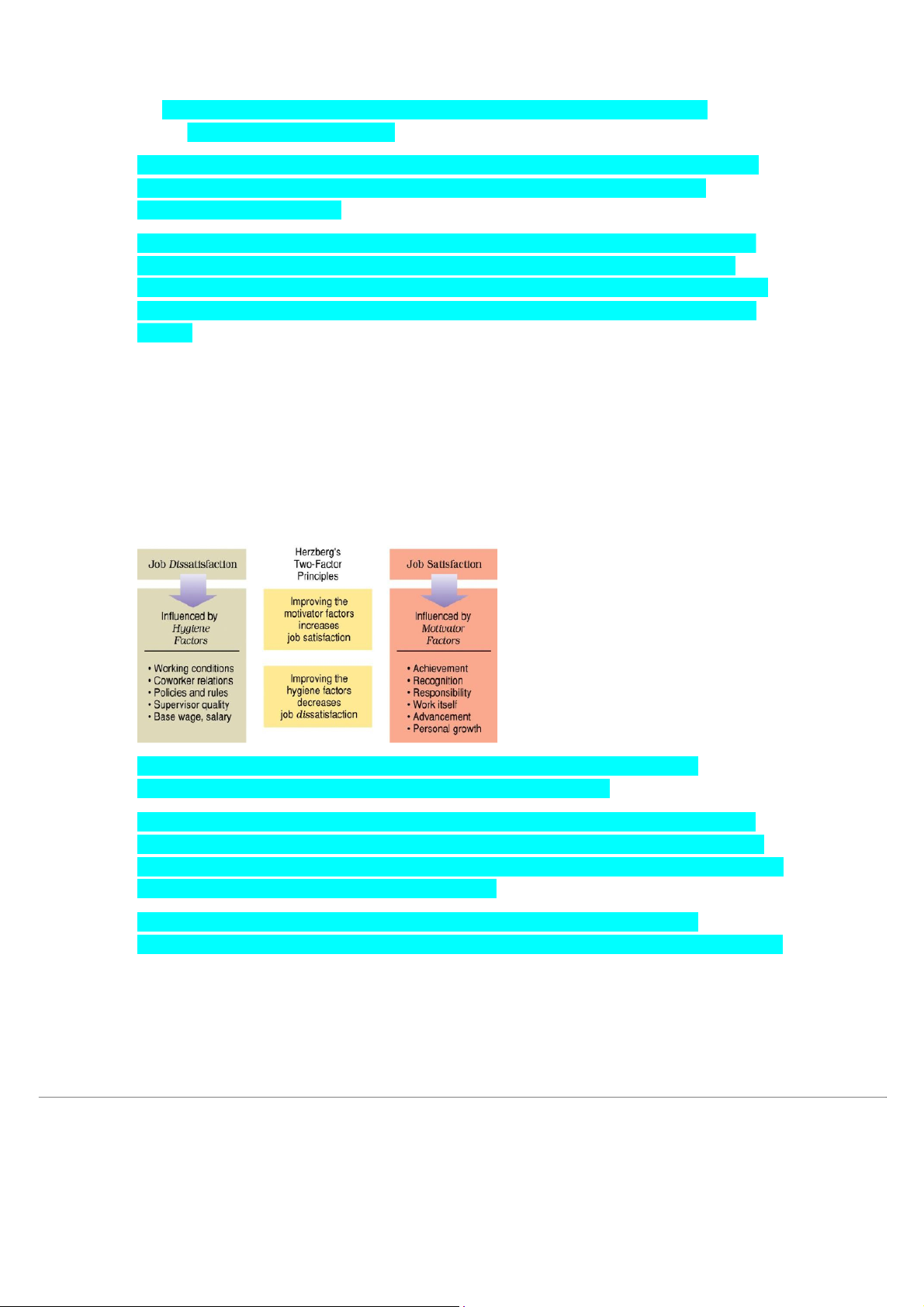
Hygiene factors:Elements of the job context ;Sources of job dissatisfaction -
Satisfier factors:Elements of the job content ;Sources of job satisfaction and motivation
Figure 16.2 Elements in Herzberg’s two-factor theory
Herzberg found that different factors cause job satisfaction and job
dissatisfaction, and they are not opposites but separate:
Hygiene factors: These are related to the job environment or context (like
salary, company policies, working conditions). If these are poor, employees
get dissatisfied, but improving them doesn’t necessarily increase satisfaction
much. They mostly prevent dissatisfaction.
Satisfier factors (motivators): These relate to the job itself and how
challenging or meaningful it is (like achievement, recognition, responsibility).
These factors truly motivate employees and lead to job satisfaction when present.
4. Acquired needs theory - Developed by David McClelland -
People acquire needs through their life experiences - Needs that are acquired:
Need for Achievement (nAch):Desire to do something better or more
efÏciently, to solve problems, or to master complex tasks .People high in
(nAch) prefer work that:Involves individual responsibility for results ;Involves
achievable but challenging goals;Provides feedback on performance ;
Need for Power (nPower):Desire to control other persons, to influence their
behavior, or to be responsible for other people ;Personal power versus social
power .People high in (nPower) prefer work that:Involves control over other
persons ;Has an impact on people and events ;Brings public recognition and attention
Need for AfÏliation (nAff):Desire to establish and maintain friendly and warm
relations with other persons .People high in (nAff) prefer work that:Involves
interpersonal relationships ;Provides for companionship;Brings social approval
This theory says people develop certain needs based on their life
experiences, rather than being born with them.
The main three types of acquired needs are:
1. Need for Achievement (nAch):
The desire to do things better, solve problems, and master difÏcult tasks.
People with high nAch like jobs where they have individual
responsibility, face challenging but doable goals, and get
feedback on how well they are doing.
2. Need for Power (nPower):
The desire to control or influence others, or to have
responsibility over people or situations.
There are two kinds of power:
Personal power (for personal gain or status)
Social power (used to help others or the organization).
People high in nPower like jobs where they can control
others, make an impact, and receive public recognition.
3. Need for AfÏliation (nAff):
The desire to build and maintain friendly, warm relationships with others.
People with high nAff prefer jobs that involve working
closely with others, provide companionship, and bring social approval. Summary:
We all have different motivations based on what we’ve learned or
experienced in life—some want to achieve, some want to lead, and some
want to belong. Knowing these needs helps managers assign tasks and roles
that fit each person’s motivation.
2. Process Theories of Motivation -
How people make choices to work hard or not -
Choices are based on:Individual preferences ;Available rewards ;Possible work outcomes
Process theories explain how people decide to work hard or not. Their choices depend on:
What they prefer as individuals,
The rewards they expect to get,
The possible outcomes from their work. 1. Equity theory - Developed by J. Stacy Adams -
When people believe that they have been treated unfairly in
comparison to others, they try to eliminate the discomfort and restore
a perceived sense of equity to the situation :Perceived inequity ;Perceived equity
Figure 16.3 Equity theory and the role of social comparison -
Equity and social comparison:People compare their ratio of outcomes-
to-inputs to the outcomes-to-inputs ratio of another (a referent) -
Over-reward inequity (positive inequity) occurs when an individual
perceives that rewards received are more than what is fair for work inputs -
Under-reward inequity (negative inequity) occurs when an individual
perceives that rewards received are less than what is fair for work inputs -
People respond to perceived negative inequity by changing …Work
inputs ;Rewards received ;Referent’s inputs or outcomes;Comparison points ;Situation -
Managerial implications of equity theory: Underpaid people experience
anger;Overpaid people experience guilt ;Perceptions of rewards
determine motivational outcomes ;Negative consequences of equity
comparisons should be minimized, if not eliminated ;Do not
underestimate the impact of pay as a source of equity controversies in
the workplace (Gender equity ;Comparable worth)
Equity Theory (J. Stacy Adams)
People feel motivated when they believe they are treated fairly compared to others.
They compare their inputs (effort, skills, time) and outcomes (pay,
recognition) to others — called social comparison.
If they perceive inequity (unfairness), they feel uncomfortable and try to fix it. Types of inequity:
Over-reward inequity: Feeling you get more rewards than your work
deserves (can cause guilt).
Under-reward inequity: Feeling you get less than what’s fair (can cause anger).
How people respond to unfairness:
Change how much effort they put in,
Change their perception of rewards,
Compare themselves to different people,
Or try to change the situation. Managers should: Avoid pay inequities,
Recognize that fairness in rewards strongly affects motivation,
Address gender equity and fair pay concerns carefully. 2. Expectancy theory - Developed by Victor Vroom -
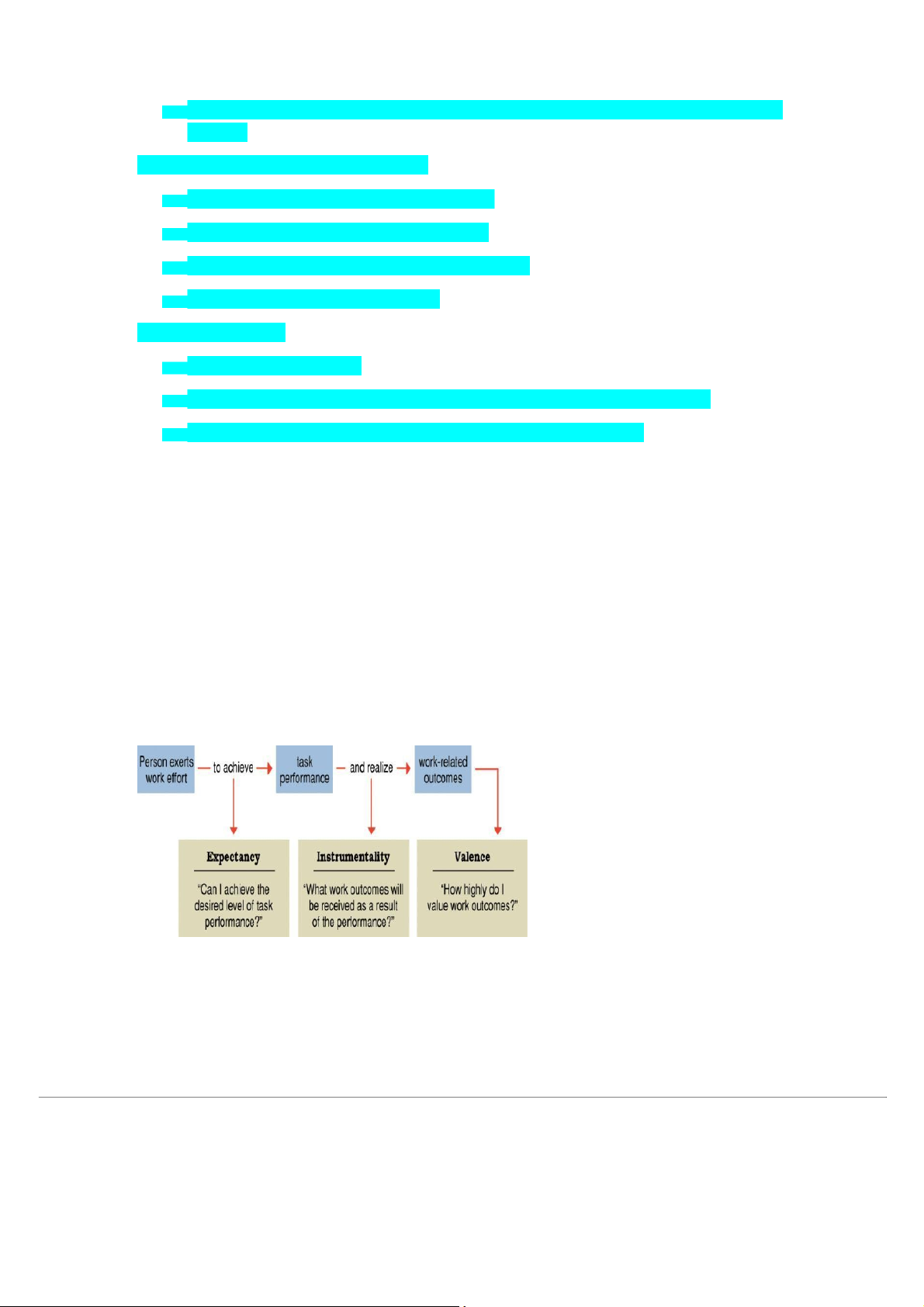
Key expectancy theory variables:
Expectancy — belief that working hard will result in desired level of performance
Instrumentality — belief that successful performance will be followed by rewards
Valence — value a person assigns to rewards and other work related outcomes
Figure 16.4 Elements in the expectancy theory of motivation -
Motivation (M), expectancy (E), instrumentality (I), and valence (V) are
related to one another in a multiplicative fashion:
Motivation = Expectancy x Instrumentality x Valence
If either E, I, or V is low, motivation will be low -
Managerial implications of expectancy theory
To maximize expectancy, managers should:Select workers with ability ;Train
workers to use ability ;Support work efforts ;Clarify performance goals
To maximize instrumentality, managers should:Clarify psychological
contracts ;Communicate performance-outcome possibilities ;Identify rewards
that are contingent on performance
To maximize valence in a positive direction, managers should:Use content
theories;Increase communication;Link needs/desires with rewards
Expectancy Theory (Victor Vroom)
This theory says motivation depends on three key beliefs:
Expectancy: Belief that working hard will lead to good performance.
Instrumentality: Belief that good performance will be rewarded.
Valence: How much the person values the reward.
Motivation = Expectancy × Instrumentality × Valence
If any of these is low, motivation will be low.
Managers can improve motivation by: Increasing Expectancy:
Hire capable employees, train them, support their work, and set clear goals. Increasing Instrumentality:
Clearly explain what rewards come from which performance levels,
and make sure rewards are linked to performance. Increasing Valence:
Understand what rewards employees value and connect those rewards
to their needs and desires. 3. Goal-setting theory - Developed by Edwin Locke -
Properly set and well-managed task goals can be highly motivating -
Motivational effects of task goals:Provide direction to people in their
work ;Clarify performance expectations ;Establish a frame of reference
for feedback ;Provide a foundation for behavioral self-management
How to Make Goal Setting Work for You: Set specific goals Set challenging goals
Build goal acceptance and commitment Clarify goal priorities
Provide feedback on goal accomplishment Reward goal accomplishment -
Participation in goal setting: unlocks the motivational potential of goal
setting ;management by objectives (MBO) promotes participation
;when participation is not possible, workers will respond positively if
supervisory trust and support exist Goal-Setting Theory
(Developed by Edwin Locke)
Setting clear and well-managed goals for tasks can strongly motivate people. Goals help by:
oGiving direction on what to do,
oClarifying what performance is expected,
oCreating a standard to measure progress,
oHelping people manage their own behavior to reach goals.
How to Make Goal Setting Work:
Set specific goals (clear and precise).
Set challenging but achievable goals.
Get commitment and acceptance of the goals.
Clarify which goals are the top priorities.
Provide feedback on how well goals are being met.
Reward people when they achieve their goals.
Participation in Goal Setting:
When people participate in setting their goals, motivation increases.
Management by Objectives (MBO) encourages this participation.
If participation isn’t possible, positive motivation can still happen if
there is trust and support from supervisors.
4. Self-efÏcacy theory -
a person’s belief that he or she is capable of performing a task -
Capability directly affects motivation:higher self-efÏcacy will have
higher expectancy ;self-efÏcacy is linked to performance goal setting -
Enactive mastery:person gains confidence through positive experience -
Vicarious modeling:learning by observing others -
Verbal persuasion:encouragement from others that one can perform a task -
Emotional arousal :high stimulation or energy to perform well in a situation
Self-EfÏcacy Theory
Self-efÏcacy is a person’s belief in their ability to perform a task successfully.
Higher self-efÏcacy means higher motivation and better performance
because people believe they can succeed.
Ways to build self-efÏcacy:
oEnactive mastery: Gaining confidence by successfully completing tasks.
oVicarious modeling: Learning and gaining confidence by
watching others succeed.
oVerbal persuasion: Getting encouragement and positive feedback from others.
oEmotional arousal: Feeling energized and motivated to perform well 3. Reinforcement Theory -
Fundamentals of reinforcement theory
Focuses on the impact of external environmental consequences on behavior
Law of effect — behavior followed by pleasant consequences is likely to be
repeated: behavior followed by unpleasant consequences is not - Operant conditioning: Developed by B.F. Skinner
Applies law of effect to control behavior by manipulating its consequences What It’s About:
Reinforcement theory focuses on how external consequences (rewards or
punishments) influence our behavior at work.
🔁 Law of Effect (by Edward Thorndike)
If a behavior is followed by something good, we are more likely to repeat it.
If a behavior is followed by something bad, we are less likely to do it again.
🧠 Operant Conditioning
(Developed by B.F. Skinner)
It uses the Law of Effect to change behavior.
The idea is to encourage good behavior and discourage bad behavior
by changing what happens after someone does something. People tend to:
Repeat behaviors that bring rewards.
Avoid behaviors that bring punishment or unpleasant results.
1. Reinforcement strategies -
Operant conditioning strategies:
Positive reinforcement :Increases the frequency of a behavior through the
contingent presentation of a pleasant consequence
Negative reinforcement:Increases the frequency of a behavior through the
contingent removal of an unpleasant consequence
Punishment:Decreases the frequency of a behavior through the contingent
presentation of an unpleasant consequence
Extinction:Decreases the frequency of a behavior through the contingent
removal of an pleasant consequence Strategy What it Does Example Positive
Adds a pleasant reward to
Giving praise or a bonus Reinforcement encourage behavior for good work Negative
Removes something unpleasant Taking away extra tasks Reinforcement to encourage behavior when goals are met
Punishment Adds something unpleasant to Giving a warning for stop behavior being late
Extinction Takes away a pleasant outcome
Ignoring bad behavior so to stop behavior it disappears
2. Positive reinforcement -
Successful implementation of positive reinforcement is based on
Law of contingent reinforcement —Reward delivered only if desired behavior is exhibited
Law of immediate reinforcement —More immediate the delivery of a reward,
the more reinforcement value it has -
Guidelines for using positive reinforcement:
Clearly identify desired work behaviors
Maintain a diverse inventory of rewards
Inform everyone about what must be done to get rewards
Recognize individual differences when allocating rewards
Follow the laws of immediate and contingent reinforcement To make it effective:
Law of Contingent Reinforcement: Reward must only follow the desired behavior.
Law of Immediate Reinforcement: Reward should be given right after the behavior. Guidelines:
Be clear on which behaviors you want to encourage.
Use different types of rewards (money, praise, time off, etc.).
Let people know what they need to do to earn rewards.
Match rewards to individual preferences.
Always give rewards quickly and only when the right behavior happens. -
Schedules of reinforcement:Continuous reinforcement administers a
reward each time a desired behavior occurs ;Intermittent
reinforcement rewards behavior only periodically ;Acquisition of
behavior is quicker with continuous reinforcement ;Behavior acquired
under an intermittent schedule is more permanent ;Shaping is the
creation of a new behavior by positive reinforcement of successive approximations to it .
Continuous Reinforcement: Reward every time the behavior happens (best for learning).
Intermittent Reinforcement: Reward only sometimes (makes behavior more lasting).
Shaping: Build a new behavior by rewarding small steps toward the full behavior. 3. Punishment -
Guidelines for using punishment:Tell the person what is being done
wrong ;Tell the person what is being done right ;Match the punishment
to the behavior ;Administer punishment in private ;Follow laws of
immediate and contingent reinforcement To use it correctly:
Explain what the person did wrong.
Also, tell them what they should do instead.
Make sure the punishment fits the behavior.
Always give punishment privately.
Give it immediately after the behavior and only when necessary.
Figure 16.5 Applying reinforcement strategies: case of total quality management
4. Motivation and Job Design 1. Job simplification -
Standardizing work procedures and employing people in well-defined and highly specialized tasks -
Simplified jobs are narrow in job scope and low in job depth
Job simplification means breaking down work into small, easy, and repetitive
tasks that are done the same way every time. The job becomes very
focused, with low variety and little responsibility.
It’s often used to make training faster and reduce mistakes, but it can also
make the job boring and unmotivating for workers. 🛠 Example:
In a fast-food restaurant like McDonald's, one worker might only flip burgers,
another only assembles the sandwich, and another only packs the food. Each
person repeats one simple task all day. -
Automation :Total mechanization of a job ;Most extreme form of job simplification Potential advantages of job
Potential disadvantages of job simplification: simplification:
Easier and quicker training of Productivity suffers workers Cost increases due to Workers are less difÏcult to
absenteeism/ turnover of unhappy supervise workers Workers are easier to replace
Poor performance may result from
Development of expertise in doing worker boredom/ alienation repetitive tasks
✅ Advantages of Job Simplification:
Easy and fast to train new workers Simple to supervise
Workers get very good at their small task
Easy to replace a worker
❌ Disadvantages of Job Simplification:
Work can get boring and tiring
Workers may lose interest or feel unimportant
High turnover or absenteeism
Productivity and quality may drop over time -
Job rotation and job enlargement:Expands job scope; Job rotation
(Increases task variety by periodically shifting workers among jobs
involving different task assignments )
Job rotation means switching tasks among workers every few hours or days
to add variety. This helps reduce boredom and keeps workers more engaged. 🔄 Example:
In a warehouse, one worker may unload boxes in the morning, check
inventory in the afternoon, and help with packing the next day. This gives
the worker different experiences and skills. -
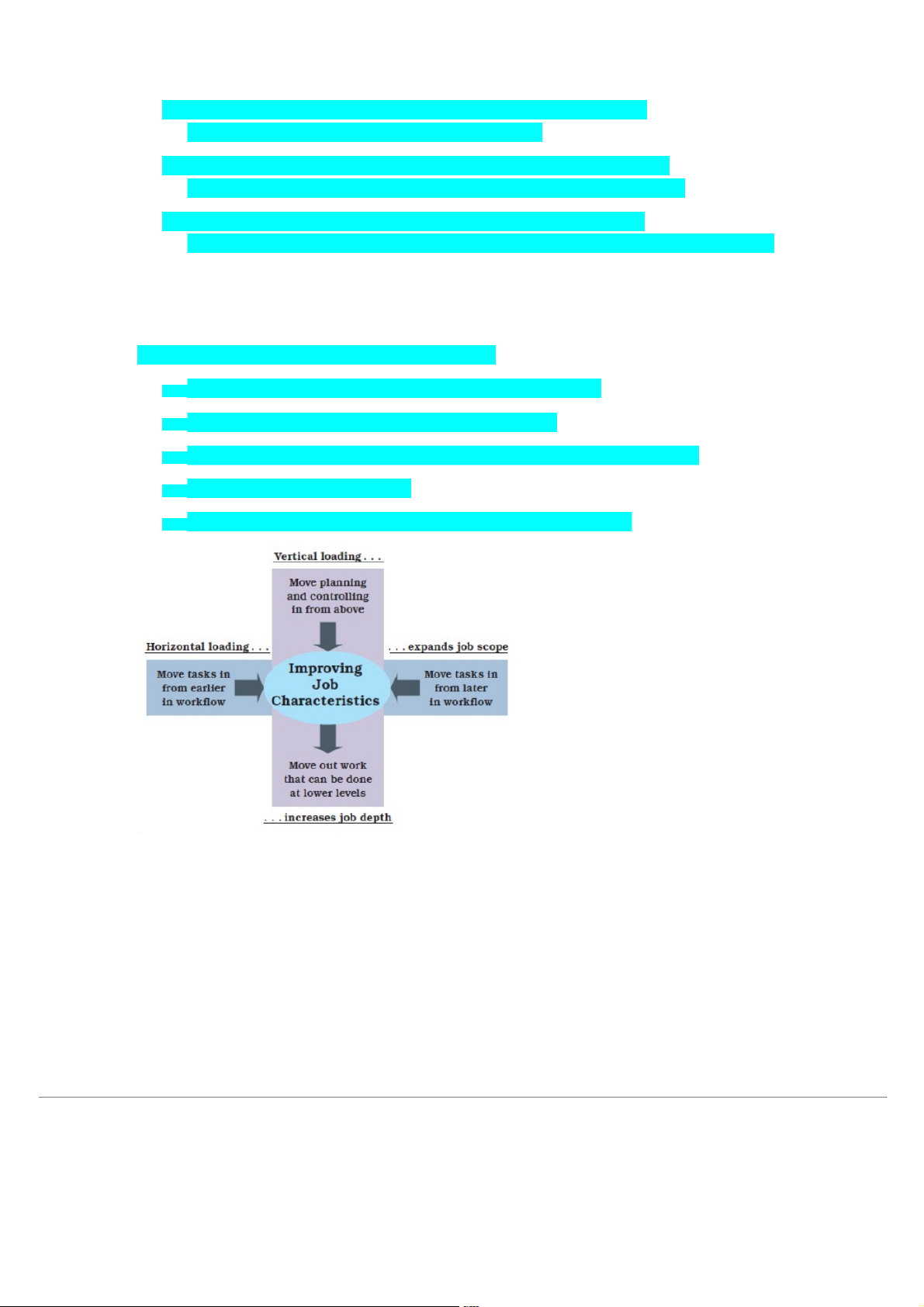
Job enlargement :Increases task variety by combining two or more
tasks previously assigned to separate workers;Horizontal loading
Job enlargement means adding more tasks to a single job, so the worker
does more types of work at the same level. It's sometimes called horizontal
loading, because the job becomes wider (more variety), but not deeper (no extra authority). ➕ Example:
In an ofÏce, instead of one employee only answering emails and another
only processing forms, both tasks are given to one person. They now have a
more varied and less repetitive job. 2. Job enrichment -
Building more opportunities for satisfaction into a job by expanding its content -
Increases job depth by adding work planning duties normally performed by a supervisor -
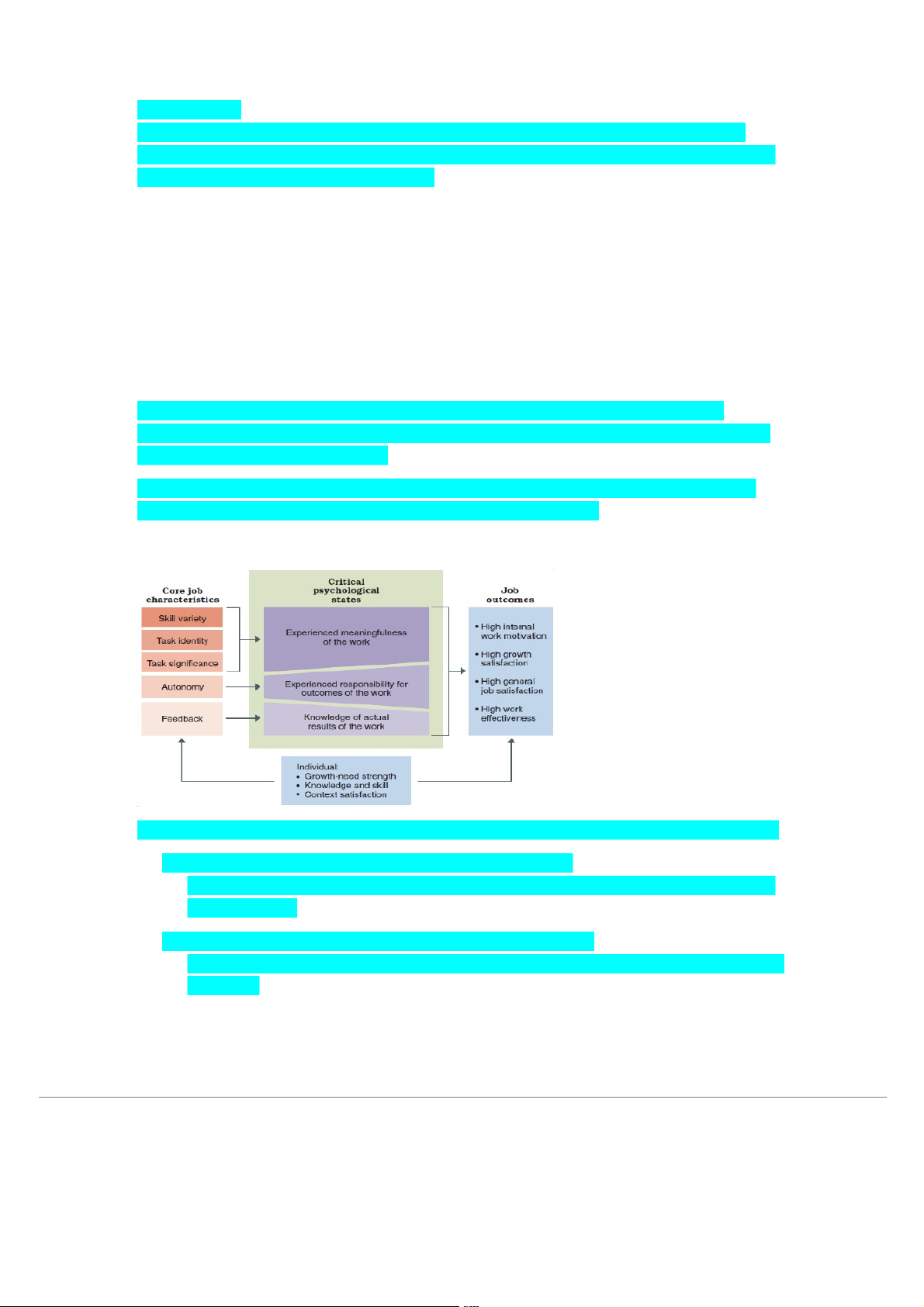
Focuses attention on the extent to which five core job characteristics
are present in a job:Skill variety ;Task identity ;Task significance ;Autonomy ;Feedback
Job enrichment means making a job more rewarding and satisfying by
adding meaningful tasks and responsibilities—not just more work, but more
important or interesting work.
It gives employees more control and involvement in their job, which helps
increase motivation, commitment, and job satisfaction.
Figure 16.6 Job design essentials using the job characteristics model
✅ Key Elements of Job Enrichment (based on the Job Characteristics Model):
1. Skill variety – Using different skills and talents
🧠 Example: A graphic designer who also writes content and manages social media.
2. Task identity – Completing a whole piece of work
🧩 Example: A carpenter building an entire piece of furniture from start to finish.
3. Task significance – Feeling your work matters to others
💡 Example: A nurse who helps save lives.
4. Autonomy – Having freedom to decide how to do your job
🔧 Example: A delivery driver who chooses their own route.
5. Feedback – Getting clear info on how well you're doing
📣 Example: A sales rep who gets regular updates on sales goals met. -
How to improve core job characteristics:Form natural units of work
;Combine tasks ;Establish client relationships ;Open feedback channels ;Practice vertical loading
How to improve jobs using job enrichment:
Combine small tasks into larger, meaningful units
Allow employees to see results of their work
Give them more control over how tasks are done (autonomy)
Provide feedback regularly
Build stronger relationships with clients or customers
3. Alternative work schedules -
Any work schedule that gives employees some choice in the pattern of their daily work hours
Alternative work schedules give employees more flexibility in choosing
when, where, and how they work, rather than following the traditional 9-to-5, five-day week.
Core time — all employees must be at work
Flextime — allows employees to schedule around personal and family responsibilities -
Potential benefits of flexible working hours:
People have greater autonomy in work scheduling while ensuring
maintenance of work responsibilities
Organizations can attract and retain employees who have special non-work responsibilities Worker morale may be improved 🔄 1. Flextime
Employees choose their start and end times, but must be present
during a required “core time.”
Example: A working parent starts at 7:00 AM and leaves at 3:00 PM to
pick up kids, while others work 9:00–5:00. ✅ Benefits:
Better work-life balance Higher morale
Attracts talent who need flexibility -
Alternative Work Schedules: Compressed workweek
Allows a full-time job to be completed in less than the standard 5 days of 8- hour shifts
•Benefits — more leisure time, lower commuting costs,
lower absenteeism, and potentially improved performance
•Disadvantages — increased fatigue, family adjustment
problems, increased scheduling problems
📅 2. Compressed Workweek
Employees work full-time hours (e.g., 40 hours) in fewer days, such as
four 10-hour shifts instead of five 8-hour ones.
Example: An IT technician works Monday to Thursday, 10 hours a day, and takes Fridays off. ✅ Benefits: More personal time Lower commuting costs Fewer absences ❌ Drawbacks: Fatigue from long days
Harder to manage family time
Scheduling issues in teams -
Alternative Work Schedules: Job sharing
One full-time job is split between two or more persons
Potential advantages of job sharing: organizations benefit by employing
talented people who are unable/unwilling to commit full-time 👥 3. Job Sharing
Two or more people share one full-time job. Each person works part- time.
Example: Two HR professionals split one position, each working 2.5 days per week. ✅ Benefits:
Gives work opportunities to people who can’t work full-time
Fresh perspectives from two people in one role ❌ Challenges:
Requires good communication
Can be tricky to coordinate tasks smoothly -
Alternative Work Schedules: Telecommuting
A work arrangement that allows a portion of scheduled work hours to be
completed outside of the ofÏce Hoteling Virtual ofÏces -
Potential advantages of telecommuting:
Freedom from:Constraints of commuting ;Fixed hours ;Special work attire
;Direct contact with supervisors . Increased productivity Fewer distractions Being one’s own boss Having more personal time -
Potential disadvantages of telecommuting: Working too much Having less personal time
DifÏculty in separating work and personal life Less time for family Feelings of isolation
Loss of visibility for promotion
DifÏculties supervising work-at-home employees from a distance -
Contingency workers:Part-time workers who supplement the full-time
workforce, often on a long-term basis -
Part-time work : Work done on any schedule less than the standard 40-
hour workweek and does not qualify person as a full-time employee
🏠 4. Telecommuting (Remote Work)
Employees work from home or remotely for part or all of the workweek.
Example: A marketing specialist works from home 3 days a week and comes
to the ofÏce 2 days.
Tài liệu liên quan:
-

CHAP 1: Introduction to Management Concepts and Functions môn Principles of Management | Trường Đại học Quốc tế, Đại học Quốc gia Thành phố Hồ Chí Minh
19 10 -

Guidelines for group’s assignments: Analysing management issues of a FDI company based inVietnam môn Principles of Management | Trường Đại học Quốc tế, Đại học Quốc gia Thành phố Hồ Chí Minh
17 9 -
Financial Planning to Achieve 300m VND Goal in 3 Years môn Principles of Management | Trường Đại học Quốc tế, Đại học Quốc gia Thành phố Hồ Chí Minh
17 9 -

A Case Study in Fast Fashion Success môn Principles of Management | Trường Đại học Quốc tế, Đại học Quốc gia Thành phố Hồ Chí Minh
15 8 -

Chap 16 Hierarchy of Needs Theory and Applications môn Principles of Management | Trường Đại học Quốc tế, Đại học Quốc gia Thành phố Hồ Chí Minh
17 9