Chapter 17 Summary: Team Dynamics and Roles môn Principle of Management | Trường Đại học Quốc tế, Đại học Quốc gia Thành phố Hồ Chí Minh
A team is a small group of people with complementary skills who interact and work with one another to achieve shared goals. And the process of achieving goals is called teamwork. Tài liệu giúp bạn tham khảo, ôn tập và đạt kết quả cao. Mời đọc đón xem!
Môn: Principles of Management 314 tài liệu
Trường: Trường Đại học Quốc tế, Đại học Quốc gia Thành phố Hồ Chí Minh 2 K tài liệu
Tác giả:








Preview text:
I. Team
A team is a small group of people with complementary skills who interact and
work with one another to achieve shared goals. And the process of achieving
goals is called teamwork.
A team leader or the manager who leads should be able to perform four roles.
-As the appointed head of a team or work unit. -As a helpful contributor.
-As the peer leader and networking hub for a special task force.
-As a coach advising on ways to improve performance. 1. Teamwork
The main reason why a team is utilized is the accomplishment of far greater
things than a loner. Synergy indicates the creation of a whole that is greater than the sum of its parts. Advantage:
• Performance gains through synergy
• More resources for problem solving
• Improved creativity and innovation
• Improved quality of decision making
• Greater member commitment to tasks
• Increased motivation of members
• Increased need satisfaction of members Disadvantage:
Social loafing is the tendency of some people to avoid responsibility by “free- riding” in groups.
In order to eliminate social loafing, leaders can try to make their contribution
visible to them, reward their achievement or assign them with interesting tasks.
2. Organizations as Networks of Teams
Formal groups are officially recognized and supported by the organization. They
may be called departments (e.g., market research department), units (e.g., audit
unit), teams (e.g., customer service team), or divisions (e.g., office products division), etc.
These groups form interlocking networks that set the foundations of organization
structure. Managers lead formal groups at one level while also serving as
members of others at the next higher level.
Informal groups emerge from natural or spontaneous relationships among people.
-Interest groups in which workers band together to pursue a common cause
-Friendship groups that develop for a variety of personal reasons
-Support groups where the members help one another do their jobs or cope with common problems
Members of informal groups can satisfy needs that are otherwise unmet in their
formal assignments: such as friendship, security, support, and a sense of belonging – social needs. II.
Trends in the Use of Teams
1. Committees, Project Teams, and Task Forces
A committee brings people together outside of their daily job assignments to
work in a small team for a specific purpose. The task agenda is typically narrow, focused, and ongoing.
Organizations usually have permanent or standing committees dedicated to a
variety of concerns, such as diversity, product quality, and product development.
Project teams or task forces bring people together to work on common
problems, but temporarily rather than on a permanent basis.
2. Cross-Functional Teams
Cross-functional teams pull together members from across functional units to
work on common goals. These teams help reduce the functional chimneys
problem by eliminating the obstacles that limit communication and cooperation
among people from different departments and functions. 3. Self-Managing Teams
Self- managing work teams operate with a high degree of task
interdependence, authority to make many decisions and collective responsibility
for results. The “self-management” responsibilities include planning and
scheduling work, training members in various tasks, distributing tasks, meeting
performance goals, ensuring high quality, and solving day-to-day operating problems. 4. Virtual Teams
Virtual teams, or distributed teams, work together through computer-based rather than face-to-face.
Virtual teams can save time and travel expenses when members work in different
locations. They can also be easily expanded with more members as needed, and
the discussions and shared information can be archived for later access. Virtual
teams are usually quite efficient because members are less prone to stray off
task and get sidetracked by interpersonal difficulties. However, the lack of face-
to-face interaction limits the role of emotions and nonverbal cues in
communication and allows relationships to stay depersonalized. 5. Team Building
Team building is a sequence of planned activities used to analyze the
functioning of a team and make constructive changes in how it operates.
The process starts with knowing there is a problem with the team, hence,
members should work together to gather data and fully understand the problem
to make and implement plans. Team building usually is done in outside locations.
A popular approach is to bring team members together in special outdoor
settings where their capacities for teamwork are put to the test. III. How Teams Work
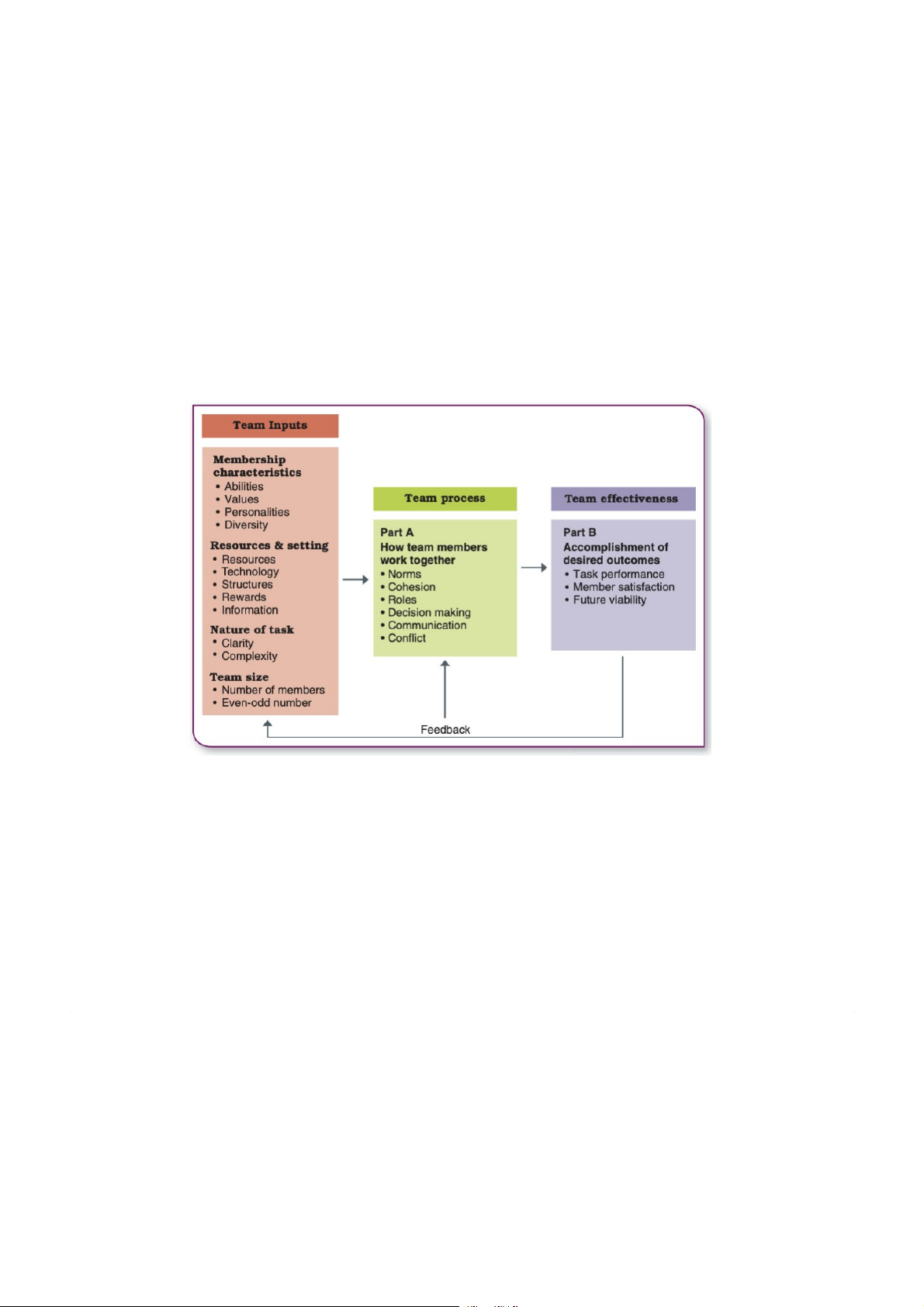
An effective team does three things well
1. Perform its tasks: a team needs to be able to transform input resources into outputs.
2. Satisfy its members: team member should be recognized for their
contributions to the overall result and be pleased about that result
3. Remain viable for the future: a team should be able to keep team
members’ willingness to work well together in the future 1. Team Inputs Membership Characteristics
Teams need members with the right abilities, or skill sets, to master and perform
tasks well. Teams must also have members whose attitudes, values, and
personalities are sufficiently compatible for everyone to work well together.
Team diversity, in terms of different values, personalities, experiences,
demographics, and cultures among the membership, affects how teams work.
-Homogeneous teams—teams whose members share similar characteristics.
-Heterogeneous teams—teams whose members are quite dissimilar to one another. Resources and Setting
The available resources and organizational setting can affect how well team
members use and pool their talents to accomplish team tasks. Teams function
best when members have good information, material resources, technology,
organization structures, and rewards. Nature of the Task
The nature of the task or task characteristics not only sets standards for the
talents needed but also affects how they work together. Clearly defined tasks are
easier to deal with. Complex tasks ask a lot more of members in things like
information sharing and coordinated action. Team Size
Team size affects how members work together, handle disagreements, and
make decisions. Too large teams create communication problems and congestion.
2. Stages of Team Development Forming Stage
The forming stage involves the first entry of members into a team where people
begin to identify with other members and with the team itself. They are
concerned about getting acquainted, establishing relationships, discovering what
is acceptable behavior, and learning how others perceive the team’s task.
Difficulties in this stage tend to be greater in more culturally and demographically diverse teams. Storming Stage
The storming stage is a period of high emotionality and can be the most difficult
stage to pass through. Tensions often emerge over tasks and interpersonal
concerns. Conflict may develop as individuals compete to impose their
preferences on others and to become influential. Norming Stage
The norming stage is also part of the critical zone of team development. As
members develop initial feelings of closeness, a division of labor, and shared
expectations, this helps protect the team from disintegration. Performing Stage
Teams in the performing stage are more mature, organized, and well-functioning.
Performing is a stage of total integration in which team members are able to deal
in creative ways with complex tasks and any interpersonal conflicts. Adjourning Stage
The final stage of team development is adjourning, when team members prepare
to achieve closure and disband. Temporary committees, task forces, and project
teams should disband when important goals have been accomplished.
3. Norms and Cohesiveness
A norm is a behavior expected of team members. It is a “rule” or “standard” that
guides behavior. Typical team norms relate to such things as helpfulness,
participation, timeliness, work quality, and creativity and innovation. A team’s
performance norm is one of the most important, since it defines the level of work
effort and performance that members are expected to contribute.
Cohesiveness is the degree to which members are attracted to and motivated to remain part of a team. Managing Team Norms
Norm development should include all team members during the forming and
storming stage. For example, norms regarding helpfulness might be developed
during the forming stage but creativity might happen during storming. Managing Team Cohesiveness
Persons in a highly cohesive team value their membership and strive to maintain
positive relationships with other team members. They then have the tendency to follow the norms.
4. Task and Maintenance Roles
Task activities contribute to the team’s performance purpose
Maintenance activities support the emotional life of the team as an ongoing social system
-Leading through task activities involves defining and solving problems and
to advance work toward results.
-Leading through maintenance activities involves strengthening the team as
a social system assuring the ability of the team to stay together over the longer term.
This concept of distributed leadership where every member is responsible for
recognizing when task or maintenance activities are needed and taking actions to provide them.
Disruptive activities are activities toward other members, withdrawing from the
discussion, and fooling around are self-serving and detract from, rather than enhance, team effectiveness.
5. Communication Networks
Decentralized communication network where all members communicate directly with one another.
Centralized communication network where activities are coordinated, and
results pooled by a central point of control.
Restricted communication network where teams are composed of subgroups
with issue-specific disagreements, such as a temporary debate. IV.
Decision Making in Teams
Decision making is the process of making choices among alternatives and it is
important as a team faces different kinds of problems.
Edgar Schein identifíd 6 methods of decision making:
-Lack of response: one idea after another is suggested without any discussion.
-Authority rule: the leader, manager, committee head makes a decision for the team.
-Minority rule: two or three people are able to dominate the team into making a decision.
-Majority rule: vote and arrive at a decision.
-Consensus: full discussion leads to one alternative being favored by most members.
-Unanimity: all team members agree on the course of action to be taken.
1. Advantages and Disadvantages of Team Decisions Advantage:
-The process of making a true team decision makes more information,
knowledge, and expertise available.
-It expands the number of alternatives that are examined, and helps to
avoid considering only one or a few options.
-Team decisions also increase understanding and acceptance by members
which helps build commitments of members to work hard to implement the decisions Disadvantage:
-The potential disadvantages of team decision making trace largely to the
difficulties with group process.
-It can be hard to reach agreement when many people are trying to make a team decision.
-the time required to make team decisions can be a disadvantage as more
people are involved in the discussion, decision making takes longer.
2. Creativity in Team Decision Making
Classic brainstorming asks members to follow these strict guidelines. -Don’t criticize each other. -Welcome “freewheeling”. -Go for quantity.
-Keep building on one another’s ideas.
Nominal group technique uses a highly structured meeting agenda that allows
everyone to contribute ideas without the interference of evaluative comments by others.
Tài liệu liên quan:
-
CHAP 1: Introduction to Management Concepts and Functions môn Principles of Management | Trường Đại học Quốc tế, Đại học Quốc gia Thành phố Hồ Chí Minh
1 1 -
Guidelines for group’s assignments: Analysing management issues of a FDI company based inVietnam môn Principles of Management | Trường Đại học Quốc tế, Đại học Quốc gia Thành phố Hồ Chí Minh
1 1 -
Financial Planning to Achieve 300m VND Goal in 3 Years môn Principles of Management | Trường Đại học Quốc tế, Đại học Quốc gia Thành phố Hồ Chí Minh
1 1 -

A Case Study in Fast Fashion Success môn Principles of Management | Trường Đại học Quốc tế, Đại học Quốc gia Thành phố Hồ Chí Minh
1 1 -
Chap 16 Hierarchy of Needs Theory and Applications môn Principles of Management | Trường Đại học Quốc tế, Đại học Quốc gia Thành phố Hồ Chí Minh
1 1