Chapter 3: Theories & Philosophies of Corporate Governance môn Principles of Management | Trường Đại học Quốc tế, Đại học Quốc gia Thành phố Hồ Chí Minh
For each CG theory in different countries at the same time, there will be no right or wrong in these time. Tài liệu giúp bạn tham khảo, ôn tập và đạt kết quả cao. Mời đọc đón xem!
Môn: Principles of Management 314 tài liệu
Trường: Trường Đại học Quốc tế, Đại học Quốc gia Thành phố Hồ Chí Minh 2 K tài liệu
Tác giả:




Preview text:
CHAPTER III: THEORIES AND PHILOSOPHIES OF CORPORATE GOVERNANCE
I. No single universal theory:
- The function of CG: Legal, cultural, institutional settings,..)
- Corporate governance development: 1. Global occurrence.
2. Complex area including legal, cultural, ownership & structural diffferences.
- For each CG theory in different countries at the same time, there will be no
right or wrong in these times.
- Some CG might be more appropriate & relevant to some countries than
others, depending on stage individual, group, countries. II. Agency theory: - The agents have more
information than the shareholders
→ Lead to information asymmetry. - Views corporate governance,
especially the board of directors, as being an essential monitoring
device to try to ensure that any problems that may be brought about by the principal-agent relationship, are minimized. - Managers must be
monitored: Checks and balances must be provided to make sure they don't abuse power. - Agency costs: The costs
resulting from managers misusing
CHAPTER III: THEORIES AND PHILOSOPHIES OF CORPORATE GOVERNANCE
their position, as well as the costs of monitoring and disciplining them to prevent abuse.
- Direct cost: The cost that reflect outside - Indirect cost:
+ Give good project and cashflow but the earnings will be earned at the end of
the project. This intentionally gives benefit to the CEO who owns this project
to maturity. But shareholders will not get enough this due to their delegation
(nhiệm kỳ) - INTENTIONAL BEHAVIOR FROM CEO
+ Happens in the management (CEO) thinks this should be good for company
(different risk preferences) such as they want to invest more risky which is
different from the management (risk-aversion). - UNINTENTIONAL BEHAVIOR FROM CEO
III. Transaction cost economics (TCE) theory: - Definition: BOD will have tendency comit long-term
contracts & agreements. Some people would prefer the old
choice over the new choice (As long as old service is good enough).
1. Ex: BOD committed a long-term
contract to another supplier. The BOD would not think alot for
many supplies but it would not
flexibility if the supply not good enough
2. Incontrast, if they sign with
another contract short-term, they
can explore more new supplier,
more flexibility but have to use the time to selection
→ Avoids uncertainty, easier to control business but missed out better opportunities
CHAPTER III: THEORIES AND PHILOSOPHIES OF CORPORATE GOVERNANCE IV. Stakeholder theory:
- Definition: Protect as much as possible about the interest of stakeholder
- Stakeholder: Either affected or affected by a project company. They have a
stake in its success or failure. They can be shareholders or owners but also be
employees of the company, bondholders who own company-issued debt,
customers, suppliers and vendors and partners.
CHAPTER III: THEORIES AND PHILOSOPHIES OF CORPORATE GOVERNANCE
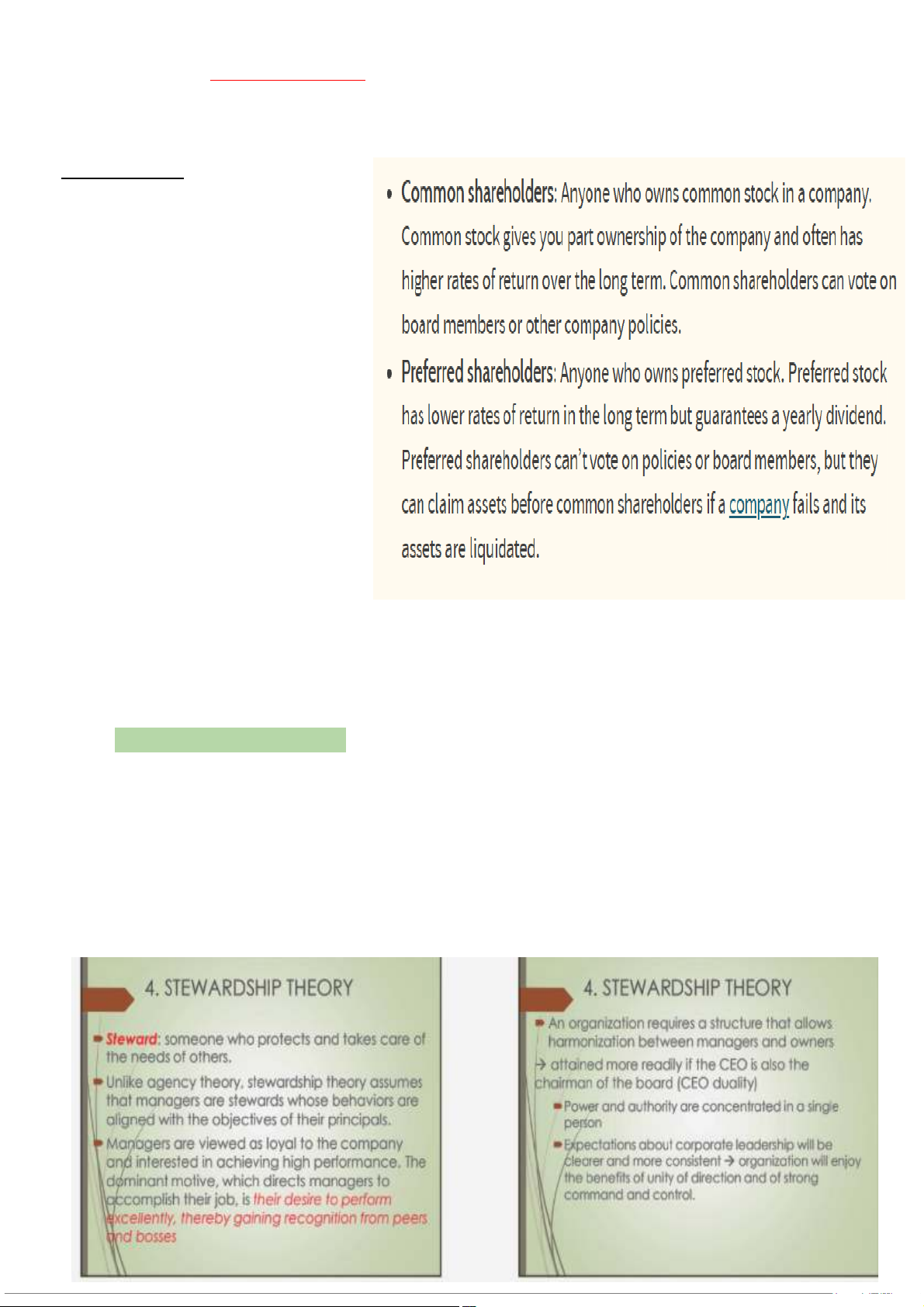
-Shareholder: Can be individual,
company or institution that owns
at least one share of a company
and has financial interest in its
profitability. Shareholder also be known as stockholder
1. Shareholders who are hoping
stock price increase because it is
part of their portfolio investment in the company. Shareholders
want the greatest return possible
on their investment as stock price and dividends go up when a company performs well and increases its value which
increases the value of stocks.
2. Shareholders also have a right to exercise a vote to affect
management of the company. Shareholders are owners of the company but they are not
liable for the company's debt.
3. There are different shareholders such as common and preferred shareholders. V. Stewardship theory:
- Assume the manager is a steward and each individual would have different
stemes. In corporate finance, stewardship can be presented as recognition
from bosses, self-esteem, and more money.
- Implication: This theory would not assume chairman (Head BOD) and CEO
are not separated → This is called CEO duality. This theory advise we
should believe the CEO (Power concentrated just only 1 person)
- In the reality, this theory would not be true because this would not oversee
Tài liệu liên quan:
-
CHAP 1: Introduction to Management Concepts and Functions môn Principles of Management | Trường Đại học Quốc tế, Đại học Quốc gia Thành phố Hồ Chí Minh
16 8 -
Guidelines for group’s assignments: Analysing management issues of a FDI company based inVietnam môn Principles of Management | Trường Đại học Quốc tế, Đại học Quốc gia Thành phố Hồ Chí Minh
15 8 -
Financial Planning to Achieve 300m VND Goal in 3 Years môn Principles of Management | Trường Đại học Quốc tế, Đại học Quốc gia Thành phố Hồ Chí Minh
13 7 -
A Case Study in Fast Fashion Success môn Principles of Management | Trường Đại học Quốc tế, Đại học Quốc gia Thành phố Hồ Chí Minh
15 8 -
Chap 16 Hierarchy of Needs Theory and Applications môn Principles of Management | Trường Đại học Quốc tế, Đại học Quốc gia Thành phố Hồ Chí Minh
16 8