CHAPTER 6 Organization Structure and Design môn Principle of Management | Trường Đại học Quốc tế, Đại học Quốc gia Thành phố Hồ Chí Minh
The Transportation Security Administration, or TSA, was created in the aftermath of the September 11, 2001, terror attacks. Its primary purpose is to maintain security for air travel. The TSA was originally designated as part of the U.S. Tài liệu giúp bạn tham khảo, ôn tập và đạt kết quả cao. Mời đọc đón xem!
Môn: Principles of Management 314 tài liệu
Trường: Trường Đại học Quốc tế, Đại học Quốc gia Thành phố Hồ Chí Minh 2 K tài liệu
Tác giả:














Preview text:
CHAPTER 6 Organization Structure and Design Learning Outcomes
After studying this chapter, you should be able to:
6-1 Identify the basic elements of organizations.
6-2 Describe the bureaucratic perspective on organization design.
6-3 Explain key situational influences on organization design.
6-4 Describe the basic forms of organization design that characterize many organizations.
This chapter, the first of three devoted to organizing, discusses many of the critical
6-5 Identify emerging issues in organization design.
elements of organization structure and design that managers can control. We first
identify and describe the various elements of organizing. Next, we explore how those
elements can be combined to create an overall design for the organization. Then we
introduce situational factors and how they impact organization design. We conclude by
describing three emerging issues in organization design. Management in Action The Stress of Screening
“You have to have courtesy, patience, politeness, and an attention to personal
appearance. . . . Even though we’re on a team, the work itself can be fairly
solitary since we have little time to socialize among each other.”
—Unidentified Transportation Security Officer
The Transportation Security Administration, or TSA, was created in the
aftermath of the September 11, 2001, terror attacks. Its primary purpose is to
maintain security for air travel. The TSA was originally designated as part of
the U.S. Department of Transportation but was later moved to be a part of the
Department of Homeland Security. The TSA is funded primarily by a $2.50 fee
that is a part of every airline ticket sold. During the period between February and
December 2002 more than 1.7 million people applied for 55,000 screening jobs.
Prior to the creation of the TSA, airport security was handled by dozens of
private security businesses. Each airport was free to hire its own security firm,
and there was considerable variation in screening procedures between airports.
Airports can actually still opt out of using the TSA and hire their own contrac-
tors to provide security. However, these private contractors must meet rigorous
standards and must follow all TSA procedures. 143
Copyright 2022 Cengage Learning. All Rights Reserved. May not be copied, scanned, or duplicated, in whole or in part. Due to electronic rights, some third party content may be suppressed from the eBook and/or eChapter(s).
Editorial review has deemed that any suppressed content does not materially affect the overall learning experience. Cengage Learning reserves the right to remove additional content at any time if subsequent rights restrictions require it. 144 PART 3 | Organizing
The hierarchy of the TSA consists of several levels. The senior leadership level
has 35 executive positions arranged across five levels. Within the Aviation Security
department of the TSA (its largest division, by far) there are an additional eight
levels, with four of these levels residing in each of over 450 individual airports
across the country. (The other units of the TSA are Transportation Security Support
and Intelligence, Federal Air Marshalls, Transportations Threat Assessment and
Credentialing, and Surface Transportation Security.) The TSA’s total annual
budget is almost $8 billion. In total, the TSA employs around 54,200 people, with
the majority of those individuals, over 47,000, working as TSOs, or Transportation
Security Officers. Most travelers know the TSOs as the security screeners at airports.
TSOs are required to be U.S. citizens or nationals, be at least 18 years old,
and pass drug screening and medical evaluation tests and are subject to both
credit andcriminal background checks. The base starting pay for TSOs is around
$29,000per year with some additional allowances for airports located in high cost-
of-living areas such as New York City and the state of Hawaii. In addition, airports
that experience high turnover rates also offer annual retention bonuses.
At any individual airport TSOs are responsible for controlling terminal entry
and exit points; verifying passenger credentials at the beginning of the security
screening process; directing passengers as they approach security screening;
monitoring various screening equipment such as body scanners, x-ray machines,
and so forth; and performing follow-up screening and searches, including pat-
downs and checking the contents of passenger bags and personal items as warranted.
At each security station the TSOs are loosely organized into teams. However,
because of the pace of the jobs and the need to keep focused, there is actually
limited interaction among team members. Focus, in particular, can be an issue for
TSOs. For example, sitting in front of an x-ray screen and paying close attention
to images of backpacks, computer cases, briefcases, small suitcases, and so forth
as they pass through on a moving belt requires intense concentration and can be mentally tiring.
Similarly, the agents directing passengers often have to deal with nervous
inexperienced travelers, harried travelers concerned about missing their flight,
passengers who may be hostile to the screening process, travelers distracted
with helping small children, passengers who may not be familiar with all of the
requirements relating to carry-on items, and international travelers who may not
be proficient in English and so can’t easily understand instructions being given in
what to them is a foreign language.
To help combat the mental fatigue associated with some of these jobs (such
as monitoring the x-ray screening) and the potential loss of patience with others
(such as directing passengers), TSOs rotate across the various positions within
each security station every 20 minutes. So, for example, a given agent might verify
passenger credentials for 20 minutes, then direct passengers as they approach the
actual screening line for 20 minutes, then watch the x-ray monitor for 20minutes,
then manage passengers as they proceed through the body scanners for 20minutes,
and then handle pat-downs and searches for 20 minutes before moving back to
their initial task of verifying credentials. There are also other positions they may rotate through as well.
Each task within a TSO team is very tightly defined and agents have very little
discretion in what standards they must apply, standard operating procedures, and
so forth. For example, passengers are allowed liquids, gels, and aerosols in travel-
size containers that are 3.4 ounces or less and all such items have to fit into a
one-quart clear bag. TSO agents cannot allow a passenger to proceed with a liquid
container that is 4 ounces or more or if a passenger has a one-quart bag plus other
liquids that won’t fit into the bag.
Copyright 2022 Cengage Learning. All Rights Reserved. May not be copied, scanned, or duplicated, in whole or in part. Due to electronic rights, some third party content may be suppressed from the eBook and/or eChapter(s).
Editorial review has deemed that any suppressed content does not materially affect the overall learning experience. Cengage Learning reserves the right to remove additional content at any time if subsequent rights restrictions require it.
CHAPTER 6 | ORGANIZATION STRUCTURE AND DESIGN 145
Perhaps not surprisingly, there is considerable turnover in the TSA. Agents
complain that the pay is low, the job monotonous, and the stress associated with the
job excessive. The jobs are also dangerous due to illegal articles that people may be
trying to sneak onto a plane, potentially unruly passengers, and few opportunities
for advancement. While turnover rates vary between different airports, one
in five new screeners quits within the first five months of their employment; at
someairports annual turnover has approached 80 percent.1
6-1 THE BASIC ELEMENTS OF ORGANIZING
Most organizations are structured into various positions or jobs. Some jobs are very complex
or technical whereas others may be simple and straightforward. The working relationships
between jobs and people in a team or organization are some of the most critical elements in
managing an organization. As you will see in this chapter, addressing the basic frameworks
that organizations use to get their work done—structure and design—is a fundamental part of the management process.
The term organization structure and design refers to the overall set of elements that can be
used to configure an organization. This section introduces and describes these elements: job
specialization, departmentalization, reporting relationships, distribution of authority, and coordination. 6-1a Job Specialization job specialization
The first building block of organization structure is job specialization. Job specialization is the The degree to which
degree to which the overal task of the organization is broken down and divided into smal er the overall task of the
component parts. For example, when Walt Disney started his company, he did everything organization is broken
himself—scripted cartoons, drew them, added the character voices, and then marketed them down and divided into
to theaters. As his business grew, though, he eventual y hired others to perform many of these smaller component parts
same functions. As growth continued, so, too, did specialization. For example, as animation
artists work on Disney movies today, they may specialize in generating computer images of
a single character or doing only background scenery. Others provide voices, and marketing
specialists develop promotional campaigns. And
today, the Walt Disney Company has literally
thousands of different specialized jobs. Clearly, no
one person could perform them al .
Benefits and Limitations of Specialization Job
specialization provides four basic benefits to
organizations.2 First, workers performing small,
simple tasks wil become very proficient at each
task. Second, transfer time between tasks decreases.
If employees perform several different tasks, some
time is lost as they stop doing the first task and
start doing the next. Third, the more narrowly
defined a job is, the easier it is to develop specialized
equipment to assist with that job. Fourth, when an
employee who performs a highly specialized job
is absent or resigns, the manager is able to train
BartlomiejMagierowski/Shutterstock.com
someone new at relatively low cost. Although
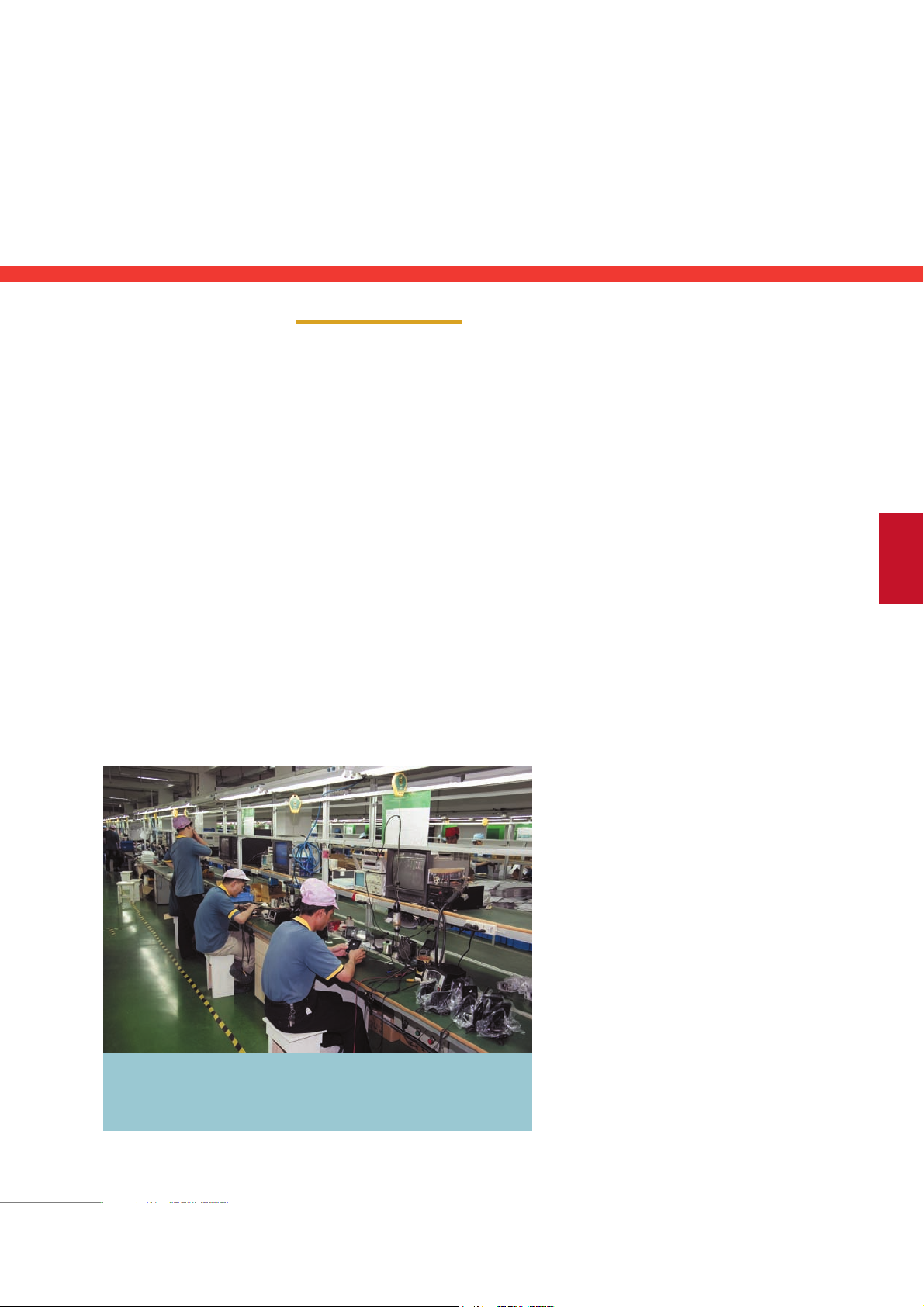
Job specialization is the basis for mass-production assembly lines such as
specialization is generally thought of in terms of
this one. Tasks are broken down into small component elements. Partially
operating jobs, organizations have also extended
assembled products move along the assembly line as each worker adds
the basic elements of specialization to managerial
to the product by attaching or building new parts of the product. and professional levels.3
Copyright 2022 Cengage Learning. All Rights Reserved. May not be copied, scanned, or duplicated, in whole or in part. Due to electronic rights, some third party content may be suppressed from the eBook and/or eChapter(s).
Editorial review has deemed that any suppressed content does not materially affect the overall learning experience. Cengage Learning reserves the right to remove additional content at any time if subsequent rights restrictions require it. 146 PART 3 | Organizing
On the other hand, job specialization can have negative consequences. The foremost criti-
cism is that workers who perform highly specialized jobs quickly become bored and dis-
satisfied. The job may be so specialized that it offers no challenge or stimulation. Boredom
and monotony set in, absenteeism rises, and the quality of work may suffer. Furthermore,
the anticipated benefits of specialization do not always occur. For example, a classic study
conducted at Maytag found that the time spent moving work in process from one worker to
another was greater than the time needed for the same individual to change from job to job.4
Thus, although some degree of specialization is necessary, it should not be carried to extremes
because of the possible negative consequences. Managers must be sensitive to situations in
which extreme specialization should be avoided. And indeed, several alternative approaches
to designing jobs have been developed.
“The best [Tour de France] teams have
Alternatives to Specialization To counter the
problems associated with specialization, managers have
specialists to help position leaders for a win.”sought other approaches to job design that achieve a better
—Paul Hochman, Business Writer5 balance between organizational demands for efficiency and
productivity and individual needs for creativity and autonomy. Five alternative approaches are
job rotation, job enlargement, job enrichment, job characteristics approach, and work teams.6
Job rotation involves systematically moving
employees from one job to another. A worker in
a warehouse might unload trucks on Monday,
carry incoming inventory to storage on Tuesday,
verifyinvoices on Wednesday, pull outgoing inven-
tory from storage on Thursday, and load trucks on
Friday. Thus, the jobs do not change, but instead
workers move from job to job. Unfortunately, for
this very reason, job rotation has not been espe-
cially successful in enhancing employee motivation
or satisfaction. Jobs that are amenable to rotation
tend to be relatively standard and routine. Workers
who are rotated to a “new” job may be more satis-
fied at first, but satisfaction soon wanes. Although
many companies (among them Raytheon, Ford,
and Prudential Insurance) have tried job rotation, Wal iy t Skiaslij /m Los o A s ngte lo es fTiten mes/ Gu ettsy eId ma gt e o s day as a training device to
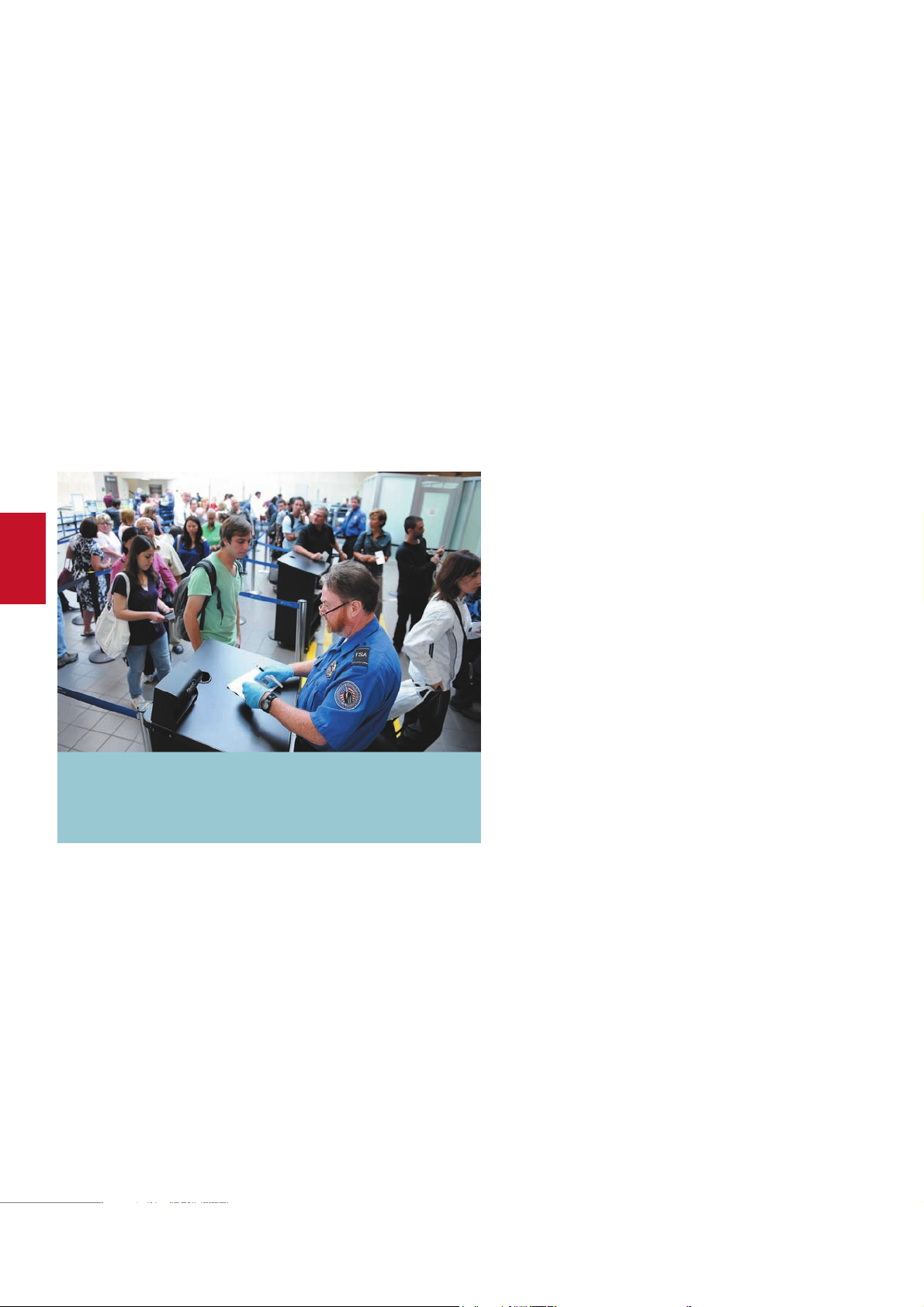
By utilizing job rotation, the Transportation Security Administration can
improve worker skills and flexibility. The TSA
help security screeners avoid becoming too complacent and losing their
(Transportation Security Administration) also
focus on their tasks. The screener shown here, rotating jobs every
rotates security screeners at airports several times a
20 minutes, wil head to the entryway checkpoint entrance next. Rotation
day to offset problems of boredom that might set in
also helps offset monotony and keeps screeners focused on their tasks.
if the same task were being performed all the time. job rotation
“[Rotating jobs] . . . makes the day go by. You don’t get bored An alternative to job
doing the same thing over and over.” specialization that involves systematically
—Rick Rush, General Motors Assembly-Line Worker7 moving employees from
Job enlargement was developed to increase the total number of tasks workers perform. one job to another
As a result, all workers perform a wide variety of tasks, which presumably reduces the level of job enlargement
job dissatisfaction. Many organizations have used job enlargement, including IBM, Detroit An alternative to job
Edison, AT&T, the U.S. Civil Service, and Maytag. At Maytag, for example, the assembly specialization that
line for producing washing machine water pumps was systematically changed so that work increases the total
that had originally been performed by six workers, who passed the work sequentially from number of tasks that
one person to another, was performed by four workers, each of whom assembled a complete workers perform
pump.8 Unfortunately, although job enlargement does have some positive consequences, they
are often offset by some disadvantages: (1) training costs usually increase, (2) unions argued
that pay should increase because the worker is doing more tasks, and (3) in many cases the
work tends to remain boring and routine even after job enlargement.
Copyright 2022 Cengage Learning. All Rights Reserved. May not be copied, scanned, or duplicated, in whole or in part. Due to electronic rights, some third party content may be suppressed from the eBook and/or eChapter(s).
Editorial review has deemed that any suppressed content does not materially affect the overall learning experience. Cengage Learning reserves the right to remove additional content at any time if subsequent rights restrictions require it.
CHAPTER 6 | ORGANIZATION STRUCTURE AND DESIGN 147
Paulo Fridman/Corbis Historical/Getty Images
Many products like Maytag washers and dryers are manufactured using job specialization and
assembly-line technology. While this approach promotes efficiency, it can also lead to monotony
and worker boredom. To help counter these negative effects, Maytag has experimented with job
enlargement and other alternatives to job specialization. job enrichment
A more comprehensive alternative, job enrichment, assumes that increasing the range An alternative to job
and variety of tasks is not sufficient by itself to improve employee motivation.9 Thus, job specialization that
enrichment attempts to increase both the number of tasks a worker does and the control attempts to increase
the worker has over the job. To implement job enrichment, managers remove some controls both the number of tasks
from the job, delegate more authority to employees, and structure the work in complete, a worker does and the
natural units. These changes increase subordinates’ sense of responsibility. Another part control the worker has
of job enrichment is to continual y assign new and challenging tasks, thereby increasing over the job
employees’ opportunity for growth and advancement. AT&T, Texas Instruments, IBM,
and General Foods are among the firms that have used job enrichment. This approach,
however, also has disadvantages. For example, work systems need to be analyzed before
enrichment, but this seldom happens, and managers rarely ask for employee preferences when enriching jobs. job characteristics
The job characteristics approach is an alternative to job specialization that does take approach
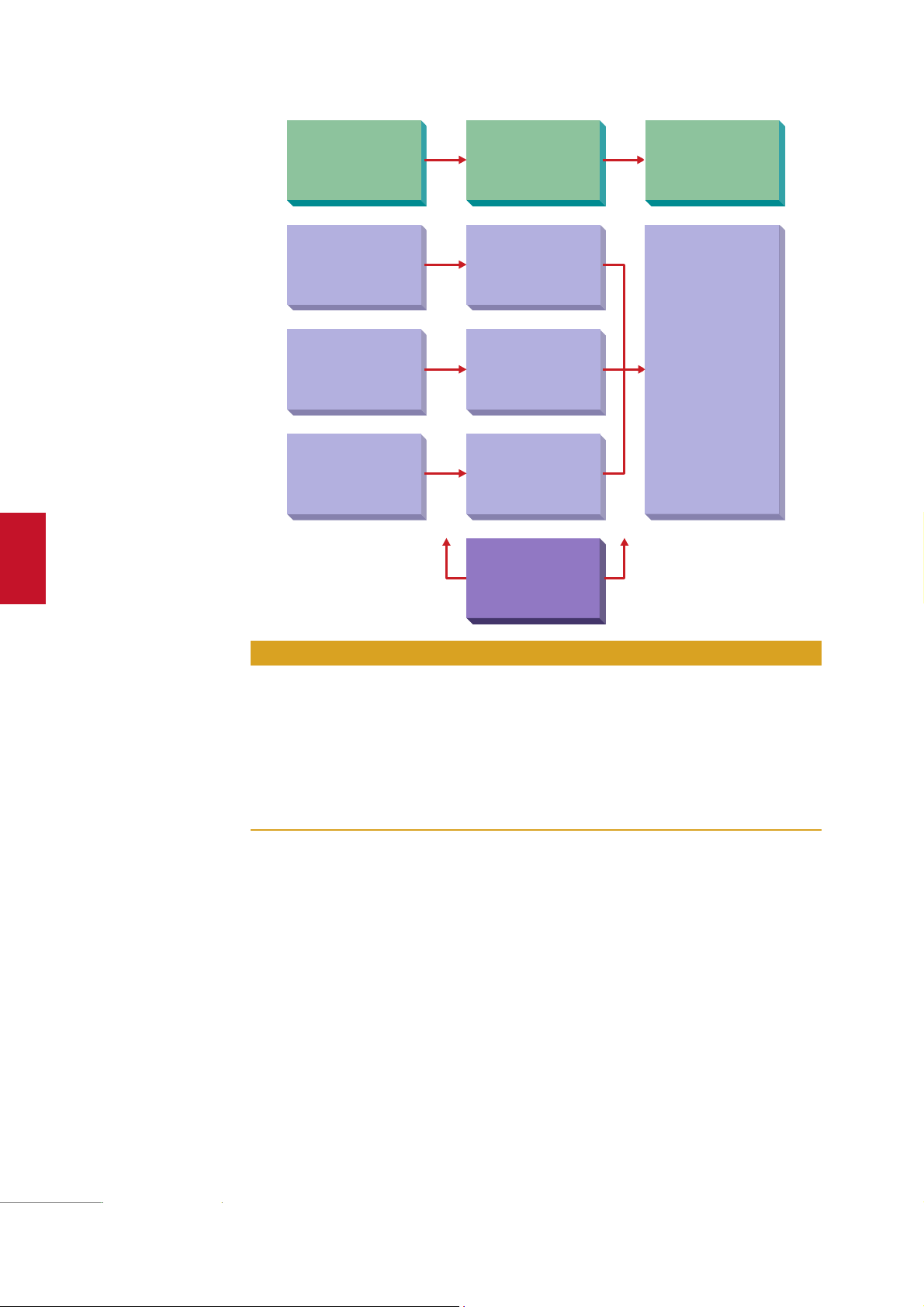
into account the work system and employee preferences.10 As il ustrated in Figure 6.1, the An alternative to job
job characteristics approach suggests that jobs should be diagnosed and improved along five specialization that core dimensions: suggests that jobs should be diagnosed and
1. Skil variety, the number of things a person does in a job improved along five core
2. Task identity, the extent to which the worker does a complete or identifiable portion of dimensions, taking into the total job account both the work
3. Task significance, the perceived importance of the task system and employee
4. Autonomy, the degree of control the worker has over how the work is performed preferences
5. Feedback, the extent to which the worker knows how well the job is being performed
Increasing the presence of these dimensions in a job presumably leads to higher motivation,
higher-quality performance, higher satisfaction, and lower absenteeism and turnover. A
large number of studies have been conducted to test the usefulness of the job characteristics
approach. Prudential Insurance, for example, implemented this approach in its claims division.
Results included moderate declines in turnover and a smal but measurable improvement in
work quality. A few studies, though, have not supported this approach as strongly. Thus,
Copyright 2022 Cengage Learning. All Rights Reserved. May not be copied, scanned, or duplicated, in whole or in part. Due to electronic rights, some third party content may be suppressed from the eBook and/or eChapter(s).
Editorial review has deemed that any suppressed content does not materially affect the overall learning experience. Cengage Learning reserves the right to remove additional content at any time if subsequent rights restrictions require it. 148 PART 3 | Organizing Core job Critical Personal and psychological dimensions work outcomes states • Skill variety • Experienced High internal • Task identity meaningfulness work motivation • Task significance of the work • High-quality work Experienced performance responsibility • Autonomy for outcomes of the work • High satisfaction with the work Knowledge of the • Feedback actual results of • Low absenteeism work activities and turnover Employee growth-need strength FIGURE 6.1
The Job Characteristics Approach
The job characteristics approach to job design provides a viable alternative to job
specialization. Five core job dimensions may lead to critical psychological states that,
in turn, may enhance motivation, performance, and satisfaction while also reducing absenteeism and turnover.
Source: J. R. Hackman and G. R. Oldham, “Motivation through the Design of Work:
Test of a Theory,” Organizational Behavior and Human Performance, 1976, Vol. 16, pp.250–279.
although the job characteristics approach is one of the most promising alternatives to job
specialization, it is probably not the final answer. work teams
Another alternative to job specialization is work teams. Under this arrangement, a group is An alternative to job
given responsibility for designing the work system to be used in performing an interrelated set specialization that
of tasks. In the typical assembly-line system, the work flows from one worker to the next, and allows an entire group to
each worker has a specified job to perform. In a work team, however, the group itself decides design the work system
how jobs will be allocated. For example, the work team assigns specific tasks to members, it will use to perform an
monitors and controls its own performance, and has autonomy over work scheduling. interrelated set of tasks
6-1b Grouping Jobs: Departmentalization
The second element of organization structure is the grouping of jobs according to some logical departmentalization
arrangement. The process of grouping jobs is called departmentalization. When organiza- The process of grouping
tions are smal and have few employees, the owner-manager can personally supervise and jobs according to some
coordinate the jobs of everyone who works there. As an organization grows and adds more logical arrangement
and more employees, however, this becomes increasingly difficult for the owner-manager.
Copyright 2022 Cengage Learning. All Rights Reserved. May not be copied, scanned, or duplicated, in whole or in part. Due to electronic rights, some third party content may be suppressed from the eBook and/or eChapter(s).
Editorial review has deemed that any suppressed content does not materially affect the overall learning experience. Cengage Learning reserves the right to remove additional content at any time if subsequent rights restrictions require it.
CHAPTER 6 | ORGANIZATION STRUCTURE AND DESIGN 149
Consequently, new managerial positions are cre-
ated to supervise or coordinate the work of others.
Employees are not assigned to particular manag-
ers randomly. Rather, jobs are grouped according
to some plan. The logic embodied in such a plan
is the basis for all departmentalization.11
Functional Departmentalization The
most common base for departmentalization,
especially among smal er organizations, is by
function. Functional departmentalization
groups together those jobs involving the same or
similar activities. (The word function is used here
to mean organizational functions such as finance
and production, rather than the basic managerial
functions, such as planning or controlling.) This
Margarita Young/Shutterstock.com
approach, which is most common in smaller
Departmentalization involves grouping jobs according to a logical
organizations, has three primary advantages.
arrangement. Individuals needing out-patient services at this hospital know
First, each department can be staffed by experts
to fol ow the directional markers on this sign, as do patients coming for x-ray
in that functional area. Marketing experts can be
services. The hospital wil also have multiple other departments such as
emergency, surgery, physical therapy, and so forth.
hired to run the marketing function, for example.
Second, supervision is facilitated because an functional
individual manager needs to be familiar with only a relatively narrow set of skills. And, third, departmentalization
coordinating activities inside each department is easier. Grouping jobs involving
On the other hand, as an organization begins to grow in size, several disadvantages of the same or similar
this approach may emerge. For one, decision making tends to become slower and more activities
bureaucratic. Employees may also begin to concentrate too narrowly on their own function
and lose sight of the total organizational system. Finally, accountability and performance
become increasingly difficult to monitor. For example, determining whether a new product
fails because of production deficiencies or a poor marketing campaign may not be possible. product
Product Departmentalization Product departmentalization, a second common departmentalization
approach, involves grouping and arranging activities around products or product groups. Grouping activities
Most larger businesses adopt this form of departmentalization for grouping activities at around products or
the business or corporate level. Product departmentalization has three major advantages. product groups
First, al activities associated with one product or product group can be easily integrated and
coordinated. Second, the speed and effectiveness of decision making are enhanced. Third,
the performance of individual products or product groups can be assessed more easily and
objectively, thereby improving the accountability of departments for the results of their activities.
Product departmentalization also has two major disadvantages. For one, managers in each
department may focus on their own product or product group to the exclusion of the rest of the
organization. For example, a marketing manager may see his or her primary duty as helping
the group rather than helping the overall organization. For another, administrative costs rise
because each department must have its own functional specialists for areas such as market
research and financial analysis. customer
Customer Departmentalization Underc ustomer departmentalization, the organization departmentalization
structures its activities to respond to and interact with specific customers or customer groups. Grouping activities to
The lending activities in most banks, for example, are usually tailored to meet the needs respond to and interact
of different kinds of customers (business, consumer, mortgage, and agricultural loans, with specific customers
for instance). The basic advantage of this approach is that the organization is able to use or customer groups
skil ed specialists to deal with unique customers or customer groups. It takes one set of
skil s to evaluate a business’s balance sheet and lend $5 million for operating capital and
a different set of skills to evaluate an individual’s creditworthiness and lend $40,000 for a
new car. However, a fairly large administrative staff is required to integrate the activities of
Copyright 2022 Cengage Learning. All Rights Reserved. May not be copied, scanned, or duplicated, in whole or in part. Due to electronic rights, some third party content may be suppressed from the eBook and/or eChapter(s).
Editorial review has deemed that any suppressed content does not materially affect the overall learning experience. Cengage Learning reserves the right to remove additional content at any time if subsequent rights restrictions require it. 150 PART 3 | Organizing
the various departments. In banks, for example, coordination is necessary to make sure that
the organization does not overcommit itself in any one area and to handle col ections on
delinquent accounts from a diverse set of customers. location
Location Departmentalization Location departmentalization groups jobs on the basis departmentalization
of defined geographic sites or areas. The defined sites or areas may range in size from a Grouping jobs on
hemisphere to only a few blocks of a large city. Transportation companies, police departments the basis of defined
(precincts represent geographic areas of a city), and the Federal Reserve Bank al use location geographic sites or areas
departmentalization. The primary advantage of location departmentalization is that it enables
the organization to respond easily to unique customer and environmental characteristics in
the various regions. On the negative side, a larger administrative staff may be required if the
organization must keep track of units in scattered locations. chain of command
6-1c Establishing Reporting Relationships A clear and distinct line of authority among
The third basic element of organizing is the establishment of reporting relationships among the positions in an
positions. The purpose of this activity is to clarify the chain of command and the span of organization management.
Chain of Command Chain of command is an old concept,
first popularized over 100 years ago. For example, early writers
about the chain of command argued that clear and distinct
lines of authority need to be established among al positions
in an organization. The chain of command actually has two
components. The first, called unity of command, suggests that
each person within an organization must have a clear reporting
relationship to one and only one boss (as we see later, newer
models of organization design routinely—and successfully—
violate this premise). The second, called the scalar principle,
suggests that there must be a clear and unbroken line of
authority that extends from the lowest to the highest position
in the organization. The popular saying “The buck stops here”
is derived from this idea—someone in the organization must
ultimately be responsible for every decision.
Span of Management Another part of establishing reporting
relationships is determining how many people will report to each
manager. This defines the span of management (sometimes
called the span of control). For years, managers and researchers
sought to determine the optimal span of management. Today
we recognize that the span of management is a crucial factor in
structuring organizations but that there are no universal, cut- Sean a G n al d up - / d Getr tyi Ied mag ep
s rescriptions for an ideal or optimalspan.12
This shift of factory workers is leaving the plant floor. They
have just been relieved by the second-shift crew.
Tall versus Flat Organizations In recent years, managers
have begun to focus attention on the optimal number of
layersin their organizational hierarchy. Having more layers span of management
results in a tal er organization, whereas having fewer layers results in a flatter organization. The number of people
What difference does it make whether the organization is tall or flat? One early study at Sears, who report to a particular
back when that organization was much larger than it is today, found that a flat structure led manager
to higher levels of employee morale and productivity.13 Researchers have also argued that a
tall structure is more expensive (because of the larger number of managers involved) and
that it fosters more communication problems (because of the increased number of people
through whom information must pass). On the other hand, a wide span of management
in a flat organization may result in a manager having more administrative responsibility
(because there are fewer managers) and more supervisory responsibility (because there are
more subordinates reporting to each manager). If these additional responsibilities become
excessive, the flat organization maysuffer.14
Copyright 2022 Cengage Learning. All Rights Reserved. May not be copied, scanned, or duplicated, in whole or in part. Due to electronic rights, some third party content may be suppressed from the eBook and/or eChapter(s).
Editorial review has deemed that any suppressed content does not materially affect the overall learning experience. Cengage Learning reserves the right to remove additional content at any time if subsequent rights restrictions require it.
CHAPTER 6 | ORGANIZATION STRUCTURE AND DESIGN 151
Many experts agree that businesses can function effectively with fewer layers of organization
than they currently have. The Franklin Mint, for example, reduced its number of management
layers from six to four. At the same time, the CEO increased his span of management from six
to 12. The British firm Cadbury PLC, maker of Cadbury Dairy chocolates, Trident gum, and
other confectionary products, eliminated a layer of management separating the CEO and the
firm’s operating units. The specific reasons for the change were to improve communication
between the CEO and the operating unit heads and to speed up decision making.15 One
additional reason for this trend is that improved digital communication technologies allow authority Power that has been
managers to stay in touch with a larger number of subordinates than was possible even just legitimized by the a few years ago. organization
6-1d Distributing Authority delegation
Another important building block in structuring organizations is the determination of how The process by which a manager assigns a
authority is to be distributed among positions. Authority is power that has been legitimized portion of his or her total
by the organization.16 Two specific issues that managers must address when distributing workload to others
authority are delegation and decentralization.
“We must build a corporate lattice, not a
The Delegation Process Delegation is the establishment
of a pattern of authority between a superior and one or more corporate ladder.”
subordinates. Specifically, delegation is the process by which
—Unnamed Partner, Deloitte LLP managers assign a portion of their total workload to others.17
In concept, the delegation process involves three steps. First, the manager assigns responsibility decentralization The process of
or gives the subordinate a job to do. The assignment of responsibility might range from telling systematically delegating
a subordinate to prepare a report to placing the person in charge of a task force. Along with the power and authority
assignment, the individual is also given the authority to do the job. The manager may give the throughout the
subordinate the power to requisition needed information from confidential files or to direct organization to middle-
a group of other workers. Final y, the manager establishes the subordinate’s accountability— and lower-level managers
that is, the subordinate accepts an obligation to carry out the task assigned by the manager.
For instance, the CEO of AutoZone will sign off for the company on financial performance centralization The process of
only when the individual manager responsible for each unit has certified his or her own results systematically retaining
as being accurate. The firm believes that this high level of accountability will help it avoid the power and authority in
kind of accounting scandal that has hit many businesses in recent times. the hands of higher-level
Decentralization and Centralization Just as authority can be delegated from one managers
individual to another, organizations also develop patterns of authority across a wide variety of
positions and departments. Decentralization is the process of systematically delegating power
and authority throughout the organization to
middle- and lower-level managers. It is important
to remember that decentralization is actually one
end of a continuum anchored at the other end
by centralization, the process of systematically
retaining power and authority in the hands of
higher-level managers. Hence, a decentralized
organization is one in which decision-making
power and authority are delegated as far down
the chain of command as possible. Conversely,
in a centralized organization, decision-making
power and authority are retained at higher levels
in the organization. Our Leading the Way feature
il ustrates how one fast-growing restaurant chain
has prospered by moving from a centralized to a
decentralized training model for its restaurants.
wavebreakmedia/Shutterstock.com
What factors determine an organization’s
Authority is power that has been legitimized by the organization. This supply
position on the decentralization–centralization
chain manager is using her authority to instruct one of her subordinates on
continuum? One common determinant is the
how to complete a project at one of the firm’s distribution centers.
organization’s external environment. In general,
Copyright 2022 Cengage Learning. All Rights Reserved. May not be copied, scanned, or duplicated, in whole or in part. Due to electronic rights, some third party content may be suppressed from the eBook and/or eChapter(s).
Editorial review has deemed that any suppressed content does not materially affect the overall learning experience. Cengage Learning reserves the right to remove additional content at any time if subsequent rights restrictions require it. 152 PART 3 | Organizing
the greater the complexity and uncertainty of the environment, the greater is the tendency to
decentralize. Another crucial factor is the history of the organization. Firms have a tendency
to do what they have done in the past, so there is likely to be some relationship between
what an organization did in its early history and what it chooses to do today in terms of
centralization or decentralization. The nature of the decisions being made is also considered.
The costlier and riskier the decisions, the more pressure there is to centralize. In short,
managers have no clear-cut guidelines for determining whether to centralize or decentralize.
Many successful organizations, such as General Electric and Johnson & Johnson, are quite
decentralized. But many equally successful firms, such as McDonald’s and Walmart, have remained centralized. LEADING THE WAY Feeding the Chicken
Jessica Webb started working at Zaxby’s, a Georgia-
during training, while others failed to attain certification
based franchise chain of fast-casual restaurants, when
and others were deemed unsuitable. As a result, certified
she was stil in high school. “I didn’t like cleaning up after managers were running only 25 percent of Zaxby’s
people,” she admits, and when she was assigned to the
outlets, where turnover was a robust 100 percent.
kitchen, she found that she didn’t like to cook either. “But,”
As a matter of fact, those numbers were about par
she hastens to add, “it was all a part of getting more
for the industry, but corporate leadership was unhappy,
on-the-job training.” Today, she confesses that “noth-
and so were franchisees, who wanted more control over
ing can replace the experience I got in the kitchen. . . .
training. “We had to find a way,” recalls Fletcher, “to
I kept trying to improve myself because I was young,
balance the need for consistent training with franchisee
and I needed to learn all I could as fast as I could.” Now
demand for control overtraining.” So in 2018, Zaxby’s
25, Webb has been general manager of the outlet for six unveiled its Licensee Managed Training Program. It
years. When it comes to training new managers (many of begins with an online licensed management system
whom are older than she is), “I tel them that it doesn’t
(LMS) that allows trainees to customize their learning
make any difference how long any of us work, there wil
plans within a basic modular structure. The company also stil be things to learn.”
provides material pegged to such specific managerial
It’s an ideal attitude for getting ahead at Zaxby’s,
roles as “front of the house,” “back of the house,”
which puts a premium on employee learning and
“manager,” and even “owner.” Franchisees are free
companywide continuous improvement. “We want
to alter materials to suit their own needs. Finally, the
someone who wants to get better every day,” says COO program tracks progress through both conventional and
David Waters. “Success is the development of people.”
hands-on tests that allow trainees to demonstrate the
Zaxby’s share of success—it’s grown to 900 outlets in skil s that they’ve learned.
just over two decades—derives in large part from its
A trainee’s success is acknowledged by a program
conviction that employee training reduces turnover,
called “feeding the chicken.” Each individual’s learning
improves standards of performance, and, in the process, plan features Zaxby’s learning logo—a cartoon chicken
helps it meet such business goals as maintaining brand
sporting a mortarboard—and as he or she meets a
consistency and preserving the company’s Southern
customized goal, the chicken turns increasingly gold,
culture. “Our mission,” explains Richard Fletcher, VP of
culminating in a solid-gold image when training has been
Talent Management, “is to attract and retain a talented completed.
workforce and provide them with a supportive learning
environment that enhances performance in alignment
References: Dwight Dana, “Worker Sticks with Zaxby’s for
with the company’s vision and values.”
Nine Years,” SCNow, January 2, 2013, www.scnow.com on
Much of Zaxby’s learning and training program is
April 10, 2020; Christine LaFave Grace, “Chasing Improvement,
designed for franchisees, who own 80 percent of those
Not Trends,” Technomic, http://blogs.technomic.com on April
900 restaurants. Originally, CEO Zach McLeroy believed
10, 2020; Terry Mayhew, “Zaxby’s Appoints a New VP of Talent
that centralized training was essential to maintaining brand Management,” QSR, November 19, 2012, www.qsrmagazine
.com on April 10, 2020; Lisa Goldstein, “Meet Richard Fletcher
consistency, so a franchisee’s management candidates
of Zaxby’s Franchising,” http://ldglobalevents.com on April10,
traveled to corporate classrooms and certified training
2020; John Tabel ione, “Zaxby’s CEO McLeroy Drums Up
restaurants at the franchisee’s expense (an average of
Decades of Growth,” http://savannahceo.com on April 10, 2020;
$6,000 per student). Unfortunately, trainees were absent Paul Harris, “‘The Chicken’ Rules Zaxby’s Learning Roost,”
from their home restaurants for six weeks. Many quit
www.astd.org on April 10, 2020.
Copyright 2022 Cengage Learning. All Rights Reserved. May not be copied, scanned, or duplicated, in whole or in part. Due to electronic rights, some third party content may be suppressed from the eBook and/or eChapter(s).
Editorial review has deemed that any suppressed content does not materially affect the overall learning experience. Cengage Learning reserves the right to remove additional content at any time if subsequent rights restrictions require it.
CHAPTER 6 | ORGANIZATION STRUCTURE AND DESIGN 153
IBM has recently undergone a transformation from using a highly centralized approach
to a much more decentralized approach to managing its operations. A great deal of decision-
making authority was passed from the hands of a select group of top executives down to six
product and marketing groups. The reason for the move was to speed up the company’s abil-
ity to make decisions, introduce new products, and respond to customers. Similarly, Toyota
recently announced its intent to provide more autonomy to country managers, especially
those in the United States. This move came in part because of poor and slow decision making
during a recent quality crisis involving Toyota products.18 In contrast, Royal Dutch Shell, long
operated in a highly decentralized manner, has recently gone through several major changes
al intended to make the firm more centralized. The firm’s CEO went so far as to note that
“fewer people wil make strategic decisions.”19 And indeed, during the COVID-19 pandemic
in 2020, most organizations pul ed decision-making authority to higher levels.
6-1e Coordinating Activities
The fifth major element of organizing is coordination. As we discussed earlier, job special-
ization and departmentalization involve breaking down jobs into small units and then com-
bining those jobs into departments. Once this has been accomplished, the activities of the
departments must be linked—systems must be put into place to keep the activities of each coordination
department focused on the attainment of organizational goals. This is accomplished by coordi- The process of linking the
nation—the process of linking the activities of the various departments of the organization.20 activities of the various departments of the
The Need for Coordination The primary reason for coordination is that departments organization
and work groups are interdependent—they depend on one another for information and
resources to perform their respective activities. The greater the interdependence between
departments, the more coordination the organization requires if departments are to be able
to perform effectively. There are three major forms of interdependence: pooled, sequential, and reciprocal.21 pooled interdependence
Pooled interdependence represents the lowest level of interdependence. Units with pooled When units operate with
interdependence operate with little interaction—the output of the units is pooled at the little interaction; their
organizational level. Old Navy clothing stores operate with pooled interdependence. Each output is pooled at the
store is considered a “department” by the parent corporation. Each has its own operating organizational level
budget, staff, and so forth. The profits or losses from each store are simply “added together”
at the organizational level. The stores are interdependent to the extent that the final success or
failure of one store affects the others, but they do not generally interact on a day-to-day basis. sequential
In sequential interdependence, the output of one unit becomes the input for another in a interdependence
sequential fashion. This creates a moderate level of interdependence. At Nissan, for example, When the output of one
one plant assembles engines and then ships them to a final assembly site at another plant, unit becomes the input
where the cars are completed. The plants are interdependent in that the final assembly plant for another in a sequential
must have the engines from engine assembly before it can perform its primary function of fashion
producing finished automobiles. But the level of interdependence is generally one way—the
engine plant is not necessarily dependent on the final assembly plant. reciprocal
Reciprocal interdependence exists when activities flow both ways between units. This interdependence
form is clearly the most complex. Within a Marriott hotel, for example, the reservations When activities flow both
department, front-desk check-in, and housekeeping are al reciprocally interdependent. Res- ways between units
ervations has to provide front-desk employees with information about how many guests to
expect each day, and housekeeping needs to know which rooms require priority cleaning. If
any of the three units does not do its job properly, all the others will be affected.
Structural Coordination Techniques Because of the obvious coordination requirements
that characterize most organizations, many techniques for achieving coordination have
been developed. Some of the most useful devices for maintaining coordination among
interdependent units are the managerial hierarchy, rules and procedures, liaison roles, task
forces, and integrating departments.22
Organizations that use the hierarchy to achieve coordination place one manager in
charge of interdependent departments or units. In Walmart distribution centers, major
activities include receiving and unloading bulk shipments from railroad cars and loading
Copyright 2022 Cengage Learning. All Rights Reserved. May not be copied, scanned, or duplicated, in whole or in part. Due to electronic rights, some third party content may be suppressed from the eBook and/or eChapter(s).
Editorial review has deemed that any suppressed content does not materially affect the overall learning experience. Cengage Learning reserves the right to remove additional content at any time if subsequent rights restrictions require it. 154 PART 3 | Organizing
other shipments onto trucks for distribution to
retail outlets. The two groups (receiving and
shipping) are interdependent in that they share
the same loading docks and some equipment.
To ensure coordination and minimize conflict,
one manager is in charge of the whole operation.
Routine coordination activities can be
handled through rules and standard procedures.
In the Walmart distribution center, an outgoing
truck shipment has priority over an incoming rail
shipment. Thus, when trucks are to be loaded, the
shipping unit is given access to al of the center’s
auxiliary forklifts. This priority is specifically
stated in a rule. But, as useful as rules and
procedures often are in routine situations, they
are not particularly effective when coordination wavepbrreoakbmeldem ia/Sh sut taerrste ockc.coom m plex or unusual.
A warehouse facility like this one often requires considerable coordination. At
As a device for coordination, a manager in
any given time shipments are coming in while other shipments are going out.
Boxes and crates are also being moved from one location to another at the
a liaison role coordinates interdependent units
same time that merchandise is being packed for shipment.
by acting as a common point of contact. This
individual may not have any formal authority
over the groups but instead simply facilitates the
flow of information between units. Two engineering groups working on component systems
for a large project might interact through a liaison. The liaison maintains familiarity with
each group as well as with the overall project. She can answer questions and otherwise serve
to integrate the activities of al the groups.
A task force may be created when the need for coordination is acute. When interdependence
is complex and several units are involved, a single liaison person may not be sufficient.
Instead, a task force might be assembled by drawing one representative from each group. The
coordination function is thus spread across several individuals, each of whom has special
information about one of the groups involved. When the project is completed, task force
members return to their original positions. For example, a col ege overhauling its degree
requirements might establish a task force made up of representatives from each department
affected by the change. Each person not only retains his or her regular departmental affiliation
and duties but also serves on the special task force. After the new requirements are agreed
on, the task force is dissolved. In 2020 the COVID-19 pandemic created the need for greater
coordination within organizations, and the creation of task forces was a common approach
to helping address these needs.
Integrating departments are occasionally used for high-level coordination. These are somewhat
similar to task forces but are more permanent. An integrating department generally has some
permanent members as well as members who are assigned temporarily from units that are
particularly in need of coordination. One study found that successful firms in the plastics industry,
which is characterized by complex and dynamic environments, used integrating departments to
maintain internal integration and coordination.23 An integrating department usually has more
authority than a task force and may even be given some budgetary control by the organization.
Digital Coordination Advances in electronic information technology are also providing
useful mechanisms for coordination. Email and text messaging, for example, make it easier
for people to communicate with one another. This communication, in turn, enhances
coordination. Similarly, many people in organizations today use digital scheduling, at least
some of which is accessible to others. Hence, if someone needs to set up a meeting with two
colleagues, he can often check their virtual schedules to determine their availability, making it
easier to coordinate their activities. During the COVID-19 pandemic there was a surge in the
use of online meetings and conferences. A variety of digital tools were used to first schedule
and then conduct the meetings and conferences.
Copyright 2022 Cengage Learning. All Rights Reserved. May not be copied, scanned, or duplicated, in whole or in part. Due to electronic rights, some third party content may be suppressed from the eBook and/or eChapter(s).
Editorial review has deemed that any suppressed content does not materially affect the overall learning experience. Cengage Learning reserves the right to remove additional content at any time if subsequent rights restrictions require it.
CHAPTER 6 | ORGANIZATION STRUCTURE AND DESIGN 155
Local networks, increasingly managed by digital devices, are also making it easier to
coordinate activities. Bechtel, for example, now requires its contractors, subcontractors,
and suppliers to use a common web-based communication system to improve coordination
among their myriad activities. The firm estimates that this improved coordination technology
routinely saves it thousands of dollars on every big construction project it undertakes. On
Viking cruises, restaurant servers enter meal requests into handheld devices. The orders are
transmitted to video screens in the kitchen where cooks and preparers assemble the meals.
When each order is complete the server gets “pinged” and knows to return to the kitchen and
collect the meals to serve to passengers.
Managers need to understand the advantages and disadvantages of each approach Manager’s
to job design but also need to also realize that there is no one perfect way to design Checklist jobs.
Managers should know the most common bases of departmentalization and the
advantages and disadvantages of each.
Managers need to have a clear understanding of the factors that should be consid-
ered when determining the appropriate span of management for a particular setting.
Managers should understand their own tendencies, as well as the tendencies
of their managers, if those tendencies relate to delegation and be aware of the
extent to which their organization is relatively more centralized or relatively more decentralized.
Managers need to be aware of the three kinds of interdependence that necessitate
coordination and the primary coordination mechanisms used in their organization. 6-2 THE BUREAUCRATIC MODEL OF ORGANIZATION DESIGN
The various elements of organizing discussed in the previous section—job specialization,
departmentalization, reporting relationships, distribution of authority, and coordination—
are all parts of an overal organization design. We now turn our attention to the organization
itself. As we will see, managers can combine these various elements in many different ways to
create an overall organization design that best fits their needs. We start with a brief look back
at some of the early thinking about organization design.
Max Weber, an influential German sociologist, was a pioneer in the study of organization
design. At the core of Weber’s writings was what he called the bureaucratic model of bureaucracy
organizations.24 The Weberian perspective suggests that a bureaucracy is a model of organization A model of organization
design based on a legitimate and formal system of authority. However, the concept of bureaucracy design based on a
has come to conjure images of “red tape,” rigidity, and passing the buck. For example, how legitimate and formal
many times have you heard people refer disparagingly to “the federal bureaucracy”? And in a system of authority
similar vein, many U.S. managers believe that bureaucracy in the Chinese government is a major
impediment to the ability of the United States to do business there.
But Weber originally viewed the bureaucratic form of organization as logical, rational, and
efficient. He offered the model as a framework to which all organizations should aspire—the
“one best way” of doing things. According to Weber, the ideal bureaucracy exhibits five basic characteristics:
1. The organization should adopt a distinct division of labor, and each position should be filled by an expert.
2. The organization should develop a consistent set of rules to ensure that task performance is uniform.
Copyright 2022 Cengage Learning. All Rights Reserved. May not be copied, scanned, or duplicated, in whole or in part. Due to electronic rights, some third party content may be suppressed from the eBook and/or eChapter(s).
Editorial review has deemed that any suppressed content does not materially affect the overall learning experience. Cengage Learning reserves the right to remove additional content at any time if subsequent rights restrictions require it. 156 PART 3 | Organizing
3. The organization should establish a hierarchy of positions or offices that creates a chain
of command from the top of the organization to the bottom.
4. Managers should conduct business in an impersonal way and maintain an appropriate
social distance between themselves and their subordinates.
5. Employment and advancement in the organization should be based on technical expertise,
and employees should be protected from arbitrary dismissal.
Perhaps the best examples of bureaucracies today are government agencies and universities.
Large labor unions are also usually organized as bureaucracies.25 Consider, for example, the
steps you must go through and the forms you must fill out to apply for admission to col ege,
request housing, register each semester, change majors, submit a degree plan, substitute a
course, and file for graduation. Even as paper has been replaced with digital media, the steps
are often the same. The reason these procedures are necessary is that universities deal with
large numbers of potential and accepted students who must be treated equally and fairly.
Hence, rules, regulations, and standard operating procedures are needed. Some bureaucracies,
such as the U.S. Postal Service, have been trying
to portray themselves as less mechanistic and
impersonal. The strategy of the Postal Service is
to become more service oriented as a way to fight
back against competitors such as FedEx and UPS.
A primary strength of the bureaucratic model
is that several of its elements (such as reliance on
rules and employment based on expertise) do,
in fact, often improve efficiency. Bureaucracies
also help minimize favoritism or bias (because
everyone must fol ow the rules) and make
procedures and practices very clear to everyone.
Unfortunately, however, this approach also has
several disadvantages. One major disadvantage is
that the bureaucratic model results in inflexibility
and rigidity. Once rules are created and put in
place, making exceptions (even when warranted) dlewios3r3 /cE+h/Gaetn ty gImian
ge gs them (when circumstances change) is
This woman pul s a number while at the Department of Motor Vehicles.
often difficult. In addition, the bureaucracy often
She is in line to renew her license. Many drivers often complain about the
results in the neglect of human and social processes
DMV’s bureaucratic and archaic processes. within the organization.
Managers should avoid the mistake of assuming there is one best way to design Manager’s an organization. Checklist
You should not automatically assume an organization that uses the bureaucratic model is ineffective.
6-3 SITUATIONAL INFLUENCES ON ORGANIZATION DESIGN situational view of
Weber argued that the bureaucratic model would always be ideal. Other experts subse- organization design
quently began to offer different models that they argued could be used in any situation. It Based on the assumption that the optimal design
eventually became apparent, though, that no one universal model of organization design for any given organization
would ever be identified. Instead, experts now acknowledge that there is no one best form depends on a set of
of organization design. That is, the situational view of organization design is based on the relevant situational
assumption that the optimal design for any given organization depends on a set of relevant factors
situational factors. In other words, situational factors play a role in determining the best
Copyright 2022 Cengage Learning. All Rights Reserved. May not be copied, scanned, or duplicated, in whole or in part. Due to electronic rights, some third party content may be suppressed from the eBook and/or eChapter(s).
Editorial review has deemed that any suppressed content does not materially affect the overall learning experience. Cengage Learning reserves the right to remove additional content at any time if subsequent rights restrictions require it.
CHAPTER 6 | ORGANIZATION STRUCTURE AND DESIGN 157
organization design for any particular circumstance.26 Four basic situational factors—tech-
nology, environment, size, and organizational life cycle—are discussed here. The World of
Difference feature also explores some of these ideas in more detail. Another factor, strategy,
is described in the next section. 6-3a Core Technology technology
Technology consists of the conversion processes used to transform inputs (such as materials Conversion process used
or information) into outputs (such as products or services). Most organizations use multiple to transform inputs into
technologies, but an organization’s most important one is called its core technology. Although outputs
most people visualize assembly lines and machinery when they think of technology, the term
can also be applied to service organizations. For example, an investment firm like Fidelity
uses technology to transform investment dollars
into income in much the same way that Union
Carbide uses natural resources to manufacture chemical products.
The link between technology and organization
design was first recognized by Joan Woodward.27
Woodward studied 100 manufacturing firms in
southern England. She col ected information about
things such as the history of each organization, its
manufacturing processes, its forms and procedures,
and its financial performance. Woodward expected
to find a relationship between the size of an
organization and its design, but no such relationship
emerged. As a result, she began to seek other
explanations for differences. Close scrutiny of the
firms in her sample led her to recognize a potential Casimiro PT/Shutterstock.com
relationship between technology and organization
Fidelity Investments uses technology to transform investment dol ars into
design. This fol ow-up analysis led Woodward to
growth and income for investors. This technology, in turn, plays a significant
first classify the organizations according to their
role in the kind of organization design that best serves Fidelity. Other firms
technology. Three basic forms of technology were
that use different technologies, meanwhile, wil likely use different forms of identified by Woodward: organization design.
1. Unit or smal -batch technology. Products are
custom-made to customer specifications or
produced in small quantities. Organizations
using this form of technology include a tailor
shop specializing in custom suits, a software
company that creates specialized software
for a single company, a printing shop that
produces business cards and company
stationery, and a photography studio.
2. Large-batch or mass-production technology.
Products are manufactured in assembly-line
fashion by combining component parts into
another part or finished product. Examples
are automobile manufacturers like Subaru,
plants that make apparel for large retailers
like Old Navy, appliance makers like Whirl-
pool Corporation, and electronics firms like Nordroden/Shutterstock.com Philips.
An organization’s core technology can play an important role in organization
3. Continuous-process technology. Raw materials
design. This factory, for example, makes use of a lot of different kinds of
are transformed to finished products by a
equipment and machinery to create the firm’s products. The core technology
series of machine or process transformations.
for the business, therefore, is reflected by this equipment and machinery.
The composition of the materials themselves
Copyright 2022 Cengage Learning. All Rights Reserved. May not be copied, scanned, or duplicated, in whole or in part. Due to electronic rights, some third party content may be suppressed from the eBook and/or eChapter(s).
Editorial review has deemed that any suppressed content does not materially affect the overall learning experience. Cengage Learning reserves the right to remove additional content at any time if subsequent rights restrictions require it. 158 PART 3 | Organizing
is changed. Examples are petroleum refineries like ExxonMobil and Shell and chemical
refineries like Dow Chemical and Hoechst AG.
These forms of technology are listed in order of their assumed levels of complexity. In other
words, unit or small-batch technology is presumed to be the least complex and continuous-
process technology the most complex. Woodward found that different configurations of
organization design were associated with each technology.
Specifically, Woodward found that the two extremes (unit or smal -batch and continuous-
process) tended to have very little bureaucracy, whereas the middle-range organizations (large-
batch or mass-production) were much more bureaucratic. The large-batch and mass-production
organizations also had a higher level of specialization.28 Finally, she found that organizational
success was related to the extent to which organizations followed the typical pattern. For
example, successful continuous-process organizations tended to have less bureaucracy, whereas
less successful firms with the same technology tended to be more bureaucratic. 6-3b Environment
Environmental elements and organization design are specifically linked in a number of
ways. The first widely recognized analysis of environment–organization design linkages was
provided by Tom Burns and G. M. Stalker.29 Like Woodward, Burns and Stalker worked in A WORLD OF DIFFERENCE
Keeping the Organizational Tools Sharp
There’s been quite a bit of news about the death of
where innovation is key, this philosophy has helped ITW
manufacturing jobs in the United States, but Il inois Tool
to focus its energies on product lines that wil create
Works (NYSE:ITW), headquartered in Glenview, Il inois, is the most synergy. ITW also emphasizes customer back
out to prove the critics wrong. Established in 1912 to man- innovation, a term it uses to describe that innovation is
ufacture metal-cutting tools, the company has grown over customer centered and focuses on the key needs of its
the last century to more than 48,000 employees around most important constituents.
the globe. Beginning in 1980, ITW grew through the acqui-
Il inois Tool Works has a strong global presence,
sition of hundreds of smaller companies, acquiring their
operating in 57 countries, with major operations
product lines and distinctive competencies. Today, the
in Australia, Belgium, Brazil, Canada, China, Czech
company is organized into seven segments or operating
Republic, Denmark, France, Germany, Ireland, Italy, the
divisions: Automotive OEM; Test and Measurement and
Netherlands, Spain, Switzerland, and the United Kingdom.
Electronics; Food Equipment; Polymers and Fluids; Weld- Though the United States is its biggest market, more than
ing; Construction Products; and Specialty Products. Its
one-quarter of its revenues are in Europe, and more than
products and services are quite diverse—in its Automo-
10 percent in Asia. This geographic diversification helps
tive OEM division, it produces plastic and metal compo-
to mitigate the risk associated with a downturn in any
nents for automobiles and light trucks, while its Polymers regional economy.
and Fluids division produces industrial adhesives, cleaning
Despite the unpredictability of the economy, sticking
and lubrication fluids, and polymers and fil ers for automo- with these winning strategies for over 30 years has paid tive repairs and maintenance.
off for Il inois Tool Works. Like most companies, it was
ITW’s structure is built around a highly decentral-
hit hard by the 2008–2009 recession, dropping from
ized philosophy. Each of the seven operating divisions is
an all-time high of $60 per share to $30, but by 2016
designed to operate as a smaller, more flexible and entre- the per share price was up to $100 and had reached
preneurial organization, maintaining its own revenue and
$190 in early 2020. So far, ITW’s key organizational
cost centers. Decision making is highly decentralized, with strategies have allowed it to weather tough times and
most decisions about strategy made within the divisions. in all likelihood wil continue to serve the company wel
The company believes that this ITW business model not in the future.
only responds effectively to customer needs, but it also
maximizes economic performance.
References: https://finance.yahoo.com/quote/ITW/ on April 10,
Another key to Il inois Tool Works’ success is its 80/20
2020; https://www.itw.com/ on April 10, 2020; https://www
Business Process. This is an operating philosophy that
.bloomberg.com/profile/company/ITW:US on April 10, 2020;
states that 80 percent of its revenues and profits should
“Il inois Tool Works,” Wikipedia, https://en.wikipedia.org/wiki/
come from just 20 percent of its customers. In a company Il inois_Tool_Works on April 10, 2020.
Copyright 2022 Cengage Learning. All Rights Reserved. May not be copied, scanned, or duplicated, in whole or in part. Due to electronic rights, some third party content may be suppressed from the eBook and/or eChapter(s).
Editorial review has deemed that any suppressed content does not materially affect the overall learning experience. Cengage Learning reserves the right to remove additional content at any time if subsequent rights restrictions require it.
CHAPTER 6 | ORGANIZATION STRUCTURE AND DESIGN 159
England. Their first step was identifying two extreme forms of organizational environment:
stable (one that remains relatively constant over time) and unstable (subject to uncertainty and
rapid change). Next, they studied the designs of organizations in each type of environment.
Not surprisingly, they found that organizations in stable environments tended to have a
different kind of design than organizations in unstable environments. The two kinds of design
that emerged were called mechanistic and organic organization.
mechanistic organization
A mechanistic organization, quite similar to the bureaucratic model, was most frequently Similar to the
found in stable environments. Free from uncertainty, organizations structured their activities bureaucratic model, most
in rather predictable ways by means of rules, specialized jobs, and centralized authority. frequently found in stable
Mechanistic organizations are also quite similar to bureaucracies. Although no environment is environments
completely stable, Abercrombie & Fitch and Wendy’s use mechanistic designs. Each A&F store,
for example, has prescribed methods for store design and merchandise-ordering processes. organic organization
Little or no deviation is allowed from these methods. An organic organization, on the other Very flexible and informal
hand, was most often found in unstable and unpredictable environments, in which constant model of organization
change and uncertainty usually dictate a much higher level of fluidity and flexibility. Verizon
design, most often found in (facing rapid technological change) and Apple (facing both technological change and constant unstable and unpredictable
change in consumer tastes) both use organic designs. A manager at Verizon, for example, has environments
considerable discretion over how work is performed and how problems can besolved. differentiation
These ideas were extended in the United States by Paul R. Lawrence and Jay W. Lorsch.30 Extent to which the
They agreed that environmental factors influence organization design but believed that this organization is broken
influence varies between different units of the same organization. In fact, they predicted that down into subunits
each organizational unit has a unique environment and responds by developing unique attri-
butes. Lawrence and Lorsch suggested that organizations could be characterized along two integration primary dimensions. Degree to which the various subunits must
One of these dimensions, differentiation, is the extent to which the organization is broken work together in a
down into subunits. A firm with many subunits is highly differentiated; one with few subunits coordinated fashion
has a low level of differentiation. The second dimension, integration, is the degree to which
the various subunits must work together in a coordinated fashion. For example, if each unit
competes in a different market and has its own production
“Networks are becoming the locus for
facilities, they may need little integration. Lawrence and
innovation. Firms . . . are more porous and Lorsch reasoned that the degree of differentiation and decentralized.”
integration needed by an organization depends on the
—Walter Powell, Professor at Stanford University31 stability of the environments that its subunits face.
6-3c Organizational Size and Life Cycle
The size and life cycle of an organization may also affect its design.32 Although several defi- organizational size
nitions of size exist, we define organizational size as the total number of full-time or full- Total number of full-time
time-equivalent employees. A team of researchers at the University of Aston in Birmingham, or full-time-equivalent
England, believed that Woodward had failed to find a size–structure relationship (which was employees
her original expectation) because almost all the organizations she studied were relatively small
(three-fourths had fewer than 500 employees).33 Thus, they decided to undertake a study of
a wider array of organizations to determine how size and technology both individually and
jointly affect an organization’s design.
Their primary finding was that technology did in fact
“Managerial problems and practices are
influence structural variables in small firms, probably
rooted in time. They do not last throughout because all their activities tend to be centered on their core
the life of an organization.”
technologies. In large firms, however, the strong technology–
—Larry Greiner, Organization Design Expert design link broke down, most likely because technology is not
as central to ongoing activities in large organizations. The
Aston studies yielded a number of basic generalizations: When compared to small organizations,
large organizations tend to be characterized by higher levels of job specialization, more standard
operating procedures, more rules, more regulations, and a greater degree of decentralization.
Walmart is a good case in point. The firm expects to continue to grow for the foreseeable future,
adding several thousand new jobs in the next few years. But, as it grows, the firm acknowledges
that it will have to become more decentralized for its first-line managers to stay in tune with
Copyright 2022 Cengage Learning. All Rights Reserved. May not be copied, scanned, or duplicated, in whole or in part. Due to electronic rights, some third party content may be suppressed from the eBook and/or eChapter(s).
Editorial review has deemed that any suppressed content does not materially affect the overall learning experience. Cengage Learning reserves the right to remove additional content at any time if subsequent rights restrictions require it. 160 PART 3 | Organizing
their customers. Of course, size is not constant.
As we noted in Chapter 5, for example, some
smal businesses are formed but soon disappear.
Others remain as small, independently operated
enterprises as long as their owner-manager lives.
A few, such as Facebook, JetBlue, and Starbucks,
skyrocket to become organizational giants. And
occasional y large organizations reduce their size
through layoffs or divestitures. Marathon Oil, for
instance, split into two independent businesses a
few years ago. One business retained Marathon’s
core operations and name but became a much smal er entity.
Although no clear pattern explains changes
in size, many organizations progress through
a four-stage organizational life cycle.34 The
Monkey Business Images/Shutterstock.com
first stage is the birth of the organization. The
Organizational life cycle affects organization design. New and modern firms
such as this one are often designed in ways that are very different from older,
second stage, youth, is characterized by growth more traditional companies.
and the expansion of organizational resources.
Midlife is a period of gradual growth evolving
eventually into stability. Final y, maturity is a
organizational life cycle
period of stability, perhaps eventually evolving into decline. Firms like Netflix, Starbucks, and Progression through
Amazon, for instance, are still in their youth stage; Halliburton, Walmart, and Chevron are which organizations
in midlife; and Ford and Procter & Gamble are in maturity. (A key challenge for managers, evolve as they grow and
of course, is to avoid allowing a mature organization to begin to decline. Hence, they must be mature
alert for opportunities to reenergize the organization with new products and new markets.)
Managers must confront a number of organization design issues as the organization
progresses through these stages. In general, as an organization passes from one stage to the
next, it becomes bigger, more mechanistic, and more decentralized. It also becomes more
specialized, devotes more attention to planning, and takes on an increasingly large staff
component. Finally, coordination demands increase, formalization increases, organizational
units become geographically more dispersed, and control systems become more extensive.
Thus, an organization’s size and design are clearly linked, and this link is dynamic because
of the organizational life cycle.
Managers need to understand how technology, the environment, organization size, Manager’s
and organizational life cycle all affect organization design. Checklist
You should also have a clear understanding of your own organization’s technology,
environment, size, and life cycle.
6-4 BASIC FORMS OF ORGANIZATION DESIGN
Because technology, environment, size, and life cycle can all influence organization design,
it should come as no surprise that organizations adopt many different kinds of designs. Most functional design
designs, however, fal into one of four basic categories. Others are hybrids based on two or Based on the more of the basic forms. functional approach to departmentalization
6-4a Functional (U-Form) Design
The functional design is an arrangement based on the functional approach to conglomerate design Used by an organization
departmentalization. This design has been termed the U-form (for unitary) approach.35 made up of a set of
Under the U-form arrangement, the members and units in the organization are grouped into unrelated businesses
functional departments such as marketing and production.
Copyright 2022 Cengage Learning. All Rights Reserved. May not be copied, scanned, or duplicated, in whole or in part. Due to electronic rights, some third party content may be suppressed from the eBook and/or eChapter(s).
Editorial review has deemed that any suppressed content does not materially affect the overall learning experience. Cengage Learning reserves the right to remove additional content at any time if subsequent rights restrictions require it.
CHAPTER 6 | ORGANIZATION STRUCTURE AND DESIGN 161
For the organization to operate efficiently in this design, there must
be considerable coordination across departments. This integration and
coordination are most commonly the responsibility of the CEO and
members of senior management. Figure 6.2 shows the U-form design
applied to the corporate level of a small manufacturing company. In a
U-form organization, none of the functional areas can survive without
the others. Marketing, for example, needs products from operations to
sell and funds from finance to pay for advertising. The WD-40 Company,
which makes a popular lubricating oil, the McIlhenny Company, which
makes TABASCO sauce, and Red Bull GmbH are all examples of firms that use the U-form design.
In general, this approach shares the basic advantages and disadvantages
of functional departmentalization. Thus, it allows the organization to
staff al important positions with functional experts and it facilitates
coordination and integration. On the other hand, it also promotes a
functional, rather than an organizational, focus and tends to promote
centralization. Functional y based designs are most commonly used in
smal organizations because an individual CEO can easily oversee and
coordinate the entire organization. As an organization grows, the CEO
finds staying on top of all functional areas increasingly difficult.
6-4b Conglomerate (H-Form) Design
Another common form of organization design is the conglomerate, or
H-form (for holding, as in holding company), approach.36 The conglomerate OMAR TORRES/AFP/Getty Images
design is used by an organization made up of a set of unrelated businesses.
This employee of the McIlhenny Company,
Thus, the H-form design is essentially a holding company that results from
famous makers of TABASCO sauce, is part of the unrelated diversification.
production team. Her company uses the U-form
This approach is based loosely on the product form of departmentalization.
design, where members and units are grouped
Each business or set of businesses is operated by a general manager who is into functional departments.
responsible for its profits or losses, and each general manager functions CEO Vice president, Vice president, Vice president, Vice president, Vice president, operations marketing finance human resources R&D Plant Regional Labor relations Scientific Controller managers sales managers director director Shift District Accounting Plant human
supervisors Lab managersales managers supervisor resource manager FIGURE 6.2
Functional (U-Form) Design for a Small Manufacturing Company
The U-form design is based on functional departmentalization. This small manufacturing firm uses managers at
the vice-presidential level to coordinate activities within each functional area of the organization. Note that each
functional area is dependent on the others.
Copyright 2022 Cengage Learning. All Rights Reserved. May not be copied, scanned, or duplicated, in whole or in part. Due to electronic rights, some third party content may be suppressed from the eBook and/or eChapter(s).
Editorial review has deemed that any suppressed content does not materially affect the overall learning experience. Cengage Learning reserves the right to remove additional content at any time if subsequent rights restrictions require it. 162 PART 3 | Organizing CEO Semiconductors TelecommunicationsAppliances Media FIGURE 6.3
Conglomerate (H-Form) Design at Samsung
Samsung Electronics Company, a South Korean firm, uses the conglomerate form
of organization design. This design, which results from a strategy of unrelated
diversification, is a complex one to manage. Managers find that comparing and
integrating activities among the dissimilar operations are difficult. Companies may
abandon this design for another approach, such as the M-form design.
independently of the others. Samsung Electronics Company, a South Korean firm, uses the
H-form design. As illustrated in Figure 6.3, Samsung consists of four basic business groups.
Other firms that use the H-form design include General Electric (power and water, oil and gas,
renewable energy, lighting, health care, transportation, and other unrelated businesses) and
TRT Holdings (gyms, hotels, oil and gas exploration, and retailing).
In an H-form organization, a corporate staff usually evaluates the performance of each
business, allocates corporate resources across companies, and shapes decisions about buying
and selling businesses. The basic shortcoming of the H-form design is the complexity
associated with holding diverse and unrelated businesses. Managers usual y find comparing
and integrating activities across a large number of diverse operations difficult. Research
suggests that many organizations fol owing this approach achieve only average-to-weak
financial performance.37 Thus, although some U.S. firms are stil using the H-form design,
many have abandoned it for other approaches. divisional design
6-4c Divisional (M-Form) Design Based on multiple
In the divisional design, which is becoming increasingly popular, a product form of businesses in related areas operating within
organization is also used; in contrast to the H-form approach, however, the divisions are a larger organizational
related. Thus, the divisional design, or M-form (for multidivisional) approach, is based on framework
multiple businesses in related areas operating within a larger organizational framework. This
design results from a strategy of related diversification.
Some activities are extremely decentralized down to
the divisional level; others are centralized at the corporate
level.38 For example, as shown in Figure 6.4, Hilton Hotels
uses this approach. Each of its divisions is headed by a
president or executive VP and operates with reasonable
autonomy, but the divisions also coordinate their activities
as is appropriate. Other firms that use this approach
are the Walt Disney Company (theme parks, movies,
television, and merchandising units, all interrelated) and
HP (computers, printers, scanners, electronic medical
equipment, and other electronic instrumentation).
The opportunities for coordination and shared
resources represent one of the biggest advantages of the Trick M y_Sh-afro k/ rShm utte rdstes
ock. icgomn. Hilton’s market research and purchasing
Hilton uses a divisional (M-form) organization design. Each of the
departments are centralized. Thus, a site selector can visit
hotel’s brands, such as Garden Inn, Hampton Inn, DoubleTree,
a city and look for possible locations for different Hilton
and Hilton, are run as separate divisions.
brands, and a buyer can purchase bed linens for multiple
Copyright 2022 Cengage Learning. All Rights Reserved. May not be copied, scanned, or duplicated, in whole or in part. Due to electronic rights, some third party content may be suppressed from the eBook and/or eChapter(s).
Editorial review has deemed that any suppressed content does not materially affect the overall learning experience. Cengage Learning reserves the right to remove additional content at any time if subsequent rights restrictions require it.
Tài liệu liên quan:
-
CHAP 1: Introduction to Management Concepts and Functions môn Principles of Management | Trường Đại học Quốc tế, Đại học Quốc gia Thành phố Hồ Chí Minh
8 4 -
Guidelines for group’s assignments: Analysing management issues of a FDI company based inVietnam môn Principles of Management | Trường Đại học Quốc tế, Đại học Quốc gia Thành phố Hồ Chí Minh
10 5 -
Financial Planning to Achieve 300m VND Goal in 3 Years môn Principles of Management | Trường Đại học Quốc tế, Đại học Quốc gia Thành phố Hồ Chí Minh
9 5 -
A Case Study in Fast Fashion Success môn Principles of Management | Trường Đại học Quốc tế, Đại học Quốc gia Thành phố Hồ Chí Minh
9 5 -
Chap 16 Hierarchy of Needs Theory and Applications môn Principles of Management | Trường Đại học Quốc tế, Đại học Quốc gia Thành phố Hồ Chí Minh
10 5