Chapter 9 - Principles of International Trade and Tariffs môn Principle of Management | Trường Đại học Quốc tế, Đại học Quốc gia Thành phố Hồ Chí Minh
When a country allows trade and becomes an exporter of a good, domestic producers of the good are better off, and domestic consumers of the good are worse off. Tài liệu giúp bạn tham khảo, ôn tập và đạt kết quả cao. Mời đọc đón xem!
Môn: Principles of Management 314 tài liệu
Trường: Trường Đại học Quốc tế, Đại học Quốc gia Thành phố Hồ Chí Minh 2 K tài liệu
Tác giả:

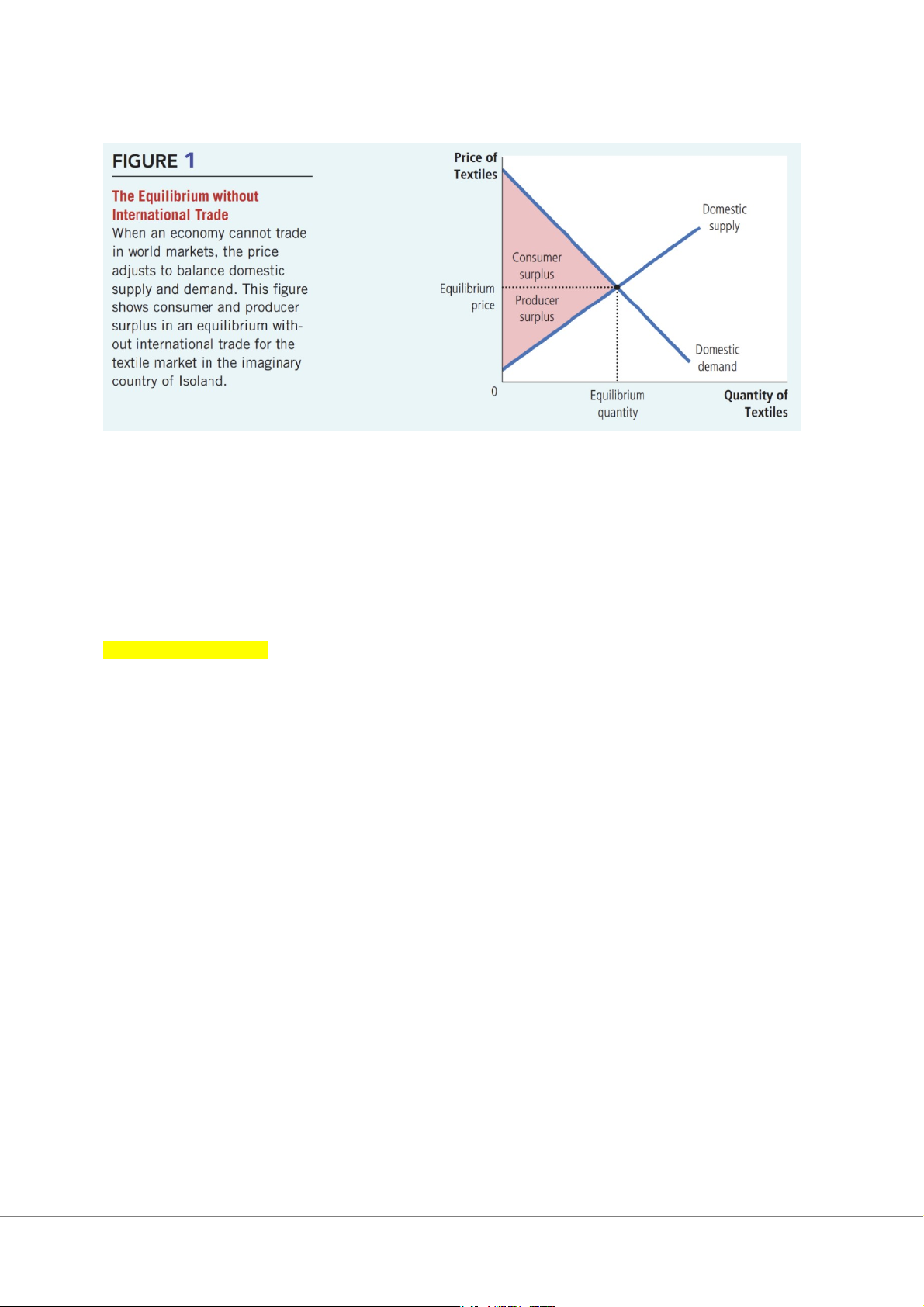




Preview text:
CHAPTER 9: Application: International Trade
If the government allows Isolandians to import and export textiles, what will
happen to the price of textiles and the quantity of textiles sold in the domestic textile market?
Who will gain from free trade in textiles and who will lose, and will the gains exceed the losses?
Should a tariff (a tax on textile imports) be part of the new trade policy? WHEN EXPORTING:
When a country allows trade and becomes an exporter of a good, domestic
producers of the good are better off, and domestic consumers of the good are worse off.
Trade raises the economic well-being of a nation in the sense that the
gains of the winners exceed the losses of the losers. WHEN IMPORTING:
When a country allows trade and becomes an importer of a good, domestic
consumers of the good are better off, and domestic producers of the good are worse off.
Trade raises the economic well-being of a nation in the sense that the
gains of the winners exceed the losses of the losers . WITH TARIFFS
Question: If the government allows Isolandians to import and export textiles, what will
happen to the price of textiles and the quantity of textiles sold in the domestic textile market?
Answer: Once trade is allowed, the Isolandian price of textiles will be driven to equal the
price prevailing around the world.
Question: Who will gain from free trade in textiles and who will lose, and will the gains exceed the losses?
Answer: The answer depends on whether the price rises or falls when trade is allowed. If
the price rises, producers of textiles gain, and consumers of textiles lose. If the price falls,
consumers gain, and producers lose. In both cases, the gains are larger than the losses.
Thus, free trade raises the total welfare of Isolandians.
Question: Should a tariff be part of the new trade policy?
Answer: A tariff has an impact only if Isoland becomes a textile importer. In this case, a
tariff moves the economy closer to the no-trade equilibrium and, like most taxes, causes
deadweight losses. A tariff improves the welfare of domestic producers and raises revenue
for the government, but these gains are more than offset by the losses suffered by
consumers. The best policy, from the standpoint of economic efficiency, would be to allow trade without a tariff. Increased variety of goods
Lower costs through economies of scale Increased competition Enhanced flow of ideas
Tài liệu liên quan:
-
CHAP 1: Introduction to Management Concepts and Functions môn Principles of Management | Trường Đại học Quốc tế, Đại học Quốc gia Thành phố Hồ Chí Minh
9 5 -
Guidelines for group’s assignments: Analysing management issues of a FDI company based inVietnam môn Principles of Management | Trường Đại học Quốc tế, Đại học Quốc gia Thành phố Hồ Chí Minh
10 5 -
Financial Planning to Achieve 300m VND Goal in 3 Years môn Principles of Management | Trường Đại học Quốc tế, Đại học Quốc gia Thành phố Hồ Chí Minh
10 5 -
A Case Study in Fast Fashion Success môn Principles of Management | Trường Đại học Quốc tế, Đại học Quốc gia Thành phố Hồ Chí Minh
9 5 -
Chap 16 Hierarchy of Needs Theory and Applications môn Principles of Management | Trường Đại học Quốc tế, Đại học Quốc gia Thành phố Hồ Chí Minh
10 5