Chapter 9: Project Management Techniques - CPM & Resource Allocation môn Principles of Management | Trường Đại học Quốc tế, Đại học Quốc gia Thành phố Hồ Chí Minh
DuPont, a chemical company, faced challenges managing large-scale plant maintenance projects, which involved multiple interconnected tasks. Tài liệu giúp bạn tham khảo, ôn tập và đạt kết quả cao. Mời đọc đón xem!
Môn: Principles of Management 314 tài liệu
Trường: Trường Đại học Quốc tế, Đại học Quốc gia Thành phố Hồ Chí Minh 2 K tài liệu
Tác giả:







Preview text:
I. CRITICAL PATH METHOD—CRASHING A PROJECT
introduce the origins of CPM
Development at DuPont (1956-1958):
●DuPont, a chemical company, faced challenges managing large-scale plant
maintenance projects, which involved multiple interconnected tasks.
● They collaborated with Remington Rand, an early computer technology company, to
develop a method to optimize project scheduling and reduce downtime. First Application:
● The method was first applied in 1958 to schedule plant shutdowns and
maintenance at DuPont. It significantly reduced project time and costs. Normal Time/Cost 1. Definition:
○Normal Time: The standard duration required to complete a task under normal working conditions.
○Normal Cost: The cost incurred to complete the task within the normal time, without expediting. 2. Characteristics:
○ Most efficient and cost-effective way to complete a task.
○ Assumes no additional resources or overtime are used.
○ Reflects the planned schedule for the project. Crash Time/Cost 1. Definition:
○Crash Time: The shortest possible duration in which an activity can be
completed, achieved by allocating additional resources.
○Crash Cost: The increased cost associated with completing the task in its crash time. 2. Characteristics:
○ Achieved through techniques such as overtime, hiring additional staff, or
using more expensive but faster methods.
○ Typically results in higher costs due to expedited resource usage.
○ Represents the absolute limit to which a task can be compressed.
Challenges in Resource Allocation for Project Crashing
Limited Resource Availability: Increased Costs:
● Accelerating tasks often requires using overtime, hiring temporary workers, or
procuring expedited materials.
Resource Overloading:
● Intensifying activities can result in overburdening existing resources, reducing
efficiency and increasing the risk of burnout or errors. Skill Mismatch:
● Additional resources may lack the specialized skills required for certain tasks,
leading to inefficiencies or rework.
Coordination Complexity:
● Reassigning resources to critical tasks disrupts the allocation plan for non-critical
activities, creating bottlenecks and conflicts.
Impact on Quality:
● Compressing timelines often forces trade-offs in quality due to rushed execution or insufficient time for reviews.
Critical Path Dependencies:
● Resources allocated to critical tasks might affect the availability for dependent
activities, leading to knock-on delays in the project schedule. Unforeseen Risks:
● The increased pace of work might introduce new risks such as equipment
breakdowns, safety incidents, or unexpected delays.
Crash Slope Formula: Where:
●Normal Time: The standard duration of the activity.
●Crash Time: The shortest possible duration for the activity.
●Normal Cost: The cost of completing the activity in normal time.
●Crash Cost: The cost of completing the activity in crash time.
Effect of project Crashing on Technology and Production
Impacts on Technology
1. Overloading Technological Systems: Accelerating project timelines may push
existing technology to its limits.
2. Increased Error Rates: Shortened testing and debugging periods can result in more
frequent errors or glitches in technological systems, affecting long-term performance.
3. Adoption of New Technologies: Project crashing often necessitates rapid deployment
of advanced technologies to maintain pace, which may increase costs and training requirements.
Impacts on Production
1. Workforce Productivity: Crashing can lead to extended working hours and higher
stress among employees, significantly reducing productivity.
2. Material and Resource Coordination: Speeding up a project demands higher
synchronization between material supply and workforce efforts. Any delays or
bottlenecks can disrupt the entire production chain.
3. Quality Concerns: Fast-tracking production activities may compromise the quality of
outputs, as detailed checks or standard procedures might be skipped to save time.
Case Study: Construction Industry
In the construction sector, project crashing has been applied to meet tight deadlines. A study
from Bukit Bintang found that crashing projects often required contractors to hire additional
skilled labor and appoint multiple material suppliers to meet demand. While this ensured
timely completion, it raised costs significantly and caused congestion among trades on-site,
leading to inefficiencies in workflow and supervision. Additionally, prolonged acceleration
introduced fatigue among workers, further lowering productivity and increasing error rates.
Similarly, in manufacturing, accelerated schedules often necessitate advanced robotics and
automated systems. While these technologies reduce cycle times, they require substantial
upfront investment and training. Misalignment during rapid integration can disrupt the overall production process.
Balancing Benefits and Risks
To mitigate these challenges, careful planning and monitoring of resource allocation,
technological deployment, and production workflows are crucial. Employing simulation
models or phased budgets can help forecast potential delays or cost overruns before
implementing project crashing strategies effectively.
Crashing a Project
Project crashing is a technique used in project management to reduce the
project duration while minimizing additional costs.
Principles for Crashing a Project
1. Focus on the Critical Path:
○ Ensure that crashing efforts target activities directly influencing the project timeline.
2. Optimize the Cost-Time Balance:
○ Aim to achieve the desired time savings at the lowest additional cost.
3. Resource Availability:
○ Evaluate the availability of additional resources before planning to crash activities. 4. Risk Management:
○ Anticipate risks such as quality issues, resource burnout, or supply chain disruptions.
5. Stakeholder Communication:
○ Keep stakeholders informed about cost increases, timeline changes, and potential risks.
Fast-Tracking in Project Management
Fast-tracking is a schedule compression technique used in project management to
accelerate the project timeline without changing its overall scope. It involves performing
tasks in parallel that were originally planned to be done sequentially, thus reducing the
overall project duration. This approach can save time but comes with increased risks and complexities.
Key Principles of Fast-Tracking 1. Parallel Execution:
○ Overlapping tasks or phases to shorten the timeline.
○ For instance, starting construction while design approvals are still pending.
2. Critical Path Focus:
○ Activities on the critical path (tasks that directly affect the project's duration)
are prioritized for fast-tracking. 3. Risk Acknowledgment:
○ The overlapping of activities can introduce risks, such as rework or quality issues.
4. No Scope Change:
○ Unlike other methods, fast-tracking does not alter the project deliverables or objectives.
II. THE RESOURCE ALLOCATION PROBLEM
Shortcomings of Previous Scheduling Procedures
Previous scheduling methods primarily focused on time milestones, often ignoring the critical
aspects of resource utilization and availability. This approach led to:
- Inefficient resource allocation: Key resources might be overused or underutilized.
- Increased costs: Due to overcommitment or delays from resource shortages.
- Lack of flexibility: As schedules were rigid, trade-offs among time, cost, and scope were not considered effectively.
Types of Resources in Project Management
1. Human Resources: Skilled workers whose availability and workload must be balanced to avoid burnout or delays.
2. Material Resources: Items like equipment, raw materials, or technology that must be timely available.
3. Financial Resources: Budget allocations, including costs for labor, materials, and overhead.
4. Time: A unique, non-renewable resource critical in all project stages.
Time-Limited vs. Resource-Limited Projects 1. Time-Limited:
- Prioritizes meeting deadlines.
- Flexibility in adding resources if needed.
- Example: Crashing techniques to speed up completion. 2. Resource-Limited:
- Constraints on resource usage.
- Deadlines might extend to match available resources.
- Example: Resource leveling to smooth out peaks. Time/Resource Trade-offs
Balancing faster project completion (time savings) with higher resource costs or vice versa. Overdetermined Systems
In overdetermined systems, all three key variables—time, cost, and scope—are fixed. This
rigidity often results in infeasibility, leaving no room for flexibility or optimization. A project
manager must advocate for adjustments to at least one variable to enable trade-offs. System-Constrained Projects
Certain tasks are system-constrained, meaning they require fixed resources and time
regardless of external adjustments. For example, industrial processes like heat treatment
have fixed durations and cannot be expedited. III. Loading and Leveling Resource Loading
Resource loading refers to analyzing the demand for specific resources over the project
timeline. This analysis helps identify periods of overuse or underuse. Resource Leveling
Resource leveling adjusts the schedule to minimize fluctuations in resource demand. The
aim is to achieve a consistent workload without exceeding capacity. Steps in Application:
1. Identify tasks with slack time.
2. Reschedule tasks to reduce over-allocations.
3. Ensure project deadlines are minimally impacted.
Resource Loading/Leveling and Uncertainty
An example from the textbook may describe a scenario where resource conflicts arise due to
simultaneous demand. The solution involved:
- Adjusting schedules to fit resource availability.
- Using heuristics or priority rules like minimum slack first. Improvements Suggested:
1. Incorporate software tools for better visualization.
2. Employ buffers (e.g., project or feeder buffers) for handling delays.
3. Ensure stakeholder communication to align on resource priorities.
IV. Allocation Under Constraints
Introduction to Two Fundamental Approaches
When allocating resources or making decisions under constraints, there are two primary approaches: 1.
Heuristic Methods: Focuses on using rules of thumb or experience-based
techniques to find quick, practical solutions. These methods do not guarantee the optimal
solution but are efficient in practice. 2.
Optimizing Methods: Aims to find the best possible solution by applying
mathematical and optimization techniques while satisfying all constraints.
Heuristic Methods
Explanation of the Method
Heuristic methods rely on simplified rules or trial-and-error strategies to identify feasible
solutions in complex situations. These methods prioritize speed and practicality over
absolute accuracy or optimality. Applications of the Method
Heuristic methods can be applied in: •
Scheduling and resource allocation •
Problem-solving under uncertainty •
Reducing computational complexity in large-scale problems
Priority Rules and Their Significance
Some common priority rules used in heuristic methods include:
1. First Come, First Served (FCFS): Allocates resources in the order requests are received. •
Significance: Simple and easy to implement; ensures fairness.
2. Shortest Processing Time (SPT): Prioritizes tasks that require the least time to complete. •
Significance: Reduces overall time to completion (makespan).
3. Earliest Due Date (EDD): Prioritizes tasks with the closest deadlines. •
Significance: Minimizes lateness or delays in critical tasks.
4. Critical Ratio (CR): Allocates resources based on the ratio of time remaining to the work required. •
Significance: Balances urgency and workload.
Outcomes of Applying Heuristic Methods
• Provides quick and workable solutions in situations where time and computational resources are limited.
• Does not guarantee the optimal solution but often yields satisfactory results in practice.
• Helps in identifying potential problem areas that may require further refinement.
Optimizing Methods Summary of the Approach
Optimizing methods involve systematic mathematical techniques, such as linear
programming or dynamic programming, to achieve the best possible allocation while
adhering to constraints. These methods provide: •
Guaranteed optimal solutions (if feasible solutions exist). •
Greater accuracy but at the cost of higher computational complexity.
V. MULTIPROJECT SCHEDULING AND RESOURCE ALLOCATION
- The multiproject problem involves determining how to allocate resources to, and set
a completion time for, a new project that is added to an existing set of ongoing
projects. This requires the development of an efficient, dynamic multiproject scheduling system.
- Three important parameters affected by project scheduling are: (1) schedule
slippage, (2) resource utilization, and (3) in-process inventory.
+ Schedule slippage, the time past a project’s due or delivery date, is often considered
the most important of the criteria.
+ Resource allocation, It’s easy to see the costs of using too many resources because
of poor scheduling. However, uncoordinated scheduling across multiple projects can
also be very costly, especially in service businesses. If two deals arrive at the same
time, one must wait. This is undesirable because other potential buyers are seeking properties.
+ In- process inventory, concerns the amount of work waiting to be processed
because there is a shortage of some resource(s).
These three criteria cannot be optimized at the same time. As usual, trade-offs are
involved. A firm must decide which criterion is most applicable in any given situation,
and then use that criterion to evaluate its various scheduling and resource allocation options. Heuristic Techniques
- Because of the difficulties with the analytical formulation of realistic problems,
major efforts in attacking the resource-constrained multiproject scheduling problem
have focused on heuristics. We touched earlier on some of the common general
criteria used for scheduling heuristics.
+ Resource Scheduling Method In calculating activity/project priority, give
precedence to that activity/project that results in the minimum increase in project duration(s).
+ Minimum Late Finish Time This rule assigns priorities to activities/projects on the
basis of finish times as determined by AOA or AON. The earliest late finishers are scheduled first.
+ Greatest Resource Demand This method assigns priorities on the basis of total
resource requirements, with higher priorities given for greater demands on resources.
+ Greatest Resource Utilization This rule gives priority to that combination of
activities that results in maximum resource utilization (or minimum idle resources)
during each sched uling period.
+ Most Possible Jobs Here, priority is given to the set of activities that results in the
greatest number of activities being scheduled in any period.
A Multiproject Scheduling Heuristic
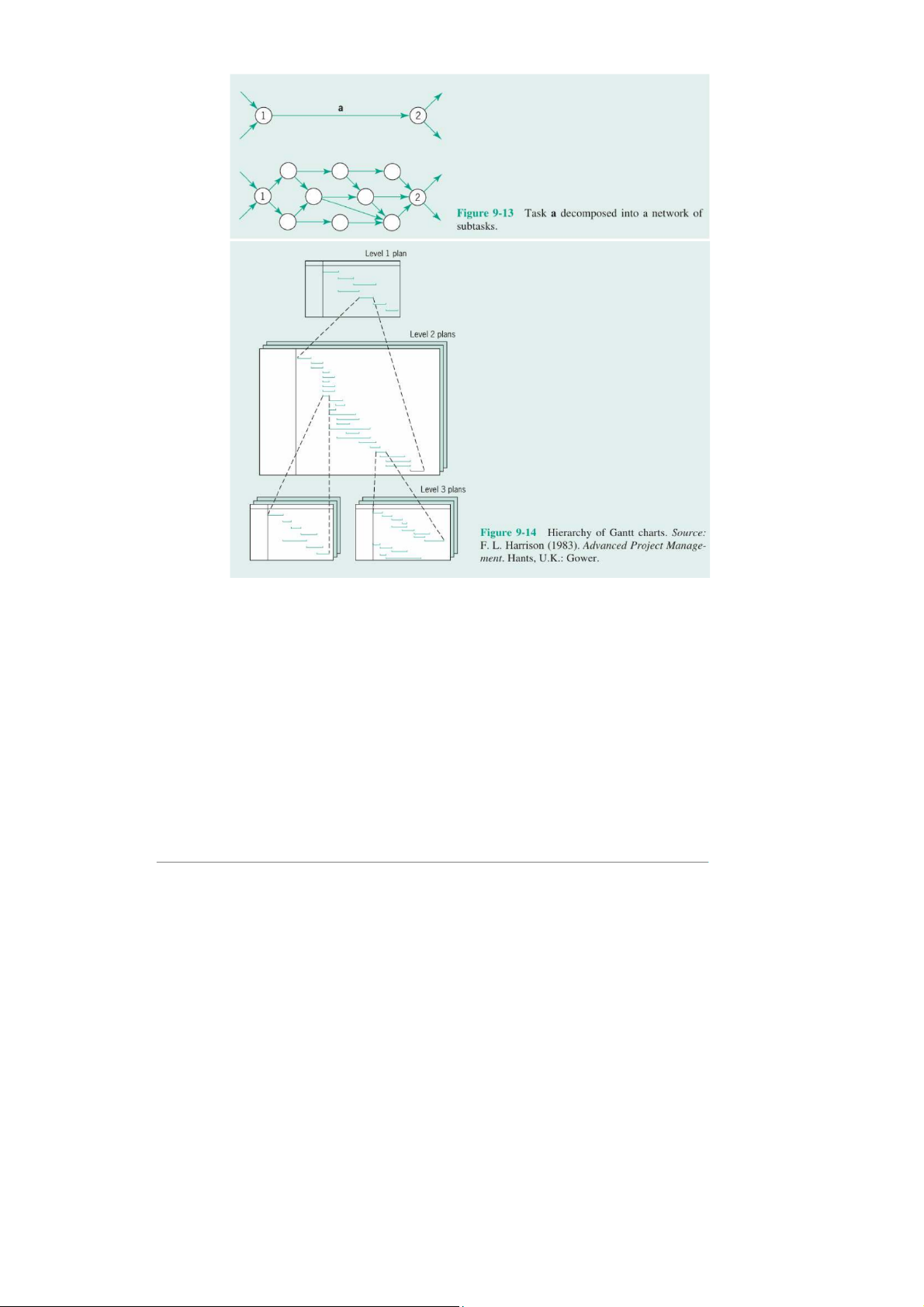
- If an entire network is decomposed into subnetworks, we have the equivalent of the
multiproject problem where each of the projects (subnetworks) is linked to
predecessor and successor projects (other subnetworks). The decomposition is
continued until the work packages are simple enough to be considered “elemental.”
- With this conceptual model, assume we have a set of projects. Each individual
project is represented by a network of tasks. We can form a single network of these
projects by connecting them with dummy activities (no resources, no duration) and/or
pseudoactivities (no resources, some duration).
- Figure 9-15 shows two different versions of the project or task life cycle. If the task
is a Type 1, borrowing would minimize the dam age to the task unless it is quite near
completion and we are willing to accept the outcome in its current state, in which case
we can deschedule. If the task is Type 2, borrowing is apt to have a catastrophic effect
on the task and we should either deschedule it (and start it again later) or reject it as a source of resources.
Tài liệu liên quan:
-

CHAP 1: Introduction to Management Concepts and Functions môn Principles of Management | Trường Đại học Quốc tế, Đại học Quốc gia Thành phố Hồ Chí Minh
14 7 -

Guidelines for group’s assignments: Analysing management issues of a FDI company based inVietnam môn Principles of Management | Trường Đại học Quốc tế, Đại học Quốc gia Thành phố Hồ Chí Minh
14 7 -

Financial Planning to Achieve 300m VND Goal in 3 Years môn Principles of Management | Trường Đại học Quốc tế, Đại học Quốc gia Thành phố Hồ Chí Minh
12 6 -

A Case Study in Fast Fashion Success môn Principles of Management | Trường Đại học Quốc tế, Đại học Quốc gia Thành phố Hồ Chí Minh
13 7 -

Chap 16 Hierarchy of Needs Theory and Applications môn Principles of Management | Trường Đại học Quốc tế, Đại học Quốc gia Thành phố Hồ Chí Minh
15 8