Elasticity Problems and Solutions: Practice Exercises | Microeconomics | Trường Đại học Quốc tế, Đại học Quốc gia Thành phố Hồ Chí Minh
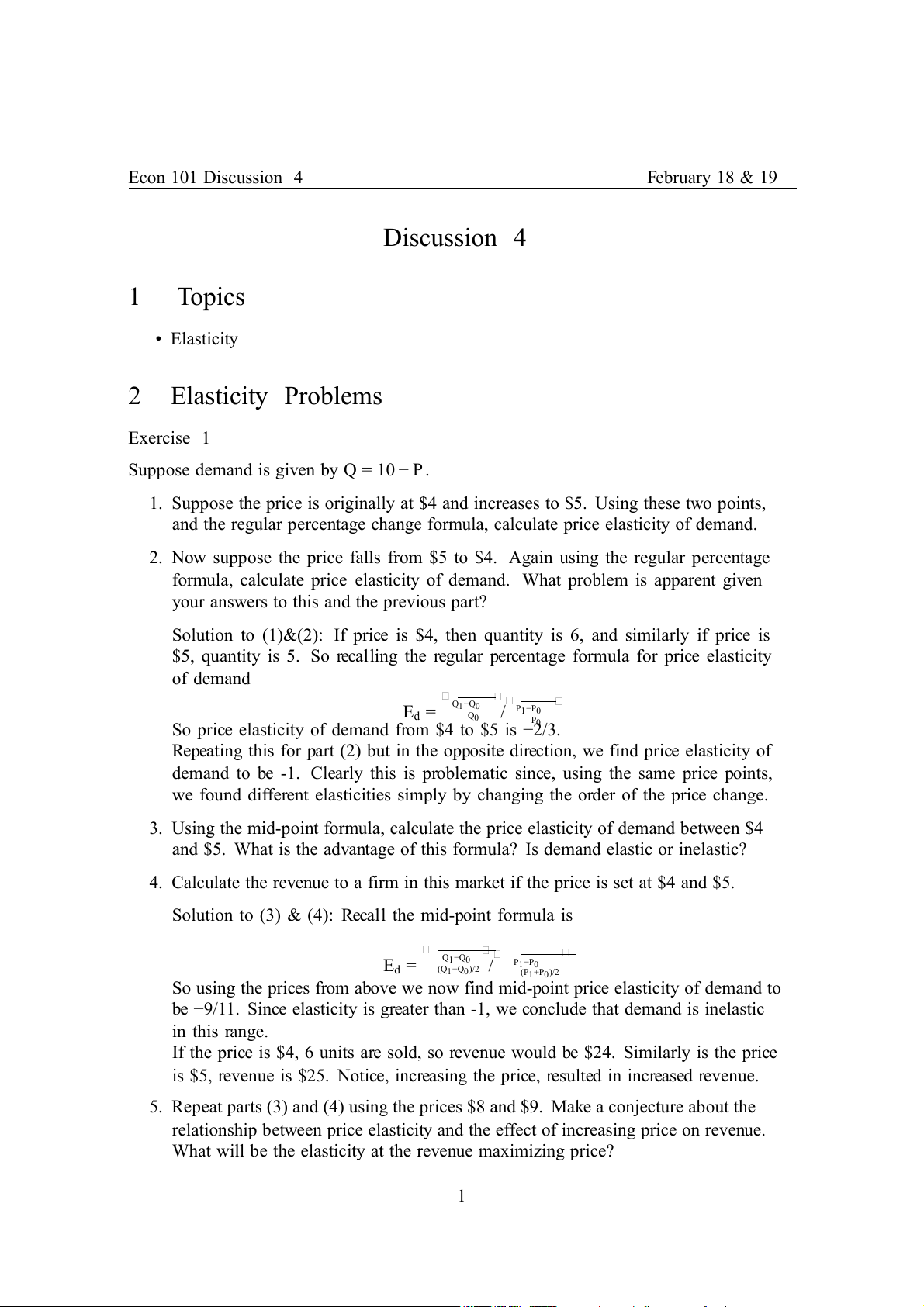
Suppose the price is originally at $4 and increases to $5. Using these two points, and the regular percentage change formula, calculate price elasticity of demand. 2. Now suppose the price falls from $5 to $4. Again using the regular percentage formula, calculate price elasticity of demand. What problem is apparent given your answers to this and the previous part? Solution to (1)&(2): If price is $4, then quantity is 6, and similarly if price is $5, quantity is 5. So recalling the regular percentage formula for price elasticity of demand. Tài liệu được sưu tầm và soạn thảo dưới dạng file PDF để gửi tới các bạn cùng tham khảo, ôn tập đầy đủ kiến thức, chuẩn bị cho các buổi học thật tốt. Mời bạn đọc đón xem!
Môn: Microeconomics 245 tài liệu
Trường: Trường Đại học Quốc tế, Đại học Quốc gia Thành phố Hồ Chí Minh 1.5 K tài liệu
Tác giả:

Preview text:
Econ 101 Discussion 4 February 18 & 19 Discussion 4 1 Topics • Elasticity 2 Elasticity Problems Exercise 1
Suppose demand is given by Q = 10 − P .
1. Suppose the price is originally at $4 and increases to $5. Using these two points,
and the regular percentage change formula, calculate price elasticity of demand.
2. Now suppose the price falls from $5 to $4. Again using the regular percentage
formula, calculate price elasticity of demand. What problem is apparent given
your answers to this and the previous part?
Solution to (1)&(2): If price is $4, then quantity is 6, and similarly if price is
$5, quantity is 5. So recalling the regular percentage formula for price elasticity of demand Ed = Q1−Q0 Q / P P 1− 0 0 P0
So price elasticity of demand from $4 to $5 is −2/3.
Repeating this for part (2) but in the opposite direction, we find price elasticity of
demand to be -1. Clearly this is problematic since, using the same price points,
we found different elasticities simply by changing the order of the price change.
3. Using the mid-point formula, calculate the price elasticity of demand between $4
and $5. What is the advantage of this formula? Is demand elastic or inelastic?
4. Calculate the revenue to a firm in this market if the price is set at $4 and $5.
Solution to (3) & (4): Recall the mid-point formula is Ed = Q1−Q0 (Q + ) 1 Q0 /2 / P P 1− 0 (P + ) 1 P0 /2
So using the prices from above we now find mid-point price elasticity of demand to
be −9/11. Since elasticity is greater than -1, we conclude that demand is inelastic in this range.
If the price is $4, 6 units are sold, so revenue would be $24. Similarly is the price
is $5, revenue is $25. Notice, increasing the price, resulted in increased revenue.
5. Repeat parts (3) and (4) using the prices $8 and $9. Make a conjecture about the
relationship between price elasticity and the effect of increasing price on revenue.
What will be the elasticity at the revenue maximizing price? 1 Econ 101 Discussion 4 February 18 & 19
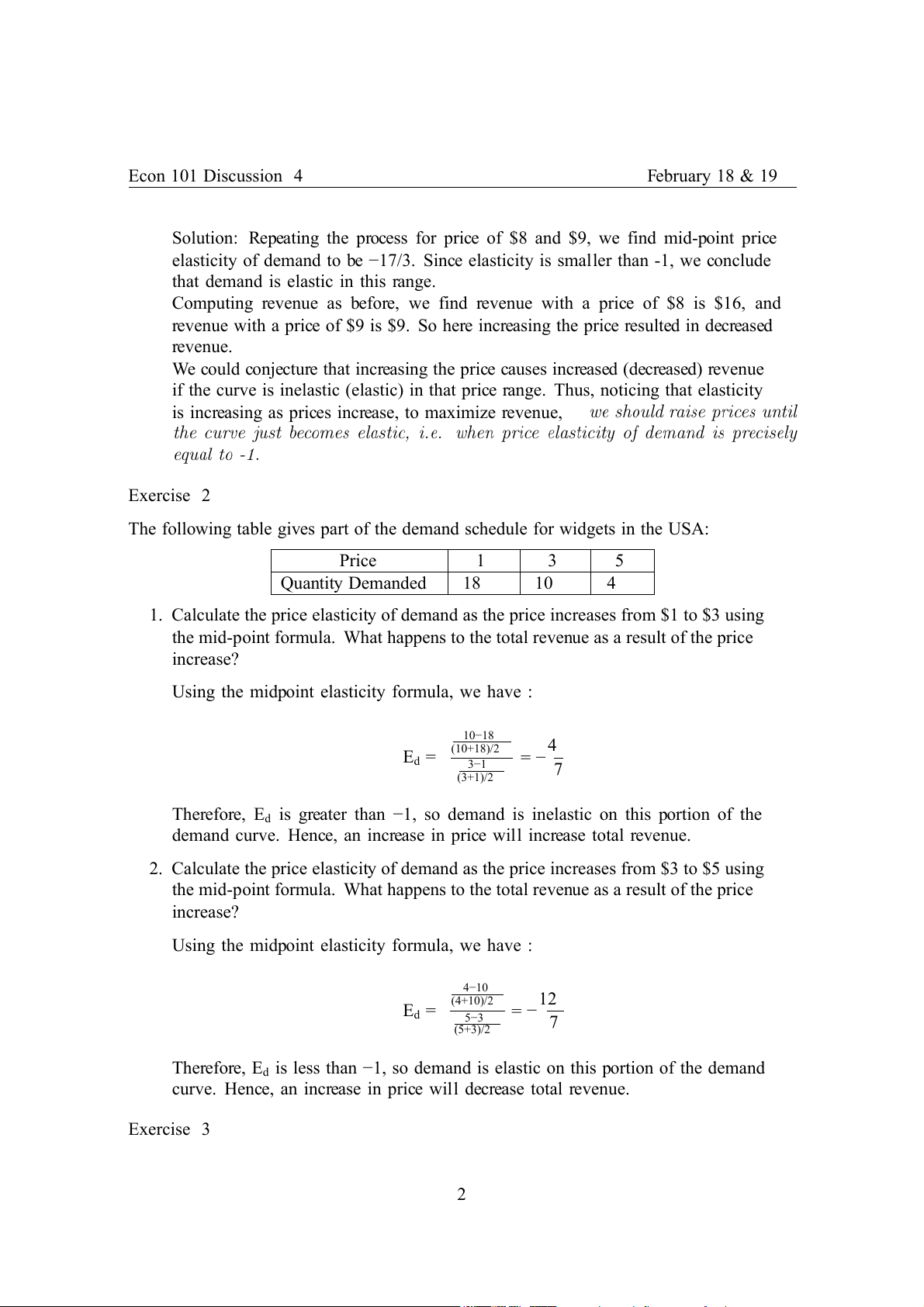
Solution: Repeating the process for price of $8 and $9, we find mid-point price
elasticity of demand to be −17/3. Since elasticity is smaller than -1, we conclude
that demand is elastic in this range.
Computing revenue as before, we find revenue with a price of $8 is $16, and
revenue with a price of $9 is $9. So here increasing the price resulted in decreased revenue.
We could conjecture that increasing the price causes increased (decreased) revenue
if the curve is inelastic (elastic) in that price range. Thus, noticing that elasticity
is increasing as prices increase, to maximize revenue, Exercise 2
The following table gives part of the demand schedule for widgets in the USA: Price 1 3 5 Quantity Demanded 18 10 4
1. Calculate the price elasticity of demand as the price increases from $1 to $3 using
the mid-point formula. What happens to the total revenue as a result of the price increase?
Using the midpoint elasticity formula, we have : 10−18 4 E (10+18)/2 d = = − 3−1 7 (3+1)/2
Therefore, Ed is greater than −1, so demand is inelastic on this portion of the
demand curve. Hence, an increase in price will increase total revenue.
2. Calculate the price elasticity of demand as the price increases from $3 to $5 using
the mid-point formula. What happens to the total revenue as a result of the price increase?
Using the midpoint elasticity formula, we have : 4−10 12 E (4+10)/2 d = = − 5−3 7 (5+3)/2
Therefore, Ed is less than −1, so demand is elastic on this portion of the demand
curve. Hence, an increase in price will decrease total revenue. Exercise 3 2 Econ 101 Discussion 4 February 18 & 19
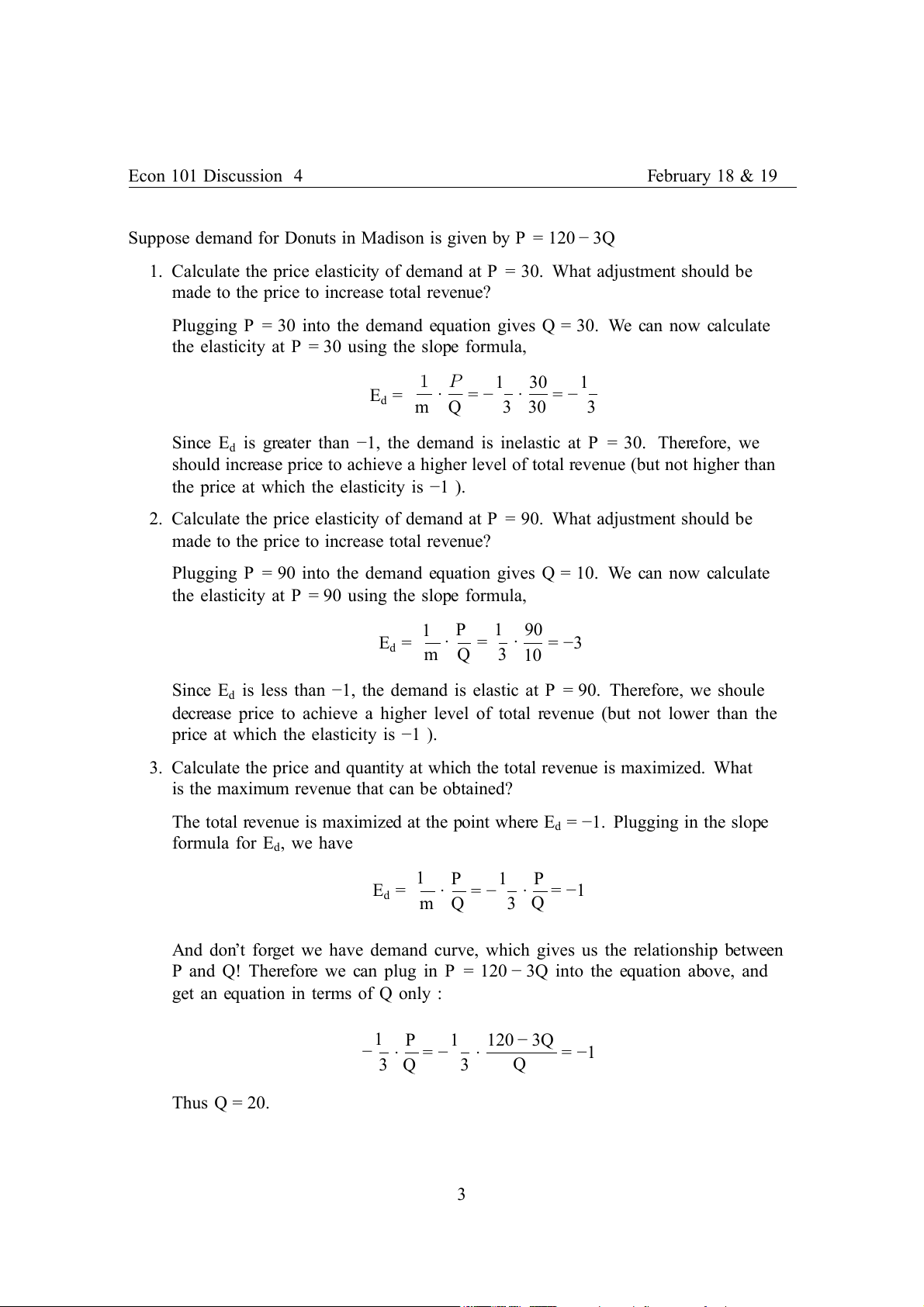
Suppose demand for Donuts in Madison is given by P = 120 − 3Q
1. Calculate the price elasticity of demand at P = 30. What adjustment should be
made to the price to increase total revenue?
Plugging P = 30 into the demand equation gives Q = 30. We can now calculate
the elasticity at P = 30 using the slope formula, 1 30 1 Ed = = − · = − m Q 3 30 3
Since Ed is greater than −1, the demand is inelastic at P = 30. Therefore, we
should increase price to achieve a higher level of total revenue (but not higher than
the price at which the elasticity is −1 ).
2. Calculate the price elasticity of demand at P = 90. What adjustment should be
made to the price to increase total revenue?
Plugging P = 90 into the demand equation gives Q = 10. We can now calculate
the elasticity at P = 90 using the slope formula, 1 P 1 90 Ed = · = · = −3 m Q 3 10
Since Ed is less than −1, the demand is elastic at P = 90. Therefore, we shoule
decrease price to achieve a higher level of total revenue (but not lower than the
price at which the elasticity is −1 ).
3. Calculate the price and quantity at which the total revenue is maximized. What
is the maximum revenue that can be obtained?
The total revenue is maximized at the point where Ed = −1. Plugging in the slope formula for Ed, we have 1 P 1 P Ed = · = − · = −1 m Q 3 Q
And don’t forget we have demand curve, which gives us the relationship between
P and Q! Therefore we can plug in P = 120 − 3Q into the equation above, and
get an equation in terms of Q only : 1 P 1 120 − 3Q − · = − · = −1 3 Q 3 Q Thus Q = 20. 3 Econ 101 Discussion 4 February 18 & 19 3 Multiple Choice Questions
Exercise 4 Which of the following statements is true?
(a) The price elasticity of demand for downward-sloping linear demand is constant
across all points on the demand curve.
(b) With a perfectly elastic demand curve, increasing price increases total revenue.
(c) With a unitary elastic demand curve, increasing price increases total revenue.
(d) On the inelastic part of a demand curve, increasing price increases total revenue. Answer: (d).
(a) is incorrect because for a downward sloping linear demand, the price elasticity
decreases, as we move down the demand curve (or move from left to right). (b) is
incorrect, because the demand elasticity is negative infinity everywhere on the perfectly
elastic demand curve. (c) is incorrect, because with a unitary elastic demand curve,
the total revenue does not change when you increase or decrease price. (d) is correct.
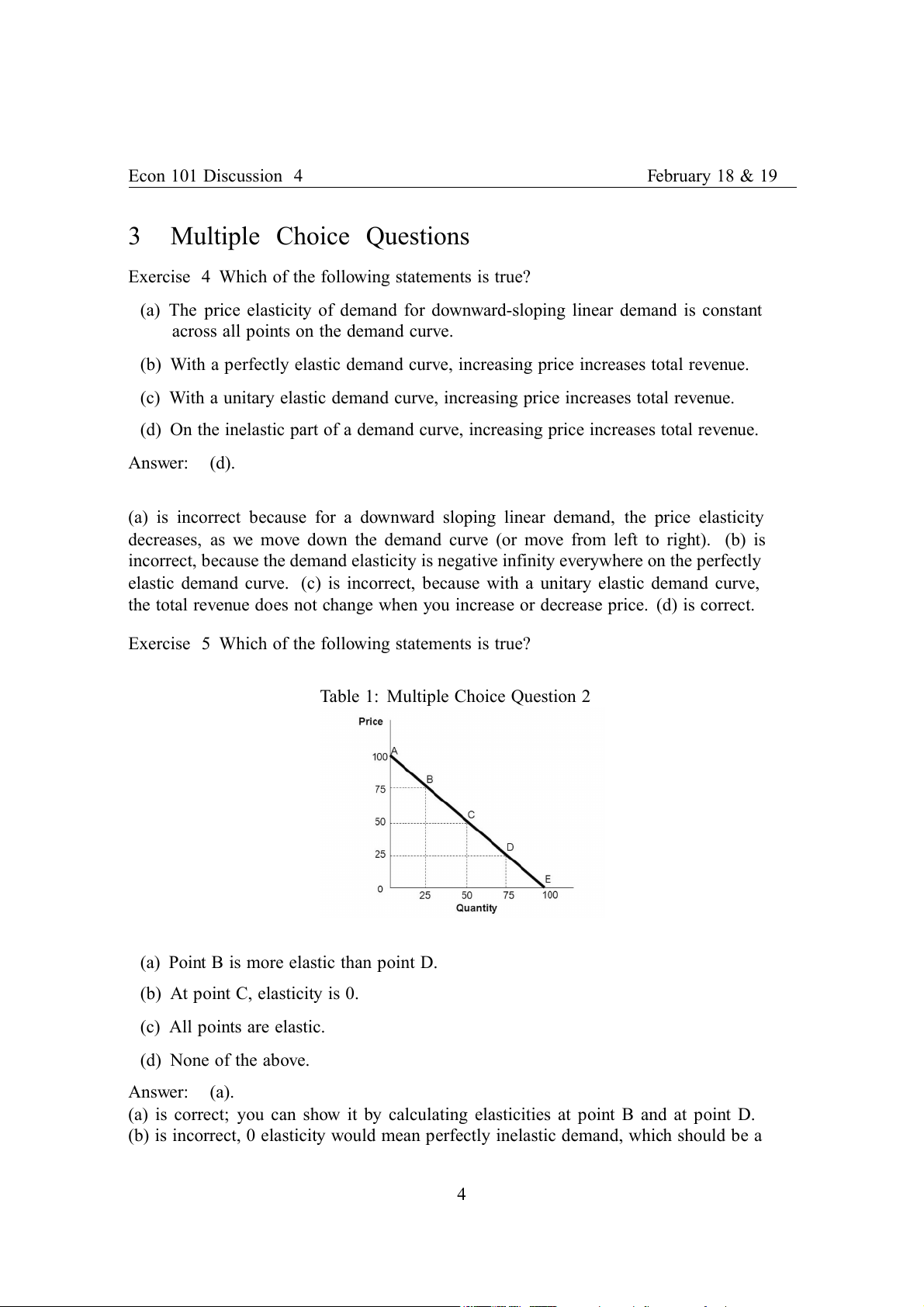
Exercise 5 Which of the following statements is true?
Table 1: Multiple Choice Question 2
(a) Point B is more elastic than point D.
(b) At point C, elasticity is 0. (c) All points are elastic. (d) None of the above. Answer: (a).
(a) is correct; you can show it by calculating elasticities at point B and at point D.
(b) is incorrect, 0 elasticity would mean perfectly inelastic demand, which should be a 4 Econ 101 Discussion 4 February 18 & 19
vertical line. At point C, elasticity is -1. (c) is incorrect, because any point below point
C has elasticity greater than -1, and by definition, inelastic.
Exercise 6 Consider the market for peanut butter and jars of jelly. Suppose that the
price elasticity of demand for peanut butter is -2, and that there is a 10% drop in the
quantity demanded for peanut butter following a change in price. What is the price change? (a) A 10% decrease in price (b) A 5% decrease in price (c) A 10% increase in price (d) A 5% increase in price Answer: (d).
We know that for a 1% increase in price, the demand drops 2%; assuming demand is
linear, then for a 10% drop in demand, the price will have increased a corresponding
5%. (Ed = −2 = −10% , i.e. ∆p = 5%.) ∆p/p p
Exercise 7 Following from the previous exercise, now suppose that the cross-price
elasticity of demand for jelly in response to a change in price for peanut butter is -3.
What is the change in demand for jelly?
(a) A 15% decrease in the demand for jelly
(b) A 5% decrease in the demand for jelly
(c) A 15% increase in the demand for jelly
(d) A 5% increase in the demand for jelly Answer: (a).
Given that the previous problem gave a 5% increase in the price of peanut butter, we
must multiply the cross-price elasticity for jelly by 5% to get the corresponding change in the demand for jelly.
cross-price elasticity of demand for jelly = ∆QjellyQ /∆Ppeanut butter = −3, jelly Ppeanut butter
i.e. ∆Qjelly = −3 × ∆Ppeanut butter Q = −3 × 5% = −15%. jelly Ppeanut butter
Exercise 8 Alice is a book lover and she says, “I always spend half of my monthly
salary on books regardless of the price.” We can conclude that her demand for books is (a) elastic (b) inelastic (c) 5 Econ 101 Discussion 4 February 18 & 19 (d) perfectly inelastic Answer: (c).
Since the total expenditure of Alice (total revenue of book sellers) will remain un-
changed if the price increases or decreases, Alice has a unitary elastic demand.
Exercise 9 Suppose the government imposed an effective price floor on a good. If the
government raises the effective price floor, the total revenue (a) would increase (b) would decrease (c) would remain unchanged (d) Answer: (d).
Because of a higher price, the quantity transacted drops. Since total revenue
is the product of the market price and quantity transacted, whether total revenue rises
or falls depends on the price elasticity of demand. For example, if the demand is in-
elastic, the total revenue would increase.
Exercise 10 Suppose the government imposed an effective price ceiling on a good. If
the government raises the effective price ceiling, the total revenue (a) would increase (b) would decrease (c) would remain unchanged
(d) may increase, decrease, or remain unchanged Answer: (a).
Because of a higher price, the quantity transacted increases. So the total revenue
would increase since it is the product of the market price and quantity transacted. 6
Tài liệu liên quan:
-

Supply and Demand - ôn tập: Market Equilibrium Effects Analysis | Microeconomics | Trường Đại học Quốc tế, Đại học Quốc gia Thành phố Hồ Chí Minh
3 2 -
Monopoly & Monopolistic Competition | Microeconomics | Trường Đại học Quốc tế, Đại học Quốc gia Thành phố Hồ Chí Minh
4 2 -
Systematic Review of Social Media Marketing in Luxury Brands | Microeconomics | Trường Đại học Quốc tế, Đại học Quốc gia Thành phố Hồ Chí Minh
4 2 -
Seminar-5: Economics | Microeconomics | Trường Đại học Quốc tế, Đại học Quốc gia Thành phố Hồ Chí Minh
4 2