Final Exam Study Notes môn Principles of Management | Trường Đại học Quốc tế, Đại học Quốc gia Thành phố Hồ Chí Minh
Strategic Management is a process of planning, organizing, leading(implementing), and controlling(evaluating) the strategies to achieve the goals. Tài liệu giúp bạn tham khảo, ôn tập và đạt kết quả cao. Mời đọc đón xem!
Môn: Principles of Management 314 tài liệu
Trường: Trường Đại học Quốc tế, Đại học Quốc gia Thành phố Hồ Chí Minh 2 K tài liệu
Tác giả:
















Preview text:
Principles of Man agement I. Strategic Management (2-3qs in Final)
a. Strategy is a set of actions in a particular way to achieve the goals in long-term
b. Strategic Management is a process of planning, organizing,
leading(implementing), and controlling(evaluating) the strategies to achieve the goals.
c. The aims of Strategic Management are to compete with rivals and attract the customers.
* How many steps in Strategic management process? 6 steps STEP 1:
Identifying the organization’s current mission, goals and strategies
STEP 2: Doing an external analysis STEP 3: Doing an internal analysis
STEP 4: Formulating the strategies STEP 5: Implementing strategies STEP 6: Evaluating results
*What is the most important step?
STEP 1: bc it provides the platform or direction for the next steps
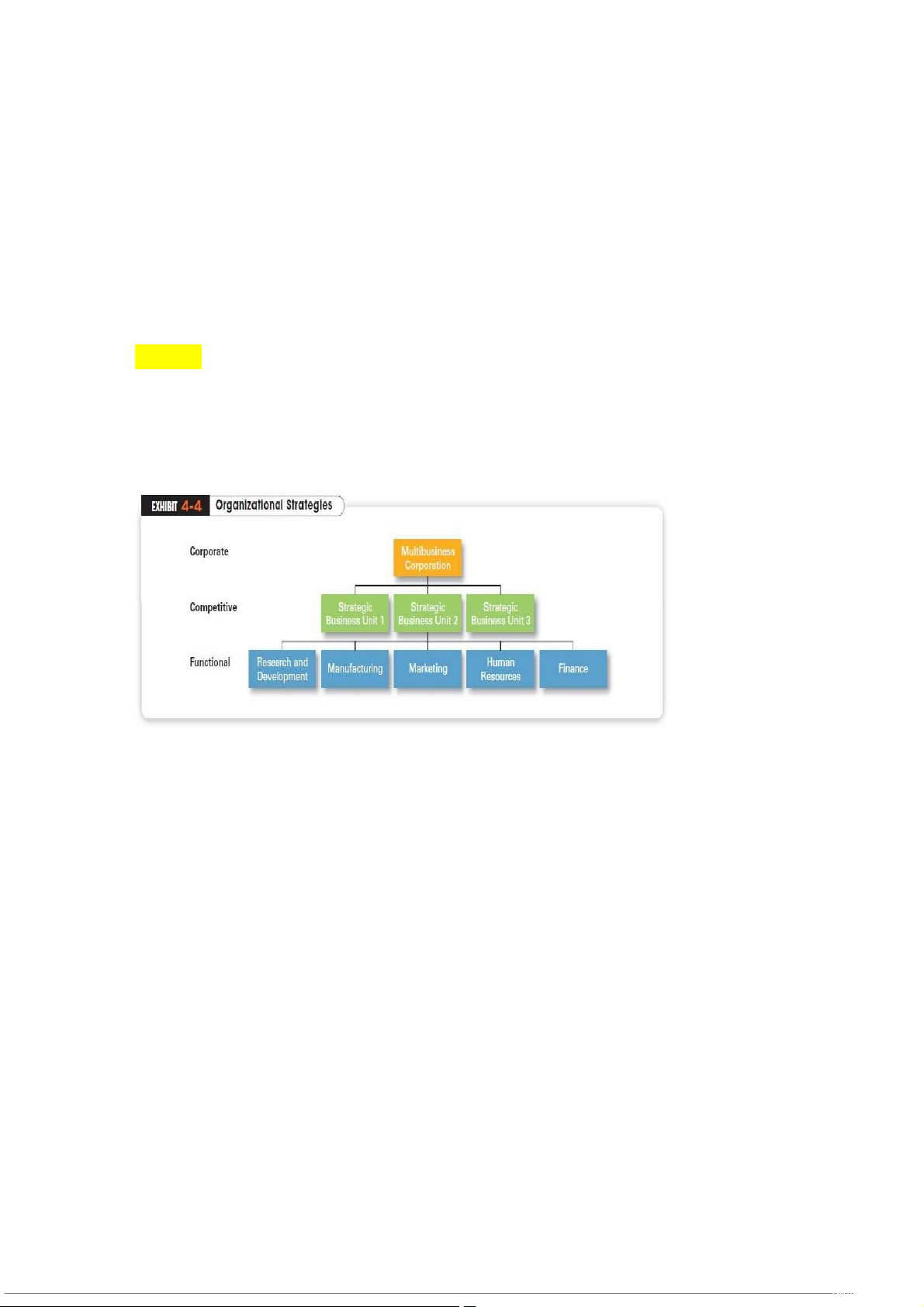
*How many levels of strategies? 3 levels *What are they? These strategies are in which lev el? 1.Cost Leaders hip strat egy 2.Diversification st rategy
3.Marketing strategy 4.Differentiation st rategy 5.Stability strat egy
(It is implemented when the environment is stable and the company
does not have many strengths as well as weaknesses, or there are some
opportunities, but the company is very weak, or the company has
some strengths, but there are many threats.
When implementing this strategy, the company does not have much
changes in size or product diversification) 6.Human resource strategy 7.Focus s trategy 8.Growth st rategy 9.Retrenchment s trategy
(It is implemented when there are many threats and the company is weak.
When implementing this strategy, the company will close some
branches or subsidiaries, or reduce product diversification) 10.Integration st rategy Đáp á n: •Corporate level: 2,5,8,9,10: 5 0đ •Business level (competitive)
: 1,4,7: 30đ •Functional level: 3,6: 2 0đ EXERCISE 3. Which growth strategy
is this? (included in the exam) 1.Vietcombank opened
new branches in Haiphong ci ty.
(same SBU->concentration growth) 2.Apple launched Ip ads. 3.SHB merged with Ha bubank. 4.Kinh Do bought Wall ice-cream from Un ilever. 5.FPT opened FPT University. 6.TH true milk opened a cow farm in Nghe An pro vince. 7.HP merged with Compaq. 8.Coca Cola launched
Dasani mineral wa ter. (2 related S BUs) 9.Sony cooperated with Erikson to produc e cell phone. 10.Toyota and GM
opened a factory in California to produce cars. Đáp á n:
•Concentration growth: 1: 1 0đ •Related d iversification: 2 , 3, 4 , 7, 8: 50 đ ( nếếu ghi th iếếu related chỉ đc 5đ/1 câu) •Unrelated dive rsification: 5: 1 0đ
•Vertical i ntegration: 6 : 10 đ ( nếếu g hi thiếếu c hỉ đ c 5 đ/1 c âu)
•Horizontal integration: 9 , 10: 2 0đ (nếếu g hi t hiếếu c hỉ đc 5đ/1 câu)
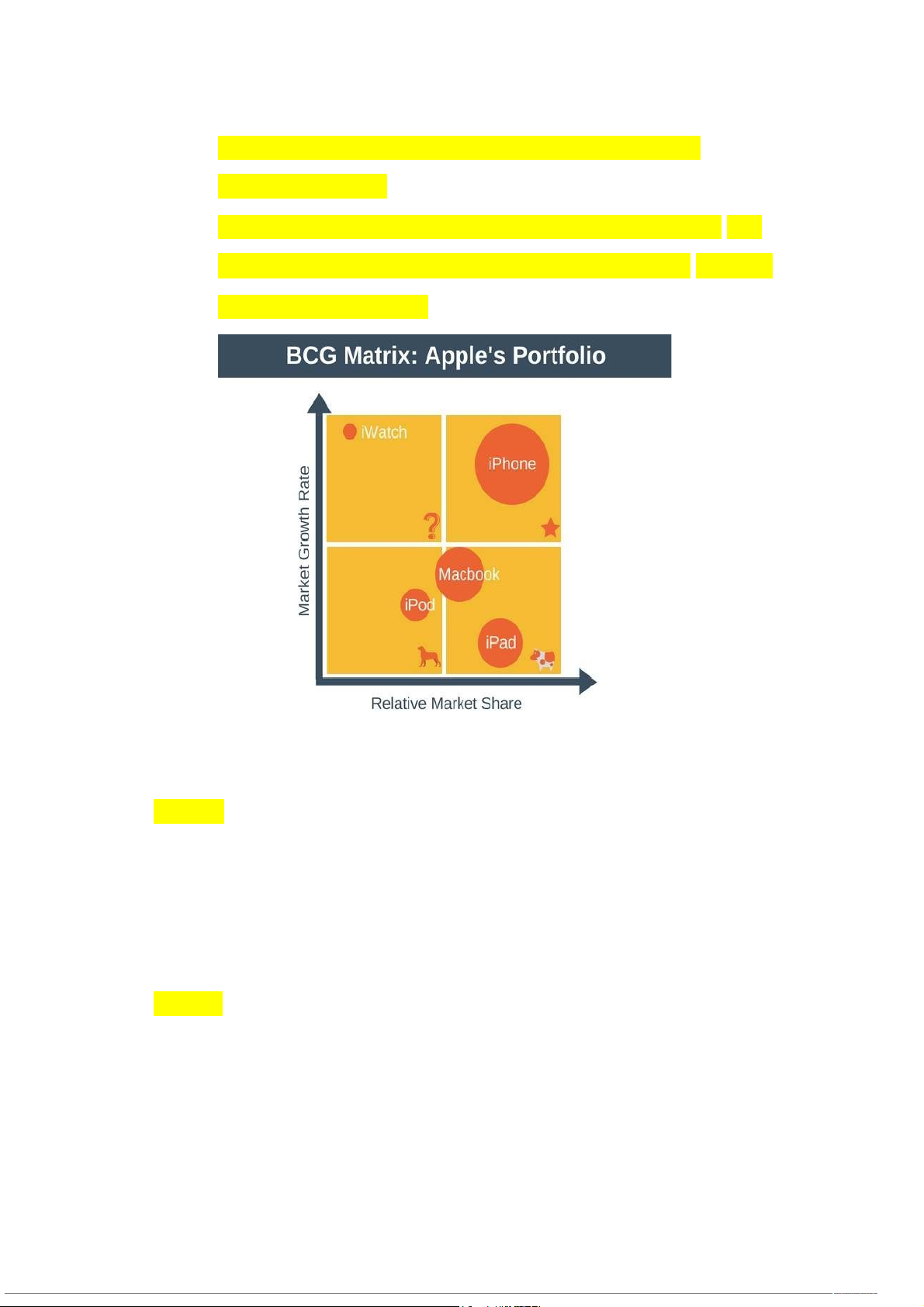
*SWOT analysis is used to formulate strategies EXERCISE 5 . 1.If relative market share is bigger than 1, what does it mean? 2.If relative market share is 1, wha t does it mean? 3.If relative market share is less than 1, what does it me an? 4.Put the following products of App le into the suitable position in BCG Matrix: •Ipad •Ipod •Iphone •Iwatch •Macbook Đáp á n: 1.This company is the
biggest one (market share): 1 0đ 2.This company
and the biggest rival share t he biggest market share: 10đ 3.This company is no t the biggest one in the market: 10đ The smaller to 1, the smaller market share the company has: 10đ 4.You can see the f igure: *Iphone:
iPhone has a relatively large economic share in high-growth industries. They
have an advantage in competing and have many opportunities to grow profits and develop in the long term. *Iwatch: These SBUs are relatively low in market share but they are high- growth and very promising industries in profitability and long- term growth. *Ipad, Mac
These are low-growth industries but have high market share and strong competitive position. *Ipod:
Weak level of competition and low market share, this is one of the slow- growing industries. II. ORGANIZING
1.Organizing is a PROCESS of ALLOCATING and
COORDINATING resources and designing organizational
STRUCTURE to achieve the goals.
2.Organizational Structure (O.S) is an OFFICIAL framework in
which JOBS/TASKS within the organization are divided and GROUPED. 3.How to design the O.S? •Division of labor •Departmentalization •Chain of command •Span of control
•Centralization or Decentralization •Formalization 4.Types of structures:
•Work specialization: A structure in which the entire
organization is made up of work teams. •Departmentalization: III. MOTIVATION
-Definition: Motivation is a PROCESS in which an individual
EFFORTS are energized, DIRECTED and reinforced.
-Types of motivation:
•Intrinsic motivation: motivated by internal desire for its own sake
Eg: reading a book because you enjoy storytelling
•Extrinsic motivation: motivated by external factors -> earn
rewards or avoid unexpected outcomes. Eg: exercising to lose weight
-Work motivation includes DIRECTION of behaviors, level of EFFORT and level of PERSISTENCE
-According to researchers, MOTIVATION + PERFORMANCE = Outputs
-According to other researchers, P=M*A*0 What each letter stands for? 1. P=PERFORMANCE 2. M=MOTIVATION 3. A=ABILITY 4. O=OPPORTUNITY
-Why is motivation important?
•individuals: more effective -> increase outcome -> promotion, ... •groups:
higher productivity/performance
•organizations: more contribution, engagement, loyalty
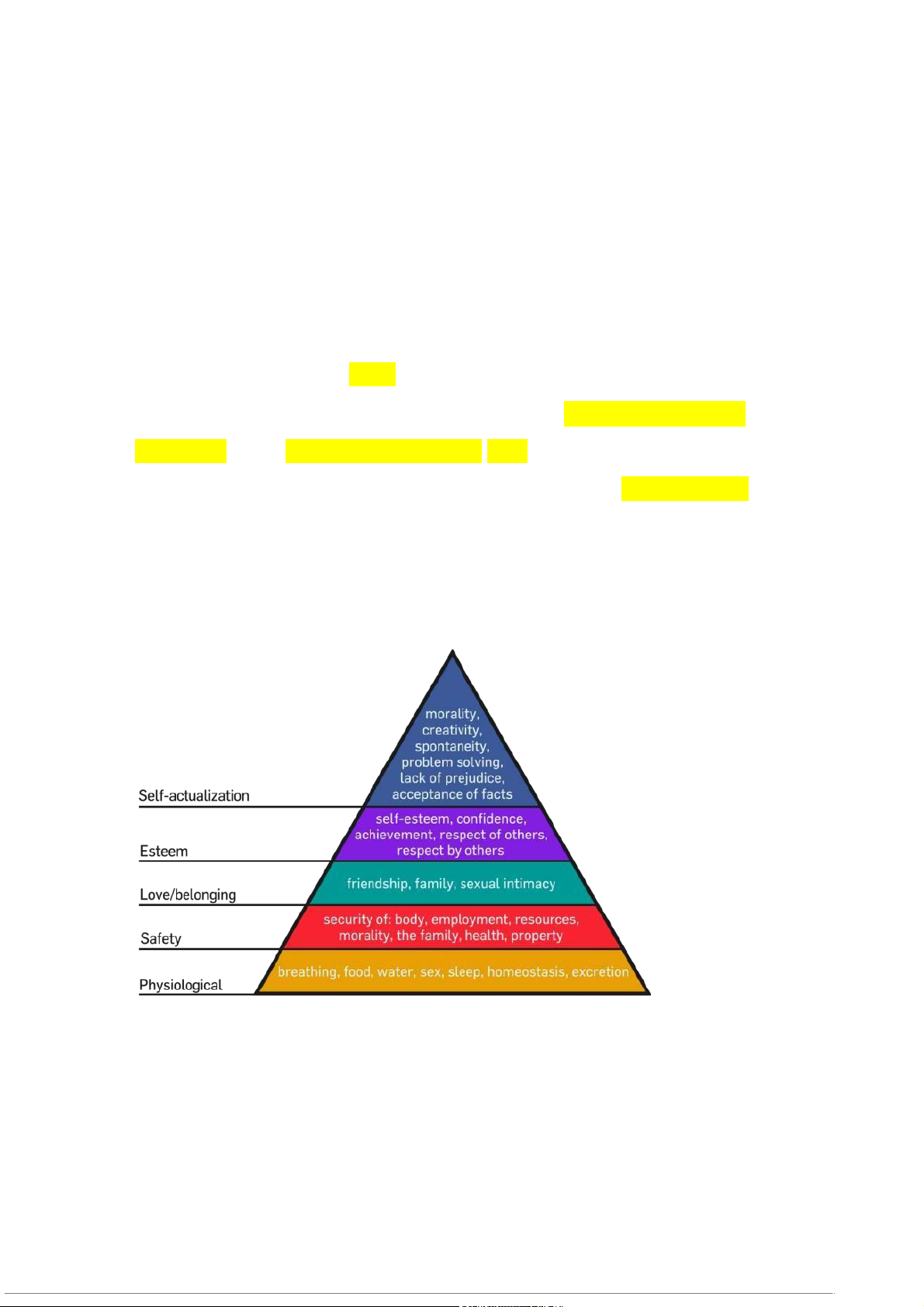
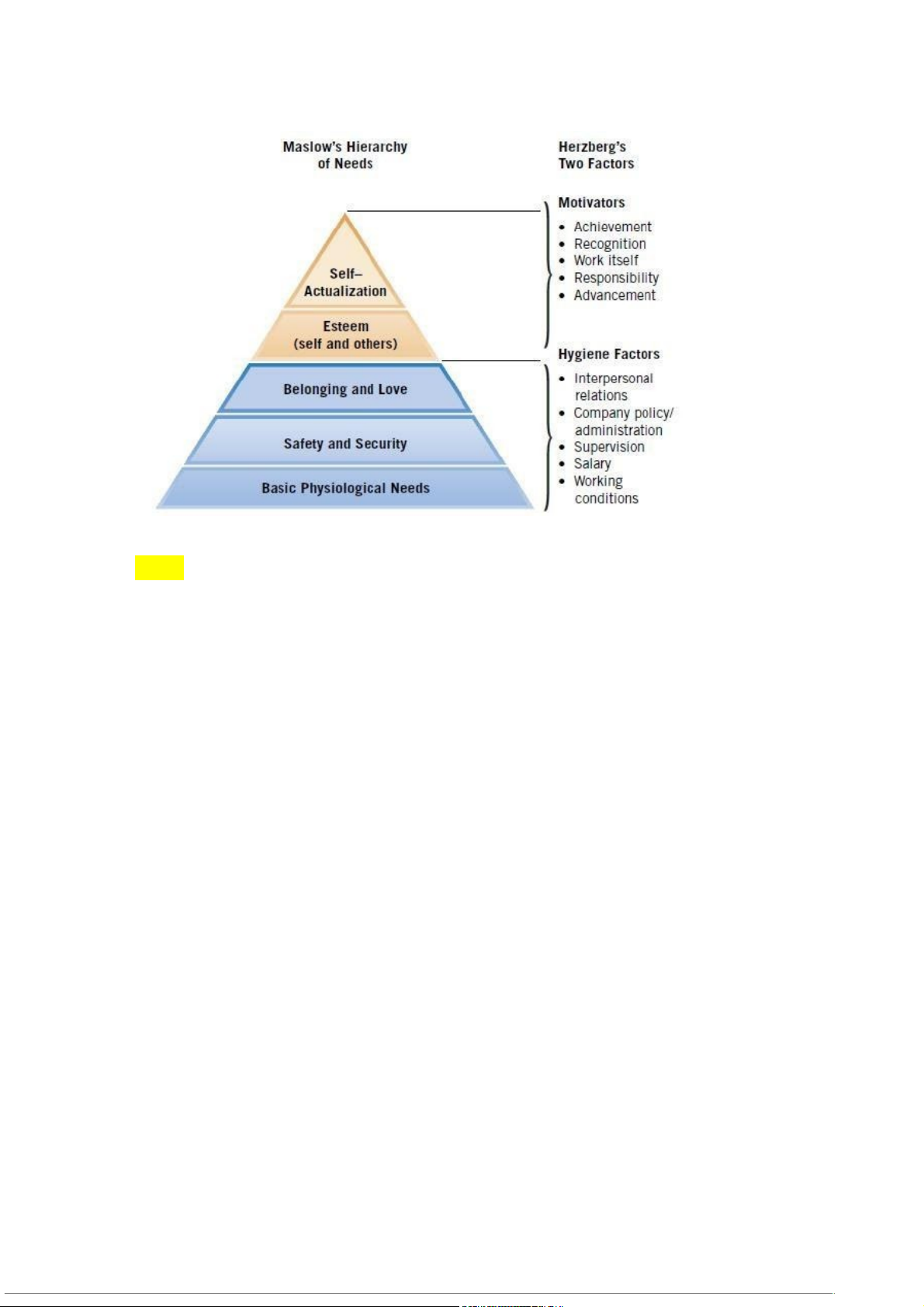
-Hierachy of Needs: (Final)
-For Maslow, needs appear one by one from the LOWER/ LOWEST/
BOTTOM to the HIGHER/ HIGHEST/ TOP
-For Maslow, when a need is satisfied, it is no longer a MOTIVATOR. Exercise: Which need is this?
Mary wants to get married. -> Social needs Peter wants to buy insurance. -> Safety
Paul wants to have good marks. -> Self-actualization David wants to take a nap. -> Physiological
Daisy wants to be promoted. -> Esteem Britney wants to have more power.-> Esteem
Tom wants to have a good relationship. -> Social Hannah wants to buy a
new house in a low criminal area. -> Safety
Andrew wants to improve his skills and ability. -> Self-actualization
Lana wants to have lunch. -> Physiological
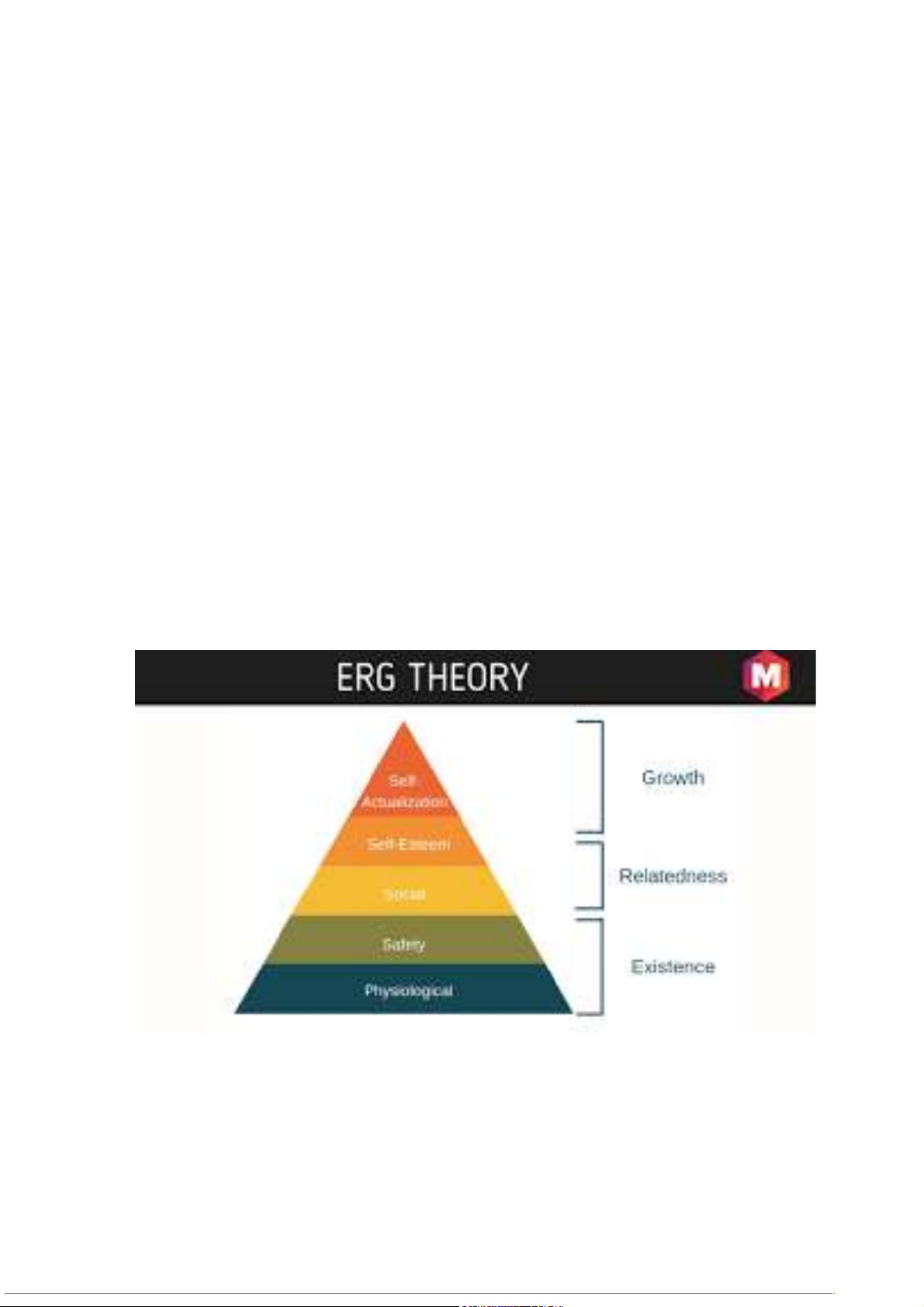
-HOW MANY TYPES OF NEED IN ERG THEORY? WHAT ARE THEY? - THERE ARE 3 TYPES -E=EXISTENCE -R=RELATEDNESS -G=GROWTH
-COMPARE HIERARCHY OF NEEDS (MASLOW) AND ERG THEORY (ALDERFER).
•BOTH TALKED ABOUT NEEDS AND MOTIVATION: 10Đ •MASLOW: 5, ALDERFER: 3 10Đ
•SO SÁNH TƯƠNG ỨNG NHƯ TRONG HÌNH VẼ SAU: 30Đ
•FOR MASLOW, NEEDS APPEAR ONE BY ONE SO THAT
AT ONE MOMENT ONE PERSON HAS ONLY ONE NEED: 10Đ
•FOR ALDERFER, NEEDS CAN APEAR MORE THAN ONE AT ONE MOMENT
EXERCISE 3. 3-need theory and 2-factor theory Q1. 3-NEED THEORY:
1. nAch stands for what? It is equal to which need in the hierarchy of Maslow?
2. nPow stands for what? It is equal to which need in the hierarchy of Maslow?
3. nAff stands for what? It is equal to which need in the hierarchy of Maslow? 1. NEED FOR ACHIEVEMENT: 10Đ
IT IS EQUAL TO SELF-ACTUALIZATION NEEDS OF MASLOW: 10Đ 2. NEED FOR POWER: 10Đ
IT IS EQUAL TO ESTEEM NEEDS OF MASLOW: 10Đ 3. NEED FOR ACHIEVEMENT: 10Đ
IT IS EQUAL TO SELF-ACTUALIZATION NEEDS OF MASLOW Q2. 2-FACTOR THEORY: Final: Which item will
be a hygiene factor? (nhìn vào Hierachy of Needs để chọn)
1-2-3: Hygiene factors (nhân tố duy trì) 4-5:
Motivators (nhân tố tạo động lực)
WHICH IS INCLUDED IN HYGIENE FACTORS AND MOTIVATORS? 1. Salary HYGIENE FACTORS
2. Relationship with co-workers HYGIENE FACTORS 3. Recognition MOTIVATORS 4. Security HYGIENE FACTORS 5. Promotion MOTIVATORS 6. Canteen HYGIENE FACTORS 7. Responsibility MOTIVATORS 8. Improvement MOTIVATORS 9. Insurance HYGIENE FACTORS
10. Working hours HYGIENE FACTORS Equity theory: (Fi nal)
1. According to this theory, people often compare what with what? Outcomes vs. Inputs
Their ratio vs. Others’s ratio What they give vs. What they get 2. What can motivate people in this theory? Fairness 3. Fill in the 4 blanks: Outcomes A Outcomes B vs. Inputs A Inputs B 4. How man y situations can be?
3 situations ( có ảnh trên docs) 5. What should
managers do to motivate emp loyees? Give outcomes equal to inputs IV. LEADERSHIP 1. FILL ONE WORD IN THE BLANK.
•Leader’s effectiveness depends on how well the leader’s style FIT the context.
•Fiedler’s generalizations about which styles of leadership are
BEST/ GOOD and WORST/ BAD are based on empirically grounded generalizations.
•3 variables of Contingency theory include: Leader- Member
RELATION, Task STRUCTURE, and Position POWER.
•Contingency theory includes 8 situations.
•For Contingency theory, Leaders are concerned primarily with reaching a goal are (8)
motivated and Leaders are concerned with developing close
interpersonal relationships are (9) motivated.
•By measuring Leader’s score and the 3 situational variables,
it is possible to predict whether a leader
will be effective in a particular setting ĐÁP ÁN: Câu 1. 1. Fit 2. Best (good) 3. Worst (bad) 4. Relation 5. Structure 6. Power 7. 8 8. Task 9. Employee 10. LPC
2. What does High LPC mean? What should leaders do if they are High LPC?
2. What does Low LPC mean? What should leaders do if they are Low LPC?
Câu 2. HIGH LPC. Mỗi ý 10đ.
•High LPC leaders describe the co-worker more positively than low LPC leaders.
•They are typed as relationship-oriented leaders, because they are able
to appreciate positive traits in the person as an individual regardless
of his or her ability to successfully complete the task at hand. Their
least preferred co-worker is often described as uncooperative and untrustworthy,
and thus inhibit positive social relationships within the work group.
•Relationship-oriented leaders utilize a human relations approach in
leading others. They are described as being concerned with group
maintenance and as striving for friendly, supportive relationships with their co-workers.
•Relationship-oriented leaders often have a high need for affiliation, a
need to be controlled by others, and a need for inclusion.
Câu 3. LOW LPC. Mỗi ý 10đ.
•Low LPC scoring leaders describe their least preferred co-worker in a negative manner.
•They are typified as task-oriented leaders because they develop very
negative feelings about a person who prevents the group from
successfully accomplishing the task.
•Task-oriented leaders' concerns focus on group goals, goal
achievement, and production. They keep their distance
psychologically from group members, and therefore are often described as cold
and aloof, with an inability to trust co- wo rkers.
•As a manager, they closely supervise their subordinates in a
controlling manner. Task-oriented leaders are associated with
objectivity, thoughtfulness, and a high need for achievement.
Tài liệu liên quan:
-
CHAP 1: Introduction to Management Concepts and Functions môn Principles of Management | Trường Đại học Quốc tế, Đại học Quốc gia Thành phố Hồ Chí Minh
14 7 -
Guidelines for group’s assignments: Analysing management issues of a FDI company based inVietnam môn Principles of Management | Trường Đại học Quốc tế, Đại học Quốc gia Thành phố Hồ Chí Minh
14 7 -
Financial Planning to Achieve 300m VND Goal in 3 Years môn Principles of Management | Trường Đại học Quốc tế, Đại học Quốc gia Thành phố Hồ Chí Minh
12 6 -
A Case Study in Fast Fashion Success môn Principles of Management | Trường Đại học Quốc tế, Đại học Quốc gia Thành phố Hồ Chí Minh
13 7 -
Chap 16 Hierarchy of Needs Theory and Applications môn Principles of Management | Trường Đại học Quốc tế, Đại học Quốc gia Thành phố Hồ Chí Minh
15 8