Final Review môn Principles of Management | Trường Đại học Quốc tế, Đại học Quốc gia Thành phố Hồ Chí Minh
Motivation: the process by which a person’s reports are energized, directed, and sustained toward attaining a goal. Tài liệu giúp bạn tham khảo, ôn tập và đạt kết quả cao. Mời đọc đón xem!
Môn: Principles of Management 314 tài liệu
Trường: Trường Đại học Quốc tế, Đại học Quốc gia Thành phố Hồ Chí Minh 2 K tài liệu
Tác giả:





Preview text:
FINAL REVIEW PRINCIPLE OF MANAGEMENT I. MOTIVATION THEORY AND PRACTICE
- Motivation: the process by which a person’s reports are energized, directed, and sustained toward attaining a goal.
- Content perspectives of motivation:
1. Maslow’s hierarchy of needs theory
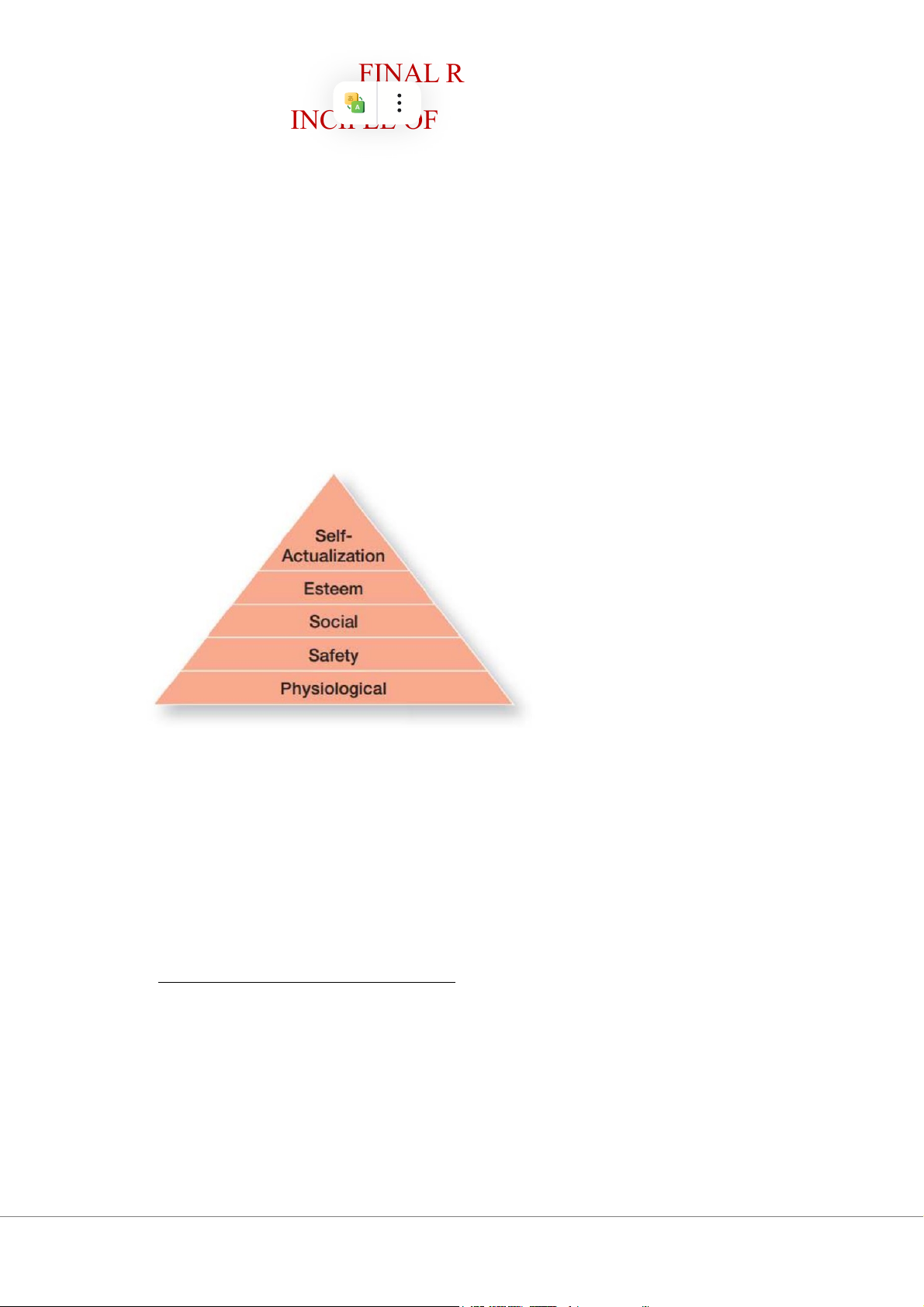
- Hierarchy of needs theory: Maslow’s theory that human needs - physiological, safety, social, esteem,
and self-actualization - form a sort of hierarchy
a. Physiological needs: A person’s needs for food, drink, shelter, sex, and other physical requirements.
Everything that your body need/want/desire
b. Safety needs: A person’s needs for security and protection from physical and emotional harm as well
as assurance that physical needs will continue to be met.
- Indirect factors destroy the safety need
+ Sexual harrasment (both violate physiological and safety need)
- Unsafe facilities: elevator, chairs, light, electrics, etc.
- The manager did not fire the employees but at the same time, did not tell
whether they have insurance or severance packed
- The manager did not tell the employees how their performance be recognized and
evaluated. If they perform well, do they be promoted?
- Direct factors destroy the safety need - Blackmail - Threaten
c. Social needs: A person’s needs for affection (yêu mến), belongingness, acceptance, and friendship.
- The need on personal interaction, relationship, belonging feeling
- If that’s the introvert employee, they actually don’t need the interaction. They still need the social
need but what they want is simply the belonging feeling
d. Esteem needs: A person’s needs for internal esteem factors such as self-respect, autonomy, and
achievement and external esteem factors such as status, recognition, and attention.
- Is the manager respect ans status the employees? - E.g:
- The manager talk politely with the employees
- The manager won’t annoy their employees at midnight
- It’s not only respect who the employee are but also respect their own life. It’s about everything around that employee
- Paying attention to the employees not only satisfy the esteem but also the social need
- Status not always is promoting.
- E.g: if their is a difficult issue, the manager always pick employee A solve; pick
employee B to serve the client.
- If the manager deal with (high IQ + high conscientious, low agreeableness) employee (e.g
Berlin), the manager should empower and provide the decision making power in order to satisfy their esteem need.
e. Self-actualization needs: a person’s needs for growth, achieving one’s potential, and self- fulfillment
(hoàn thiện bản thân); the drive to become what one is capable of becoming. - Core word: “OVERCOME”
- Whenever you have fallen into the hopeless state, you are very likely to get depression
- Of course, when you do anything, you always hope to be success, but whenever you can
overcome the things that previously assume unsuccessful, that’s self-actualization.
- This is something that no manager or anyone else except you can do it.
2. Herzberg’s two factor theory
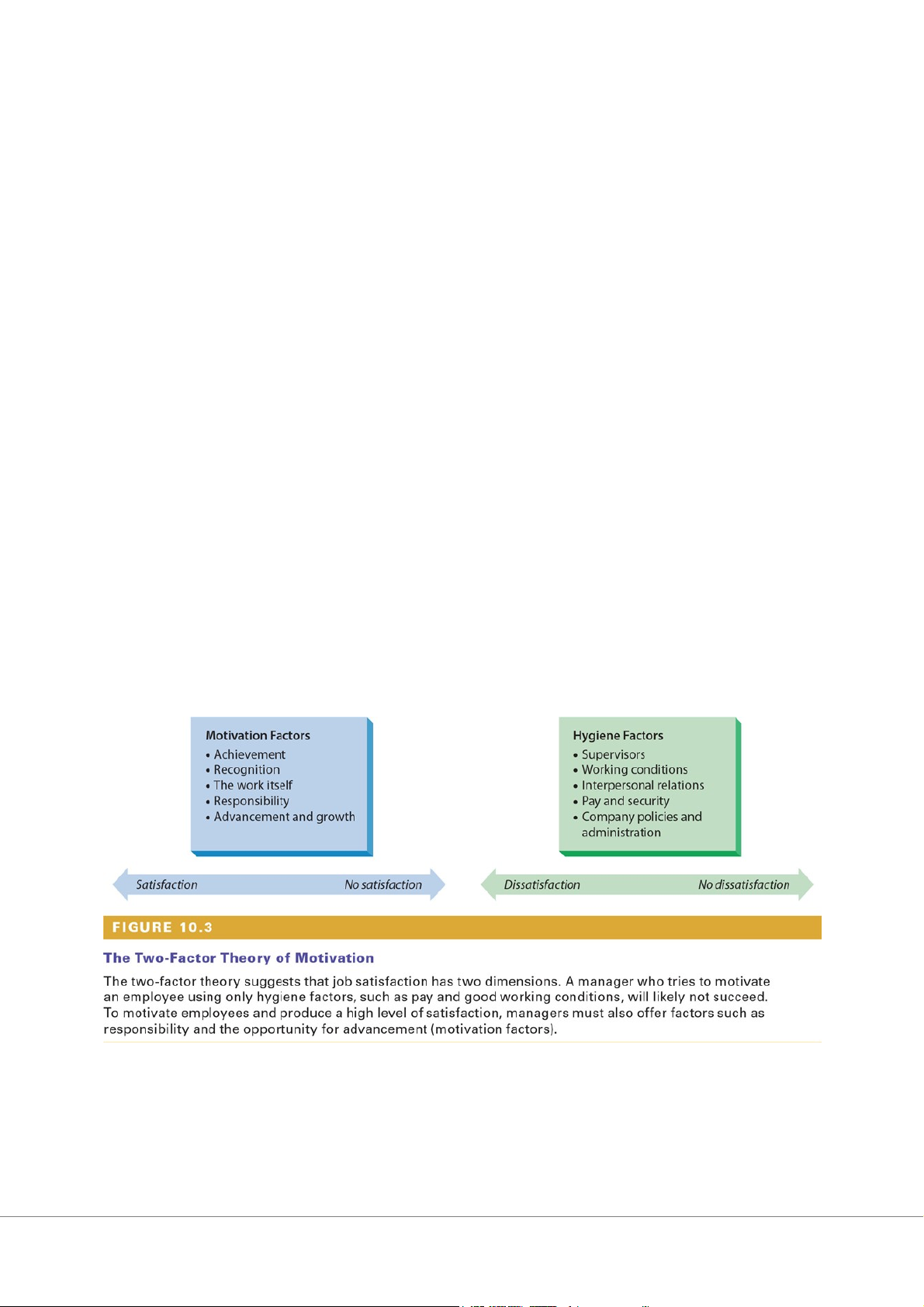
- Two-factor theory (motivation– hygiene theory): The motivation theory that intrinsic (nội tại) factors
are related to job satisfaction and motivation, whereas extrinsic factors are associated with job dissatisfaction
+ Motivators: Factors that increase job satisfaction and motivation.
=> Ensuring that deficient hygiene factors are not blocking motivation
=> Using job enrichment and redesign of jobs to increase motivational factors for employees
+ Hygiene factors: Factors that eliminate job dissatisfaction, but don’t motivate 3. McCelland’s theory
- Three-needs theory: The motivation theory that says three acquired (not innate difference from
Maslow’s Hierarchy) needs: achievement, power, and affiliation are major motives in work
+ Need for achievement: The desire to accomplish a goal or task more effectively than in the past
+ Need for affiliation: The desire for human companionship and acceptance
+ Need for power: The desire to be influential in a group and to control one’s environment II. TEAM AND TEAM DEVELOPMENT
1. Stages of Group and Team Development - Forming (S1):
+ Attempting to define the task and how it will be accomplished through discussions of task- related concepts/issues
+ First day as a team, try to figure out goals and parameters of the assignment - Storming (S2):
+ Defensiveness, intragroup competition, and the formation of factions; arguing among members, even when they agree
+ Brainstorming, discussion, and division of labor - Norming (S3):
+ Establishing and maintaining team ground rules
+ More friendliness and confiding in one another + Begin to work toward goals - Performing (S4):
+ The ability of the group/team to prevent or work through problems
+ Members develop close attachment to the team
+ Mechanism for accomplishing goals 2. Teams and Groups - Groups:
+ Formed around a common interest or purpose with the goal of sharing information, but
there is no collective accountability.
+ Consists of two or more people who interact regularly to accomplish a common purpose or goal - Team:
+ A team’s focus is collective performance, with both individual and mutual accountability.
+ A group of workers that functions as a unit, often with little or no supervision, to carry
out work-related tasks, functions, and activities III. Individual Behaviour 1. Perception
Perception is the process through which people receive and interpret information from the
environment. It is like a filter of information before we respond. And your perception is
influenced by your background, your culture and/ or your personality, hence, each of you will
perceive differently towards the same thing or situation. 2. Impression of management
Impression management is the systematic attempt to influence how others perceive us. How we
dress, talk, act, convey a desirable image to other persons. impression management can help us
to advance in jobs and careers, form relationships with people we admire, and even create path- ways to group memberships.
Tài liệu liên quan:
-
CHAP 1: Introduction to Management Concepts and Functions môn Principles of Management | Trường Đại học Quốc tế, Đại học Quốc gia Thành phố Hồ Chí Minh
14 7 -
Guidelines for group’s assignments: Analysing management issues of a FDI company based inVietnam môn Principles of Management | Trường Đại học Quốc tế, Đại học Quốc gia Thành phố Hồ Chí Minh
14 7 -
Financial Planning to Achieve 300m VND Goal in 3 Years môn Principles of Management | Trường Đại học Quốc tế, Đại học Quốc gia Thành phố Hồ Chí Minh
12 6 -
A Case Study in Fast Fashion Success môn Principles of Management | Trường Đại học Quốc tế, Đại học Quốc gia Thành phố Hồ Chí Minh
15 8 -
Chap 16 Hierarchy of Needs Theory and Applications môn Principles of Management | Trường Đại học Quốc tế, Đại học Quốc gia Thành phố Hồ Chí Minh
15 8