GIAO TRINH STAFFING ORGANITIONS
GIÁO TRÌNH CUNG CẤP KIẾN THỨC CHO MÔN QUẢN TRỊ NGUỒN NHÂN LỰC
Môn: Quản trị nguồn nhân lực (HRM3001) 12 tài liệu
Trường: Trường Đại học Kinh tế - Đại học Đà Nẵng 1.4 K tài liệu
Tác giả:

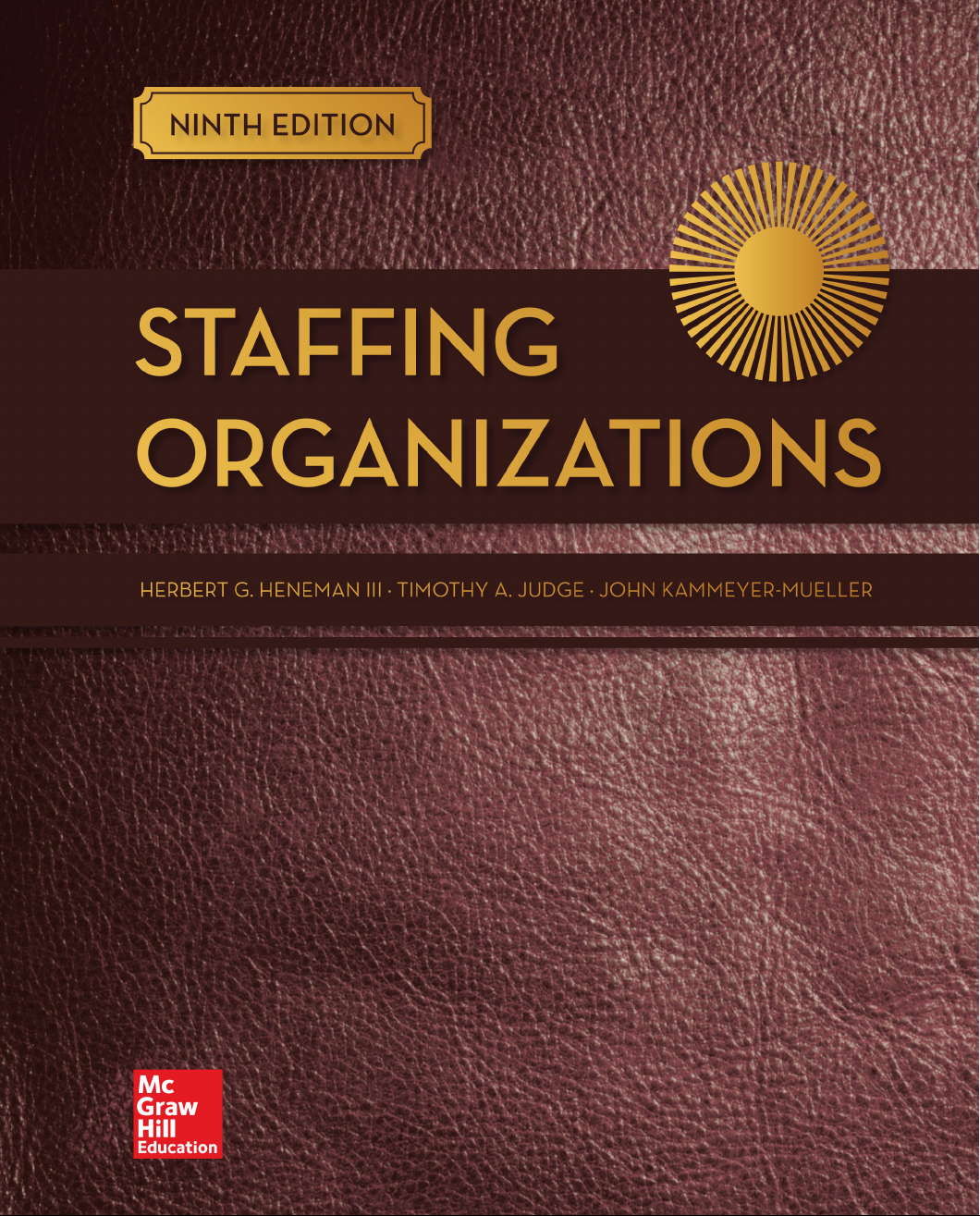



















Preview text:
STAFFING ORGAN IZATIONS Ninth Edition Herbert G. Heneman III
University of Wisconsin– Madison Timothy A. Judge The Ohio State University John D. Kammeyer- Mueller University of Minnesota Pangloss Industries Columbus, OH 1259756556_ch00_pi_xx.indd 1 12/8/17 4:49 PM Dedication To Susan, Jill, and Mia
STAFFING ORGANIZATIONS, NINTH EDITION
Published by Pangloss Industries, Inc., 4130 Mountview Road, Columbus, OH 43220, in collaboration with
McGraw-Hill Education, 2 Penn Plaza, New York, NY 10121. Copyright © 2019 by Pangloss Industries, Inc. All
rights reserved. Printed in the United States of America. Previous editions © 2015, 2012, and 2009. No part of this
publication may be reproduced or distributed in any form or by any means, or stored in a database or retrieval
system, without the prior written consent of the publisher, including, but not limited to, in any network or other
electronic storage or transmission, or broadcast for distance learning.
Some ancillaries, including electronic and print components, may not be available to customers outside the United States.
This book is printed on acid-free paper.
This publication is designed to provide accurate and authoritative information in regard to the subject matter
covered. It is sold with the understanding that the publisher is not engaged in rendering legal, accounting, or
other professional services. If legal advice or other expert assistance is required, the services of a competent
professional should be sought. (FROM A DECLARATION OF PRINCIPLES JOINTLY ADOPTED BY A
COMMITTEE OF THE AMERICAN BAR ASSOCIATION AND A COMMITTEE OF PUBLISHERS.)
1 2 3 4 5 6 7 8 9 LCR 21 20 19 18
ISBN 978-1-259-75655-9 (bound edition) Note to the Instructor:
MHID 1-259-75655-6 (bound edition)
Pangloss and McGraw-Hill Education have
ISBN 978-1-260-14133-7 (loose-leaf edition)
combined their respective skills to bring
MHID 1-260-14133-0 (loose-leaf edition)
Staffing Organizations to your classroom.
Portfolio Manager: Laura Spell
This text is marketed and distributed by
Marketing Manager: Debbie Clare
McGraw-Hill Education. For assistance in
Content Project Managers: Ryan Warczynski,
obtaining information or supplementary Karen Jozefowicz
Senior Buyer: Laura Fuller
material, please contact your McGraw-Hill
Designer: Jessica Cuevas
Education sales representative or the cus-
Content Licensing Specialist: Melisa Seegmiller
tomer services division of McGraw-Hill
Cover image: © McGraw-Hill Education Education at 800-338-3987.
Address orders and customer service questions to:
McGraw-Hill Higher Education
Address editorial correspondence to: 1333 Burr Ridge Parkway Timothy A. Judge Burr Ridge, IL 60527 Pangloss Industries 1-800-338-3987 4130 Mountview Road Columbus, OH 43220
Compositor: Westchester Publishing Services judge.56@osu.edu
Library of Congress Cataloging-in-Publication Data
Names: Heneman, Herbert G., III, 1944– author. | Judge, Tim, author. |
Kammeyer-Mueller, John, author.
Title: Staffing organizations / Herbert G. Heneman III, University of
Wisconsin-Madison, Timothy A. Judge, Ohio State University, John D.
Kammeyer-Mueller, University of Minnesota.
Description: Ninth edition. | Columbus, OH : Pangloss Industries, [2019]
Identifiers: LCCN 2017054981 | ISBN 9781259756559 (hardcover : alk. paper)
Subjects: LCSH: Employees—Recruiting. | Employee selection.
Classification: LCC HF5549.5.R44 H46 2019 | DDC 658.3/11—dc23
LC record available at https://lccn.loc.gov/2017054981 www.mhhe.com
9781259756559_ch00_pi-xx_SE.indd 2 12/27/17 9:45 PM AUTHOR PROFILES
Herbert G. Heneman III is the Dickson- Bascom Professor Emeritus in the
Management and Human Resources Department, School of Business, University
of Wisconsin– Madison. He also serves as a se nior researcher at the Wisconsin
Center for Educational Research. Herb has been a visiting faculty member at the
University of Washington and the University of Florida, and he was the University
Distinguished Visiting Professor at The Ohio State University. His research is in
the areas of staffing, per for mance management, compensation, and work motiva-
tion. He is currently investigating the design and effectiveness of teacher per for-
mance management and compensation systems. Herb was on the board of directors
of the Society for Human Resource Management Foundation and served as its
director of research. He is the se nior author of three other textbooks on human
resource management. Herb is a Fellow of the Society for Industrial and Orga-
nizational Psy chol ogy, the American Psychological Association, and the Acad emy
of Management. He is also the recipient of career achievement awards from the
Human Resources Division of the Acad emy of Management and from the Society for Human Resource Management.
Timothy A. Judge is the Joseph A. Alutto Chair in Leadership Effectiveness
and executive director of the Fisher Leadership Initiative in the Department of
Management and Human Resources, Fisher College of Business, The Ohio State
University. Tim is also the director of research for Stay Metrics, a start-up com-
pany in Notre Dame’s Innovation Park. Prior to receiving his PhD at the University
of Illinois, Tim was a man ag er for Kohl’s department stores. Tim has served on
the faculties of Cornell University, University of Iowa, University of Florida, and
University of Notre Dame. Tim’s teaching and research interests are in the areas of
personality, leadership and influence be hav iors, staffing, and job attitudes. Tim is a
former program chair for the Society for Industrial and Orga nizational Psy chol ogy
and a past chair of the Human Resources Division of the Acad emy of Manage-
ment. He has also served on the Acad emy of Management Board of Governors.
Tim is a Fellow of the American Psychological Association, the Society for Indus-
trial and Orga nizational Psy chol ogy, the American Psychological Society, and the Acad emy of Management. iii 1259756556_ch00_pi_xx.indd 3 12/8/17 4:49 PM iv Author Profiles
John D. Kammeyer- Mueller is the Curtis L. Carlson Professor of Industrial Rela-
tions in the Department of Work and Organ izations, Carlson School of Man-
agement, University of Minnesota. John’s primary research interests include the
areas of orga nizational socialization and employee adjustment, personality and
the stress pro cess, employee retention, and career development. He has taught
courses related to orga nizational staffing at the undergraduate, master’s, and doc-
toral levels. His research work has appeared in Acad emy of Management Journal;
the Journal of Applied Psy chol ogy; Personnel Psy chol ogy; the Journal of Manage-
ment; and the Journal of Orga nizational Be hav ior, among other outlets. He serves
on the editorial boards of the Journal of Applied Psy chol ogy; Personnel Psy chol ogy;
and Orga nizational Research Methods. In addition to his scholarly work, John has
performed consulting work in the areas of employee satisfaction, retention, and
workplace safety and health for 3M Corporation, Allegiance Healthcare, Allina
Healthcare, and the State of Minnesota. He has also worked with the Florida
Nurses Association and the Florida Bar on research proj ects of interest to their professional membership. 1259756556_ch00_pi_xx.indd 4 12/8/17 4:49 PM PREFACE
There has been a continual effort to incorporate strategic orga nizational con-
cerns into every edition of the textbook. The ninth edition of Staffing Organ-
izations develops these concepts significantly. Based on ideas from leading
human resources thinkers, new discussions describe how to incorporate orga-
nizational strategy into every part of the staffing pro cess. This material not only
underlines the importance of strategic thinking for students, but provides specific
guidance for specific actions that staffing decision makers can take to improve tal- ent management.
This edition has been the beneficiary of major restructuring and updating to
ensure continuing alignment of the material with current in- the- field business prac-
tices. The changes range from small inclusions of new standards to major chapter
revisions. The new structure will make it easier for students to see how each part
of the staffing pro cess proceeds from beginning to end, and it will also help them
see how the topics fit together to create a cohesive staffing management system.
The human resources landscape continues to be transformed by technology, and
this edition of the textbook reflects this influence. The use of human resources infor-
mation systems for tasks like recruitment, se lection, and forecasting is now thor-
oughly integrated into all sections. The role of social media, the Internet, and other
information management tools is emphasized in several chapters, and new examples
from companies keep the application of concepts fresh and current.
The changes for this edition reflect the integration of technology into core staff-
ing functions. Many of the previous headings related to web- based topics have thus
been eliminated to reflect that these are no longer novel add- ons to staffing manage-
ment but an integral part of the pro cess.
Listed below are updates to each chapter.
Chapter One: Staffing Models and Strategy
• Updated workforce growth statistics throughout the chapter
• Updated list of companies that are intensively hiring
• Updated material on Gore’s position as one of Fortune magazine’s 100 Best Companies to Work For
• New material on person- job match and person- organization fit v 1259756556_ch00_pi_xx.indd 5 12/8/17 4:49 PM vi Preface
• New material based on a recent report on the current talent shortage in the IT,
skilled trades, and sales industries
• Added material on the distinction between the labor force size and the labor force participation rate
• Updated definition of staffing ethics from the Society for Human Resource Management
Chapter Two: Legal Compliance
• New material on classifying individuals as either employees or in de pen-
dent contractors based on criteria from the Internal Revenue Ser vice and the Department of Labor
• Guidance from the Equal Employment Opportunity Commission (EEOC) on
defining discrimination based on the meaning of race/color, national origin,
sex, religion, disability, age, pregnancy, and ge ne tic information
• Updated information on the protected characteristics of sexual orientation and gender identity Chapter Three: Planning
• Increased emphasis on orga nizational culture in the planning pro cess
• New material on executive buy-in during human resources planning
• Updated discussion of workforce skills demand and employment patterns
• Revised exhibit showing labor force statistics trends
• New material on trends in labor force participation and work hours
• Streamlined discussion of forecasting techniques
• Comprehensive review of research on flexible workforce quality
• New material reviewing research on when to use outsourcing
• Updated information regarding affirmative action for veterans and qualified individuals with disabilities
Chapter Four: Job Analy sis and Rewards
• Greater emphasis on implementing competency- based job analy sis
• New figure showing the pro cess of job requirements job analy sis
• New figure showing the pro cess of competency- based job analy sis
• New figure outlining the distinctions among knowledge, skills, abilities, and
other characteristics and their workplace relevance
• Streamlined discussion of O*NET models
• Revised end- of- chapter cases
• Revised information on the types of evidence of essential job functions 1259756556_ch00_pi_xx.indd 6 12/8/17 4:49 PM Preface vii
Chapter Five: External Recruitment
• New material on integrating in- house recruitment with external vendors
• Integration of online recruitment techniques across topic areas
• Comprehensive review of research on applicant reactions to the external recruit- ment pro cess
• Increased discussion of social media effects on recruitment
• Revised and updated pre sen ta tion of recruitment messages
• Increased treatment of targeted recruitment techniques
• New discussion of the transition from recruitment to se lection
• Updated discussion regarding policies about written job applicants
• Revised material on best- practice recruitment ideas from the EEOC
• Updated information on recruitment using social media and job advertisements
Chapter Six: Internal Recruitment
• New material describing best practices in the strategic policy development pro cess
• Revised and updated pre sen ta tion of recruitment messages
• Revised and updated discussion of replacement and succession plans
• New discussion of the transition from recruitment to se lection
• New material on best- practice promotion ideas from the EEOC
• New discussion of barriers to upward mobility and improving upward mobility
Chapter Seven: Mea sure ment
• Updated example of the nominal level of mea sure ment
• New material on biases in subjective mea sure ment and rater training
• Revised percentiles example
• New discussion of the role of biases and contextual factors in interrater reliability
• New material on how construct- , content- , and criterion- related validation evi-
dence should be amassed and interpreted together
• New material on the situational appropriateness of predictive versus concur- rent validation designs
• Revised definition and discussion of content validity
• Updated illustrative study of the Mary land Department of Transportation
• New material reviewing the meta- analytic work on prior validity generaliza-
tion and the gaps in our current understanding
• New example using insights from Glassdoor to highlight practical consider- ations in staffing
• New discussion of mobile and Internet- based test administration 1259756556_ch00_pi_xx.indd 7 12/8/17 4:49 PM viii Preface
Chapter Eight: External Se lection I
• New material on applicant reactions toward per for mance tests and the valid- ity of such tests
• Updated discussion of video résumés
• New material on the adverse impact of résumés, letters of recommendation, credit checks, and biodata
• New discussion of the “double jeopardy” effect
• New discussion of the usefulness of a college education and quality of school
as educational requirements, including examples
• New material on how studying abroad leads to an expanded cultural intelli-
gence, an area of extracurricular activities that may be impor tant for staffing
• New material on how experience is multidimensional, with many characteris- tics and levels of analy sis
• New discussion of “Ban the Box” legislation
• New material on initial impressions as bias in initial interviews
• Updated material on applicant reactions and attraction from meta- analytic research
• Updated list of states that currently limit the use of credit information in staffing
• New material on social media screening and safeguards
• New discussion of bona fide occupational qualification claims and their justification
Chapter Nine: External Se lection II
• Updated Big Five stability and heritability estimates with the most recent meta- analytic research
• Updated website links and test information throughout the chapter
• New material and discussion on the “too much of a good thing” effect with conscientiousness
• New material and discussion on the “trivial validities” of personality, includ-
ing updated meta- analytic research and additional personality frameworks
• New material and meta- analytic evidence on personality test faking
• New material and discussion on when socially desirable be hav ior is not desir- able for job per for mance
• Updated Exhibits 9.2 and 9.13 based on new evidence
• Updated evaluation of cognitive ability tests with newest meta- analytic research
on organizational citizenship behavior and counterproductive work behavior
• Revised adverse impact evidence for cognitive ability tests
• New material on how “star applicants” can become offended by having to take cognitive ability tests 1259756556_ch00_pi_xx.indd 8 12/8/17 4:49 PM Preface ix
• New material and discussion on physical abilities tests that draw from the
most recent meta- analytic estimates
• New material and discussion on performance- based emotional intelligence
mea sure ment and emotional intelligence validity
• Updated meta- analytic validity estimates of work sample tests
• New material and discussion on the “situational” perspective on situational judgment tests
• New material on integrity test validity and faking
• New material on vocational congruence and attained vocational aspirations
• Updated meta- analytic research and other material for interviews, including
structured interview characteristics, behavioral and situational interview com-
parisons, validity, and interviewer characteristics
• New material on the National Football League (NFL) and how OCBs matters
less to outsiders (e.g., external con sul tants) than to insiders in team se lection
• Updated statistics and figures on drug testing
• Revised material on the Uniform Guidelines on Employee Se lection Procedures
• New discussion of marijuana and other drug testing
Chapter Ten: Internal Se lection
• Updated peer assessment section with meta- analytic results
• New material on the impact of self- assessments on biased promotion judgments
• New material on the impact of biases such as po liti cal skill on promotability ratings
• New meta- analytic material on the characteristics of assessment centers
• New material and discussion on solutions for the assessment center construct validity dilemma
• Revised the validity ranges to match traditional standards
Chapter Eleven: Decision Making
• New section on predictive analytics
• New section describing the interface between orga nizational leaders and HR
representatives based on best practices in the field
• New material covering techniques for assessing economic impact
• New exhibit reviewing techniques for assessing links between economic impact
analy sis and other functional areas of the business
• New exhibit covering the role of decision makers in se lection
• New section covering differential weighting techniques for predictors
• Updated and revised discussion of choosing among weighting schemes
• Streamlined discussion of test score banding 1259756556_ch00_pi_xx.indd 9 12/8/17 4:49 PM x Preface Chapter Twelve: Final Match
• New section on long- term adjustment and the pro cess of new hire onboarding over time
• Updated and revised discussion of specific onboarding practices
• Increased discussion of expatriate adjustment in staffing
• Updated and revised discussion of the strategic approach to job offers, with
increased linkages to decision making and system management
• Streamlined discussion of pay policies
• Streamlined discussion of employment contracts
• Revised material on negligent hiring and minimizing its occurrence
Chapter Thirteen: Staffing System Management
• New section describing the design and administration of staffing systems
• Emphasis on strategic fit between staffing systems and orga nizational goals and pro cesses
• Incorporation of strategic management research regarding HR systems
• New exhibit contrasting hierarchical and participative staffing systems
• Review of techniques for defining the mission of staffing
• Updated and revised material on orga nizational arrangements • New EEO-1 report
• New discussion of incorporating implicit (hidden) bias material into EEO training
• New and revised material on internal and external dispute resolution procedures
Chapter Fourteen: Retention Management
• Enhanced review of techniques for analyzing turnover
• Comprehensive update and reor ga ni za tion of material related to retention initiatives
• New section on predictive analytics in retention management
• New exhibit contrasting hire, quit, and layoff differences across industries
• New exhibit demonstrating how to use turnover breakout results
• Updated exhibit describing guidelines for increasing satisfaction and retention of employees
• Updated and revised discussion of causes of turnover
• Updated and revised discussion of the costs and benefits of turnover
In preparing previous editions, we have benefited greatly from the critiques and
suggestions of numerous people whose assistance was invaluable. They helped us 1259756556_ch00_pi_xx.indd 10 12/8/17 4:49 PM Preface xi
identify new topics, as well as clarify, rearrange, and delete material. We extend our
many thanks to the following individuals:
• Amy Banta, Franklin University
• Fred Dorn, University of Mississippi
• Hank Findley, Troy University
• Diane Hagan, Ohio Business College
• Mark Lengnick- Hall, University of Texas– San Antonio
We wish to extend a special note of thanks to the McGraw- Hill Education pub-
lishing team—in par tic u lar, Michael Ablassmeir, Laura Spell, Melissa Leick, and
Jane Beck— for their hard work and continued support of the number- one staffing
textbook in the market. Thanks also to the staff at Westchester Publishing Ser-
vices for their dedicated work in this collaborative undertaking. We wish to thank
Dr. David R. Glerum for his hard work on manuscript revisions, editing, and prepa-
ration. Fi nally, we wish to thank you— the students and faculty who use the book. If
there is anything we can do to improve your experience with Staffing Organ izations,
please contact us. We will be happy to hear from you. 1259756556_ch00_pi_xx.indd 11 12/8/17 4:49 PM 1259756556_ch00_pi_xx.indd 12 12/8/17 4:49 PM CONTENTS PA R T O N E Applications 38
Staffing for Your Own Job 38
The Nature of Staffing 3
Staffing Strategy for a New Plant 40 Endnotes 41 C H A P T E R O N E Staffing Models and Strategy 5
Learning Objectives and Introduction 6 Learning Objectives 6 PA R T T W O Introduction 6 The Nature of Staffing 7 Support Activities 45 The Big Picture 7 Definition of Staffing 10 C H A P T E R T W O
Implications of Definition 10 Legal Compliance 47
Staffing System Examples 13
Learning Objectives and Introduction 49 Staffing Models 15 Learning Objectives 49
Staffing Quantity: Levels 15 Introduction 49
Staffing Quality: Person/Job Match 16 The Employment Relationship 50
Staffing Quality: Person/Or ga ni za tion Employer– Employee 50 Match 18
In de pen dent Contractors 53
Staffing System Components 20 Temporary Employees 54
Staffing Organ izations 23
Unpaid Interns and Trainees 55 Staffing Strategy 27 Laws and Regulations 55 Staffing Levels 27
Need for Laws and Regulations 55 Staffing Quality 32
Sources of Laws and Regulations 56 Staffing Ethics 33
EEO/AA Laws: General Provisions and Plan for the Book 36 Enforcement 58 Summary 37 General Provisions 58 Discussion Questions 38 Enforcement: EEOC 61 Ethical Issues 38 Enforcement: OFCCP 67 xiii 1259756556_ch00_pi_xx.indd 13 12/8/17 4:49 PM xiv Contents
EEO/AA Laws: Specific Staffing Staffing Planning 121 Provisions 69
Staffing Planning Pro cess 121
Civil Rights Acts (1964, 1978, 1991) 69 Core Workforce 124
Age Discrimination in Employment Act Flexible Workforce 125 (1967) 72 Outsourcing 128
Americans With Disabilities Act (1990, Diversity Planning 130 2008) 73
Demography of the American Workforce 130
Ge ne tic Information Nondiscrimination Act
Business Case for Diversity 131 (2008) 77
Planning for Diversity 132
Rehabilitation Act (1973) 78 Legal Issues 134
Executive Order 11246 (1965, 1967,
Affirmative Action Plans 134 2014) 78
Legality of AAPs and Diversity Other Staffing Laws 79 Programs 139 Federal Laws 79
AAPs for Veterans and Individuals With State and Local Laws 82 Disabilities 142
Civil Ser vice Laws and Regulations 83
EEO and Temporary Workers 142
Legal Issues in Remainder of Book 85 Summary 143 Summary 85 Discussion Questions 144 Discussion Questions 86 Ethical Issues 144 Ethical Issues 86 Applications 145 Applications 87
Markov Analy sis and Forecasting 145
Age Discrimination in a Promotion? 87
Deciding Whether to Use Flexible
Disparate Impact: What Do the Statistics Staffing 145 Mean? 88 Endnotes 147 Endnotes 89 C H A P T E R F O U R C H A P T E R T H R E E
Job Analy sis and Rewards 153 Planning 91
Learning Objectives and Introduction 155
Learning Objectives and Introduction 93 Learning Objectives 155 Learning Objectives 93 Introduction 155 Introduction 93 The Need for Job Analy sis 156
Internal and External Influences 94
Types of Job Analy sis 156
Orga nizational Strategy 94
The Changing Nature of Jobs 157
Orga nizational Culture 95
Job Requirements Job Analy sis 159 Labor Markets 97 Overview 159 Technology 102
Job Requirements Matrix 160 Human Resource Planning 103
Job Descriptions and Job
Pro cess and Example 103 Specifications 168 Initial Decisions 105
Collecting Job Requirements
Forecasting HR Requirements 108 Information 169
Forecasting HR Availabilities 111
Competency- Based Job Analy sis 177
Reconciliation and Gaps 119 Overview 179 1259756556_ch00_pi_xx.indd 14 12/8/17 4:49 PM Contents xv
Nature of Competencies 179 Strategy Implementation 236
Collecting Competency Information 182
Individual Recruitment Sources 236 Job Rewards 185
Social Recruitment Sources 239 Types of Rewards 185
Orga nizational Recruitment Sources 242
Employee Value Proposition 185 Recruitment Metrics 248
Collecting Job Rewards Information 186 Transition to Se lection 251 Legal Issues 193 Legal Issues 252
Job Relatedness and Court Cases 193
Definition of a Job Applicant 252
Essential Job Functions 194
Affirmative Action Programs 254 Summary 195
Electronic Recruitment 254 Discussion Questions 196 Job Advertisements 257 Ethical Issues 197
Fraud and Misrepre sen ta tion 257 Applications 197 Summary 258
Conducting a Job Requirements or Job Discussion Questions 259
Rewards Job Analy sis 197 Ethical Issues 259
Maintaining Job Descriptions 198 Applications 260 Endnotes 199
Improving a College Recruitment Program 260
Internet Recruitment 262 PA R T T H R E E Endnotes 263
Staffing Activities: Recruitment 203 C H A P T E R S I X Internal Recruitment 269 C H A P T E R F I V E
Learning Objectives and Introduction 270
External Recruitment 205 Learning Objectives 270
Learning Objectives and Introduction 207 Introduction 270 Learning Objectives 207
Strategic Recruitment Planning 271 Introduction 207
Defining Strategic Internal Recruitment
Strategic Recruitment Planning 208 Goals 271
Defining Strategic External Recruitment
Mobility Paths and Policies 271 Goals 209
Closed, Open, and Hybrid Recruitment 276
Open Versus Targeted Recruitment 211
Organ ization and Administration 279
Organ ization and Administration 213 Timing 280 Applicant Reactions 219 Applicant Reactions 283
Reactions to Job and Orga nizational Communication 284 Characteristics 220
Communication Message 284
Reactions to Recruiters 220 Communication Media 285
Reactions to the Recruitment Pro cess 221 Strategy Implementation 286
Reactions to Diversity Issues 222 Recruitment Sources 286 Communication 223 Recruitment Metrics 292
Communication Message 223 Transition to Se lection 295 Communication Media 229 Legal Issues 295 1259756556_ch00_pi_xx.indd 15 12/8/17 4:49 PM xvi Contents
Affirmative Action Programs 296 Discussion Questions 361
Bona Fide Se niority Systems 296 Ethical Issues 361 The Glass Ceiling 298 Applications 361 Summary 301
Evaluation of Two New Assessment Methods Discussion Questions 302
for Selecting Telephone Customer Ser vice Ethical Issues 302 Representatives 361 Applications 302
Conducting Empirical Validation and
Recruitment in a Changing Internal
Adverse Impact Analy sis 364 Labor Market 302 Endnotes 367
Succession Planning for a CEO 304 Endnotes 304 C H A P T E R E I G H T External Se lection I 371
Learning Objectives and Introduction 372 PA R T F O U R Learning Objectives 372 Introduction 372
Staffing Activities: Se lection 309 Preliminary Issues 372
The Logic of Prediction 373 C H A P T E R S E V E N
The Nature of Predictors 374 Mea sure ment 311
Development of the Se lection Plan 376
Learning Objectives and Introduction 313 Se lection Sequence 376 Learning Objectives 313 Initial Assessment Methods 379 Introduction 313
Résumés and Cover Letters 379
Importance and Use of Mea sures 314 Application Blanks 383 Key Concepts 315
Biographical Information 391 Mea sure ment 315
Reference and Background Checks 396 Scores 319 Initial Interview 402
Correlation Between Scores 322
Choice of Initial Assessment Methods 404 Quality of Mea sures 327 Legal Issues 409
Reliability of Mea sures 328 Disclaimers 410
Validity of Mea sures 336 Reference Checks 410
Validation of Mea sures in Staffing 339
Social Media Screening 411
Validity Generalization 348
Background Checks: Credit and
Staffing Metrics and Benchmarks 351 Criminal 412
Collection of Assessment Data 351
Preemployment Inquiries 415 Testing Procedures 352 Bona Fide Occupational
Acquisition of Tests and Test Manuals 354 Qualifications 417
Professional Standards 354 Summary 420 Legal Issues 355 Discussion Questions 420
Determining Adverse Impact 355 Ethical Issues 421 Standardization 358 Applications 421 Best Practices 358
Reference Reports and Initial Assessment in Summary 359
a Start- Up Com pany 421 1259756556_ch00_pi_xx.indd 16 12/8/17 4:49 PM Contents xvii
Developing a Lawful Application C H A P T E R T E N Blank 422 Internal Se lection 513 Endnotes 424
Learning Objectives and Introduction 515 Learning Objectives 515 C H A P T E R N I N E Introduction 515
External Se lection II 431 Preliminary Issues 516
Learning Objectives and Introduction 432
The Logic of Prediction 516 Learning Objectives 432 Types of Predictors 517 Introduction 432 Se lection Plan 517
Substantive Assessment Methods 433 Initial Assessment Methods 518 Personality Tests 433
Talent Management/Succession Ability Tests 442 Systems 518
Emotional Intelligence Tests 450 Peer Assessments 519
Per for mance Tests and Work Self- Assessments 521 Samples 453
Managerial Sponsorship 521
Situational Judgment Tests 456
Informal Discussions and Integrity Tests 459 Recommendations 523
Interest, Values, and Preference
Choice of Initial Assessment Methods 525 Inventories 464
Substantive Assessment Methods 525
Structured Interview 466
Se niority and Experience 526
Se lection for Team Environments 475 Job Knowledge Tests 527
Choice of Substantive Assessment
Per for mance Appraisal 528 Methods 477
Promotability Ratings 530
Discretionary Assessment Methods 481 Assessment Centers 531
Contingent Assessment Methods 481
Interview Simulations 538 Drug Testing 482
Promotion Panels and Review Boards 539 Medical Exams 488
Choice of Substantive Assessment Legal Issues 488 Methods 539
Uniform Guidelines on Employee Se lection
Discretionary Assessment Methods 541 Procedures 488 Legal Issues 541
Se lection Under the Americans With
Uniform Guidelines on Employee Se lection Disabilities Act 489 Procedures 541
Marijuana and Other Drug Testing 493 The Glass Ceiling 542 Summary 494 Summary 543 Discussion Questions 495 Discussion Questions 544 Ethical Issues 496 Ethical Issues 544 Applications 496 Applications 544
Assessment Methods for the Job of Human
Changing a Promotion System 544 Resources Director 496
Promotion From Within at Citrus Glen 545
Choosing Among Finalists for the Job of Questions 546
Human Resources Director 498 Endnotes 547 Endnotes 499 1259756556_ch00_pi_xx.indd 17 12/8/17 4:49 PM xviii Contents PA R T F I V E
Choosing Entrants Into a Management Training Program 589
Staffing Activities: Employment 553 Endnotes 591
C H A P T E R E L E V E N
C H A P T E R T W E LV E Decision Making 555 Final Match 595
Learning Objectives and Introduction 557
Learning Objectives and Introduction 597 Learning Objectives 557 Learning Objectives 597 Introduction 557 Introduction 597
Choice of Assessment Method 558 Employment Contracts 598
Validity Coefficient 558
Requirements for an Enforceable
Correlation With Other Predictors 560 Contract 598 Adverse Impact 560
Parties to the Contract 599 Hiring Success Gain 560
Form of the Contract 600 Economic Gain 563 Disclaimers 602
Determining Assessment Scores 566 Contingencies 603 Single Predictor 566 Job Offers 603 Multiple Predictors 566
Strategic Approach to Job Offers 604
Hiring Standards and Cut Scores 571 Job Offer Content 606
Description of the Pro cess 572 Job Offer Pro cess 615
Consequences of Cut Scores 573
Formulation of the Job Offer 615
Methods to Determine Cut Scores 574
Pre sen ta tion of the Job Offer 622 Methods of Final Choice 579 Timing of the Offer 623 Random Se lection 579
Job Offer Ac cep tance and Rejection 623 Ranking 579 Reneging 624 Grouping 580 New Employee Orientation and Ongoing Hiring 580 Socialization 626 Decision Makers 581 Orientation 627
Orga nizational Leaders 581 Socialization 627
Human Resource Professionals 582
Long- Term Adjustment 631 Man ag ers 583
Examples of Programs 632 Coworkers 583 Legal Issues 633 Legal Issues 584
Employment Eligibility Verification 633
Uniform Guidelines on Employee Se lection Negligent Hiring 634 Procedures 584
Employment- at- Will 635
Diversity and Hiring Decisions 585 Summary 635 Summary 586 Discussion Questions 636 Discussion Questions 587 Ethical Issues 637 Ethical Issues 587 Applications 637 Applications 587 Making a Job Offer 637
Utility Concerns in Choosing an Assessment Method 587 1259756556_ch00_pi_xx.indd 18 12/8/17 4:49 PM Contents xix
Evaluating a Hiring and Variable- Pay
C H A P T E R F O U R T E E N Plan 639
Retention Management 687 Endnotes 641
Learning Objectives and Introduction 689 Learning Objectives 689 Introduction 689 PA R T S I X Turnover and Its Causes 690
Nature of the Prob lem 690 Staffing System and Types of Turnover 690
Retention Management 647 Causes of Turnover 692 Analy sis of Turnover 695
C H A P T E R T H I R T E E N Mea sure ment 695
Staffing System Management 649
Reasons for Leaving: Self- Report 697
Learning Objectives and Introduction 650
Reasons for Leaving: Predictive Learning Objectives 650 Analytics 699 Introduction 650 Costs and Benefits 700
Design and Administration of Staffing
Retention Initiatives: Voluntary Systems 651 Turnover 707
Defining the Mission of Staffing 651
Desirability of Leaving 708
Orga nizational Arrangements 652 Ease of Leaving 713
Policies and Procedures 655 Alternatives 714
Human Resource Information
Current Practices and Deciding to Act 715 Systems 657
Retention Initiatives: Discharge 720 Outsourcing 660
Per for mance Management 720
Evaluation of Staffing Systems 663
Progressive Discipline 725 Staffing Pro cess 663
Retention Initiatives: Downsizing 726
Staffing Pro cess Results 666
Weighing Advantages and
Calculating Staffing Metrics 672 Disadvantages 726 Legal Issues 673
Staffing Levels and Quality 727
Rec ord Keeping and Privacy 673
Alternatives to Downsizing 728 EEO Report 675
Employees Who Remain 728 Legal Audits 675 Legal Issues 730
Training for Man ag ers and
Separation Laws and Regulations 730 Employees 677
Per for mance Appraisal 730 Dispute Resolution 678 Summary 731 Summary 680 Discussion Questions 733 Discussion Questions 681 Ethical Issues 733 Ethical Issues 681 Applications 734 Applications 681
Managerial Turnover: A Prob lem? 734
Learning About Jobs in Staffing 681
Retention: Deciding to Act 735
Evaluating Staffing Pro cess Results 682 Endnotes 737 Endnotes 683 Name Index 743 Subject Index 753 1259756556_ch00_pi_xx.indd 19 12/8/17 4:49 PM
Tài liệu liên quan:
-
SACH GIAO TRINH GAME AND EXCERCISE
5 3 -
Tổng Hợp Câu Hỏi Trả Lời Ngành Quản Trị Nguồn Nhân Lực | Quản trị nguồn nhân lực | Đại học Kinh tế - Đại học Đà Nẵng
70 35 -

Quy chế đánh giá mức độ hoàn thành công việc tại Công ty | Quản trị nguồn nhân lực | Đại học Kinh tế - Đại học Đà Nẵng
70 35 -
Hiệp ước An ninh Mỹ-Nhật: Tác động và Vai trò Chiến lược | Quản trị nguồn nhân lực | Đại học Kinh tế - Đại học Đà Nẵng
69 35