Key Concepts in Management and Business Strategies môn Principles of Management | Trường Đại học Quốc tế, Đại học Quốc gia Thành phố Hồ Chí Minh
There are 6 elements are critically considered across industries: talent, technology, globalization, ethics, diversity and careers. Tài liệu giúp bạn tham khảo, ôn tập và đạt kết quả cao. Mời đọc đón xem!
Môn: Principles of Management 314 tài liệu
Trường: Trường Đại học Quốc tế, Đại học Quốc gia Thành phố Hồ Chí Minh 2 K tài liệu
Tác giả:




















Preview text:
CHAP 1 Takeaway 1:
There are 6 elements are critically considered across industries: talent, technology,
globalization, ethics, diversity and careers.
Talent: human resource is one of the advantages that every company want to
achieve. Talented people are able to deliver efÏcient outcomes in competing with rivals.
-Intellectual capital equation: Intellectual Capital = Competency x Commitment.
Competency is your advantage, your ability or talent that needed for your job
Commitment is your willingness to work hard, to apply them to your tasks.
Both are required to meet career needs and performance requirements.
Knowledge workers: persons whose minds are critical assets. It relates to the
knowledge, the information you acquire and your mindset. Technology:
-Tech IQ: your ability to use technology in all your life aspects and stay
informed on the latest technological developments. High TechIQ is important
because it helps adapting quickly to new innovations.
-Ex: LinkedIn.com as online career sites used by job hunters and employers.
Filling your online profile with the right key words. Employers use special
software to scan online profiles for indicators of real job skills and
experiences that fit their needs.
Globalization: indicates worldwide interdependence of resource flows, product
markets, and business competition that characterizes our economy.
-Job migration, the shifting of jobs from one country to another.
Ethics: set of moral standards for what behavior is right and what is wrong. It
depends on individual being responsible for conducting right ethical business at all
levels. Leaders are supposed to conduct things right so that their followers can follow.
Diversity: a group of workers or a workforce that have differences in gender, age,
race, ethnicity, religion, sexual orientation, and ablebodiedness. Since society is
diverse, the way we deal with diversity in the workplace is an issue. Some major problems are:
-Prejudice: the holding of negative, irrational opinions and attitudes
regarding members of diverse populations.
-Discrimination: minority members are unfairly treated and denied the full
benefits of organizational membership.
-Glass ceiling effect: an invisible barrier that prevents women and
minorities from rising above a certain level regarding organizational responsibility. Careers:
-Shamrock organization is a core group of permanent, full-time employees,
freelancers and part-time staff.
-Free- agent economy: you can change jobs often and work on flexible
contracts with a mix of employers over time.
-Self-management: realistically assess yourself, make constructive changes,
and manage your personal development. Takeaway 2:
An organization is a collection of people working together to achieve a common
purpose. Its members perform tasks not only for their accomplishment but also for
the final goal of the organization.
Organization as an open system that interact with their environments: Obtaining
resource inputs—people, information, resources, and capital—and transforming
them into outputs in the form of finished goods and services for customers.
-Productivity: measures the quantity and quality of outputs relative to the cost of inputs.
-Performance effectiveness is an output measure of task or goal accomplishment.
-Performance efÏciency is an input measure of the resource costs against goal accomplishment.
There are changes in organizations:
-Focus on valuing human capital: work settings that create the knowledge,
experience, and commitment of all members.
-Demise of “command-and-control”: instead of “do as I say”, managers treat people with respect.
-Emphasis on teamwork: Organizations are driven by teamwork that consists
of talents for creative problem solving.
-Preeminence of technology: New developments change the way
organizations operate and how people work.
-Importance of networking: members are networked for intense, real-time
communication and coordination.
-New workforce expectations: A new generation is less tolerant of hierarchy,
more informal, attentive to performance merit, and concerned for work–life balance.
-Priorities on sustainability: more attention to natural resources and
understanding how work affects human well-being. Takeaway 3:
Manager: supports, supervises, and helps motivate the work efforts and
performance accomplishments of staff, followers, team members.
If classifying by levels, we have 4 levels of managers.
-Board of directors whose members are elected by stockholders to
represent their ownership interests. The basic responsibilities of board
members is to make sure that the organization is always being run right
-Top managers are an executive team that reports to the board and is
responsible for the performance of an organization as a whole.
-Middle managers are in charge of relatively large departments consisting of several smaller work units.
-Team leader is in charge of a small work group composed of nonmanagerial staff.
If classifying by levels, we have 4 types of managers.
-Line managers are responsible for work that makes a direct contribution to the organization’s outputs.
-Staff managers use technical expertise to advise and support line workers.
-Functional managers have responsibility for a single area of activity such
as finance, marketing, production, human resources, accounting, or sales.
-General managers are responsible for activities covering many functional areas.
-Administrators are used in non-profit org. Managerial Performance
-Accountability is the requirement of one person to answer to a higher
authority for performance results in his or her area of work responsibility.
-Quality of work life (QWL) indicating the quality of staff experience with their job.
Changing Nature of Managerial Work
The concept of the upside-down pyramid fits with the changing mindset of managerial today.
Takeaway 4: these are the 4 basic functions of a manager
-Planning: is the process of setting performance objectives and determining
what actions should be taken to accomplish them. Through planning, a
manager identifies desired results and ways to achieve them.
-Organizing: Once plans are set, they must be implemented. The process of
assigning tasks, allocating resources, and coordinating the activities to accomplish plans.
-Leading: is the process of arousing people’s enthusiasm and motivating their
efforts to work hard to accomplish objectives. Managers build commitments,
encourage activities and influencing others to do their work.
-Controlling: is the process of measuring performance, comparing results to
objectives, and taking corrective action as needed. Managers control by
staying in contact with people as they work, gathering and interpreting
measurements and make constructive changes. Managerial Roles
Mintzberg identified a set of 10 roles commonly filled by managers:
-Interpersonal roles involve interactions with people inside and outside of org. -
A manager’s informational roles involve the giving, receiving, and analyzing of information. -
The decisional roles involve using information to make decisions to solve
problems or address opportunities.
There are Essential Skills for a manager
-Technical Skills: the ability to use a special proficiency or expertise to
perform particular tasks. Technical skills are very important at job entry and early career levels. -
Human and Interpersonal Skills: the ability to work well in cooperation with others.
oEmotional intelligence: how well you recognize, understand, and
manage feelings while interacting and dealing with others. -
Conceptual and Analytical Skills: the capacity to break problems into
parts, see the relations between the parts, and recognize the implications of
each problem for others. Conceptual skills are important in high levels of management. CHAP 2
1. Classical management approaches a. Scientific management b. Administrative principles c. Bureaucratic organization
2. Behavioral Management Approaches
a. Follett’s organizations as communities b. The Hawthorne studies.
c. Maslow’s theory of human needs
d. McGregor’s Theory X and Theory Y
e. Argyris’s theory of adult personality
3. Modern Management Foundations
a. Quantitative analysis and tools b. Organization as systems c. Contingency thinking d. Quality management
e. Knowledge management and organizational learning f. Evidence-based management
CLASSICAL MANAGEMENT APPROACHES: assumes that people are rational in
taking opportunities to achieve personal and monetary gain
I.Sciencetific management: emphasizes careful selection and training of
workers and supervisory support.
It comes with 4 guiding principles: -
A “science” that includes rules of motion, standardized work implements, and proper working conditions. -
Carefully selection of workers with the right abilities. -
Carefully training workers to do the job and proper incentives to cooperate with job “science.” -
Supporting workers by planning and by smoothing the jobs.
Motion study means reducing a task to its basic physical motions. It is encourage
that wasted activities in a task should be eliminated in order to improve efÏciency
Insights from scientific management approach: - Advances of job design, -
Work standards, and incentive wage plans.
II.Administrative Principles
Fayol identifies the five “rules” of management:
1. Foresight—to complete a plan for the future
2. Organization—to provide and allocate resources to implement the plan
3. Command—to lead and evaluate workers to get the best work
4. Coordination—to fit diverse efforts and to ensure information is shared and problems are solved
5. Control—to make sure things happen according to plan and to take necessary corrective action
The foundation for the 4 functions of management
Principles to guide managers including:
- Scalar chain principle—a clear and unbroken line of communication from the
top to the bottom in the organization. So that information can be shared and
transparency of a business is secured
- Unity of command principle—each person should receive orders from only
one boss in order to avoid confusion and power overlapping
- Unity of direction principle—one person should be in charge of all activities
that have the same performance objective
III.Bureaucratic Organization: a rational and efÏcient form of organization
founded on logic, order, and legitimate authority. His ideas developed after
noticing organizations performed poorly since people holding positions of
authority not because of their capabilities, but because of their “privileged”
social status. So according to Weber’s approach, people with ability will take
authority and be in charge. A whole organization will be run based on a
hierarchy structure where managers give out order to their lower level and then
it is passed on to the subordinates.
The characteristics of bureaucratic organization are:
-Clear division of labor: Jobs are well defined, and workers become highly skilled at performing them
-Clear hierarchy of authority: Authority and responsibility are well defined for
each position, and employees know who they report to
-Formal rules and procedures: established written guidelines and written files are kept for historical record
-Impersonality: Rules and procedures are impartially and uniformly applied,
with no one receiving special treatment
-Careers based on merit: Workers are selected and promoted on ability, competency, and performance
BEHAVIORAL MANAGEMENT APPROACHES: assume that people are social and
self-actualizing, responding to group pressures, and searching for personal fulfillment.
-Follett’s notion of organizations as communities -The Hawthorne studies
-Maslow’s theory of human needs -Douglas McGregor -Chris Argyris
I. Follett’s Organizations as Communities
Organizations as “communities”: managers and workers labor in harmony without
one party dominating the other, and with the freedom reconcile conflicts and
differences, the respect for the experience and knowledge of workers, warned
against the dangers of too much hierarchy
Based on Follet’s study, there are insights that are still helpful: -
Emphasis on employee ownership in order to enhance their commitment
-Business problems involve a variety of factors that are in relationship to one another
-And private profits should always be considered vis-J-vis the public good: ethics and CSR
II. The Hawthorne Studies: people’s feelings, attitudes, and relationships with
coworkers affected their work, and that groups were important influences on individuals
Social setting and human relation affect productivity: pleasant social interactions
with one another and received special attention that made employees feel important
Members would restrict their output to avoid the displeasure of the group -> groups
have strong negative/ positive influences on individual productivity
Hawthorne effect: the tendency of people who are singled out for special
attention to perform as anticipated because of expectations created by the situation III.
Maslow’s Theory of Human Needs
Maslow’s theory is based on two underlying principles:
-Deficit principle—a satisfied need is not a motivator of behavior. It means
people act to satisfy “desired” needs, a deficit
-Progression principle—a need at any level is activated only when the next- lower-level need is satisfied
IV. McGregor’s Theory X and Theory Y
managers holding Theory X assumes that those who work for them generally
dislike work, lack ambition, are irresponsible, are resistant to change, and prefer to be led rather than to lead
Theory Y assumes that manager believes people are willing to work, capable of
self-control, willing to accept responsibility, imaginative and creative, and capable of self-direction
V. Argyris’s Theory of Adult Personality
Managers who treat people positively and as responsible adults will achieve the
highest productivity. Theory is contradict to the classical management approaches: -
In scientific management, people will work more efÏciently as tasks become
simpler and better defined. Argyris believes that this limits opportunities for self-actualization -
In Weber’s bureaucracy, people work in a clear hierarchy of authority.
Argyris worries that this creates dependent, passive workers -
In Fayol’s administrative principles, the concept of unity of direction assumes
that efÏciency will increase when a person’s work is planned and directed by
a supervisor. Argyris suggests that this creates conditions for psychological failure.
MODERN MANAGEMENT FOUNDATIONS I.
Quantitative Analysis and Tools
Managers mine data in order to make decisions --> analytics: the systematic
analysis of large databases to solve problems and make informed decisions.
Organizations as Systems
One company achieves great things by combining resources and the contributions
of many individuals to achieve a common purpose.
Subsystems are formed which are interrelated to each other
High performance occurs only when each subsystem both performs its tasks
well and works well in cooperation with others
II. Contingency Thinking
Contingency thinking matches responses with problems and opportunities
specific to different people and settings
The contingency perspective tries to help managers understand situational
differences and respond to them in ways that fit their characteristics. III. Quality Management
TQM makes quality principles part of the organization’s strategic objectives,
applying them to all aspects of operations. TQM approaches begin with the total
quality commitment applies to every subsystem in an organization
Measure and control the quality of the whole open system from the inputs to
outputs as well as the feedback which contributes to the improvement of input resources
Continuous improvement: always looking for new ways to improve on current performance.
ISO certification is a global quality benchmark that businesses want to achieve in
order to define their quality level IV.
Knowledge Management and Organizational Learning
Knowledge management describes the processes through which organizations
use information technology to develop, organize, and share knowledge to achieve performance success
Intellectual assets such as patent, intellectual property rights, trade secrets, etc.
need to be well managed and continually enhanced
A learning organization is the one that people, values, and systems continuously
change and improve its performance based upon experience
Help all members to learn through information sharing, teamwork,
empowerment, and participation.
V. Evidence-Based Management
Evidence-based management means making management decisions based on
what really works rather than on things that sound good but lack of empirical proof. Four sources of information:
-Practitioner expertise and judgment: knowledge and past experience
-Evidence from the local context
-Critical evaluation of the best available evidence
-Perspectives of those people who might be affected by the decision CHAP 5 I. GLOBAL ECONOMY
1. Global economy in which resource supplies, product markets, and business
competition are worldwide rather than local or national in scope.
2. Globalization is the growing interdependence among elements of the global economy
3. Economic globalisation can be defined as all the things that happen when: goods,M ideas,M people,M services, andM capitalM
move from one nation to another.
Globalisation is important because the flow affects jobs, salaries, income distributions, and so on.M
4. World 3.0 is a world where nations cooperate in the global economy while still
respecting different national characters and interests.
5. The term used to describe management in businesses and organizations with
interests in more than one country is global management.
6. Global management will require global manager. The success of firms like
these depends on being able to attract and hire truly global managers who have
strong global perspectives, are culturally aware, and always stay informed about international developments.
7. International businesses are businesses that conduct for-profit transactions
of goods and services across national boundaries, like Nike.
- Nike does no domestic manufacturing. All of its products are made from sources abroad
- New Balance makes use of global suppliers and licensing its products
internationally, and produces at factories in the United States.
Both are doing international businesses for these common reasons:
- Profits—Gain profits through expanded operations.
- Customers—Enter new markets to gain new customers.
- Suppliers—Get access to materials, products, and services.
- Labor—Get access to lower-cost talented workers.
- Capital—Tap a larger pool of financial resources.
- Risk—Spread assets among multiple countries.
8. There would be 2 approaches:
a. Market-entry strategies that involve the sale of goods or services to
foreign markets without expensive investments
b. Direct investment strategies require major capital commitments,
create rights of ownership and control over operations in the foreign country
Market entry strategies are the first steps in globalizing an organization:
-Global sourcing—the process of purchasing materials, manufacturing
components, or locating business services around the world.
-Exporting—selling locally made products in foreign markets.
-Importing—buying foreign-made products and selling them in domestic markets.
-Licensing agreement whereby foreign firms pay a fee for rights to make or
sell another company’s products in a specified region.
-Franchising is a form of licensing in which the foreign firm buys the rights to
use another’s name and operating methods in its home country.
Direct investment strategies:
-Foreign direct investment, or FDI, involves setting up and buying all or
part of a business in another country. And the ability to attract foreign
business investors has been a key to succeeding in the global economy ->
insourcing is job creation through DI.
-When foreign firms invest in a new country, a common way to start is with a
joint venture. This is a co-ownership arrangement in which the foreign and
local partners agree to pool resources, share risks, and jointly operate the
new business. It can be a part ownership of the local organization or both can
join together to have a new operation.
-International joint ventures are types of global strategic alliances in which
foreign and domestic firms work together for mutual benefit. Both gain their own benefits.
-A foreign subsidiary is a local operation completely owned and controlled
by a foreign firm. Or a company operating overseas that is part of a larger
corporation with headquarters in another country, often known as a parent company or a holding company.
oThe difference between a foreign subsidiary and a joint venture is that
subsidiary is operated as a completely foreign-owned enterprise while
a joint-venture company is owned by both foreign investors and at least one domestic investor.
-Greenfield ventures where it is built from constructing all facilities from
start by the foreign owner. You open a business in a new market without the
help of another business which is already present there. It has advantages of
high level of control over business operations and image, High level of quality
control over the manufacturing and sale of products, and be able to create
jobs for the economy where the greenfield investment is taking place.
However, this is the riskiest form of foreign direct investment with potentially
high market entry cost, Government regulations and high fixed cost. II.
GLOBAL BUSINESS ENVIRONMENT
1. Legal and Political Systems
Some of the biggest risk in international business comes from differences in legal
and political systems. Global firms are expected to abide by local laws, some of which may be unfamiliar.
Political risk—the potential loss in value of an investment in or managerial control
over a foreign asset because of instability and political changes in the host country.
The major threats of political risk today come from terrorism, civil wars, armed
conflicts, and new government systems and policies.
Most global firms use a planning technique called political-risk analysis to
forecast the probability of disruptive events that can threaten the security of a foreign investment.
2. Trade Agreements and Trade Barriers
When international businesses believe they are being mistreated in foreign
countries, or when local companies believe foreign competitors are disadvantaging
them, their respective governments might take the cases to the World Trade Organization.
Yet trade barriers are still common. They include
-Tariffs, which are taxes that governments impose on imports.
-Nontariff barriers that discourage imports in nontax ways such as quotas, import restrictions.
-Protectionism that give favorable treatment to domestic businesses.
The purpose for tariffs and protectionism is to protect local firms from foreign
competition and save jobs for local workers.
3. Regional Economic Alliances: nations agree to work together for economic gains. 4. Global Businesses a. Host-Country Issues
-Potential host-country costs are: complaints that global corporations extract
excessive profits, dominate the local economy, interfere with the local
government, do not respect local customs and laws, fail to help domestic
firms develop, hire the most talented of local personnel, and fail to transfer
their most advanced technologies. b. Home-Country Issues
-Global corporations can also get into trouble at home in the countries where
they were founded and where their headquarters are located.
-Even as many global firms try to operate as transnationals, home-country
governments and citizens still tend to identify them with local and national interests.
-Whenever a global business cuts back home-country jobs, or closes a
domestic operation in order to shift work to lower-cost international
destinations, the loss is controversial.
-Corporate decision makers are likely to be called upon by government and
community leaders to reconsider and give priority to domestic social responsibilities.
5. Ethics Challenges for Global Businesses
-Corruption: occurs when people engage in illlegal practices to further their personal business interests.
-Child Labor and Sweatshops:
oChild labor—the employment of children to perform work otherwise
done by adults, a major ethics issue for global businesses as they
follow the world’s low-cost manufacturing from country to country
oSweatshops—business operations that employ workers at low wages
for long hours in poor working conditions III.
CULTURE AND GLOBAL DIVERSITY
-Culture is the shared set of beliefs, values, and patterns of behavior common to a group of people.
-Culture shock is the confusion and discomfort a person experiences when in an unfamiliar culture.
-Ethnocentrism, a tendency to view one’s culture as su- perior to that of others.
-Cultural intelligence, the ability to adapt and adjust to new cultures.
1. The silent language of culture:
a. Context: cultures differ in their use of language in communication.
Most communication in low-context cultures takes place via the written or spoken
word: say or write what they mean and mean what they say.
In high-context cultures what is said or written may convey only part of the real
message. The rest must be interpreted from the situation, body language, physical
setting, and even past relationships. b. Time
People in monochronic cultures often do one thing at a time. It is common in the
United States, for example, to schedule meetings with specific people and focus on a specific agenda
Members of polychronic cultures are more flexible toward time. They often try to
work on many different things at once, perhaps not in any particular order, and give
in to distractions and interruptions c. Space
Proxemics, the study of how people use space to communicate.
2. Tight and Loose Cultures
The concept of cultural tightness-looseness:
(1) the strength of norms that govern social behavior, and
(2) the tolerance that exists for any deviations from the norms.
3. Values and National Cultures
4 cultural dimensions: power distance, uncertainty avoidance, individualism– collectivism, and masculinity
-Power distance is the degree to which a society accepts unequal distribution of power.
-Individualism–collectivism is the degree to which a society emphasizes
individuals and their self-interests.
-Uncertainty avoidance is the degree to which a society tolerates risk and uncertainty.
-Masculinity–femininity is the degree to which a society values
assertiveness and materialism.
-Time orientation is the degree to which a society emphasizes short-term or long-term goals.
-Intercultural competencies are skills and personal characteristics that
help us be successful in cross-cultural situations. CHAP 8
I.Why do managers plan? 1.
It creates a solid foundation for the other management functions.
You know where to put your staff and how to distribute your resources (organizing),
you know what activities need to be done and how to lead (leading) and you will be
able to identify whether there is a need for corrective actions (controlling)
Planning: The process of setting objectives and determining how to accomplish them
Objectives and goals: Identify the specific results or desired outcomes that one intends to achieve
Plan: A statement of action steps to be taken in order to accomplish the objectives 2. Steps of planning process:
1. Define your objectives—Identify desired goals or results in very specific ways.
2. Determine where you stand along with objectives—Evaluate your
current accomplishments relation with the desired results.
3. Develop premises regarding future conditions—Forecast future events.
4. Analyze alternatives and make a plan—Then list and evaluate possible activities.
5. Implement the plan and evaluate results—Take the plan into real
practice, execute it and measure your progress toward your goals.
The main focus in planning phase is objectives and goals. 3. Benefits of Planning a.
Planning Improves Focus and Flexibility
An organization with focus knows what it does best, its strengths and
it knows the needs of customers, and how to serve those needs well. A
person with focus knows where he or she wants to go in life and what his or her competencies are
An organization with flexibility is willing and able to change and adapt
to shifting circumstances without losing focus, and it operates with an orientation
toward the future rather than the past. An individual with flexibility adjusts career
plans to fit new competencies, developing opportunities as well as shifting market demands b.
Planning Improves Action Orientation
During planing phase, you are able to set your objectives and it helps
focusing our attention on priorities and avoiding the complacency trap— being
being carried along by the flow of events and lose track of the actual target c.
Planning Improves Coordination and Control
The individuals, groups, and subsystems’ efforts must be combined into
meaningful contributions to the organization.
Good plans will help coordinate the activities of individuals, groups, and
subsystems to achieve the common goals. d. Planning and Time Management
Planning helps in terms of time management. Some tips for time management:
–DO say “no” to requests that distract from what you should be doing
–DO screen telephone calls, emails, and meeting requests
–DO prioritize your important and urgent work
–DO follow priorities; do most important and urgent work first
–DON’T let drop-in visitors instant messaging use up your time
–DON’T get bogged down in details that can be addressed later
–DON’T become calendar bound by letting others control your schedule
II.Types of Plans Used by Managers
By classifying plan in terms of period that plan is applied: -
Long-term plans looked three or more years into the future -
Short-term plans covered one year or less.
Long-term plan sets the context for staff to work on useful short-term plan
By classifying based on the scope that plan covers:
- Vision is what you want to be in the future, where you wanna to stand. -
Strategic plans focused on the performance of organization as a
whole. They set broad action directions and allocate resources for maximum performance impact. -
Tactical plans are developed and used to implement strategic plans.
They specify how the organization’s resources can be used to put strategies into action. -
Functional plans indicate how different components of the enterprise
will contribute to the overall strategy. It is a kind of tactical plans, but it focuses on
each department or sub-system of an organization. -
Operational plans are plans that identify behavior and describe what
needs to be done in the short term to support strategic and tactical plans. They
include both standing plans like policies and procedures that are used over and over
again, and single-use plans like budgets that apply to one specific task or time period.
III. Planning Tools and Techniques 1. Forecasting
Forecasting is the process of predicting what will happen in the future.
It relies on human judgement; hence, it is not recommended to base all your planning on forecasting. 2. Contingency Planning
Contingency planning is identifying alternative courses of action that can
be implemented if circumstances change. 3. Scenario Planning
Scenario planning is a long-term version of contingency planning.
It involves identifying several possible future scenarios and making plans to
deal with each scenario. In this sense, scenario planning forces us to think far ahead
and be open to lots of possibilities that can impact our plans, impact our operation or even the objectives. 4. Benchmarking
Benchmarking is the use of external and internal comparisons to better
evaluate current performance and identify possible ways to improve for the future
The purpose of benchmarking is to find out best practices then plan how to
incorporate these ideas into your own operations. 5. Staff Planning
The use of staff planners to help coordinate and energize all dept and other
employees to participate in planning. They can help to improve focus and expertise
to a wide variety of planning tasks. The risk is communication. People / staff need to
work closely in planning and commit to implementing the plan IV. Implementing Plans 1. Goal Setting
Specific—clearly targeted key results and outcomes to be accomplished.
Timely—linked to specific timetables and “due dates.”
Measurable—described so results can be measured without ambiguity.
Challenging—include a stretch factor that moves toward real gains.
Attainable—although challenging, realistic and possible to achieve. SMART: SMAR(elevant)T
STRECH goals: Goals set beyond current capabilities or
expectations, encourage big thinking and innovation 2. Goal Alignment
Goal alignment is important, cause what we do within a company should
contribute to each other and to the overall performance. Each sub-system has its
own goal to achieve but those goals have to aligned with each other in contributing
to the accomplishment of common goals of org as a whole.
Within a team, goal alignment is needed so that all team members are aware
of what the purpose of their tasks and how their contributions can help achieving team’s goal:
–Jointly plan: set objectives, set standards, choose actions
–Individually set: perform tasks (member), provide support (leader)
–Jointly control: review results, discuss implications, renew cycle 3. Participation and Involvement
–“Participation” and “Involvement” are two of planning core components.
–Participatory planning includes in all planning steps the people who
will be affected by the plans and asked to help implement them.
–Participation can increase the creativity and information available for
planning, increase the understanding and acceptance of plans, as well as commitment to their success.
–Even though it is time consuming, it improves results by improve plan
quality and effectiveness when implementing. CHAP 9 I. Why and how to control?
Controlling purpose is to measure performance in order to take corrective action.
The target of it is to assure the right things happen, with the right process at the right time II. Types of control
Feedforward controls input: solve problem before it occurs: make sure the objective
is cleared, direction is set and resource is available
Concurrent controls throughput: solve problem during it occurs: keep things go as planned
Feedback controls output: solve problem after it occurs: perform improvement or learning
Internal – self-control: self-discipline influences the behavior.
External: external factors influnece behavior
-Bureaucratic control: influences behavior by authority, policies, budget, regulations
-Clan control: influence behavior by the organizational culture, norms
-Market control: market influences organization behavior with product adjustment, process improvement III. Steps of controlling process: IV. Tools and techniques:
1. Gantt chart: graphic display of scheduled tasks required to complete a project
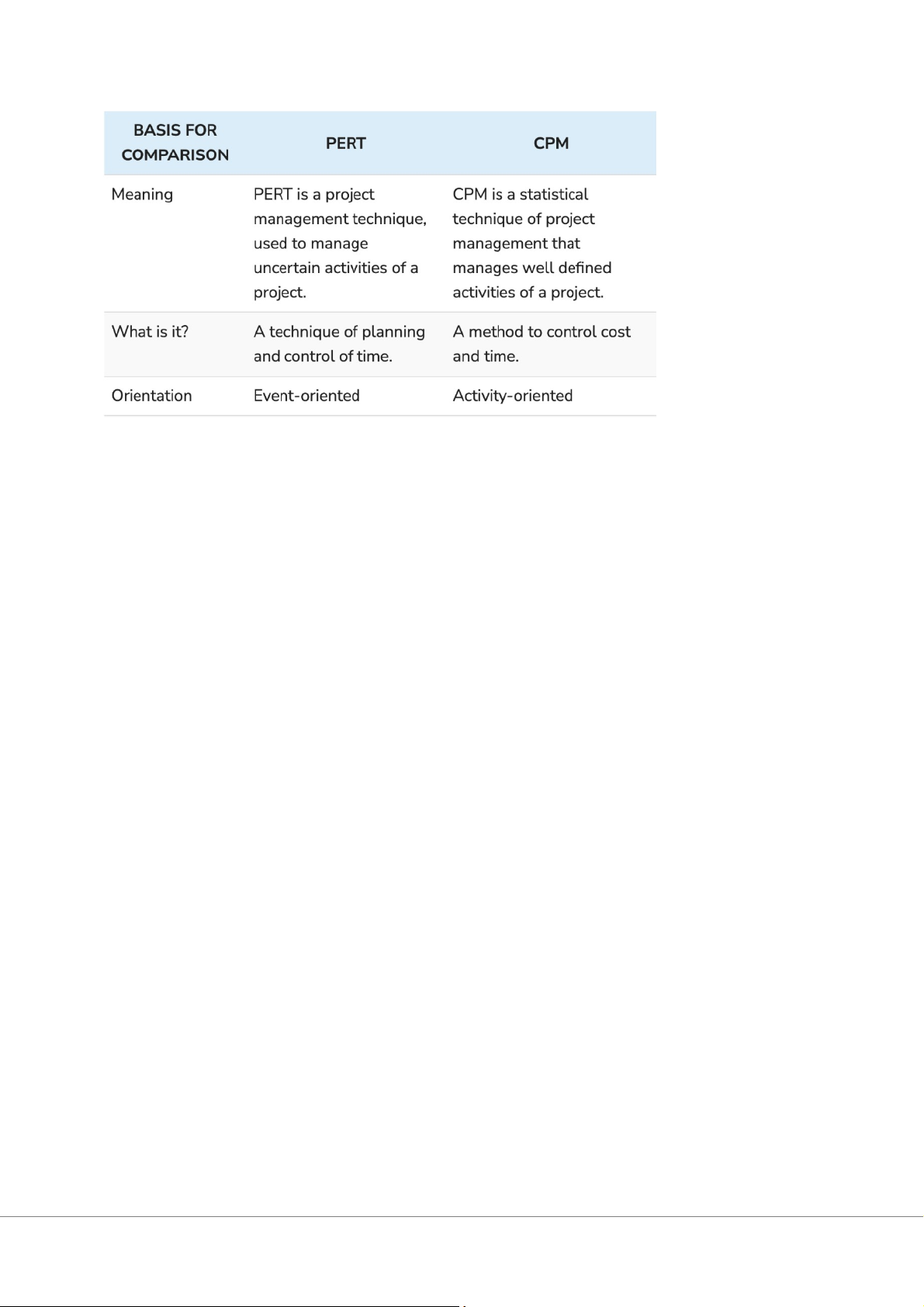
2. CPM/PERT chart: combination of the critical path method and program evaluation and review technique
3. Inventory control: ensures that inventory is only big enough to meet immediate needs
i. Economic order quantity: places new orders when inventory levels fall to predetermined points
ii. Just-in-time scheduling: routes materials to workstations just in time for use
4. Breakeven analysis: performs what-if calculations under different revenue and cost conditions
i. Breakeven point: occurs where revenues just equal costs
5. Financial control: basic Financial Ratios
oLiquidity measures ability to meet short-term obligations: the higher the better
Current Ratio = Current Assets/Current Liabilities
Quick Ratio = Current Assets - Inventories/Current Liabilities
oLeverage measures use of debt: the lower the better
Debt Ratio = Total Debts/Total Assets
oAsset Management measures asset and inventory efÏciency: the higher the better
Asset Turnover = Sales/Total Assets
Inventory Turnover = Sales/Average Inventory
oProfitability measures ability to earn revenues greater than costs: the higher the better
Net Margin = Net Income/Sales
Return on Assets (ROA) = Net Income/Total Assets
Return on Equity (ROE) = Net Income/Owner’s Equity
6. Balanced Scorecard: tallies organizational performance in financial, customer
service, internal process, and innovation
oFactors used to develop scorecard goals and measures: –Financial performance –Customer Satisfaction
–Internal process improvement –Innovation and learning Case study
On December 7, 2016, there was a special delivery event in the UK - the first
products delivered by a drone from Amazon. Amazon Prime Air's future goals are
ambitious. In addition to building the system in the UK, it is also researching the
viability of drone delivery in other nations.
Drone testing is not limited to Amazon, with the FAA approving the first delivery in
2015 in the US, and Walmart applying to the authorities for permission to test drone
home deliveries. Google is also looking at possibilities in Ireland, where the rules are
less stringent. However, there are still many issues to overcome such as government legislation.
After all, Drone technology offers an innovative solution to delivery problems, with
consumers looking for convenience and speed.
7-18. What immediate and long-term issues can managers face in organizations
that embrace this new drone technology? Immediate issue
•Facing the high cost of operations:
•For deploying the technology needed to make the drones function efÏciently and effectively.
•For experts hiring in managing the operation and development of the
drones. For training the skills of the employees to use the systems.
•Obeying specific rules regarding the use of drones: Government
legislation. For example, in the UK, drones must fly at a height of 122m or
less, and must avoid flying within 150m of congested areas and 50m of a person or structure.
•Deciding on the targeted customers: Who will be the main users of this
new delivery system. Not all the customers are likely to accept delivery by
air, for ex, tech savvy PostMillenials. Long-term issue
•Gaining trust and openness from customers: They need time to accept
this new delivery system and believe in the safety and convenience that it provides.
•Developing a plan on building and testing this new system to attract
more customers and maintain the safety of this delivery system.
•Moral and ethical issues:
Many people believe that it will take over the jobs of the humans who are
engaged in the transport of goods and in executing jobs which will be
replaced by drones, leading to unemployment.
(=> Encourage the high quality laborers to adapt with the working environment.)
•Serious risk of collision: Even with these rules in place, there have been a number of worrying incidents.
For ex: In April 2016, a British Airways flight reported hitting a drone while
approaching Heathrow Airport, and the U.K. Airprox Board investigated 23
near-miss incidents between April and October 2015.
7-19.In the case, many of the organizations operate in different countries.
Will the external forces vary between countries?
Obviously yes. The first factor is that the national laws of each government
are different, the company must create operating policies to match the laws of each
country. Besides, the second influencing factor is the population growth and
service users. Some countries with an aging population will not be the ideal place to
develop electronic services. To sum up, it is clearly to be seen that external forces
vary between countries, and the companies have to establish policies, recruitment,
and marketing for each country to adapt to that market.
7-20.When considering the employment of drone technology, are there any
demographic environmental forces to consider? Consider the differences
between the baby boomers and the iGeneration.
When contemplating the implementation of drone technology, it is crucial
to take into account various demographic and environmental factors.
Differences between the baby boomer and iGeneration cohorts should be
considered: - Baby boomers
Grew up in a time when technology was not as ubiquitous, potentially
making them less familiar and comfortable with drone technology.
Additionally, baby boomers may harbor apprehensions about job displacement
through drone technology as they near retirement.
Tài liệu liên quan:
-
CHAP 1: Introduction to Management Concepts and Functions môn Principles of Management | Trường Đại học Quốc tế, Đại học Quốc gia Thành phố Hồ Chí Minh
14 7 -

Guidelines for group’s assignments: Analysing management issues of a FDI company based inVietnam môn Principles of Management | Trường Đại học Quốc tế, Đại học Quốc gia Thành phố Hồ Chí Minh
14 7 -
Financial Planning to Achieve 300m VND Goal in 3 Years môn Principles of Management | Trường Đại học Quốc tế, Đại học Quốc gia Thành phố Hồ Chí Minh
12 6 -

A Case Study in Fast Fashion Success môn Principles of Management | Trường Đại học Quốc tế, Đại học Quốc gia Thành phố Hồ Chí Minh
13 7 -
Chap 16 Hierarchy of Needs Theory and Applications môn Principles of Management | Trường Đại học Quốc tế, Đại học Quốc gia Thành phố Hồ Chí Minh
15 8