Key Concepts in Management and Planning môn Principles of Management | Trường Đại học Quốc tế, Đại học Quốc gia Thành phố Hồ Chí Minh
Planning is the process ofsetting objectivesanddetermining how to best accomplish them. Tài liệu giúp bạn tham khảo, ôn tập và đạt kết quả cao. Mời đọc đón xem!
Môn: Principles of Management 314 tài liệu
Trường: Trường Đại học Quốc tế, Đại học Quốc gia Thành phố Hồ Chí Minh 2 K tài liệu
Tác giả:












Preview text:
PLANNING 1. Definition:
- Planning is the process of setting objectives and determining how to best accomplish them
- Objectives: Identify the specific results or desired outcomes that one intends to achieve
- Plan is a statement of action steps to be taken in order to accomplish the objectives.
2. Steps in the planning process: - Define your objectives.
- Determine where you stand vis-à-vis objectives.
- Develop premises regarding future conditions.
- Analyze and choose among action alternatives.
- Implement the plan and evaluate results.
3. Benefits of planning(soạn cho dui)
- Improves focus and flexibility. - Improves action orientation. - Improves coordination. - Improves time management. - Improves control.
4. Types of planning: there are 4 forms of planning: strategic, tactical, operational and contingency. -
Long-term plans typically look three or more years into the future. -
Short-term plans typically cover one year or less.
-Strategic plans (for top managers)
-Tactical plans (for middle managers): Tactical plans are plans
developed and used to implement strategic plans. They specify how the
organization’s resources can be used to put strategies into action.
-Tactical plans in business often take the form of functional plans that
indicate how different components of the enterprise will contribute to
the overall strategy. Such functional plans might include:
- Production plans—dealing with work methods and technologies.
- Financial plans—dealing with money and capital investments.
- Facilities plans—dealing with facilities and work layouts.
- Logistics plans—dealing with suppliers and acquiring resource inputs.
- Marketing plans—dealing with selling and distributing goods or services.
- Human resource plans—dealing with building a talented workforce.
-Operational plans (for first-line managers): An operational plan
identifies short term activities to implement strategic plans. They
include both standing plans like policies and procedures that are used
over and over again, and single-use plans like budgets that apply to one specific task or time period.
-A policy is a standing plan that communicates broad guidelines
for decisions and action employee hiring, termination, performance
appraisals, pay increases, promotions, and discipline
-A procedure is a rule describing actions that are to be taken in specific situations
-A budget is a plan that commits resources to projects or activities.
-Contingency plans: the process of preparing alternative courses of
action that may be used if the primary plans do not achieve the
organization’s objectives due to some reasons such as pandemic,
disaster, recession, ….(backup plan in case primary plans fail)
5. Planning tools and techniques
-Forecasting is the process of predicting what will happen in the future
-(Contingency planning) identifies alternative courses of action to take when things go wrong
-Scenario planning is a long-term version of contingency planning, it
identifies alternative future scenarios and makes plans to deal with each
-Benchmarking—the use of external and internal comparisons to better
evaluate one’s current performance and identify possible ways to improve for the future
-Goal setting: SMART model
a) Specific—clearly targeted key results and outcomes to be accomplished.
b) Measurable—described so results can be measured without ambiguity.
c) Attainable—although challenging, realistic and possible to achieve.
d) Reality-Challenging—include a stretch factor that moves toward real gains
e) Timely—linked to specific timetables and “due dates.”
- Goal alignment: the process in which the goals of employees, departments
support the goals of organization
- Participatory planning includes the persons who will be affected by plans
and/or those who will implement them
- Vision: is a desired future position that a firm wants to achieve
- Mission: classifies the purpose of the organization LEADING I) Nature of Leadership:
Leadership: The process of inspiring others to work hard to accomplish important tasks Leadership and Power
Power: the ability to get someone else to do something you want done or to make things happen the way you want 1) Position Power
Based on a manager’s official status in the organization’s hierarchy of authority Sources Reward power Coercive power Legitimate power Definition Capacity to offer Capacity to Capacity to something of value as punish or withhold influence other a means of positive outcomes people by virtue of influencing other as a means of formal people influencing other authority, or the people rights of office Example “If you do what I ask,
“If you don’t do what “Because I am the I’ll give you a I ask, I’ll punish boss; you must do reward.” you.” as I ask.” 2) Personal Power
Based on the unique personal qualities that a person brings to the leadership situation
(on how managers are viewed by others) Sources Expert power Referent power Definition capacity to influence other
capacity to influence other people people because of specialized
because of their desire to identify knowledge personally with you Expertise—as a source of Reference—as a person with special knowledge and whom others like to identify information
II) Contingency Approaches to Leadership:
1) Fielder’s Contingency Model: a)Definition:
- Leadership style is part of one’s personality and difficult to change. Therefore,
good leadership depends on a match or fit between leadership and situational demands.
- Leadership style in Fiedler’s model is measured on LPC (least-preferred
coworker scale) on two factors:
Task- Motivated ( Low LPC)
Relationship- Motivated ( High LPC) Definition + Leader motivate bằng công
+ Leader motivate bằng quan hệ việc. Succeed In + Very Favourable ( High + Moderate Control Situations Control) and Very Unfavourable ( Low Control) Situations
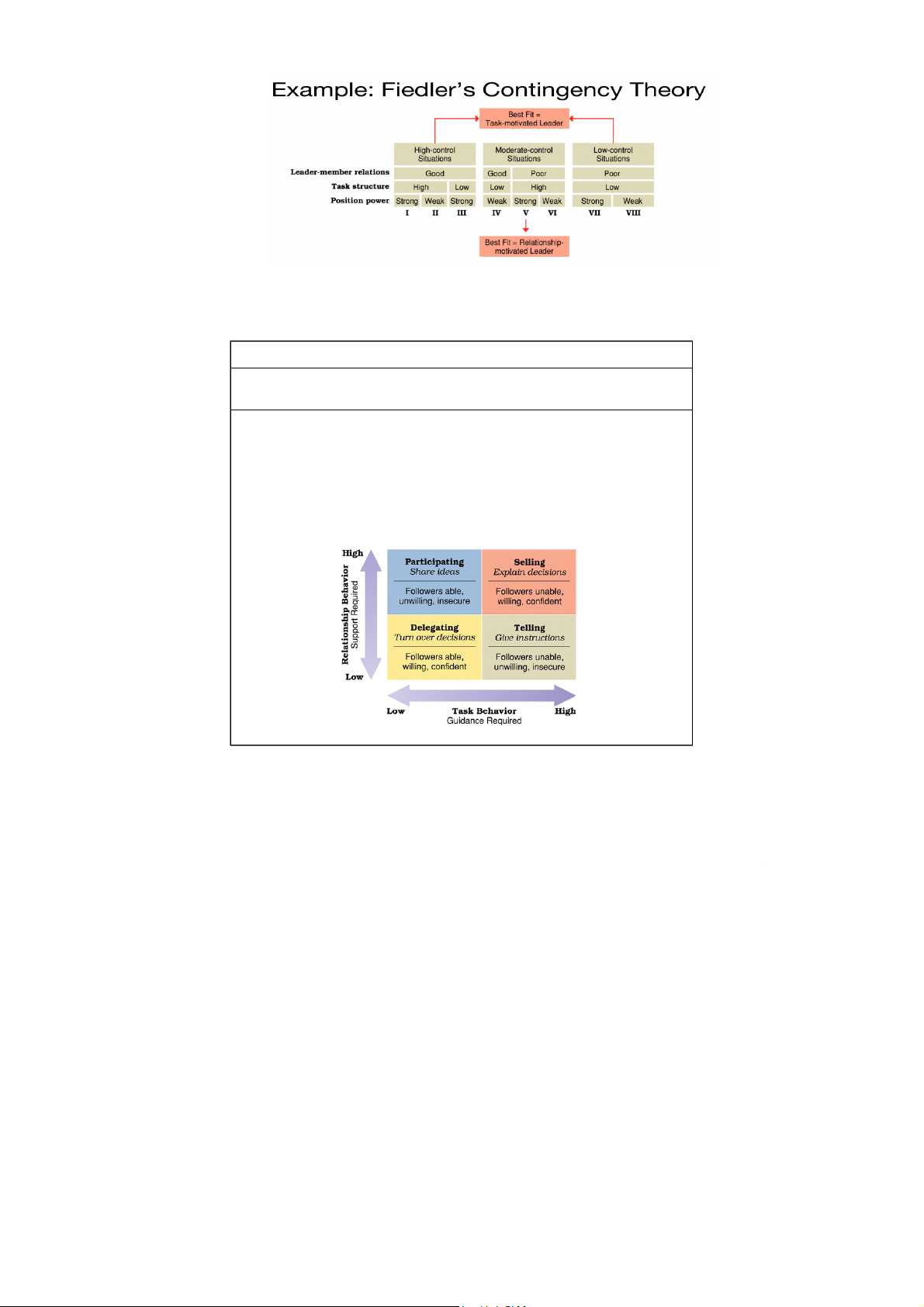
b) Fiedler’s Contingency Theory:
Chia thành ba tiêu chí: Leader- Member Relations,Task Structure, Position Power
+High Control ( Good Relations, High Task Structure, Strong Position Power)
+Low Control ( Poor Relations, Low Task Structure, Weak Position Power)
+Moderate Control ( Modest Relations, Normal Task Structure, Normal Position Power)
Có 8 loại Leaders theo Fiedler Model:
2) Hersey Blanchard’s Situational Model
Hersey-Blanchard Situational Leadership Model
Leaders adjust their styles depending on the readiness of their followers to
perform in a given situation
•Delegating—allowing the group to take responsibility for task decisions; a
low-task, low-relationship style.
•Participating—emphasizing shared ideas and participative decisions on task
directions; a low-task, high-relationship style.
•Selling—explaining task directions in a supportive and persuasive way; a
high-task, high-relationship style.
•Telling—giving specific task directions and closely supervising work; a high-task, low-relationship style
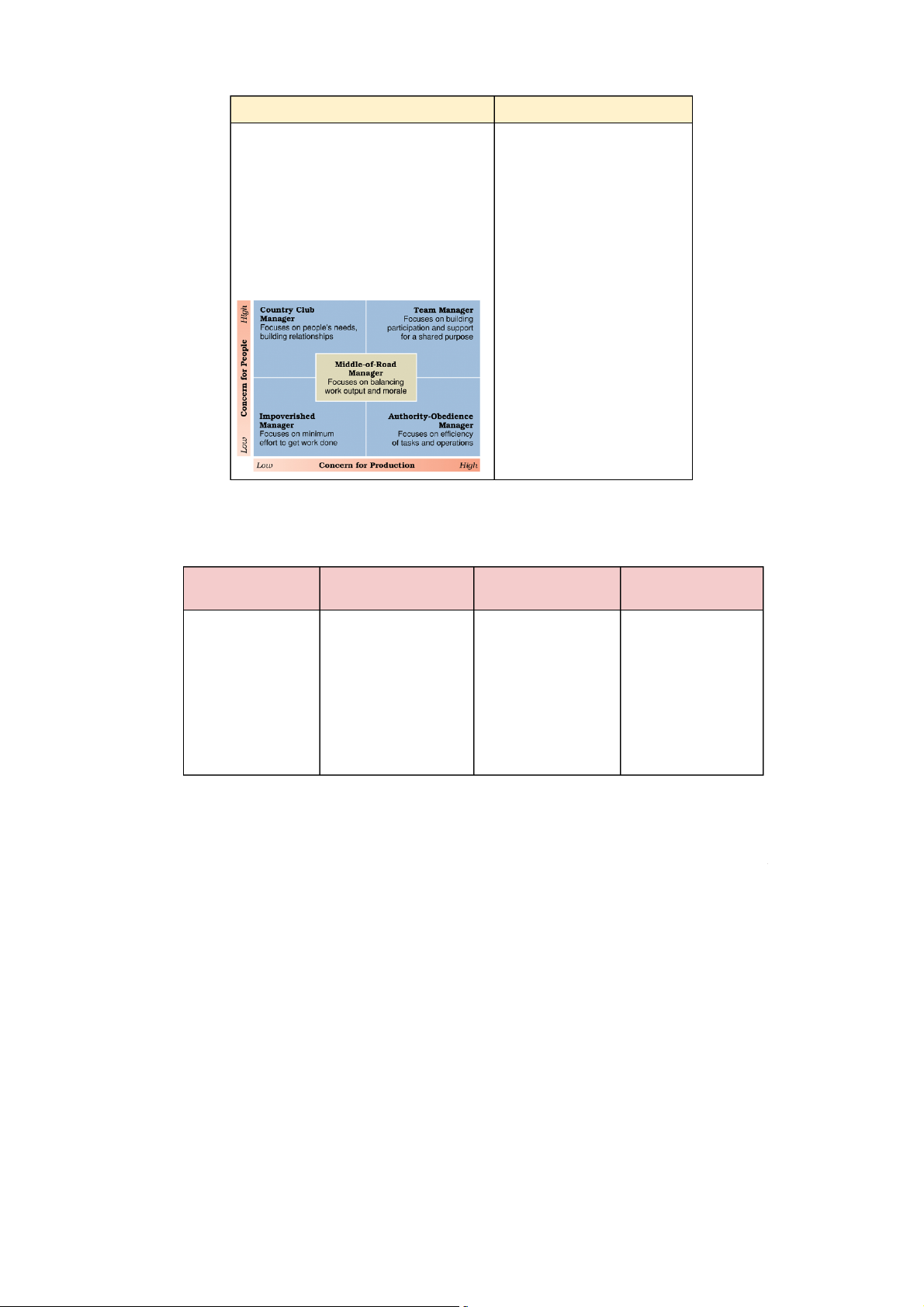
3) Blake & Mouton’s Leadership Grid versus Classical Leadership Styles :
Blake and Mouton Leadership Grid
Classical Leadership Styles Team management Democratic style -
High task concern; high people concern - Committed to task and
Authority-obedience management people -
High task concern; low people concern Autocratic style Country club management - Emphasizes task over -
High people concern; low task concern people Impoverished management -
Low task concern; low people concern Human relations style
Middle of the road management - Emphasizes people over -
Non-committal for both task concern task and people concern Laissez-faire style - Shows little concern for task -
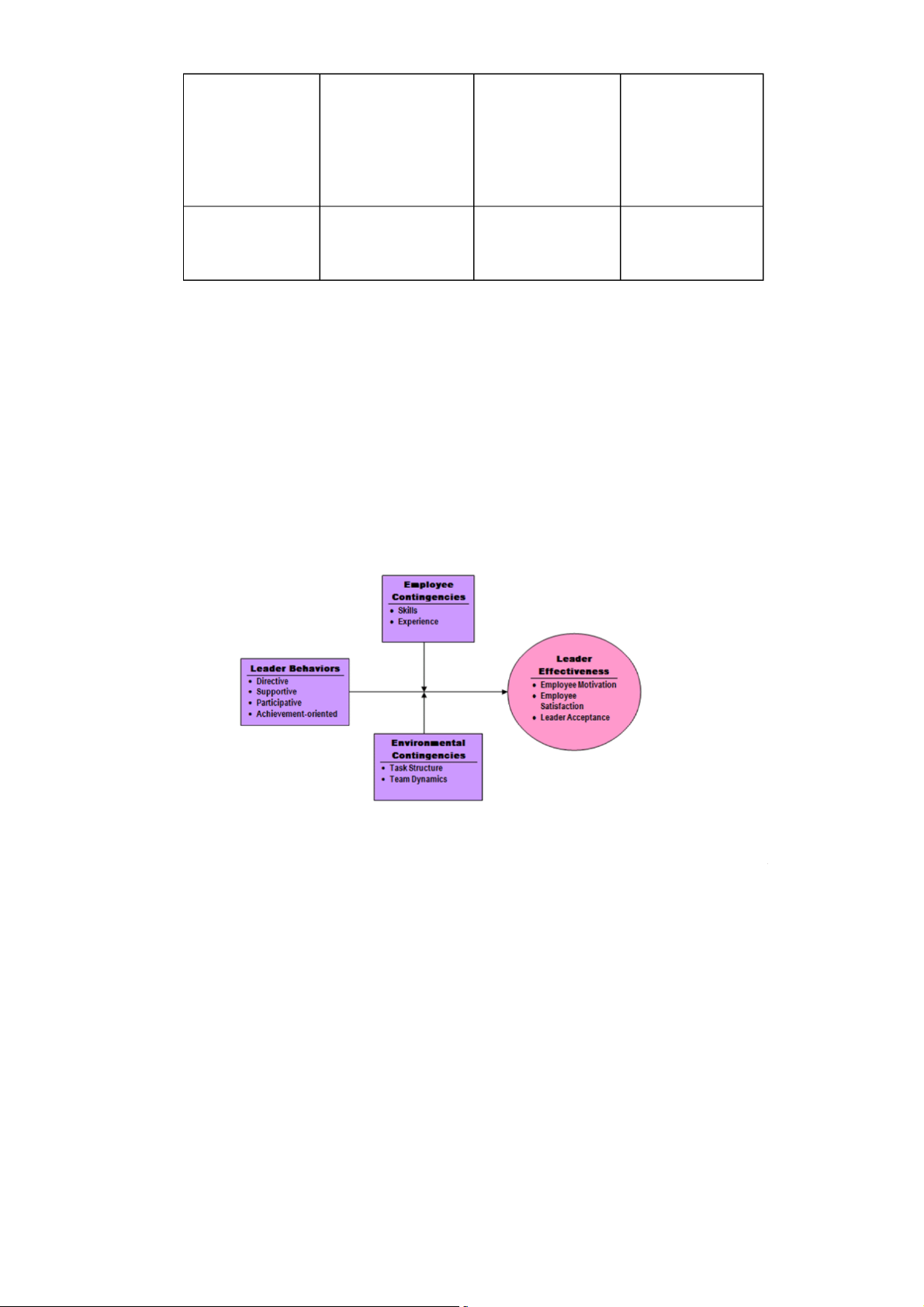
4) House’s Path-goal Theory:
a)Leadership Styles: House believes that a leader can use all of the
following leadership styles to shift back and forth. Có 4 loại Leaders: Directive Leadership Supportive Leadership Achievement- oriented Participative Leadership Leadership ●Let followers ●Doing things makes ●Set goals ●Involved in know what is work pleasant decision-making their ●Expect highest progress expectations ●Treat equally performance ●Consult ●Give directions ●Friendly & ●Emphasize on employees Approachable improvement ●Schedule works ●Ask for ●Show concern for ●Display employees’s ●Maintain employees’s health confidence in suggestions performance’s meeting standards high-standards ●Use employees’s suggestions ●Clarify leader’s roles Use when: Use when: Use when: Use when: ●Job assignments ●Worker ●Task challenge is ●Performance are ambiguous self-confidence is insufficient. incentives are low. poor.
b) Substitutes For Leadership:
Note: Ngoài tính cách của leaders thì các yếu tố dưới đây sẽ quyết định mức độ can
thiệp của leader vào công việc
- Follower Characteristics ( Tính cách nhân viên) + Ability + Experience
+ Independence ( Locus of Control)
- Task Characteristics ( Tính chất của công việc) + Routine + Feedback
- Organization Characteristics (Tính chất công ty)
+ Clear of Plans (Task Structure)
+ Formalized Rules (Authority System) + Procedures (Work Group) Controlling
1. Definition: The process of measuring performance and taking action to ensure desired results
- How controlling fits with management functions :Ensures that the right things
happen, in the right way, at the right time 2. Controlling process:
- Establish performance objectives and standards - Measure actual performance
- Compare actual performance with objectives and standards
- Take corrective action when needed and provide positive feedback for work well done 3. Types of controls
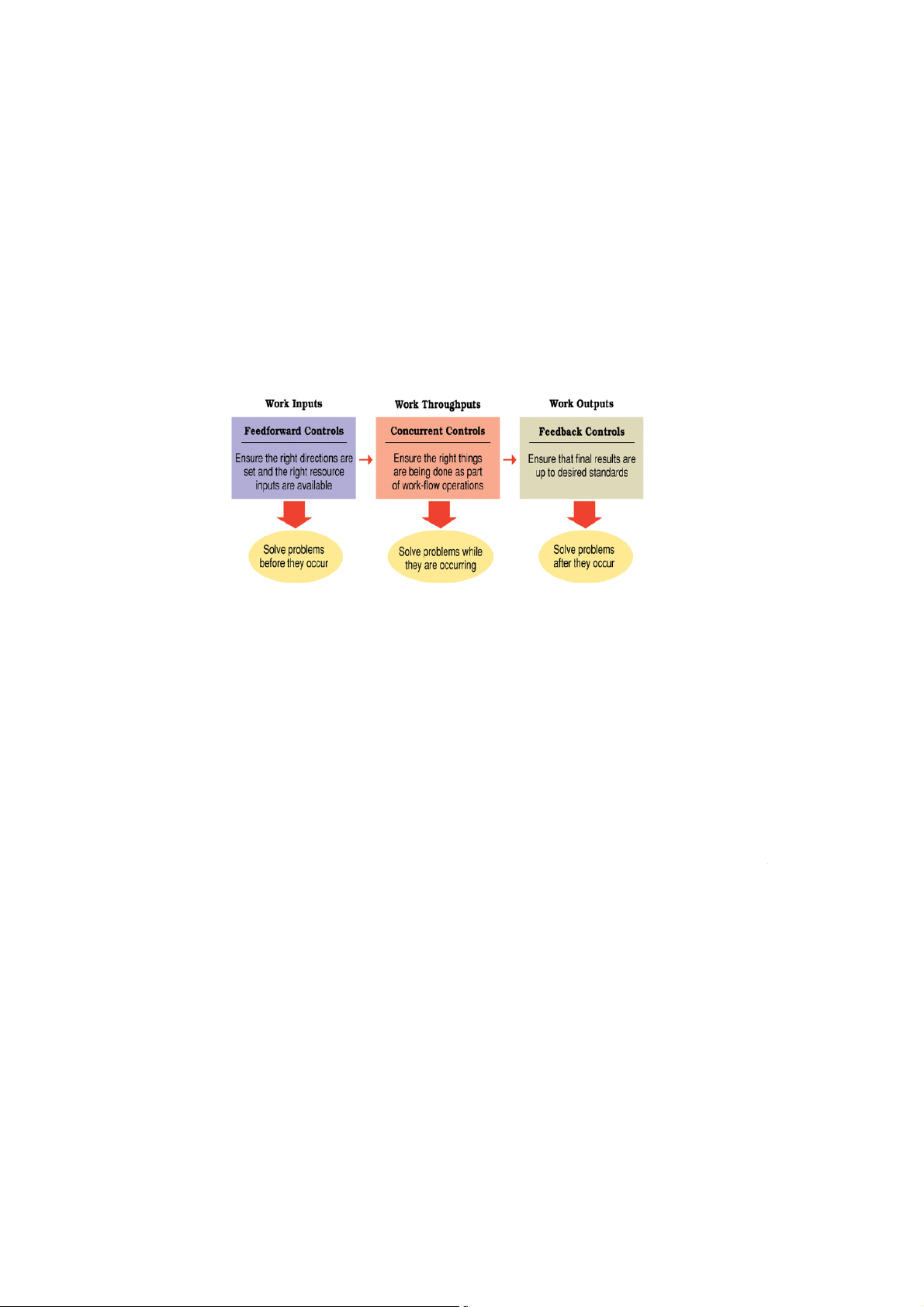
3.1 Based on the working process - Feedforward control:
+ Ensures that directions and resources are right before the work begins.
+ Goal: solve problems before they occur -Concurrent control:
+ Focuses on what happens during the work process, making sure things are being done according to plan.
+ Goal: solve problem as they occur -Feedback control
+ Takes place after an action is completed, make sure things are being done according to plan.
+ Goal: solve problems after they occur and prevent further ones
3.2 Based on whole company
-Internal control: Allows motivated individuals and groups to exercise
self-discipline in fulfilling job expectations (ví dụ: thầy không cần điểm danh vẫn tự lên đi học)
+Self-control: is internal control that occurs through self-discipline in
fulfilling work and personal responsibilities.:
-External control: Occurs through personal supervision and the use of formal
administrative systems (ví dụ: để mn đi học thì thầy sẽ cho điểm cộng và điểm trừ khi điểm danh)
-Clan control influences behavior through norms and expectations set by the organizational culture.
-Market control : the influence of market competition on the behavior of
organizations and their members.
-Bureaucratic control: influences behavior through authority, policies,
procedures, job descriptions, budgets, and day-to-day supervision.
4. Control tools and techniques 4.1 Project management
-Projects: one-time activities with many component tasks that must be
completed in proper order and according to budget
-Project management: responsibility for overall planning, supervision and control of projects - Techniques:
+Gantt chart: displays the scheduling of tasks required to complete a project
+CPM/PERT: a combination of the critical path method and the program
evaluation and review technique 4.2 Inventory control:
-Inventory control ensures that inventory is only big enough to meet immediate needs.
-Just-in-time inventory control:
Scheduling materials to arrive at a
workstation or facility just in time for use and hence, it reduces costs and improves workflow. 4.3 Breakeven analysis
- Break Even point: Revenue=costs
- Breakeven analysis: performs what-if calculations under diff erent revenue and cost conditions 4.4 Financial control
- A balance sheet: shows assets and liabilities at one point in time
- An income statement shows profits or losses at one point in time. 4.5 Balanced scorecards
- Balanced scorecard tallies organizational performance in financial, customer
service, internal process, and innovation and learning areas. Organising 1. Organising
-Organizing is the process of arranging people and other resources to
work together to accomplish a goal
- Purpose : create a division of labor and then coordinate results to achieve a common purpose
2. Organization structure is a system of tasks, reporting relationships, and communication linkages.
An organization chart describes the arrangement of work positions within an organization.
-Formal structure is the official structure of the organization.
-Informal structure is the set of unofficial relationships among an organization’s members.
3. How does the company organise? traditional modern FUNCTIONAL STRUCTURE TEAM STRUCTURE
Definition: A functional structure groups
- A team structure uses permanent and
together people with similar skills who
temporary cross-functional teams to
perform similar tasks. (marketing, finance, improve lateral relations
production, and human resources.)
- A cross-functional team brings together Advantages:
members from different functional
- Economies of scale with efficient use of departments. resources.
-Project teams are convened for a
- Task assignments consistent with
particular task or project and disband expertise and training. once it is completed.
- High-quality technical problem solving. Advantages:
- In-depth training and skill development - Eliminates difficulties with within functions.
communication and decision making
- Clear career paths within functions.
- Eliminates barriers between operating Disadvantages: departments
- functional chimneys or functional silos - Improved morale
problem—a lack of communication,
- Greater sense of involvement and
coordination, and problem solving identification
across functions. This happens because - Increased enthusiasm for work
the functions become formalized not
- Improved quality and speed of decision
only on the organization chart, but also making in the mind-sets of people. Disadvantages:
- Conflicting loyalties among members
- Excessive time spent in meetings
- Effective use of time depends on
quality of interpersonal relations, group dynamics, and team management DIVISIONAL STRUCTURE NETWORK STRUCTURE (Departmentalization)
Definition: A network structure uses
Definition: A divisional structure groups
information technologies to link with
together people working on the same
networks of outside suppliers and service
product, in the same area, with similar contractors.
customers, or on the same processes.
(product, geographical, customer, process)
- A product structure groups together
people and jobs focused on a single product or service.
- A geographical structure groups Advantages:
together people and jobs performed in - Firms can operate with fewer the same location. full-time employees and less
- A customer structure groups together complex internal systems
people and jobs that serve the same - Reduced overhead costs and customers or clients increased operating efficiency
- A process structure groups jobs and
- Permits operations across great
activities that are part of the same distances processes. Disadvantages: Advantages:
- Control and coordination problems
- More flexibility in responding to may arise from network environmental changes complexity - Improved coordination
- Potential loss of control over
- Clear points of responsibility outsourced activities
- Expertise focused on specific
- Potential lack of loyalty among
customers, products, and regions infrequently used contractors
- Greater ease in restructuring
- Excessively aggressive outsourcing can be dangerous Disadvantage:
- Duplication of resources and efforts across divisions
- Competition and poor coordination across divisions
- Emphasis on divisional goals at
expense of organizational goals MATRIX STRUCTURE BOUNDARYLESS STRUCTURE
Definition: an organization where Definition:
specialists from different parts of the
- A boundaryless organization eliminates
organization are brought together to work
internal boundaries among subsystems
temporarily on specific projects but still
and external boundaries with the
remain part of a line and staff structure. external environment. Advantages:
- A virtual organization uses IT and the
-Better cooperation across functions
Internet to engage a shifting network of - Improved decision making strategic alliances.
- Increased flexibility in restructuring
- Combination of team and network - Better customer service structure
- Better performance accountability
- Improved strategic management Disadvantages:
- Two-boss system is susceptible to power struggles
- Two-boss system can create task
confusion and conflict in work priorities
- Team meetings are time consuming
- Increased costs due to adding team leaders to structure Mechanistic Designs Organic Designs •Predictable goals •Adaptable goals •Centralized authority •Decentralized authority •Many rules and procedures •Few rules and procedures •Narrow spans of control •Wide spans of control •Specialized tasks •Shared tasks •Few teams and task forces •Many teams and task forces
•Formal and impersonal means of
•Informal and personal means of coordination coordination INTRODUCING MANAGEMENT 1. Talents:
- People and their talents are the ultimate foundations of organizational performance
-Intellectual capital is the collective brainpower or shared knowledge of a
workforce that can be used to create value
- A knowledge worker’s mind is a critical asset to employers and adds to the
intellectual capital of an organization
- Commitment x Competency = Intellectual Capital 2. Technology:
-Tech IQ is a person’s ability to use technology to stay informed:
+ Checking inventory, making a sales transaction, ordering supplies + Telecommuting + Virtual teams
+ Effective use of online resources ●Databases ●Job searches ●Recruiting ●Social Media
3. Globalization:
- Globalization is the worldwide interdependence of resource flows, product
markets, and business competition that characterize our economy.
- Job migration, which is one controversial side effect to globalization,
occurs when firms shift jobs from one country to another.
4. Ethicsis a code of moral principles that sets standards of conduct of what
is “good” and “right” in one’s behavior.
Ethical expectations for modern businesses:
– Integrity and ethical leadership at all levels – Social responsibility – Sustainability 5. Diversity:
-Workforce diversity reflects differences with respect to gender, age, race,
ethnicity, religion, sexual orientation, and able-bodiedness
- How diversity bias can occur in the workplace:
●Prejudice is the display of negative, irrational attitudes toward members of diverse populations.
●Discrimination actively denies minority members the full benefts of organizational membership.
●Glass ceiling effect is an invisible barrier limiting career advancement of women and minorities. 6.Organization
- An organization is a collection of people working together to achieve a
common purpose, it provides useful goods and/or services that return
value to society and satisfy customer needs.
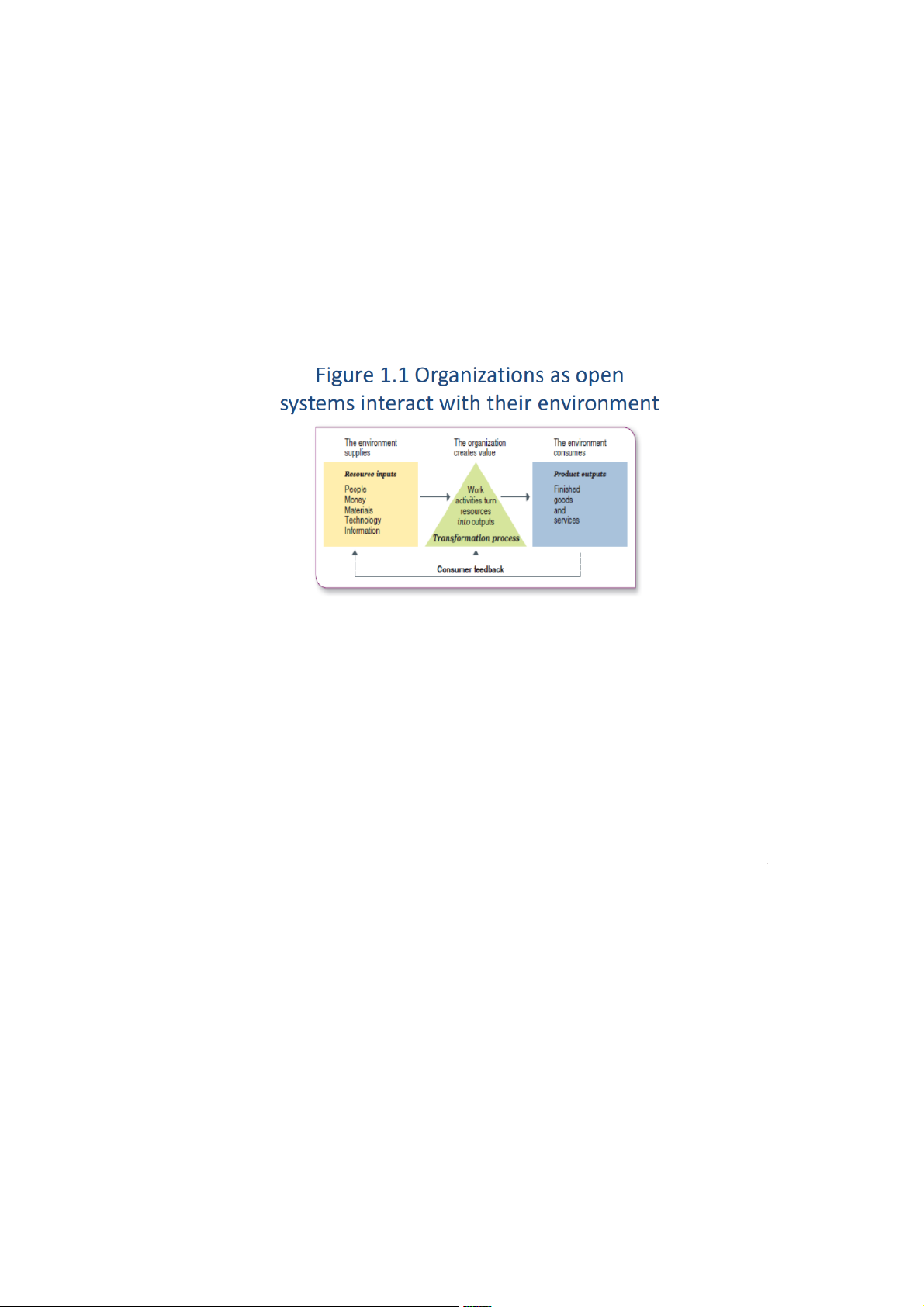
- An open system transforms resource inputs from the environment into product outputs. - Organizational performance:
+Productivity is the quantity and quality of work
performance, with resource utilization considered.
+Performance effectiveness is an output measure of task or goal accomplishment.
+Performance efficiency is an input measure of resource cost
associated with goal accomplishment. 7.Managers:
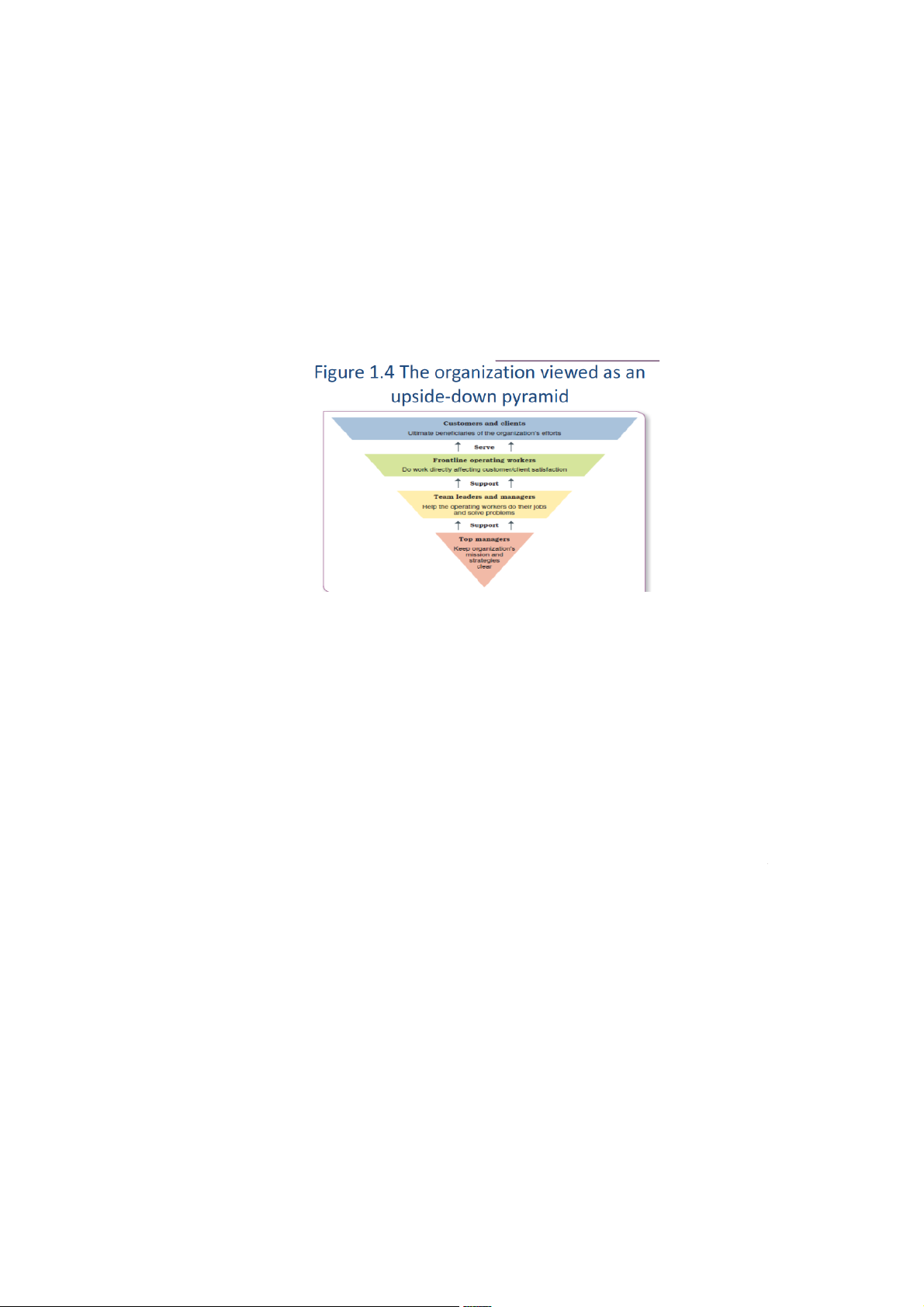
- A manager is a person who supports, activates, and is responsible for the work of others. - Levels:
+Members of a board of directors or board of trustees are supposed to
make sure an organization is run right.
+Top managers are responsible for the performance of an organization as a
whole or for one of its major parts.
+Middle managers oversee large departments or divisions.
+Team leaders supervise non-managerial workers.
-Nonmanagerial workers (the people who managers help) are the ones
whose tasks represent the real work of the organization.
-Accountability is the requirement to show performance results to a supervisor.
-Quality of work life (QWL) is an indicator of the overall quality of human experiences in the workplace.
-Management is the process of planning, organizing, leading, and
controlling the use of resources to accomplish performance goals.
- Four functions of management:
+Planning is the process of setting objectives and determining what actions
should be taken to accomplish them.
+Organizing is the process of assigning tasks, allocating resources, and coordinating work activities.
+Leading is the process of arousing people’s enthusiasm to work hard and
direct their efforts to achieve goals.
+Controlling is the process of measuring work performance and taking
action to ensure desired results. - Managerial skills:
+ A technical skill is the ability to use expertise to perform a task with proficiency.
+ A human skill or interpersonal skill is the ability to work well in cooperation with other people.
Emotional intelligence is the ability to manage ourselves and our relationships effectively.
+ A conceptual skill is the ability to think analytically to diagnose and solve complex problems3
Tài liệu liên quan:
-
CHAP 1: Introduction to Management Concepts and Functions môn Principles of Management | Trường Đại học Quốc tế, Đại học Quốc gia Thành phố Hồ Chí Minh
15 8 -
Guidelines for group’s assignments: Analysing management issues of a FDI company based inVietnam môn Principles of Management | Trường Đại học Quốc tế, Đại học Quốc gia Thành phố Hồ Chí Minh
15 8 -
Financial Planning to Achieve 300m VND Goal in 3 Years môn Principles of Management | Trường Đại học Quốc tế, Đại học Quốc gia Thành phố Hồ Chí Minh
12 6 -
A Case Study in Fast Fashion Success môn Principles of Management | Trường Đại học Quốc tế, Đại học Quốc gia Thành phố Hồ Chí Minh
15 8 -
Chap 16 Hierarchy of Needs Theory and Applications môn Principles of Management | Trường Đại học Quốc tế, Đại học Quốc gia Thành phố Hồ Chí Minh
15 8