Key Takeaways and Insights môn Principles of Management | Trường Đại học Quốc tế, Đại học Quốc gia Thành phố Hồ Chí Minh
These value-creating activities include (1) providing an assortment of products and services, (2) breaking bulk, (3) holding inventory, and (4) providing services. Tài liệu giúp bạn tham khảo, ôn tập và đạt kết quả cao. Mời đọc đón xem!
Môn: Principles of Management 314 tài liệu
Trường: Trường Đại học Quốc tế, Đại học Quốc gia Thành phố Hồ Chí Minh 2 K tài liệu
Tác giả:







Preview text:
Chap 1 Vertical integration
Backward and Forward integration
These value-creating activities include (1) providing an assortment of products and services, (2) breaking
bulk, (3) holding inventory, and (4) providing services.
Intratype competition: competition between the same type of retailers
Intertype competition: competition between retailers that sell similar merchandise, use different types of retail outlet Chap 2
Variety (breadth of merchandise – bề ngang, nhìu ngành hang khác nhau) wide vs narrow
Assortment (depth of merchandise – số lượng item trong cùng 1 category, SKU) deep vs shallow
Stocking a deep and broad assortment, is appealing to customers but costly for retailers.
When a retailer offers many SKUs, its inventory investment increases, because the retailer must have
backup stock for each and every SKU.
Services attract customers to the retailer, but they also are costly. Child care facilities, restrooms,
dressing rooms, and check rooms take up valuable store space that could be used to stock and display merchandise.
To make a profit, retailers that offer broader variety, deeper assortments, and/or additional services need to charge higher prices.
The trade-off between the costs and benefits of maintaining additional inventory or providing additional services
Suppermarket: A conventional supermarket is a large, self-service retail food store offering
groceries, meat, and produce, as well as some nonfood items; carry about 30,000 SKUs
Limited assortment supermarkets, or extreme-value food retailers: only stock about 2,000 SKUs;
offer one or two brands and sizes, one of which is a store brand; and offer merchandise at prices
40 percent lower than those at conventional supermarkets
Supercenter: are large stores (185,000 square feet) that combine a supermarket with a full-line
discount store, some customers find them inconvenient because it can take a long time to find the items they want.
Hypermarket: are also large (100,000 to 300,000 square feet), combination food (60 to 70
percent) and general merchandise (30 to 40 percent) stores.
Warehouse club: are retailers that offer a limited and irregular assortment of food and general
merchandise with little service at low prices for ultimate consumers and small businesses
(Costco, Sam’s Club (Walmart)); are large (100,000 to 150,000 square feet) and typically located
in low-rent districts; carrying a limited assortment of fast-selling items. Use low-locations,
inexpensive store design, little customer service
Convenience stores: are also selling more fresh merchandise and healthy fast food that appeal to
today’s on-the-go consumers, especially women and young adults; provide a limited variety and
assortment of merchandise at a convenient location in 3,000- to 5,000-square-foot stores with speedy checkout.
Size: Supercenter > Warehouse club > Conventional supermarket > Limited assortment supermarket > CVS
SKU a.k.a Assortment: Supercenter (deep) > Conventional supermarket (avg) > Warehouse club
(shallow) > CVS > Limited
Variety: the same with size board board avg narrow narrow
Department store (Vinmart, Lotte): are retailers that carry a broad variety and deep assortment,
offer customer services, and organize their stores into distinct departments for displaying merchandise.
Full-line discount stores: are retailers that offer a broad variety of merchandise, limited service,
and low prices. Discount stores offer both private labels and national brands.
Specialty stores (H&M, TGDĐ): concentrate on a limited number of complementary merchandise
categories and provide a high level of service; offering deep but narrow assortments (ít vari nhiều SKU).
Extreme-value retailers are small discount stores that offer a limited merchandise assortment at
very low prices. They offer a broad variety but shallow assortment of household goods, health
and beauty aids, and groceries.
Off-price retailers, also known as closeout retailers, offer an inconsistent assortment of brand-
name merchandise at a significant discount off the manufacturers’ suggested retail price; a
special type of off-price retailer is the outlet store
Type of retail ownership: Single store establishment (independent), Corporate retail chains, Franchising Chap 3
Non store retailing
Internet channel: also called online retailing, electronic retailing , and e-tailing , is a retail channel in
which the offering of products and services for sale is communicated to customers over the Internet.
Catalog channel: The catalog channel is a nonstore retail channel in which the retail offering is
communicated to customers through a catalog mailed to customers.
Direct selling is a retail channel in which salespeople interact with customers face-to-face in a
convenient location, either at the customer’s home or at work (party plan system, multilevel system, pyramid scheme).
Automated retailing is a retail channel in which merchandise or services are stored in a machine and
dispensed to customers when they deposit cash or use a credit card (vending machine)
How internet overcome limitation: use tech to convert “touch and feel” into “look and see” info Store retailing
Stores offer several benefits to customers that they cannot get when they shop through nonstore
channels such as catalogs or the Internet: touching and feeling products, personal service, risk
reduction, immediate gratification, entertainment and social experience, browsing, and cash payment.
How store-based retailers are using multiple channels to improve their offerings to their
customers and build a competitive advantage
Benefit of multichannel retailing -
Overcoming the Limitations of an Existing Format: Increased Assortments; Low-Cost, Consistent
Execution; Current (updated) Information -
Increasing Customer Satisfaction and Loyalty -
Gaining Insights into Consumer Shopping Behavior - Expanding Market Presence - Building a Strategic Advantage
Retailers also benefit by using multiple channels synergistically
Challenges of effective multichannel retailing -
Providing an Integrated Shopping Experience still struggling to provide an integrated shopping
experience across all their channels because unique skills and resources are needed to manage
each channel; Store channel information systems are typically product-centric, while nonstore channels are customer-centric. - Supporting M-Commerce -
Organizing for Multichannel Retailing: Centralized Customer Database, provide a consistent
brand image, different assortments are appropriate for each of the channels (For example,
multichannel retailers offer a broader and deeper merchandise assortment through their
Internet channel than through their store channel), pricing, Reduction of Channel Migration Shopping in future - Multi purpose - Personalization - 360 độ experience - AR example in retailing - Omnishopping Chap 4
Type of need: utilitarian and hedonic need
The pattern of buying both premium and low-priced merchandise or patronizing both expensive, status-
oriented retailers and price-oriented retailers is called cross-shopping. Source of information: -
Internal sources are information in a customer’s memory -
External sources consist of information provided by ads and other people (WoM).
Encourage customer to spend time with retailers
Consideration set or the set of alternatives the customer evaluates when making a choice of a retailer to patronize
Increase convert into purchase: -
Don’t stock out of popular merchandise -
Reduce waiting time at checkout - Offer after purchase service Type of buying decision
Extended problem solving: financial, social, physical (affect health and safety) need
Limited problem solving: involve moderate amount of effort and time, rely on personal knowledge,
engage when having prior experience with product/service
-> complementary product, signage, put merchandise where customer is waiting
Habitual problem solving: involve little or no conscious effort
-> reward to loyal customer, availability of the merchandise
Social factor influence buying behavior: family, reference group (self-image, celebrities), culture (collectivism, individualism)
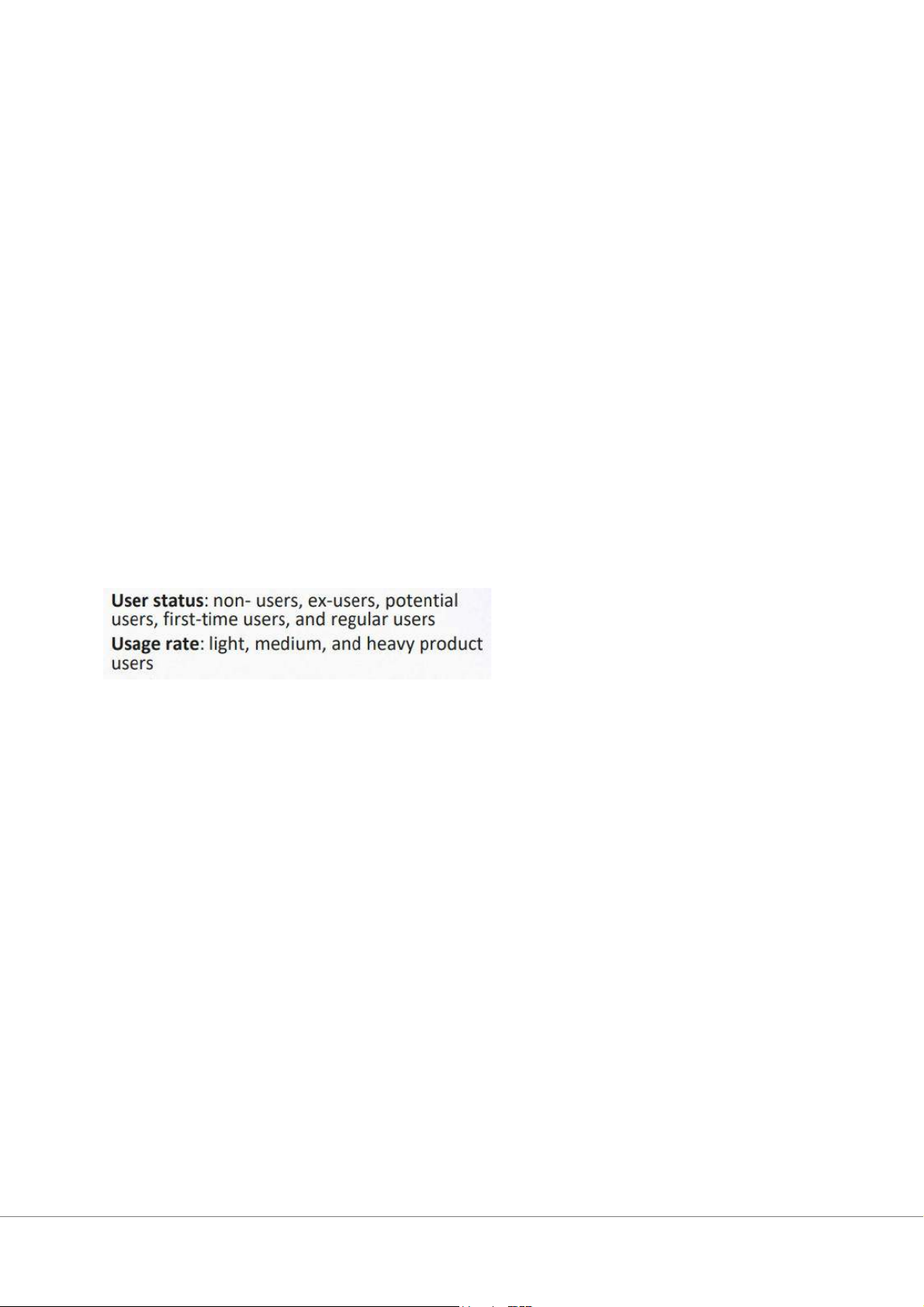
Market segmentation: geographic, demographic, psychographic, behavioral (occasion usage), benefit Chap 7 Type of location:
Unplanned retail location: do not have centralized management that determines what stores
will be in a development (Freestanding site)
Planned location: the shopping center and/or manager makes and enforces policies that govern store operations
Gross leasable area: Total floor area designed for the retailer’s occupancy.
City or Town location: Gentrification - sự chuyển đổi của một khu phố trong thành phố từ giá trị thấp sang giá trị cao).
Central business district (CBD) Shopping center
+ power center (collections of big-box retail stores such as discount stores, off-price stores, warehouse
clubs, and category specialists; free-standing anchor; large trade area) AEON Mall
+ shopping mall (many different types of stores; attract many shopper; on main street) + mega mall
+ lifestyle center: Small department store format, design ambience and amenities
+ mixed use development (MXD): combine several different uses into one complex including retail,
ofÏce, residential, hotel, recreation, or other functions. They are pedestrian- oriented and therefore
facilitate a live, work, play environment – Saigon center, landmark
+ outlet center: contain mostly manufacturers and retail outlet stores
+ theme/festival center: Located in places of historic interests or for tourists; anchored by restaurants and entertainment facilities
+ omnicenter: Combines enclosed malls, lifestyle center, and power centers
+ Temporary or pop-up store, merchandise kiosk (dior in Saigon center)
Three types of shopping situations
Convenience shopping: Minimize the customer’s effort to get the product or service by locating store
close to where customers are located (CVS or gas station)
Comparison shopping: Customers have a good idea of what type of product they want, but don’t have a
strong preference for brand, model or retailer (furniture, appliances, cameras).
Specialty shopping: Customers know what they want, designer labels, convenient location matters less
A second factor that affects the choice of location type is the density of the retailer’s target market in relation to the location.
Finally, uniqueness of retail offering
Chap 8: Evaluating factor for Location
Economic condition: The level and growth of population and employment
Level of competition affects the demand
Strategic fit: Area needs to have consumers in the retailer’s target market Operating cost
Open store in economy of scale or cannibalization (open stores as long as profits increase)
Evaluating Site location
The characteristic of the site (trafÏc flow, parking, visibility, accessibility, adjacent tenants –ng thuê liền
kề, and restrictions and costs)
The characteristic of the trading area
The estimated potential sales that can be generated
Trade area: primary zone (60 to 65 percent of its customers), secondary zone (20 percent of a store’s
sales), tertiary zone (customers who occasionally shop at the store or shopping center)
Factor affect size of trade area: Accessibility • Natural & Physical Barriers • Type of Shopping Area •
Type of Store • The nature of merchandise, assortment, location of alternative sources for the
merchandise • Competition • Parasite Stores
Tài liệu liên quan:
-
CHAP 1: Introduction to Management Concepts and Functions môn Principles of Management | Trường Đại học Quốc tế, Đại học Quốc gia Thành phố Hồ Chí Minh
19 10 -
Guidelines for group’s assignments: Analysing management issues of a FDI company based inVietnam môn Principles of Management | Trường Đại học Quốc tế, Đại học Quốc gia Thành phố Hồ Chí Minh
17 9 -
Financial Planning to Achieve 300m VND Goal in 3 Years môn Principles of Management | Trường Đại học Quốc tế, Đại học Quốc gia Thành phố Hồ Chí Minh
17 9 -
A Case Study in Fast Fashion Success môn Principles of Management | Trường Đại học Quốc tế, Đại học Quốc gia Thành phố Hồ Chí Minh
16 8 -
Chap 16 Hierarchy of Needs Theory and Applications môn Principles of Management | Trường Đại học Quốc tế, Đại học Quốc gia Thành phố Hồ Chí Minh
17 9