Lecture Notes for Discrete-Time Signals and Systems - Chuong 2 môn Xử lý tín hiệu số| Đại học Bách khoa Hà Nội
.Tài liệu giúp bạn tham khảo, ôn tập và đạt kết quả cao. Mời đọc đón xem!
Môn: Xử lý tín hiệu số hust 33 tài liệu
Trường: Đại học Bách Khoa Hà Nội 5.6 K tài liệu
Tác giả:














Preview text:
14:35, 10/01/2026
Lecture Notes for Discrete-Time Signals and Systems - Chuong 2 - Studocu
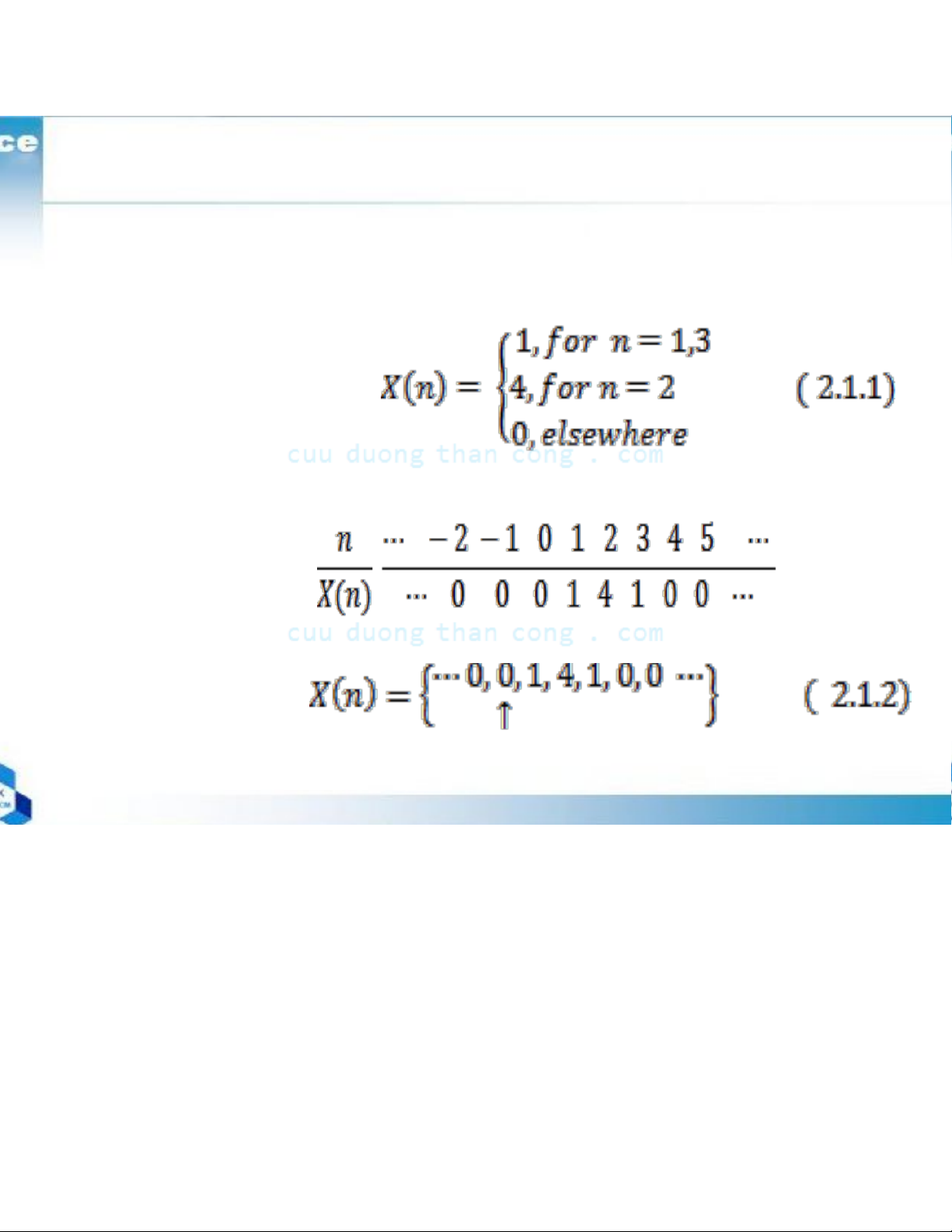
- There are some alternative representations of a
discrete –time signal: + Functional + Tabular + Sequence
Symbol ↑ is represented n = 0 ©2013, CE Department CuuDuongThanCong.com
https://fb.com/tailieudientucntt 14:35, 10/01/2026
Lecture Notes for Discrete-Time Signals and Systems - Chuong 2 - Studocu
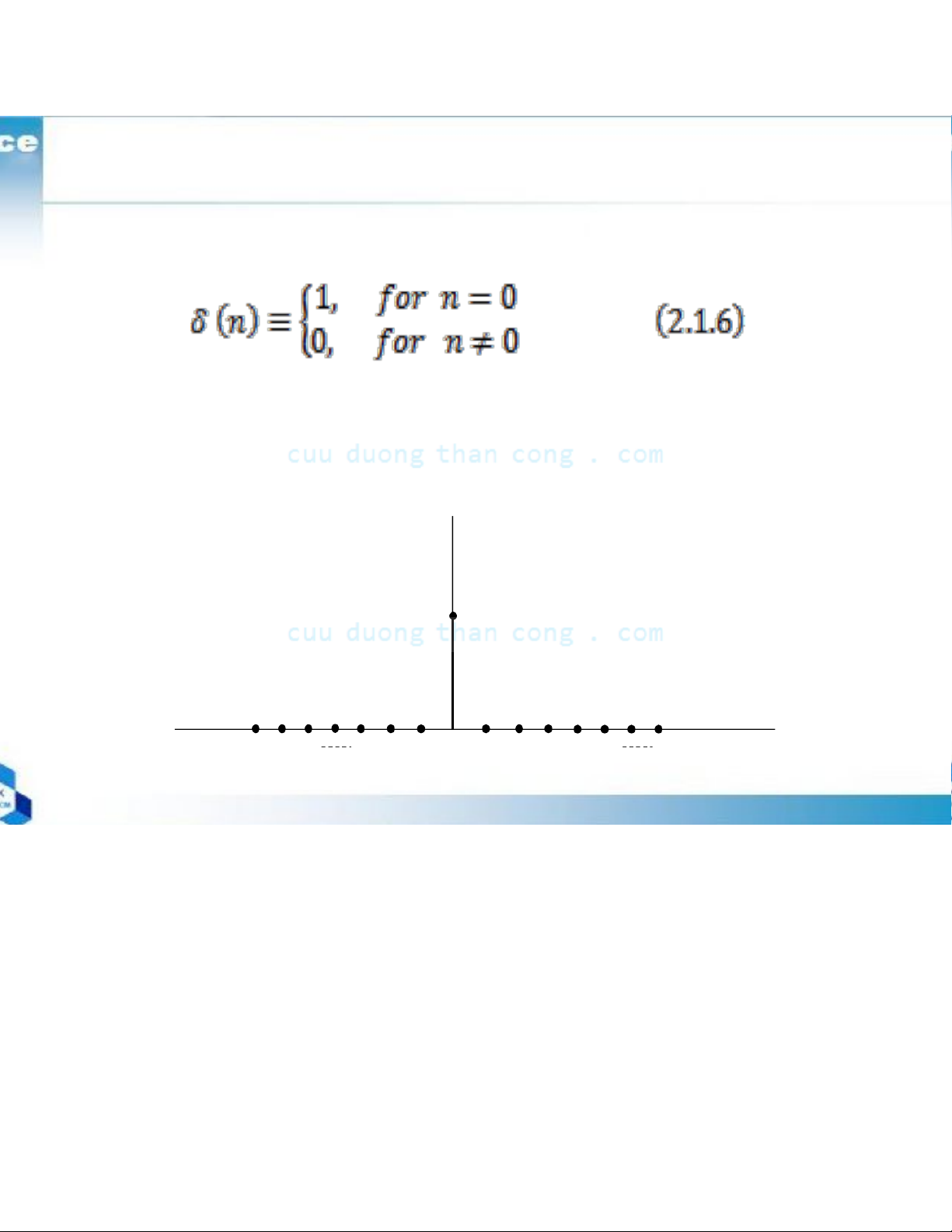
2.1.1 Some Elementary Discrete-Time Signals
+ The unit sample sequence:
Figure 2.2: Graphical representation of the unit signal δ(n) !!1 "2 "1 &&& n2 3 0 4 1
CuuDuongThanCong.com https://fb.com/tailieudientucntt ©2013, CE Department 14:35, 10/01/2026
Lecture Notes for Discrete-Time Signals and Systems - Chuong 2 - Studocu
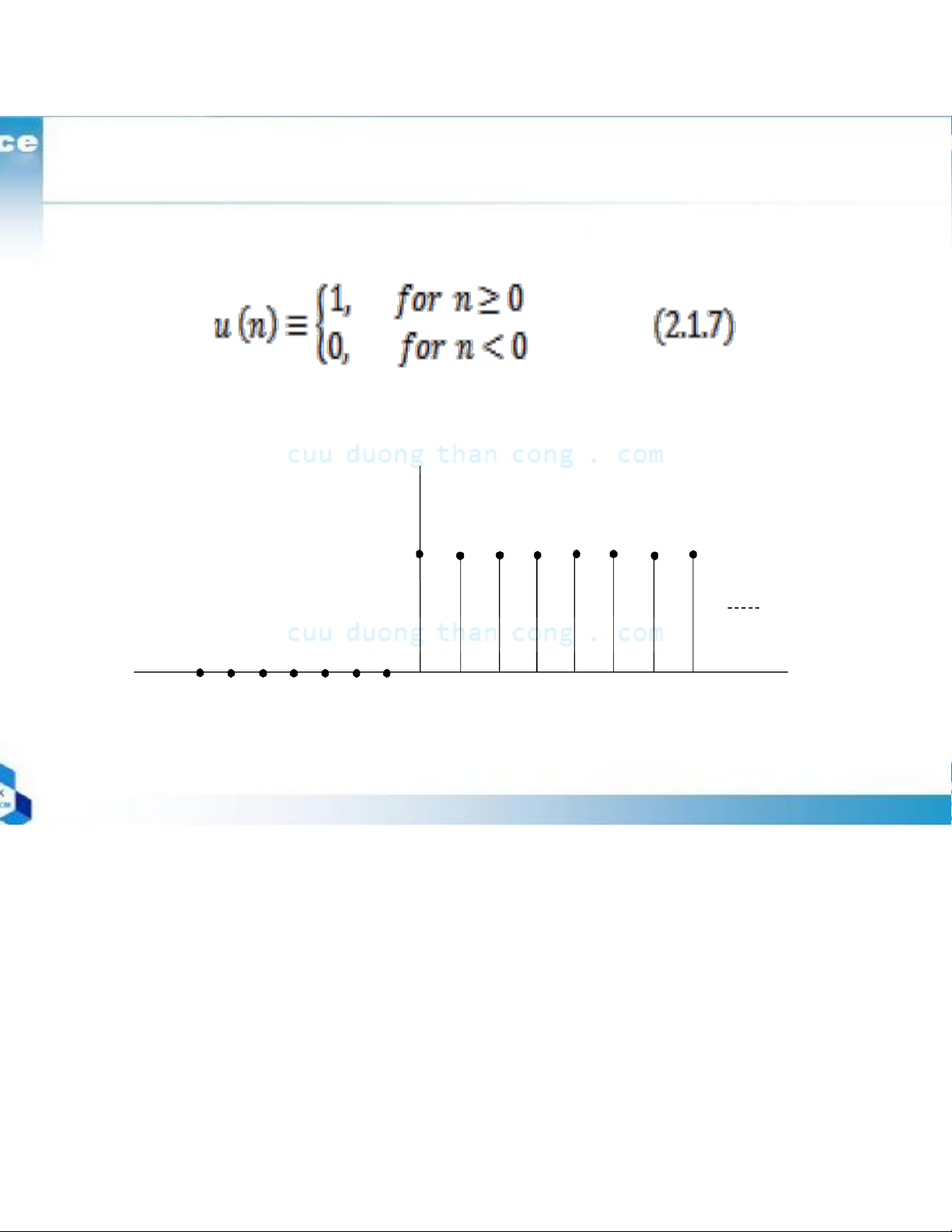
2.1.1 Some Elementary Discrete-Time Signals
+ The unit step signal:
Figure 2.3: Graphical representation of the unit step signal u(n) !!!1 !!0 !!!1 !!!
2 !!!3 !!4 !!5 !6 7 n
CuuDuongThanCong.com https://fb.com/tailieudientucntt ©2013, CE Department 14:35, 10/01/2026
Lecture Notes for Discrete-Time Signals and Systems - Chuong 2 - Studocu
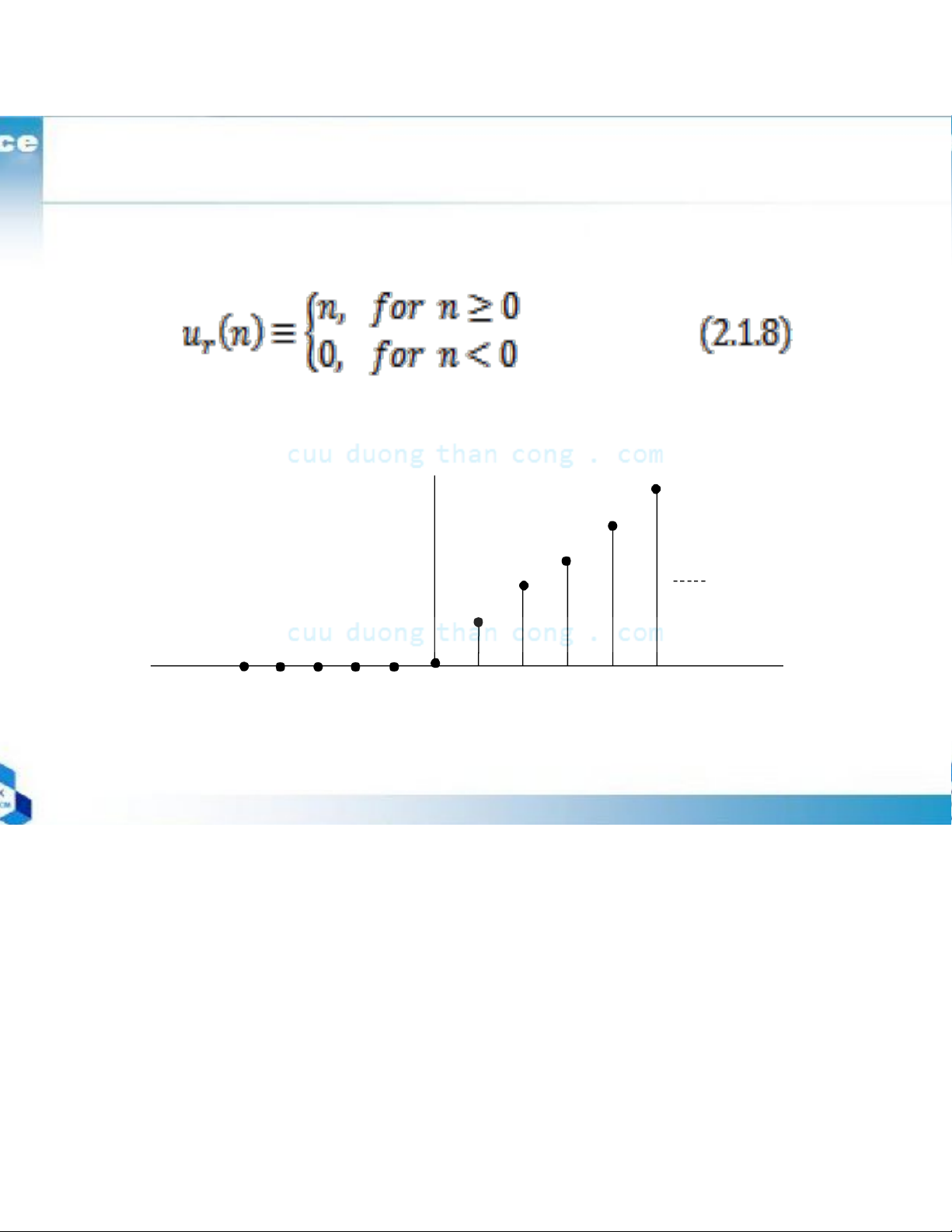
2.1.1 Some Elementary Discrete-Time Signals
+ The unit ramp signal
Figure 2.4: Graphical representation of the unit ramp signal n
CuuDuongThanCong.com https://fb.com/tailieudientucntt ©2013, CE Department 14:35, 10/01/2026
Lecture Notes for Discrete-Time Signals and Systems - Chuong 2 - Studocu
2.1.1 Some Elementary Discrete-Time Signals
+ The exponential signal:
Figure 2.5 Graphical representation of exponential signal 0 x(n) a>1 a>1 nn n *1 a<-1 n
CuuDuongThanCong.com https://fb.com/tailieudientucntt ©2013, CE Department 14:35, 10/01/2026
Lecture Notes for Discrete-Time Signals and Systems - Chuong 2 - Studocu
2.1.2 Classification of Discrete-Time signals
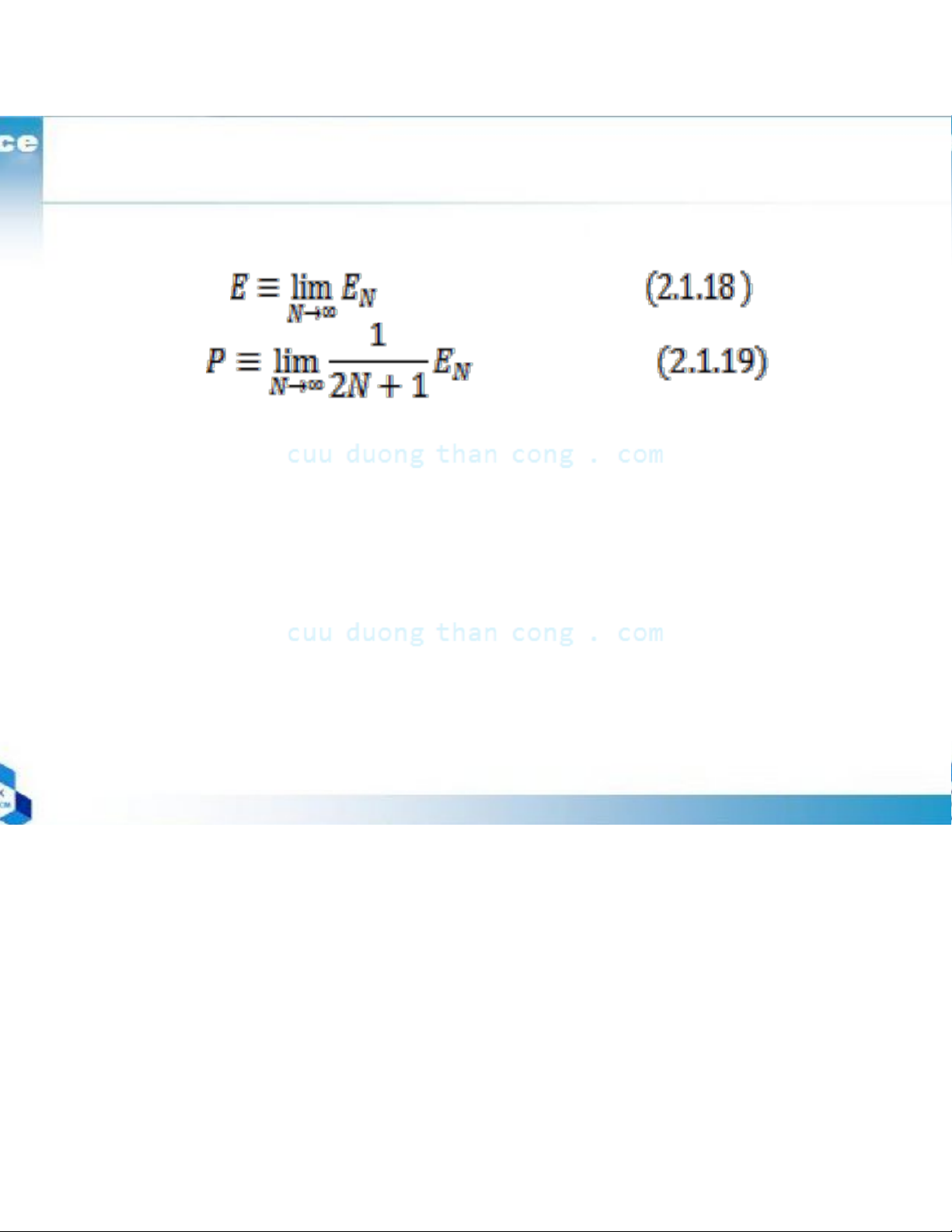
+ The energy E of a signal X(n) is defined as
If 0< E < ∞ then x(n) called an energy signal
+ The average power of a discrete-time signal x(n) is defined as
+ If -N ≤ n ≤ N as
CuuDuongThanCong.com https://fb.com/tailieudientucntt ©2013, CE Department 14:35, 10/01/2026
Lecture Notes for Discrete-Time Signals and Systems - Chuong 2 - Studocu
2.1.2 Classification of Discrete-Time signals
+ The we can express the signal energy E as and
+ If P is finite the signal is called a power signal.
- Periodic signals and aperiodic signals.
+ Signal x(n) is periodic with period N (N>0)
if and only if X(n+N) = X(n) for all n (2.1.20)
then N is called the fundamental period
+ If there is no value of N that satisfies (2.1.20), the
signal is called nonperiodic or aperiodic.
CuuDuongThanCong.com https://fb.com/tailieudientucntt ©2013, CE Department 14:35, 10/01/2026
Lecture Notes for Discrete-Time Signals and Systems - Chuong 2 - Studocu
2.1.2 Classification of Discrete-Time signals
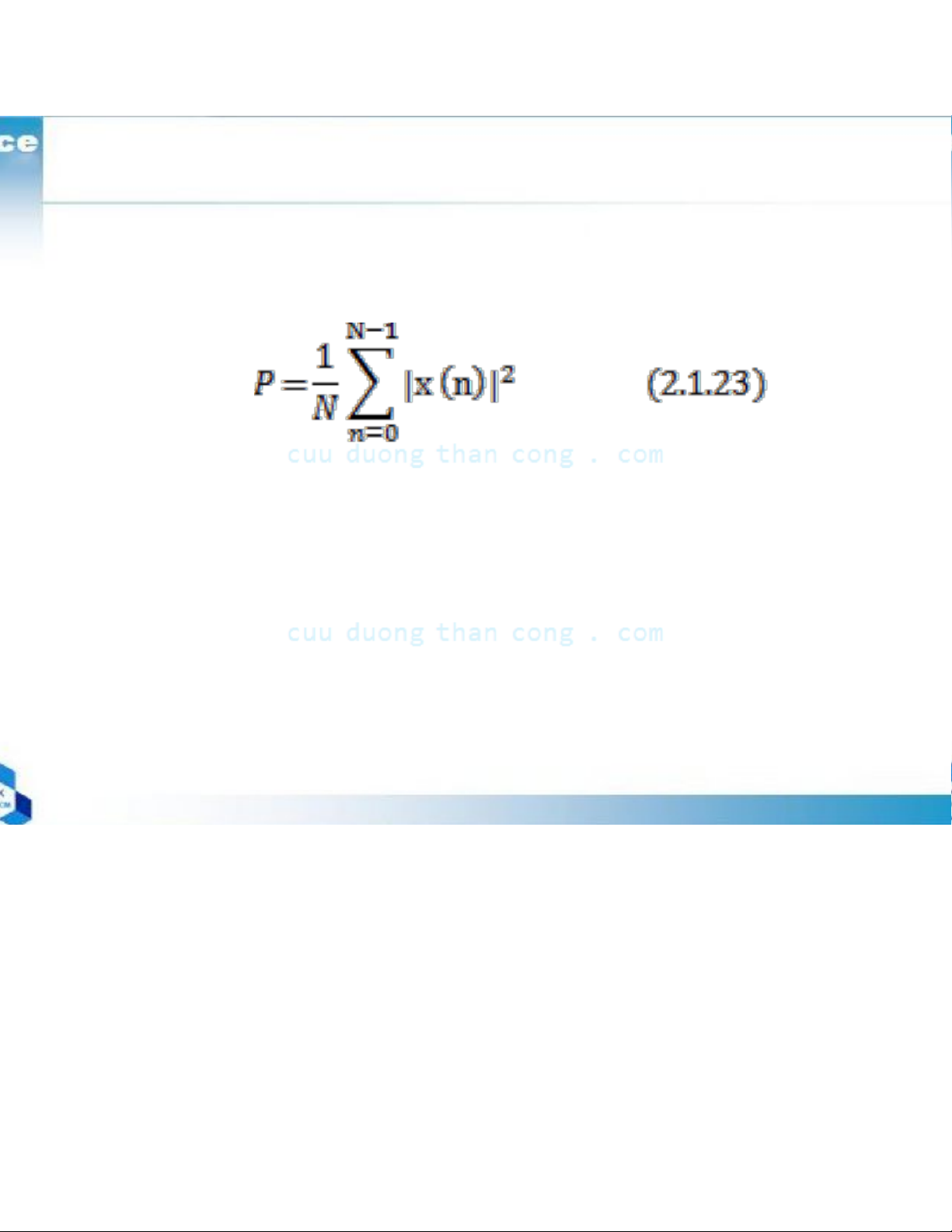
+ If X(n) is a periodic signal with fundamental
period N and takes on finite values, its power is given by
Consequently, periodic signals are power signals.
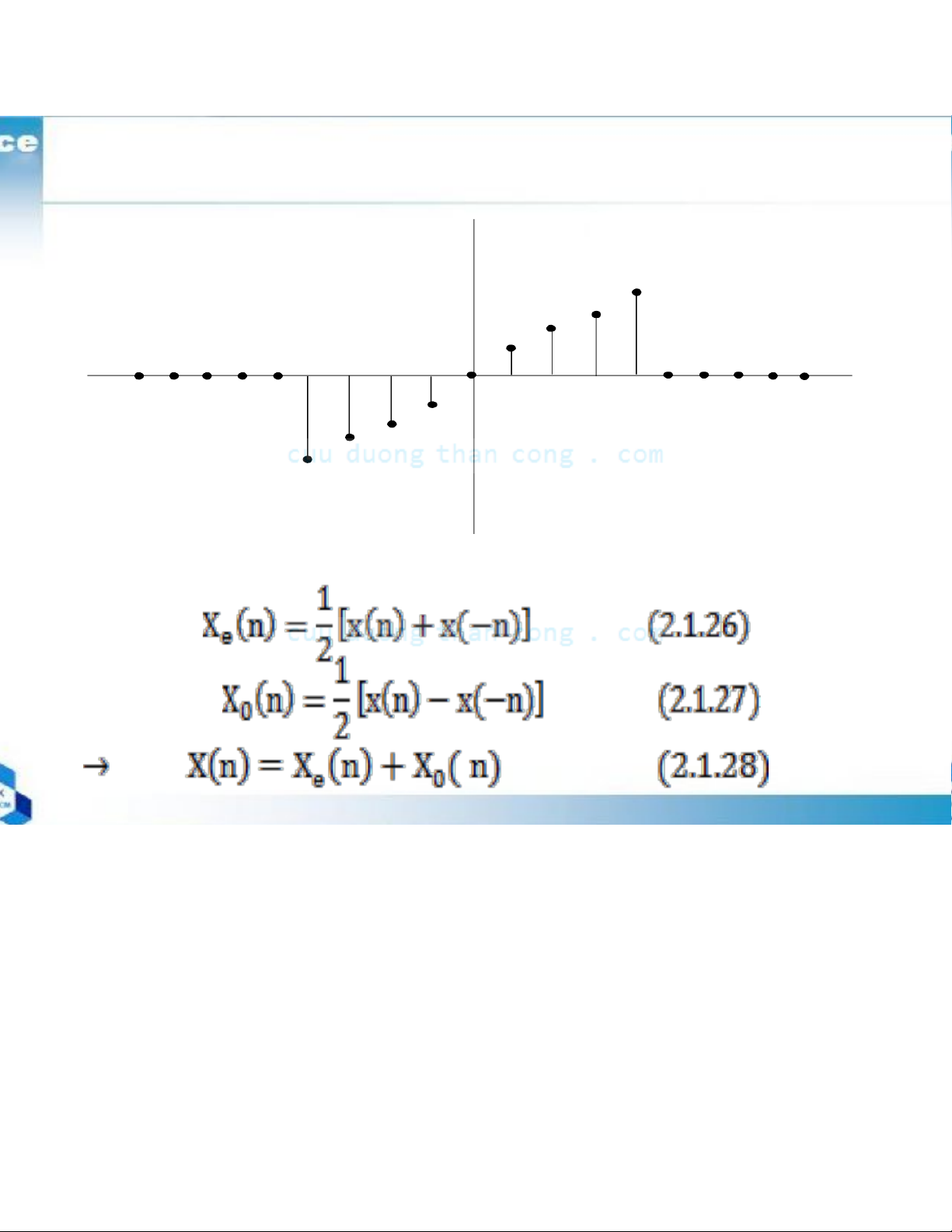
- Symmetric (even) and antisymmetric (odd) signal.
+ A real-valued signal X(n) is called symmetric
(even) if X(-n) = X(n) (2.1.24)
+ A signal X(n) is called antisymmetric (odd) if X(-n) = - X(n) (2.1.25)
CuuDuongThanCong.com https://fb.com/tailieudientucntt ©2013, CE Department 14:35, 10/01/2026
Lecture Notes for Discrete-Time Signals and Systems - Chuong 2 - Studocu
2.1.2 Classification of Discrete-Time signals Figure 2.8
Example of even (a) and odd (b) signal x!(n) "4 "3 1 "2 "1
&&&n !!!0 2 3 4 (a)
CuuDuongThanCong.com https://fb.com/tailieudientucntt ©2013, CE Department 14:35, 10/01/2026
Lecture Notes for Discrete-Time Signals and Systems - Chuong 2 - Studocu
2.1.2 Classification of Discrete-Time signals x!(n) "&4 "3 "2 "1 !!!0 2 13 4 !!!n (b)
CuuDuongThanCong.com https://fb.com/tailieudientucntt ©2013, CE Department 14:35, 10/01/2026
Lecture Notes for Discrete-Time Signals and Systems - Chuong 2 - Studocu
2.1.3 Simple Manipulations of Discrete-Time Signal
Transformation of the independent variable (time)
A signal X(n) may be shifted in time by replacing
independent variable n by n - k, where k is an integer
Figure 2.9 Graphical representation of a signal, and
its delayed and advanced versions. x(n) !!!4 !*!5
*!4 !!*!3 !!!"2 !!"1 !!0 !!!1
2 !!!3 !!4 n (a)
CuuDuongThanCong.com https://fb.com/tailieudientucntt ©2013, CE Department 14:35, 10/01/2026
Lecture Notes for Discrete-Time Signals and Systems - Chuong 2 - Studocu
2.1.3 Simple Manipulations of Discrete-Time Signal x(n(3) !!!4 !!!"2
!!"1 !!! !! 1
0 !!!2 !!!3 !!4 n !!5 !6 7 (b) x(n+2) !!!4 *!7
!*!6 !*!5 *!4
!!*!3 !!!"2 !!"1
!!0 !!! !!!1
2 !!!3 !!4 n (c)
CuuDuongThanCong.com https://fb.com/tailieudientucntt ©2013, CE Department 14:35, 10/01/2026
Lecture Notes for Discrete-Time Signals and Systems - Chuong 2 - Studocu
2.1.3 Simple Manipulations of Discrete-Time Signal
To replace the independent variable n by –n is a folding
or a reflection of the signal about the time origin n = 0
+ Time-delay operation by TD and the folding
operation by FD : TDK [x (n)] = x (n-k) k>0 FD [x(n)] = x(-n) (2.1.29)
Now TDK { FD[x(n)] } = TDK [x(-n)] = x(-n - k) (2.1.30
Whereas FD {TDK [x(n)] } = FD [x(n-k)] = x(-n - k) (2.1.31
+ Replacing n by µn, is as time scaling or down-sampling. µ is an integer
CuuDuongThanCong.com https://fb.com/tailieudientucntt ©2013, CE Department 14:35, 10/01/2026
Lecture Notes for Discrete-Time Signals and Systems - Chuong 2 - Studocu
2.1.3 Simple Manipulations of Discrete-Time Signal
Addition, multiplication, and scaling of sequences
+ Amplitude scaling of signal by a constant A is
accomplished by multiplying the value of every signal by A y(n) = Ax(n) -∞ < n <∞
+ The sum of two signal X1(n) and X2(n) y(n) = x1(n) + x2(n) -∞ < n <∞
+ The product of two signal y(n) = x1(n)x2(n) -∞ < n <∞
CuuDuongThanCong.com https://fb.com/tailieudientucntt ©2013, CE Department 14:35, 10/01/2026
Lecture Notes for Discrete-Time Signals and Systems - Chuong 2 - Studocu
2.2 Discrete-Time Systems
Discrete-Time Systems is a device or
algorithm that operates on a discrete-time
signal, called the input or excitation, to produce
another discrete-time signal called the output
or response of the system. y(n) ≡ ح [x(n)] (2.2.1)
to denotes the transformation by the ح
.)system on x(n) to produce y(n
CuuDuongThanCong.com https://fb.com/tailieudientucntt ©2013, CE Department 14:35, 10/01/2026
Lecture Notes for Discrete-Time Signals and Systems - Chuong 2 - Studocu
2.2.1 Input-Output Description of Systems
Figure 2.12 Block diagram representation of a discrete-time system Discrete,-me/
x!(n) y(n) System/ Input&signal&or& Output&signal&or& excita;on response
CuuDuongThanCong.com https://fb.com/tailieudientucntt ©2013, CE Department 14:35, 10/01/2026
Lecture Notes for Discrete-Time Signals and Systems - Chuong 2 - Studocu
2.2.1 Input-Output Description of Systems
The general input- output relationship in (2.2.1), alternatively.
+ which simply means that y(n) is the system ح to the excitation x(n)
+ The additional information required to determine y(n) for
n ≥ n0 is the initial condition y(n0 - 1)
+ If the initial condition is y(n0 - 1) = 0, thus system is
initially relaxed.
+ Block Diagram Representation of Discrete-Time System in fig 2.12
CuuDuongThanCong.com https://fb.com/tailieudientucntt ©2013, CE Department 14:35, 10/01/2026
Lecture Notes for Discrete-Time Signals and Systems - Chuong 2 - Studocu
2.2.2 Block Diagram Representation of Discrete-Time Systems + An adder
Figure 2.13 Graphical representation of an adder x1!(n)!
y!(n)!=!x1!(n)!+!x2!(n) + x2!(n)!
+ A constant multiplier
Figure 2.14 Graphical representation of a constant multiplier.
x(n) a y(n)!=!ax!(n)
CuuDuongThanCong.com https://fb.com/tailieudientucntt ©2013, CE Department 14:35, 10/01/2026
Lecture Notes for Discrete-Time Signals and Systems - Chuong 2 - Studocu
2.2.2 Block Diagram Representation of Discrete-Time Systems + A signal multiplier
Figure 2.15 Graphical representation of a signal multiplier x
y(n)=!x1!(n)x2!(n) 1(n) X x2(n)
+ A unit delay element
Figure 2.16 Graphical representation of unit delay element
x(n) y(n)=!x(n(1)
&&&z(1
CuuDuongThanCong.com https://fb.com/tailieudientucntt ©2013, CE Department 14:35, 10/01/2026
Lecture Notes for Discrete-Time Signals and Systems - Chuong 2 - Studocu
2.2.2 Block Diagram Representation of Discrete-Time Systems
+ A unit advance element
Figure 2.17 Graphical representation of unit advance element
x(n) y(n)=!x(n+1)
&&&&&&&z
CuuDuongThanCong.com https://fb.com/tailieudientucntt ©2013, CE Department
Tài liệu liên quan:
-
Bài Tập Chương 2: Cơ Học - Tính Toán Lực và Gia Tốc môn Xử lý tín hiệu số| Đại học Bách khoa Hà Nội
30 15 -
Lấy Mẫu và Lượng Tử Hóa Tín Hiệu Trên Kit C6713 DSK - Báo Cáo Thí Nghiệm môn Xử lý tín hiệu số| Đại học Bách khoa Hà Nội
32 16 -
Mô phỏng hàm truyền trong Python: Hướng dẫn sử dụng scipy.signal và control môn Xử lý tín hiệu số| Đại học Bách khoa Hà Nội
33 17 -
VXL HK231 DE1 DA Final Exam Solutions and Code Explanations môn Xử lý tín hiệu số| Đại học Bách khoa Hà Nội
34 17 -

A Model for Mobile Content Filtering in Recommendation Systems môn Xử lý tín hiệu số| Đại học Bách khoa Hà Nội
37 19