Logistics Strategies for CNUS B2C Cross-Border E-Commerce 2023 | Logistics | Trường Đại học Kinh tế, Đại học Quốc gia Hà Nội
Tài liệu được sưu tầm và soạn thảo dưới dạng file PDF với mục đích hỗ trợ học tập và tham khảo. Nội dung tài liệu được trình bày rõ ràng, dễ tiếp cận, phù hợp cho việc ôn tập và củng cố kiến thức trong quá trình học đại học. Đây sẽ là nguồn tư liệu hữu ích giúp các bạn sinh viên chuẩn bị tốt hơn cho các buổi học, đồng thời mở rộng thêm hiểu biết về môn học. Hy vọng tài liệu này sẽ mang lại nhiều giá trị và hỗ trợ các bạn trong hành trình học tập. Mời bạn đọc cùng tham khảo!
Môn: Logistics 61 tài liệu
Trường: Trường Đại học Kinh tế, Đại học Quốc gia Hà Nội 491 tài liệu
Tác giả:

Preview text:
EXPLORING THE RIGHT LOGISTICS STRATEGY FOR CHINA-U.S. B2C CROSS-BORDER E-COMMERCE white paper | march 2023 TABLE OF CONTENTS Executive Summary 4 Introduction 5
Cross-Border E-commerce in China 6 Market Overview 6 Key Sales Channels 7
Cross-Border E-commerce in the U.S. 9 Market Overview 9 Key Sales Channels 10 Logistics Models 12
Business-to-Consumer / Direct Shipping 12
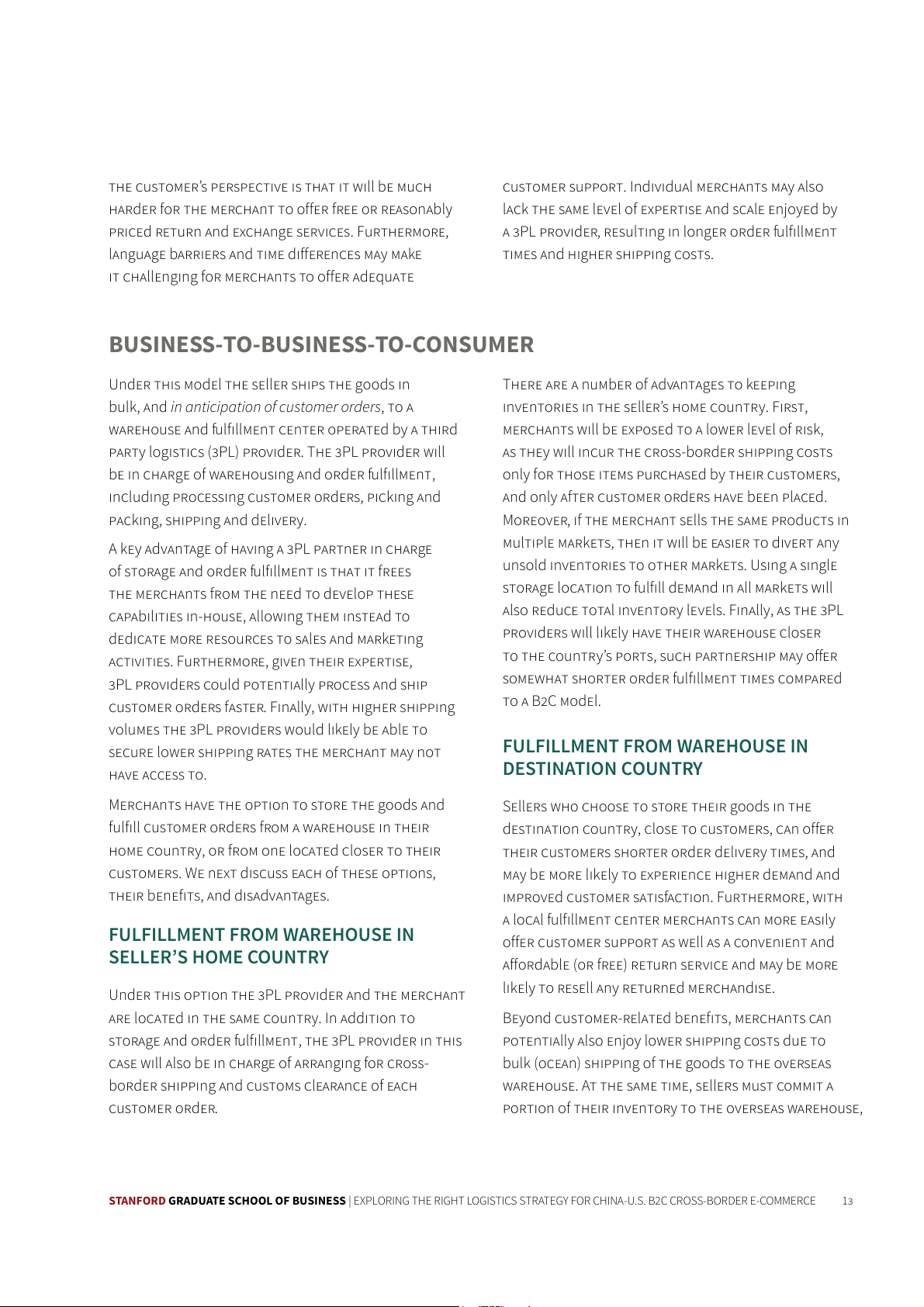
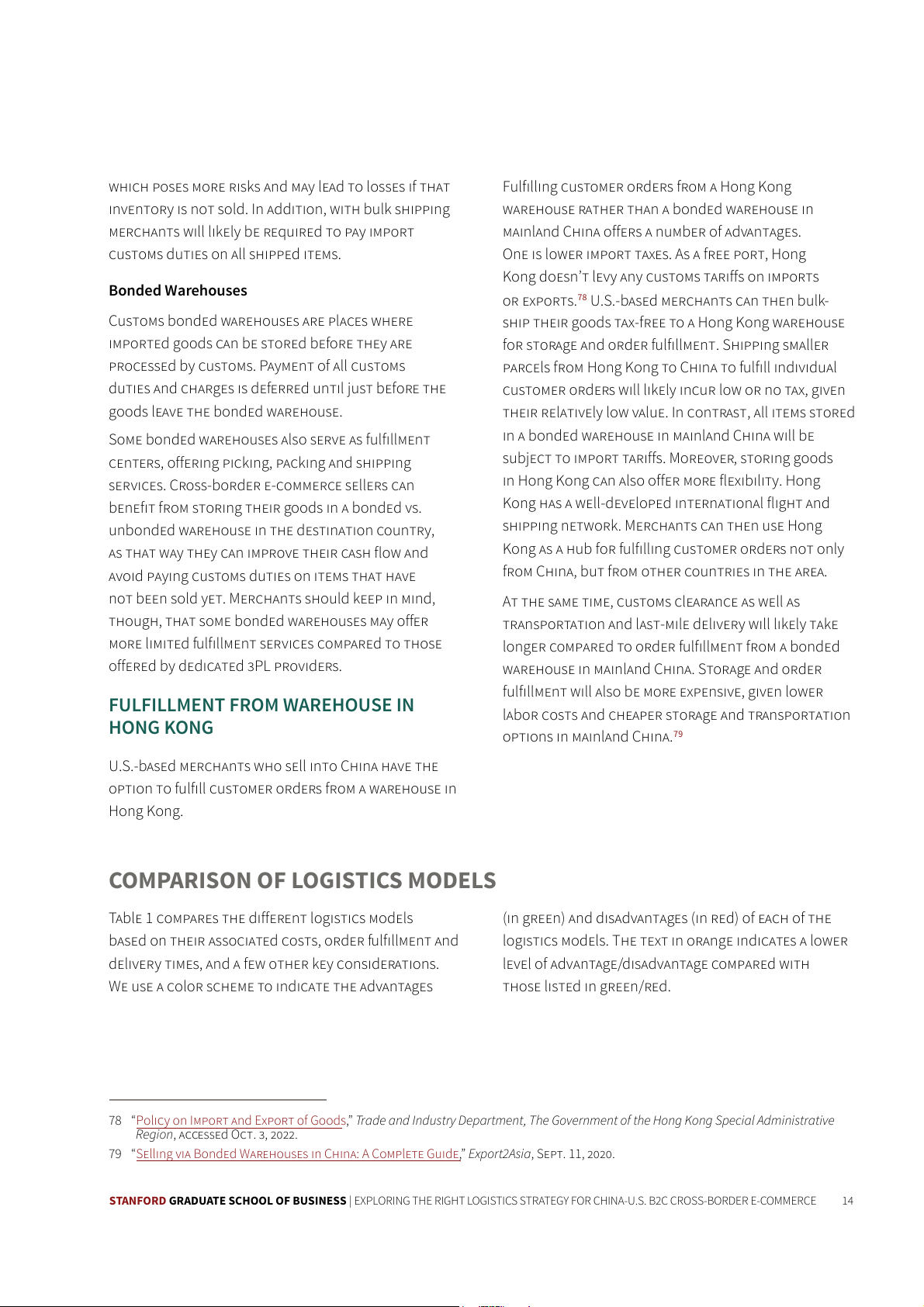
Business-to-Business-to-Consumer 13
Comparison of Logistics Models 14
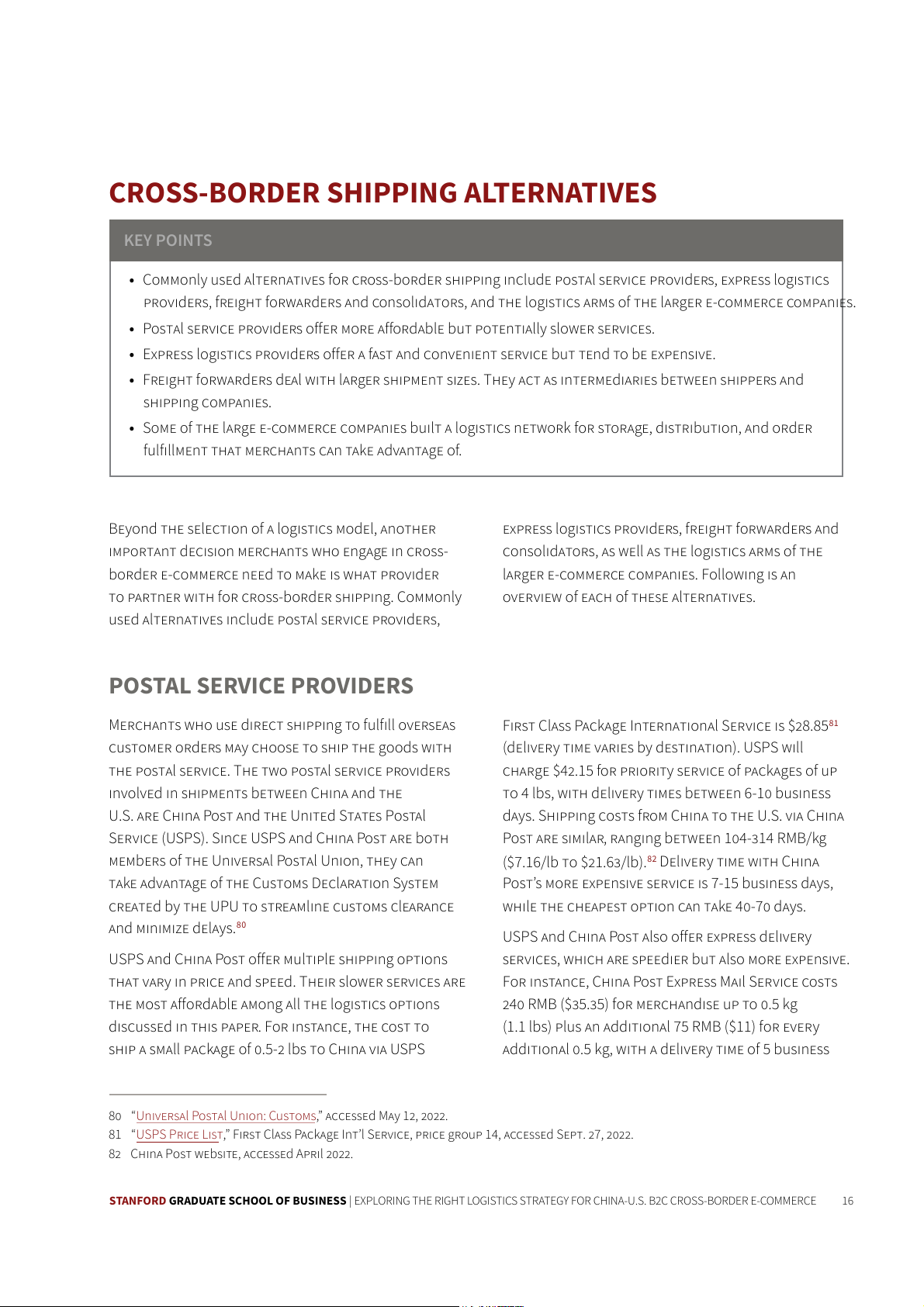
Cross-Border Shipping Alternatives 16 Postal Service Providers 16 Express Logistics Providers 17
Freight Forwarders and Consolidators 17
Logistics Arms of E-commerce Platforms 18 Logistics Flows 20 Postal Service Providers 20 Express Logistics Providers 21
Freight Forwarders and Consolidators 22
E-commerce Platforms: Amazon (China-to-U.S.) 24
E-commerce Platforms: Alibaba/Cainiao (U.S.-to-China) 26
Trends in CBEC Logistics 29
Expansion of Service Offerings and Geographic Footprint 30
Increased Reliance on Air Freight 31
Investment in Technology and Digital Capabilities 32 Green-Shipping Initiatives 33
Selecting a Logistics Strategy 35
Familiarity with Target Market 36 Demand Characteristics 37 Product Characteristics 38 Detailed Analysis 39 Conclusion 40
STANFORD GRADUATE SCHOOL OF BUSINESS | EXPLORING THE RIGHT LOGISTICS STRATEGY FOR CHINA-U.S. B2C CROSS-BORDER E-COMMERCE 2 AUTHORS Barchi Gillai
Hau L. Lee, Principal Investigator
Associate Director, Value Chain Innovation Initiative
Thoma Professor of Operations, Information and Technology
Stanford Graduate School of Business
Faculty Co-Director, Value Chain Innovation Initiative Email: barchi@stanford.edu
Stanford Graduate School of Business RESEARCH ASSISTANTS Caroline Yuandi Ling Araya Sornwanee
MBA & Master of Science, Environment and Resources
Master of Science, Management Science and Engineering Stanford University Stanford University Tony Lianfeng Shan
Master of Science, Management Stanford University
ABOUT THE VALUE CHAIN INNOVATION INITIATIVE
The Value Chain Innovation Initiative brings
Our research and professional workshops focus on
together academics, industry leaders and
addressing problems that are highly relevant to the
practitioners to advance the theory and practice of
greater global business community, and cover a
global value chain innovation through research and
broad range of topics including global supply chain knowledge dissemination.
design in complex trade environments, responsible
Housed within the Graduate School of Business
supply chains, technological innovations and their
at Stanford University, we seek to understand
impact on value chains, and more.
the economic and social impacts of the global
Learn more at gsb.stanford.edu/vcii.
dynamics and technologies that are reshaping
businesses, industries and ecosystems across the value chain.
STANFORD GRADUATE SCHOOL OF BUSINESS | EXPLORING THE RIGHT LOGISTICS STRATEGY FOR CHINA-U.S. B2C CROSS-BORDER E-COMMERCE 3 EXECUTIVE SUMMARY
Business-to-consumer (B2C) cross-border
well as the logistics arms of the larger e-commerce
e-commerce (CBEC) is the practice of consumers
companies. The paper offers a description of each
purchasing goods directly from merchants located in
alternative, its pros and cons, and the scenarios under other countries.
which each alternative may be more relevant. We
Sound logistics services are critical for supporting
also offer a detailed description of the logistics flows
CBEC, given the importance consumers place on
associated with each of these shipping alternatives.
such aspects of the shopping experience as shipping
Finally, we also highlight in this paper some of
times and costs, visibility to their goods while in
the ways in which the logistics landscape has
transit, and the availability of return services.
evolved in recent years and discuss how these
Given the importance of CBEC logistics services and
trends are helping to address some of the main
the complexity of fulfilling cross-border orders, we
challenges sellers and buyers engaged in CBEC have
offer in this paper an overview of the logistics options traditionally faced.
available to cross-border merchants. We focus
The last part of the paper lays out our
specifically on the logistics alternatives supporting
recommendations for how merchants should
trade between China and the U.S. — two dominant
approach the task of determining the right logistics
players in the global CBEC market.
strategy for their specific business needs. Merchants
At a high level, merchants can consider two logistics
should base their decisions on a detailed analysis
models: business-to-consumer (B2C), also known
that compares the expected costs, revenues, and
as direct-shipping, and business-to-business-to-
risk factors associated with each logistics alternative.
consumer (B2B2C). Merchants should also decide
They should conduct this analysis while taking into
whether to fulfill customer orders from their home
consideration such factors as their internal expertise
country, or from a fulfillment center located closer
and familiarity with the target market, expected
to their customers. Each alternative offers a different
demand patterns, and the characteristics of the
set of trade-offs between cost, risk, speed of delivery, products that they sell.
and overall customer satisfaction.
As for selecting the logistics provider(s) to partner
with for cross-border shipping, key alternatives
include postal service providers, express logistics
providers, freight forwarders and consolidators, as
STANFORD GRADUATE SCHOOL OF BUSINESS | EXPLORING THE RIGHT LOGISTICS STRATEGY FOR CHINA-U.S. B2C CROSS-BORDER E-COMMERCE 4 INTRODUCTION
Business-to-consumer (B2C) cross-border
items were valued below €25 (about US$24.6 4). Some
e-commerce (CBEC) is the practice of consumers
of the key reasons for shoppers to order goods from
purchasing goods directly from merchants located
other countries are the easy access to products and
in other countries. Common ways for consumers
brands that may not be available at their home
to engage in cross-border shopping is by ordering
country, as well as the ability to purchase items at a
goods directly from merchants’ own websites or
lower total cost compared to the prices charged at through online marketplaces.
local stores. At the same time, shipping and delivery
In recent years online shoppers have become more
are important aspects of the shopping experience
comfortable with cross-border shopping, leading
and may impact the willingness of online shoppers
to a steady growth of the global CBEC market. Most
to purchase goods from foreign websites. The results
experts expect this trend to continue in the coming
of a global survey by solution provider ESW illustrate
years. According to one market report, the global
this point, with 27% of participants selecting long
CBEC market is expected to expand at a compound
shipping times and high shipping costs as the main
annual growth rate (CAGR) of 17.4%, from $578.57
reasons for them to avoid buying cross-border. 5
billion in 2019 to $2,248.57 billion by 2026. 1 We’d like
In another global survey, about two thirds of
to caution, though, that with the world potentially
respondents wanted the option of free standard
edging toward a global recession in 2023, 2 and with
shipping and identified delivery tracking and a clear
the world’s largest economies already experiencing a
delivery time frame as motivators to buy more. 6
sharp slowdown, the global CBEC market may end up
Given the importance and complexity of cross-
expanding at a slower pace than initially anticipated.
border shipping and delivery, we offer in this paper
As for the impact of COVID-19 on the market, while
an overview of the logistics options available
early on the pandemic led to a significant increase
to merchants engaged in CBEC. We specifically
in online shopping, cross-border e-commerce
focus on the logistics solutions available to small
experienced slower growth compared to domestic
and medium-size companies, which represent a
e-commerce markets. This can potentially be
large share of the CBEC market. We further offer
attributed to a combination of growing support for
our observations of the evolution of the logistics
local retailers and disruptions to global supply chains.
landscape in recent years and the way these changes
are alleviating some of the hurdles traditionally faced
Many cross-border orders are relatively small and
by merchants and shoppers engaged in CBEC.
inexpensive, as is illustrated by the results of a global
cross-border shopper survey by the International
China and the U.S. are the two leading countries
Post Corporation (IPC), 3 where 43% of orders
in terms of the dollar value of their B2C cross-
weighed up to 0.5 kg (1.1 lb) and a third of ordered
border e-commerce exports. 7 Furthermore, a
1 “Global Cross-Border E-commerce Market - Segment Analysis, Opportunity Assessment, Competitive Intelligence, Industry Outlook
2016-2026,” All the Research, Feb. 2021.
2 “Risk of Global Recession in 2023 Rises Amid Simultaneous Rate Hikes,” The World Bank, Sept. 15, 2022.
3 “Cross Border E-Commerce Shopper Survey 2021: Key Findings,” IPC, Jan. 2022.
4 Based on Oct. 17, 2022 exchange rate.
5 “Global Voices 2022,” ESW, accessed Oct. 17, 2022.
6 “Global Voices Pre-Peak Pulse 2021,” ESW, Sept. 17, 2021.
7 “Estimates of Global E-Commerce 2019 And Preliminary Assessment of Covid-19 Impact on Online Retail 2020,” UNCTAD, accessed Oct. 19, 2021.
STANFORD GRADUATE SCHOOL OF BUSINESS | EXPLORING THE RIGHT LOGISTICS STRATEGY FOR CHINA-U.S. B2C CROSS-BORDER E-COMMERCE 5
significant portion of this global trade takes place
countries Chinese shoppers buy from. 8, 9 Due to
between these two countries, as indicated by
the high CBEC trade volume between the U.S. and
several consumer surveys. They point to China as
China, the paper focuses on the logistics flows
the foreign country most U.S. online consumers between these two countries.
shop from, and to the U.S. as one of the top three
CROSS-BORDER E-COMMERCE IN CHINA KEY POINTS
• Retail cross-border e-commerce has become increasingly popular in China.
• Many of China’s CBEC shoppers are relatively young, well educated, with medium to high income.
• Only products on the “Positive List” can be imported into China through this channel.
• Domestic and foreign e-commerce platforms are the most popular sales channels for CBEC.
• The use of social platforms for CBEC has also been gaining momentum. MARKET OVERVIEW
China is the world’s largest e-commerce market,
China’s express delivery industry and its expansion
accounting in 2021 for more than a half (52.1%) of
to smaller towns and more rural areas. According to
total worldwide retail e-commerce sales. 10 China
some estimates, the market reached a total of 483.74
also has the highest e-commerce penetration rate,
billion Yuan ($76 billion 12) in 2021, 13 with 280 million
with 46.3% of the country’s retail sales taking place
buyers expected to make cross-border e-commerce
online. 11 The market comprises two key segments,
purchases in 2023. 14 We caution though that such
domestic and cross-border e-commerce, with the
estimates vary widely across sources.
latter being the focus of this paper.
B2C cross-border e-commerce is viewed in China
Retail CBEC has become increasingly popular in
as an important force that stabilizes the country’s
China in recent years. This is due in part to the wide
foreign trade. 15 Because of that, China has
selection of imported goods available, attractive
implemented over the years a series of policies
pricing, and the convenience of online shopping.
designed to improve the regulation of CBEC retail
Another potential contributor is the rapid growth of
imports and promote the development of this
8 “Cross Border E-Commerce Shopper Survey 2021,” IPC, Jan. 2022.
9 “The Great Pivot in Global eCommerce: Borderless Commerce Report 2021,” PayPal, accessed Oct. 17, 2022.
10 “Top 10 Countries, Ranked by Retail Ecommerce Sales Share, 2021,” Insider Intelligence, May 2021.
11 “Top 10 Countries, Ranked by Retail Ecommerce Share of Total Retail Sales, 2022,” Insider Intelligence, Jan. 2022.
12 Based on the Chinese Yuan to US Dollar spot exchange rates on Dec. 31, 2021, ExchangeRates.org.uk, accessed Feb. 1, 2023.
13 “Market Size of Cross-Border E-Commerce Retail Imports in China from 2016 to 2021,” Statista, March 2022.
14 “Cross-Border Retail eCommerce Buyers, by Country,” Insider Intelligence, Jan. 2023.
15 “China Remains World’s Largest B2C Cross-Border E-Commerce Market,” People’s Daily Online, July 13, 2021.
STANFORD GRADUATE SCHOOL OF BUSINESS | EXPLORING THE RIGHT LOGISTICS STRATEGY FOR CHINA-U.S. B2C CROSS-BORDER E-COMMERCE 6
sector. 16 At the same time, calls by Beijing to promote
goods, some of the key product categories imported
“common prosperity” and curb excess may serve
through B2C cross-border e-commerce include
to tone down the hype China’s big e-commerce
cosmetics, maternity and baby products and
platforms have been building around cross-border healthcare products. 20
shopping. 17 Several other external forces may also
Not all types of products can be imported to
put a dent on the growth of China’s CBEC market, at
China through this channel. In 2016 the Chinese
least in the short term. They include the slowing of
government introduced the Positive List, which lists
the Chinese economy due to COVID-zero policies and
the product categories that can be imported into
strict lockdowns, the country’s real estate crisis and
China through a CBEC model. When first introduced,
other factors, which are motivating consumers to cut
the Positive List contained 1,293 categories, of which
back debt and increase savings. 18
about 360 were food or agricultural products. 21
Many of China’s CBEC shoppers are relatively young,
Since then the list has been updated several times,
well educated, with medium to high income. 19
bringing the total number to 1,476 categories by
Driven by a desire for high quality and authentic February 2022. 22 KEY SALES CHANNELS
When shopping cross-border, Chinese consumers are
of shopping agents (Daigou). 24 This distribution
most concerned about the authenticity of the products
represents a significant shift from several years ago
that they buy, the reputation of the shopping website,
when, based on a 2015 survey, only 46% of shoppers
product variety, price, and ease of shopping. 23 Given
used e-commerce platforms while 29% shopped
these concerns, it is no surprise that most Chinese
directly on foreign-brand websites. 25 Interestingly,
consumers prefer to shop cross-border on domestic
the introduction of the Positive List in 2016 renewed
platforms, with which they are familiar and that
interest in the services of Daigo u agents, since as a C2C
have a reputation for offering authentic products at
channel, Daigou agents can bypass the Positive List
competitive prices. According to an iResearch report,
which only applies to B2B2C or B2C trade. 26
in 2020 58.3% of shoppers used domestic e-commerce
platforms for cross-border shopping. An additional
The most popular domestic platforms for cross-
19.1% shopped through foreign platforms. Only 12.7%
border imports include Tmall Global (39.6% of total
shopped on official websites of foreign brands, and the
volume), JD Worldwide (25%), Kaola (20.1%), and
rest shopped in duty-free stores or used the services
VIP International (8.6%). 27 Some of the other players,
16 C.H. Poon, “China Updates Cross-Border Retail Import Policy,” HKTDC, July 22, 2019.
17 Josh Horowitz and Brenda Goh, “From Splurge to ‘Common Prosperity’: Alibaba Tones Down Singles Day,” Reuters, Nov. 1, 2021.
18 Yujing Liu and Tom Hancock, “The Perils of Chinese Thrift,” Bloomberg BusinessWeek, Aug. 22, 2022.
19 “2021 Cross-border Online Shopping Report,” iResearch, 2021.
20 Forging Ahead Against Headwinds: China’s Imported Goods Market Research 2020, Tmall Global and Deloitte China, Nov. 3, 2020.
21 “Chinese Government Policies Change for Cross-Border e-Commerce,” USDA, Dec. 7, 2016.
22 “China Cross-Border eCommerce: “Positive List” Helper,” TMO Group, accessed Oct. 19, 2022.
23 “Online Shopping Report,” iResearch, 2021.
24 “Online Shopping Report,” iResearch, 2021.
25 Hau L. Lee et al., “U.S.-to-China B2C E-Commerce: Improving Logistics to Grow Trade,” Stanford VCII, Aug. 2016.
26 “Cross-border E-commerce Positive List Published (And Its Expansion),” EIBENS, accessed Oct. 19, 2022.
27 “Market Share of Import Cross-Border B2C E-Commerce Retailers in China in 3rd Quarter of 2022,” Statista, Nov. 2022.
STANFORD GRADUATE SCHOOL OF BUSINESS | EXPLORING THE RIGHT LOGISTICS STRATEGY FOR CHINA-U.S. B2C CROSS-BORDER E-COMMERCE 7
each with less than 3% of the market, include Amazon
in 2021 the Gross Merchandise Value (GMV) of social
Global, Little Red Book, Suning Global, and Xiaomi
commerce in China reached 2,532 billion yuan ($398
Youpin Global. Below is a brief description for each of
billion 34). 35 Pre-pandemic the industry has been the key players in this field.
rapidly growing, almost doubling in size every year.
Tmall Global: Launched in 2014 by Alibaba, Tmall
But the COVID-19 pandemic dramatically slowed
Global is China’s largest cross-border B2C online
down this expansion, with 2020 and 2021 seeing a
marketplace. As of early 2022, the platform is in use
growth rate of 11.62% and 10.09% respectively. 36
by over 100 million active consumers and 30,000
While much of the growth has been related to international brands. 28
domestic shopping, social commerce has also
Kaola: Founded in 2015 by NetEase, the company
penetrated CBEC. E-commerce platform Little Red
was acquired by Alibaba in 2019. It has become an
Book has been a social commerce pioneer, gaining
important CBEC unit of Alibaba and maintains its
a reputation for reliable, authentic product reviews
independent operations. As of August 2022 it had over
and successfully integrating between social media 30 million active users. 29
and retail. 37 JD Worldwide has also taken advantage
of social commerce through a partnership with
JD Worldwide: Launched by JD.com in 2015, JD
Little Red Book. Under this partnership, overseas
Worldwide offers over 10 million SKUs (stock keeping
merchants can operate a storefront embedded in
units) of products imported from 20,000 brands all over
JD Worldwide’s homepage on Little Red Book and
the world. 30 JD.com has over 580 million active users,
then use JD’s logistics network for order fulfillment. 38
all of whom have access to JD Worldwide. 31
Other examples include Tmall Global, which among
VIP International: Launched in 2014 by VIPShop,
other initiatives has expanded its Global Influencers
which is an online discount retailer platform. 32 In 2021
program to support overseas brands, 39 and social
VIPShop had 93.9 million active customers, 33 with all of
media platform WeChat, which offers overseas
them having access to VIP International.
brands a way to sell cross-border through a branded WeChat shop. 40 SOCIAL COMMERCE
Social commerce, which is the process of buying
and selling goods through a social platform, is a
huge industry in China. According to one estimate,
28 “How to Sell in China With Tmall Global,” TMO Group, March 9, 2022.
29 Complete Guide to Selling on Kaola for China Cross-border E-Commerce, GMA, Aug. 17, 2022.
30 Rachel Liu, “In-depth Report: JD Worldwide Six Years and Going: Bridging Brands and Customers,” JD.com, April 16, 2021.
31 Doris Liu, “JD Worldwide Sales Jump as 618 Grand Promotion Kicks Off,” JD.com, June 3, 2022.
32 “Selling on Vipshop and VIP International in China: The Ultimate Guide,” Export2Asia, Oct. 19, 2020.
33 “VIPShop Reports Unaudited Fourth Quarter and Full Year 2021 Financial Results,” VIP, Feb. 23, 2022.
34 Chinese Yuan to US Dollar spot exchange rates on Dec. 31, 2021, ExchangeRates.org.uk.
35 “2021 China’s social commerce market statistical report,” 100ec.cn, March 23, 2022.
36 “China’s social commerce,” 100ec.cn.
37 David Henriques, “Guide to Social Commerce in China 2022,” Sekkei Studio, Nov. 17, 2021.
38 “JD Worldwide Lands on Xiaohongshu, Unlocking China’s E-commerce for 20 Global Brands,” DAO Insights, May 24, 2022.
39 Cecilia Li, “Tmall Global Expands Its Global Influencers Program To Support Overseas Brands,” Alizila, Nov. 11, 2020.
40 “How to sell in China from outside via WeChat,” WeChat Wiki, accessed Oct. 20, 2022.
STANFORD GRADUATE SCHOOL OF BUSINESS | EXPLORING THE RIGHT LOGISTICS STRATEGY FOR CHINA-U.S. B2C CROSS-BORDER E-COMMERCE 8
CROSS-BORDER E-COMMERCE IN THE U.S. KEY POINTS
• A growing number of U.S. online shoppers feel comfortable making cross-border purchases.
• Popular product categories include clothing, toys, consumer electronics, media products, accessories, and eyewear.
• Several rules and regulations make retail CBEC from China to the U.S. more attractive financially.
• E-commerce platforms are the most popular sales channel for CBEC. MARKET OVERVIEW
U.S. consumers feel comfortable making more
to Amazon (41.0%) and ahead of Walmart (6.6%) and
and more of their purchases online. While in 2010 eBay (4.2%). 46
e-commerce represented only 4.3% of all retail sales, 41
As for cross-border shopping, a growing number of U.S.
by the third quarter of 2022 this percentage went up
online shoppers are comfortable with making such
to 14.8%. 42 E-commerce market share is expected to
purchases. In a 2022 PayPal survey 41% of respondents
continue growing, reaching 23.6% of all retail sales by
made an international online purchase, which is a
2025. 43 Moreover, the market is expected to surpass
sizable increase from the 33% polled the previous
$1 trillion for the first time in 2022, growing by 9.4%
year. 47 Overall, the U.S. is expected to have 69.8 million
over 2021 numbers. 44 Amazon is by far the leading
cross-border retail e-commerce buyers (24.8% of the
e-retailer in the U.S., accounting for 37.8% of the
population) in 2023. 48 Some of the product categories
e-commerce market as of June 2022, followed by
cross-border shoppers frequently buy include clothing,
Walmart at 6.3%, Apple at 3.9%, eBay at 3.5%, and
toys and hobbies, consumer electronics, media
Target at 2.1%. 45 Shopify, which is not an e-retailer but
products, accessories and eyewear. 49, 50 Popular
rather an e-commerce platform that merchants can
reasons for shopping cross-border include better
use to set up their online stores, is also an important
prices, access to items not available locally, and the
player in this market. In terms of GMV, Shopify had a
discovery of new and interesting products. 51 At the
10.3% market share in the U.S. in 2021, second only
same time, difficulty of returning unwanted items is
41 “E-commerce as Percentage of Total Retail Sales in the United States from 2000 to 2020,” Statista, Jan. 2022.
42 “Quarterly Retail E-Commerce Sales, 3rd quarter 2022,” U.S. Census Bureau News, Nov. 18, 2022, accessed Feb. 2, 2023.
43 Suzy Davidkhanian, “US Ecommerce Forecast 2021,” eMarketer, July 8, 2021.
44 Rachel Hasson, “US Retail & Ecommerce Snapshot,” Insider Intelligence, June 21, 2022.
45 “Market share of Leading Retail E-commerce Companies in the United States as of June 2022,” Statista, Aug. 2022.
46 “Shopify Market Share and Usage Statistics in 2022,” Kinsta, accessed Nov. 7, 2022.
47 “Turn Shifting Values Into Cross-Border Opportunities: Borderless Commerce Report 2022,” PayPal, page 93, accessed Oct. 21, 2022.
48 “Cross-Border Retail eCommerce Buyers: US, 2020-2024,” Insider Intelligence, Jan. 2023.
49 Selling via E-Commerce in the United States, Government of Canada, March 2018.
50 “Borderless Commerce Report 2022,” PayPal, page 94.
51 “Borderless Commerce Report 2022,” PayPal, page 94.
STANFORD GRADUATE SCHOOL OF BUSINESS | EXPLORING THE RIGHT LOGISTICS STRATEGY FOR CHINA-U.S. B2C CROSS-BORDER E-COMMERCE 9
often seen as a barrier to cross-border shopping. The
$800. 55 This means that many of the items ordered by
top countries U.S. consumers buy from are China,
U.S consumers directly from China can be imported Canada, and the UK. 52, 53
free of duties and taxes. It is important to note that
Several rules and regulations make B2C e-commerce
new legislation introduced in the U.S. congress in
from China to the U.S. more attractive financially. They
early 2022 aims to close this loophole. 56 If passed,
include China’s decision in 2018 to waive export taxes
e-commerce companies selling into the U.S. may no
for direct-to-consumer companies, 54 as well as the U.S.
longer be able to avoid paying taxes and tariffs on
decision in 2016 to raise the value of imported goods their imported goods.
that are exempt from duties and taxes from $200 to KEY SALES CHANNELS
E-commerce platforms are the most popular channel
number of international traders on the platform is
for cross-border e-commerce in the U.S. In a 2022
relatively small, over half of them are based in China
PayPal survey, 75% of respondents reported using
and Hong Kong. 59 Walmart, which in the past only
online marketplaces for shopping cross-border,
allowed U.S.-based merchants to sell on the Walmart
45% shopped on a store/retailer website, while 37%
Marketplace, expanded it in March 2021 to allow
shopped on a social media marketplace. 57 Following is
foreign sellers as well. 60 By mid-2022, the platform
a brief overview of these sales channels.
added over 10,000 new sellers from China. 61
Domestic platforms: Unlike in China, where
Foreign platforms: AliExpress, 62 owned by the Alibaba
e-commerce companies operate dedicated
Group, is probably the most well-known Chinese
marketplaces for cross-border e-commerce, in the
marketplace that sells to the U.S. market. AliExpress
U.S. the same platforms are used for domestic and
sellers are predominantly based in China, though
cross-border shopping. Among them Amazon is the
they also include vendors in other South-East Asian
most dominant platform. Not only is it the leading
countries. 63 Other relevant China-based marketplaces
e-retailer in the U.S., but more than 50% of its top 100k
include Banggood, 64 GearBest, 65 DHgate, 66 and more.
sellers are based in China. 58 As for eBay, while the total
52 “Borderless Commerce Report 2022,” PayPal, page 94.
53 “Cross-Border E-Commerce Shopper Survey 2021,” IPC, Jan. 2022.
54 “How Trump’s Trade War Built Shein, China’s First Global Fashion Giant,” Bloomberg BusinessWeek, June 13, 2021.
55 “De Minimis Value Increases to $800,” U.S. Customs and Border Protection, March 11, 2016.
56 Deborah Belgum, “$800 Gorilla In The Room: De Minimis A Tale of ‘Unintended Consequences,’ Congressman Says,” Sourcing Journal, March 10, 2022.
57 “Borderless Commerce Report 2022,” PayPal, page 94.
58 “Chinese Sellers Don’t Want to Rely on Amazon,” Marketplace Pulse, April 20, 2022.
59 “The World’s Top eBay Sellers 2021,” Webretailer, accessed Oct. 25, 2022.
60 “Chinese Sellers Join Walmart Marketplace,” Marketplace Pulse, March 26, 2021.
61 “Chinese Sellers Don’t Want to Rely on Amazon,” Marketplace Pulse, April 20, 2022.
62 www.aliexpress.us, accessed Oct. 25, 2022.
63 Dan Price, “The 10 Best Chinese Shopping Sites That Ship To The US,” MakeUseOf, July 27, 2022.
64 usa.banggood.com, accessed Oct. 25, 2022.
65 www.gearbest.com, accessed Oct. 25, 2022.
66 www.dhgate.com, accessed Oct. 25, 2022.
STANFORD GRADUATE SCHOOL OF BUSINESS | EXPLORING THE RIGHT LOGISTICS STRATEGY FOR CHINA-U.S. B2C CROSS-BORDER E-COMMERCE 10
Retailer websites: Several large Chinese brands,
U.S. market pales in comparison to China’s social
such as fast fashion retailer Shein and electronics
commerce market, which is about 10 times bigger. 72
manufacturer Anker, operate their own web stores.
Facebook is the top social commerce platform in the
Increasingly though, smaller Chinese merchants are
U.S. It is estimated that in 2022 more than 60% of
also turning to building their own direct-to-consumer
U.S. social media users ages 14 and older will make
(DTC) channels as a way to reduce their reliance
a purchase via Facebook, and about 40% will do so
on third-party e-commerce platforms. Some of the
via Instagram. Other key platforms include TikTok
reasons for moving away particularly from Amazon
and Pinterest, which are expected to draw 23.1% and
include high fees charged by the e-commerce
15.5% of social buyers in that age group respectively. 73
giant, the freezing of thousands of Chinese seller
E-commerce companies are taking steps to
accounts, 67 and the blocking of merchants’ access
increase their presence in the social media space.
to customer data. 68 Building their own brands and
For instance, a partnership between Shopify and
operating their own web stores offer merchants an
TikTok, announced in October 2020, 74 allows Shopify
opportunity to improve their profitability, develop
merchants to create, run and optimize their TikTok
closer relationships with their customers, and also
marketing campaigns directly from the Shopify
experiment with more innovative marketing and
dashboard. Similarly, YouTube Shopping, launched
sales tactics. Many of these Chinese sellers turn
in July 2022, offers Shopify merchants an easy way
to e-commerce platform Shopify to build their
to integrate their online store with the YouTube
DTC channel, as the platform offers an easy way
platform and sell their products on YouTube. 75
for merchants to create their online stores. The
Another example is offered by eBay. The company
strategic partnership between JD.com and Shopify,
recently announced an alliance with Snapchat,
announced in January 2022, may further accelerate
under which eBay merchants can showcase
this trend, as it promises to simplify access and
their eBay listings on Snapchat. 76 And Amazon is
compliance for Chinese brands looking to reach
reportedly testing a new tool called “Inspire,” which is
consumers in Western markets. 69
a photo and video feed of products similar in nature
Social commerce: Social commerce is increasing to TikTok. 77
in popularity in the U.S. Market research company
eMarketer estimates U.S. retail social commerce sales
to equal $53.1 billion in 2022, or 5.1% of total retail
e-commerce sales that year, and a 34.4% increase
from 2021 numbers. 70 The market is expected to
further grow to $130.1 billion by 2026. 71 Still, the
67 “From Prime to ban: Amazon’s Crackdown on Chinese Sellers,” Daxue Consulting, Dec. 20, 2021.
68 “Chinese Sellers Don’t Want to Rely on Amazon,” Marketplace Pulse, April 20, 2022.
69 Rita Liao, “Shopify and China’s JD.com Team Up to Capture Cross-border Sellers,” TechCrunch, Jan. 18, 2022.
70 “Retail Social Commerce Sales: US, 2022-2026,” eMarketer, July 2022.
71 “Retail Social Commerce Sales: US, 2022-2026,” eMarketer, July 2022.
72 “Social Commerce Surpasses $30 billion in the US,” Insider Intelligence, July 7, 2021.
73 Sara Lebow, “Facebook Will Stay Atop the US Social Commerce Ladder,” eMarketer, Sept. 8, 2022.
74 Sarah Perez, “TikTok Partners with Shopify on Social Commerce,” TechCrunch, Oct. 27, 2020.
75 “Hit record: Shopify Partners with YouTube to Scale the Creator Economy,” Shopify, July 19, 2022.
76 “eBay Made Easy with Snapchat,” Snapchat, Aug. 9, 2022.
77 Amanda Silberling, “Amazon Is Internally Testing A TikTok-Like Feed In Its App,” TechCrunch, Aug. 17, 2022.
STANFORD GRADUATE SCHOOL OF BUSINESS | EXPLORING THE RIGHT LOGISTICS STRATEGY FOR CHINA-U.S. B2C CROSS-BORDER E-COMMERCE 11 LOGISTICS MODELS KEY POINTS
• Two key logistics models for satisfying CBEC orders are business-to-consumer (B2C) and business-to-
business-to-consumer (B2B2C). Under a B2C model orders are shipped directly from the seller to the buyer.
Under a B2B2C model the merchant first ships the goods in bulk to a fulfillment center operated by a 3rd
party; once customers place their orders, they are shipped from the fulfillment center.
• Cross-border orders can be fulfilled from a warehouse located in the seller’s home country, or in the
destination country. Sales into China can also be fulfilled from a warehouse in Hong Kong.
• Each of these logistics models offer a different mix of costs, shipping and delivery times, exposure to risks,
and level of customer support.
Fulfilling orders placed by shoppers located in a
satisfying cross-border e-commerce orders: business-
different country is quite challenging. Transportation
to-consumer (B2C), and business-to-business-to-
is more expensive and shipping times are much
consumer (B2B2C). Another potential option for
longer. The process is also more complex as each
merchants is to forego the ownership of inventory and
segment of the way (domestic transportation in
instead rely on drop shipping. Under a drop-shipping
the seller’s home country, cross-country air/ocean
model, the merchants would pass the details of any
shipping, transportation in the buyer’s country, and
orders they receive from their customers over to their
last mile delivery) may be handled by a different
own suppliers (either manufacturers or wholesalers),
entity. The multiple hand-offs of cargo between
who would then be in charge of shipping the ordered
these entities may reduce visibility to the goods in
items directly to the customers. The drop-shipping
transit and may lead to multiple delays. Import and
model is outside the scope of this paper and will not
export tariffs, regulations and customs clearance be further discussed here.
requirements further complicate the process.
Following is a brief description of the B2C and B2B2C
Merchants who own the goods that they sell can
models. We also offer an overview of the storage
consider at a high level two logistics models for
location alternatives merchants should consider.
BUSINESS-TO-CONSUMER / DIRECT SHIPPING
Under this model sellers ship the ordered items
storage and order fulfillment may result in lower
directly from their warehouse to the buyer’s
operating costs compared to the fees charged by a
location. The entire shipping process takes place
third party logistics partner. Another advantage of
after customers place their orders. The seller is
direct shipping is that the merchant will likely be
responsible for inventory management and for
required to pay fewer customs fees, as the value of
preparing the ordered items for shipment.
most parcels will fall under the threshold for import
Direct shipping may provide a low-risk way for
taxes. At the same time, with international shipping
the merchant to assess demand patterns at the
order delivery times will be long, potentially leading
target market before signing any contracts with
to lower customer satisfaction and lower demand
external logistics providers. In addition, in-house
levels. Another disadvantage of this model from
STANFORD GRADUATE SCHOOL OF BUSINESS | EXPLORING THE RIGHT LOGISTICS STRATEGY FOR CHINA-U.S. B2C CROSS-BORDER E-COMMERCE 12
the customer’s perspective is that it will be much
customer support. Individual merchants may also
harder for the merchant to offer free or reasonably
lack the same level of expertise and scale enjoyed by
priced return and exchange services. Furthermore,
a 3PL provider, resulting in longer order fulfillment
language barriers and time differences may make
times and higher shipping costs.
it challenging for merchants to offer adequate
BUSINESS-TO-BUSINESS-TO-CONSUMER
Under this model the seller ships the goods in
There are a number of advantages to keeping
bulk, and in anticipation of customer orders, to a
inventories in the seller’s home country. First,
warehouse and fulfillment center operated by a third
merchants will be exposed to a lower level of risk,
party logistics (3PL) provider. The 3PL provider will
as they will incur the cross-border shipping costs
be in charge of warehousing and order fulfillment,
only for those items purchased by their customers,
including processing customer orders, picking and
and only after customer orders have been placed.
packing, shipping and delivery.
Moreover, if the merchant sells the same products in
A key advantage of having a 3PL partner in charge
multiple markets, then it will be easier to divert any
of storage and order fulfillment is that it frees
unsold inventories to other markets. Using a single
the merchants from the need to develop these
storage location to fulfill demand in all markets will
capabilities in-house, allowing them instead to
also reduce total inventory levels. Finally, as the 3PL
dedicate more resources to sales and marketing
providers will likely have their warehouse closer
activities. Furthermore, given their expertise,
to the country’s ports, such partnership may offer
3PL providers could potentially process and ship
somewhat shorter order fulfillment times compared
customer orders faster. Finally, with higher shipping to a B2C model.
volumes the 3PL providers would likely be able to
secure lower shipping rates the merchant may not
FULFILLMENT FROM WAREHOUSE IN have access to. DESTINATION COUNTRY
Merchants have the option to store the goods and
Sellers who choose to store their goods in the
fulfill customer orders from a warehouse in their
destination country, close to customers, can offer
home country, or from one located closer to their
their customers shorter order delivery times, and
customers. We next discuss each of these options,
may be more likely to experience higher demand and
their benefits, and disadvantages.
improved customer satisfaction. Furthermore, with
a local fulfillment center merchants can more easily
FULFILLMENT FROM WAREHOUSE IN
offer customer support as well as a convenient and SELLER’S HOME COUNTRY
affordable (or free) return service and may be more
Under this option the 3PL provider and the merchant
likely to resell any returned merchandise.
are located in the same country. In addition to
Beyond customer-related benefits, merchants can
storage and order fulfillment, the 3PL provider in this
potentially also enjoy lower shipping costs due to
case will also be in charge of arranging for cross-
bulk (ocean) shipping of the goods to the overseas
border shipping and customs clearance of each
warehouse. At the same time, sellers must commit a customer order.
portion of their inventory to the overseas warehouse,
STANFORD GRADUATE SCHOOL OF BUSINESS | EXPLORING THE RIGHT LOGISTICS STRATEGY FOR CHINA-U.S. B2C CROSS-BORDER E-COMMERCE 13
which poses more risks and may lead to losses if that
Fulfilling customer orders from a Hong Kong
inventory is not sold. In addition, with bulk shipping
warehouse rather than a bonded warehouse in
merchants will likely be required to pay import
mainland China offers a number of advantages.
customs duties on all shipped items.
One is lower import taxes. As a free port, Hong
Kong doesn’t levy any customs tariffs on imports Bonded Warehouses
or exports. 78 U.S.-based merchants can then bulk-
Customs bonded warehouses are places where
ship their goods tax-free to a Hong Kong warehouse
imported goods can be stored before they are
for storage and order fulfillment. Shipping smaller
processed by customs. Payment of all customs
parcels from Hong Kong to China to fulfill individual
duties and charges is deferred until just before the
customer orders will likely incur low or no tax, given
goods leave the bonded warehouse.
their relatively low value. In contrast, all items stored
Some bonded warehouses also serve as fulfillment
in a bonded warehouse in mainland China will be
centers, offering picking, packing and shipping
subject to import tariffs. Moreover, storing goods
services. Cross-border e-commerce sellers can
in Hong Kong can also offer more flexibility. Hong
benefit from storing their goods in a bonded vs.
Kong has a well-developed international flight and
unbonded warehouse in the destination country,
shipping network. Merchants can then use Hong
as that way they can improve their cash flow and
Kong as a hub for fulfilling customer orders not only
avoid paying customs duties on items that have
from China, but from other countries in the area.
not been sold yet. Merchants should keep in mind,
At the same time, customs clearance as well as
though, that some bonded warehouses may offer
transportation and last-mile delivery will likely take
more limited fulfillment services compared to those
longer compared to order fulfillment from a bonded
offered by dedicated 3PL providers.
warehouse in mainland China. Storage and order
fulfillment will also be more expensive, given lower
FULFILLMENT FROM WAREHOUSE IN
labor costs and cheaper storage and transportation HONG KONG options in mainland China. 79
U.S.-based merchants who sell into China have the
option to fulfill customer orders from a warehouse in Hong Kong.
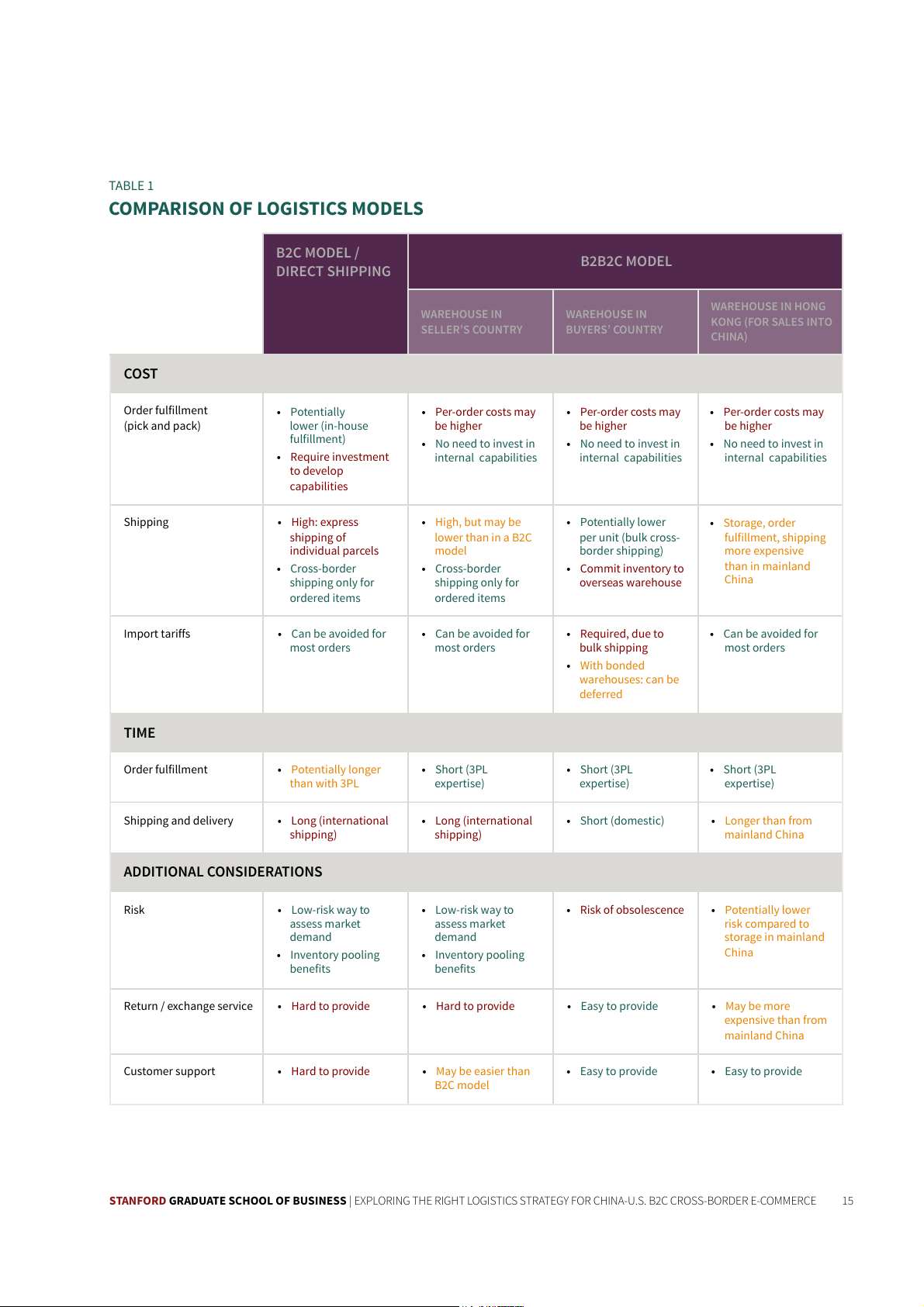
COMPARISON OF LOGISTICS MODELS
Table 1 compares the different logistics models
(in green) and disadvantages (in red) of each of the
based on their associated costs, order fulfillment and
logistics models. The text in orange indicates a lower
delivery times, and a few other key considerations.
level of advantage/disadvantage compared with
We use a color scheme to indicate the advantages those listed in green/red.
78 “Policy on Import and Export of Goods,” Trade and Industry Department, The Government of the Hong Kong Special Administrative Region, accessed Oct. 3, 2022.
79 “Selling via Bonded Warehouses in China: A Complete Guide,” Export2Asia, Sept. 11, 2020.
STANFORD GRADUATE SCHOOL OF BUSINESS | EXPLORING THE RIGHT LOGISTICS STRATEGY FOR CHINA-U.S. B2C CROSS-BORDER E-COMMERCE 14 TABLE 1
COMPARISON OF LOGISTICS MODELS B2C MODEL / B2B2C MODEL DIRECT SHIPPING WAREHOUSE IN HONG WAREHOUSE IN WAREHOUSE IN KONG (FOR SALES INTO SELLER’S COUNTRY BUYERS’ COUNTRY CHINA) COST Order fulfillment • Potentially
• Per-order costs may
• Per-order costs may
• Per-order costs may (pick and pack) lower (in-house be higher be higher be higher fulfillment)
• No need to invest in
• No need to invest in
• No need to invest in • Require investment internal capabilities internal capabilities internal capabilities to develop capabilities Shipping • High: express • High, but may be • Potentially lower • Storage, order shipping of lower than in a B2C per unit (bulk cross- fulfillment, shipping individual parcels model border shipping) more expensive • Cross-border • Cross-border
• Commit inventory to than in mainland shipping only for shipping only for overseas warehouse China ordered items ordered items Import tariffs • Can be avoided for • Can be avoided for • Required, due to • Can be avoided for most orders most orders bulk shipping most orders • With bonded warehouses: can be deferred TIME Order fulfillment • Potentially longer • Short (3PL • Short (3PL • Short (3PL than with 3PL expertise) expertise) expertise) Shipping and delivery
• Long (international
• Long (international • Short (domestic) • Longer than from shipping) shipping) mainland China
ADDITIONAL CONSIDERATIONS Risk • Low-risk way to • Low-risk way to
• Risk of obsolescence • Potentially lower assess market assess market risk compared to demand demand storage in mainland • Inventory pooling • Inventory pooling China benefits benefits Return / exchange service • Hard to provide • Hard to provide • Easy to provide • May be more expensive than from mainland China Customer support • Hard to provide • May be easier than • Easy to provide • Easy to provide B2C model
STANFORD GRADUATE SCHOOL OF BUSINESS | EXPLORING THE RIGHT LOGISTICS STRATEGY FOR CHINA-U.S. B2C CROSS-BORDER E-COMMERCE 15
CROSS-BORDER SHIPPING ALTERNATIVES KEY POINTS
• Commonly used alternatives for cross-border shipping include postal service providers, express logistics
providers, freight forwarders and consolidators, and the logistics arms of the larger e-commerce companies.
• Postal service providers offer more affordable but potentially slower services.
• Express logistics providers offer a fast and convenient service but tend to be expensive.
• Freight forwarders deal with larger shipment sizes. They act as intermediaries between shippers and shipping companies.
• Some of the large e-commerce companies built a logistics network for storage, distribution, and order
fulfillment that merchants can take advantage of.
Beyond the selection of a logistics model, another
express logistics providers, freight forwarders and
important decision merchants who engage in cross-
consolidators, as well as the logistics arms of the
border e-commerce need to make is what provider
larger e-commerce companies. Following is an
to partner with for cross-border shipping. Commonly
overview of each of these alternatives.
used alternatives include postal service providers,
POSTAL SERVICE PROVIDERS
Merchants who use direct shipping to fulfill overseas
First Class Package International Service is $28.85 81
customer orders may choose to ship the goods with
(delivery time varies by destination). USPS will
the postal service. The two postal service providers
charge $42.15 for priority service of packages of up
involved in shipments between China and the
to 4 lbs, with delivery times between 6-10 business
U.S. are China Post and the United States Postal
days. Shipping costs from China to the U.S. via China
Service (USPS). Since USPS and China Post are both
Post are similar, ranging between 104-314 RMB/kg
members of the Universal Postal Union, they can
($7.16/lb to $21.63/lb). 82 Delivery time with China
take advantage of the Customs Declaration System
Post’s more expensive service is 7-15 business days,
created by the UPU to streamline customs clearance
while the cheapest option can take 40-70 days. and minimize delays. 80
USPS and China Post also offer express delivery
USPS and China Post offer multiple shipping options
services, which are speedier but also more expensive.
that vary in price and speed. Their slower services are
For instance, China Post Express Mail Service costs
the most affordable among all the logistics options
240 RMB ($35.35) for merchandise up to 0.5 kg
discussed in this paper. For instance, the cost to
(1.1 lbs) plus an additional 75 RMB ($11) for every
ship a small package of 0.5-2 lbs to China via USPS
additional 0.5 kg, with a delivery time of 5 business
80 “Universal Postal Union: Customs,” accessed May 12, 2022.
81 “USPS Price List,” First Class Package Int’l Service, price group 14, accessed Sept. 27, 2022.
82 China Post website, accessed April 2022.
STANFORD GRADUATE SCHOOL OF BUSINESS | EXPLORING THE RIGHT LOGISTICS STRATEGY FOR CHINA-U.S. B2C CROSS-BORDER E-COMMERCE 16
days. With USPS Priority Express it will cost $69.50 to
additional pound, with an expected delivery time of
ship a small package of up to 1 lb plus $6.75 for each
3-5 business days to many major markets.
EXPRESS LOGISTICS PROVIDERS
Another option for merchants who use direct
the logistics options discussed in this paper. As an
shipping and are looking for a fast and convenient
example, shipping a small package weighing 1 lb
delivery service is to ship their customer orders with
from California to Shanghai with UPS will cost about
an express logistics provider. Such providers offer
$150, with a delivery time of 3-4 business days. 83
an end-to-end service with short delivery times, full
While the Chinese express logistics companies are
tracking from pickup to delivery, and fully managed
likely to be less expensive than the international
customs clearance. They may also offer other value-
alternatives, their coverage may be more limited and
added services, such as assistance with special
their delivery times may be slightly longer. 84
customs clearance needs or allowing customers to
Some of the leading express logistics providers
adjust delivery time and location. At the same time,
include U.S.-based FedEx and UPS, Germany-based
their services are likely to be the most expensive of
DHL, and China-based SF Express.
FREIGHT FORWARDERS AND CONSOLIDATORS
Freight forwarders and consolidators usually deal
“freight forwarder” for the remainder of the paper
with larger shipment sizes, so their services will be
when referring to these service providers.
most relevant for merchants who operate under
Smaller freight forwarders may collaborate with a
the B2B2C model or those who have higher sales
correspondent agent in the destination country,
volumes. The role of a consolidator is to combine
who will take care of inbound document processing,
several smaller shipments belonging to multiple
deconsolidation, and collection or delivery. Some
shippers into full container loads, to reduce shipping
of the larger freight forwarders may offer a broader
costs. A freight forwarder specializes in organizing
solution that covers activities at the origin and
shipments by acting as an intermediary between destination countries.
shippers and shipping companies. Freight forwarders
Some freight forwarders may offer additional
do not move the goods. Rather, they help identify
services beyond cross-border ocean or air freight
the best carriers for the specific needs of the
transportation. These may include organizing inland
shipper based on such parameters as cost, speed,
transportation to/from the international port,
and reliability, and then coordinate the shipments
preparing and processing customs documentation
on behalf of shippers. These days the two terms,
(or managing the expert services of independent
consolidator and freight forwarder, are often used
customs brokers, whose role is to ensure that all
interchangeably, as many of the companies in the
documentation is prepared and filed correctly), and
field offer both consolidation and freight forwarding
helping businesses identify the most cost-effective
services. For convenience, we will only use the term
insurance providers and export packing services.
83 “UPS: Calculate Time and Cost,” accessed Nov. 3, 2022.
84 “SF-International: Rates & Transit Time,” accessed Nov. 3, 2022.
STANFORD GRADUATE SCHOOL OF BUSINESS | EXPLORING THE RIGHT LOGISTICS STRATEGY FOR CHINA-U.S. B2C CROSS-BORDER E-COMMERCE 17
Some may also offer or help secure warehousing
The freight forwarding global market is extremely
and order fulfillment services. Merchants can decide
fragmented, with each of the leading companies
whether to take advantage of the wider range of
holding no more than 3-6% market share. 85
services offered by some of the freight forwarders
Some of the top freight forwarding companies for
or collaborate with multiple service providers,
trade between the U.S. and China include DSV,
each specializing in one aspect of the cross-border
Kuehne+Nagel, DB Schenker, Expeditors, C.H. shipping process. Robinson, and Flexport.
LOGISTICS ARMS OF E-COMMERCE PLATFORMS
The larger e-commerce companies, including
Cainiao: Cainiao Network, launched in 2013, is a
China-based Alibaba and JD.com and North America
global smart-logistics company and the logistics
companies Amazon and Shopify, have built an
arm of Alibaba Group. According to company data,
in-house network of storage facilities, fulfillment
Cainiao delivered a daily average of 4.5 million
centers, and distribution networks. Merchants taking
cross-border and international packages in FY2022.
advantage of these networks can enjoy a fast and
Through Cainiao’s full-chain logistics network
seamless order fulfillment, and can in turn offer their
spanning over 200 countries, merchants can enjoy
customers fast delivery and a simple returns process.
a range of cost- and time-efficient delivery options
Below is a brief overview of the logistics offerings of
for the goods that they sell online. U.S. merchants
these leading e-commerce companies.
selling to Chinese consumers can take advantage
Amazon: Amazon operates an extensive logistics
of the end-to-end logistics services offered by
network in the U.S., which includes cargo planes,
Cainiao into mainland China as well as into China’s
freight and delivery trucks, warehouses, and
Hainan Free Trade Port. These services support
fulfillment centers. Third party merchants selling on
both B2C and B2B2C models and include inland
Amazon.com can take advantage of this logistics
transportation in the U.S., shipping to China, storage
infrastructure by choosing to have Amazon fulfill
and order fulfillment, as well as inland transportation
their customer orders through the Fulfillment By
and delivery in China. Cainiao also offers end-to-
Amazon (FBA) service. Merchants located in China
end services for the China-to-U.S. route, supporting
can combine the FBA service with the Amazon Global
direct shipping as well as order fulfillment from a
Logistics service, under which Amazon takes care
U.S. fulfillment center. These services are available
of shipping merchants’ cargo from China directly
to all merchants, regardless of whether they sell
to Amazon fulfillment centers in the U.S. Merchants
their goods through one of Alibaba’s e-commerce
who sell to U.S. consumers on Amazon.com as well platforms.
as other sales channels can use Amazon’s fulfillment
JD.com: JD.com has one of the largest fulfillment
network to fulfill orders received through all the
infrastructures of any e-commerce company in different channels. 86
the world. As of September 2022, the company
85 “DSV Annual Report 2021,” page 15, accessed Sept. 19, 2022.
86 “Multi-Channel Fulfillment,” Amazon.com, accessed March 15, 2022.
STANFORD GRADUATE SCHOOL OF BUSINESS | EXPLORING THE RIGHT LOGISTICS STRATEGY FOR CHINA-U.S. B2C CROSS-BORDER E-COMMERCE 18
operated over 1,500 warehouses, 87 as well as a
a range of services including inventory management,
network of logistics parks. JD also operates a number
product storage and handling, order pick and pack,
of air cargo routes and hundreds of cross-border
fast delivery, and returns processing. 91 Shopify’s
transportation routes by sea, rail, and trucks. 88 Their
acquisition of e-commerce fulfillment company
logistics services from China to the U.S. include direct
Deliverr in May 2022 further enhanced its end-to-end
line shipping, international air and sea transport, logistics offerings. 92
and global fulfillment from six U.S.-based fulfillment
JD.com and Shopify Alliance: In January 2022
centers. As for imports from the U.S. to China, JD’s
JD.com and Shopify announced a strategic
import logistics services consist of storage in cross-
partnership aimed at helping to solve cross-border
border bonded warehouses, overseas special mail,
commerce challenges for merchants in the U.S. and
cross-border traceability, smart customs clearance,
China. Under this partnership, U.S.-based merchants
and more. 89 JD offers these logistics services to all
can easily list their products on JD Worldwide, with
merchants, regardless of whether they sell their
expedited onboarding. They can also take advantage
goods on the company’s marketplace.
of JD’s global logistics network to handle end-to-
Some of the smaller e-commerce platforms are also
end fulfillment from JD’s warehouses in the U.S.
taking advantage of JD’s global logistics network.
directly to consumers in China. 93 As for China-based
One example is VIP International, which in 2018
merchants, those who set up their storefronts on
entered a strategic alliance with JD Global. Under
Shopify can enjoy a simplified logistics process
this alliance, VIP International shares its 12 overseas
for order fulfillment, taking advantage of JD’s
warehouses with JD.com, which in turn shares its
global logistics network for shipping to the U.S., in
logistics capabilities with VIP International. 90
combination with the Shopify Fulfillment Network. 94
Shopify: The company operates multiple fulfillment
centers throughout the U.S. and offers its merchants
87 “Our Business - JD Logistics,” JD.com, accessed Dec. 7, 2022.
88 Vivian Yang, “JD Logistics Spotlights Air Cargo and Automated Warehouses for Global Expansion,” JD.com, Oct. 18, 2021.
89 “JD International Logistics,” JD Worldwide, accessed Nov. 7, 2022.
90 “A look at CBEC: VIP Global and JD Global share their overseas logistics resources,” Southern Metropolis Daily, May 25, 2018.
91 “Shopify Fulfillment Network: Grow Your Business with Fast, Affordable Delivery,” Shopify, accessed Feb. 7, 2023.
92 “Shopify Completes Acquisition of Deliverr to Expand Fast and Easy Fulfillment for Merchants Across Multiple Channels,” Shopify, July 8, 2022.
93 “Shopify and JD.com Unlock World’s Largest Ecommerce Market for Merchants,” Shopify, Jan. 18, 2022.
94 Rita Liao, “Shopify and China’s JD.com Team Up to Capture Cross-Border Sellers,” TechCrunch, Jan. 18, 2022.
STANFORD GRADUATE SCHOOL OF BUSINESS | EXPLORING THE RIGHT LOGISTICS STRATEGY FOR CHINA-U.S. B2C CROSS-BORDER E-COMMERCE 19 LOGISTICS FLOWS KEY POINTS
• The flow of goods from the merchant’s warehouse to the end customer will differ based on the logistics
model and shipping alternative selected by the merchant.
• This section provides an overview of the logistics flows associated with each shipping alternative and the
entity in charge of each step of the process.
We next provide a detailed description of the
flows for China-to-U.S. and U.S.-to-China shipments
logistics flows associated with each of the shipping
are similar, we offer only a detailed description of the
alternatives discussed in the previous section. To China-to-U.S. route.
avoid repetition, in those cases when the logistics
POSTAL SERVICE PROVIDERS
When shipping goods from China to the U.S. with
to be shipped to the U.S. (the parcels will likely be
the postal service, the typical process flow will look
shipped with an airline or freight carrier China Post
as follows 95 (see Figure 1): First, the merchant (or a
collaborates with). Once the parcels arrive to the
local 3PL provider the merchant partners with) will
U.S., they will be processed and go through customs
pick and pack the ordered items, label the parcel,
clearance at one of the USPS inward OEs. Finally,
prepare the required customs documents, and
USPS will ship the parcel from the entry airport all
bring the parcel to the post office. After verifying the way to the customer.
that all the customs declaration forms have been
When shipping goods from the U.S. to China the
properly completed, China Post will ship the parcel
process will be similar, only that the roles of China
to one of its outward offices of exchange (OE) for
Post and USPS will be reversed.
dispatch. Next, China Post will arrange for the parcel
95 Partly based on “WCO-UPU Postal Customs Guide,” April 2018.
STANFORD GRADUATE SCHOOL OF BUSINESS | EXPLORING THE RIGHT LOGISTICS STRATEGY FOR CHINA-U.S. B2C CROSS-BORDER E-COMMERCE 20
Tài liệu liên quan:
-
Giáo trình logistic về quản trị logistics
7 4 -

Chương 3 Đóng gói và vân chuyển - Mối quan hệ giữa đóng gói và vận chuyển trong logistics môn Logistics | Trường Đại học Kinh tế, Đại học Quốc gia Hà Nội
31 16 -

Yếu Tố: Các Quy Định Mà Tổ Chức Tuân Thủ môn logistics | Trường Đại học Kinh tế, Đại học Quốc gia Hà Nội
27 14 -
Mối liên hệ giữa Logistics và Vận tải đa phương thức môn Logistics | Trường Đại học Kinh tế, Đại học Quốc gia Hà Nội
38 19 -
E-Business & E-Commerce: Managing eCustomer Relationships | Logistics | Trường Đại học Kinh tế, Đại học Quốc gia Hà Nội
38 19