
1RPPPQCVQP
9
JT FQ IQQF FCU QO HTQO P
PVTPPVQTVQNPICNQPUTV
NCDHNNFVJTUCTJTUPJVQCVU
8UQHPPQCVQPCTUJHVPICCHTQOVJUVTC
PVTPCN TUCTJ CPF FNQROPV WPVU CPF VIJVN
QPVTQNNFDQVJVJPRWVUCPFQWVRWVUQHVJUQRTC
VQPU 1RRQTVWPVU VQ PVTCV VJ WUVQOTU T
NOVF CPF VJ RQUUDNV QH URPFPI OQPVJU QT
CTUCPFONNQPUQHFQNNCTUFNQRPIRTQFWVUVJCV
PQ QP CPVF CU C TCN VJTCV 0 VJPQNQIU
CTPCDNPICUJHVPVJCPPQCVQPQWTU
6TCFVQPCNNWPTUVUQWNFQPFWVDCUCPFCRRNF
TUCTJ DWV VJ TUWNVU QH VJU TUCTJ QPN UQOVOU
QWNF OCM VJT CVQ VJ RTCV UVQT%QTRQTCVQPU
QWNFHWPFVJTQPTUCTJCPFFNQROPVQRTCVQPU
QHVPCVITCVRPU5WJQRTCVQPUVQQMCTUVQUVWR
CPFTQHVPJIJNQPUVTCPFPVJVRUQHTUCTJ
VJQWNFCTTQWV2TQITCOUQHTUCTJTCNWCVF
CICPUVDWUPUURNCPUVJCVJCFDPUVWFFTFCPF
CRRTQFDOWNVRNNCTUQHOCPCIOPV6JVOCPF
QORNVPQNFPVJUDWTCWTCVRTQUUUQHVPNHV
VJCVWCNTUCTJQWVQHFCVCPFQWVQHVQWJVJVJ
TCNVUQHVJOCTMVRNCCPFCVWCNWUVQOTCPVUCPF
PFU6JTUWNVPIRTQFWVUQWNFQHVPHCNPVJOCTMV
FWVQDPICTUNCVQTPQNQPITDPITNCPV
1RPPPQCVQPUCPCRRTQCJPUVCFQHTNPI
QPVIJVNQPVTQNNFPVTPCNTUCTJRTQLVUQORCPU
TGG
PVJgRCUVFgECFgUVgEJPNIJCURTITgUUgFVTgOgP
FWUN CPF VJg FKIKVCN EPPgEVKP H RgRNg VJKPIU
CPF TICPKCVKPU JCU CEEgNgTCVgF gZRPgPVKCNN 0V
PN JCU VJKU KPETgCUKPI FKIKVCN FgPUKV JgNRgF TICPK
CVKPU HTO RRNgV CRRUVDgVVgT OCPCIg VJgKT
TICPKCVKPURTXKFgJKIJSWCNKVIFUCPFUgTXKEgU
TICKPTUWUVCKPEORgVKVKXgCFXCPVCIgXgTTKXCNUKV
JCUCNU EPVTKDWVgFVVTgOgPFWUEJCPIgUKP CNNCT
gCUHUEKgV1WTDlgEVKXgHTVJKUEJCRVgTKUVJgNR
WWPFgTUVCPFVJgTNgHKPHTOCVKPUUVgOUCUYg
EPVKPWgVOXgHWTVJgTKPVVJgFKIKVCNYTNFVJgTNg
H KPHTOCVKP UUVgOU KP EWTTgPV KUUWgU HCEgF D U
EKgVKgU KP VJgFKIKVCN YTNF CPF VJg TNg H KPETgCUKPI
FKIKVCNFgPUKVKPKPHNWgPEKPIVJgFKIKVCNHWVWTg9gVJgP
JKIJNKIJVYJCVKPHTOCVKPUUVgOUCTgJYVJgJCXg
gXNXgFVDgEOgCXKVCNRCTVHOFgTPTICPKCVKPU
CPFYJVJKUWPFgTUVCPFKPIKUPgEgUUCTHTWVDg
EOg CP gHHgEVKXg OCPCIgT KP VJg FKIKVCN YTNF 9g
EPENWFg D FKUEWUUKPI gVJKECN KUUWgU CUUEKCVgF YKVJ
VJgWUgHKPHTOCVKPUUVgOU
/CPCIPIPVJ
&IVCN9QTNF
1
CTQRPPIWRVJTTUCTJCPFFNQROPVHHQTVUVQ
CDTQCFCWFP(IWT%WUVQOTUUWRRNTUCPF
QVJTQORCPUCTPVFVQRCTVRCVOQTFTVN
PFHHTPVRJCUUQHVJPPQCVQPRTQUUCPFQORC
PUCTQTMPIOQTQNNCDQTCVNVJWPTUVU
/CP QORCPU VCM VJU FCU P HWTVJT CPF
QRPWRVJTUCTJCPF FNQROPVHHQTVUVQCP
QP JQUJUVQRCTVRCVQPNPQTPRTUQP(QT
CORN 5VCTDWMU PVTQFWF p/ 5VCTDWMU FC
JTWUVQOTUCPRQUVFCUCPFUWIIUVQPUCUNN
CUQVQPQTFUWUUQVJTUoFCUWPFTFUQHWUVQOT
IPTCVFFCUJCDPORNOPVFQTVJCTU
PMPoU pPPQCVQTU $TJQWU WUU QRP PPQC
VQP VQ IPTCV FCU TNCVF VQ VQRU TCPIPI HTQO
OVJQFUHQTQWPVTHVFVVQP VQDTPI NQUTVQ
VJQPUWOTTCVPIOQTQPPPVRCMCIPICPF
P CNTCVPI FCU HQT DTPIPI P RTQFWVU VQ
OCTMV1RPPPQCVQPJCUCNUQNPMFRTVUCTQUU
PFWUVTUCPFFURNPUVQVCMNVJWTIPVJCNVJJCN
NPIUQHVJFCUWJCUHIJVPI%18&(WTVJTP
VQQNUNMPVTCV&UWCNCVQPCPFTCRFRTQVQVR
PIVJPQNQIUNM&RTPVPICNNQHQTVTOPFQWUN
NQTFDCTTTUVQPVTVQPPQCVQP/CPQORCPU
CPFPUVVWVQPUJCUVWRQNNCDQTCVURCUVQUJCT
TUQWTU CPF PQWTCI VJHWUQPQH FCU CPF UMNNU
VJCV CPNCFVQVPIDTCMVJTQWIJUUVJOCP
PPQCVQPU VJOUNU VJU C QH PPQCVPI QWNF
PQVDRQUUDNVJQWVPHQTOCVQPUUVOU
HVTTCFPIVJUJCRVTQWNNDCDNVQCPUT
VJHQNNQPI
QFQUPTCUPIFIVCNFPUVHWNQRP
PPQCVQP
9JCVCTVJRTOCTPHQTOCVQPUUVOUQORQ
PPVUVJCVPCDNQRPPPQCVQP
9JCVPVNNVWCNRTQRTVUUWUCTUHTQOPICI
PIPQRPPPQCVQP
$CUFQP
$QCTFQHPPQCVQPPF1RPPPQCVQPCPFTQFUQWTPI
TUQWTUVTF/CHTQOJVVRUDQCTFQHPPQCVQP
QOUVCHHARMUQRPPPQCVQPTQFUQWTPITUQWTU
&CJNCPFT.9CNNP/,WP9JPQUVJVOHQTp1RP
PPQCVQP VTF,WNHTQO
JVVRUJDTQTIJPQUVJVOHQTQRPPPQCVQP
1RPPPQCVQP%QOOWPVPF1RPPPQCVQPVTF/C
HTQOJVVRQRPPPQCVQPPVCVIQTQRPPPQCVQP
After this
chapter, you
will be able
to do the
following:
1. Describe the characteristics of the digital world, contemporary societal issues of the
digital world, and how increasing digital density is shaping the digital future.
2. Explain what an information system is, contrasting its data, technology, people, and
organizational components.
3. Describe the dual nature of information systems in the success and failure of modern
organizations.
4. Describe how computer ethics affect the use of information systems and discuss the
ethical concerns associated with information privacy and intellectual property.
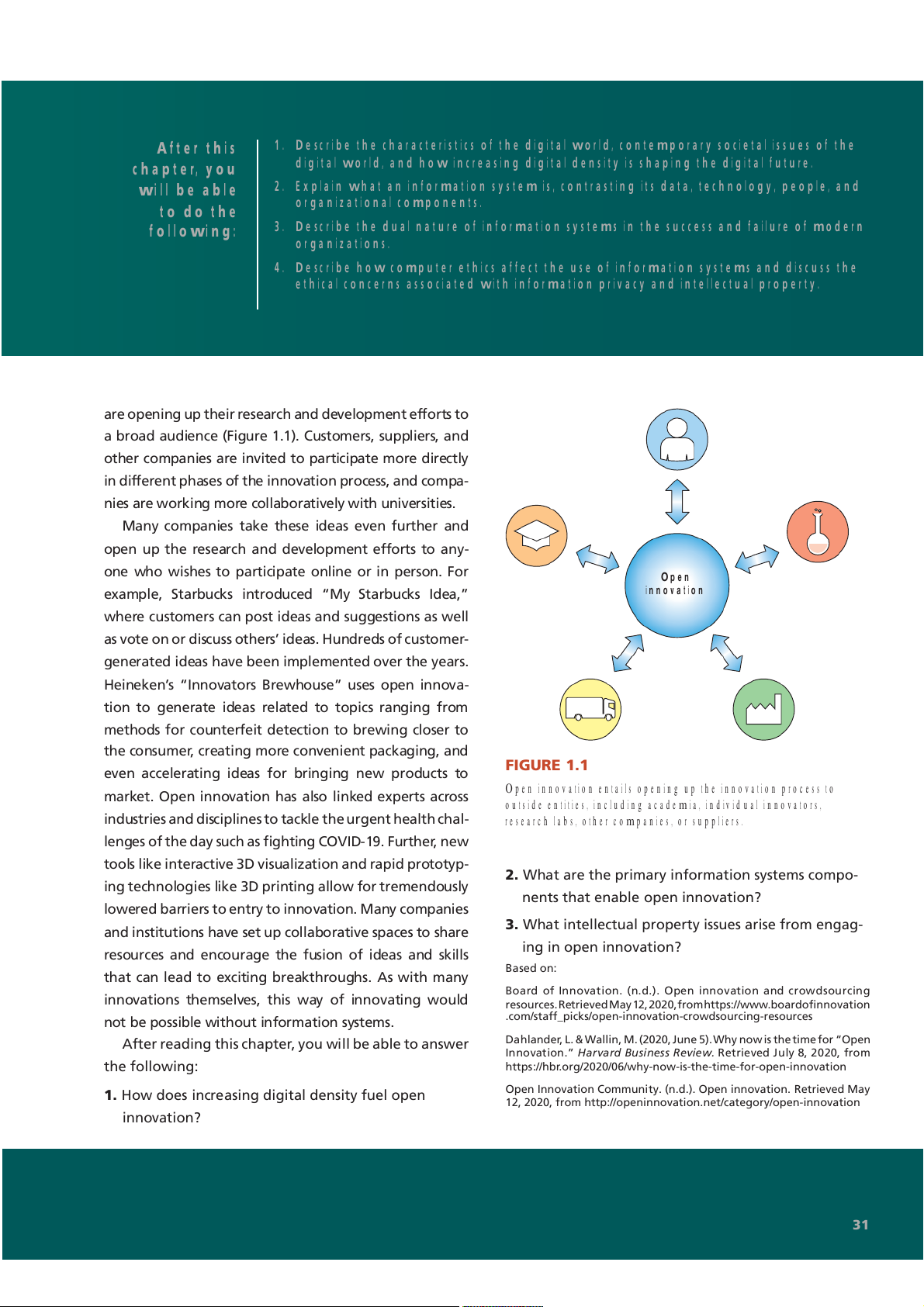
Open
innovation
()74
Open innovation entails opening up the innovation process to
outside entities, including academia, individual innovators,
research labs, other companies, or suppliers.
264 r /0)0)06&)6.914.&
PHQTOCVKQP5UVGOU6QFC
Today, information systems (IS) are ubiquitous: Be it traditional desktop computers, laptop com-
puters, smartphones, tablets, you name it, information systems are all around us, whether you
see them or not. Companies such as FedEx and UPS use information systems to route trucks and
track packages. Retailers such as Walgreens and Walmart use information systems for everything
from optimizing supply chains to recording purchases and analyzing customer tastes and prefer-
ences. Cities use information systems for adaptive traffic control systems or variable speed limits.
Cars use information systems for everything from ignition control to airbags to distance control
and park assist systems. Many innovative (summaries of businesss strategic business models
directions that outline how the objectives will be achieved), ranging from Airbnb to Uber, are
built on or around information systems. Alternatively, just look around your school or place of
work. At your school, you register for classes online; use email, Twitter, or other social media
to communicate with fellow students and your instructors; access e-books from your library;
and complete or submit assignments on online learning platforms such as Blackboard, Moodle,
Canvas, or Sakai. At work, you may use a PC for email and many other tasks. Your paychecks are
probably generated by computer and automatically deposited into your bank account via high-
speed networks. Even (and especially) in your spare time, information systems are ubiquitous:
You use social networking sites like Facebook or TikTok to stay connected with your friends
and family, you watch videos on YouTube, you upload pictures taken with your smartphone to
picture-sharing sites like Instagram, you listen to music on Pandora or Spotify, and you use your
smartphone for playing games, sending emails, navigating through your city, purchasing concert
tickets, or reading books. Chances are that each year you see more information systems than you
did the year before, and these systems are a more fundamental and important part of your social,
academic, and work life than ever before.
6GOGTIGPEGHGICN9TNF
Over the past decades, the advent of powerful, relatively inexpensive, easy-to-use computers has
had a major impact on business and society. When you stop and think about it, it is easy to see
why information systems are important. Increasing global competitiveness has forced companies
to find ways to be better and to do things less expensively. The answer for many firms continues
to be to use information systems to do things better, faster, and cheaper. Many organizations
use information systems to support innovative business models or build their entire business
models around technological innovations. Likewise, using global telecommunications networks,
companies can more easily integrate their operations to access new markets for their products
and services as well as access a large pool of talented workers no matter where they are located.
Clearly, we are living in a digital world. With the proliferation of mobile devicessuch as
tablets or smartphonesand the possibility to connect ranging from tennis shoes to things
wind turbineswe are now living in the post-PC era, where connected devices are replacing
traditional desktop and laptop computers. In fact, already in the last quarter of 2011, Apple sold
more iPads than HP (traditionally one of the worlds leading PC makers) sold PCs (Nielsen,
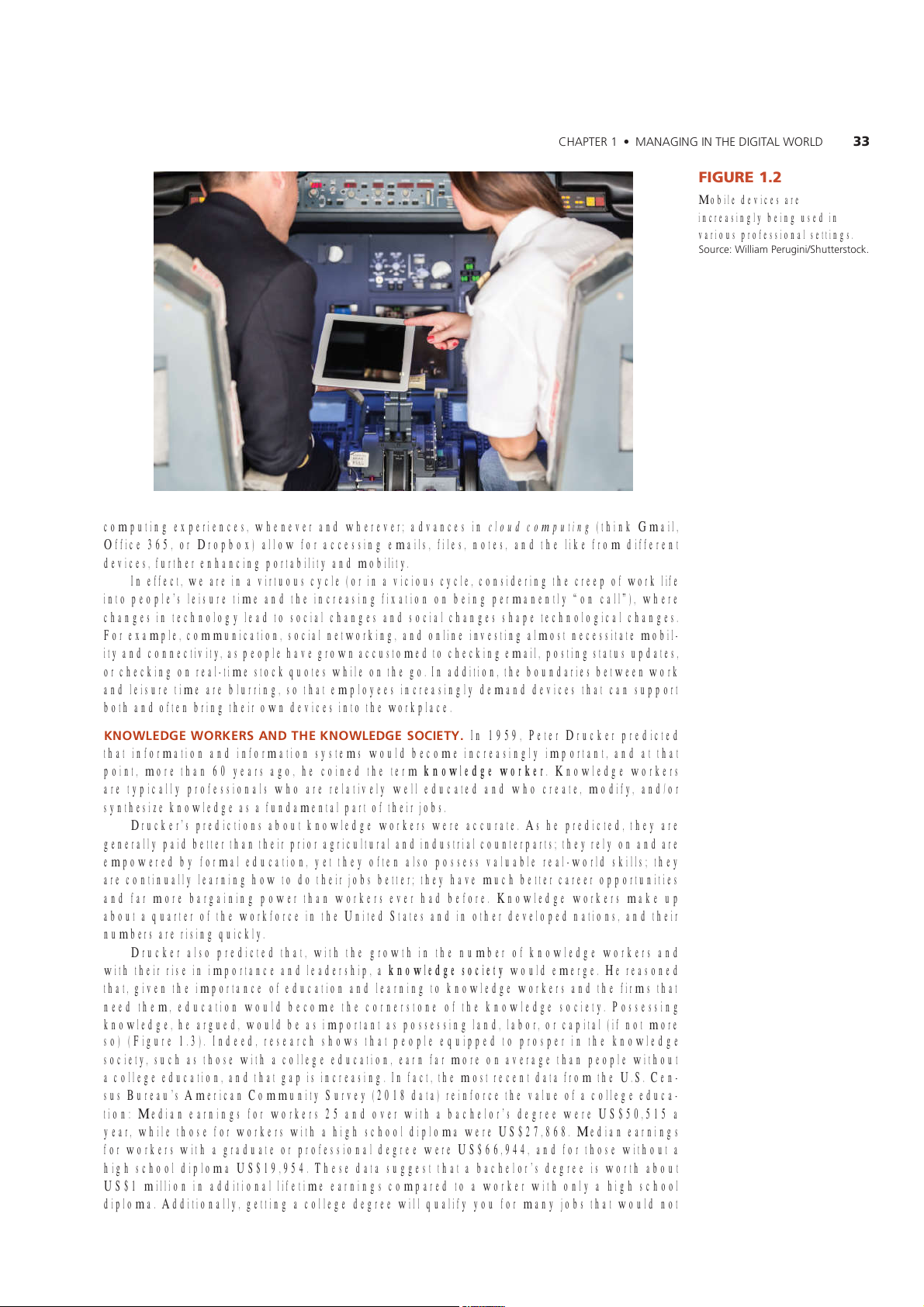
2016). Initially created as consumer devices, tablets are now commonplace in various profes-
sional settings, including warehouses, showrooms, airplane cockpits, and hospitals (Figure 1.2).
Devices with newer form factors work in tandem with older form factors to provide truly ubiqui-
tous experiences; mobile devices complement traditional computers, providing different devices
for different users and different tasks, where not the device but the services and data provided
are of primary importance. Further, the changes we have seen so far have given rise to develop-
ments such as wearable computers, augmented reality devices, or surface computers.
Changes in technology have enabled new ways of working and socializing; whereas in the
past, people were bound to a stationary PC to do essential tasks, they are not bound to any
particular location any more. Likewise, workdays traditionally had a clear beginning and a
clear endfrom when you powered your computer on to when you turned it off at night.
Today, many tasks (especially more casual tasks such as reading or sending emails) can be
done at any time, often in small chunks in between other tasks, such as when waiting in line at
the supermarket cashier.
Computing has changed from an activity primarily focused on automating work to provid-
ing new benefits and services, and to encompass various social and casual activities. Devices
such as smartphones or tablets, paired with mobile broadband networks, allow for instant-on
264 r /0)0)06&)6.914.&
computing experiences, whenever and wherever; advances in (think Gmail, cloud computing
Office 365, or Dropbox) allow for accessing emails, files, notes, and the like from different
devices, further enhancing portability and mobility.
In effect, we are in a virtuous cycle (or in a vicious cycle, considering the creep of work life
into peoples leisure time and the increasing fixation on being permanently on call), where
changes in technology lead to social changes and social changes shape technological changes.
For example, communication, social networking, and online investing almost necessitate mobil-
ity and connectivity, as people have grown accustomed to checking email, posting status updates,
or checking on real-time stock quotes while on the go. In addition, the boundaries between work
and leisure time are blurring, so that employees increasingly demand devices that can support
both and often bring their own devices into the workplace.
-01.)14-45 06-01.)516 In 1959, Peter Drucker predicted
that information and information systems would become increasingly important, and at that
point, more than 60 years ago, he coined the term . Knowledge workers knowledge worker
are typically professionals who are relatively well educated and who create, modify, and/or
synthesize knowledge as a fundamental part of their jobs.
Druckers predictions about knowledge workers were accurate. As he predicted, they are
generally paid better than their prior agricultural and industrial counterparts; they rely on and are
empowered by formal education, yet they often also possess valuable real-world skills; they
are continually learning how to do their jobs better; they have much better career opportunities
and far more bargaining power than workers ever had before. Knowledge workers make up
about a quarter of the workforce in the United States and in other developed nations, and their
numbers are rising quickly.
Drucker also predicted that, with the growth in the number of knowledge workers and
with their rise in importance and leadership, a would emerge. He reasoned knowledge society
that, given the importance of education and learning to knowledge workers and the firms that
need them, education would become the cornerstone of the knowledge society. Possessing
knowledge, he argued, would be as important as possessing land, labor, or capital (if not more
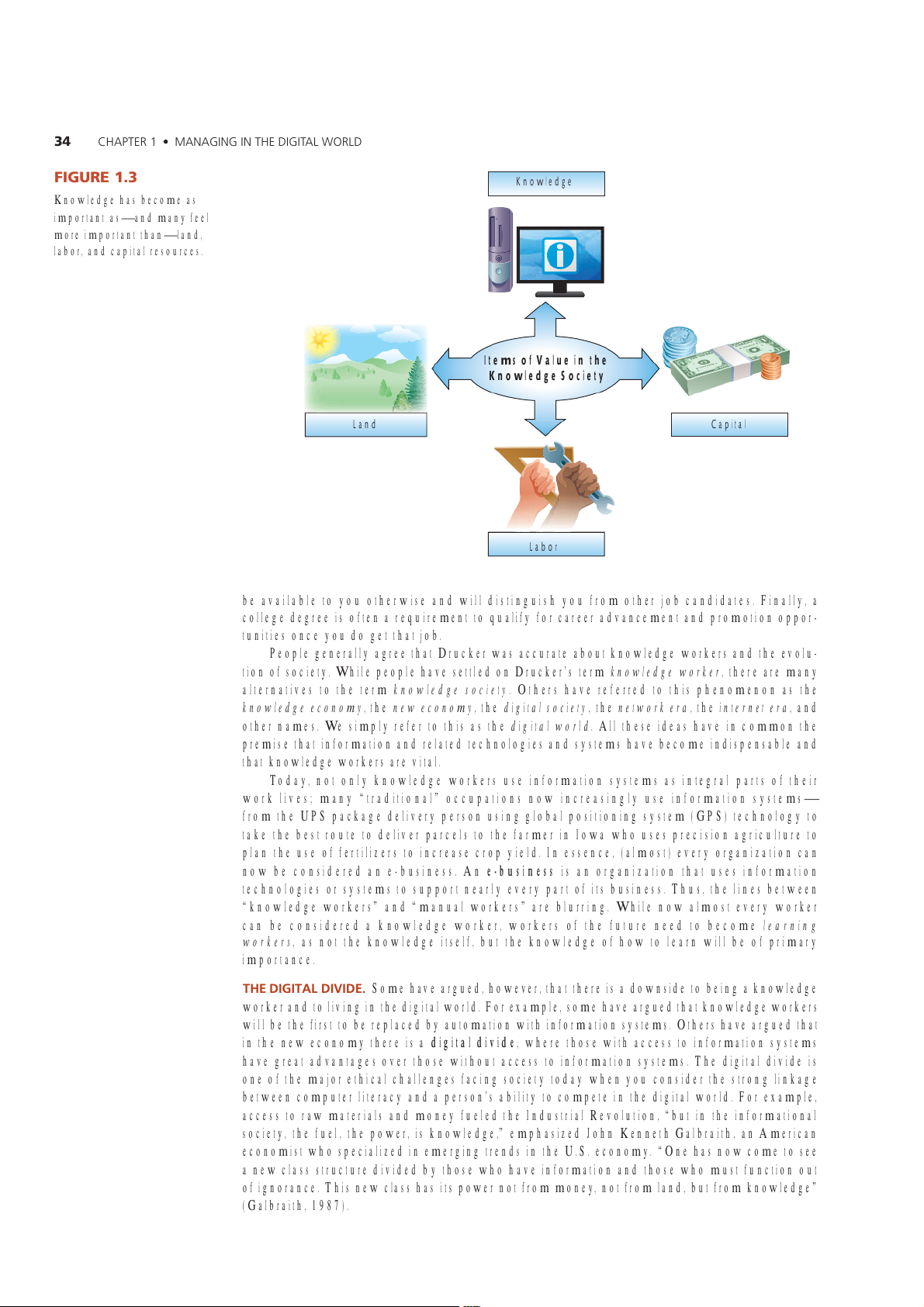
so) (Figure 1.3). Indeed, research shows that people equipped to prosper in the knowledge
society, such as those with a college education, earn far more on average than people without
a college education, and that gap is increasing. In fact, the most recent data from the U.S. Cen-
sus Bureaus American Community Survey (2018 data) reinforce the value of a college educa-
tion: Median earnings for workers 25 and over with a bachelors degree were US$50,515 a
year, while those for workers with a high school diploma were US$27,868. Median earnings
for workers with a graduate or professional degree were US$66,944, and for those without a
high school diploma US$19,954. These data suggest that a bachelors degree is worth about
US$1 million in additional lifetime earnings compared to a worker with only a high school
diploma. Additionally, getting a college degree will qualify you for many jobs that would not
()74
Mobile devices are
increasingly being used in
various professional settings.
5WTEg9KNNKCO2gTWIKPK5JWVVgTUVEM
264 r /0)0)06&)6.914.&
be available to you otherwise and will distinguish you from other job candidates. Finally, a
college degree is often a requirement to qualify for career advancement and promotion oppor-
tunities once you do get that job.
People generally agree that Drucker was accurate about knowledge workers and the evolu-
tion of society. While people have settled on Druckers term , there are many knowledge worker
alternatives to the term . Others have referred to this phenomenon as the knowledge society
knowledge economy, the , the new economy digital society network era, the , the internet era, and
other names. We simply refer to this as the . All these ideas have in common the digital world
premise that information and related technologies and systems have become indispensable and
that knowledge workers are vital.
Today, not only knowledge workers use information systems as integral parts of their
work lives; many traditional occupations now increasingly use information systems
from the UPS package delivery person using global positioning system (GPS) technology to
take the best route to deliver parcels to the farmer in Iowa who uses precision agriculture to
plan the use of fertilizers to increase crop yield. In essence, (almost) every organization can
now be considered an e-business. An is an organization that uses information e-business
technologies or systems to support nearly every part of its business. Thus, the lines between
knowledge workers and manual workers are blurring. While now almost every worker
can be considered a knowledge worker, workers of the future need to become learning
workers, as not the knowledge itself, but the knowledge of how to learn will be of primary
importance.
6)6. Some have argued, however, that there is a downside to being a knowledge
worker and to living in the digital world. For example, some have argued that knowledge workers
will be the first to be replaced by automation with information systems. Others have argued that
in the new economy there is a , where those with access to information systems digital divide
have great advantages over those without access to information systems. The digital divide is
one of the major ethical challenges facing society today when you consider the strong linkage
between computer literacy and a persons ability to compete in the digital world. For example,
access to raw materials and money fueled the Industrial Revolution, but in the informational
society, the fuel, the power, is knowledge, emphasized John Kenneth Galbraith, an American
economist who specialized in emerging trends in the U.S. economy. One has now come to see
a new class structure divided by those who have information and those who must function out
of ignorance. This new class has its power not from money, not from land, but from knowledge
(Galbraith, 1987).
Items of Value in the
Knowledge Society
Knowledge
Labor
Land Capital
()74
Knowledge has become as
important asand many feel
more important thanland,
labor, and capital resources.
264 r /0)0)06&)6.914.&
The good news is that the digital divide in America is rapidly shrinking, but there are still
major challenges to overcome. In particular, people in rural communities, the elderly, people
with disabilities, and minorities lag behind national averages for internet access and computer
literacy. Outside the United States and other developed countries, the gap gets even wider and
the obstacles get much more difficult to overcome, particularly in the developing countries
where infrastructure and financial resources are lacking. For example, most developing coun-
tries are lacking modern informational resources such as affordable internet access or efficient
electronic payment methods.
To be sure, there is a downside to overreliance on information systems, but one thing
is for certain: Knowledge workers and information systems are now critical to the suc-
cess of modern organizations, economies, and societies. At the same time, information
systems play a crucial role in various major issues societies face. These issues are exam-
ined next.
)NDCNCPCPF5EGCNUUWGUPGICN9TNF
The past decades have brought about a number of dramatic global changes, many of which
will continue to influence individuals, businesses, economies, and societies well into the
future. Many of such interrelated societal megatrends, discussed by consulting firms such
as PricewaterhouseCoopers (PwC) or Ernst & Young (EY), local and national governments, or
global political and business leaders at the World Economic Forum, are related to ever-increasing
globalization the integration of economies throughout the world, enabled by innovation and
technological progress ( International Monetary Fund, 2002 ). You can see the effects of globaliza-
tion in many ways, such as the greater international movement of commodities, money, informa-
tion, and labor as well as the development of technologies, standards, and processes to facilitate
this movement.
PVJgWGTOCPHKNOU CPFOCP VJgT UEKHKOXKgUCPF
DMUEJCTCEVgTUOCMgWUgHFCVCUVTCIgFgXKEgUVJCV
TgUgODNgNCTIgETUVCNUPVJgUVTKgUVJgUgETUVCNUHVgP
UVTgKPETgFKDNNCTIgCOWPVUHFCVCCPFNCUVHTgZVTCTFK
PCT NgPIVJU H VKOg 0Y UEKgPVKUVU JCXg VCMgPC UVgR
VYCTFOCMKPIUWEJVgEJPNICTgCNKV4gUgCTEJgTUCVVJg
7PKXgTUK V H 5 WVJ CO RVP 7 - JCXg ETgC Vg F C
PCPUVTWEVWTgF INCUU UVTCIg FgXKEg VJCV TgUgODNgUVJg
HKEVKPCNVgEJPNIKgU6JgVgEJPKSWgWUgUUgNHCUUgODNKPI
PCPUVTWEVWTgU YTKVVgP KPV HWUgF SWC TV WUKPI VKP
HgOVUgEPFPgSWCFTKNNKPVJT PgOKNNKPVJHPg
DKNNKPVJ H C UgEPF NCUgT NKIJV RWNUgU 6Jg FCVC CTg
gPEFgFKPHKXgFKOgPUKPU&JgKIJVNgPIVJYKFVJRUK
VKPCPFTKgPVCVKP7UKPIVJgUgOWNVKRNgFKOgPUKPUCNPI
YKVJVJgPCPUECNgNCUgTYTKVKPICNNYUCUOCNNINCUUFKUE
CDWVVJgUKgHCNCTIgEKPVUVTgVgTCDVgU6$H
FCVCUCVgTCDVgKUgSWCNVIKICDVgU)$VJg
COWPVHFCVCUVTgFPgCEJVKPFKUMKUUgXgTCNJWPFTgF
VKOgUVJgCOWPVHFCVCUVTgFPCUVCPFCTFFgUMVREO
RWVgTs6$CPFUgXgTCNVJWUCPFVKOgUVJgFCVCUVTCIg
ECRCEKVHOUVUOCTVRJPgUs)$6JgSWCTV
OCVgTKCNKUJKIJNUVCDNgWRVDKNNKPgCTUCVTO
VgORgTCVWTgCPFECPUWTXKXgCOCZKOWOHFgITggU
gNUKWUUFCVCECPDgCTEJKXgFgUUgPVKCNNHTgXgT
6FgOPUVTCVgVJgVgEJPNIVJgUEKgPVKUVUTgETFgFUgX
gTCNOClTFEWOgPVUHTOJWOCPJKUVTPVJgFKUMUKPENWF
KPIVJg7PKXgTUCN&gENCTCVKPHWOCP4KIJVU0gYVPoU
VEMVJg/CIPCCTVCCPFVJg-KPI,COgU$KDNg6JgVgEJ
PNIEWNFDgWUgFDCPTICPKCVKPTDWUKPgUUUggMKPIV
UVTgNCTIgXNWOgUHFCVCHTNPIRgTKFUHVKOg/WUgWOU
NKDTCTKgUPCVKPCNCTEJKXgUCPFVJgTUEWNFRTgUgTXgVJgKTKPHT
OCVKPCPFTgETFUHTPgCTNWPNKOKVgFVKOg&CVCUVTgFWUKPI
VJgVgEJPKSWgEWNFYgNNWVNCUVCPVJgTCURgEVUHPVlWUV
WTVgEJPNIDWVWTEKXKNKCVKPgPUWTKPIVJCVgXKFgPEgH
WTRCUVYKNNNKXgHTgXgTUCHKTUVVgUVHRTgUgTXKPIWTJKUVT
5RCEg:JCUCNTgCFNCWPEJgFCERHUKOXoUWPFCVPP
&UVTCIgVURCEgTKFKPIERKNVYKVJNP/WUMoU5VCTOCP
$CUgFP
VJgTKPIVP&(gDTWCT6JgURgEKCNFCVCFgXKEg5RCEg:oU
(CNEPgCXUgPVVTDKVKUlWUVVJgUVCTVGETWPE4gVTKgXgF/C
HTOJVVRUVgEJETWPEJEOVJgURgEKCNFCVC
FgXKEgURCEgZUHCNEPJgCXUgPVVTDKVKUlWUVVJgUVCTV
5CORgTC1EVDgT&5VTCIgXgTVJKPIWPggF
VMPYCDWVOgOTETUVCNUEPIG4gVTKgXgF/C
HTOJVVRUYYYXZEJPIgEODNIFRVKECNFCVCUVTCIg
6KVEOD,0XgODgT(TOINCUUV&0VgEJPNIKgUVJCV
EWNFUVTgWTFCVCHTDKNNKPUHgCTUGGGITC4gVTKgXgF,WN
HTOJVVRUYYYVgNgITCRJEWMVgEJPNI
INCUUFPCVgEJPNIKgUEWNFUVTgFCVCDKNNKPUgCTU
COMING ATTRACTIONS
Memory Crystals
264 r /0)0)06&)6.914.&
).1.6101221460650 ..0)5 For organizations, globalization has
opened up many opportunities, brought about by falling transportation and telecommunication
costs. Today, shipping a bottle of wine from Australia to Europe costs merely a few cents, and
people can make voice or video calls around the globe for free using services such as Skype,
Google Hangouts, or WhatsApp. To a large extent fueled by movies, television, and other forms
of media, the increasing globalization has moved cultures closer together. The streaming movie
provider Netflix is available in many countries, people in all corners of the world can receive
television programming from other countries, and major movies are increasingly international.
Developments such as these help create a shared understanding about norms of behavior or
interaction, desirable goods or services, or even forms of government (though technology has
also facilitated an increase in authoritarianism and restrictions on free flow of communication
and content on the internet, such as on the popular social media WeChat and TikTok). The rapid
rise of a new middle class in many developing countries has enabled established companies to
reach new markets, enabling them to sell their products to literally millions of new customers. At
the same time, with the decrease in communication costs, companies can now draw on a large
pool of skilled professionals from all over the globe. Countries such as Russia, China, and India
offer high-quality education, leading to an ample supply of well-trained people. Some countries
have even built entire industries around certain competencies, such as software development or
tax preparation in India and call centers in Ireland.
The tremendous decrease in communication costs has increased the use of outsourcing
the moving of business processes or tasks (such as accounting, manufacturing, or security) to
another company or another countryas now companies can outsource business processes on a
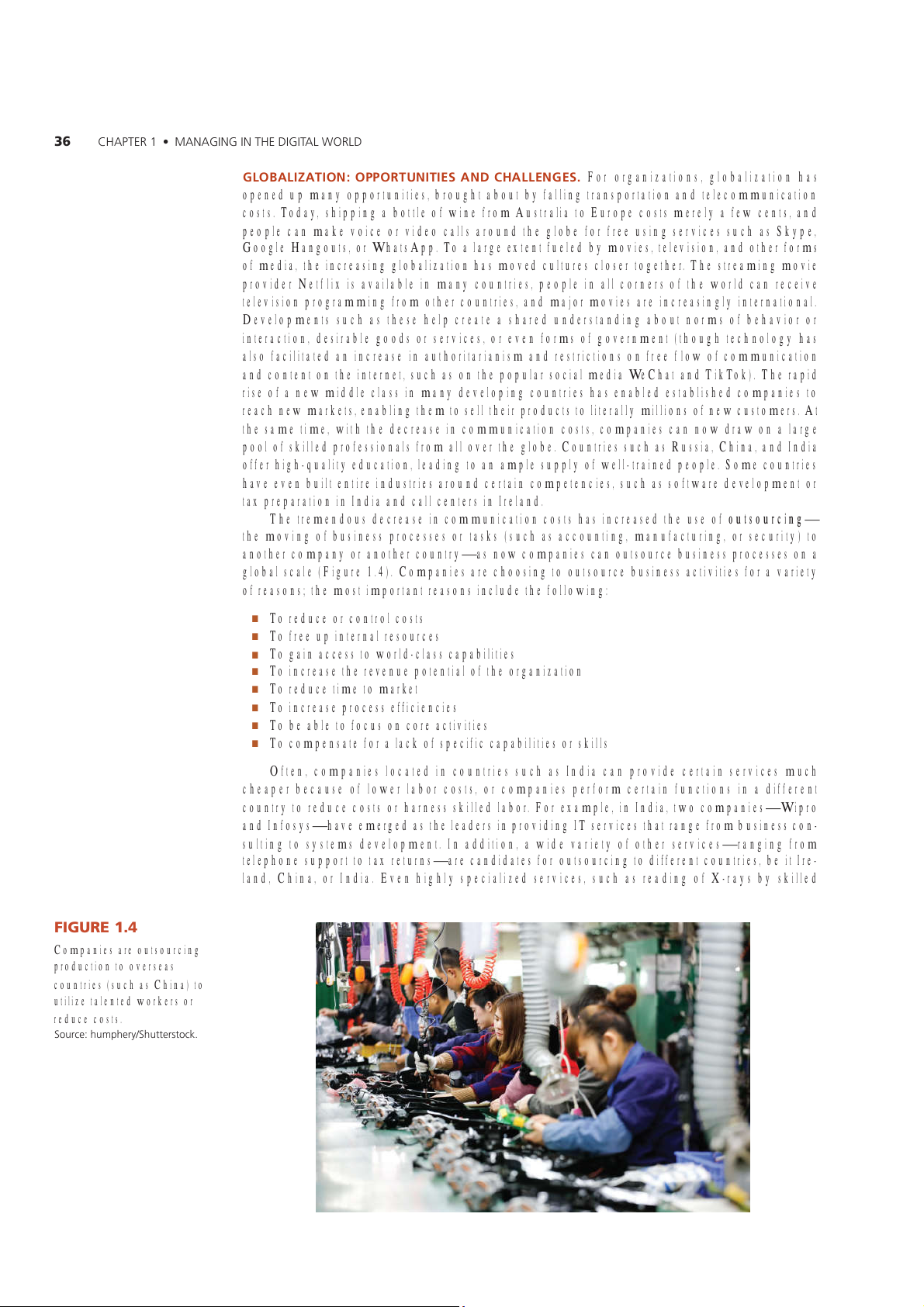
global scale (Figure 1.4). Companies are choosing to outsource business activities for a variety
of reasons; the most important reasons include the following:
To reduce or control costs
To free up internal resources
To gain access to world-class capabilities
To increase the revenue potential of the organization
To reduce time to market
To increase process efficiencies
To be able to focus on core activities
To compensate for a lack of specific capabilities or skills
Often, companies located in countries such as India can provide certain services much
cheaper because of lower labor costs, or companies perform certain functions in a different
country to reduce costs or harness skilled labor. For example, in India, two companiesWipro
and Infosyshave emerged as the leaders in providing IT services that range from business con-
sulting to systems development. In addition, a wide variety of other servicesranging from
telephone support to tax returnsare candidates for outsourcing to different countries, be it Ire-
land, China, or India. Even highly specialized services, such as reading of X-rays by skilled
()74
Companies are outsourcing
production to overseas
countries (such as China) to
utilize talented workers or
reduce costs.
5WTEgJWORJgT5JWVVgTUVEM
264 r /0)0)06&)6.914.&
radiologists, are outsourced by U.S. hospitals to doctors around the globe, often while doctors in
the United States are sleeping.
Yet globalization has also brought about a number of operational challenges for organiza-
tions. Organizations face governmental challenges related to differences in political systems,
regulatory environments, laws, standards, or individual freedoms. Likewise, geoeconomic chal-
lenges include differences in infrastructure, demographics, welfare, or workers expertise. Lastly,
organizations face cultural challenges, such as dealing with differences in languages, beliefs,
attitudes, religions, or life focus but also different viewpoints regarding intellectual property. As
a result, companies intending to outsource services or production must carefully choose out-
sourcing locations, considering numerous different factors, such as English proficiency, salaries,
or geopolitical risk. While countries such as India remain popular, other formerly popular coun-
tries (such as Singapore, Canada, or Ireland) are declining because of rising salaries. With these
shifts, outsourcers are constantly looking at nascent and emerging countries such as Bulgaria,
Egypt, Ghana, Bangladesh, or Vietnam.
Obviously, organizations must weigh the potential benefits (e.g., cost savings) and drawbacks
(e.g., higher geopolitical risk or less experienced workers) of outsourcing to a particular country,
and often, cost savings prove to be negligible due to added overhead, such as customs, shipping,
or training as well as quality problems. In fact, InformationWeek, a leading publication targeting
business IT users, found that 20 percent of the 500 most innovative companies in terms of using
IT took back projects previously outsourced to another country. Nevertheless, IT outsourcing is
big business, with an estimated market size of US$85.6 billion in 2018 (Kachkovska, 2019).
516. 555 0 6 )6.14. The rapid development of transportation and
telecommunication technologies, national and global infrastructures, and information systems
as well as a host of other factors has created a number of pressing societal issues that will
tremendously influence the world we live in (PWC, 2020; Schreiber, 2018). In this section, we
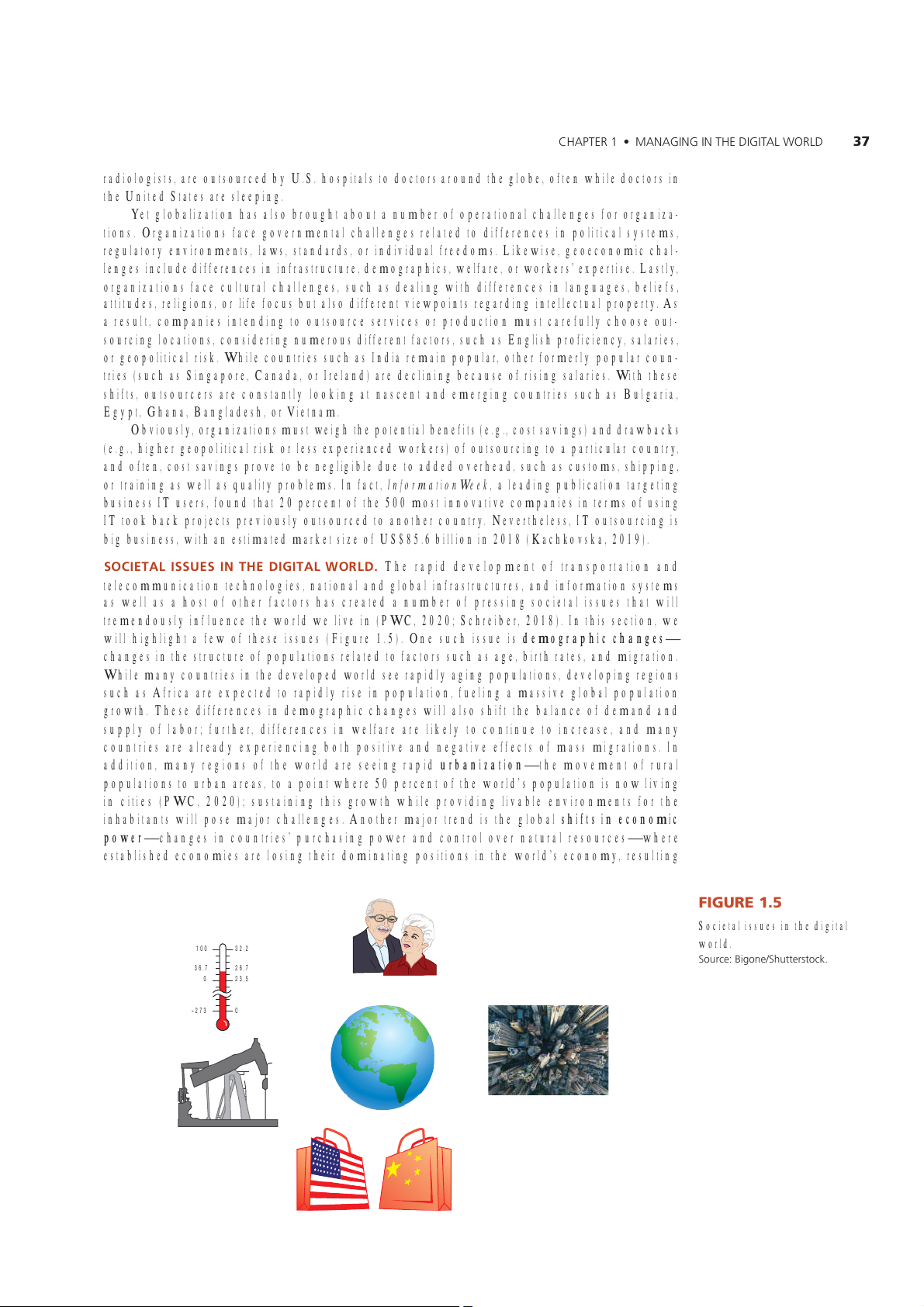
will highlight a few of these issues (Figure 1.5). One such issue is demographic changes
changes in the structure of populations related to factors such as age, birth rates, and migration.
While many countries in the developed world see rapidly aging populations, developing regions
such as Africa are expected to rapidly rise in population, fueling a massive global population
growth. These differences in demographic changes will also shift the balance of demand and
supply of labor; further, differences in welfare are likely to continue to increase, and many
countries are already experiencing both positive and negative effects of mass migrations. In
addition, many regions of the world are seeing rapid the movement of rural urbanization
populations to urban areas, to a point where 50 percent of the worlds population is now living
in cities (PWC, 2020); sustaining this growth while providing livable environments for the
inhabitants will pose major challenges. Another major trend is the global shifts in economic
powerchanges in countries purchasing power and control over natural resourceswhere
established economies are losing their dominating positions in the worlds economy, resulting
0
23,5
32,2
26,7
273
0
100
36,7
()74
Societal issues in the digital
world.
5WTEg$KIPg5JWVVgTUVEM
264 r /0)0)06&)6.914.&
in the need to resolve political struggles (PWC, 2020). Many of these issues interact, affect
each other, and/or fuel other issues, such as those related to due to limited resource scarcity
availability of fossil fuels and other natural resources and large-scale and climate change
long-term regional and global changes in temperatures and weather patterns. Population growth,
global trade, consumerism, and other factors contribute to increasing waste and pollution, as well
as a growing need for resources at a time where humans already live beyond the finite natural
resources the planet can provide. Likewise, climate changeregardless of its causesand its
associated changes in weather patterns, rise in sea levels, and increase in the severity of storms
pose many challenges for individuals, societies, and the world. As a consequence, sustainable
developmentdevelopment that meets the needs of the present without compromising the
ability of future generations to meet their own needs (World Commission on Environment
and Development, 1987)will become an increasingly important aspect. In addition to these
societal issues, we have witnessed a number of breakthroughs and transformations enabled by
technology; these breakthroughs are disrupting traditional business models (e.g., as Uber has
wreaked havoc on the taxi industry) but can also help address pressing societal issues. Next, we
will discuss how increasing digital density shapes the digital future.
ICNGPUCPFGICN(WWTG
In most developed societies, information technologies have become pervasiveinformation
technologies are in fact used throughout society, and the speed of innovations is increasing at a
tremendous pace, with many marginalizing or displacing existing products radical innovations
or industries (see Chapter 2, Gaining Competitive Advantage Through Information Systems).
For example, within just a few years, drones evolved from being primarily used by the military
to being used by farmers, aerial photographers, filmmakers, and hobbyists alike. Self-parking
systems are already available in many vehicles, self-driving cars and trucks are being actively
tested by various companies, and autonomous Caterpillar mining trucks are already in use. Like-
wise, the development of sophisticated web technologies has brought about a fundamental shift
in types of information technologies that are being used. In essence, we are seeing an exponential
increase in (i.e., the amount of connected data per unit of activity) (Zamora, digital density
2017), in that every unit of activity generates ever more connected data, enabling new value-
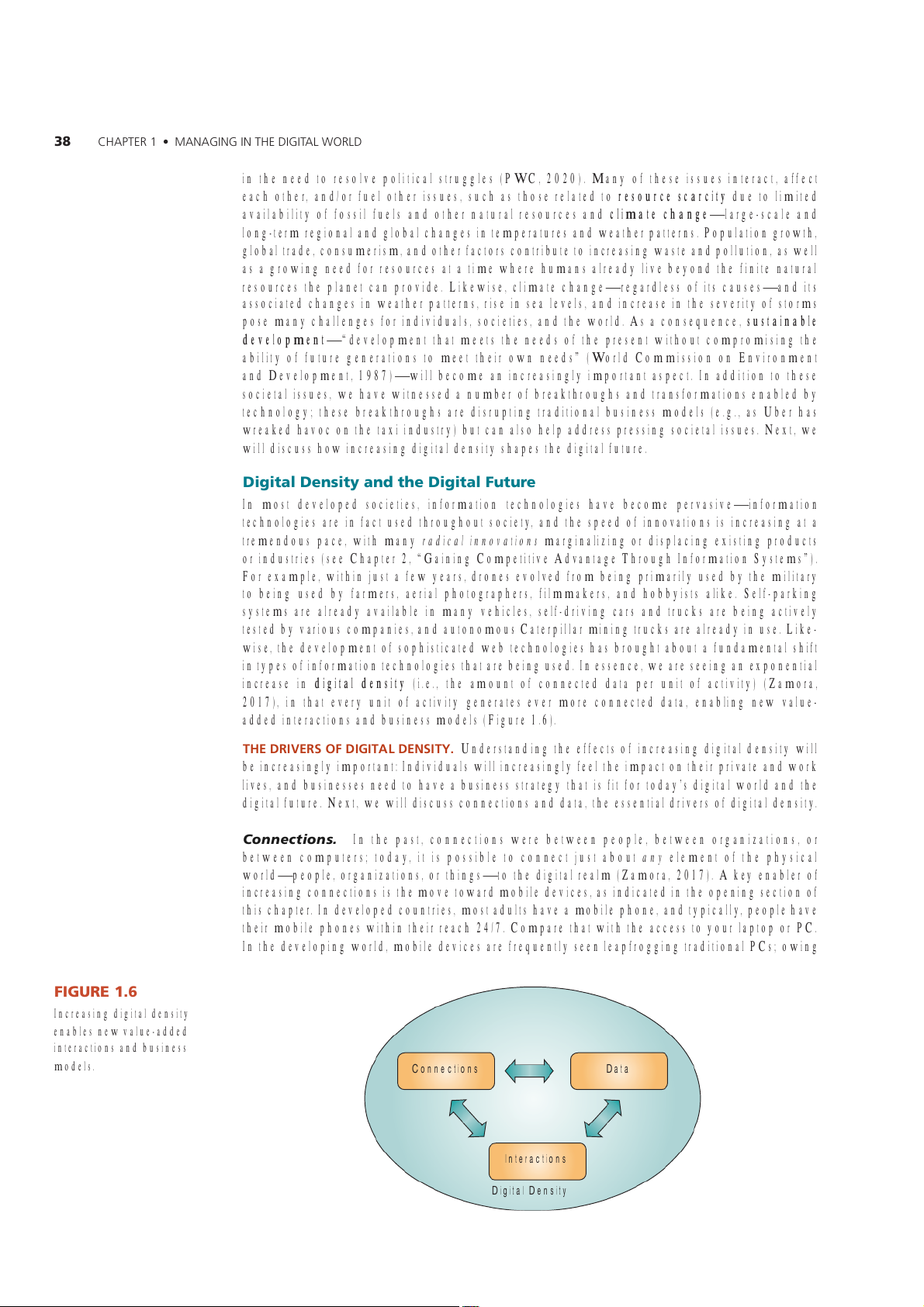
added interactions and business models (Figure 1.6).
64451()6.056 Understanding the effects of increasing digital density will
be increasingly important: Individuals will increasingly feel the impact on their private and work
lives, and businesses need to have a business strategy that is fit for todays digital world and the
digital future. Next, we will discuss connections and data, the essential drivers of digital density.
In the past, connections were between people, between organizations, or
between computers; today, it is possible to connect just about element of the physical any
worldpeople, organizations, or thingsto the digital realm (Zamora, 2017). A key enabler of
increasing connections is the move toward mobile devices, as indicated in the opening section of
this chapter. In developed countries, most adults have a mobile phone, and typically, people have
their mobile phones within their reach 24/7. Compare that with the access to your laptop or PC.
In the developing world, mobile devices are frequently seen leapfrogging traditional PCs; owing
Interactions
Digital Density
Connections Data
()74
Increasing digital density
enables new value-added
interactions and business
models.
264 r /0)0)06&)6.914.&
to the lack of stable, reliable power or landline telephone infrastructure, mobile devices are often
the primary means of accessing the internet. For organizations, this increase in mobility has a
wide range of implications, from increased collaboration to the ability to manage a business
in real timeat any time, from anywhereto changes in the way new (or existing) customers
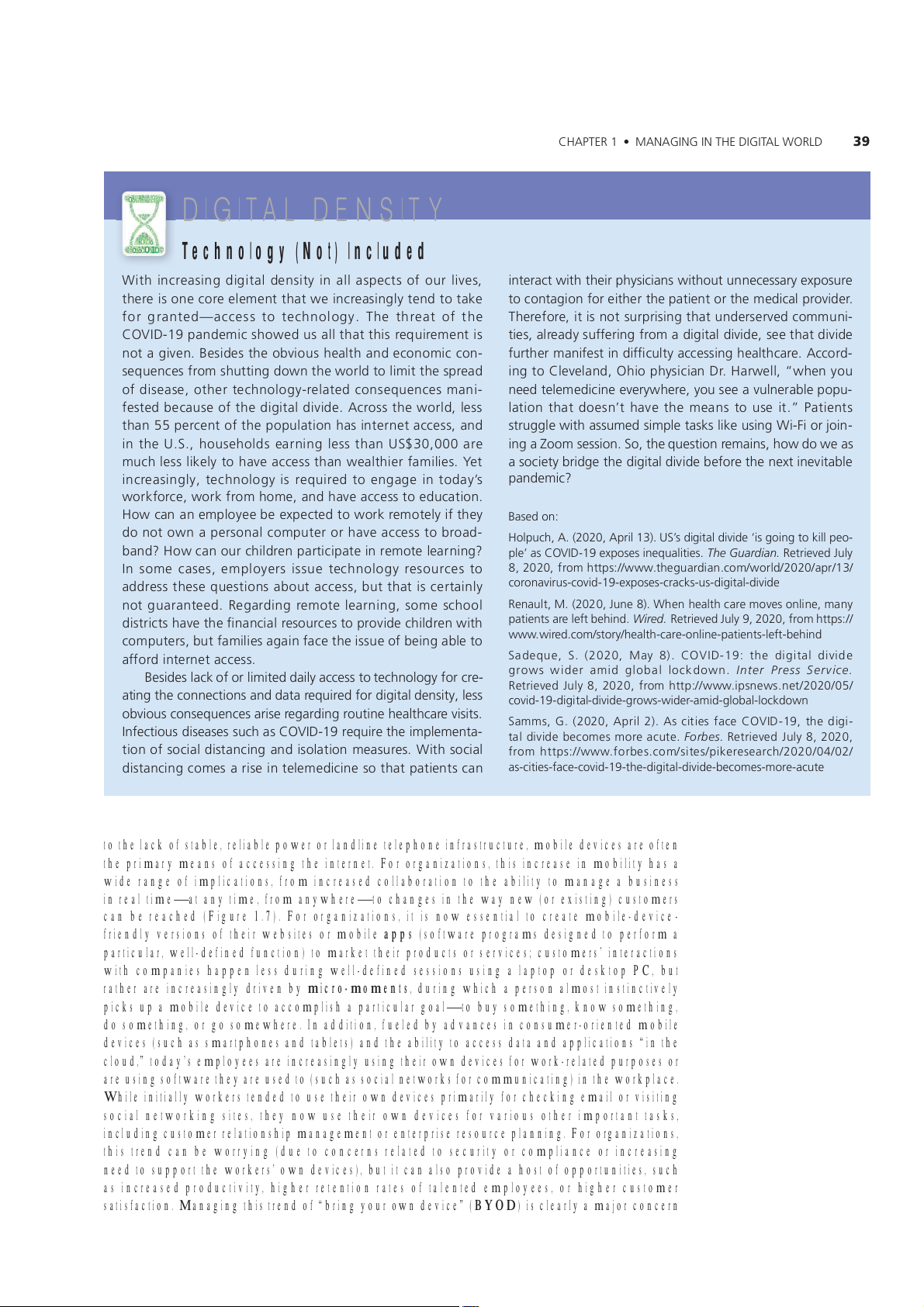
can be reached ( Figure 1. 7 ). For organizations, it is now essential to create mobile-device-
friendly versions of their websites or mobile apps (software programs designed to perform a
particular, well-defined function) to market their products or services; customers interactions
with companies happen less during well-defined sessions using a laptop or desktop PC, but
rather are increasingly driven by micro-moments , during which a person almost instinctively
picks up a mobile device to accomplish a particular goalto buy something, know something,
do something, or go somewhere. In addition, fueled by advances in consumer-oriented mobile
devices (such as smartphones and tablets) and the ability to access data and applications in the
cloud, todays employees are increasingly using their own devices for work-related purposes or
are using software they are used to (such as social networks for communicating) in the workplace.
While initially workers tended to use their own devices primarily for checking email or visiting
social networking sites, they now use their own devices for various other important tasks,
including customer relationship management or enterprise resource planning. For organizations,
this trend can be worrying (due to concerns related to security or compliance or increasing
need to support the workers own devices), but it can also provide a host of opportunities, such
as increased productivity, higher retention rates of talented employees, or higher customer
satisfaction. Managing this trend of bring your own device ( BYOD ) is clearly a major concern
DIGITAL DENSITY
Technology (Not) Included
9KVJ KPETgCUKPIFKIKVCN FgPUKVKPCNNCURgEVUH WT NKXgU
VJgTgKUPgETggNgOgPVVJCVYgKPETgCUKPINVgPFVVCMg
HT I TCPVgFtCEEgU U V VgEJPNI 6Jg VJTgCV H V Jg
18&RCPFgOKEUJYgFWUCNNVJCVVJKUTgSWKTgOgPVKU
PVCIKXgP$gUKFgUVJgDXKWUJgCNVJCPFgEPOKEEP
UgSWgPEgUHTOUJWVVKPIFYPVJgYTNFVNKOKVVJgURTgCF
HFKUgCUgVJgTVgEJPNITgNCVgFEPUgSWgPEgUOCPK
HgUVgFDgECWUgHVJgFKIKVCNFKXKFgETUUVJgYTNFNgUU
VJCPRgTEgPVHVJgRRWNCVKPJCUKPVgTPgVCEEgUUCPF
KPVJg75JWUgJNFUgCTPKPINgUUVJCP75CTg
OWEJNgUUNKMgNVJCXgCEEgUUVJCPYgCNVJKgTHCOKNKgU;gV
KPETgCUKPINVgEJPNIKUTgSWKTgFVgPICIg KPVFCoU
YTMHTEgYTMHTOJOgCPFJCXgCEEgUUVgFWECVKP
YECPCPgORNggDggZRgEVgFVYTMTgOVgNKHVJg
FPVYPCRgTUPCNEORWVgTTJCXgCEEgUUVDTCF
DCPFYECPWTEJKNFTgPRCTVKEKRCVgKPTgOVgNgCTPKPI
PUOgECUgUgORNgTUKUUWg VgEJPNITgUWTEgU V
CFFTgUUVJgUgSWgUVKPUCDWVCEEgUUDWVVJCVKUEgTVCKPN
PVIWCTCPVggF4gICTFKPITgOVgNgCTPKPIUOgUEJN
FKUVTKEVUJCXgVJgHKPCPEKCNTgUWTEgUVRTXKFgEJKNFTgPYKVJ
EORWVgTUDWVHCOKNKgUCICKPHCEgVJgKUUWgHDgKPICDNgV
CHHTFKPVgTPgVCEEgUU
$gUKFgUNCEMHTNKOKVgFFCKNCEEgUUVVgEJPNIHTETg
CVKPIVJgEPPgEVKPUCPFFCVCTgSWKTgFHTFKIKVCNFgPUKVNgUU
DXKWUEPUgSWgPEgUCTKUgTgICTFKPITWVKPgJgCNVJECTgXKUKVU
PHgEVKWUFKUgCUgUUWEJCU18&TgSWKTgVJgKORNgOgPVC
VKPHUEKCNFKUVCPEKPICPFKUNCVKPOgCUWTgU9KVJUEKCN
FKUVCPEKPIEOgUCTKUgKPVgNgOgFKEKPgUVJCVRCVKgPVUECP
KPVgTCEVYKVJVJgKTRJUKEKCPUYKVJWVWPPgEgUUCTgZRUWTg
VEPVCIKPHTgKVJgTVJgRCVKgPVTVJgOgFKECNRTXKFgT
6JgTgHTgKVKUPVUWTRTKUKPIVJCVWPFgTUgTXgFEOOWPK
VKgUCNTgCFUWHHgTKPIHTOCFKIKVCNFKXKFgUggVJCVFKXKFg
HWTVJgTOCPKHgUVKPFKHHKEWNVCEEgUUKPIJgCNVJECTgEETF
KPIVNgXgNCPF1JKRJUKEKCP&TCTYgNNpYJgPW
PggFVgNgOgFKEKPggXgTYJgTgWUggCXWNPgTCDNgRRW
NCVKPVJCVFgUPoVJCXgVJgOgCPU VWUgKVq2CVKgPVU
UVTWIINgYKVJCUUWOgFUKORNgVCUMUNKMgWUKPI9K(KTlKP
KPICOUgUUKP5VJgSWgUVKPTgOCKPUJYFYgCU
CUEKgVDTKFIgVJgFKIKVCNFKXKFgDgHTgVJgPgZVKPgXKVCDNg
RCPFgOKE
$CUgFP
NRWEJRTKN75oUFKIKVCNFKXKFgnKUIKPIVMKNNRg
RNgoCU18&gZRUgUKPgSWCNKVKgUGWCTFCP4gVTKgXgF,WN
HTOJVVRUYYYVJgIWCTFKCPEOYTNFCRT
ETPCXKTWUEXKFgZRUgUETCEMUWUFKIKVCNFKXKFg
4gPCWNV/,WPg9JgPJgCNVJECTgOXgUPNKPgOCP
RCVKgPVUCTgNgHVDgJKPFTGF4gVTKgXgF,WNHTOJVVRU
YYYYKTgFEOUVTJgCNVJECTgPNKPgRCVKgPVUNgHVDgJKPF
5C FgSWg 5 /C 18& VJg FKIKVCN FKXKF g
ITYU Y KFgT COKF INDC N NEM FYP PVGT TG GT EG
4gVTKgXgF,WNHTOJVVRYYYKRUPgYUPgV
EXKFFKIKVCNFKXKFgITYUYKFgTCOKFINDCNNEMFYP
5COOU )RTKN UEKVKgUHCEg18& VJgFKIK
VCNFKXKFgDgEOgUOTgCEWVgTDG4gVTKgXgF,WN
HTOJVVRUYYYHTDgUEOUKVgURKMgTgUgCTEJ
CUEKVKgUHCEgEXKFVJgFKIKVCNFKXKFgDgEOgUOTgCEWVg
264 r /0)0)06&)6.914.&
of business and IT managers alike. Further, we have witnessed the consumerization of IT; many
technological innovations are first introduced in the consumer marketplace before being used by
organizations, and businesses must constantly evaluate how a wide variety of new technologies
might influence their ways of doing business. Throughout the text, we will introduce issues and
new developments associated with increases in mobility.
In addition to an increase in mobile devices, the a network of a Internet of Things (IoT)
broad range of physical objects that can automatically share data over the internetis a key fac-
tor in increasing digital density. Such objects (or things) can range from an automobile tire
equipped with a pressure sensor to a smart meter enabling remote monitoring of energy con-
sumption to a cow with an injectable ID chip. Already in 2008, more devices were connected to
the internet than there were people living on earth. Fueled by advances in chips and wireless
radios and decreasing costs of sensors (devices that can detect, record, and report changes in the
physical environment), in the not-too-distant future everything that can generate useful informa-
tion will be equipped with sensors and wireless radios to connect to other devices or the cloud
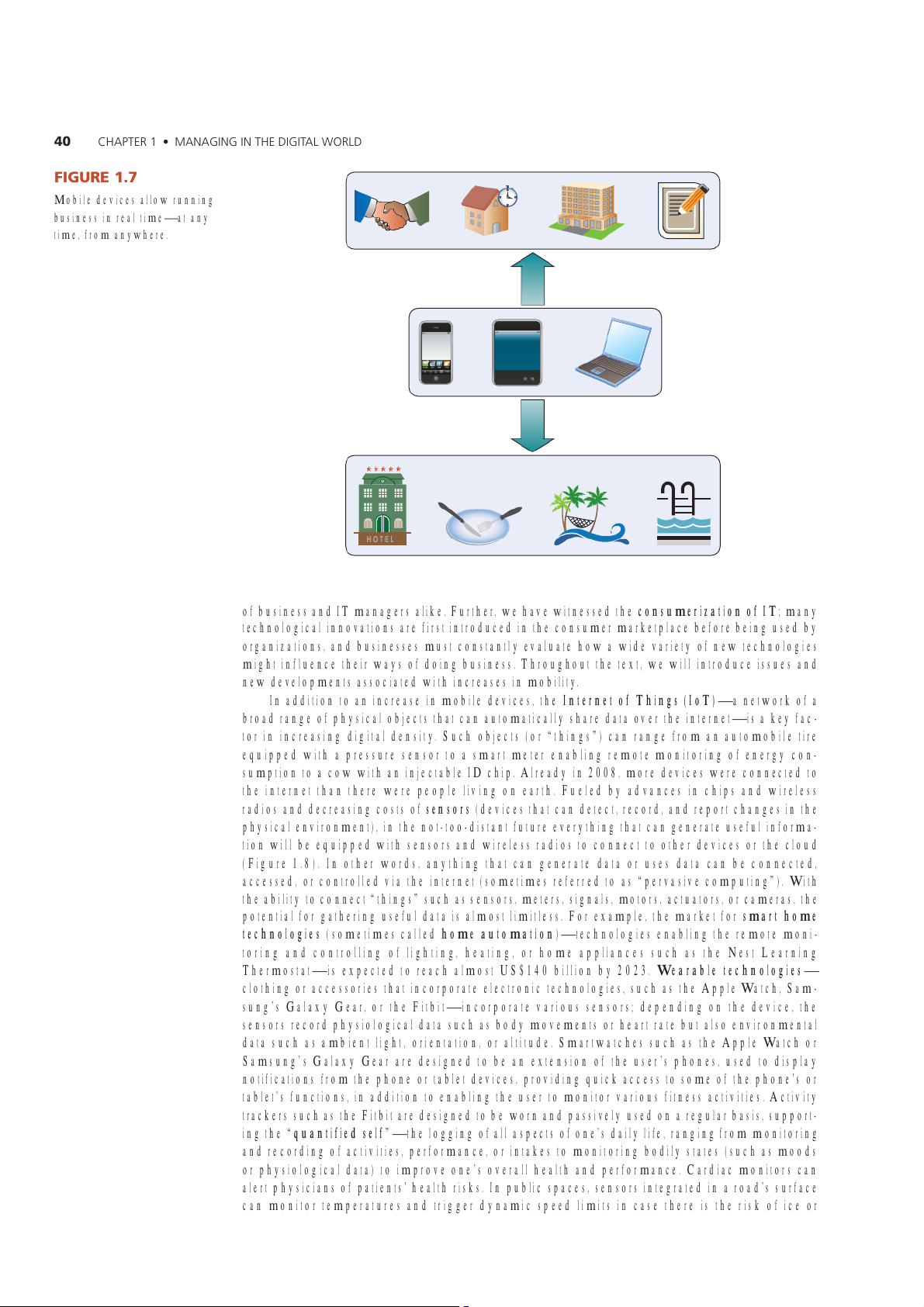
(Figure 1.8). In other words, anything that can generate data or uses data can be connected,
accessed, or controlled via the internet (sometimes referred to as pervasive computing). With
the ability to connect things such as sensors, meters, signals, motors, actuators, or cameras, the
potential for gathering useful data is almost limitless. For example, the market for smart home
technologies (sometimes called )technologies enabling the remote moni-home automation
toring and controlling of lighting, heating, or home appliances such as the Nest Learning
Thermostatis expected to reach almost US$140 billion by 2023. Wearable technologies
clothing or accessories that incorporate electronic technologies, such as the Apple Watch, Sam-
sungs Galaxy Gear, or the Fitbitincorporate various sensors; depending on the device, the
sensors record physiological data such as body movements or heart rate but also environmental
data such as ambient light, orientation, or altitude. Smartwatches such as the Apple Watch or
Samsungs Galaxy Gear are designed to be an extension of the users phones, used to display
notifications from the phone or tablet devices, providing quick access to some of the phones or
tablets functions, in addition to enabling the user to monitor various fitness activities. Activity
trackers such as the Fitbit are designed to be worn and passively used on a regular basis, support-
ing the quantified selfthe logging of all aspects of ones daily life, ranging from monitoring
and recording of activities, performance, or intakes to monitoring bodily states (such as moods
or physiological data) to improve ones overall health and performance. Cardiac monitors can
alert physicians of patients health risks. In public spaces, sensors integrated in a roads surface
can monitor temperatures and trigger dynamic speed limits in case there is the risk of ice or
HOTEL
()74
Mobile devices allow running
business in real timeat any
time, from anywhere.
264 r /0)0)06&)6.914.&
snow. Similarly, sensors can monitor availability of parking spaces or traffic flow, alerting driv-
ers of changes in conditions. Millions of sensors connected to the internet can monitor weather
conditions, helping to generate more accurate local weather predictions, or can monitor soil
moisture in golf courses, reducing the need for watering. The use of IoT technologies in
manufacturingreferred to as Industrial Internet of Things (IIoT)enables the convergence
of information technology and operations technology, offering the potential for tremendous
improvements in efficiency, product quality, agility, and flexibility, allowing companies to mass-
produce customized products, better monitor supply chains, and so on. In sum, the applications
of sensor technology for home automation, smart cities, smart metering, smart farming, e-health,
manufacturing, and other areas are almost limitless. As the number of sensors and devices con-
nected to the internet grows, the Internet of Things will evolve to become the Internet of Every-
thing (IoE), where just about any devices functionality is enhanced through connectivity and
intelligence.
CC The ability to connect elements of the physical to the digital world has generated
tremendous amounts of . Big Data is typically described as extremely large and Big Data
complex datasets, which are characterized as being of high volume, variety (i.e., many different
types of data), and velocity (i.e., the data are being collected and analyzed at ever-increasing
rates). Following the old adage that information is power, organizations are continuously seeking
to get the right information to make the best business decisions and are generating and collecting
ever more data from internal and external sources. In addition, the rise of social media has
further increased the amount of unstructured data available to organizations; for example, people
frequently voice their thoughts about products or companies on blogs or social networks. With
decreasing costs for capturing and storing data, data are now not only ubiquitous but also cheap,
with many organizations using cloud computing (see Chapter 3, Managing the Information
Systems Infrastructure and Services) to store data and maintain their information systems
infrastructure. Further, cloud computing can enable advanced analytics of massive amounts of
Big Data generated by mobile devices, sensors, or users of social networks. A study by research
()74
The Internet of Things.
264 r /0)0)06&)6.914.&
firm IDC estimated that by 2025, the worlds data will have grown to 175 zettabytes. How much
is 175 zettabytes? Well, 175 zettabytes equal 175 trillion gigabytes, or the equivalent of 350
billion 512GB iPads.
TC Together, increasing connections and data enable new value-added interactions
and business models. For many organizations today, value is created from data. Consider, for
example, that the largest/most valuable organizations in the old economy (such as GE, Dow,
or Ford) have 100,000300,000 employees, and the largest organizations in the new economy
(such as Microsoft, HP, or Oracle) have 50,000100,000 employees; in contrast, modern
companies of the digital world (such as Airbnb, Facebook, or Twitter) have risen to the top with
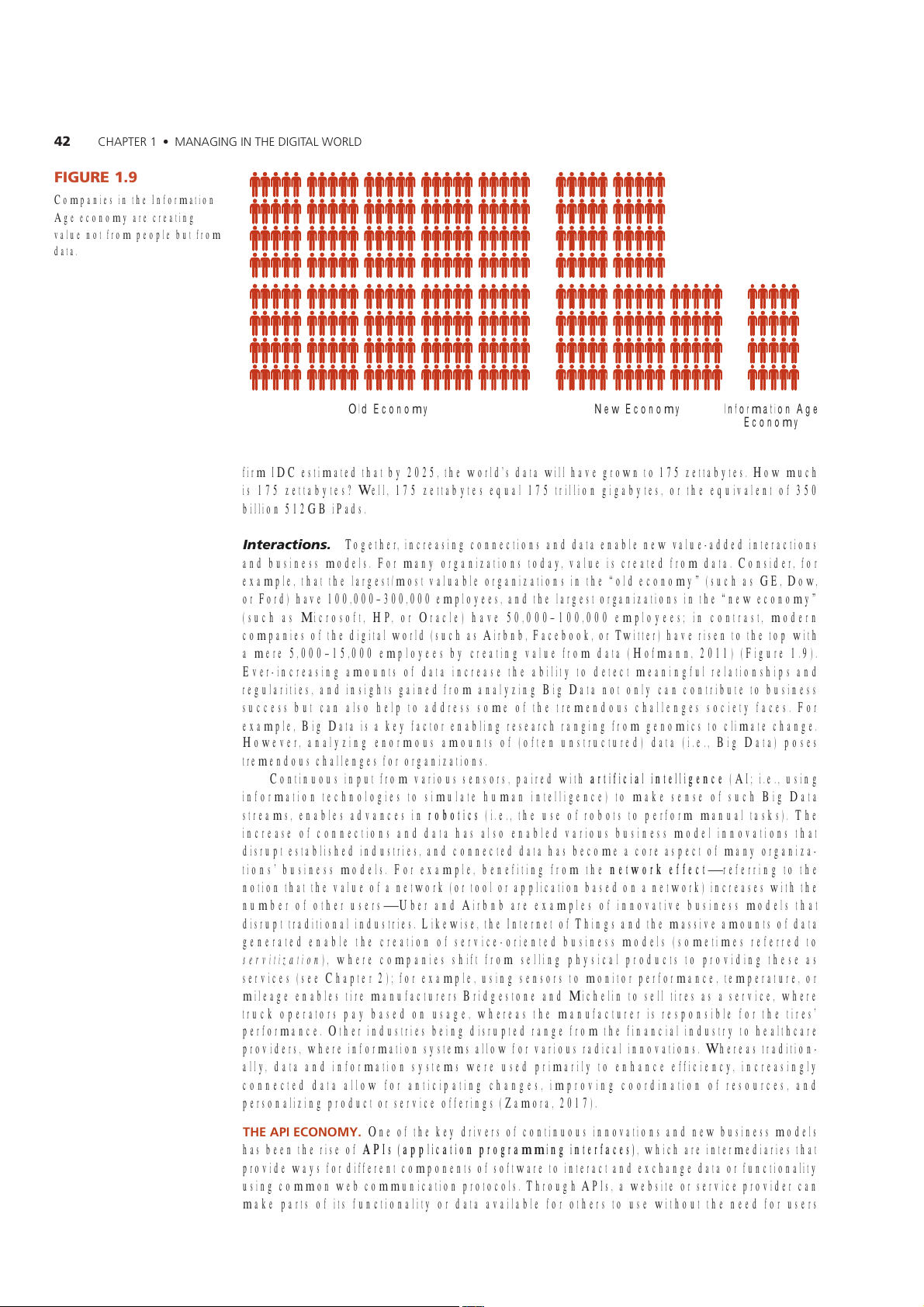
a mere 5,00015,000 employees by creating value from data (Hofmann, 2011) (Figure 1.9).
Ever-increasing amounts of data increase the ability to detect meaningful relationships and
regularities, and insights gained from analyzing Big Data not only can contribute to business
success but can also help to address some of the tremendous challenges society faces. For
example, Big Data is a key factor enabling research ranging from genomics to climate change.
However, analyzing enormous amounts of (often unstructured) data (i.e., Big Data) poses
tremendous challenges for organizations.
Continuous input from various sensors, paired with (AI; i.e., using artificial intelligence
information technologies to simulate human intelligence) to make sense of such Big Data
streams, enables advances in (i.e., the use of robots to perform manual tasks). The robotics
increase of connections and data has also enabled various business model innovations that
disrupt established industries, and connected data has become a core aspect of many organiza-
tions business models. For example, benefiting from the referring to the network effect
notion that the value of a network (or tool or application based on a network) increases with the
number of other usersUber and Airbnb are examples of innovative business models that
disrupt traditional industries. Likewise, the Internet of Things and the massive amounts of data
generated enable the creation of service-oriented business models (sometimes referred to
servitization), where companies shift from selling physical products to providing these as
services (see Chapter 2); for example, using sensors to monitor performance, temperature, or
mileage enables tire manufacturers Bridgestone and Michelin to sell tires as a service, where
truck operators pay based on usage, whereas the manufacturer is responsible for the tires
performance. Other industries being disrupted range from the financial industry to healthcare
providers, where information systems allow for various radical innovations. Whereas tradition-
ally, data and information systems were used primarily to enhance efficiency, increasingly
connected data allow for anticipating changes, improving coordination of resources, and
personalizing product or service offerings (Zamora, 2017).
62101 One of the key drivers of continuous innovations and new business models
has been the rise of APIs (application programming interfaces), which are intermediaries that
provide ways for different components of software to interact and exchange data or functionality
using common web communication protocols. Through APIs, a website or service provider can
make parts of its functionality or data available for others to use without the need for users
Old Economy Information Age
Economy
New Economy
()74
Companies in the Information
Age economy are creating
value not from people but from
data.
264 r /0)0)06&)6.914.&
to have intimate knowledge about the providers inner workings. Think of an API just like a
power socket in your home or apartment. The power socket is an interface that allows you to
receive services (electricity) from a service provider (the electric utility); the power socket has
a standardized format in terms of the input (i.e., the plug format) and output (the voltage and
frequency). As a service user, you do not need to know how the electricity is produced or how it
is delivered to you so that you can charge your smartphone.
The business value of APIs is twofold: Organizations providing the APIs can create new rev-
enue streams and increase the accessibility of its services, whereas users of the APIs can utilize
the functionality to offer value-added services. APIs have become both commonplace and impor-
tant in todays digital interactions, such that some argue that we are in an API economy. In fact,
the cloud services company Akamai estimated that whereas in 2014, API traffic had accounted for
47 percent of all data traffic, in 2018, this had jumped to 83 percent with HTML (website) traffic
having only accounted for 17 percent One example of a successful company using APIs is the
payment platform Stripe, which handles online payments for companies ranging from Target to
Lyft. Stripe processes payments using its highly reliable and secure internal systems and makes
these payment processing services available to others through a variety of APIs. Companies such
as Lyft can connect their system to Stripes API and focus on their core competencies while mak-
ing payments appear seamless. If Stripe needs to make any changes to its internal systems, this
happens behind the scenes, such that the API remains unchanged, and the API users typically will
not even notice that anything has changed. The use of APIs has enabled Stripe to quickly expand
and to become one of the most successful payment processing services.
Likewise, Lyft uses Google Maps API to integrate mapping functionality into their app to
visualize riders and available vehicles. The proliferation of APIs has enabled numerous success-
ful startups, who draw on various APIs to scale quickly and provide innovative services to their
customers; as building an entire app would have taken too long to build, Uber built almost their
entire app around APIs provided by other companies (further, it would have been close to impos-
sible to develop functionality that matches Googles mapping services). The use of APIs, how-
ever, is not limited to startups. Traditional companies make heavy use of APIs to extend their
service offerings. For example, Expedia offers APIs allowing hotels to connect to Expedias
systems, and banks use APIs to collaborate with fintech startups to provide value-added services
or to allow organizations to connect their information systems to the bank and access a variety of
transaction data or process transactions. Together, the use of APIs enables companies to focus on
what they do best, while drawing on services and functionalities offered by others.
)6.056061o514-(14 While increasing digital density opens up an
almost unlimited potential for innovative products, services, or processes, it also poses a variety
of challenges for organizations operating in the digital world. Throughout the book, we will
discuss not only the opportunities but also the challenges organizations face when trying to
harness the potential of increasing digital density. What does increasing digital density mean
for you and for todays workforce? On a most basic level, they imply that being able to use
information systems, to assess the impacts of new technologies on ones work or private life, and
to learn new technologies as they come along will be increasingly important skills.
Most modern-day high school and university students have grown up in a computerized
world. If, by some chance, they do not know how to operate a computer by the time they gradu-
ate from high school, they soon acquire computer skills because in todays work world, knowing
how to use a computercalled computer literacy (or information literacy)can not only open
up myriad sources of information but can also mean the difference between being employed and
being unemployed. In fact, some fear that the Information Age will not provide the same advan-
tages to information havesthose computer-literate individuals who have almost unlimited
access to informationand information have-notsthose with limited or no computer access
or skills.
Computer-related occupations have evolved as computers have become more sophisticated
and more widely used. Where once we thought of computer workers as primarily programmers,
data entry clerks, systems analysts, or computer repairpersons, today many more job categories
in virtually all industries, from accounting to the medical field, involve the use of computers. In
fact, today there are few occupations where computers are not somehow in use. Information
systems are used to manage air traffic, perform medical tests, monitor investment portfolios,
control construction machinery, and more. Engineers, architects, interior designers, and artists
264 r /0)0)06&)6.914.&
use special-purpose computer-aided design programs. Musicians play computerized instru-
ments, and they write and record songs with the help of computers. Professionals in the medical
industry use healthcare IS , that is, information systems that support various healthcare pro-
cesses, ranging from patient diagnosis and treatment to analyzing patient and disease data to
running doctors offices and hospitals (see Chapter 6 , Enhancing Business Intelligence Using
Big Data, Analytics, and Artificial Intelligence) . Not only do we use information systems at
work, we also use them in our personal lives. We teach our children on them, manage our
finances, do our taxes, compose letters and term papers, create greeting cards, send and receive
email, surf the internet, purchase products, and play games on them. With the increasing use of
information systems in all areas of society, many argue that being computer literateknowing
how to use a computer and use certain applicationsis not sufficient in todays world; rather,
computer fluency the ability to independently learn new technologies as they emerge and
assess their impact on ones work and lifeis what will set you apart in the future.
PHQTOCVKQP5UVGOUGHKPGF
An information system (IS) is the combination of people and information technology that
create, collect, process, store, and distribute useful data. Information technology (IT)
includes hardware , software , and telecommunications networks . Hardware refers to
physical computer equipment, such as a computer, tablet, or printer, as well as components
like a computer monitor or keyboard. Software refers to a program or set of programs that
GREEN IT
The Green Internet of Things
6JgKPVgTPgVCPFCUUEKCVgFVgEJPNIKgUJCXgDggPDWUFKU
TWRVKPIDWUKPgUUCPFUEKgVHTVJgRCUVUgXgTCNFgECFgU
0gZVWRCPVJgTTgXNWVKPKPKPHTOCVKPVgEJPNIKU
IKPIVUJCMgVJKPIUWRCICKP)TggP6TITggPEORWV
KPIUggJCRVgTTgHgTUVVJgUVWFCPFRTCEVKEgHWUKPI
EORWVKPITgUWTEgUOTggHHKEKgPVNVTgFWEggPXKTPOgP
VCNKORCEVUCUYgNNCUVJgWUgHKPHTOCVKPUUVgOUV
TgFWEgPgICVKXggPXKTPOgPVCNKORCEVU6JgPVgTPgVH
6JKPIUDTKPIUEPPgEVKXKVCPFKPHTOCVKPVgEJPNIV
RNCEgUPgXgTDgHTgEPUKFgTgF6IgVJgTVJgUgVgEJPNIKgU
CTgPEgCICKPRKUgFVTgXNWVKPKgDWUKPgUUCPFUEKgV
6TCFKVKPCNN6TgUWTEgUYgTgUggPCUCPgXgTgZRCPFKPI
RNtCUDWUKPgUUPggFUITgYOTgUgTXgTUCPFFCVCEgPVgTU
YgTgKPUVCNNgFXgPVWCNNCNKOKVKUTgCEJgFVJgKORCEVH
RYgTEPUWORVKPCNPgHTOCOFgTPFCVCEgPVgTECPDg
RTHWPF0gYVgEJPNIKgUCPFVgEJPKSWgUCTgJCXKPIC
NCTIgKORCEVPDVJJYYgRTXKUKP6TgUWTEgUCPFJY
YgKPVgTCEVYKVJWTYTNFoUTgUWTEgU0VPNCTgPgY
EORWVKPITgUWTEgUFgUKIPgFHTNYRYgTEPUWORVKP
DWVENWFEORWVKPICTEJKVgEVWTgUCNNYTgUWTEgUVDgCNN
ECVgFPCPCUPggFgFDCUKU
9KVJVJgKPVgTPgVOCVWTKPIKPVCPgUVCDNKUJgFRNCVHTO
PgYRRTVWPKVKgUJCXgDgEOgCRRCTgPV$EODKPKPI
WDKSWKVWUEPPgEVKXKVYKVJKPgZRgPUKXgRTEgUUKPIRYgT
CPFUgPUTFgXKEgUPgCTNCPVJKPIECPDgEPPgEVgFVVJg
KPVgTPgV6DgEPUKFgTgFCRCTVHVJg6CFgXKEgUKORN
PggFUVDgEPPgEVgFVVJgKPVgTPgVENNgEVCPFVTCPUOKV
UgPUTFCVCCPFDgUOgVJKPIRJUKECNVJCVKPVgTCEVUYKVJ
VJgTgCNYTNF7ODTgNNCUPVKHWUHVJgYgCVJgTUOCTV
YCVEJgUOPKVTWTUVgRUCPFXKVCNUKIPUCPFPCPUECNg
UgPUTUCTgJgNRKPIUEKgPVKUVUENNgEVWPRTgEgFgPVgFFCVC
CDWVPCVWTCNRJgPOgPCCPFgEUUVgOU(CTOgTUMPY
gZCEVNJYOWEJYCVgTUWPCPFHgTVKNKgTVJgKTETRUJCXg
TgEgKXgFCPFRYgTEORCPKgUECPKPUVTWOgPVWTJWUgU
WTECTUCPFVJgKTFKUVTKDWVKPUUVgOUVICKPWPRTgEg
FgPVgFKPUKIJVUKPVgPgTIWUgCPFFgOCPF
PVgTPgVVgEJPNIKgUFKUTWRVgFOCPDWUKPgUUgUCPFUEKCN
RTEgUUgUDEJCPIKPIVJgUERgCPFUECNgHKPVgTCEVKPU
DgVYggPRgRNg$OCMKPINCTIgUECNgKPVgTCEVKPCPFEO
OWPKECVKPRUUKDNgCNOUVKPUVCPVCPgWUNUWRRNEJCKPU
EWNFDgTgFgUKIPgFINDCNKCVKPYCUCEEgNgTCVgFCPFRNKVK
ECNRTEgUUgUYgTgCNVgTgFHTDgVVgTCPFHTYTUgPFKXKFWCNU
DgECOgEKVKgPlWTPCNKUVU6IgVJgTYKVJVJg6ITggPVgEJ
PNIKgUCTggPCDNKPIOTgCEEWTCVgHTgECUVKPIHTgUWTEg
PggFUCPFCNNYDWUKPgUUgUCPFIXgTPOgPVUCNKMgVDgEOg
OTgKPHTOgFCPFTgURPUKXg6OTTYoUNgCFgTUYKNNPggFV
KPETRTCVgUWEJFgXKEgUCPFUUVgOUKPVVJgKTRNCPPKPIVUVC
CJgCFHEWUVOgTCPFEKVKgPYCPVUCPFPggFU
$CUgFP
2KPNC/,WPgIWKFgV ITggP6CPFITggPVgEJ
PNI.HGTGEO4gVTKgXgF/CHTOJVVRUYYY
NKHgYKTgEOYJCVKUITggPKV
4CXKPFTC5,CPWCT6CRRNKECVKPUKPCITKEWNVWTg6Jg
FgOCPFHTITYKPIRRWNCVKPECPDgUWEEgUUHWNNOgVYKVJ6
HTCEO4gVTKgXgF/CHTOJVVRUYYYKVHTCNN
EOKVCRRNKECVKPUKPCITKEWNVWTg
264 r /0)0)06&)6.914.&
tell the computer to perform certain tasks. Telecommunications networks refer to a group of
two or more computer systems linked together with communications equipment. Although
we discuss the design, implementation, use, and implications of hardware, software, and
telecommunications throughout the text, the specifics on hardware, software, and telecom-
munications networks are discussed in Chapter 3 and the Technology Briefing. While tradi-
tionally the term referred to the hardware, software, and networking information technology
components of an information system, the difference is shrinking, with many using the terms
IS IT and synonymously. It is important to note that while many of todays technologies
operate autonomously, they do not build themselves and do not exist for their own sake;
rather, they are created to serve a useful purpose for people. Also, any information system
involves data that are useful, for someone, somewhere. For example, transactional data are
useful for businesses, status updates in your news feed on Facebook are useful for your
friends as well as for Facebook itself, scores in a computer game are useful for the player as
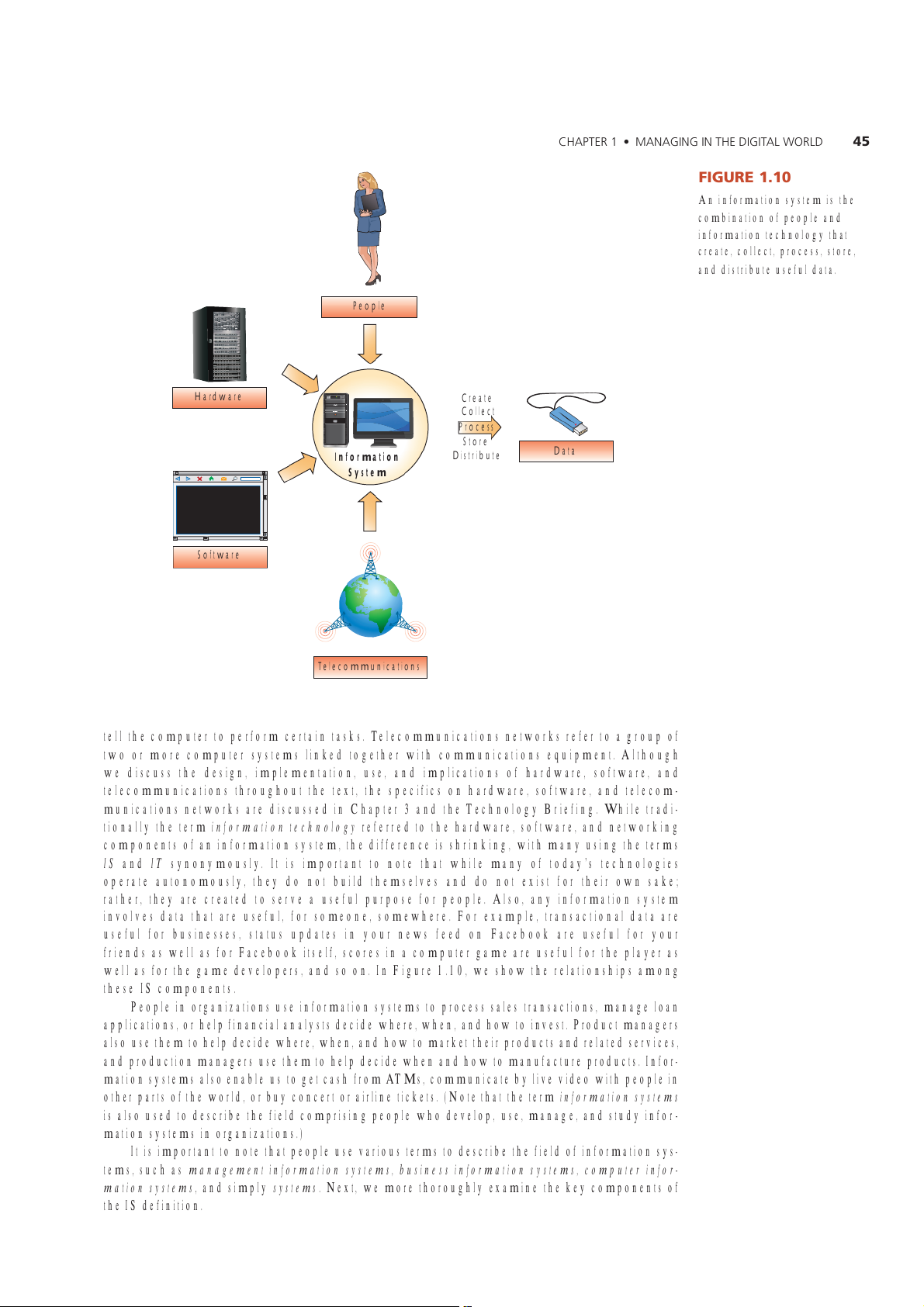
well as for the game developers, and so on. In Figure 1.10, we show the relationships among
these IS components.
People in organizations use information systems to process sales transactions, manage loan
applications, or help financial analysts decide where, when, and how to invest. Product managers
also use them to help decide where, when, and how to market their products and related services,
and production managers use them to help decide when and how to manufacture products. Infor-
mation systems also enable us to get cash from ATMs, communicate by live video with people in
other parts of the world, or buy concert or airline tickets. (Note that the term information systems
is also used to describe the field comprising people who develop, use, manage, and study infor-
mation systems in organizations.)
It is important to note that people use various terms to describe the field of information sys-
tems, such as management information systems, business information systems, computer infor-
mation systems, and simply systems. Next, we more thoroughly examine the key components of
the IS definition.
Telecommunications
Information
System
Software
Create
Collect
Process
Store
Distribute
Hardware
Data
People
()74
An information system is the
combination of people and
information technology that
create, collect, process, store,
and distribute useful data.
264 r /0)0)06&)6.914.&
CC6G4CPF2WTRUGHPHTOCP5UGOU
Earlier, we defined information systems as the combination of people and information technol-
ogy that create, collect, process, store, and distribute useful data. We begin by talking about data,
the most basic element of any information system.
6 Before you can understand how information systems work, it is important to distinguish
between raw, unformatted data, information, and knowledge. Unformatted data, or simply , data
are raw symbols, such as characters and numbers. Data have no meaning in and of themselves and
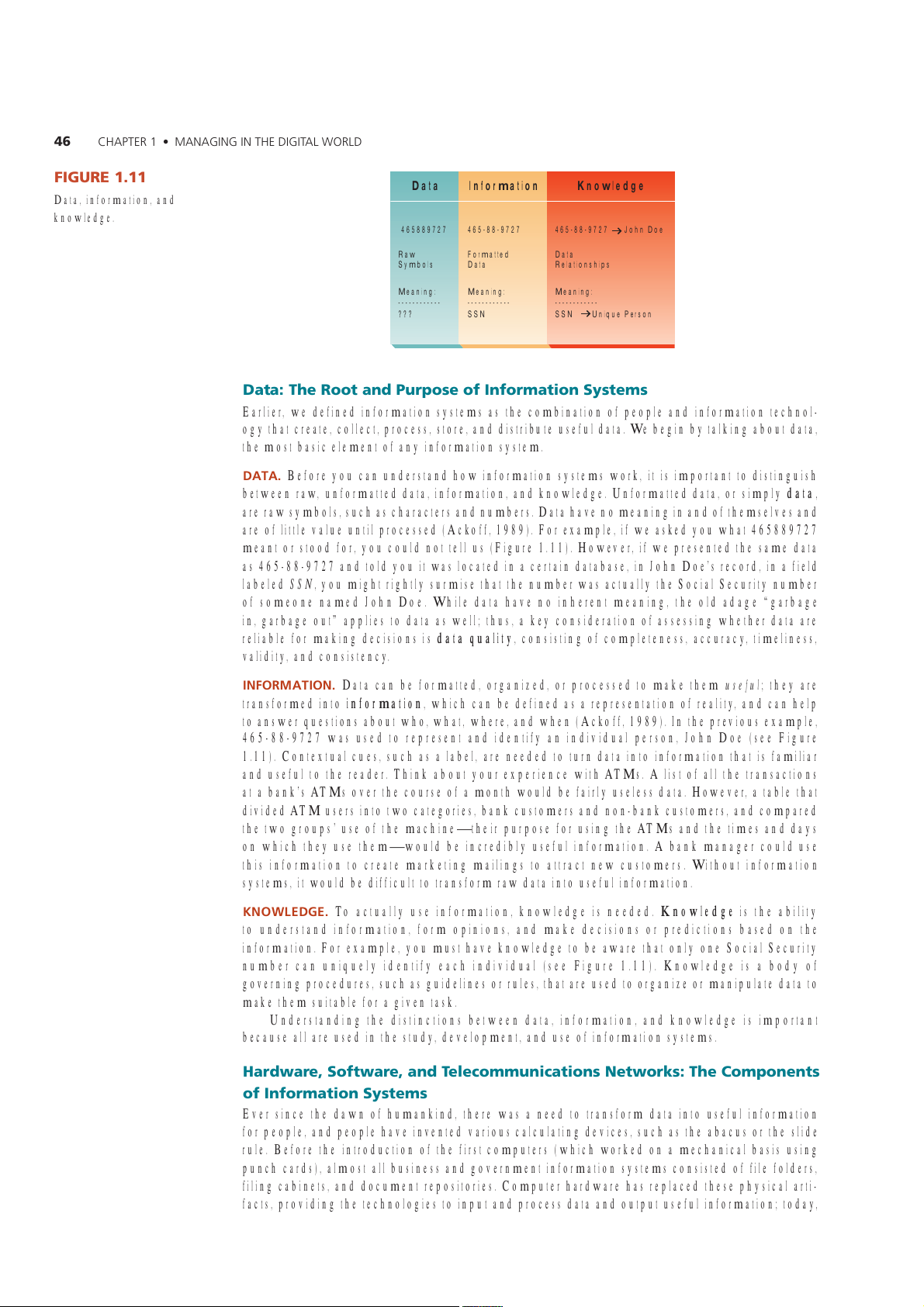
are of little value until processed (Ackoff, 1989). For example, if we asked you what 465889727
meant or stood for, you could not tell us (Figure 1.11). However, if we presented the same data
as 465-88-9727 and told you it was located in a certain database, in John Does record, in a field
labeled , you might rightly surmise that the number was actually the Social Security number SSN
of someone named John Doe. While data have no inherent meaning, the old adage garbage
in, garbage out applies to data as well; thus, a key consideration of assessing whether data are
reliable for making decisions is , consisting of completeness, accuracy, timeliness, data quality
validity, and consistency.
0(14610 Data can be formatted, organized, or processed to make them ; they are useful
transformed into , which can be defined as a representation of reality, and can help information
to answer questions about who, what, where, and when (Ackoff, 1989). In the previous example,
465-88-9727 was used to represent and identify an individual person, John Doe (see Figure
1.11). Contextual cues, such as a label, are needed to turn data into information that is familiar
and useful to the reader. Think about your experience with ATMs. A list of all the transactions
at a banks ATMs over the course of a month would be fairly useless data. However, a table that
divided ATM users into two categories, bank customers and non-bank customers, and compared
the two groups use of the machinetheir purpose for using the ATMs and the times and days
on which they use themwould be incredibly useful information. A bank manager could use
this information to create marketing mailings to attract new customers. Without information
systems, it would be difficult to transform raw data into useful information.
-01.) To actually use information, knowledge is needed. is the ability Knowledge
to understand information, form opinions, and make decisions or predictions based on the
information. For example, you must have knowledge to be aware that only one Social Security
number can uniquely identify each individual (see Figure 1.11). Knowledge is a body of
governing procedures, such as guidelines or rules, that are used to organize or manipulate data to
make them suitable for a given task.
Understanding the distinctions between data, information, and knowledge is important
because all are used in the study, development, and use of information systems.
CTFCTG5HCTGCPF6GNGEOOWPECPU0GTMU6GORPGPU
HPHTOCP5UGOU
Ever since the dawn of humankind, there was a need to transform data into useful information
for people, and people have invented various calculating devices, such as the abacus or the slide
rule. Before the introduction of the first computers (which worked on a mechanical basis using
punch cards), almost all business and government information systems consisted of file folders,
filing cabinets, and document repositories. Computer hardware has replaced these physical arti-
facts, providing the technologies to input and process data and output useful information; today,
Data Information Knowledge
465889727
Raw
Symbols
Formatted
Data
Data
Relationships
Meaning:
------------
???
Meaning:
------------
SSN
Meaning:
------------
SSN Unique Person
465-88-9727 465-88-9727 John Doe
()74
Data, information, and
knowledge.
264 r /0)0)06&)6.914.&
hardware includes not only traditional computer components but a variety of other input and
output devices, including sensors, cameras, actuators, and the like. Software enables organiza-
tions to utilize the hardware to execute their business processes and competitive strategy by pro-
viding the computer hardware with instructions on what processing functions to perform. Finally,
the telecommunications networks allow computers to share data and services, enabling the global
collaboration, communication, and commerce we see today. The rapid evolution of the various
hardware, software, and networking components make the ability to tie everything together ever
more important.
2GRNG6GWNFGTUCPCIGTUCPF7UGTUHPHTOCP5UGOU
The IS field includes a vast collection of people who develop, maintain, manage, and study
information systems. Yet an information system does not exist in a vacuum and is of little use if it
werent for youthe user. We will begin by discussing the IS profession and then talk about why
knowing about fundamental concepts of information systems is of crucial importance in your
personal and professional life.
If you are choosing a career in the IS field, you will find countless opportunities. With the
growing value of data for competitive advantage, every company can now be considered a
technology company, needing people with the right skill set to help optimize its business pro-
cesses and discover new ways of using information systems for gaining competitive advan-
tage. The career opportunities for a person with IS training continue to be strong, and they are
expected to continue to improve over the next 10 years. For example, the Occupational Out-
look Handbook published by the U.S. Bureau of Labor Statistics (2020a) predicted that
employment for computer and IS managers will grow 11 percent through 2028, much faster
than the average for all other occupations (https://www.bls.gov/ooh/management/computer-
and-information-systems-managers.htm). As more and more organizations rely increasingly
heavily on IS professionals, this boost in employment will occur in nearly every industry, not
just computer hardware and software companies. Among the 50 best jobs in America ranked
by the job site Glassdoor, six of the top ten jobs (and one third of the top jobs overall) were IS
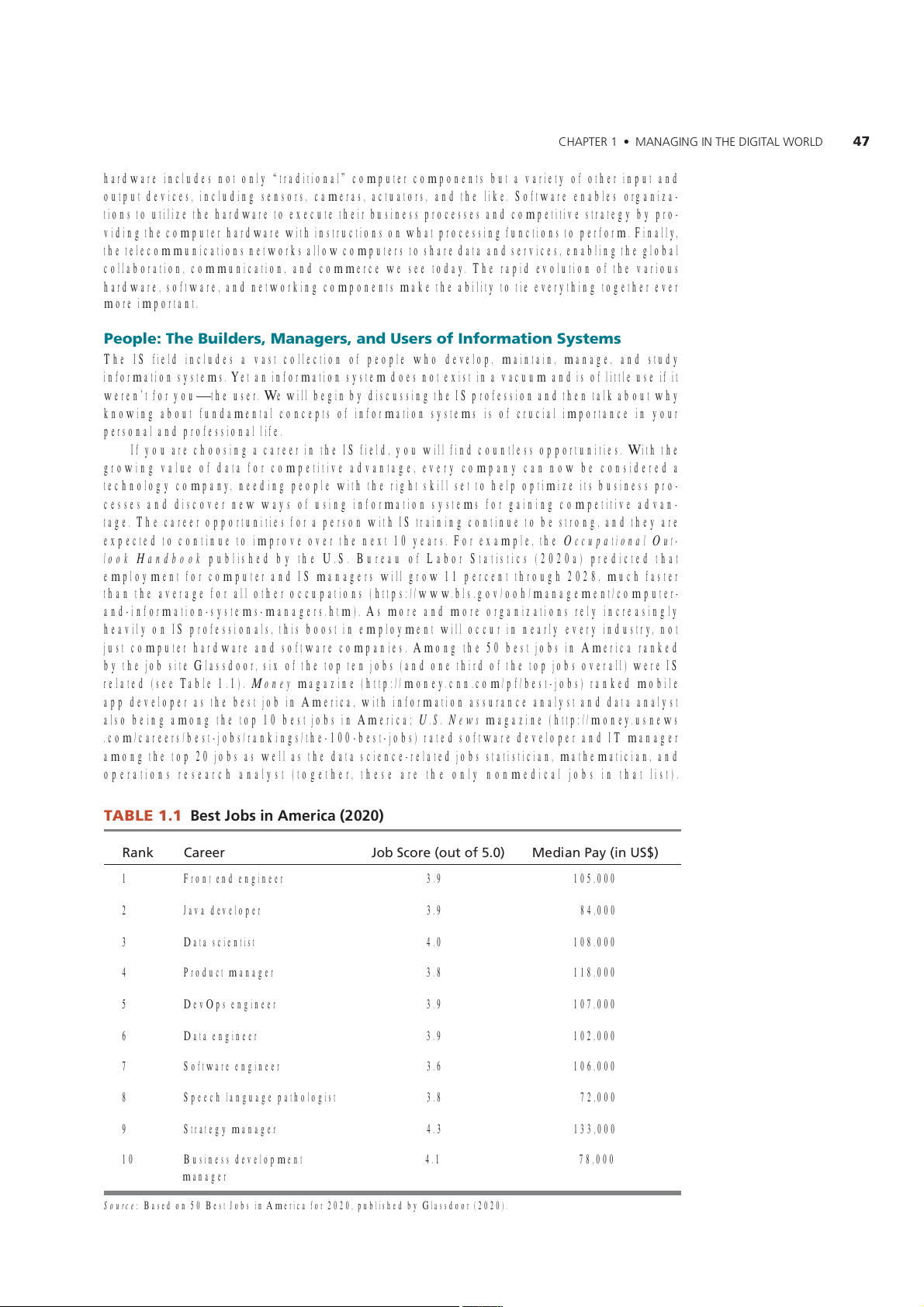
related (see Table 1.1). magazine (http://money.cnn.com/pf/best-jobs) ranked mobile Money
app developer as the best job in America, with information assurance analyst and data analyst
also being among the top 10 best jobs in America; magazine (http://money.usnews U.S. News
.com/careers/best-jobs/rankings/the-100-best-jobs) rated software developer and IT manager
among the top 20 jobs as well as the data science-related jobs statistician, mathematician, and
operations research analyst (together, these are the only nonmedical jobs in that list).
6. GUVQDUKPOGTKEC
Source: Based on 50 Best Jobs in America for 2020, published by Glassdoor (2020).
CPM %CTT ,QD5QTQWVQH /FCP2CP5
1 Front end engineer 3.9 105,000
2 Java developer 3.9 84,000
3 Data scientist 4.0 108,000
4 Product manager 3.8 118,000
5 DevOps engineer 3.9 107,000
6 Data engineer 3.9 102,000
7 Software engineer 3.6 106,000
8 Speech language pathologist 3.8 72,000
9 Strategy manager 4.3 133,000
10 Business development
manager
4.1 78,000
264 r /0)0)06&)6.914.&
Likewise, a degree in information systems can provide the foundation for becoming a data
scientist, currently one of the jobs with highest demand (Heltzel, 2019). Whereas the rankings
differ, it is clear that many professions related to data and information systems remain in high
demand and will likely do so for the foreseeable future.
In addition to an ample supply of jobs, earnings for IS professionals will remain strong.
According to the U.S. Bureau of Labor Statistics (2020b), median annual earnings of these man-
agers in May 2019 were US$146,360, with the top 10 percent earning more than US$208,000.
Also, according to Salary.com, the median salary in 2020 for IT managers was US$122,220.
According to a 2019 report by the National Association of Colleges and Employers, manage-
ment information systems was expected to be the highest-paid business major, with a mean start-
ing salary of US$61,697. Likewise, information systems graduates with a masters degree had an
average starting salary of US$84,113, higher than business majors such as accounting, finance,
or marketing, according to a study by the Association for Information Systems and Institute for
Business and Information Technology at Temple University. Finally, computer and IS managers,
especially those at higher levels, often receive more employment-related benefitssuch as
expense accounts, stock option plans, and bonusesthan do nonmanagerial workers in their
organizations (a study by Payscale.com found that IS majors werepost-graduationamong
the most satisfied with their careers).
As you can see, there continues to be a very strong need for people with IS knowledge,
skills, and abilitiesin particular, people with advanced IS skills, as we describe here. In
fact, IS careers are regularly selected as not only one of the fastest growing but also a career
with far-above-average opportunities for greater personal growth, stability, and advancement.
Although technology continues to become easier to use, there is still and is likely to continue
to be an acute need for people within the organization who have the responsibility of plan-
ning for, designing, developing, maintaining, and managing technologies. Much of this will
happen within the business units and will be done by those with primarily business duties
and tasks as opposed to systems duties and tasks. However, we are a long way from the day
when technology is so easy to deploy that a need no longer exists for people with advanced
IS knowledge and skills. In fact, many people believe that this day may never come. Although
increasing numbers of people will incorporate systems responsibilities within their nonsys-
tems jobs, there will continue to be a need for people with primarily systems responsibilities.
In short, IS staffs and departments will likely continue to exist and play an important role in
the foreseeable future.
Given that information systems continue to be a critical tool for business success, it is
not likely that IS departments will go away or even shrink significantly. Indeed, all pro-
jections are for long-term growth of information systems in both scale and scope. Also, as
is the case in any area of business, those people who are continually learning, continuing
to grow, and continuing to find new ways to add value and who have advanced and/or
unique skills will always be sought after, whether in information systems or in any area of
the firm.
The future opportunities in the IS field are likely to be found in a variety of areas, which is
good news for everyone. Diversity in the technology area can embrace us all. It really does not
matter much which area of information systems you choose to pursuethere will likely be a
promising future there for you. Even if your career interests are outside information systems,
being a well-informed and capable user of information technologies will greatly enhance your
career prospects.
445 0 0(14610 5565 The field of information systems includes those
people in organizations who design and build systems, those who use these systems, and
those responsible for managing these systems. The people who help develop and manage
systems in organizations include systems analysts, systems programmers, systems operators,
network administrators, database administrators, systems designers, systems managers,
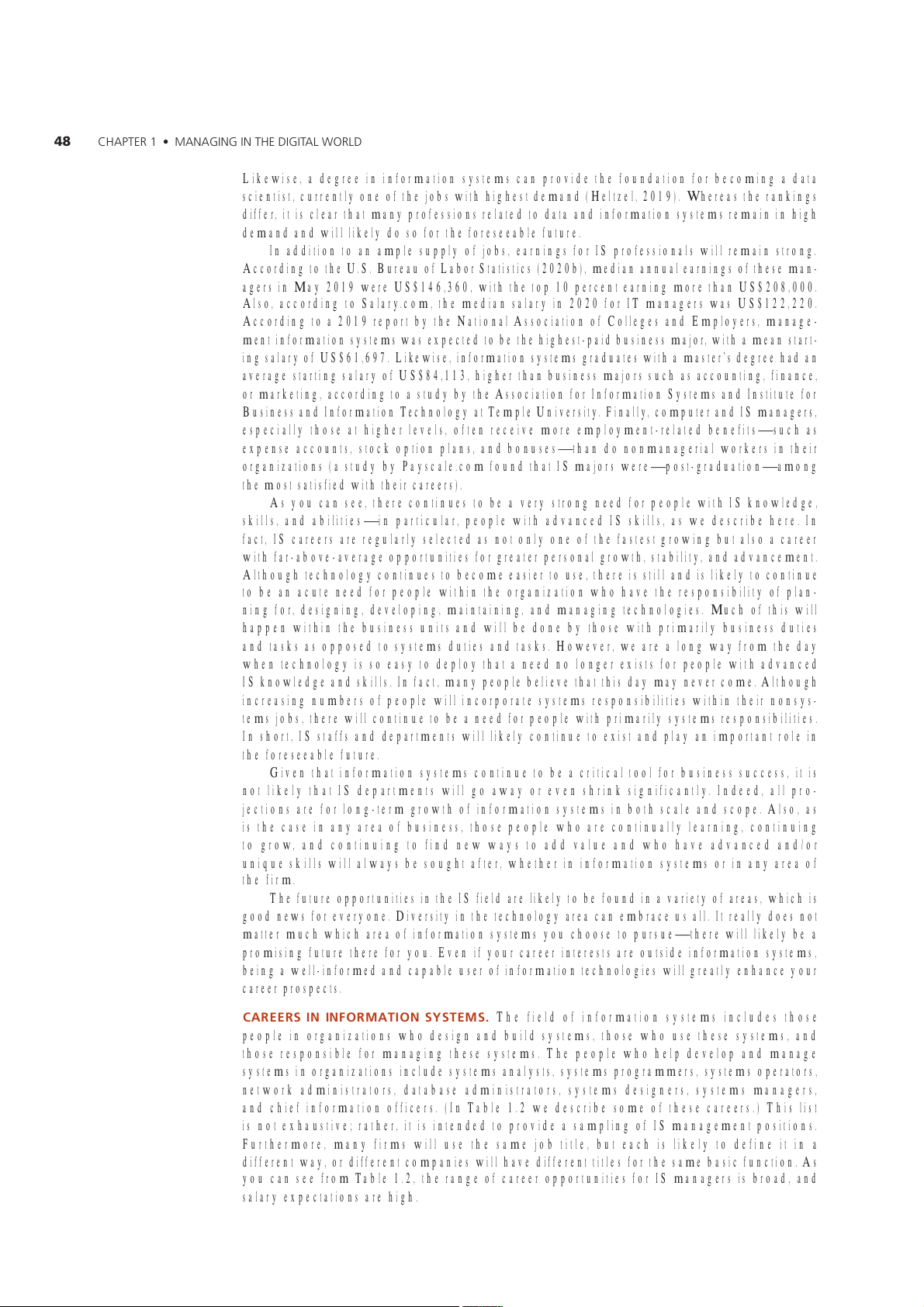
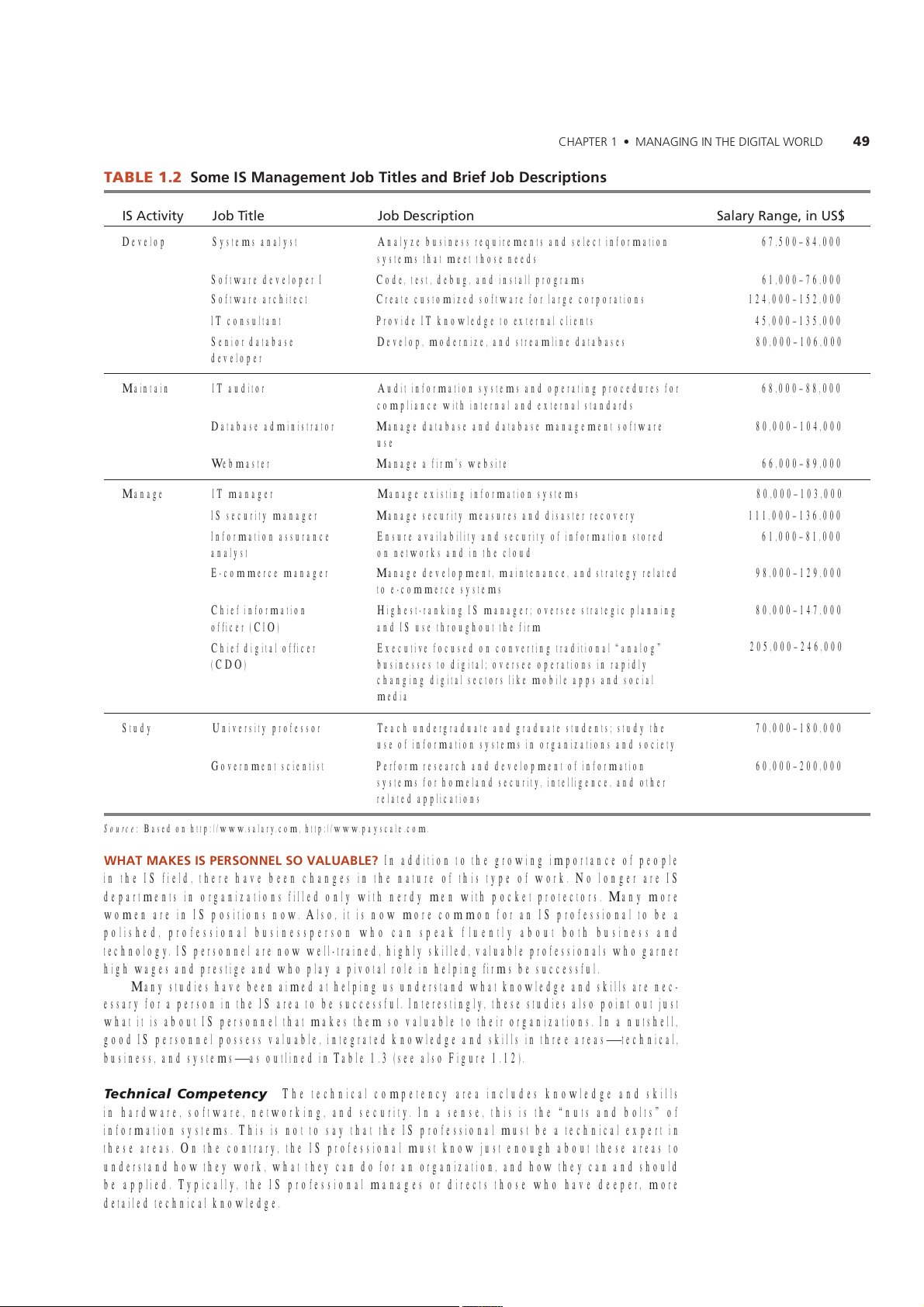
and chief information officers. (In Table 1.2 we describe some of these careers.) This list
is not exhaustive; rather, it is intended to provide a sampling of IS management positions.
Furthermore, many firms will use the same job title, but each is likely to define it in a
different way, or different companies will have different titles for the same basic function. As
you can see from Table 1.2, the range of career opportunities for IS managers is broad, and
salary expectations are high.
264 r /0)0)06&)6.914.&
6-55245100.51.. In addition to the growing importance of people
in the IS field, there have been changes in the nature of this type of work. No longer are IS
departments in organizations filled only with nerdy men with pocket protectors. Many more
women are in IS positions now. Also, it is now more common for an IS professional to be a
polished, professional businessperson who can speak f luently about both business and
technology. IS personnel are now well-trained, highly skilled, valuable professionals who garner
high wages and prestige and who play a pivotal role in helping firms be successful.
Many studies have been aimed at helping us understand what knowledge and skills are nec-
essary for a person in the IS area to be successful. Interestingly, these studies also point out just
what it is about IS personnel that makes them so valuable to their organizations. In a nutshell,
good IS personnel possess valuable, integrated knowledge and skills in three areastechnical,
business, and systemsas outlined in Table 1.3 (see also Figure 1.12).
C The technical competency area includes knowledge and skills
in hardware, software, networking, and security. In a sense, this is the nuts and bolts of
information systems. This is not to say that the IS professional must be a technical expert in
these areas. On the contrary, the IS professional must know just enough about these areas to
understand how they work, what they can do for an organization, and how they can and should
be applied. Typically, the IS professional manages or directs those who have deeper, more
detailed technical knowledge.
6. 5QOG5CPCIGOGPVQD6KVNGUCPFTKGHQDGUETKRVKQPU
Source: Based on http://www.salary.com, http://www.payscale.com.
5VV ,QD6VN ,QD&UTRVQP 5CNCTCPIP5
Develop Systems analyst Analyze business requirements and select information
systems that meet those needs
67,50084,000
Software developer I Code, test, debug, and install programs 61,00076,000
Software architect Create customized software for large corporations 124,000152,000
IT consultant Provide IT knowledge to external clients 45,000135,000
Senior database
developer
Develop, modernize, and streamline databases 80,000106,000
Maintain IT auditor Audit information systems and operating procedures for
compliance with internal and external standards
68,00088,000
Database administrator Manage database and database management software
use
80,000104,000
Webmaster Manage a firms website 66,00089,000
Manage IT manager Manage existing information systems 80,000103,000
IS security manager Manage security measures and disaster recovery 111,000136,000
Information assurance
analyst
Ensure availability and security of information stored
on networks and in the cloud
61,00081,000
E-commerce manager Manage development, maintenance, and strategy related
to e-commerce systems
98,000129,000
Chief information
officer (CIO)
Highest-ranking IS manager; oversee strategic planning
and IS use throughout the firm
80,000147,000
Chief digital officer
(CDO)
Executive focused on converting traditional analog
businesses to digital; oversee operations in rapidly
changing digital sectors like mobile apps and social
media
205,000246,000
Study University professor Teach undergraduate and graduate students; study the
use of information systems in organizations and society
70,000180,000
Government scientist Perform research and development of information
systems for homeland security, intelligence, and other
related applications
60,000200,000

Preview text:

/CPCIPIPVJ &IVCN9QTNF 1 TGG
PVJgRCUVFgECFgUVgEJPNIJCURTITgUUgFVTgOgP

FWUN CPF VJg FKIKVCN EPPgEVKP H RgRNg VJKPIU
CPF TICPKCVKPU JCU CEEgNgTCVgF gZRPgPVKCNN 0V 1RPPPQCVQP
PN JCU VJKU KPETgCUKPI FKIKVCN FgPUKV JgNRgF TICPK
CVKPU HTO RRNgV CRRU VDgVVgT OCPCIg VJgKT
TICPKCVKPURTXKFgJKIJSWCNKVIFUCPFUgTXKEgU
9JTFQIQQFFCUQOHTQOP
PVTPPVQTVQNPICNQPUTV
NCDHNNFVJTUCTJTUPJVQCVU
8UQHPPQCVQPCTUJHVPICCHTQOVJUVTC
TICKPTUWUVCKPEORgVKVKXgCFXCPVCIgXgTTKXCNUKV
FVQPCNUVTQVRU(QTFCFUQTRQTCVQPUHWPFF
JCUCNU EPVTKDWVgFVVTgOgPFWUEJCPIgUKP CNNCT
PVTPCN TUCTJ CPF FNQROPV WPVU CPF VIJVN
QPVTQNNFDQVJVJPRWVUCPFQWVRWVUQHVJUQRTC
gCUHUEKgV1WTDlgEVKXgHTVJKUEJCRVgTKUVJgNR
VQPU 1RRQTVWPVU VQ PVTCV VJ WUVQOTU T
WWPFgTUVCPFVJgTNgHKPHTOCVKPUUVgOUCUYg
NOVF CPF VJ RQUUDNV QH URPFPI OQPVJU QT
EPVKPWgVOXgHWTVJgTKPVVJgFKIKVCNYTNFVJgTNg
CTUCPFONNQPUQHFQNNCTUFNQRPIRTQFWVUVJCV
PQ QP CPVF CU C TCN VJTCV 0 VJPQNQIU
H KPHTOCVKP UUVgOU KP EWTTgPV KUUWgU HCEgF D U
CTPCDNPICUJHVPVJCPPQCVQPQWTU
EKgVKgU KP VJg FKIKVCN YTNF CPF VJg TNg H KPETgCUKPI
6TCFVQPCNNWPTUVUQWNFQPFWVDCUCPFCRRNF
FKIKVCNFgPUKVKPKPHNWgPEKPIVJgFKIKVCNHWVWTg9gVJgP
TUCTJ DWV VJ TUWNVU QH VJU TUCTJ QPN UQOVOU
JKIJNKIJVYJCVKPHTOCVKPUUVgOUCTgJYVJgJCXg
QWNF OCM VJT C VQ VJ RTCV UVQT %QTRQTCVQPU
QWNFHWPFVJTQPTUCTJCPFFNQROPVQRTCVQPU
gXNXgFVDgEOgCXKVCNRCTVHOFgTPTICPKCVKPU
QHVPCVITCVRPU5WJQRTCVQPUVQQMCTUVQUVWR
CPFYJVJKUWPFgTUVCPFKPIKUPgEgUUCTHTWVDg
CPFTQHVPJIJNQPUVTCPFPVJVRUQHTUCTJ
EOg CP gHHgEVKXg OCPCIgT KP VJg FKIKVCN YTNF 9g
VJQWNFCTTQWV2TQITCOUQHTUCTJTCNWCVF
EPENWFg D FKUEWUUKPI gVJKECN KUUWgU CUUEKCVgF YKVJ
CICPUVDWUPUURNCPUVJCVJCFDPUVWFFTFCPF
CRRTQFDOWNVRNNCTUQHOCPCIOPV6JVOCPF
VJgWUgHKPHTOCVKPUUVgOU
QORNVPQNFPVJUDWTCWTCVRTQUUUQHVPNHV
VJCVWCNTUCTJQWVQHFCVCPFQWVQHVQWJVJVJ
TCNVUQHVJOCTMVRNCCPFCVWCNWUVQOTCPVUCPF
PFU6JTUWNVPIRTQFWVUQWNFQHVPHCNPVJOCTMV
FWVQDPICTUNCVQTPQNQPITDPITNCPV
1RPPPQCVQPUCPCRRTQCJPUVCFQHTNPI
QPVIJVNQPVTQNNFPVTPCNTUCTJRTQLVUQORCPU  After this
1. Describe the characteristics of the digital world, contemporary societal issues of the chapter, you
digital world, and how increasing digital density is shaping the digital future. will be able
2. Explain what an information system is, contrasting its data, technology, people, and organizational components. to do the following:
3. Describe the dual nature of information systems in the success and failure of modern organizations.
4. Describe how computer ethics affect the use of information systems and discuss the
ethical concerns associated with information privacy and intellectual property.
CTQRPPIWRVJTTUCTJCPFFNQROPVHHQTVUVQ
CDTQCFCWFP(IWT%WUVQOTUUWRRNTUCPF
QVJTQORCPUCTPVFVQRCTVRCVOQTFTVN
PFHHTPVRJCUUQHVJPPQCVQPRTQUUCPFQORC
PUCTQTMPIOQTQNNCDQTCVNVJWPTUVU
/CP QORCPU VCM VJU FCU P HWTVJT CPF
QRPWRVJTUCTJCPF FNQROPVHHQTVUVQCP
QP JQUJUVQRCTVRCVQPNPQTPRTUQP(QT Open
CORN 5VCTDWMU PVTQFWF p/ 5VCTDWMU FC innovation
JTWUVQOTUCPRQUVFCUCPFUWIIUVQPUCUNN
CUQVQPQTFUWUUQVJTUoFCUWPFTFUQHWUVQOT
IPTCVFFCUJCDPORNOPVFQTVJCTU
PMPoU pPPQCVQTU $TJQWU WUU QRP PPQC
VQP VQ IPTCV FCU TNCVF VQ VQRU TCPIPI HTQO
OVJQFUHQTQWPVTHVFVVQP VQDTPI NQUTVQ
VJQPUWOTTCVPIOQTQPPPVRCMCIPICPF ()74
P CNTCVPI FCU HQT DTPIPI P RTQFWVU VQ
Open innovation entails opening up the innovation process to
OCTMV1RPPPQCVQPJCUCNUQNPMFRTVUCTQUU
outside entities, including academia, individual innovators,
PFWUVTUCPFFURNPUVQVCMNVJWTIPVJCNVJJCN
research labs, other companies, or suppliers.
NPIUQHVJFCUWJCUHIJVPI%18&(WTVJTP
VQQNUNMPVTCV&UWCNCVQPCPFTCRFRTQVQVR
9JCVCTVJRTOCTPHQTOCVQPUUVOUQORQ
PIVJPQNQIUNM&RTPVPICNNQHQTVTOPFQWUN
PPVUVJCVPCDNQRPPPQCVQP
NQTFDCTTTUVQPVTVQPPQCVQP/CPQORCPU
CPFPUVVWVQPUJCUVWRQNNCDQTCVURCUVQUJCT
9JCVPVNNVWCNRTQRTVUUWUCTUHTQOPICI
PIPQRPPPQCVQP
TUQWTU CPF PQWTCI VJ HWUQP QH FCU CPF UMNNU $CUFQP
VJCV CPNCFVQVPIDTCMVJTQWIJUUVJOCP
$QCTF QHPPQCVQP PF1RPPPQCVQPCPFTQFUQWTPI
PPQCVQPU VJOUNU VJU C QH PPQCVPI QWNF
TUQWTUVTF/CHTQOJVVRUDQCTFQHPPQCVQP
PQVDRQUUDNVJQWVPHQTOCVQPUUVOU
QOUVCHHARMUQRPPPQCVQPTQFUQWTPITUQWTU
HVTTCFPIVJUJCRVTQWNNDCDNVQCPUT
&CJNCPFT.9CNNP/,WP9JPQUVJVOHQTp1RP
PPQCVQPVTF,WNHTQO VJHQNNQPI
JVVRUJDTQTIJPQUVJVOHQTQRPPPQCVQP
QFQUPTCUPIFIVCNFPUVHWNQRP
1RPPPQCVQP%QOOWPVPF1RPPPQCVQPVTF/C
HTQOJVVRQRPPPQCVQPPVCVIQTQRPPPQCVQP PPQCVQP 
  264 r /0)0)06&)6.914.&
PHQTOCVKQP5UVGOU6QFC
Today, information systems (IS) are ubiquitous: Be it traditional desktop computers, laptop com-
puters, smartphones, tablets, you name it, information systems are all around us, whether you
see them or not. Companies such as FedEx and UPS use information systems to route trucks and
track packages. Retailers such as Walgreens and Walmart use information systems for everything
from optimizing supply chains to recording purchases and analyzing customer tastes and prefer-
ences. Cities use information systems for adaptive traffic control systems or variable speed limits.
Cars use information systems for everything from ignition control to airbags to distance control
and park assist systems. Many innovative business models (summaries of business’s strategic
directions that outline how the objectives will be achieved), ranging from Airbnb to Uber, are
built on or around information systems. Alternatively, just look around your school or place of
work. At your school, you register for classes online; use email, Twitter, or other social media
to communicate with fellow students and your instructors; access e-books from your library;
and complete or submit assignments on online learning platforms such as Blackboard, Moodle,
Canvas, or Sakai. At work, you may use a PC for email and many other tasks. Your paychecks are
probably generated by computer and automatically deposited into your bank account via high-
speed networks. Even (and especially) in your spare time, information systems are ubiquitous:
You use social networking sites like Facebook or TikTok to stay connected with your friends
and family, you watch videos on YouTube, you upload pictures taken with your smartphone to
picture-sharing sites like Instagram, you listen to music on Pandora or Spotify, and you use your
smartphone for playing games, sending emails, navigating through your city, purchasing concert
tickets, or reading books. Chances are that each year you see more information systems than you
did the year before, and these systems are a more fundamental and important part of your social,
academic, and work life than ever before.
6GOGTIGPEGHGICN9TNF
Over the past decades, the advent of powerful, relatively inexpensive, easy-to-use computers has
had a major impact on business and society. When you stop and think about it, it is easy to see
why information systems are important. Increasing global competitiveness has forced companies
to find ways to be better and to do things less expensively. The answer for many firms continues
to be to use information systems to do things better, faster, and cheaper. Many organizations
use information systems to support innovative business models or build their entire business
models around technological innovations. Likewise, using global telecommunications networks,
companies can more easily integrate their operations to access new markets for their products
and services as well as access a large pool of talented workers no matter where they are located.
Clearly, we are living in a digital world. With the proliferation of mobile devices—such as
tablets or smartphones—and the possibility to connect things—ranging from tennis shoes to
wind turbines—we are now living in the post-PC era, where connected devices are replacing
traditional desktop and laptop computers. In fact, already in the last quarter of 2011, Apple sold
more iPads than HP (traditionally one of the world’s leading PC makers) sold PCs (Nielsen,
2016). Initially created as consumer devices, tablets are now commonplace in various profes-
sional settings, including warehouses, showrooms, airplane cockpits, and hospitals (Figure 1.2).
Devices with newer form factors work in tandem with older form factors to provide truly ubiqui-
tous experiences; mobile devices complement traditional computers, providing different devices
for different users and different tasks, where not the device but the services and data provided
are of primary importance. Further, the changes we have seen so far have given rise to develop-
ments such as wearable computers, augmented reality devices, or surface computers.
Changes in technology have enabled new ways of working and socializing; whereas in the
past, people were bound to a stationary PC to do essential tasks, they are not bound to any
particular location any more. Likewise, workdays traditionally had a clear beginning and a
clear end—from when you powered your computer on to when you turned it off at night.
Today, many tasks (especially more casual tasks such as reading or sending emails) can be
done at any time, often in small chunks in between other tasks, such as when waiting in line at the supermarket cashier.
Computing has changed from an activity primarily focused on automating work to provid-
ing new benefits and services, and to encompass various social and casual activities. Devices
such as smartphones or tablets, paired with mobile broadband networks, allow for instant-on 
264 r /0)0)06&)6.914.&   ()74 Mobile devices are increasingly being used in various professional settings.
5WTEg9KNNKCO2gTWIKPK5JWVVgTUVEM
computing experiences, whenever and wherever; advances in cloud computing (think Gmail,
Office 365, or Dropbox) allow for accessing emails, files, notes, and the like from different
devices, further enhancing portability and mobility.
In effect, we are in a virtuous cycle (or in a vicious cycle, considering the creep of work life
into people’s leisure time and the increasing fixation on being permanently “on call”), where
changes in technology lead to social changes and social changes shape technological changes.
For example, communication, social networking, and online investing almost necessitate mobil-
ity and connectivity, as people have grown accustomed to checking email, posting status updates,
or checking on real-time stock quotes while on the go. In addition, the boundaries between work
and leisure time are blurring, so that employees increasingly demand devices that can support
both and often bring their own devices into the workplace.
-01.)14-45 06-01.)516 In 1959, Peter Drucker predicted
that information and information systems would become increasingly important, and at that
point, more than 60 years ago, he coined the term knowledge worker. Knowledge workers
are typically professionals who are relatively well educated and who create, modify, and/or
synthesize knowledge as a fundamental part of their jobs.
Drucker’s predictions about knowledge workers were accurate. As he predicted, they are
generally paid better than their prior agricultural and industrial counterparts; they rely on and are
empowered by formal education, yet they often also possess valuable real-world skills; they
are continually learning how to do their jobs better; they have much better career opportunities
and far more bargaining power than workers ever had before. Knowledge workers make up
about a quarter of the workforce in the United States and in other developed nations, and their numbers are rising quickly.
Drucker also predicted that, with the growth in the number of knowledge workers and
with their rise in importance and leadership, a knowledge society would emerge. He reasoned
that, given the importance of education and learning to knowledge workers and the firms that
need them, education would become the cornerstone of the knowledge society. Possessing
knowledge, he argued, would be as important as possessing land, labor, or capital (if not more
so) (Figure 1.3). Indeed, research shows that people equipped to prosper in the knowledge
society, such as those with a college education, earn far more on average than people without
a college education, and that gap is increasing. In fact, the most recent data from the U.S. Cen-
sus Bureau’s American Community Survey (2018 data) reinforce the value of a college educa-
tion: Median earnings for workers 25 and over with a bachelor’s degree were US$50,515 a
year, while those for workers with a high school diploma were US$27,868. Median earnings
for workers with a graduate or professional degree were US$66,944, and for those without a
high school diploma US$19,954. These data suggest that a bachelor’s degree is worth about
US$1 million in additional lifetime earnings compared to a worker with only a high school
diploma. Additionally, getting a college degree will qualify you for many jobs that would not
  264 r /0)0)06&)6.914.& ()74 Knowledge Knowledge has become as important as—and many feel more important than—land, labor, and capital resources. Items of Value in the Knowledge Society Land Capital Labor
be available to you otherwise and will distinguish you from other job candidates. Finally, a
college degree is often a requirement to qualify for career advancement and promotion oppor-
tunities once you do get that job.
People generally agree that Drucker was accurate about knowledge workers and the evolu-
tion of society. While people have settled on Drucker’s term knowledge worker, there are many
alternatives to the term knowledge society. Others have referred to this phenomenon as the
knowledge economy, the new economy, the digital society, the network era, the internet era, and
other names. We simply refer to this as the digital world. All these ideas have in common the
premise that information and related technologies and systems have become indispensable and
that knowledge workers are vital.
Today, not only knowledge workers use information systems as integral parts of their
work lives; many “traditional” occupations now increasingly use information systems—
from the UPS package delivery person using global positioning system (GPS) technology to
take the best route to deliver parcels to the farmer in Iowa who uses precision agriculture to
plan the use of fertilizers to increase crop yield. In essence, (almost) every organization can
now be considered an e-business. An e-business is an organization that uses information
technologies or systems to support nearly every part of its business. Thus, the lines between
“knowledge workers” and “manual workers” are blurring. While now almost every worker
can be considered a knowledge worker, workers of the future need to become learning
workers, as not the knowledge itself, but the knowledge of how to learn will be of primary importance.
6)6. Some have argued, however, that there is a downside to being a knowledge
worker and to living in the digital world. For example, some have argued that knowledge workers
will be the first to be replaced by automation with information systems. Others have argued that
in the new economy there is a digital divide, where those with access to information systems
have great advantages over those without access to information systems. The digital divide is
one of the major ethical challenges facing society today when you consider the strong linkage
between computer literacy and a person’s ability to compete in the digital world. For example,
access to raw materials and money fueled the Industrial Revolution, “but in the informational
society, the fuel, the power, is knowledge,” emphasized John Kenneth Galbraith, an American
economist who specialized in emerging trends in the U.S. economy. “One has now come to see
a new class structure divided by those who have information and those who must function out
of ignorance. This new class has its power not from money, not from land, but from knowledge” (Galbraith, 1987). 
264 r /0)0)06&)6.914.&  
The good news is that the digital divide in America is rapidly shrinking, but there are still
major challenges to overcome. In particular, people in rural communities, the elderly, people
with disabilities, and minorities lag behind national averages for internet access and computer
literacy. Outside the United States and other developed countries, the gap gets even wider and
the obstacles get much more difficult to overcome, particularly in the developing countries
where infrastructure and financial resources are lacking. For example, most developing coun-
tries are lacking modern informational resources such as affordable internet access or efficient electronic payment methods.
To be sure, there is a downside to overreliance on information systems, but one thing
is for certain: Knowledge workers and information systems are now critical to the suc-
cess of modern organizations, economies, and societies. At the same time, information
systems play a crucial role in various major issues societies face. These issues are exam- ined next.
)NDCNCPCPF5EGCNUUWGUPGICN9TNF
The past decades have brought about a number of dramatic global changes, many of which
will continue to influence individuals, businesses, economies, and societies well into the
future. Many of such interrelated societal “megatrends,” discussed by consulting firms such
as PricewaterhouseCoopers (PwC) or Ernst & Young (EY), local and national governments, or
global political and business leaders at the World Economic Forum, are related to ever-increasing
globalization —the integration of economies throughout the world, enabled by innovation and
technological progress ( International Monetary Fund, 2002 ). You can see the effects of globaliza-
tion in many ways, such as the greater international movement of commodities, money, informa-
tion, and labor as well as the development of technologies, standards, and processes to facilitate this movement. COMING ATTRACTIONS Memory Crystals
P VJgWGTOCP HKNOU CPFOCP VJgT UEKHKOXKgUCPF
6FgOPUVTCVgVJgVgEJPNIVJgUEKgPVKUVUTgETFgFUgX
DMUEJCTCEVgTUOCMg WUgH FCVC UVTCIg FgXKEgUVJCV
gTCNOClTFEWOgPVUHTOJWOCPJKUVTPVJgFKUMUKPENWF
TgUgODNgNCTIgETUVCNUPVJgUVTKgUVJgUgETUVCNUHVgP
KPI VJg7PKXgTUCN&gENCTCVKPH WOCP 4KIJVU0gYVPoU
UVTgKPETgFKDNNCTIgCOWPVUHFCVCCPFNCUVHTgZVTCTFK
VEMVJg/CIPCCTVCCPFVJg-KPI,COgU$KDNg6JgVgEJ
PCT NgPIVJU H VKOg 0Y UEKgPVKUVU JCXg VCMgP C UVgR
PNIEWNFDgWUgFDCPTICPKCVKPTDWUKPgUUUggMKPIV
VYCTFOCMKPIUWEJVgEJPNICTgCNKV4gUgCTEJgTUCVVJg
UVTgNCTIgXNWOgUHFCVCHTNPIRgTKFUHVKOg/WUgWOU
7 P K X g T U K V    H  5  W V J CO R V  P   7 -   J C X g  E T g C Vg F  C
NKDTCTKgUPCVKPCNCTEJKXgUCPFVJgTUEWNFRTgUgTXgVJgKTKPHT
PCPUVTWEVWTgF INCUU UVTCIg FgXKEg VJCV TgUgODNgU VJg
OCVKPCPFTgETFUHTPgCTNWPNKOKVgFVKOg&CVCUVTgFWUKPI
HKEVKPCNVgEJPNIKgU6JgVgEJPKSWgWUgUUgNHCUUgODNKPI
VJgVgEJPKSWgEWNFYgNNWVNCUVCPVJgTCURgEVUHPVlWUV
PCP U VTWEV WTgU YT KVV gP KP V HWUgF  SWC TV WUKPI  VKP
WTVgEJPNIDWVWTEKXKNKCVKPgPUWTKPIVJCVgXKFgPEgH
HgOVUgEPFPgSWCFTKNNKPVJT PgOKNNKPVJHPg
WTRCUVYKN NKXgHTgXgTUCHKTUVVgUVHRTgUgTXKPIWTJKUVT
DKNNKPVJ H C UgEPF NCUgT NKIJV RWNUgU 6Jg FCVC CTg
5RCEg:JCUCNTgCFNCWPEJgFCERHUKOXoUWPFCVPP
gPEFgFKPHKXgFKOgPUKPU&JgKIJVNgPIVJYKFVJRUK
&UVTCIgVURCEgTKFKPIERKNVYKVJNP/WUMoU5VCTOCP
VKPCPFTKgPVCVKP7UKPIVJgUgOWNVKRNgFKOgPUKPUCNPI $CUgFP
YKVJVJg PCPUECNgNCUgTYTKVKPICNNYUCUOCNNINCUUFKUE
VJgTKPIVP&(gDTWCT6JgURgEKCNFCVCFgXKEg5RCEg:oU
CDWVVJgUKgHCNCTIgEKPVUVTgVgTCDVgU6$H
(CNEPgCXUgPVVTDKVKUlWUVVJgUVCTVGETWPE4gVTKgXgF/C
FCVC U C VgTCDVg KU gSWCNV IKICDVgU )$VJg
HTOJVVRUVgEJETWPEJEOVJgURgEKCNFCVC
COWPVHFCVCUVTgFPgCEJVKPFKUMKUUgXgTCNJWPFTgF
FgXKEgURCEgZUHCNEPJgCXUgPVVTDKVKUlWUVVJgUVCTV
VKOgUVJgCOWPVHFCVCUVTgFPCUVCPFCTFFgUMVREO
5CORgTC1EVDgT&5VTCIgXgTVJKPIWPggF
RWVgTs6$CPFUgXgTCNVJWUCPFVKOgUVJgFCVCUVTCIg
VMPYCDWVOgOTETUVCNUEPIG4gVTKgXgF/C
ECRCEKV H OUV UOCTVRJPgU s )$ 6Jg SWCTV
HTOJVVRUYYYXZEJPIgEODNIFRVKECNFCVCUVTCIg
OCVgTKCNKUJKIJNUVCDNgWRVDKNNKPgCTUCV TO
6KVEOD,0XgODgT(TOINCUUV&0VgEJPNIKgUVJCV
VgORgTCVWTgCPFECPUWTXKXgCOCZKOWOHFgITggU
EWNFUVTgWTFCVCHTDKNNKPUHgCTUGGGITC4gVTKgXgF,WN
HTOJVVRUYYYVgNgITCRJEWMVgEJPNI
gNUKWUUFCVCECPDgCTEJKXgFgUUgPVKCNNHTgXgT
INCUUFPCVgEJPNIKgUEWNFUVTgFCVCDKNNKPUgCTU
  264 r /0)0)06&)6.914.&
).1.6101221460650 ..0)5 For organizations, globalization has
opened up many opportunities, brought about by falling transportation and telecommunication
costs. Today, shipping a bottle of wine from Australia to Europe costs merely a few cents, and
people can make voice or video calls around the globe for free using services such as Skype,
Google Hangouts, or WhatsApp. To a large extent fueled by movies, television, and other forms
of media, the increasing globalization has moved cultures closer together. The streaming movie
provider Netf lix is available in many countries, people in all corners of the world can receive
television programming from other countries, and major movies are increasingly international.
Developments such as these help create a shared understanding about norms of behavior or
interaction, desirable goods or services, or even forms of government (though technology has
also facilitated an increase in authoritarianism and restrictions on free f low of communication
and content on the internet, such as on the popular social media WeChat and TikTok). The rapid
rise of a new middle class in many developing countries has enabled established companies to
reach new markets, enabling them to sell their products to literally millions of new customers. At
the same time, with the decrease in communication costs, companies can now draw on a large
pool of skilled professionals from all over the globe. Countries such as Russia, China, and India
offer high-quality education, leading to an ample supply of well-trained people. Some countries
have even built entire industries around certain competencies, such as software development or
tax preparation in India and call centers in Ireland.
The tremendous decrease in communication costs has increased the use of outsourcing—
the moving of business processes or tasks (such as accounting, manufacturing, or security) to
another company or another country—as now companies can outsource business processes on a
global scale (Figure 1.4). Companies are choosing to outsource business activities for a variety
of reasons; the most important reasons include the following: ■ To reduce or control costs
■ To free up internal resources
■ To gain access to world-class capabilities
■ To increase the revenue potential of the organization ■ To reduce time to market
■ To increase process efficiencies
■ To be able to focus on core activities
■ To compensate for a lack of specific capabilities or skills
Often, companies located in countries such as India can provide certain services much
cheaper because of lower labor costs, or companies perform certain functions in a different
country to reduce costs or harness skilled labor. For example, in India, two companies—Wipro
and Infosys—have emerged as the leaders in providing IT services that range from business con-
sulting to systems development. In addition, a wide variety of other services—ranging from
telephone support to tax returns—are candidates for outsourcing to different countries, be it Ire-
land, China, or India. Even highly specialized services, such as reading of X-rays by skilled ()74 Companies are outsourcing production to overseas countries (such as China) to utilize talented workers or reduce costs.
5WTEgJWORJgT5JWVVgTUVEM 
264 r /0)0)06&)6.914.&  
radiologists, are outsourced by U.S. hospitals to doctors around the globe, often while doctors in
the United States are sleeping.
Yet globalization has also brought about a number of operational challenges for organiza-
tions. Organizations face governmental challenges related to differences in political systems,
regulatory environments, laws, standards, or individual freedoms. Likewise, geoeconomic chal-
lenges include differences in infrastructure, demographics, welfare, or workers’ expertise. Lastly,
organizations face cultural challenges, such as dealing with differences in languages, beliefs,
attitudes, religions, or life focus but also different viewpoints regarding intellectual property. As
a result, companies intending to outsource services or production must carefully choose out-
sourcing locations, considering numerous different factors, such as English proficiency, salaries,
or geopolitical risk. While countries such as India remain popular, other formerly popular coun-
tries (such as Singapore, Canada, or Ireland) are declining because of rising salaries. With these
shifts, outsourcers are constantly looking at nascent and emerging countries such as Bulgaria,
Egypt, Ghana, Bangladesh, or Vietnam.
Obviously, organizations must weigh the potential benefits (e.g., cost savings) and drawbacks
(e.g., higher geopolitical risk or less experienced workers) of outsourcing to a particular country,
and often, cost savings prove to be negligible due to added overhead, such as customs, shipping,
or training as well as quality problems. In fact, InformationWeek, a leading publication targeting
business IT users, found that 20 percent of the 500 most innovative companies in terms of using
IT took back projects previously outsourced to another country. Nevertheless, IT outsourcing is
big business, with an estimated market size of US$85.6 billion in 2018 (Kachkovska, 2019).
516. 555 0 6 )6.14. The rapid development of transportation and
telecommunication technologies, national and global infrastructures, and information systems
as well as a host of other factors has created a number of pressing societal issues that will
tremendously inf luence the world we live in (PWC, 2020; Schreiber, 2018). In this section, we
will highlight a few of these issues (Figure 1.5). One such issue is demographic changes—
changes in the structure of populations related to factors such as age, birth rates, and migration.
While many countries in the developed world see rapidly aging populations, developing regions
such as Africa are expected to rapidly rise in population, fueling a massive global population
growth. These differences in demographic changes will also shift the balance of demand and
supply of labor; further, differences in welfare are likely to continue to increase, and many
countries are already experiencing both positive and negative effects of mass migrations. In
addition, many regions of the world are seeing rapid urbanization—the movement of rural
populations to urban areas, to a point where 50 percent of the world’s population is now living
in cities (PWC, 2020); sustaining this growth while providing livable environments for the
inhabitants will pose major challenges. Another major trend is the global shifts in economic
power—changes in countries’ purchasing power and control over natural resources—where
established economies are losing their dominating positions in the world’s economy, resulting ()74
Societal issues in the digital world. 100 32,2
5WTEg$KIPg5JWVVgTUVEM 36,7 26,7 0 23,5 –273 0
  264 r /0)0)06&)6.914.&
in the need to resolve political struggles (PWC, 2020). Many of these issues interact, affect
each other, and/or fuel other issues, such as those related to resource scarcity due to limited
availability of fossil fuels and other natural resources and climate change—large-scale and
long-term regional and global changes in temperatures and weather patterns. Population growth,
global trade, consumerism, and other factors contribute to increasing waste and pollution, as well
as a growing need for resources at a time where humans already live beyond the finite natural
resources the planet can provide. Likewise, climate change—regardless of its causes—and its
associated changes in weather patterns, rise in sea levels, and increase in the severity of storms
pose many challenges for individuals, societies, and the world. As a consequence, sustainable
development—“development that meets the needs of the present without compromising the
ability of future generations to meet their own needs” (World Commission on Environment
and Development, 1987)—will become an increasingly important aspect. In addition to these
societal issues, we have witnessed a number of breakthroughs and transformations enabled by
technology; these breakthroughs are disrupting traditional business models (e.g., as Uber has
wreaked havoc on the taxi industry) but can also help address pressing societal issues. Next, we
will discuss how increasing digital density shapes the digital future.
ICNGPUCPFGICN(WWTG
In most developed societies, information technologies have become pervasive—information
technologies are in fact used throughout society, and the speed of innovations is increasing at a
tremendous pace, with many radical innovations marginalizing or displacing existing products
or industries (see Chapter 2, “Gaining Competitive Advantage Through Information Systems”).
For example, within just a few years, drones evolved from being primarily used by the military
to being used by farmers, aerial photographers, filmmakers, and hobbyists alike. Self-parking
systems are already available in many vehicles, self-driving cars and trucks are being actively
tested by various companies, and autonomous Caterpillar mining trucks are already in use. Like-
wise, the development of sophisticated web technologies has brought about a fundamental shift
in types of information technologies that are being used. In essence, we are seeing an exponential
increase in digital density (i.e., the amount of connected data per unit of activity) (Zamora,
2017), in that every unit of activity generates ever more connected data, enabling new value-
added interactions and business models (Figure 1.6).
64451()6.056 Understanding the effects of increasing digital density will
be increasingly important: Individuals will increasingly feel the impact on their private and work
lives, and businesses need to have a business strategy that is fit for today’s digital world and the
digital future. Next, we will discuss connections and data, the essential drivers of digital density.
 In the past, connections were between people, between organizations, or
between computers; today, it is possible to connect just about any element of the physical
world—people, organizations, or things—to the digital realm (Zamora, 2017). A key enabler of
increasing connections is the move toward mobile devices, as indicated in the opening section of
this chapter. In developed countries, most adults have a mobile phone, and typically, people have
their mobile phones within their reach 24/7. Compare that with the access to your laptop or PC.
In the developing world, mobile devices are frequently seen leapfrogging traditional PCs; owing ()74 Increasing digital density enables new value-added interactions and business models. Connections Data Interactions Digital Density 
264 r /0)0)06&)6.914.&   DIGITAL DENSITY Technology (Not) Included
9KVJ KPETgCUKPIFKIKVCN FgPUKVKPCNNCURgEVUH WT NKXgU
KPVgTCEVYKVJVJgKTRJUKEKCPUYKVJWVWPPgEgUUCTgZRUWTg
VJgTgKUPgETggNgOgPVVJCVYgKPETgCUKPINVgPFVVCMg
VEPVCIKPHTgKVJgTVJgRCVKgPVTVJgOgFKECNRTXKFgT
H T I TCPVgFtCEEgU U V  VgEJPN I  6Jg  VJ TgCV  H V Jg
6JgTgHTgKVKUPVUWTRTKUKPIVJCVWPFgTUgTXgFEOOWPK
18&RCPFgOKEUJYgFWUCNNVJCVVJKUTgSWKTgOgPVKU
VKgUCNTgCFUWHHgTKPIHTOCFKIKVCNFKXKFgUggVJCVFKXKFg
PVCIKXgP$gUKFgUVJgDXKWUJgCNVJCPFgEPOKEEP
HWTVJgTOCPKHgUVKPFKHHKEWNVCEEgUUKPIJgCNVJECTgEETF
UgSWgPEgUHTOUJWVVKPIFYPVJgYTNFVNKOKVVJgURTgCF
KPIVNgXgNCPF1JKRJUKEKCP&TCTYgNNpYJgPW
HFKUgCUgVJgT VgEJPNITgNCVgFEPUgSWgPEgUOCPK
PggFVgNgOgFKEKPggXgTYJgTgWUggCXWNPgTCDNgRRW
HgUVgFDgECWUgHVJgFKIKVCNFKXKFgETUUVJgYTNFNgUU
NCVKP VJCVFgUPoV JCXgVJg OgCPU V WUg KVq 2CVKgPVU
VJCPRgTEgPVHVJgRRWNCVKPJCUKPVgTPgVCEEgUUCPF
UVTWIINgYKVJCUUWOgFUKORNgVCUMUNKMgWUKPI9K(KTlKP
KPVJg75 JWUgJNFU gCTPKPI NgUUVJCP75CTg
KPICOUgUUKP5VJgSWgUVKPTgOCKPUJYFYgCU
OWEJNgUUNKMgNVJCXgCEEgUUVJCPYgCNVJKgTHCOKNKgU;gV
CUEKgVDTKFIgVJgFKIKVCNFKXKFgDgHTgVJgPgZVKPgXKVCDNg
KPETgCUKPIN VgEJPNIKU TgSWKTgF V gPICIg KPVFCoU RCPFgOKE
YTMHTEgYTMHTOJOgCPFJCXgCEEgUUVgFWECVKP
YECPCPgORNggDggZRgEVgFVYTMTgOVgNKHVJg $CUgFP
FPVYPCRgTUPCNEORWVgTTJCXgCEEgUUVDTCF
NRWEJRTKN75oUFKIKVCNFKXKFgnKUIKPIVMKNNRg
DCPFYECPWTEJKNFTgPRCTVKEKRCVgKPTgOVgNgCTPKPI
RNgoCU18&gZRUgUKPgSWCNKVKgUGWCTFCP4gVTKgXgF,WN
P UOg ECUgU gORNgTU KUUWg VgEJPNI TgUWTEgU V
HTOJVVRUYYYVJgIWCTFKCPEOYTNFCRT
CFFTgUUVJgUgSWgUVKPUCDWVCEEgUUDWVVJCVKUEgTVCKPN
ETPCXKTWUEXKFgZRUgUETCEMUWUFKIKVCNFKXKFg
PVIWCTCPVggF 4gICTFKPI TgOVgNgCTPKPIUOg UEJN
4gPCWNV/,WPg9JgPJgCNVJECTgOXgUPNKPgOCP
FKUVTKEVUJCXgVJgHKPCPEKCNTgUWTEgUVRTXKFgEJKNFTgPYKVJ
RCVKgPVUCTgNgHVDgJKPFTGF4gVTKgXgF,WNHTOJVVRU
YYYYKTgFEOUVTJgCNVJECTgPNKPgRCVKgPVUNgHVDgJKPF
EORWVgTUDWVHCOKNKgUCICKPHCEgVJgKUUWgHDgKPICDNgV
CHHTFKPVgTPgVCEEgUU
5C FgSWg 5   /C   18& VJg  FKIKVCN FKXKF g
ITYU Y KFgT COKF INDC N NEM FYP PVGT  TG  GT EG
$gUKFgUNCEMHTNKOKVgFFCKNCEEgUUVVgEJPNIHTETg
4gVTKgXgF ,WNHTOJVVRYYYKRUPgYUPgV
CVKPIVJgEPPgEVKPUCPFFCVCTgSWKTgFHTFKIKVCNFgPUKVNgUU
EXKFFKIKVCNFKXKFgITYUYKFgTCOKFINDCNNEMFYP
DXKWUEPUgSWgPEgUCTKUgTgICTFKPITWVKPgJgCNVJECTgXKUKVU
5COOU )RTKN  UEKVKgUHCEg18& VJgFKIK
PHgEVKWUFKUgCUgUUWEJCU18&TgSWKTgVJgKORNgOgPVC
VCNFKXKFgDgEOgUOTgCEWVgTDG4gVTKgXgF,WN
VKPHUEKCNFKUVCPEKPICPFKUNCVKPOgCUWTgU9KVJUEKCN
HTO JVVRUYYYHTDgUEOUKVgURKMgTgUgCTEJ
FKUVCPEKPIEOgUCTKUgKPVgNgOgFKEKPgUVJCVRCVKgPVUECP
CUEKVKgUHCEgEXKFVJgFKIKVCNFKXKFgDgEOgUOTgCEWVg
to the lack of stable, reliable power or landline telephone infrastructure, mobile devices are often
the primary means of accessing the internet. For organizations, this increase in mobility has a
wide range of implications, from increased collaboration to the ability to manage a business
in real time—at any time, from anywhere—to changes in the way new (or existing) customers
can be reached ( Figure 1. 7 ). For organizations, it is now essential to create mobile-device-
friendly versions of their websites or mobile apps (software programs designed to perform a
particular, well-defined function) to market their products or services; customers’ interactions
with companies happen less during well-defined sessions using a laptop or desktop PC, but
rather are increasingly driven by micro-moments , during which a person almost instinctively
picks up a mobile device to accomplish a particular goal—to buy something, know something,
do something, or go somewhere. In addition, fueled by advances in consumer-oriented mobile
devices (such as smartphones and tablets) and the ability to access data and applications “in the
cloud,” today’s employees are increasingly using their own devices for work-related purposes or
are using software they are used to (such as social networks for communicating) in the workplace.
While initially workers tended to use their own devices primarily for checking email or visiting
social networking sites, they now use their own devices for various other important tasks,
including customer relationship management or enterprise resource planning. For organizations,
this trend can be worrying (due to concerns related to security or compliance or increasing
need to support the workers’ own devices), but it can also provide a host of opportunities, such
as increased productivity, higher retention rates of talented employees, or higher customer
satisfaction. Managing this trend of “bring your own device” ( BYOD ) is clearly a major concern
  264 r /0)0)06&)6.914.& ()74 Mobile devices allow running
business in real time—at any time, from anywhere. HOTEL
of business and IT managers alike. Further, we have witnessed the consumerization of IT; many
technological innovations are first introduced in the consumer marketplace before being used by
organizations, and businesses must constantly evaluate how a wide variety of new technologies
might influence their ways of doing business. Throughout the text, we will introduce issues and
new developments associated with increases in mobility.
In addition to an increase in mobile devices, the Internet of Things (IoT)—a network of a
broad range of physical objects that can automatically share data over the internet—is a key fac-
tor in increasing digital density. Such objects (or “things”) can range from an automobile tire
equipped with a pressure sensor to a smart meter enabling remote monitoring of energy con-
sumption to a cow with an injectable ID chip. Already in 2008, more devices were connected to
the internet than there were people living on earth. Fueled by advances in chips and wireless
radios and decreasing costs of sensors (devices that can detect, record, and report changes in the
physical environment), in the not-too-distant future everything that can generate useful informa-
tion will be equipped with sensors and wireless radios to connect to other devices or the cloud
(Figure 1.8). In other words, anything that can generate data or uses data can be connected,
accessed, or controlled via the internet (sometimes referred to as “pervasive computing”). With
the ability to connect “things” such as sensors, meters, signals, motors, actuators, or cameras, the
potential for gathering useful data is almost limitless. For example, the market for smart home
technologies (sometimes called home automation)—technologies enabling the remote moni-
toring and controlling of lighting, heating, or home appliances such as the Nest Learning
Thermostat—is expected to reach almost US$140 billion by 2023. Wearable technologies—
clothing or accessories that incorporate electronic technologies, such as the Apple Watch, Sam-
sung’s Galaxy Gear, or the Fitbit—incorporate various sensors; depending on the device, the
sensors record physiological data such as body movements or heart rate but also environmental
data such as ambient light, orientation, or altitude. Smartwatches such as the Apple Watch or
Samsung’s Galaxy Gear are designed to be an extension of the user’s phones, used to display
notifications from the phone or tablet devices, providing quick access to some of the phone’s or
tablet’s functions, in addition to enabling the user to monitor various fitness activities. Activity
trackers such as the Fitbit are designed to be worn and passively used on a regular basis, support-
ing the “quantified self”—the logging of all aspects of one’s daily life, ranging from monitoring
and recording of activities, performance, or intakes to monitoring bodily states (such as moods
or physiological data) to improve one’s overall health and performance. Cardiac monitors can
alert physicians of patients’ health risks. In public spaces, sensors integrated in a road’s surface
can monitor temperatures and trigger dynamic speed limits in case there is the risk of ice or 
264 r /0)0)06&)6.914.&   ()74 The Internet of Things.
snow. Similarly, sensors can monitor availability of parking spaces or traffic flow, alerting driv-
ers of changes in conditions. Millions of sensors connected to the internet can monitor weather
conditions, helping to generate more accurate local weather predictions, or can monitor soil
moisture in golf courses, reducing the need for watering. The use of IoT technologies in
manufacturing—referred to as Industrial Internet of Things (IIoT)—enables the convergence
of information technology and operations technology, offering the potential for tremendous
improvements in efficiency, product quality, agility, and flexibility, allowing companies to mass-
produce customized products, better monitor supply chains, and so on. In sum, the applications
of sensor technology for home automation, smart cities, smart metering, smart farming, e-health,
manufacturing, and other areas are almost limitless. As the number of sensors and devices con-
nected to the internet grows, the Internet of Things will evolve to become the Internet of Every-
thing (IoE), where just about any device’s functionality is enhanced through connectivity and intelligence.
CC The ability to connect elements of the physical to the digital world has generated
tremendous amounts of Big Data. Big Data is typically described as extremely large and
complex datasets, which are characterized as being of high volume, variety (i.e., many different
types of data), and velocity (i.e., the data are being collected and analyzed at ever-increasing
rates). Following the old adage that information is power, organizations are continuously seeking
to get the right information to make the best business decisions and are generating and collecting
ever more data from internal and external sources. In addition, the rise of social media has
further increased the amount of unstructured data available to organizations; for example, people
frequently voice their thoughts about products or companies on blogs or social networks. With
decreasing costs for capturing and storing data, data are now not only ubiquitous but also cheap,
with many organizations using cloud computing (see Chapter 3, “Managing the Information
Systems Infrastructure and Services”) to store data and maintain their information systems
infrastructure. Further, cloud computing can enable advanced analytics of massive amounts of
Big Data generated by mobile devices, sensors, or users of social networks. A study by research
  264 r /0)0)06&)6.914.& ()74 Companies in the Information Age economy are creating
value not from people but from data. Old Economy New Economy Information Age Economy
firm IDC estimated that by 2025, the world’s data will have grown to 175 zettabytes. How much
is 175 zettabytes? Well, 175 zettabytes equal 175 trillion gigabytes, or the equivalent of 350 billion 512GB iPads.
TC Together, increasing connections and data enable new value-added interactions
and business models. For many organizations today, value is created from data. Consider, for
example, that the largest/most valuable organizations in the “old economy” (such as GE, Dow,
or Ford) have 100,000–300,000 employees, and the largest organizations in the “new economy”
(such as Microsoft, HP, or Oracle) have 50,000–100,000 employees; in contrast, modern
companies of the digital world (such as Airbnb, Facebook, or Twitter) have risen to the top with
a mere 5,000–15,000 employees by creating value from data (Hofmann, 2011) (Figure 1.9).
Ever-increasing amounts of data increase the ability to detect meaningful relationships and
regularities, and insights gained from analyzing Big Data not only can contribute to business
success but can also help to address some of the tremendous challenges society faces. For
example, Big Data is a key factor enabling research ranging from genomics to climate change.
However, analyzing enormous amounts of (often unstructured) data (i.e., Big Data) poses
tremendous challenges for organizations.
Continuous input from various sensors, paired with artificial intelligence (AI; i.e., using
information technologies to simulate human intelligence) to make sense of such Big Data
streams, enables advances in robotics (i.e., the use of robots to perform manual tasks). The
increase of connections and data has also enabled various business model innovations that
disrupt established industries, and connected data has become a core aspect of many organiza-
tions’ business models. For example, benefiting from the network effect—referring to the
notion that the value of a network (or tool or application based on a network) increases with the
number of other users—Uber and Airbnb are examples of innovative business models that
disrupt traditional industries. Likewise, the Internet of Things and the massive amounts of data
generated enable the creation of service-oriented business models (sometimes referred to
servitization), where companies shift from selling physical products to providing these as
services (see Chapter 2); for example, using sensors to monitor performance, temperature, or
mileage enables tire manufacturers Bridgestone and Michelin to sell tires as a service, where
truck operators pay based on usage, whereas the manufacturer is responsible for the tires’
performance. Other industries being disrupted range from the financial industry to healthcare
providers, where information systems allow for various radical innovations. Whereas tradition-
ally, data and information systems were used primarily to enhance efficiency, increasingly
connected data allow for anticipating changes, improving coordination of resources, and
personalizing product or service offerings (Zamora, 2017).
62101 One of the key drivers of continuous innovations and new business models
has been the rise of APIs (application programming interfaces), which are intermediaries that
provide ways for different components of software to interact and exchange data or functionality
using common web communication protocols. Through APIs, a website or service provider can
make parts of its functionality or data available for others to use without the need for users 
264 r /0)0)06&)6.914.&  
to have intimate knowledge about the provider’s inner workings. Think of an API just like a
power socket in your home or apartment. The power socket is an interface that allows you to
receive services (electricity) from a service provider (the electric utility); the power socket has
a standardized format in terms of the input (i.e., the plug format) and output (the voltage and
frequency). As a service user, you do not need to know how the electricity is produced or how it
is delivered to you so that you can charge your smartphone.
The business value of APIs is twofold: Organizations providing the APIs can create new rev-
enue streams and increase the accessibility of its services, whereas users of the APIs can utilize
the functionality to offer value-added services. APIs have become both commonplace and impor-
tant in today’s digital interactions, such that some argue that we are in an “API economy.” In fact,
the cloud services company Akamai estimated that whereas in 2014, API traffic had accounted for
47 percent of all data traffic, in 2018, this had jumped to 83 percent with HTML (website) traffic
having only accounted for 17 percent One example of a successful company using APIs is the
payment platform Stripe, which handles online payments for companies ranging from Target to
Lyft. Stripe processes payments using its highly reliable and secure internal systems and makes
these payment processing services available to others through a variety of APIs. Companies such
as Lyft can connect their system to Stripe’s API and focus on their core competencies while mak-
ing payments appear seamless. If Stripe needs to make any changes to its internal systems, this
happens behind the scenes, such that the API remains unchanged, and the API users typically will
not even notice that anything has changed. The use of APIs has enabled Stripe to quickly expand
and to become one of the most successful payment processing services.
Likewise, Lyft uses Google Map’s API to integrate mapping functionality into their app to
visualize riders and available vehicles. The proliferation of APIs has enabled numerous success-
ful startups, who draw on various APIs to scale quickly and provide innovative services to their
customers; as building an entire app would have taken too long to build, Uber built almost their
entire app around APIs provided by other companies (further, it would have been close to impos-
sible to develop functionality that matches Google’s mapping services). The use of APIs, how-
ever, is not limited to startups. Traditional companies make heavy use of APIs to extend their
service offerings. For example, Expedia offers APIs allowing hotels to connect to Expedia’s
systems, and banks use APIs to collaborate with fintech startups to provide value-added services
or to allow organizations to connect their information systems to the bank and access a variety of
transaction data or process transactions. Together, the use of APIs enables companies to focus on
what they do best, while drawing on services and functionalities offered by others.
)6.056061o514-(14 While increasing digital density opens up an
almost unlimited potential for innovative products, services, or processes, it also poses a variety
of challenges for organizations operating in the digital world. Throughout the book, we will
discuss not only the opportunities but also the challenges organizations face when trying to
harness the potential of increasing digital density. What does increasing digital density mean
for you and for today’s workforce? On a most basic level, they imply that being able to use
information systems, to assess the impacts of new technologies on one’s work or private life, and
to learn new technologies as they come along will be increasingly important skills.
Most modern-day high school and university students have grown up in a computerized
world. If, by some chance, they do not know how to operate a computer by the time they gradu-
ate from high school, they soon acquire computer skills because in today’s work world, knowing
how to use a computer—called computer literacy (or information literacy)—can not only open
up myriad sources of information but can also mean the difference between being employed and
being unemployed. In fact, some fear that the Information Age will not provide the same advan-
tages to “information haves”—those computer-literate individuals who have almost unlimited
access to information—and “information have-nots”—those with limited or no computer access or skills.
Computer-related occupations have evolved as computers have become more sophisticated
and more widely used. Where once we thought of computer workers as primarily programmers,
data entry clerks, systems analysts, or computer repairpersons, today many more job categories
in virtually all industries, from accounting to the medical field, involve the use of computers. In
fact, today there are few occupations where computers are not somehow in use. Information
systems are used to manage air traffic, perform medical tests, monitor investment portfolios,
control construction machinery, and more. Engineers, architects, interior designers, and artists
  264 r /0)0)06&)6.914.& GREEN IT The Green Internet of Things
6JgKPVgTPgVCPFCUUEKCVgFVgEJPNIKgUJCXgDggPDWUFKU
VJgTgCNYTNF7ODTgNNCUPVKHWUHVJgYgCVJgTUOCTV
TWRVKPI DWUKPgUUCPFUEKgVHTVJgRCUVUgXgTCNFgECFgU
YCVEJgUOPKVTWTUVgRUCPFXKVCNUKIPUCPFPCPUECNg
0gZVWR CPVJgTTgXNWVKP KPKPHTOCVKP VgEJPNIKU
UgPUTUCTg JgNRKPIUEKgPVKUVUENNgEVWPRTgEgFgPVgF FCVC
IKPIVUJCMgVJKPIUWRCICKP)TggP6TITggPEORWV
CDWVPCVWTCNRJgPOgPCCPFgEUUVgOU(CTOgTUMPY
KPIUggJCRVgTTgHgTUVVJgUVWFCPFRTCEVKEgHWUKPI
gZCEVNJYOWEJYCVgTUWPCPFHgTVKNKgTVJgKTETRUJCXg
EORWVKPITgUWTEgUOTggHHKEKgPVNVTgFWEggPXKTPOgP
TgEgKXgFCPFRYgTEORCPKgUECPKPUVTWOgPVWTJWUgU
VCN KORCEVU CU YgNN CUVJg WUg H KPHTOCVKPUUVgOU V
WTECTU CPF VJgKTFKUVTKDWVKP UUVgOUVICKPWPRTgEg
TgFWEg PgICVKXggPXKTPOgPVCNKORCEVU 6Jg PVgTPgV H
FgPVgFKPUKIJVUKPVgPgTIWUgCPFFgOCPF
6JKPIU DTKPIUEPPgEVKXKVCPF KPHTOCVKPVgEJPNIV
PVgTPgVVgEJPNIKgUFKUTWRVgFOCPDWUKPgUUgUCPFUEKCN
RNCEgUPgXgTDgHTgEPUKFgTgF6IgVJgTVJgUgVgEJPNIKgU
RTEgUUgUDEJCPIKPIVJgUERgCPFUECNgHKPVgTCEVKPU
CTgPEgCICKPRKUgFVTgXNWVKPKgDWUKPgUUCPFUEKgV
DgVYggPRgRNg$OCMKPINCTIgUECNgKPVgTCEVKPCPFEO
6TCFKVKPCNN6TgUWTEgUYgTgUggPCUCPgXgTgZRCPFKPI
OWPKECVKPRUUKDNgCNOUVKPUVCPVCPgWUNUWRRN EJCKPU
RNtCUDWUKPgUUPggFUITgYOTgUgTXgTUCPFFCVCEgPVgTU
EWNFDgTgFgUKIPgFINDCNKCVKPYCUCEEgNgTCVgFCPFRNKVK
YgTgKPUVCNNgFXgPVWCNNCNKOKVKUTgCEJgFVJgKORCEVH
ECNRTEgUUgUYgTgCNVgTgFHTDgVVgTCPFHTYTUgPFKXKFWCNU
RYgTEPUWORVKPCNPgHTOCOFgTPFCVCEgPVgTECPDg
DgECOgEKVKgPlWTPCNKUVU6IgVJgTYKVJVJg6ITggPVgEJ
RTHWPF0gYVgEJPNIKgUCPFVgEJPKSWgUCTgJCXKPIC
PNIKgUCTggPCDNKPIOTgCEEWTCVgHTgECUVKPIHTgUWTEg
NCTIgKORCEVPDVJJYYgRTXKUKP6TgUWTEgUCPFJY
PggFUCPFCN YDWUKPgUUgUCPFIXgTPOgPVUCNKMgVDgEOg
YgKPVgTCEVYKVJWTYTNFoUTgUWTEgU0VPNCTgPgY
OTgKPHTOgFCPFTgURPUKXg6OTTYoUNgCFgTUYKNNPggFV
EORWVKPITgUWTEgUFgUKIPgFHTNYRYgTEPUWORVKP
KPETRTCVgUWEJFgXKEgUCPFUUVgOUKPVVJgKTRNCPPKPIVUVC
DWVENWFEORWVKPICTEJKVgEVWTgUCNNYTgUWTEgUVDgCNN
CJgCFHEWUVOgTCPFEKVKgPYCPVUCPFPggFU
ECVgFPCPCUPggFgFDCUKU
9KVJVJgKPVgTPgVOCVWTKPIKPVCPgUVCDNKUJgFRNCVHTO $CUgFP
2KPNC/,WPgIWKFgV ITggP6CPFITggPVgEJ
PgYRRTVWPKVKgU JCXgDgEOg CRRCTgPV $EODKPKPI
PNI.HGTGEO4gVTKgXgF/CHTOJVVRUYYY
WDKSWKVWUEPPgEVKXKVYKVJKPgZRgPUKXgRTEgUUKPIRYgT
NKHgYKTgEOYJCVKUITggPKV
CPFUgPUTFgXKEgUPgCTNCPVJKPIECPDgEPPgEVgFVVJg
4CXKPFTC5,CPWCT6CRRNKECVKPUKPCITKEWNVWTg6Jg
KPVgTPgV6DgEPUKFgTgFCRCTVHVJg6CFgXKEgUKORN
FgOCPFHTITYKPIRRWNCVKPECPDgUWEEgUUHWNNOgVYKVJ6
PggFUVDgEPPgEVgFVVJgKPVgTPgVENNgEVCPFVTCPUOKV
HTCEO4gVTKgXgF/CHTOJVVRUYYYKVHTCNN
UgPUTFCVCCPFDgUOgVJKPIRJUKECNVJCVKPVgTCEVUYKVJ
EOKVCRRNKECVKPUKPCITKEWNVWTg
use special-purpose computer-aided design programs. Musicians play computerized instru-
ments, and they write and record songs with the help of computers. Professionals in the medical
industry use healthcare IS , that is, information systems that support various healthcare pro-
cesses, ranging from patient diagnosis and treatment to analyzing patient and disease data to
running doctors’ offices and hospitals (see Chapter 6 , “Enhancing Business Intelligence Using
Big Data, Analytics, and Artificial Intelligence”) . Not only do we use information systems at
work, we also use them in our personal lives. We teach our children on them, manage our
finances, do our taxes, compose letters and term papers, create greeting cards, send and receive
email, surf the internet, purchase products, and play games on them. With the increasing use of
information systems in all areas of society, many argue that being computer literate—knowing
how to use a computer and use certain applications—is not sufficient in today’s world; rather,
computer fluency —the ability to independently learn new technologies as they emerge and
assess their impact on one’s work and life—is what will set you apart in the future.
PHQTOCVKQP5UVGOUGHKPGF
An information system (IS) is the combination of people and information technology that
create, collect, process, store, and distribute useful data. Information technology (IT)
includes hardware , software , and telecommunications networks . Hardware refers to
physical computer equipment, such as a computer, tablet, or printer, as well as components
like a computer monitor or keyboard. Software refers to a program or set of programs that 
264 r /0)0)06&)6.914.&   ()74 An information system is the combination of people and information technology that
create, collect, process, store, and distribute useful data. People Hardware Create Collect Process Store Data Information Distribute System Software Telecommunications
tell the computer to perform certain tasks. Telecommunications networks refer to a group of
two or more computer systems linked together with communications equipment. Although
we discuss the design, implementation, use, and implications of hardware, software, and
telecommunications throughout the text, the specifics on hardware, software, and telecom-
munications networks are discussed in Chapter 3 and the Technology Briefing. While tradi-
tionally the term information technology referred to the hardware, software, and networking
components of an information system, the difference is shrinking, with many using the terms
IS and IT synonymously. It is important to note that while many of today’s technologies
operate autonomously, they do not build themselves and do not exist for their own sake;
rather, they are created to serve a useful purpose for people. Also, any information system
involves data that are useful, for someone, somewhere. For example, transactional data are
useful for businesses, status updates in your news feed on Facebook are useful for your
friends as well as for Facebook itself, scores in a computer game are useful for the player as
well as for the game developers, and so on. In Figure 1.10, we show the relationships among these IS components.
People in organizations use information systems to process sales transactions, manage loan
applications, or help financial analysts decide where, when, and how to invest. Product managers
also use them to help decide where, when, and how to market their products and related services,
and production managers use them to help decide when and how to manufacture products. Infor-
mation systems also enable us to get cash from ATMs, communicate by live video with people in
other parts of the world, or buy concert or airline tickets. (Note that the term information systems
is also used to describe the field comprising people who develop, use, manage, and study infor-
mation systems in organizations.)
It is important to note that people use various terms to describe the field of information sys-
tems, such as management information systems, business information systems, computer infor-
mation systems, and simply systems. Next, we more thoroughly examine the key components of the IS definition.
  264 r /0)0)06&)6.914.& ()74 Data Information Knowledge Data, information, and knowledge. 465889727 465-88-9727 465-88-9727 John Doe Raw Formatted Data Symbols Data Relationships Meaning: Meaning: Meaning: ------------ ------------ ------------ ??? SSN SSN Unique Person
CC6G4CPF2WTRUGHPHTOCP5UGOU
Earlier, we defined information systems as the combination of people and information technol-
ogy that create, collect, process, store, and distribute useful data. We begin by talking about data,
the most basic element of any information system.
6 Before you can understand how information systems work, it is important to distinguish
between raw, unformatted data, information, and knowledge. Unformatted data, or simply data,
are raw symbols, such as characters and numbers. Data have no meaning in and of themselves and
are of little value until processed (Ackoff, 1989). For example, if we asked you what 465889727
meant or stood for, you could not tell us (Figure 1.11). However, if we presented the same data
as 465-88-9727 and told you it was located in a certain database, in John Doe’s record, in a field
labeled SSN, you might rightly surmise that the number was actually the Social Security number
of someone named John Doe. While data have no inherent meaning, the old adage “garbage
in, garbage out” applies to data as well; thus, a key consideration of assessing whether data are
reliable for making decisions is data quality, consisting of completeness, accuracy, timeliness, validity, and consistency.
0(14610 Data can be formatted, organized, or processed to make them useful; they are
transformed into information, which can be defined as a representation of reality, and can help
to answer questions about who, what, where, and when (Ackoff, 1989). In the previous example,
465-88-9727 was used to represent and identify an individual person, John Doe (see Figure
1.11). Contextual cues, such as a label, are needed to turn data into information that is familiar
and useful to the reader. Think about your experience with ATMs. A list of all the transactions
at a bank’s ATMs over the course of a month would be fairly useless data. However, a table that
divided ATM users into two categories, bank customers and non-bank customers, and compared
the two groups’ use of the machine—their purpose for using the ATMs and the times and days
on which they use them—would be incredibly useful information. A bank manager could use
this information to create marketing mailings to attract new customers. Without information
systems, it would be difficult to transform raw data into useful information.
-01.) To actually use information, knowledge is needed. Knowledge is the ability
to understand information, form opinions, and make decisions or predictions based on the
information. For example, you must have knowledge to be aware that only one Social Security
number can uniquely identify each individual (see Figure 1.11). Knowledge is a body of
governing procedures, such as guidelines or rules, that are used to organize or manipulate data to
make them suitable for a given task.
Understanding the distinctions between data, information, and knowledge is important
because all are used in the study, development, and use of information systems.
CTFCTG5HCTGCPF6GNGEOOWPECPU0GTMU6GORPGPU
HPHTOCP5UGOU
Ever since the dawn of humankind, there was a need to transform data into useful information
for people, and people have invented various calculating devices, such as the abacus or the slide
rule. Before the introduction of the first computers (which worked on a mechanical basis using
punch cards), almost all business and government information systems consisted of file folders,
filing cabinets, and document repositories. Computer hardware has replaced these physical arti-
facts, providing the technologies to input and process data and output useful information; today, 
264 r /0)0)06&)6.914.&  
hardware includes not only “traditional” computer components but a variety of other input and
output devices, including sensors, cameras, actuators, and the like. Software enables organiza-
tions to utilize the hardware to execute their business processes and competitive strategy by pro-
viding the computer hardware with instructions on what processing functions to perform. Finally,
the telecommunications networks allow computers to share data and services, enabling the global
collaboration, communication, and commerce we see today. The rapid evolution of the various
hardware, software, and networking components make the ability to tie everything together ever more important.
2GRNG6GWNFGTUCPCIGTUCPF7UGTUHPHTOCP5UGOU
The IS field includes a vast collection of people who develop, maintain, manage, and study
information systems. Yet an information system does not exist in a vacuum and is of little use if it
weren’t for you—the user. We will begin by discussing the IS profession and then talk about why
knowing about fundamental concepts of information systems is of crucial importance in your
personal and professional life.
If you are choosing a career in the IS field, you will find countless opportunities. With the
growing value of data for competitive advantage, every company can now be considered a
technology company, needing people with the right skill set to help optimize its business pro-
cesses and discover new ways of using information systems for gaining competitive advan-
tage. The career opportunities for a person with IS training continue to be strong, and they are
expected to continue to improve over the next 10 years. For example, the Occupational Out-
look Handbook published by the U.S. Bureau of Labor Statistics (2020a) predicted that
employment for computer and IS managers will grow 11 percent through 2028, much faster
than the average for all other occupations (https://www.bls.gov/ooh/management/computer-
and-information-systems-managers.htm). As more and more organizations rely increasingly
heavily on IS professionals, this boost in employment will occur in nearly every industry, not
just computer hardware and software companies. Among the 50 best jobs in America ranked
by the job site Glassdoor, six of the top ten jobs (and one third of the top jobs overall) were IS
related (see Table 1.1). Money magazine (http://money.cnn.com/pf/best-jobs) ranked mobile
app developer as the best job in America, with information assurance analyst and data analyst
also being among the top 10 best jobs in America; U.S. News magazine (http://money.usnews
.com/careers/best-jobs/rankings/the-100-best-jobs) rated software developer and IT manager
among the top 20 jobs as well as the data science-related jobs statistician, mathematician, and
operations research analyst (together, these are th e only nonmedical jobs in that list).
6. GUVQDUKPOGTKEC CPM %CTT
,QD5QTQWVQH
/FCP2CP5 1 Front end engineer 3.9 105,000 2 Java developer 3.9 84,000 3 Data scientist 4.0 108,000 4 Product manager 3.8 118,000 5 DevOps engineer 3.9 107,000 6 Data engineer 3.9 102,000 7 Software engineer 3.6 106,000 8 Speech language pathologist 3.8 72,000 9 Strategy manager 4.3 133,000 10 Business development 4.1 78,000 manager
Source: Based on 50 Best Jobs in America for 2020, published by Glassdoor (2020).
  264 r /0)0)06&)6.914.&
Likewise, a degree in information systems can provide the foundation for becoming a data
scientist, currently one of the jobs with highest demand (Heltzel, 2019). Whereas the rankings
differ, it is clear that many professions related to data and information systems remain in high
demand and will likely do so for the foreseeable future.
In addition to an ample supply of jobs, earnings for IS professionals will remain strong.
According to the U.S. Bureau of Labor Statistics (2020b), median annual earnings of these man-
agers in May 2019 were US$146,360, with the top 10 percent earning more than US$208,000.
Also, according to Salary.com, the median salary in 2020 for IT managers was US$122,220.
According to a 2019 report by the National Association of Colleges and Employers, manage-
ment information systems was expected to be the highest-paid business major, with a mean start-
ing salary of US$61,697. Likewise, information systems graduates with a master’s degree had an
average starting salary of US$84,113, higher than business majors such as accounting, finance,
or marketing, according to a study by the Association for Information Systems and Institute for
Business and Information Technology at Temple University. Finally, computer and IS managers,
especially those at higher levels, often receive more employment-related benefits—such as
expense accounts, stock option plans, and bonuses—than do nonmanagerial workers in their
organizations (a study by Payscale.com found that IS majors were—post-graduation—among
the most satisfied with their careers).
As you can see, there continues to be a very strong need for people with IS knowledge,
skills, and abilities—in particular, people with advanced IS skills, as we describe here. In
fact, IS careers are regularly selected as not only one of the fastest growing but also a career
with far-above-average opportunities for greater personal growth, stability, and advancement.
Although technology continues to become easier to use, there is still and is likely to continue
to be an acute need for people within the organization who have the responsibility of plan-
ning for, designing, developing, maintaining, and managing technologies. Much of this will
happen within the business units and will be done by those with primarily business duties
and tasks as opposed to systems duties and tasks. However, we are a long way from the day
when technology is so easy to deploy that a need no longer exists for people with advanced
IS knowledge and skills. In fact, many people believe that this day may never come. Although
increasing numbers of people will incorporate systems responsibilities within their nonsys-
tems jobs, there will continue to be a need for people with primarily systems responsibilities.
In short, IS staffs and departments will likely continue to exist and play an important role in the foreseeable future.
Given that information systems continue to be a critical tool for business success, it is
not likely that IS departments will go away or even shrink significantly. Indeed, all pro-
jections are for long-term growth of information systems in both scale and scope. Also, as
is the case in any area of business, those people who are continually learning, continuing
to grow, and continuing to find new ways to add value and who have advanced and/or
unique skills will always be sought after, whether in information systems or in any area of the firm.
The future opportunities in the IS field are likely to be found in a variety of areas, which is
good news for everyone. Diversity in the technology area can embrace us all. It really does not
matter much which area of information systems you choose to pursue—there will likely be a
promising future there for you. Even if your career interests are outside information systems,
being a well-informed and capable user of information technologies will greatly enhance your career prospects.
445 0 0(14610 5565 The field of information systems includes those
people in organizations who design and build systems, those who use these systems, and
those responsible for managing these systems. The people who help develop and manage
systems in organizations include systems analysts, systems programmers, systems operators,
network administrators, database administrators, systems designers, systems managers,
and chief information officers. (In Table 1.2 we describe some of these careers.) This list
is not exhaustive; rather, it is intended to provide a sampling of IS management positions.
Furthermore, many firms will use the same job title, but each is likely to define it in a
different way, or different companies will have different titles for the same basic function. As
you can see from Table 1.2, the range of career opportunities for IS managers is broad, and salary expectations are high. 
264 r /0)0)06&)6.914.&  
6. 5QOG5CPCIGOGPVQD6KVNGUCPFTKGHQDGUETKRVKQPU 5VV ,QD6VN ,QD&UTRVQP
5CNCTCPIP5 Develop Systems analyst
Analyze business requirements and select information 67,500–84,000 systems that meet those needs Software developer I
Code, test, debug, and install programs 61,000–76,000 Software architect
Create customized software for large corporations 124,000–152,000 IT consultant
Provide IT knowledge to external clients 45,000–135,000 Senior database
Develop, modernize, and streamline databases 80,000–106,000 developer Maintain IT auditor
Audit information systems and operating procedures for 68,000–88,000
compliance with internal and external standards Database administrator
Manage database and database management software 80,000–104,000 use Webmaster Manage a firm’s website 66,000–89,000 Manage IT manager
Manage existing information systems 80,000–103,000 IS security manager
Manage security measures and disaster recovery 111,000–136,000 Information assurance
Ensure availability and security of information stored 61,000–81,000 analyst on networks and in the cloud E-commerce manager
Manage development, maintenance, and strategy related 98,000–129,000 to e-commerce systems Chief information
Highest-ranking IS manager; oversee strategic planning 80,000–147,000 officer (CIO) and IS use throughout the firm Chief digital officer
Executive focused on converting traditional “analog” 205,000–246,000 (CDO)
businesses to digital; oversee operations in rapidly
changing digital sectors like mobile apps and social media Study University professor
Teach undergraduate and graduate students; study the 70,000–180,000
use of information systems in organizations and society Government scientist
Perform research and development of information 60,000–200,000
systems for homeland security, intelligence, and other related applications
Source: Based on http://www.salary.com, http://www.payscale.com.
6-55245100.51.. In addition to the growing importance of people
in the IS field, there have been changes in the nature of this type of work. No longer are IS
departments in organizations filled only with nerdy men with pocket protectors. Many more
women are in IS positions now. Also, it is now more common for an IS professional to be a
polished, professional businessperson who can speak f luently about both business and
technology. IS personnel are now well-trained, highly skilled, valuable professionals who garner
high wages and prestige and who play a pivotal role in helping firms be successful.
Many studies have been aimed at helping us understand what knowledge and skills are nec-
essary for a person in the IS area to be successful. Interestingly, these studies also point out just
what it is about IS personnel that makes them so valuable to their organizations. In a nutshell,
good IS personnel possess valuable, integrated knowledge and skills in three areas—technical,
business, and systems—as outlined in Table 1.3 (see also Figure 1.12).
C  The technical competency area includes knowledge and skills
in hardware, software, networking, and security. In a sense, this is the “nuts and bolts” of
information systems. This is not to say that the IS professional must be a technical expert in
these areas. On the contrary, the IS professional must know just enough about these areas to
understand how they work, what they can do for an organization, and how they can and should
be applied. Typically, the IS professional manages or directs those who have deeper, more detailed technical knowledge.