Market Efficiency - Micro 3 Exam Review | Kinh tế vĩ mô | Trường Đại học kinh tế Thành Phố Hồ Chí Minh
The demand curve for cookies is downward-sloping. When the price of cookies is $3, the quantity demanded is 100. if the price falls to $2, what happens to consumer surplus? a. it falls by less than $100. b. it falls by more than $100. c. it rises by less than $100. d. it rises by more than $100. Tài liệu được sưu tầm và soạn thảo dưới dạng file PDF để gửi tới các bạn cùng tham khảo, ôn tập đầy đủ kiến thức, chuẩn bị cho các buổi học thật tốt. Mời bạn đọc đón xem!
Môn: Kinh tế vĩ mô ( UEH) 0.9 K tài liệu
Trường: Đại học Kinh tế Thành phố Hồ Chí Minh 2.5 K tài liệu
Tác giả:

Preview text:
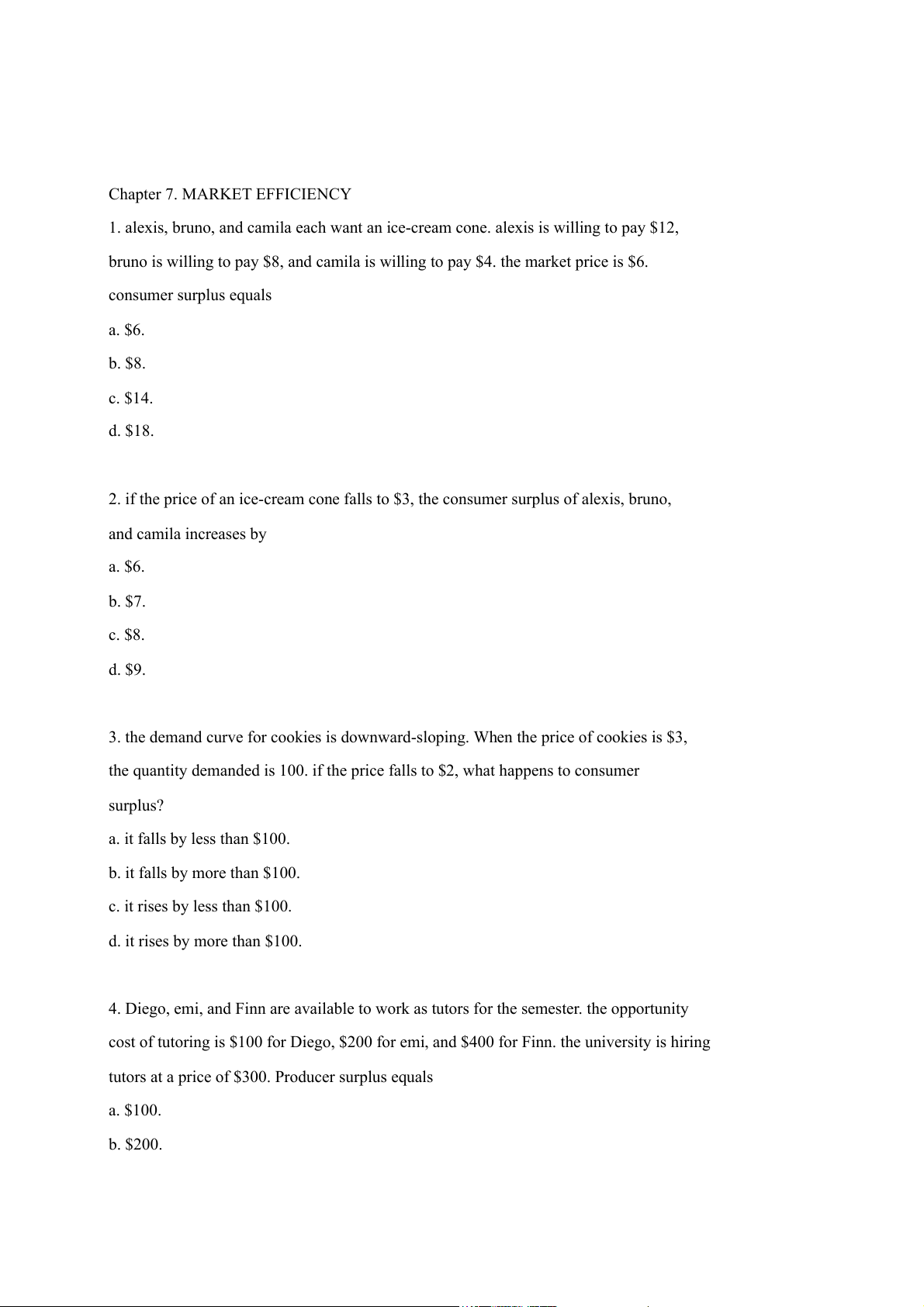
Chapter 7. MARKET EFFICIENCY
1. alexis, bruno, and camila each want an ice-cream cone. alexis is willing to pay $12,
bruno is willing to pay $8, and camila is willing to pay $4. the market price is $6. consumer surplus equals a. $6. b. $8. c. $14. d. $18.
2. if the price of an ice-cream cone falls to $3, the consumer surplus of alexis, bruno, and camila increases by a. $6. b. $7. c. $8. d. $9.
3. the demand curve for cookies is downward-sloping. When the price of cookies is $3,
the quantity demanded is 100. if the price falls to $2, what happens to consumer surplus? a. it falls by less than $100. b. it falls by more than $100. c. it rises by less than $100. d. it rises by more than $100.
4. Diego, emi, and Finn are available to work as tutors for the semester. the opportunity
cost of tutoring is $100 for Diego, $200 for emi, and $400 for Finn. the university is hiring
tutors at a price of $300. Producer surplus equals a. $100. b. $200. c. $300. d. $400.
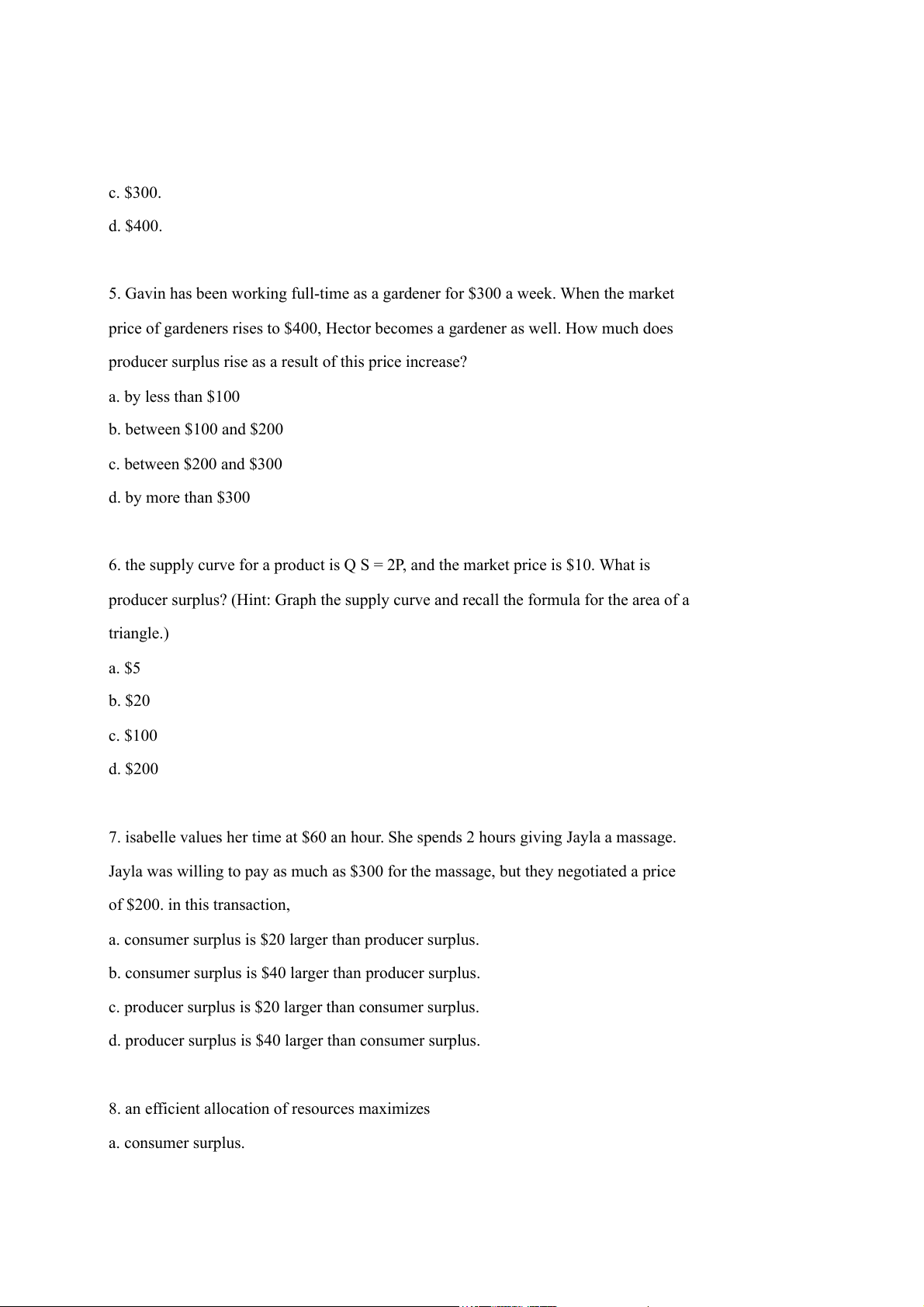
5. Gavin has been working full-time as a gardener for $300 a week. When the market
price of gardeners rises to $400, Hector becomes a gardener as well. How much does
producer surplus rise as a result of this price increase? a. by less than $100 b. between $100 and $200 c. between $200 and $300 d. by more than $300
6. the supply curve for a product is Q S = 2P, and the market price is $10. What is
producer surplus? (Hint: Graph the supply curve and recall the formula for the area of a triangle.) a. $5 b. $20 c. $100 d. $200
7. isabelle values her time at $60 an hour. She spends 2 hours giving Jayla a massage.
Jayla was willing to pay as much as $300 for the massage, but they negotiated a price of $200. in this transaction,
a. consumer surplus is $20 larger than producer surplus.
b. consumer surplus is $40 larger than producer surplus.
c. producer surplus is $20 larger than consumer surplus.
d. producer surplus is $40 larger than consumer surplus.
8. an efficient allocation of resources maximizes a. consumer surplus. b. producer surplus.
c. consumer surplus plus producer surplus.
d. consumer surplus minus producer surplus.
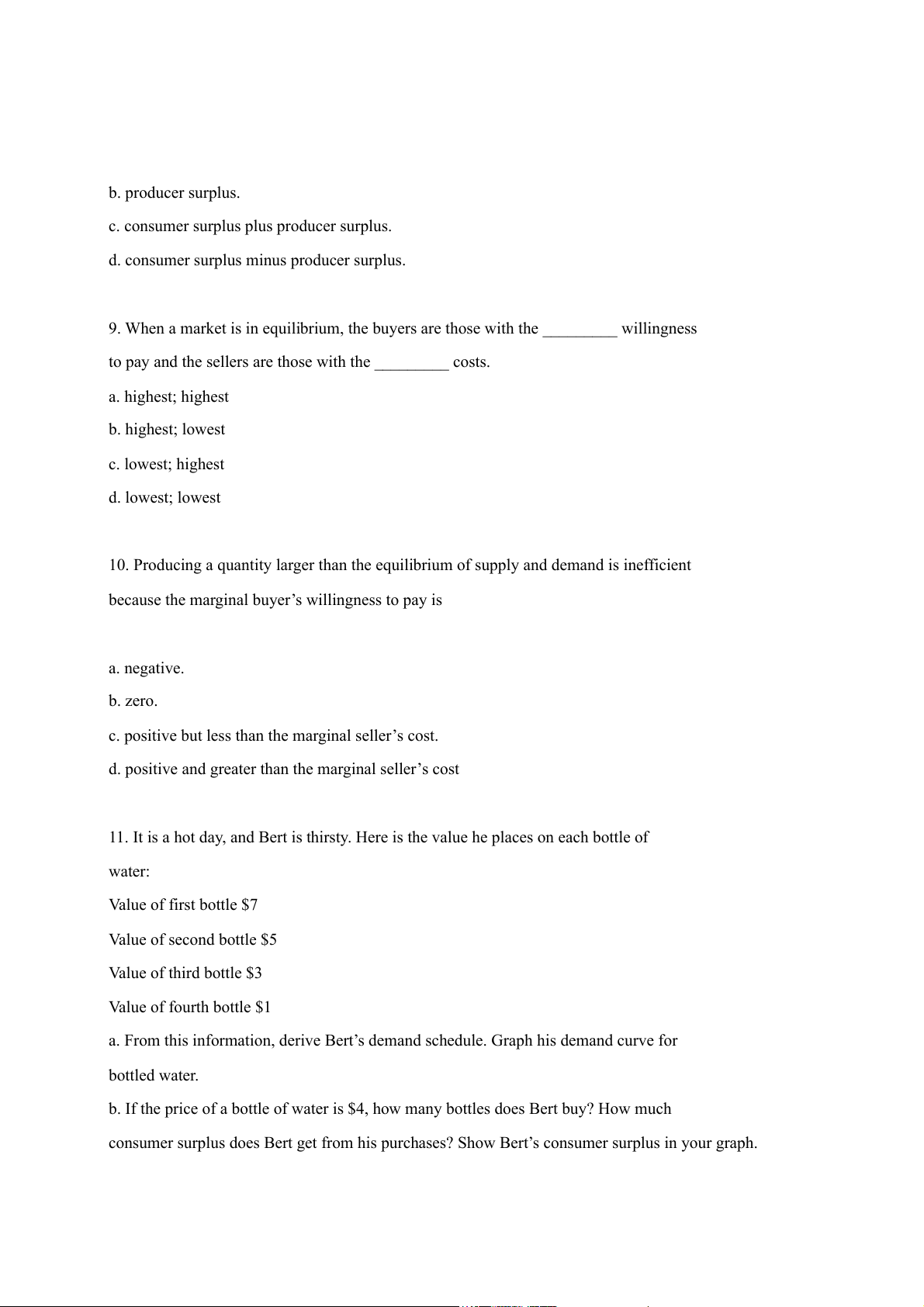
9. When a market is in equilibrium, the buyers are those with the _________ willingness
to pay and the sellers are those with the _________ costs. a. highest; highest b. highest; lowest c. lowest; highest d. lowest; lowest
10. Producing a quantity larger than the equilibrium of supply and demand is inefficient
because the marginal buyer’s willingness to pay is a. negative. b. zero.
c. positive but less than the marginal seller’s cost.
d. positive and greater than the marginal seller’s cost
11. It is a hot day, and Bert is thirsty. Here is the value he places on each bottle of water: Value of first bottle $7 Value of second bottle $5 Value of third bottle $3 Value of fourth bottle $1
a. From this information, derive Bert’s demand schedule. Graph his demand curve for bottled water.
b. If the price of a bottle of water is $4, how many bottles does Bert buy? How much
consumer surplus does Bert get from his purchases? Show Bert’s consumer surplus in your graph.
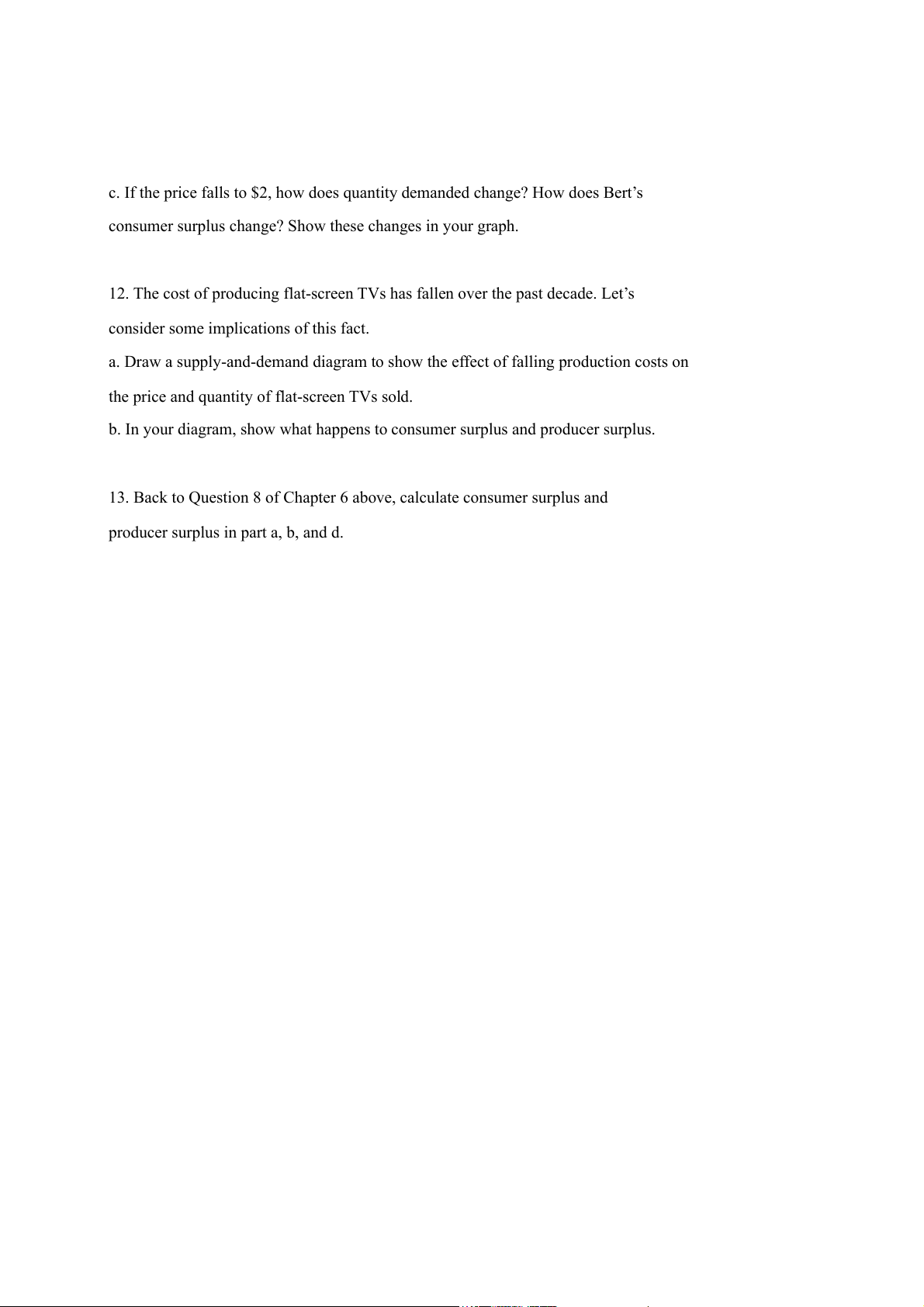
c. If the price falls to $2, how does quantity demanded change? How does Bert’s
consumer surplus change? Show these changes in your graph.
12. The cost of producing flat-screen TVs has fallen over the past decade. Let’s
consider some implications of this fact.
a. Draw a supply-and-demand diagram to show the effect of falling production costs on
the price and quantity of flat-screen TVs sold.
b. In your diagram, show what happens to consumer surplus and producer surplus.
13. Back to Question 8 of Chapter 6 above, calculate consumer surplus and
producer surplus in part a, b, and d.
Tài liệu liên quan:
-
Tổng hợp công thức kinh tế vĩ mô | Kinh tế vĩ mô | Trường Đại học kinh tế Thành Phố Hồ Chí Minh
1 1 -
Revised Title: Overview and Key Concepts | Kinh tế vĩ mô | Trường Đại học kinh tế Thành Phố Hồ Chí Minh
1 1 -
Câu hỏi và đáp án Kinh Tế Học | Kinh tế vĩ mô | Trường Đại học kinh tế Thành Phố Hồ Chí Minh
1 1 -
Phân Tích Tỷ Giá EUR/USD & GBP/USD - Tài Liệu Hữu Ích | Kinh tế vĩ mô | Trường Đại học kinh tế Thành Phố Hồ Chí Minh
0 0