Midterm Revision Essay môn Principle of Management | Trường Đại học Quốc tế, Đại học Quốc gia Thành phố Hồ Chí Minh
A contingency theory is an organizational theory that claims that there is no best way to organize a corporation, to lead a company, or to make decisions. ... Instead, the optimal course of action is contingent (dependent). Tài liệu giúp bạn tham khảo, ôn tập và đạt kết quả cao. Mời đọc đón xem!
Môn: Principles of Management 314 tài liệu
Trường: Trường Đại học Quốc tế, Đại học Quốc gia Thành phố Hồ Chí Minh 2 K tài liệu
Tác giả:






Preview text:
Midterm Revision Essay 1.
Define contingency thinking and give an example of how it might apply
to management
-A contingency theory is an organizational theory that claims that there is no best way to organize a
corporation, to lead a company, or to make decisions. ... Instead, the optimal course of
action is contingent (dependent) upon the internal and external situation. In other words,
the way you manage should change depending on the circumstances. 2. Explain why the external environment is so important in the open-systems
view of orga nizations
-The external environment includes a wide variety of needs and influences that can affect the
organization, but which the organization cannot directly control. Influences can be political,
economic, ecological, societal and technological in nature. A highly effective organization is
regularly exchanging feedback with its external environment – it is an open system. Healthy
organizations regularly try to understand their environments through use of environmental scanning,
market research and evaluations. These organizations often try to influence their external
environment, as well, for example, through use of public relations, advertising and promotions,
lobbying and advocacy, and educating industry and local leaders. 3. Who and/or what should be considered as key stakeholders by a business executive when mapping the task environment for his/her organization
-When it comes to organizational stakeholders, the list should always begin with customers and
suppliers to establish the output/input players in the value chain. Employees should be included as
well as shareholders/investors to identify the interests of the "producers" and the "owners." Given the
significance of sustainability, it is important to include society at large and future generations in the
stakeholder map; it is also important to include the local communities in which the organization
operates. Beyond these basic map components, the stakeholders for any given organization will
include a broad mix of people, groups, and organizations from regulators to activist organizations to government agencies and more. 4. Why do host countries sometimes complain about how global corporations operate within their borders ? The potential drawbacks of MNCs on host countries inc lude:
- Domestic businesses may not be able to compete with MNCs and some will fail
- MNCs may not feel that they need to meet the host country
expectations for acting ethically and/or in a socially-responsible way
- MNCs may be accused of imposing their culture on the host
country, perhaps at the expense of the richness of local culture.
- Might MNCs reduce cultural diversity around the world as
they continue to expand, particularly into less developed or developing countries?
- Profits earned by MNCs may be remitted back to the MNC's
base country rather than reinvested in the host economy.
- MNCs may make use of transfer pricing and other tax
avoidance measures to significant reduce the profits on which they pay tax to the government in the host country 5. Why is the powe
r-distance dimension of national
culture important in management ?
-This dimension deals with the fact that all individuals in
societies are not equal – it expresses the attitude of the culture
towards these inequalities amongst us. Power Distance is
defined as the extent to which the less powerful members of institutions and organisations within a country expect and accept that power is distributed
unequally. (nói chung ra là ở
những nền văn hóa mà quyền lực là thứ quyết định, như VN
thì lớn tuổi hơn có tiếng nói hơn - sếp lớn tuổi có uy hơn sếp
nhỏ tuổi - hay những người có uy quyền sẽ được quyết định
nhiều vấn đề trong công ty và cấp dưới phải nghe theo - cho thêm ví dụ)
- Power distance defines how social inequality is perceived and accepted in different cultures. In high
power distance cultures children are raised with a great emphasis on respecting elders, which is
carried through to adulthood. Therefore organisations are more centralised, employees prefer a more
autocratic leadership style where subordinates are expected to be told what to do and there are wide
wage gaps in the hierarchical structure. On the other hand, in low power distance cultures inequality
is not desired, employees prefer to be consulted with regards to decision making and thus prefer a
more resourceful and democratic leader. 6. How do regio nal economic
alliances(liên minh) impact the global economy
? ( Các liên minh kinh tế khu vực tác
động thế nào đến nền kinh tế toàn cầu)
- Promoting trade between countries in the region leads to an increase in their GDP
- Increasing competition in technology, labor, product quality leads to domestic GDP and
CPI boost. There is supportive cooperation from developed countries to developing countries
(câu này hơi khó với kiểu international economy quá, tìm thêm ví dụ về APEC, EU, Asian,…) 7. How does planning help to improve focus ? Key points:
- Planning is a management process concerned with defining goals for a company’s future
direction and determining the resources required to achieve those goals. Managers may develop a
variety of plans ( business plan, marketing plan, etc.) during the planning process.
- Achieving a vision requires coordinated efforts that adhere to a broader organizational plan.
This is enabled through consistent strategies that are supported by staff at all levels.
- Planning enables increased focus on, and coordinated action toward, competitive strategies, while
minimizing wasted time and ensuring there are benchmarks for the control process.
- Planning typically offers a unique opportunity for information-rich and productively focused
discussions between the various managers involved. The plan and the discussions that arise
from it provide an agreed context for subsequent management activities.
Since they have achieved defined goals through the planning process, managers and employees can
focus and control their efforts and their resources, follow determined plans of action, coordinate
activities between divisions, and use time management to meet specific goals. Planning helps to
achieve these goals or targets by efficiently and effectively using available time and resources. In short,
planning, if executed properly, should lead to the benefits There are a wide variety of activities an
organization (or the individuals within the organization) might viably pursue. While there is value in
the pursuit of many activities, understanding which ones the organization should focus on to leverage
organizational competencies and align with market research requires careful planning and delegation.
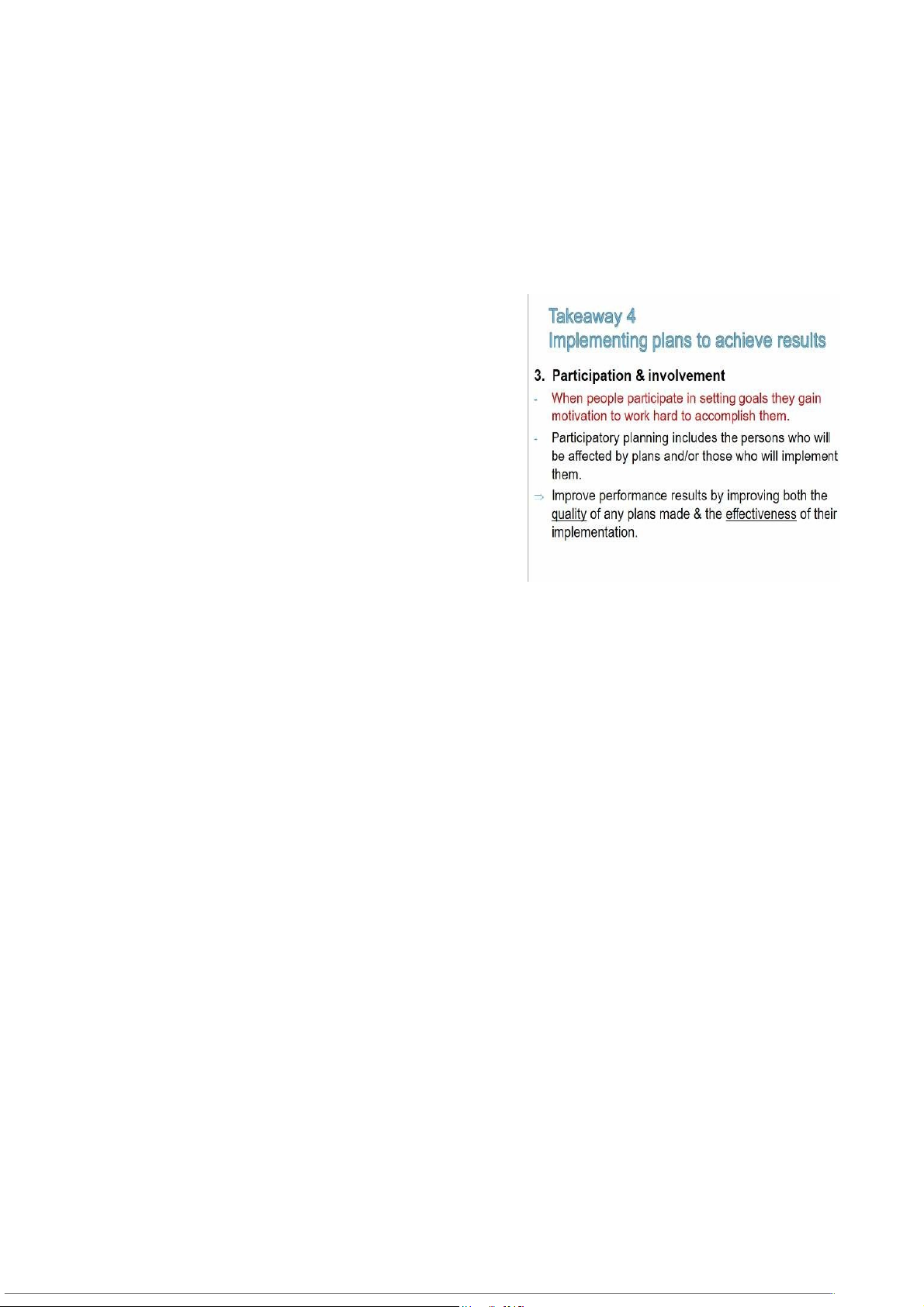
This is how planning achieves focus. 8. Why does participatory planning facilita
te implementation? (Tại sao việc lập kế hoạch có sự tham gia lại tạo điều kiện
thuận lợi cho việc thực hiện) Case Study: Britain in the 194 0s
After the bombing of British cities during World War II,
planning advocates wanted to use the reconstruction
planning as a way to engage the public. The planners
wanted more authority in the political system to play a more
substantive role within their democracy. The planners
created new techniques to, "communicate with laypeople,
including mobilizing publicity, measuring public opinion,
organizing exhibitions, and experimenting with new visual
strategies". They also developed a forum to educate and ask
the public about various plans and policies.
Cincinnati's Over-the-Rhine neighborhood[edit]
Cincinnati's Over-The-Rhine's Comprehensive Plan was created in a participatory planning process, but
its consistent monitoring of its implementation failed. Looking at Cincinnati's Over-the-Rhine
neighborhood, geographers saw potential logistical ways to obtain "necessary data, create a land-use
GIS to analyze the data, update the data, and monitor the progress of the implementation of the Over-
the Rhine Comprehensive Plan". In the case of Cincinnati, it is proven that plans that are not carried
out fail to live up to the participatory planning theory. Failures like that of the Over-the-Rhine plan
make it harder for further progress toward plan's goal and objectives as well as muting the participants. 9. How does Douglas McGegor’
s Theory Y relate to the concept of internal control ?
Self-control is internal control that occurs through self-discipline in fulfilling work & personal
responsibilities. Better be considered as personal capacity, even a life skill. Self-control is internal
control that occurs through self- discipline in fulfilling work & personal responsibilities.
Managers that are categorized as Theory Y assume employees are happy, enjoy their work, are
selfmotivated and choose greater responsibility. In response to these assumptions, Theory Y managers
can function in a decentralized form and allow employees various degrees of decision rights.
Nôm na là từ theory Y, internal control sẽ làm cho nhân viên tự biết mình cần phải làm gì, có trách
nhiệm với công việc với sự thúc đẩy tích cực từ manager
Tài liệu liên quan:
-
CHAP 1: Introduction to Management Concepts and Functions môn Principles of Management | Trường Đại học Quốc tế, Đại học Quốc gia Thành phố Hồ Chí Minh
1 1 -
Guidelines for group’s assignments: Analysing management issues of a FDI company based inVietnam môn Principles of Management | Trường Đại học Quốc tế, Đại học Quốc gia Thành phố Hồ Chí Minh
1 1 -
Financial Planning to Achieve 300m VND Goal in 3 Years môn Principles of Management | Trường Đại học Quốc tế, Đại học Quốc gia Thành phố Hồ Chí Minh
1 1 -

A Case Study in Fast Fashion Success môn Principles of Management | Trường Đại học Quốc tế, Đại học Quốc gia Thành phố Hồ Chí Minh
1 1 -

Chap 16 Hierarchy of Needs Theory and Applications môn Principles of Management | Trường Đại học Quốc tế, Đại học Quốc gia Thành phố Hồ Chí Minh
1 1