Monetary Policy and Finance Concepts Quiz | Business Technology and Finance | Học viện Tài chính
Question 1: Carrying out monetary policy is the role of: /A. Central bank. B. Primary bank. C. Secondary bank. D. Retail bank. Question 2: Analysis of payroll costs is the business partnering of finance function and: A. IT function. B. R&D function. C. Procurement function. /D. HR function. Question 3: Lan is a new accountant of Company X. Her duty is to ensure that resources are properly controlled. Lan is working in: /A. Recording financial transaction section. B. Management accounting section. C. Financial reporting section. D. Treasury management. Question 4: Centralised finance function is: A. helpful with internal reporting. /B. problematic for multinational corporations. Tài liệu được sưu tầm và soạn thảo dưới dạng file PDF để gửi tới các bạn cùng tham khảo, ôn tập đầy đủ kiến thức, chuẩn bị cho các buổi học thật tốt. Mời bạn đọc đón xem!
Môn: Business Technology and Finance (BTF 1) 11 tài liệu
Trường: Học viện Tài chính 1.1 K tài liệu
Tác giả:












Preview text:
Question 1: Carrying out monetary policy is the role of: /A. Central bank. B. Primary bank. C. Secondary bank. D. Retail bank.
Question 2: Analysis of payroll costs is the business partnering of finance function and: A. IT function. B. R&D function. C. Procurement function. /D. HR function.
Question 3: Lan is a new accountant of Company X.
Her duty is to ensure that resources are properly controlled. Lan is working in:
/A. Recording financial transaction section.
B. Management accounting section.
C. Financial reporting section. D. Treasury management.
Question 4: Centralised finance function is:
A. helpful with internal reporting.
/B. problematic for multinational corporations. Có vấn đề ở các quốc gia khác nhau
C. useful in supporting local operational management. Các chi nhánh
D. that there are local finance departments which provide financial information for local managers.
Question 5: The bank borrows the customer's deposits and undertakes to repay
them. This is the relationship of: /A. Receivable and payable. B. Bailor and bailee. C. Principal and agent. D. Mortgagor and morgagee.
Question 6: The quantity of the service or product produced in relation to the resources put in is: A. Profitability. /B. Productivity. C. Activity. D. Economy. Question 7: Efficiency is:
A. containment of cost. Economy
B. achieving the objectives of the business. Effectiveness
/C. controlling costs without losing operational effectiveness.
D. those product features that are particularly valued by a group of customers.
Question 8: The process whereby an institution or group of institutions will
undertake to purchase any securities not subscribed for by the public in exchange for a fixed fee is:
A. Offer for sale by tender. Mua lại những cổ phiếu k dc mua -> trả phí để bảo lãnh B. Share issues. /C. Underwriting. D. Going public. Question 9: Secondary bank is: A. Retail bank. B. Commercial bank. C. Clearing bank. /D. Merchant bank.
Question 10: Nam is an accountant for Company X, which is considering a
substantial new project. Nam has been asked to assist in determining whether it
should be financed by retained earnings, equity, loans or a mix of all sources. It
would appear that Nam is employed by:
A. Transaction recording section.
/B. Treasury management section.
C. Financial reporting section.
D. Management accounting section.
Question 11: Moody plc is reviewing its internal control system. Its control
activities should be directed at controlling: A. Threats to its operations. B. Its operations.
/C. Threats to achievement of its objectives.
D. Achievement of its objectives.
Question 12: The measure of number of invoices recorded per hour of employee time is: /A. Productivity. B. Activity. C. Profitability. D. Economy.
Question 13: Ms. Thu's duties involve maintaining the sales ledger, and providing
information to the credit control department. Ms. Thu is employed by finance function's:
A. Financial reporting section.
B. Treasury management section.
C. Management accounting section.
/D. Financial transaction recording section.
Question 14: Due to the risks taken by capital providers:
/A. Short-term finance is cheaper than long-term finance. Khi so sánh chi phí sd
vốn phải đứng trên góc độ ng cấp vốn
B. Equity is cheaper than debt.
C. External finance is cheaper than internal finance.
D. Share issue is cheaper than bond.
Question 15: Medium term needs is to pay A. wages. /B. inventory. C. daily expenses. D. PP&E.
Question 16: In a defensive business: phòng thủ
/A. short-term finance finances only some of the fluctuating current assets. B. profit is higher. C. risk is higher.
D. short-term finance finances all of fluctuating current assets.
Question 17: Which is NOT likely to be a form of crowdfunding? Gọi vốn cộng
đồng thg kêu gọi trên internet trình bày ý tưởng kinh doanh của mình A. Donation. Ủng hộ
B. Pre-buying products. Mua trc C. Equity. Góp vốn /D. Business angels.
Question 18: Which is one of the money market financial instruments?:
/A. Commercial paper. Thương phiếu B. Leasing. C. Loan stock. D. Ordinary shares.
Question 19: Measures of product quality and product failure rates will be included in the balanced scorecard's: A. Financial perspective.
/B. Internal business process perspective. Đầu vào
C. Innovation and learning perspective.
D. Customer perspective. Đầu ra
Question 20: A very easy and the most important source of equity is: A. Share issues. B. Right issues of shares. C. Placings. /D. Retained earnings.
Question 21: Qualitative measures are:
A. expressed in numerical terms.
/B. subjective and judgmental. Chủ quan và mang tc xét đoán C. objective. D. key performance indicators.
Question 22: Which one is NOT a form of new share issues? A. Placings. B. Offers for sale. C. Direct offers. /D. Right issues of shares.
Question 23: A short-term loan of variable amount up to a limit from a bank is: A. Debt factoring. B. Term loans. /C. Overdraft. D. Loan stock.
Question 24: Which is a characteristic of venture capital?
A. Holding more than 50% of shares of the company. (20-49,9) B. A short-term finance.
/C. Return is in the form of capital gains. Bán lại cổ phiếu
D. The investors are not able to influence management.
Question 25: When there is a short-term surplus of cash, the business should:
/A. invest in various financial products in the money markets.
B. invest in longer-term projects.
C. return to shareholders as dividends. D. keep on hand.
Question 26: The most common method of new issues of shares when a company
first comes onto the market is: thứ tự d c b A. Right issues.
B. Direct offers. Trực tiếp
C. Offers for sale. Thông qua issuing house
/D. Placings. Riêng lẻ cho các cổ đông chiến lược
Question 27: The bank accepting the customer's property for storage in its safe
deposit. This bank/customer contractual relationship is: A. Receivable and payable. /B. Bailor and bailee. C. Principal and agent. D. Mortgagor and morgagee.. Question 28: In the balanced
scorecard, measures of how quickly and fully employee suggestions are
implemented would be included in:
A. Financial perspective measures.
B. Customer perspective measures.
C. Internal business process perspective measures.
/D. Innovation and learning perspective measures. Khả năng cải tổ hiện trạng công ty: nhận feaback
Question 29: The bank asks the customer to secure a loan with a charge over its
assets. In this relationship, bank is: A. Mortgagor. /B. Morgagee. C. Bailor. D. Bailee.
Question 30: Which one is a disadvantage of going public?
/A. Dilution of control. Pha loãng quyền kiểm soát
B. Access to a large source of finance.
C. Improving the standing of the company.
D. Higher marketability of shares. Mock test 2
Question 1: Marginal propensity to consume (MPC) equal to 1 means:
A. A household spends less than the added income received.
B. A household does not spend and puts all in savings.
C. A household spends more than an increase in income.>1
/D. A household spends 100% of the additional income on goods and services and saves nothing.
Question 2: The price of a good is 15,000 VND and the monthly demand is 20,000
units. If the price falls to 14,000 VND, the demand will increase by 2,000 units.
What is the Price Elasticity of Demand of the goods at 15,000 VND? A. 0.10 B. 0.67 /C. 1.50 D. 1.96
Question 3: When the government imposes a maximum price on a market, when will supply be reduced? A. At all time.
B. If the maximum price is set above equilibrium.
/C. If the maximum price is set below equilibrium. D. Never.
Question 4: Corporate governance of a company in which the sales are made by
individual salespeople who routinely bypass the company's strict credit check
procedure faces the problem of:
A. Domination by a small group.
B. Lack of contact with shareholders. /C. Lack of supervision.
D. Misleading financial statements.
Question 5: An economy is considered to be in recession phase of business cycle
when it experiences a decrease in its GDP for: giảm 2 quý liên tiếp là suy thoái A. Two consecutive years. B. Three consecutive years. C. Three consecutive quarters. /D. Two consecutive quarters.
Question 6: The view of corporate governance that
"the law requires directors to act in the best interests of the company when acting
as stewards of its resources" is arisen from which of the following perspectives?
A. The public policy perspective. B. The corporate perspective.
C. The stakeholder perspective.
/D. The stewardship perspective.
Question 7: The supply curve of Product A is a horizontal straight line. This indicates that the supply A. perfectly inelastic. B. of unitary elasticity. C. perfectly elastic. D. one.
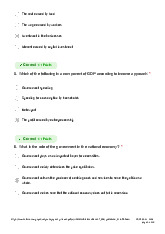
Question 8: Which is a component of GDP according to income approach: gdp=
interest +wage+land(rent)+profit /A. The rent earned by land.
B. Consumer Spending. Consumption approach C. Net exports. D. Value added.
Question 9: Which of the following pairs of factors are likely to enable managers
to run a company in their own interests?
A. Low levels of management accountability and shareholders access to the same information as management.
B. High levels of management accountability and managers access better information than shareholders.
C. High levels of management accountability and shareholders access to the same information as managers,
/D. Low levels of management accountability and managers access better information than shareholders.
Question 10: In recession phase of business cycle, general price level: suy thoái k có nghĩa là lạm phát A. Remains constant. /B. Begins to fall. C. Begins to rise slowly. D. Rises sharply.
Question 11: A depression is commonly defined as an extreme recession that
lasts:khủng hoảng được định nghĩa là suy thoái nghiêm trọng
A. Two consecutive quarters or more.
B. Two consecutive years or more.
/C. Three consecutive years or more.
D. Three consecutive quarters or more.
Question 12: Governance structure which adopts the principles of good corporate
governance such as OECD's Principle of Corporate Governance is:
A. Shareholder-led approach.@ vì lợi ích của shareholder /B. Principle-based approach.@
C. Management-dominated approach. D. Regulation-based approach.
Question 13: A depression is commonly defined as an extreme recession that
results in a drop in annual GDP of at least: A. 8%. /B 10%. C. 4%. D. 15%.
Question 14: The average price level in recovery phase will:
/A. Remain constant or begin to rise slowly. Tăng chậm B. Begin to decrease. C. Begin to rise sharply. D. Plummet. Question 15: Deflation is:
A. An increase in price levels generally. /B. Falling prices generally.
C. Decline in the purchasing power of money. D. Inflation and stagnation.
Question 16: The corporate perspective on corporate governance concerns:
A. The best interests of the company.
B. The interest of the public at large.
C. Align the interest of shareholders and companies with those of other stakeholders.
/D. Long-term sustained value for shareholders.
Question 17: Monetary policy is government policies A. Taxation. B. Public borrowing. C. Public spending. /D. Interest rates.
Question 18: Which is one of the cause of cost push inflation?
A. An increase in government spending. Tăng cầu
B. A reduction in taxes. Tăng cầu /C. Rising oil prices.
D. Extended credit. Tăng tín dụng->Tăng cầu
Question 19: When interest rate increases, consumption of households would:
A. Increase since savings increase.
B. Decrease since borrowing increases.
C. Increase since borrowing increases.
/D. Decrease since savings increase.
Question 20: Which is one of the cause of demand pull inflation? /A. A reduction in taxes. B. Rising oil prices.
C. Rising nominal wages. (Wage là chi phí vì chưa chắc phản ánh thu nhập)
D. Depreciation of home currency. (Sự mất giá nội tệ)
Question 21: If a country has a higher rate of inflation than its major trading
partners, then: lạm phát cao khó xuất khẩu hơn (xk giảm nk tăng)
A. Balance of payment is not affected.
B. Balance of payment increases. C. Import decreases.
/D. Export becomes relatively expensive.
Question 22: In terms of the economic environment, the interest rate is part of:
A. global influences in the macroeconomic environment.
B. the microeconomic environment of the firm.
/C. national influences in the macroeconomic environment.
D. the price mechanism in the microeconomic environment of the firm.
Question 23: Which of the following is NOT included in key elements of corporate governance? A. External auditors. B. Board of directors. C. Senior management /D. Government.
Question 24: The correct sequence of phases in the business cycle is:
A. Boom, Recovery, Depression, Recession.
B. Recession, Depression, Boom, Recovery.
C. Depression, Recession, Recovery, Boom.
/D. Recession, Depression, Recovery, Boom.
Question 25: When the demand for a good increases as inçomes increase, the good is termed? A. giffen. /B. normal. C. inferior. D. veblen.
Question 26: Y is a complement of X in consumption. An increase in the price of Y will:
A. increase the demand for Y and decrease the demand for X.
B. decrease the demand for Y and increase the demand for Y.
C. increase the demand for both Y and X.
/D. decrease the demand for both Y and X.
Question 27: In a dual governance structure, the management board has the power to: /A. Manage the company.
B. Appoint and remove members of the management boards.
C. Perform independent reviews. D. Inspect books and records.
Question 28: The difference between an increase in disposable income and an
increase in consumption by households is a formula to measure: A. Gross domestic product,
/B. Marginal propensity to consume. Delta C/ delta Y C. Price elasticity of demand.
D. Income elasticity of demand.
Question 29: A brand of cheese is an inferior good. A consultant has made two statements about cheese
Statement (1): Demand for the cheese will rise as income rise.
Statement (2): Demand for the cheese only exists because of the effects of advertising.
Identify whether each statement is accurate.
A. Statement (1) is accurate; Statement (2) is inaccurate.
/B. Statement (1) is inaccurate; Statement (2) is inaccurate.
C. Statement (1) is accurate; Statement (2) is accurate.
D. Statement (1) is inaccurate; Statement (2) is accurate.
Question 30: A characteristic of market-based financial systems is that:
/A. It is unregulated comparatively.
B. Markets are volatile and speculative.
C. Households prefer to bear little risk.
D. Households have less access to investment in physical assets.
Tài liệu liên quan:
-
Báo cáo Phân tích Công ty Cổ phần Chứng khoán SSI môn Business Technology and Finance | Học viện Tài chính
20 10 -
Chap 7 Finance Function Insights | Business Technology and Finance | Học viện Tài chính
74 37 -
Chapter 7 & 8: Finance Functions & Business Finance Insights | Business Technology and Finance | Học viện Tài chính
61 31 -
Key Concepts in Business and Organizations | Business Technology and Finance | Học viện Tài chính
78 39 -
Economic Environment in Business & Finance Analysis | Business Technology and Finance | Học viện Tài chính
64 32