Motivation and theory practices môn Principle of Management | Trường Đại học Quốc tế, Đại học Quốc gia Thành phố Hồ Chí Minh
Motivation—the forces within the individual that account for the level, direction, and persistence of effort expended at work. Tài liệu giúp bạn tham khảo, ôn tập và đạt kết quả cao. Mời đọc đón xem!
Môn: Principles of Management 314 tài liệu
Trường: Trường Đại học Quốc tế, Đại học Quốc gia Thành phố Hồ Chí Minh 2 K tài liệu
Tác giả:


















Preview text:
MOTIVATION AND THEORY PRACTICES OUTLINE
1. How do individual needs influence motivation?
2. What are the process theories of motivation?
3. What role does reinforcement play in motivation?
4. What is the link between job design and motivation? 1. Individual Needs and 3. Reinforcement Theory Motivation 1. Reinforcement strategies 1. Hierarchy of needs 2. Positive reinforcement theory 3. Punishment 2. ERG theory 4. Motivation and Job Design 1. Job simplification 3. Two-factor theory 2. Job enrichment 4. Acquired needs theory 3. Alternative work schedules 2. Process Theories of Motivation 1. Equity theory 2. Expectancy theory 3. Goal-setting theory 4. Self-efÏcacy theory
Takeaway 1: Individual Needs and Motivation
Motivation—the forces within the individual that account for the level,
direction, and persistence of effort expended at work
(là những lực bên trong cá nhân thúc đẩy họ hành động, đặc biệt trong
môi trường công việc, gồm 3 yếu tố: Level (Mức độ nỗ lực): Cá nhân cố
gắng nhiều hay ít: Direction (Hướng nỗ :
lực) Họ tập trung vào điều gì:
Persistence (Tính kiên trì): Họ duy trì nỗ lực đó được bao lâu) Needs
–Unfulfilled physiological and psychological desires of an individual
–Explain workplace behavior and attitudes
–Create tensions that influence attitudes and behavior
–Good managers and leaders facilitate employee need satisfaction –Ví dụ thực tế:
–Một nhân viên bị thiếu an toàn (cảm thấy có thể bị sa thải bất cứ lúc
nào) thì khó có thể tập trung làm việc hiệu quả, vì họ bị phân tâm bởi nỗi lo mất việc
–An employee who feels insecure (believing they could be fired at
any time) will find it difÏcult to stay focused and work effectively, as
they are distracted by the fear of losing their job. Hierarchy of needs theory
–Developed by Abraham Maslow
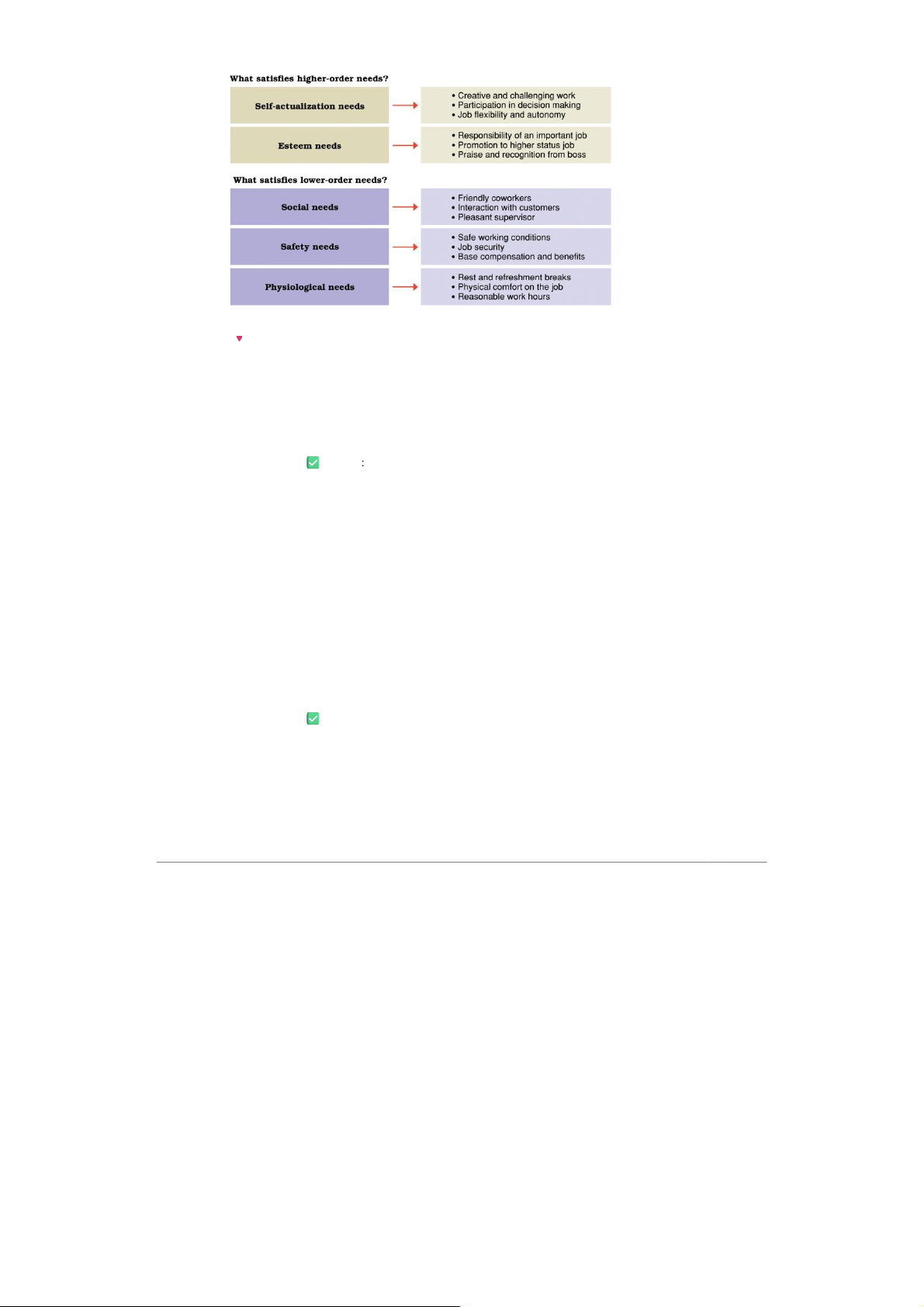
–Lower-order and higher-order needs affect workplace behavior and attitudes –Lower-order needs:
•Physiological, safety, and social needs
•Desires for physical and social well being –Higher-order needs:
•Esteem and self-actualization needs
•Desire for psychological growth and development
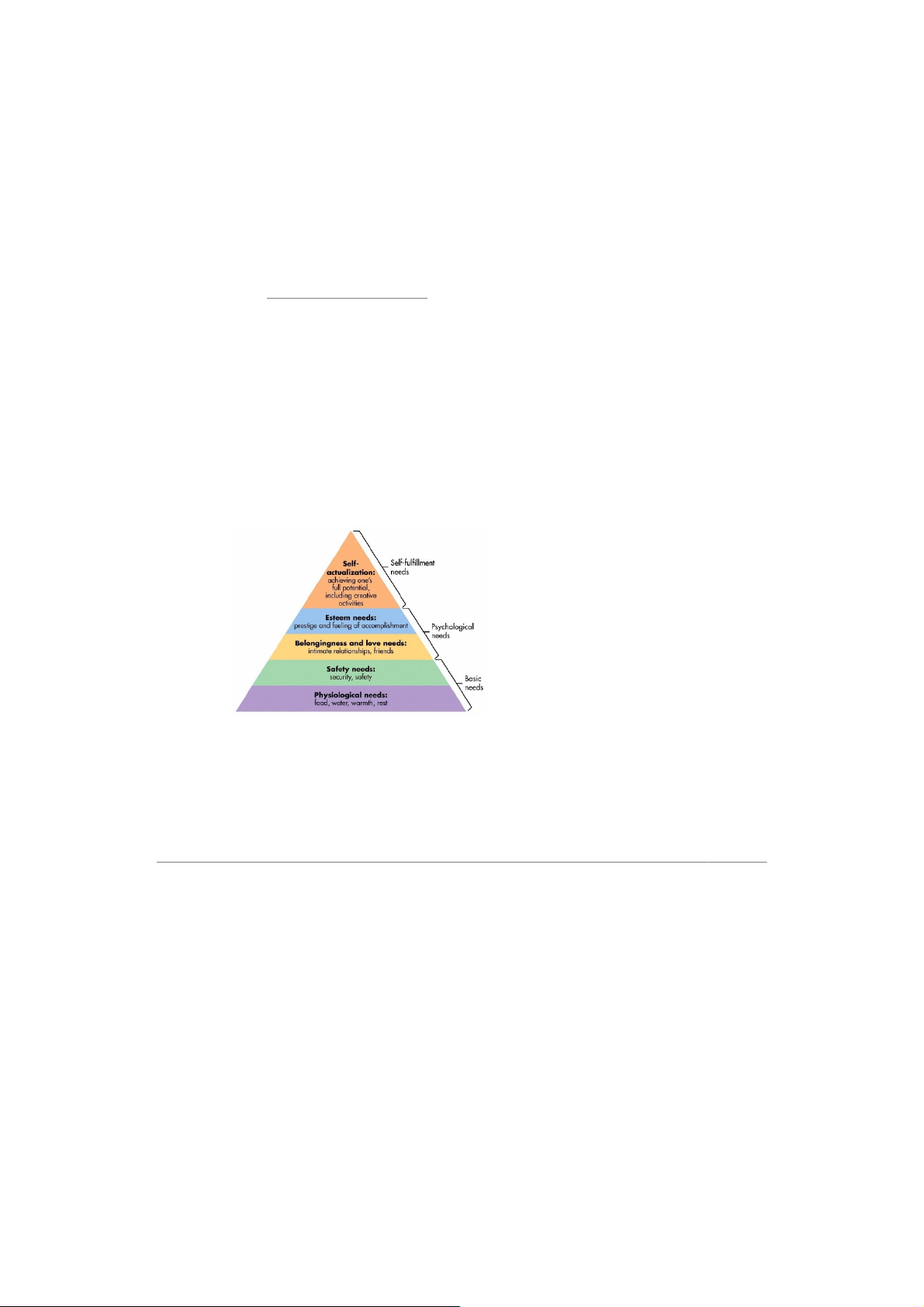
Figure 16.1 Opportunities for satisfaction in Maslow’s hierarchy of human needs Maslow cho rằng:
🔻 Nhu cầu con người được sắp xếp theo hình kim tự tháp, từ cơ bản đến cao cấp, bao gồm:
A. Lower-order needs (Nhu cầu bậc thấp)
1. Physiological needs (Sinh lý)
oĂn, uống, nghỉ ngơi, chỗ làm mát mẻ, không gian làm việc thoải mái.
✅ Ví dụ: Nhân viên được nghỉ trưa, có ghế ngồi thoải mái,
được uống nước đầy đủ.
oPhysiological needs are the most basic human necessities
required for survival. These include food, water, air, rest, and
physical comfort. Without satisfying these needs, a person
cannot focus on anything else. In the workplace, this might
involve having access to clean drinking water, regular meal
breaks, or a comfortable working environment. For example,
an employee who works in an ofÏce with air conditioning and
receives enough break time to eat and rest is having their physiological needs met.
2. Safety needs (An toàn)
oAn toàn trong công việc, không bị đe dọa, có hợp đồng, bảo hiểm.
✅ Ví dụ: Nhân viên ký hợp đồng chính thức, được đóng bảo hiểm xã hội.
oOnce physiological needs are fulfilled, people seek safety and
security in their lives. Safety needs include physical safety,
financial security, health protection, and a stable environment.
In the context of work, this could mean job security, a safe
physical workspace, health insurance, and protection from
harassment or accidents. For instance, a factory worker
provided with safety equipment and job insurance feels secure
and is more likely to stay motivated and productive.
3. Social needs (Tình cảm, xã hội)
oCó bạn bè, đồng nghiệp thân thiện, mối quan hệ tốt với sếp và khách hàng.
✅ Ví dụ: Nhân viên cảm thấy vui vì có nhóm làm việc hợp tác, sếp thân thiện.
oBelongingness needs involve the human desire to form strong
relationships, be accepted by others, and feel part of a group.
These social needs include friendships, family bonds, team
spirit, and a sense of community. In the workplace, it can be
seen through supportive coworkers, team collaboration, and
positive relationships with supervisors. For example, when
employees are included in team activities and feel valued by
their peers, they are more likely to be engaged and loyal to the company.
B. Higher-order needs (Nhu cầu bậc cao)
4. Esteem needs (Được công nhận, tự trọng)
oĐược thăng chức, khen ngợi, tin tưởng.
✅ Ví dụ: Nhân viên được khen thưởng cuối tháng vì làm tốt,
được giao dự án quan trọng.
oEsteem needs refer to the desire for recognition, respect, and
self-worth. People want to be valued by others and also want
to feel competent and confident in their abilities. This can be
satisfied through praise, promotions, or increased
responsibilities. For example, an employee who is publicly
recognized for a successful project or promoted to a
leadership role is fulfilling their esteem needs, which boosts
their confidence and motivation
5. Self-actualization needs (Tự thể hiện bản thân)
oPhát huy tiềm năng sáng tạo, làm công việc thử thách và ý nghĩa.
✅ Ví dụ: Nhân viên được tự đề xuất ý tưởng mới và được thực hiện chúng.
oAt the top of the hierarchy is self-actualization, which is the
desire to realize one’s full potential and pursue personal
growth, creativity, and meaningful goals. People at this level
seek challenging work, autonomy, and opportunities for
innovation. For example, an employee who is given freedom
to lead a new project, experiment with new ideas, or take on
creative tasks is achieving self-actualization. This level is
about doing what you are truly passionate about and
becoming the best version of yourself.
Hai nguyên lý quan trọng trong thuyết Maslow –
Deficit principle (Nguyên lý thiếu hụt)
•A satisfied need is not a motivator of behavior
–Một khi nhu cầu đã được thỏa ,
mãn nó không còn thúc đẩy hành vi nữa.
–✅ Ví dụ: Một nhân viên đã có đủ điều kiện an toàn, sẽ không bị thúc
đẩy thêm bởi việc tăng bảo hiểm, mà cần sự công nhận (Esteem).
–Progression principle (Nguyên lý tiến triển)
•A need at one level does not become activated until the
next lower-level need is satisfied
–Một nhu cầu chỉ trở thành động lực khi các nhu cầu thấp hơn
đã được thỏa mãn.
–✅ Ví dụ: Một người chưa ăn no (Physiological) thì không thể tập
trung vào chuyện được thăng chức (Esteem).
Application in Management – The Role of the Manager A good manager should:
–Identify which level of needs the employee is currently at.
–Design jobs or create an environment that meets those needs.
–Provide opportunities for employees to progress to higher levels. ERG theory
–Developed by Clayton Alderfer –Three need levels
–1. Existence Needs (nhu cầu tồn tại)
These refer to basic survival needs that include physiological and
material well-being—such as food, water, shelter, and salary. In a
work setting, these needs are satisfied through job security, proper
wages, and safe working conditions.
Example: A factory worker is mainly concerned with earning
enough to pay rent, buy food, and take care of their family. If the
salary is too low or the job is physically unsafe, they won’t be
motivated to think about higher goals.
–2. Relatedness Needs (nhu cầu quan hệ)
This level includes the need for satisfying interpersonal relationships
—such as feeling accepted, maintaining friendships, and having
good communication with others. In the workplace, this relates to
teamwork, a supportive manager, and a positive work culture.
Example: An employee enjoys their job more because they have
friendly coworkers and a respectful boss who values their opinions.
Even if they aren’t highly paid, strong relationships can keep them motivated.
–3. Growth Needs (nhu cầu phát triển)
Growth needs are desires for continued psychological development,
such as achieving personal goals, learning new skills, and feeling
fulfilled. These needs are linked to creativity, responsibility, and self- improvement.
Example: A marketing professional is highly motivated when
allowed to lead new campaigns, learn advanced tools, and develop
their leadership skills—even if they already have a good salary and work environment.
Existence needs - Relatedness needs- Growth needs nhu cầu tồn tại nhu cầu quan hệ desires for desires for satisfying desires for
physiological and interpersonal continued
material well-being relationships psychological growth and development
–Any/all needs can influence behavior at one time
–Frustration-regression principle
•An already satisfied lower-level need becomes
reactivated when a higher-level need is frustrated (Nếu
các nhu cầu ở cấp cao hơn (ví dụ: phát triển) bị cản trở,
người đó có thể thoái lui và tập trung trở lại vào các nhu
cầu ở mức thấp hơn đã được đáp ứng (ví dụ: quan hệ hoặc tồn tại).)
–Example: A manager who is denied promotion may stop trying to
grow professionally and instead focus on socializing with coworkers
or asking for better work-life balance. • Two-factor theory (lý thuyết 2 nhân tố)
–Developed by Frederick Herzberg
–Hygiene factors: These are related to the job environment or
context. They don’t motivate employees to work harder, but if
missing, they cause dissatisfaction. (Hygiene Factors là những
yếu tố thuộc môi trường làm việc, không tạo động lực, nhưng
nếu thiếu thì gây ra sự không hài lòng.) Examples: Poor working conditions Low salary Bad supervisor Strict company policies
Example: An employee working in a noisy, unsafe ofÏce with
unclear rules and low pay will likely feel dissatisfied, even if the work is meaningful.
–Satisfier factors: These are related to the job content—the
nature of the work itself. They actively increase job
satisfaction and motivation. (là những yếu tố thuộc nội dung
công việc, giúp tạo động lực và làm nhân viên thấy thỏa mãn, yêu thích công việc.) Examples: Achievement Recognition Advancement Responsibility
Opportunities for personal growth
Example: A software engineer is excited about their work because they
get to solve complex problems, are recognized by their team, and have
chances to lead new projects. These motivators make the job fulfilling.
Figure 16.2 Elements in Herzberg’s two-factor theory Yếu Ảnh Kết tố hưởng quả Hygiene
Nếu thiếu → gây bất Không tạo động factors mãn lực Motivator
Nếu có → tạo sự hài Tạo động lực factors lòng mạnh mẽ Acquired needs theory (nhu cầu đạt được)
–Developed by David McClelland
–People acquire needs through their life experiences –Needs that are acquired: Need for Achievement (nAch) Need for Need for AfÏliation Power (nAff) (nPower)
Need for Achievement (nAch) - nhu cầu thành tích
-Desire to do something better or more efÏciently,
to solve problems, or to master complex tasks
People high in (nAch) prefer work that:
-Involves individual responsibility for results
oInvolves achievable but challenging goals
oProvides feedback on performance -The need for
achievement reflects a strong desire to
do something better or more efÏciently, to solve
complex problems, or to master difÏcult tasks.
Individuals high in this need often set challenging but
realistic goals, seek personal responsibility for
outcomes, and desire regular feedback on their performance. -Example:
A software developer who constantly seeks to improve
their coding skills, sets goals to build more efÏcient
algorithms, and feels satisfied when completing
challenging tasks on time is driven by a high need for achievement.
Need for Power (nPower) – nhu cầu quyền lực
-Desire to control other persons, to influence their
behavior, or to be responsible for other people
-Personal power versus social power
People high in (nPower) prefer work that:
-Involves control over other persons
-Has an impact on people and events
-Brings public recognition and attention
–The need for power refers to the desire to control, influence, or be
responsible for others. This need can be expressed in two ways:
personal power (seeking dominance) and social power
(influencing others for the good of the group or organization).
People with high power needs prefer roles where they can lead,
make decisions, and be recognized publicly. –Example:
A manager who enjoys leading team meetings, influencing project
direction, and gaining recognition from upper management for their
leadership style likely has a high need for power.
Need for AfÏliation (nAff) – nhu cầu gắn bó
-Desire to establish and maintain friendly and
warm relations with other persons
People high in (nAff) prefer work that:
-Involves interpersonal relationships -Provides for companionship -Brings social approval
–The need for afÏliation involves the desire to build and maintain
warm, friendly, and close relationships with others. People high in
this need prefer jobs that involve working with others, teamwork,
and social interaction. They are motivated by social approval and acceptance. –Example:
An HR professional who enjoys working closely with employees,
fostering a positive workplace culture, and organizing team-building
events demonstrates a strong need for afÏliation.
Takeaway 2: Process Theories of Motivation (Các
lý thuyết quá trình của động lực)
•Process theories of motivation …
–How people make choices to work hard or not –Choices are based on: •Individual preferences •Available rewards •Possible work outcomes
•Types of process theories: –Equity theory –Expectancy theory –Goal-setting theory Equity theory
– lý thuyết công bằng
–Developed by J. Stacy Adams
–When people believe that they have been treated unfairly in
comparison to others, they try to eliminate the discomfort and
restore a perceived sense of equity to the situation
–Con người so sánh tỷ lệ giữa phần thưởng và nỗ lực của mình
với người khác (gọi là “đối tượng tham chiếu” – referent
–Nếu thấy không công bằng, họ sẽ cảm thấy khó chịu và cố gắng
khôi phục lại sự công bằng •Perceived inequity •Perceived equity Perceived
Equity Cảm thấy công bằng → Hài lòng, không thay đổi hành vi. Perceived
Cảm thấy bất công → Không hài lòng, thay đổi để khôi Inequity phục công bằng.
1. Perceived Equity:
When an employee feels that their ratio of inputs (e.g., time, effort, skills)
to outcomes (e.g., salary, recognition) is equal to , others' they feel
satisfied and do not change their behavior. This leads to stable and positive motivation at work. Real-life example:
Minh and Lan both work as administrative staff, have the same workload,
and receive a monthly salary of 10 million VND. Both feel the other is
contributing equally and being fairly rewarded → they are satisfied and continue working effectively.
2. Perceived Inequity
If an employee feels they are not being treated fairly compared to
others (e.g., working harder but getting paid less), they experience
discomfort and may change their behavior to restore equity—such as
reducing effort, complaining, or quitting. Real-life example:
Thao works overtime and takes on more tasks but gets the same salary as
Dung, who often arrives late and does less. Thao feels unfairly treated,
becomes demotivated, slows down her work, and starts looking for a new job.
Figure 16.3 Equity theory and the role of social comparison Equity and social comparison:
–People compare their ratio of outcomes-to-inputs to the outcomes-
to-inputs ratio of another (a referent)
-Over-reward inequity (positive inequity) được lợi occurs
when an individual perceives that rewards received are
more than what is fair for work inputs
-Under-reward inequity (negative inequity) bị thiệt occurs
when an individual perceives that rewards received are
less than what is fair for work inputs
-Inputs and Outcomes Explanation:
In equity theory, inputs are what a person invests (time, effort,
skills, experience), and outcomes are what they receive (salary,
rewards, recognition). People constantly compare their input-
outcome ratio with others’ to assess fairness. Real-life example:
Mai has a master's degree, works 8 hours a day, and exceeds sales
targets, but receives the same salary as a colleague with only a
diploma and lower performance. She compares her inputs and
outcomes → feels under-rewarded and demands a raise.
–Referent (Đối tượng so sánh) Explanation:
A “referent” is the person an individual chooses to compare
themselves with when evaluating fairness. This could be a
coworker, friend, or someone in a similar role elsewhere. Feelings of
equity or inequity strongly depend on who the referent is. Real-life example:
Hung works at company X and compares his salary and benefits to
his best friend at company Y who has a similar position. He realizes
his friend is getting much better rewards → he feels dissatisfied and begins job hunting.
Over-reward Inequity (Bất công do được thưởng quá nhiều) Explanation:
This happens when someone receives more rewards than they
believe is fair for their efforts, especially when compared to others.
It can lead to feelings of guilt, which may push the person to work
harder to “justify” the rewards. Real-life example:
Quan just joined the company and, thanks to a connection with the
boss, receives a higher salary than others with more experience. At
first, he feels happy, but later starts to feel guilty and pressured,
so he volunteers for extra tasks and arrives early to prove his worth.
Under-reward Inequity (Bất công do được thưởng quá ít) Explanation:
This occurs when someone feels they are receiving less than what
they deserve, or less than others doing similar work. This often
leads to anger, frustration, and a drop in motivation. Real-life example:
Hoang works in the technical department, often stays late to fix
machinery, but receives a smaller Tet bonus than the ofÏce staff,
who have lighter tasks. He feels unappreciated and starts
disengaging while looking for a better job elsewhere.
–People respond to perceived negative inequity by changing (Khi
cảm thấy công sức mình bỏ ra không được đền đáp xứng đáng
so với người khác, họ có thể thay đổi một số yếu tố sau)
–Work inputs (Công sức bỏ ra)
Employees may reduce their effort, come in late, leave early, or do the bare minimum
Example: An feels she is working harder than her colleagues but is paid
less. She starts slowing down her work and refuses to work overtime.
–Rewards received (Phần thưởng nhận được)
They may request a raise, a bonus, or improved benefits.
Example: A sales employee asks for a higher commission after
discovering a coworker earns more for the same sales performance.
–Referent’s inputs or outcomes (Công sức hoặc phần
thưởng của người so sánh)
They may mentally downgrade the effort or achievements of the comparison person.
Example: “He just sits around writing reports. That’s nowhere near as
hard as what I do—yet we get paid the same.”
–Comparison points (Đối tượng so sánh)
They might choose a different person to compare themselves to, one that
makes them feel more fairly treated.
Example: Instead of comparing herself to the top performer, an employee
compares herself to someone at a similar skill level. –Situation (Tình huống)
If the inequity feels too strong, they may change their situation—by
transferring to another department or quitting.
Example: An employee quits after realizing that new hires with less
experience earn more than she does.
Managerial implications of equity theory - Hàm ý
quản lý của Lý thuyết Công bằng
–Underpaid people experience anger (Người bị trả lương thấp cảm thấy tức giận)
Example: A long-time employee becomes resentful upon learning that a
newcomer with the same job earns more, leading to low morale or even resignation
–Overpaid people experience guilt (Người được trả cao hơn mức
công bằng có thể cảm thấy tội lỗi)
They may try to justify their higher rewards by working harder or taking on more responsibility.
Example: An employee who was unexpectedly promoted volunteers to work longer hours to
feel more deserving of their new salary.
–Perceptions of rewards determine motivational outcomes
(Cảm nhận về phần thưởng quyết định động lực)
How fair the reward feels is more important than the actual amount.
Example: Even with a small raise, employees feel satisfied if their
manager explains it transparently and fairly.
–Negative consequences of equity comparisons should be
minimized, if not eliminated (Cần giảm thiểu so sánh tiêu cực)
Managers should reduce the chances of unhealthy comparisons.
Example: Avoid announcing bonuses publicly when there are major
differences between employees who hold unrelated roles
–Do not underestimate the impact of pay as a source of equity
controversies in the workplace (Không đánh giá thấp vai trò
của lương trong tranh cãi về công bằng) Salary is a major
source of perceived fairness or unfairness in the workplace. 📌
Example: A company is criticized for paying well below
industry standards, causing high employee turnover
•Gender equity (Công bằng giới tính) Ensure men and
women receive equal pay for equal work. 📌
Example: A company faces backlash after a female
employee discovers her male colleague with the same title earns more
•Comparable worth (Giá trị công việc tương đương)
Different roles with similar value to the organization should be fairly compensated. 📌
Example: A customer service agent and a
warehouse worker both play essential roles in customer
retention, so their pay should reflect that.
Expectancy theory -
Thuyết kỳ vọng –Developed by Victor Vroom
–Key expectancy theory variables:
•Expectancy (Kỳ vọng) — belief that working hard will
result in desired level of performance (Niềm tin rằng nỗ
lực sẽ dẫn đến hiệu suất) –Explanation:
Employees are only willing to put in effort if they believe that hard work will actually
help them succeed. This depends on their skills, tools, support, and clarity of goals. –Real-life example:
Lan is a new employee in the accounting department. She is asked to prepare a
complex financial report, but hasn’t received proper training yet. Lan doesn’t believe
her effort will result in success, so she lacks motivation and procrastinates.
•Instrumentality (Tính công cụ) — belief that successful
performance will be followed by rewards (Niềm tin rằng
hiệu suất tốt sẽ được thưởng)
–Even if someone believes they can perform well, they won’t be motivated unless they
also believe their good performance will be recognized or rewarded. This depends
on how transparent and reliable the reward system is. –Real-life example:
Tuan exceeded his sales target last quarter, but the company delayed his bonus due to
“pending approval.” Next time, even though he knows he can succeed again, he no
longer believes the company will reward him — so his motivation drops.
•Valence (Giá trị của phần thưởng) — value a person
assigns to rewards and other work related outcomes
(Mức độ người đó đánh giá cao phần thưởng) –Explanation:
A reward only motivates if the individual personally values it. If the reward doesn’t
match their needs or desires, it won’t boost motivation — even if performance and
reward delivery are guaranteed. –Real-life example:
A company offers a “dinner voucher” as a reward for top performance. However, Huy
is on a strict diet and doesn’t enjoy eating out. For him, this reward has low valence
— and won’t motivate him to try harder
Full Scenario Example:
High motivation case:
Linh believes that if she practices her sales skills (expectancy is high), she
will close many deals (instrumentality is high), and the reward is a
scholarship for an MBA program she dreams of (valence is high). → She is highly motivated.
Low motivation case:
Minh feels that no matter how hard he tries, he won’t improve his sales
(low expectancy), he distrusts the company’s reward system (low
instrumentality), and the prize is just a small trophy (low valence). → He
has no motivation.
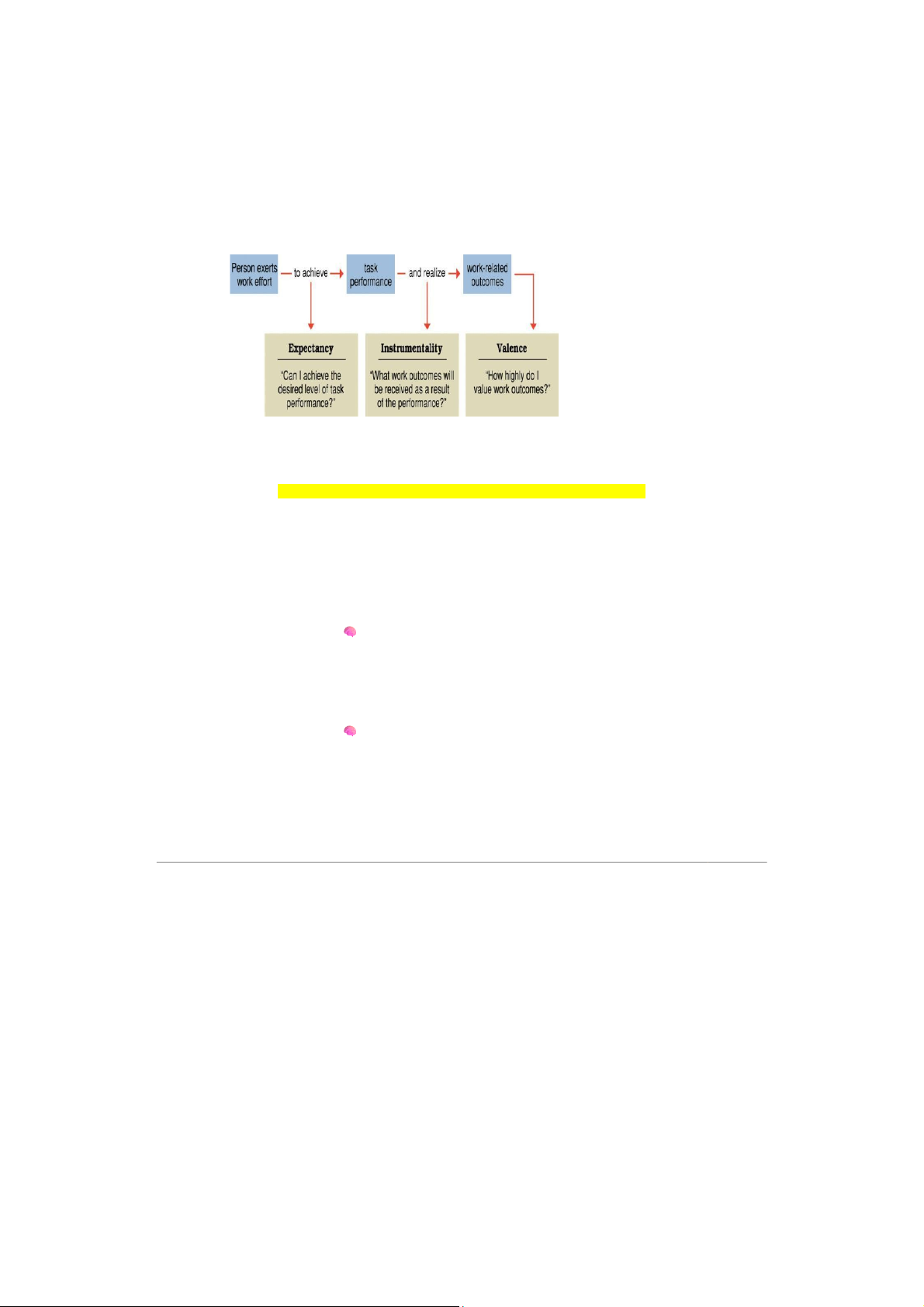
Figure 16.4 Elements in the expectancy theory of motivation
–Motivation (M), expectancy (E), instrumentality (I), and
valence (V) are related to one another in a multiplicative fashion:
Motivation = Expectancy x Instrumentality x Valence
If either E, I, or V is low, motivation will be low
Managerial implications of expectancy theory
–To maximize expectancy, managers should:
•Select workers with ability. => Hire people who already
have the skills or potential for the job. 🧠
Example: Hiring an experienced graphic designer for
a marketing campaign increases the chance they’ll feel confident about succeeding.
•Train workers to use ability => Provide training so employees can perform well. 🧠
Example: A customer service team is trained on how
to handle complaints effectively, so they feel more capable in tough situations.
•Support work efforts => Offer resources, coaching, and remove barriers. 🧠
Example: Giving employees modern software or extra
help during busy seasons boosts their sense of control.
•Clarify performance goals => Set specific and realistic expectations. 🧠
Example: Instead of telling an employee to "do
better," say "Increase client satisfaction rating by 10% this quarter."
–To maximize instrumentality, managers should:
•Clarify psychological contracts: Make sure employees
understand what they can expect in return for their work. 🧠
Example: Clearly state that if they meet sales targets,
they’ll receive a performance bonus.
•Communicate performance-outcome possibilities: Be
transparent about how rewards are tied to outcomes. 🧠
Example: Use a reward chart or evaluation form to show
how bonuses, promotions, or recognition are earned.
•Identify rewards that are contingent on performance:
Ensure rewards are only given when goals are met. 🧠
Example: Only give overtime pay or spot bonuses to
those who meet deadlines or exceed expectations—not everyone equally.
–To maximize valence in a positive direction, managers should:
•Use content theories: Apply Maslow, Herzberg, or ERG
Theory to understand what employees truly value. 🧠
Example: Some employees may prefer flexible hours
(relatedness), others want skill training (growth).
•Increase communication: Talk to employees regularly about what motivates them. 🧠
Example: Ask during performance reviews or informal
check-ins: “What kind of reward or support would help you do your best work?”
•Link needs/desires with rewards: Match the reward to individual preferences. 🧠
Example: One employee gets a training course voucher,
another gets a day off — both feel valued. Goal-setting theory –Developed by Edwin Locke
–Properly set and well-managed task goals can be highly motivating
–Motivational effects of task goals:
•Provide direction to people in their work (Cung cấp định
hướng) Goals guide what people should focus on. 🧠
Example: A sales employee who is told “Sell 20 units
this week” knows exactly what to prioritize.
•Clarify performance expectations (Làm rõ kỳ vọng về
hiệu suất): Employees know what is expected. 🧠
Example: Instead of saying “Do your best,” a manager
says “Reduce customer complaints by 15%.”
•Establish a frame of reference for feedback (Làm cơ sở
để phản hồi): Goals make it easier to give meaningful feedback. 🧠
Example: If someone’s goal was to complete a report by
Friday and they did it by Wednesday, they can receive praise for early delivery.
•Provide a foundation for behavioral self-management
(Hỗ trợ quản lý bản thân): Employees can track their own progress. 🧠
Example: A student sets weekly study goals and checks
off topics as they go—no supervisor needed.
How to Make Goal Setting Work for You:
–Set specific goals - Avoid vague targets. Mục tiêu nên rõ ràng, không mơ hồ.
“Increase website trafÏc by 20% in 3 months” is better than “Do more marketing.”
–Set challenging goals - Mang tính thử thách - Goals should push
people without overwhelming them.
Asking an intern to improve process efÏciency by 10% gives them a reason to grow.
–Build goal acceptance and commitment - Cam kết và chấp nhận
mục tiêu: People should accept and believe in the goals.
Letting employees have input into their targets boosts motivation
–Clarify goal priorities - Làm rõ thứ tự ưu tiên: If there are multiple
goals, know which matters most.
Focus on improving customer service before expanding into new markets.
–Provide feedback on goal accomplishment - Phản hồi liên tục:
Regular updates help people adjust their efforts.
Weekly check-ins let employees know if they’re on the right track.
–Reward goal accomplishment - Thưởng khi đạt mục tiêu: Recognition strengthens motivation.
A bonus or public praise for completing a tough project motivates future effort.
–Participation in goal setting - Tham gia đặt mục tiêu
•unlocks the motivational potential of goal setting
•management by objectives (MBO) promotes participation
•when participation is not possible, workers will respond
positively if supervisory trust and support exist Self-EfÏcacy Theory - Thuyết Hiệu Quả Bản Thân
–a person’s belief that he or she is capable of performing a
task. The stronger the belief, the more likely the person is to
be motivated, work harder, and succeed. Hiệu quả bản
thân là niềm tin của một người vào khả năng hoàn thành một nhiệm vụ nào đó.
–Capability directly affects motivation
•higher self-efÏcacy will have higher expectancy (If
someone believes they can succeed, they’ll likely try
harder and expect good results.)
Tài liệu liên quan:
-

CHAP 1: Introduction to Management Concepts and Functions môn Principles of Management | Trường Đại học Quốc tế, Đại học Quốc gia Thành phố Hồ Chí Minh
6 3 -

Guidelines for group’s assignments: Analysing management issues of a FDI company based inVietnam môn Principles of Management | Trường Đại học Quốc tế, Đại học Quốc gia Thành phố Hồ Chí Minh
6 3 -
Financial Planning to Achieve 300m VND Goal in 3 Years môn Principles of Management | Trường Đại học Quốc tế, Đại học Quốc gia Thành phố Hồ Chí Minh
6 3 -

A Case Study in Fast Fashion Success môn Principles of Management | Trường Đại học Quốc tế, Đại học Quốc gia Thành phố Hồ Chí Minh
6 3 -
Chap 16 Hierarchy of Needs Theory and Applications môn Principles of Management | Trường Đại học Quốc tế, Đại học Quốc gia Thành phố Hồ Chí Minh
7 4