Organizational Structures and Leadership Styles môn Principle of Management | Trường Đại học Quốc tế, Đại học Quốc gia Thành phố Hồ Chí Minh
Leadership and power Leadership success begins with the ways a manager uses power to influence the behavior of other people. Power is the ability to get someone else to do something you want done,. Tài liệu giúp bạn tham khảo, ôn tập và đạt kết quả cao. Mời đọc đón xem!
Môn: Principles of Management 314 tài liệu
Trường: Trường Đại học Quốc tế, Đại học Quốc gia Thành phố Hồ Chí Minh 2 K tài liệu
Tác giả:









Preview text:
CHAPTER 11:
org chart: An organization chart or org chart is a diagram that
+Functional organizational structure: The organization
displays a reporting or relationship hierarchy and structure.
divides its employees into groups based on their roles or
informal structure:An informal organizational structure is an
specialties. For example, an organization using this structure
organizational structure without written guidelines for
may have a finance, a marketing and a research-and-
operating but is based on norms and systems developed by
development department, with each department having
members. So, there are no formal and written rules,
specialty groups within them who report to the department
procedures, or chain of command. manager.
+advantages: Informal organizations are often formed outside
*advantages:When employees who have similar skills and
the company’s official structure. However, it contributes to
experiences are grouped together, it makes production more
satisfying employees’ social needs such as friendship, love,
efficient and of a higher quality. Roles and tasks do not change and support.
very much so there is little time spent learning, and
In addition, the bonds formed can strengthen relationships and
accountability is clear. Since the hierarchy is simple,
collaboration within the company. They develop a sense of
employees know the one manager they are to answer to,
belonging to each other. So, they can work together to achieve
instead of multiple people. This streamlines communication the company’s goals.
and reduces confusion among employees. Employees can feel
Other advantages of an informal organizational structure are:
confident about what they're doing because it is standardized.
Fast communication. Communication need not follow a chain
They are more likely to feel a loyalty to their department and
of command. Instead, it just flows. Thus, it can be much faster
the organization as a whole. This increases morale and work
than can be done in a formal organization.
ethic, as there is more job security. There is a clear path of
Faster troubleshooting. For example, employees might
growth for employees which provides motivation, and they are
congregate after normal business hours. They discuss their
more likely to be corporative with people in their department.
work and other non-work issues. They give each other
A functional organizational structure provides a perfect
constructive feedback and find solutions to each other. So,
environment for learning for new employees (especially new
they can solve it themselves without waiting for instructions
college graduates) to be taught the real-world application of from their superiors. theoretical information.
More adaptive. Management can get higher support when, for
+In a divisional structure, people are grouped together based
example, introducing change through a new target or strategy,
on the product or service they provide, not the work they do.
which requires employees to adapt. And approaching informal
For example, a large corporation such as General Electric has
groups within the company is important to reduce employee
divisions for electronics, transportation, and aviation, each resistance.
with its own team of accountants, marketers, etc.
More creativity. Employees are freer to explore and express *advantags:
their creativity and ideas. And it may be difficult in the formal
Divisional structure has the following advantages:
structure due to fewer opportunities, possible punishment, or
(i) It helps the managers to develop varied skills related to a
pessimism from being rejected by their superiors.
product and facilitates managerial development.
disadvantage:Hard to survive. Informal organizations are
(ii) Fixation of responsibility and accountability is easy, as
easy to form but also easy to break up. For example, when the
divisional heads are responsible for the profits and losses of
leader leaves, there is a void. And, it can cause the their divisions.
organization to disband because the person who replaces it
(iii) With more initiative and flexibility, decisions are taken
doesn’t have the same qualities.
much faster in divisional structure.
Interpersonal and intergroup conflicts. The incompatibility
(iv) It facilitates expansion and growth as new divisi on can be
often arises between members and against other organizational
added without interrupting the existing operations.
groups. It can worsen interpersonal relationships, resulting in
Disadvantages of Divisional Structure chaos within the company.
Divisional structure suffers from the following disadvantages:
Unsystematic work. There is no official structure. The
(i) Conflict may arise between different divisions on allocation
organization does not divide the roles, authorities, of funds and other resources.
responsibilities, and duties into several units. Thus, it is more
(ii) There is a duplication of physical facilities and functions, uncoordinated.
which leads to increase in cost.
Low control. There are no official rules or ways to bind
(iii) Greater autonomy to divisional heads may lead to misuse
member compliance. It does not rely on the encouragement of of authority.
rewards or punishments. Thus, it is difficult to manage and
(iv) Managers in each division focus on their own objectives, control the organization.
without thinking of the organisational goals.
Negative information. Rumors and misleading information
+A matrix structure is a hybrid of the functional and
often spread more quickly through informal organizational
divisional structures. It may involve employees reporting to structures.
different bosses depending on their current assignment. For
More concerned with individual interests. Although, the
example, a software design specialist may report to her boss in
members have common interests. But, it is less important than
IT, but she’s also brought onto specific projects because of her
individual interests. And, there is no obligation for members to
expertise. When that happens, she will report to a different
achieve common interests above individual interests.
boss as long as that project continues.
traditional organization: An organizational structure defines
ad: improve decision-making, since there are two chains of
how work gets delegated throughout an organization. A command
traditional organizational structure follows a system in which
help break down traditional 'silo' barriers
power flows upward through the organization, and all
improve communication across the business
employees follow a chain of command.
allow staff to apply their skills in different roles
ex: The traditional organizational chart may look like a
help share best practice and ideas across teams
pyramid. The chief executive officer would sit at the top, and
increase efficiencies due to sharing resources across
the layer underneath would consist of department managers departments
who report to the CEO and oversee the overall operations of
disad: confusion regarding roles, responsibilities and priorities
their department. Next would be first-line managers, or
divided loyalties between project teams
supervisors, who manage the daily operations of their
blurred lines of accountability
department or teams and below are the non-management
difficulties in coordinating tasks or functions employees who report to them.
power struggle between the project manager and the functional
Leadership is the process of inspiring others to work hard to manager accomplish important tasks.
large overhead costs, on account of having multiple managers
+team structure:A team structure is a design or framework 1.
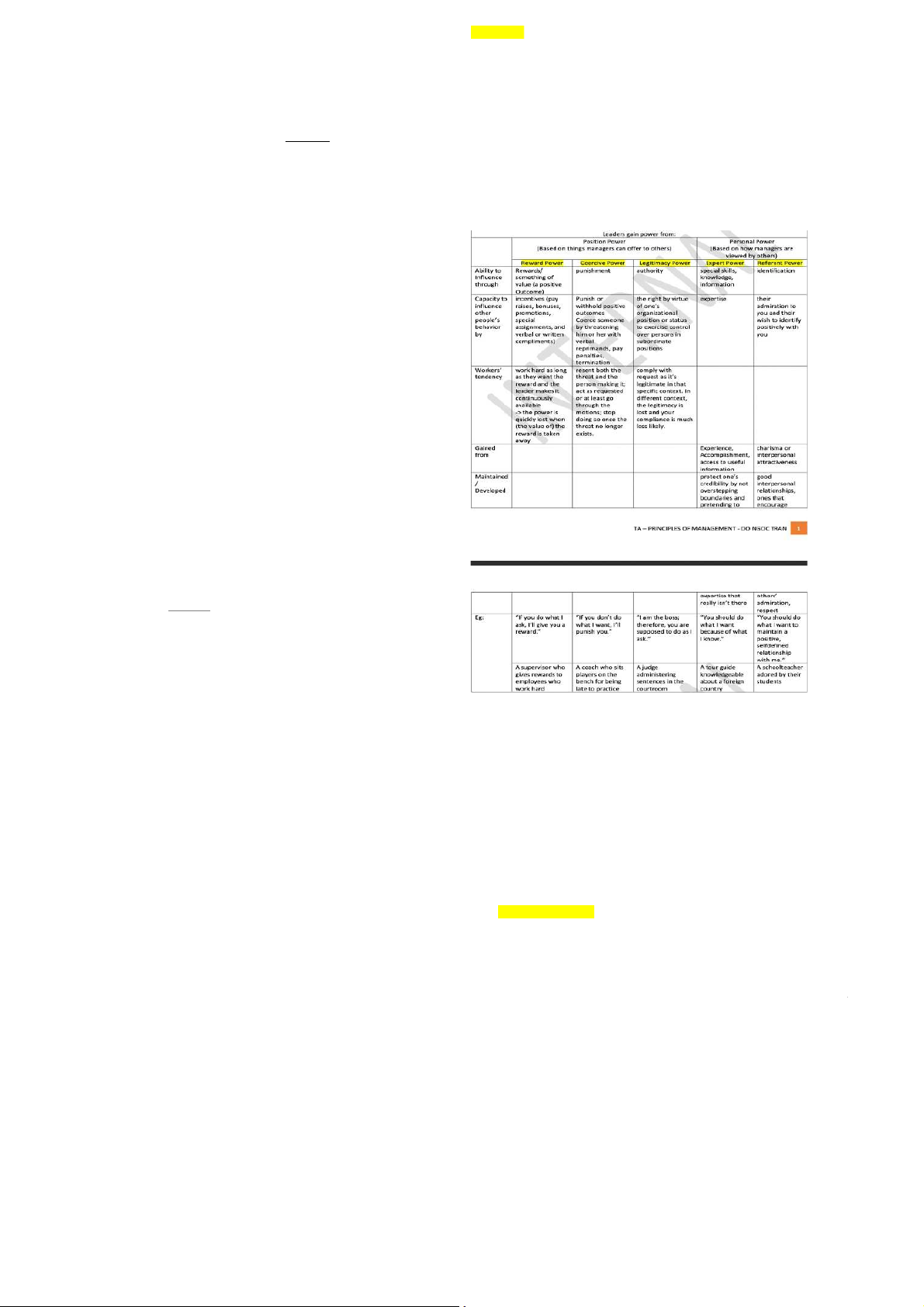
Leadership and power Leadership success begins with the ways
that defines the relationships between leadership, team
a manager uses power to influence the behavior of other
responsibilities, activities, and each team member. The team
people. Power is the ability to get someone else to do
structure that you select will have a large impact on how team
something you want done, or to make things happen the way
members collaborate and make efforts to see continuous you want.
improvements for the company. example:A company has a
-> “positive” face of power = foundation of effective
marketing and operations team. The marketing team is leadership:
concerned with improving the marketing performance by
devising comprehensive marketing campaigns. On the other
not using power with the desire to influence others for the
sake of personal satisfaction.
hand, the operations team is tasked with improving operational
✓ using power to influence others for the good of the group or
performance by optimizing operations and processes. These organization as a whole.
two teams work towards a common goal, i.e., to improve the company's overall performance.
ad: -Promotes innovative ideas.Team-based structure promotes
innovative ideas and suggestions. Because team members can
freely determine the strategies and procedures to follow when
performing their responsibilities, they can introduce creative ideas
-Empowers team members.Team members in an organization
with a team-based structure can maximize their skill set
without worrying about restrictions from team leaders -Increases efficiency
-Promotes constructive competition.For example, a marketing
team leader with multiple teams can set a weekly quota and a
bonus for the team with the highest quality leads. Doing this
can encourage team members to increase their work output to
qualify for the bonus. A constructive competition can increase
team members' productivity and expand the company.
-Introduces flexibility.For example, a team leader can assign a
team member to the research team after working in the
marketing team for a while. While doing this expands team
members' experiences and skill sets, it enables the company to
create a team of generalized professionals who can ensure
consumer satisfaction in any project they complete.
network:For example, suppose an organization designs shirts
for customers and has leaders who rather focus on design than
production or retail. To maintain control of their product, the
organization may rent retail space through their network and
purchase production capabilities from a partner organization.
While designing shirts, its partnership network can ensure it
completes other essential operations.
disad:example:employee accountability might change with
increased reliance on external vendors to complete essential
operations. By ensuring internal members remain responsible
and accountable for tasks, an organization can retain control
over its operational success. Clarifying which professional
makes final decisions can also help avoid conflict and ensure
healthy interactions in the workplace.
boundaryless:an example, Starbucks formed a highly
successful partnership with PepsiCo to market its Frappuccino 2. Leadership and vision
cold drinks. Starbucks has immediate brand-name recognition
in this cold coffee drink, but its desire to capture shelf space in
“The job of a good leader is to articulate a vision that others are inspired to follow.”
supermarkets required marketing savvy and experience that
- Leaders use their power associated with vision exceptionally
Starbucks did not possess at the time. By partnering with
well. Truly exceptional leaders turn the vision (a future that
PepsiCo, Starbucks gained an important head start in the
one hopes to create or achieve to improve upon the present
marketing and distribution of this product
state of affairs) into accomplishments.
virtual:Corning, the glass and ceramics maker, is one such
- Visionary leadership ((lAnh đCo cD tEm nhFn xa) - a leader
firm known for making partnerships work to their advantage.
who brings to the situation a clear, compelling sense of the
Corning has partnered with such firms as Siemens, Germany's
future, and an understanding of the actions needed to get there
electronics conglomeration, and Vitro, Mexico's largest successfully:
glassmaker. Alliances are so important to Corning's business + Have a clear vision
strategy that the corporation has defined itself as a network of + Communicate the vision organizations.
+ Get people motivated and inspired to pursue the vision in their daily work CHAPTER 14
- Visionary leadership gives meaning to people’s work; it
makes what they do seem worthy and valuable. “Effective I- The Nature of Leadership
leadership means having a lot of people working toward a
common goal.” If you can achieve that with no one caring who
gets the credit, you’re going to accomplish a lot.
3. Leadership as service : Servant leadership: serve others and
helping them fully use their talents so that organizations benefit
society. In servant leadership, the followers are most important
than leaders A servant leader is “other-centered” and not “self- centered.”
A leader shifts the focus away from himself toward others ->
empowerment: the process of allowing others to exercise power
and achieve influence within the organization.
- Servant leaders: + realize that power in organizations is not a
“zero-sum” quantity -> reject the idea that for one person to gain
power someone else needs to give it up (k thIch kiJu cho ngKLi nMy dc mM ng kia mNt)
+ empower others by providing them with the information,
responsibility, authority, and trust to make decisions and act independently
+ expect that people who are empowered will work hard so that
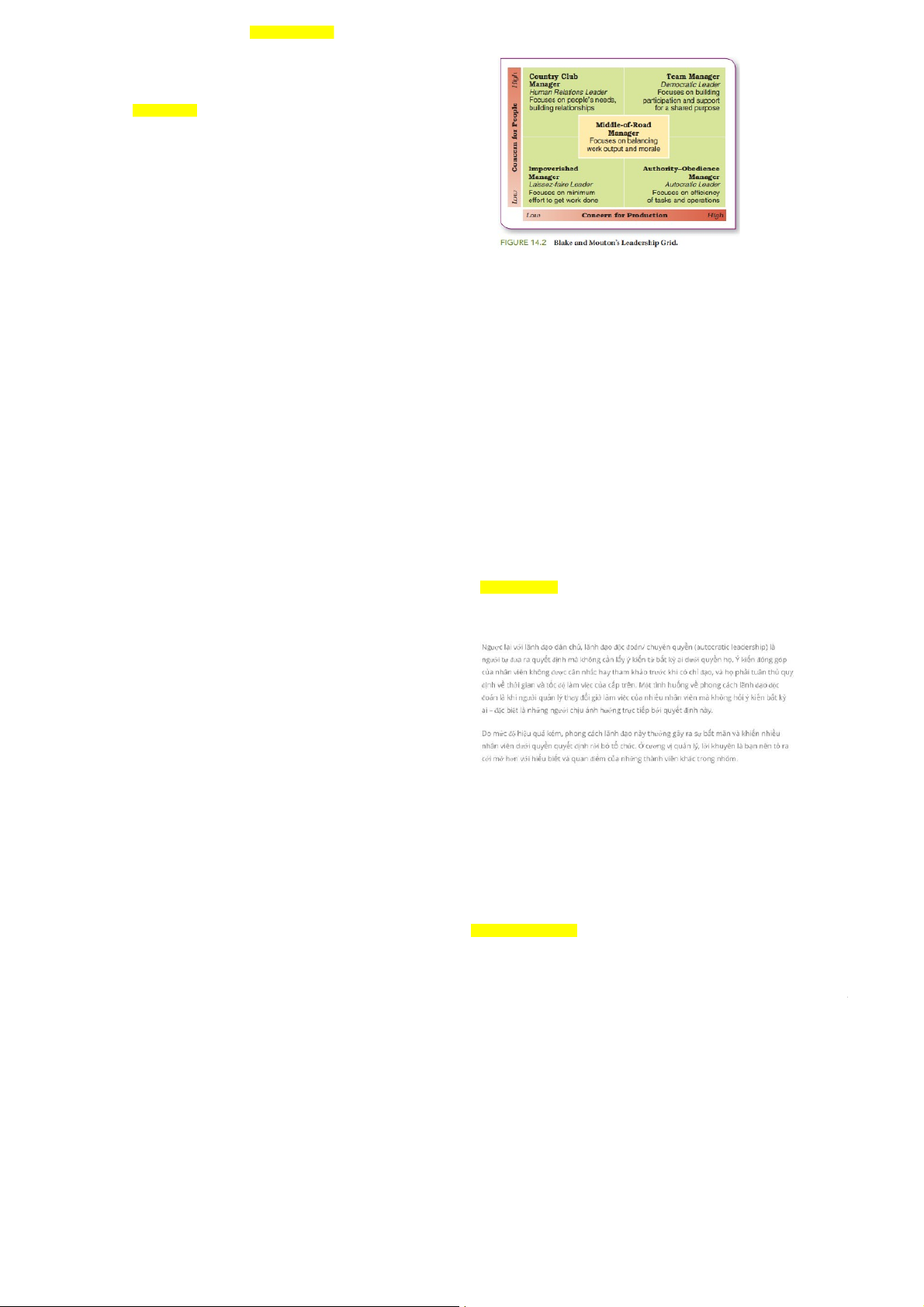
Eg: Country Club manager (HighP, LowPr) pays much
the organization as a whole is more powerful in pursuing its
attention to the security and comfort of the employees. He cause or mission.
hopes that this will increase performance Những nhM lAnh đCo
II- Leadership Traits and Behaviors
nMy chủ yếu sử dụng sức mCnh của phần thưởng đJ duy trF kỷ luật vM 1. Leadership traits
khuyến khIch cả đội hoMn thMnh những mục tiêu chung. Trong khi đD,
họ hEu nhK không cD khả năng sử dụng quyền hCn đJ cKỡng chế hay
Question—What personal traits and characteristics are
trừng phCt, vF họ sợ rằng, sử dụng những quyền hCn đD cD thJ gây ảnh
associated with leadership success? Certain personal traits are
hKởng tiêu cực tới mối quan hệ với những thMnh viên khác trong đội.
common among the best leaders:
Eg: In authority-obedience manager (LowP, HighPr),
- Drive— have high energy, display initiative, and are tenacious.
Authority Obedience Leadership is when a manager focuses
- Self-confidence—trust themselves and have confidence in their
entirely on production to an extreme level while blatantly abilities.
disregarding any need to focus on people and relationships.
- Creativity—are creative and original in their thinking.
Authority Obedience Management is also called Produce or
- Cognitive ability—have the intelligence to integrate and interpret
Perish Management, which describes this poor leadership style information. even better.
- Job-relevant knowledge—know their industry and its technical
Eg: Impoverished manager (LowP, LowPr) avoids getting into foundations.
trouble. His main concern is not to be held responsible for any
- Motivation—enjoy influencing others to achieve shared goals. mistakes. -
—adapt to fit the needs of followers and Flexibility the demands of
Eg: Team manager (HighP, HighPr): The manager encourages situations.
teamwork and commitment among employees. This leader
- Honesty and integrity—are trustworthy; they are honest,
shares decisions with team members, empowers them, predictable, and dependable.
encourages participation, and supports teamwork.
2. Leadership behaviors: how leaders behave when dealing with 3. Classic leadership styles followers
Leadership styles : the recurring patterns of behaviors exhibited by
Question—How is leadership success affected by the ways leaders leaders.
behave when engaging with followers? 2 dimensions of leadership
- Autocratic style (authority-obedience manager) (độc tMi): behavior:
emphasize task over people, retain authority and information, and
- Concern for the task to be accomplished/ initiating structure/
act in a unilateral (đmn phKmng), command-and-control fashion (ra production-centered
lệnh kiJm soát) (nhiệm vụ cao, quan hệ không tốt
+ plans and defines the work to be done + urges task completion
+ assigns task responsibilities + monitors performance results. + sets clear work standards
- Concern for the people doing the work/ consideration/ employee- centered.
+ acts with warmth and supportiveness toward followers
RNt giỏi lên lịch trFnh; họ yêu cEu nhân viên lMm những gF họ nDi mM
không cEn hỏi hay thảo luận gF cả; + respects their feelings
Khi gặp khD khăn, họ thKLng tFm xem đD lM lỗi của ai hmn lM tập trung tFm + is sensitive to their needs
hiJu xem vNn đề lM gF vM lMm cách nMo đJ ngăn chặn điều đD;
Họ không chNp nhận những ý kiến phản đối (dù chỉ lM ý kiến sáng tCo của
ngKLi khác). VF thế, các cNp dKới thKLng gặp khD khăn khi muốn đDng + shows trust
gDp hoặc phát triJn ý kiến.
+ maintains good social relations
- Human relations style (the country club manager): do just the
➔ Effective leaders should both high in concerns for both people
opposite and emphasizes people over task. and task.
- Laisser-faire style (the impoverished manager) (k xen vMo): show
In the Leadership Grid of Robert Blake and Jane Mouton:
little concern for the task, let the group make decisions, and acts
with a “do the best you can and don’t bother me” attitude.
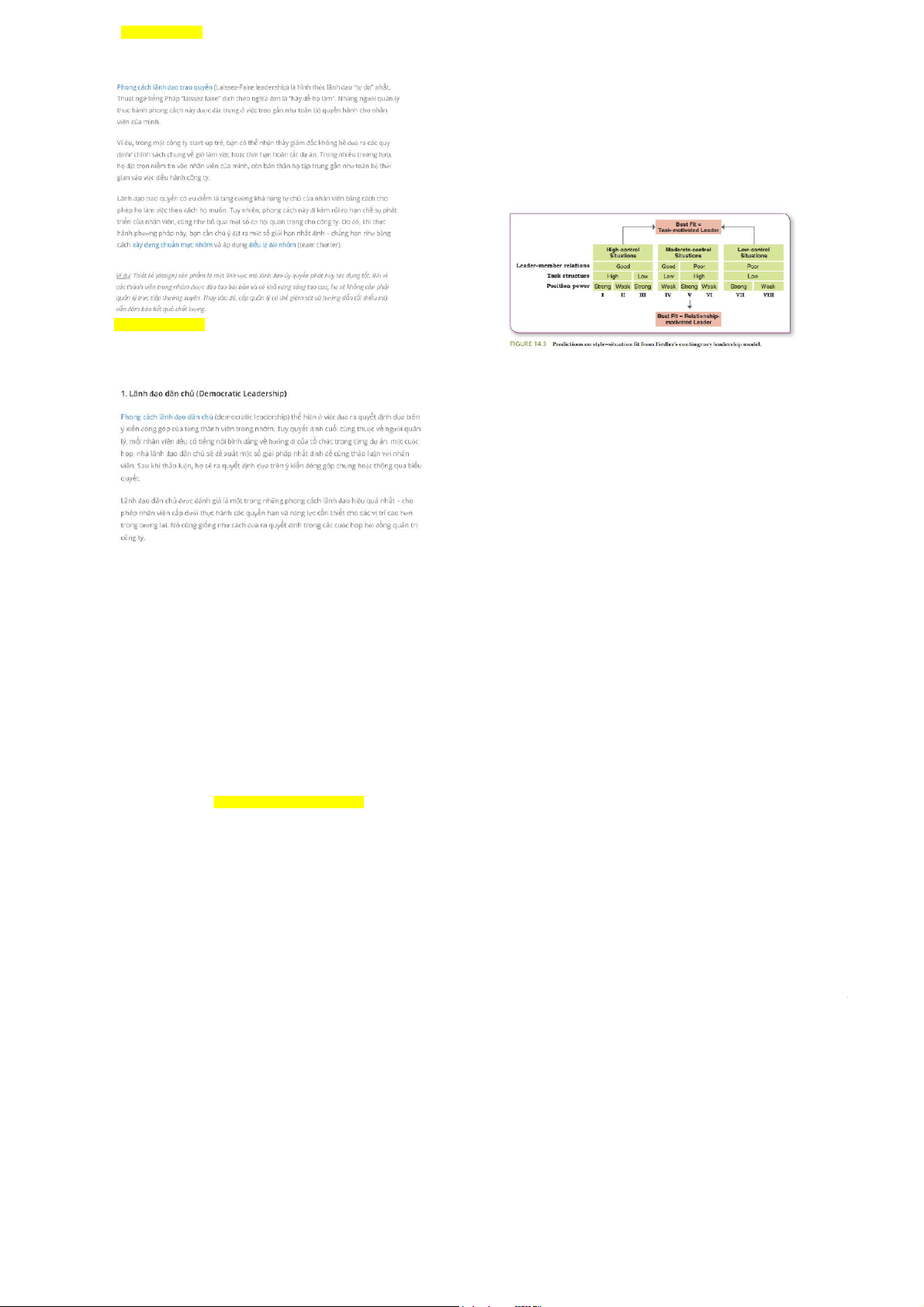
+ The degree of task structure (high or low): the extent to which
task goals, procedures, and guidelines areclearly spelled out.
+ The amount of position power (strong or weak): the degree to
which the position gives the leader power to reward and punish subordinates.
- Democratic style (“high-high” team manager) (dân chủ): is
committed to both task and people, try to get things done while
sharing information, encourage participation in decision making,
and otherwise help others develop their skills and capabilities
- 8 leadership situations that result from different combinations of 3
contingency variables (range from the most favorable situation of
high control (good LMR, high TS, strong PP) to the least favorable
situation of low control (poor LMR, low TS, weak PP))
b) Matching Leadership Style and Situation
Both style work best when used in the right situation. - Task-
motivated style—This leader will be most successful in either very
favorable (high-control) or very unfavorable (low-control) situations.
- Relationship-motivated style—This leader will be most
successful in situations of moderate control. Eg: Assume you are the
leader of a team of market researchers.
III-Contingency Approaches to Leadership
- The researchers seem highly supportive of you -> Good Leader-
1. Fiedler’s contingency model member relations
Question—Which leadership styles work best in the different types
- Their job is clearly defined regarding what needs to be done ->
of situations that leaders face? high Task structure
Good leadership depends on a match or fit between a person’s
leadership style and situational demands. Leadership style is part
- You have the authority to evaluate their performance and to make
of one’s personality and is difficult to change. -> requires both self-
pay and promotion recommendations. -> Strong position power
awareness of one’s leadership style and a good understanding of the
situational strengths and weaknesses of that style.
➔ A high-control situation -> a task-motivated leader is the best fit
a) Understanding Leadership Styles and Situations
2. Hersey-Blanchard situational model - Leadership style
Question: How should leaders adjust their leadership styles
according to the task readiness of followers?
+ is measured on the least-preferred coworker scale (the LPC
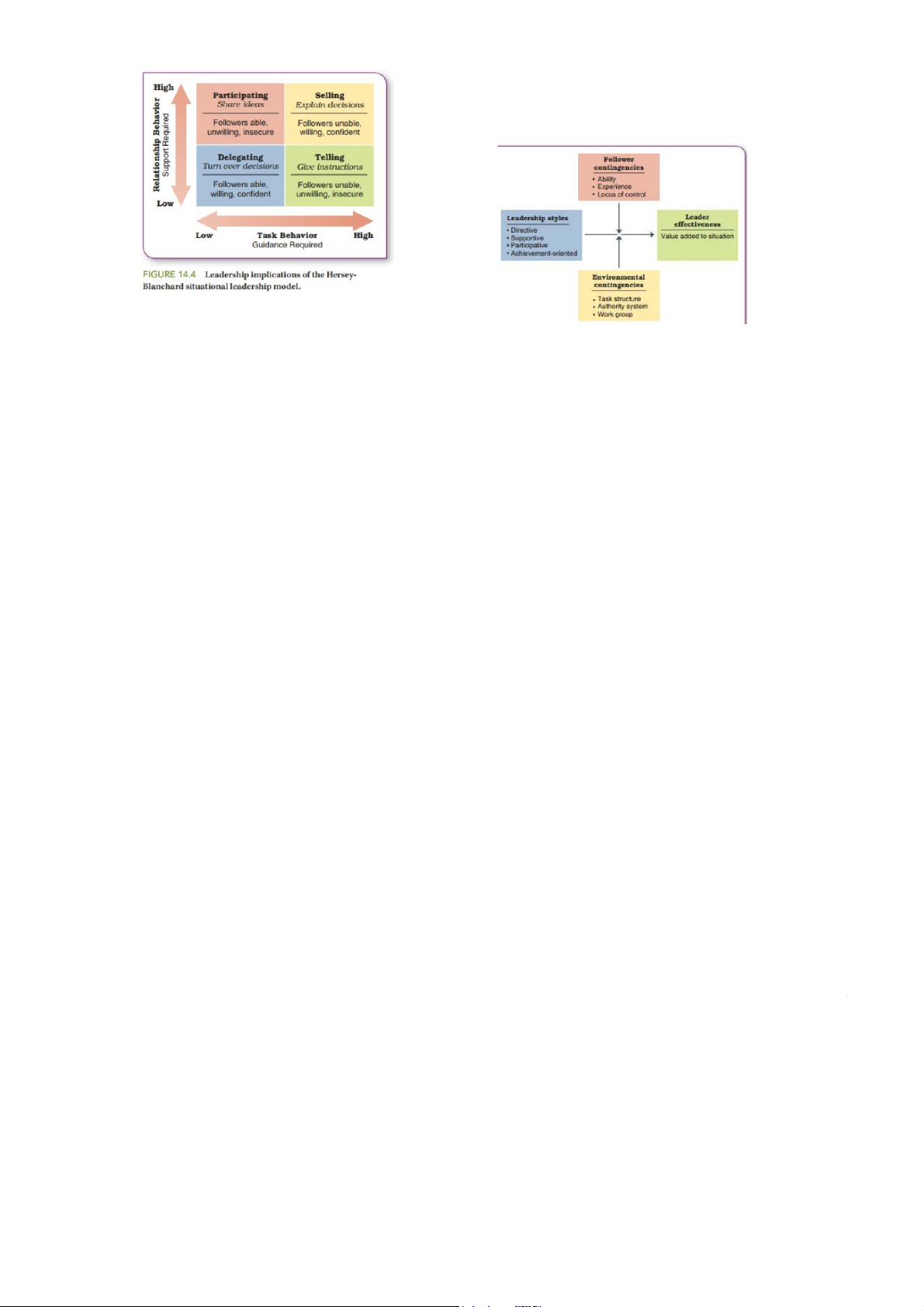
- HerseyBlanchard situational leadership model suggests that
scale) -describing tendencies to behave either as a task-motivated
successful leaders do adjust their styles wisely based on the task
leader (low LPC score) or relationship-motivated leader (high LPC
readiness (task maturity) of followers. score).
“Readiness”: how able and willing or confident followers are to Leadership style
perform required tasks. 4 leadership styles are based on: + is hard to change.
+ Relational Behavior - the interpersonal relationship between leader and subordinate.
- Leadership situations are assessed according to amount of control they offer the leader.
+ Task Behavior- concerns the amount of direction provided by the leader to subordinates
- 3 contingency variables measure situational control:
+ The quality of leader–member relations (good or poor): the
degree to which the group supports the leader.
- It seeks the right fit between leadership style and situation:
+ Determine follower contigencies and evironmental contigencies - 4 leadership styles:
+ Choose the leadership style
+ Telling: A high-task, low-relationship style
+ Focus on motivational elements to make value added to situation
Followers: unable and unwilling, or insecure
- Unlike Fiedler, House believes that a leader can use all of the
Leader: give specific task directions and closely supervising work; make decision
following leadership styles and actually shift back and forth among them:
➔ Work best: low-readiness situation
+ Selling: A high-task, high-relationship style
+ Directive leadership (ch2 huy): let followers know what is
expected; give directions on what to do and how; schedule work to
be done; maintain definite standards of performance; clarify the
Followers: unable, but willing or confident leader’s role in the group
Leader: explain task directions in a supportive and persuasive way/ persuade + Supportive leadership: do things to make work more pleasant;
their followers about the importance of the task and how they should do it;
treat team members as equals; be friendly and approachable; show
coach and keep followers motivated throughout the task.
concern for the wellbeing of subordinates.
➔ Work best: moderate-to-high-readiness situation
+ Achievement-oriented leadership: set challenging goals; expect
the highest levels of performance; emphasize continuous
+ Participating: A low-task, high-relationship style:
improvement in performance; display confidence in meeting high standards.
Followers: able but unwilling, or insecure -> have a higher
level of capability and experience (than Telling and Selling) but lack
+ Participative leadership: involve team members in decision confidence and commitment
making; consult with them and asking for suggestions; use these
Leader: allow followers to take an active role in sharing
suggestions when making decisions
ideas and making participative decisions on task directions a) Path–Goal Contingencies
➔ Work best: low-to-moderate-readiness situation
- The path–goal theory advises leaders to shift among the four styles
+ Delegating: A low-task, low-relationship style
in ways that best fit situational needs. The critical thing is to use the
style that adds real value to a situation by contributing something
that is missing or needs strengthening.
Followers: able, willing, and confident -> can make most
decisions and take responsibility for the outcomes, are highly experienced
and can perform tasks with minimal supervision; have the willingness and
Leaders should avoid redundancy and doing things that are already confidence to do so. taken care of.
Leader: allows the group to take responsibility for task
Eg: When team members are already expert and competent at their
decisions, can give empowerment to followers.
tasks, it is unnecessary and even dysfunctional for the leader to tell them how to do things.
- Some research-based guidance on how to contingently match
➔ Work best: high-readiness situation
leadership styles with situational characteristics:
Leadership styles should be adjusted as followers change over time. If the
+ When job assignments are unclear -> directive leadership ->
correct styles are used in lower-readiness situations, followers will “mature” clarify task objectives and expected rewards.
and grow in ability, willingness, and confidence => the leader become less
directive and more participative as followers mature.
+ When worker self-confidence is low -> supportive leadership ->
increase confidence by emphasizing individual abilities and offering
3. Path–goal theory (Robert House) needed assistance.
Question: How can leaders use alternative leadership styles to add value in + When task challenge is insufficient in a job -> achievement-
different types of situations?
oriented leadership -> set goals and raise performance aspirations.
+ When performance incentives are poor -> participative
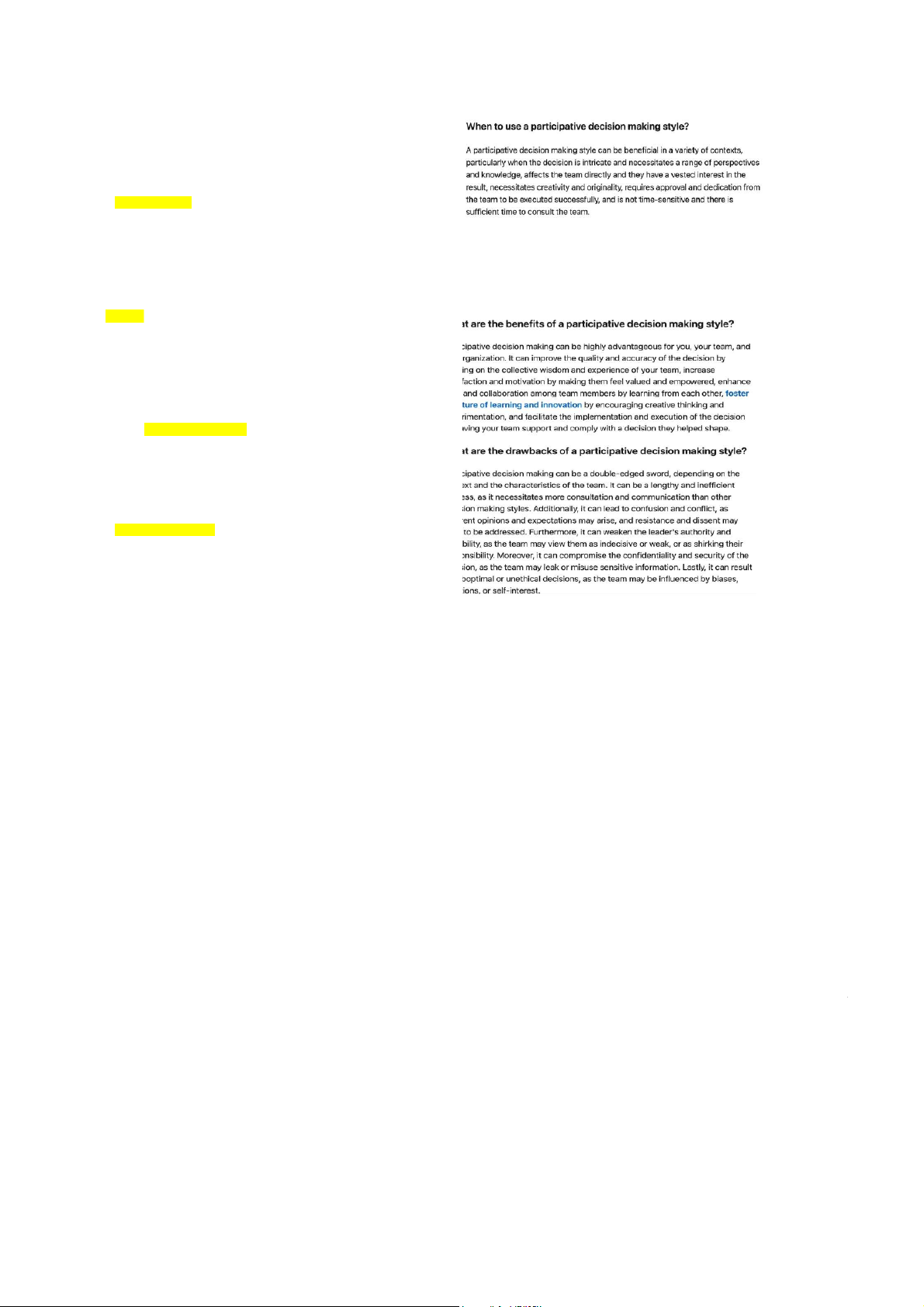
A leader’s decision-making alternatives fall into three broad
leadership -> clarify individual needs and identify appropriate
categories: authority, consultative, or group decisions: rewards.
- An authority decision is made by the leader and then
b) Substitutes for Leadership: Substitutes for leadership: aspects of communicated to the group.
the work setting and the people involved that can reduce the need
- A consultativeis decision made by the leader after gathering
for active leader involvement:
information and advice from others.
- A group decision is made by the group with the leader’s support
- follower characteristics: ability, experience, and as a contributing member independence;
- task characteristics: the presence or absence of
routine and the availability of feedback;
- organizational characteristics: clarity of plans and
formalization of rules and procedures.
When these substitutes for leadership are present, managers are
advised in true path–goal fashion to avoid duplicating them. Instead,
they should concentrate on making other and more important leadership contributions.
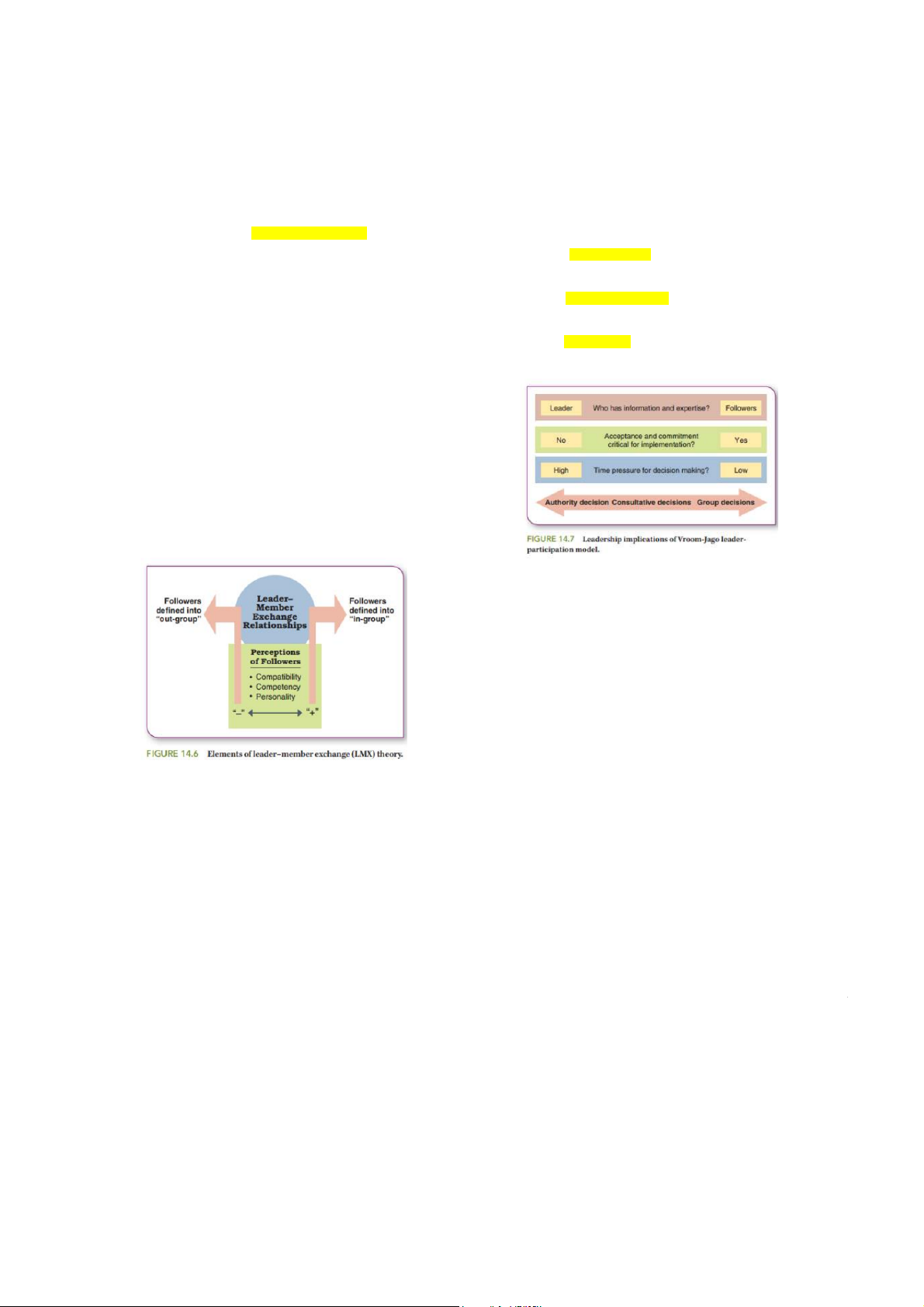
4. Leader–member exchange theory
Question—How do in-group and out-group dynamics influence
leader–follower relationships?
A leader’s choice among alternative decision-making methods is governed by 3 factors:
(1) Decision quality: who has the information needed for problem solving;
(2) Decision acceptance: the importance of follower acceptance to the
decision’s eventual implementation
(3) Decision time: the time available to make and implement the decision.
Because each decision method has its + and - in respect to these
factors, effective leaders continually shift methods as they deal with
daily problems and opportunities:
- Authority decisions work best when:
- LMX theory notices the tendency of leaders to develop “special”
+ leaders have the expertise needed to solve the problem and are
relationships with some team members. confident and acting alone.
- Not everyone is treated the same by the leader:
+ In-group members: enjoy special and trusted high-exchange
+ followers are likely to accept and implement the leader’s decision
relationships with the leaders; get special rewards, assignments,
privileges, and access to information.
+ there is little or no time available for group discussion.
➔ motivating and satisfying to receive such favorable treatments.
- Consultative and group decisions work best when:
+ Out-group members: have a low-exchange relationship and may
be marginalized, ignored; get fewer benefits.
➔ frustrating to receive fewer rewards, less information, and little or
+ the leader lacks the expertise and information needed to solve the no special attention. problem.
Eg: in work teams between leaders and certain members. Members
+ the problem is unclear, follower acceptance is uncertain but
of leaders’ in-groups get more positive performance evaluations and
necessary for implementation, and adequate time is available.
report higher levels of job satisfaction. They’re more loyal as
followers and less prone to turnover than are members of out-
Five Ways for Leaders to Make Decisions groups.
1. Decide alone—This is an authority decision; the manager decides
5. Leader–participation model (Vroom-Jago)
how to solve the problem and communicates the decision to the group.
2. Consult individually—The manager makes the decision after
Question—How should leaders make decisions in different types of
sharing the problem and consulting individually with group members problem situations? to get their suggestions.
It links leadership success with use of alternative decisionmaking
3. Consult with group—The manager makes the decision after
methods. Leaders are most effective when they make decisions in
convening the group, sharing the problem, and consulting with
ways that best fit the problem situation.
everyone to get their suggestions.
4. Facilitate group—The manager convenes the group, shares the
problem, and facilitates discussion to make a decision.
5. Delegate to group—The manager convenes the group and delegates
authority to define the problem and make a decision.
Consultative and group decisions’ benefits
✓ improve decision quality by bringing more information to bear on the problem.
✓ improve decision acceptance as participants gain understanding and commitment.
✓ contribute to leadership development by allowing others to gain
experience in the problem-solving process.
Consultative and group decisions’ negative:
Participative decision making is time consuming and leaders don’t
A leader strong in emotional intelligence possesses:
always have extra time available.
+ Self-awareness: ability to understand our own moods and emotions,
and to understand their impact on our work and on others.
+ Self-management (self-regulation): ability to think before we act and
When problems must be resolved immediately, the authority
to control otherwise disruptive impulses.
decision may be the only option.
+ Motivation and persistence: willing to work hard for reasons other than money and status.
IV- Personal Leadership Development
+ Social awareness (empathy): ability to understand the emotions of
others and to use this understanding to better relate to them.
1. Charismatic and transformational leadership
+ Relationship management: ability to establish rapport with others
and to build social capital through relationships and networks.
A charismatic leader inspires followers in extraordinary ways.
Transformational leadership is inspirational and arouses 3. Gender and leadership
extraordinary effort and performance
- Gender similarities hypothesis: males and females are very similar
Transformational leaders use their personalities to inspire followers.
to one another in terms of psychological properties.
They get them so highly excited about their jobs and organizational
goals that they strive for extraordinary performance accomplishments.
- both women and men can be equally effective as leaders.
➔ The easiest way to spot a truly transformational leader is through
- men and women are sometimes perceived as using somewhat
his or her followers who are enthusiastic about the leader, loyal and
different styles, and perhaps arriving at leadership success from
devoted to his ideas, and willing to work exceptionally hard to achieve different angles. leader’s vision.
When men and women are perceived differently as leaders, the
perceptions fit traditional stereotypes
Transformational leadership starts with a willingness to bring real
emotion to the leader–follower relationship:
- Men: “take-charge” leaders -> task-oriented, directive, and
assertive while trying to get things done in traditional command-and-
+ acting with integrity and living up to the trust of others control ways.
+ having a compelling vision of the future and the ability to
- Women: “take-care” leaders -> behave in supportive and nurturing
communicate that vision in ways that cause others to work hard ways. together to achieve it
Transformational leaders excel in part because of the strong sense of
Female leaders are viewed as more participative; strong on motivating
high aspiration, confidence, and contagious enthusiasm they bring to a
others, EI, persuading, fostering communication, listening to others, situation.
mentoring, and supporting high-quality work than male leaders.
Women were rated more highly than men in all but one area of
2. Emotional intelligence and leadership: Emotional intelligence: an
leadership— visioning because women are less directive as leaders,
ability to understand emotions in yourself and others and use this
they aren’t perceived as visionaries.
understanding to handle social relationships effectively -> an
important influence on leadership success
Interactive leaders - strong communicators and act democratic,
participative and inclusive with followers:
+ approach problems and decisions through teamwork, show respect
for others, and share power and information.
+ use communication and involvement to build good interpersonal relations and seek consensus.
+ get things done more through personal power and good
interpersonal relationships than through command- and-control use of position power.
Risk: Discussion of gender and leadership can fall prey to stereotypes
-> set gender issues aside, accept the gender similarities hypothesis,
cD thJ ủy thác một số quyết định cho nhDm của mFnh hoặc đJ họ đCt đKợc sự
and focus instead on the notion of interactive leadership.
đồng thuận với nhau. Phong cách ra quyết định cD sự tham gia dựa trên giả
định rằng nhDm của bCn cD kiến thức, kỹ năng vM hiJu biết cD giá trị cD thJ cải
thiện chNt lKợng vM sự chNp nhận của quyết định. 4. Moral leadership:
The concept of servant leadership fits with the concept of a moral
leader and the notion of authentic leadership.
- Moral leadership: is always “good” and “right” by ethical standards
+ Anyone in a leadership position will ideally practice high ethical
Phong cách ra quyết định cD sự tham gia cD thJ cD lợi trong nhiều bối cảnh, đặc
standards of behavior, try to build and maintain an ethical
biệt khi quyết định phức tCp vM đòi hỏi nhiều quan điJm vM kiến thức, ảnh
organizational culture; help and require others to behave ethically in
hKởng trực tiếp đến nhDm vM họ cD quyền lợi nhNt định đối với kết quả, đòi hỏi
sự sáng tCo vM độc đáo, cEn cD sự chNp thuận vM sự cống hiến của nhDm đJ their work.
đKợc thực hiện thMnh công, không nhCy cảm về thLi gian vM cD đủ thLi gian đJ
tham khảo ý kiến của nhDm.
+ Moral leadership begins with personal integrity. Leading with
integrity: acting in an honest, credible, and consistent manner in
putting one’s values into action -> earns the trust of followers. ->
followers believe leaders are trustworthy -> behave in ways that live
up to the leader’s expectations.
+ Transforming Leadership creates significant, revolutionary, change
in social systems, while still based on integrity.
+ Risk: moral overconfidence - an overly positive view of one’s
strength of character. Leaders with moral overconfidence may act
unethically without recognizing it or while justifying it by
inappropriate rationalizations.
+ Eg: “I’m a good person, so I can’t be wrong”
- Authentic leadership: activates positive psychological states to
achieve selfawareness & positive self-regulation.
+ Has a high level of self-awareness and a clear understanding of his or her personal values.
Việc ra quyết định cD sự tham gia cD thJ rNt cD lợi cho bCn, nhDm của bCn vM tổ
chức. ND cD thJ cải thiện chNt lKợng vM độ chInh xác của quyết định bằng cách
+ Acts consistent with those values, being honest and avoiding self-
dựa trên trI tuệ vM kinh nghiệm tập thJ của nhDmcủa bCn, tăng sự hMi lòng vM
deceptions -> perceived by followers as genuine, gains their respect,
động lực bằng cách khiến họ cảm thNy cD giá trị vM đKợc trao quyền, tăng
and develops a capacity to positively influence their behaviors.
cKLng sự tin tKởng vM hợp tác giữa các thMnh viên trong nhDm bằng cách học
hỏi lẫn nhau, nuôi dKỡng văn hoá học tập vM đổi mới bằng cách khuyến khIch
tK duy sáng tCo vM thử nghiệm, đồng thLi tCo điều kiện thuận lợi cho việc triJn
+ The values and actions of authentic leaders create a positive ethical
khai vM thực hiện quyết định bằng cách nhL nhDm của bCn hỗ trợ vM tuân thủ
climate in their organizations.
quyết định mM họ đA giúp hFnh thMnh.
Hạn chế của phong cách ra quyết định có sự tham gia là gì?
5. Drucker’s “old-fashioned” leadership
Việc ra quyết định cD sự tham gia cD thJ lM con dao hai lKỡi, tùy thuộc vMo bối
cảnh vM đặc điJm của nhDm. ND cD thJ lM một quá trFnh kéo dMi vM không hiệu
quả, vF nD đòi hỏi nhiều sự tK vNn vM trao đổi thông tin hmn so với các phong
+ Define and establish a sense of mission.
cách ra quyết định khác. NgoMi ra, nD cD thJ dẫn đến nhEm lẫn vM xung đột, vF
+ Set and keep the goals, priorities, and standards
các ý kiến vM kỳ vọng khác nhau cD thJ nảy sinh, đồng thLi cD thJ phải giải all clear and visible.
quyết sự phản kháng vM bNt đồng quan điJm. Hmn nữa, nD cD thJ lMm suy yếu
+ Accept leadership as a responsibility rather than a
quyền lực vM uy tIn của ngKLi lAnh đCo, vF nhDm cD thJ coi họ lM ngKLi thiếu rank.
quyết đoán hoặc yếu kém, hoặc trốn tránh trách nhiệm. Hmn nữa, nD cD thJ ảnh
+ Surround themselves with talented people, aren’t
hKởng đến tInh bảo mật vM an toMn của quyết định, vF nhDm cD thJ rò rỉ hoặc
afraid to develop strong and capable followers,
lCm dụng thông tin nhCy cảm. Cuối cùng, nD cD thJ dẫn đến các quyết định
dKới mức tối Ku hoặc phi đCo đức, vF nhDm cD thJ bị ảnh hKởng bởi các thMnh
+ Not blame others when things go wrong
kiến, cảm xúc hoặc tK lợi.
+ Earn and keep the trust of others.
+ Keep the personal integrity
+ not based on being clever; it is based primarily on being consistent
Authority Obedience Leadership is when a manager focuses entirely CHAPTER 15
on production to an extreme level while blatantly disregarding any
need to focus on people and relationships. Authority Obedience I- Perception
Management is also called Produce or Perish Management, which
describes this poor leadership style even better- Phong cách ra quyết định
cD sự tham gia lM một cách đKa ra quyết định liên quan đến việc các thMnh viên Perception:
trong nhDm của bCn tham gia vMo quá trFnh nMy. BCn hỏi ý kiến, đề xuNt vM sở
thIch của họ vM bCn cân nhắc chúng khi đKa ra quyết định cuối cùng. BCn cũng
a major influence on individual behavior.
the process through which people receive and interpret
than external factors relating to the environment. -> blame pp first, not situation
information from the environment.
Eg: A team leader might blame a person’s lack of job skills or laziness for the
affects the impressions we form about ourselves, other people,
poor-quality work. -> the leader may resolve the problem through training, and daily life experiences.
reward or punishment, or even replacement.
acts as a screen or filter through which information passes
before we respond to it (we behave according to perceptions)
Fundamental attribution error neglects possible external explanations for the
influenced by: cultural background, values, and other personal
poor-quality work (unrealistic time pressures or bad technology) -> and situational circumstances
opportunities to improve these factors easily get missed
➔ people can and do perceive the same people, things, or situations differently
- Recognizes tendencies toward self-serving bias:
1.Perception and psychological contracts
Self-serving bias (lỗi thiên vị bản thân): happens when individuals blame
personal failures or problems on external causes while attributing successes to Psychological contract:
internal causes -> “our success” but “their failure”
Eg: When“It’s not my fault!” error when something is wrong or “It was me, I
did it!” error when things go right.
way in which perception influences individual behavior
the set of individual expectations about the employment relationship.
Eg: A student blame the lecturer’s inadequate lessons for his poor grade or
claim his knowledge in the test that received a high grade.
Self-serving bias creates a false sense of confidence -> causes us to overlook
A healthy psychological contract offers a balance between individual
opportunities for personal change and development.
contributions made to the organization and inducements received from the organization.
3. Perception tendencies and distortions: A variety of perceptual tendencies and
distortions also influence the way we communicate with and behave toward one
Contributions are work activities (effort, time, creativity, and
another. They include the use of stereotypes, halo effects, selective perception, loyalty)
and projection. And importantly, they can each cause us to lose sight of
Inducements are what the organization gives to the individual in
important individual differences.
exchange for these contributions (pay, fringe benefits, training and opportunities
for personal ;growth and advancement, and job security)
a) Stereotypes (lỗi rập khuôn) A stereotype
+ Occurs when someone is identified with a group or category, and then
oversimplified attributes associated with the group or category are used to
describe the individual (making generalizations about an individual based on
the group to which that person belongs)
+ We all make use of stereotypes (not always negative or ill-intended). But
those based on gender, age, and race,.. can bias perceptions. Eg: Girls like pink,
dolls,.. while boys like legos, blue,..
Although employment barriers caused by gender stereotypes are falling, they
The ideal psychological contract: exchange of its values is perceived as fair. can still cause even everyday behavior to be misconstrued:
➔ when the psychological contract is perceived as unbalanced or broken => - Scene: A man is talking with coworkers—stereotyped interpretation: he’s Problems are likely to occur. discussing a new project.
Eg: Individuals who sense they are getting less from the organization than they - Scene: A woman is talking with coworkers—stereotyped interpretation: she’s
are giving, might try to compensate through lower performance, withdrawal, gossiping. and poor citizenship.
b) Halo Effects: A halo effect: occurs when one attribute is used to develop an 2. Perception and attribution
overall impression of a person or situation (Drawing a general impression
about an individual on the basis of a single characteristic) Attribution:
Eg: When meeting someone new, the halo effect may cause one trait (a pleasant
+ Way that perception influences individual behavior (Judging Others)
smile) to trigger overall positive perceptions.
+ Our perception and judgment of others is significantly influenced by our
Eg: A unique hairstyle or manner of dressing, by contrast, may trigger negative
assumptions of the other person’s internal state
perceptions. When first come to bf’s house, if you wear sexy outfit, you might
be judged as not a good girl or impolite.
+ The process of developing explanations for events.
Halo effect errors often show up in performance evaluations. One factor (a
Errors and biases in Attribution theory: - Describes how people try to explain person’s punctuality or pleasant personality,..) may become the “halo” for a
the behavior of themselves and other people, while often making errors in the positive overall performance assessment even though a full set of facts would process: show it is not deserved.
Fundamental attribution error (lỗi qui kết cm bản): occurs when someone’s
c) Selective Perception (thEy bDi xem voi)
performance problems are blamed more on internal failures of the individual
Selective perception: the tendency to single out for attention those aspects of a
+ how that behavior is regarded by others.
situation or person that reinforce one’s existing beliefs, values, or needs/ the
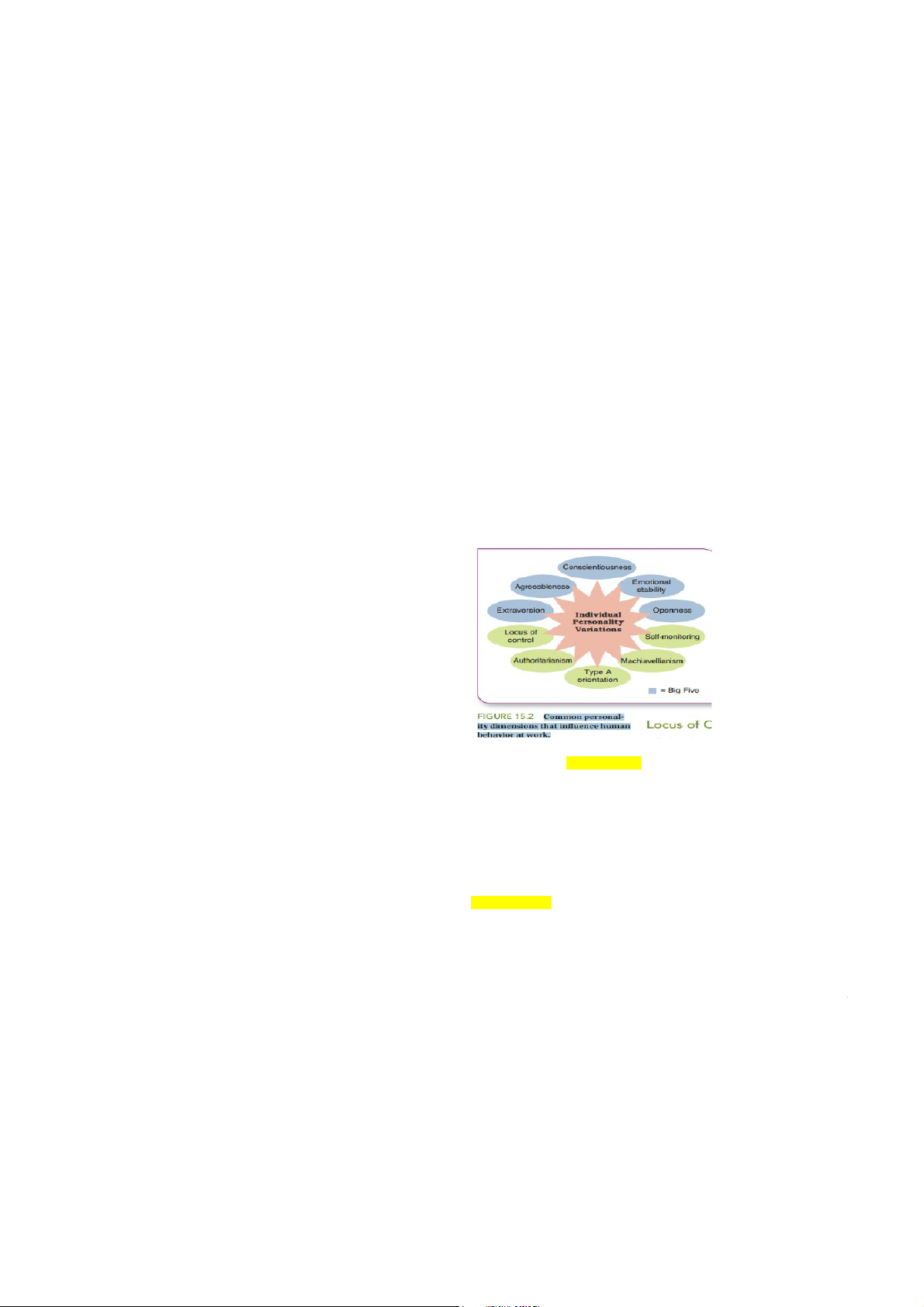
tendency to define problems from one’s own point of view. Information that 1. Big five personality dimensions
makes us uncomfortable is screened out; comfortable information is allowed
in (People selectively interpret what they see on the basis of their interests,
background, experience, and attitudes (chỉ nhFn thứ mM mFnh thIch, không đJ ý
- Extraversion (hKớng ngoCi)—the degree to which someone is outgoing,
đến những yếu tố khác))
sociable, and assertive, gregarious. ➔ An extravert is comfortable and
confident in interpersonal relationships
➔ An introvert is more withdrawn and reserved.
In organizations, pp from different departments (marketing and designing) see
things from their own points of view and fail to recognize other points of view. - Agreeableness (d‡ chịu)—the degree to which someone is good-natured,
cooperative, and trusting. ➔ An agreeable person gets along well with others
➔ Solution: gather and be open to inputs and opinions from many people => ➔ A disagreeable person is a source of conflict and discomfort for others.
Reduce this tendency and avoid the negative impact of selective perception
- Conscientiousness (tận tâm)—the degree to which someone is responsible,
d) Projection (suy bụng ta ra bụng ngKLi)
dependable, and careful, organized. ➔ A conscientious person focuses on
what can be accomplished and meets commitments
Projection: involves the assignment of personal attributes to other
➔ A person who lacks conscientiousness is careless, often trying to do too much
individuals. A classic projection error is to assume that other people share our and failing, or doing little. - Emotional stability (ổn định cảm xúc)—the degree needs, desires, and values.
to which someone is relaxed, secure, and unworried, cal, selfconfident.
Eg: You are the newly appointed manager for a team whose jobs you consider ➔ A person who is emotionally stable is calm and confident
dull and routine but the workers enjoy the responsibilities of the workload. If
you give team members more responsibilities and challenge, this may not be a
good decision as instead of designing jobs to best fit members’ needs, you have
➔ A person lacking in emotional stability is anxious, nervous, and tense. designed the jobs to fit
needs. -> some people might be quit your e satisfied
doing jobs that seem overly routine to you but others might not
- Openness to experience—the degree to which someone is curious, open to new ideas, and imaginative.
➔ Solution: control through self-awareness and a willingness to communicate
and empathize with other persons. => must try to see things through their eyes ➔ An open person is broad-minded, receptive to new things, and comfortable with change
4. Perception and impression management
➔ A person who lacks openness is narrowminded, has few interests, and is resistant to change.
Impressions can create both positive and negative perception
A considerable body of literature links the personality dimensions of the Big
Impression management: the systematic attempt to influence how others
Five model with individual behavior at work and in life overall. perceive us.
Eg: + Conscientiousness -> job performance (conscientious people tend to be
It’s really a matter of routine in everyday life. We dress, talk, act, and surround less risky,; more open to experience are more creative)
ourselves with things that convey a desirable image to other persons. When well
done, impression management can help us to advance in jobs and careers, form
relationships with people we admire, and even create pathways to group
+ Extraversion -> management and sales (extraverts tend to be happier than memberships.
introverts in their lives overall)
Eg: Dress in ways that convey positive appeal, know when to “dress up” and You can easily spot the Big Five personality traits in all of us (ourselves and
when to “dress down.” Use words to flatter other people in ways that generate people we socialize). Others form impressions of your personality, and respond
positive feelings toward you. Make eye contact and smile when engaged in to it. We do the same.
conversations so as to create a personal bond. Display a high level of energy that
is suggestive of lots of work commitment and initiative.
Eg: Managers often use personality judgments when making job assignments,
building teams, and engaging in the daily social give-and-take of work.
2. Myers-Briggs personality type indicator The Myers-Briggs Type Indicator :
+ “types” personalities based on a questionnaire that probes into how people act
or feel in various situations.
+ was developed by Katherine Briggs and Isabel Briggs-Myers from
foundations in the work of Carl Jung. Jung’s model of personality differences included 3 main distinctions: II- Personality
- How people differ in the ways they relate with others (E or I) Personality: + by extraversion
- describe the profile of enduring characteristics that makes each of us unique. + by introversion
(as the growth and development of a person’s whole psychological system)
- How they differ in the ways they gather information (S or I)
- can have consequences for: + how she or he behaves
+ by sensation (emphasizing details, facts, and routine) + authoritarianism
+ by intuition (looking for the “big picture” and being willing to deal with + Machiavellianism various possibilities). + self-monitoring
- How they differ in ways of evaluating information (T or F)
- Emotional adjustment trait: describes how they are inclined toward
+ by thinking (using reason and analysis)
handling stress and uncomfortable situations. + Type A orientation
+ by feeling (responding to the feelings and desires of others)
Briggs and Briggs-Myers added a fourth dimension that describes how people
differ in the ways they relate to the outside world— judging or perceiving. The 4 MBTI dimensions are:
Extraverted vs. introverted (E or I)—social interaction: whether a person tends
toward being outgoing and sociable or shy and quiet.
- Sensing vs. intuitive (S or I)—gathering data: whether a person tends to focus
on details or on the big picture in dealing with problems.
- Thinking vs. feeling (T or F)—decision making: whether a person tends to rel
on logic or emotions in dealing with problems.
- Judging vs. perceiving (J or P)—work style: whether a person prefers order a) Locus of Control: Locus of control: the extent to which that some
and control or acts with flexibility and spontaneity.
people believe they are in control of their destinies, while others
believe that what happens to them is beyond their control.
16 possible MBTI personality types result from combinations of 4 dimensions.
A sample of MyersBriggs types are:
- “Internals”: more self-confident and accept responsibility for their
own actions -> tend to be more satisfied and less alienated from
- ESTJ (extraverted, sensing, thinking, judging)—decisive, logical, and quick to their work
dig in; common among managers.
- “Externals”: more prone to blame others and outside forces for
- ENTJ (extraverted, intuitive, thinking, judging)—analytical, strategic, quick what happens to them. b) Authoritarianism b) Authoritarianism:
to take charge; common for leaders.
Authoritarianism (độc đoán): the degree to which a person defers to
authority and accepts status differences.
- ISJF (introverted, sensing, judging, feeling)—conscientious, considerate, and
helpful; common among team players.
- A person with an authoritarian personality tends to
- INTJ (introverted, intuitive, thinking, judging)—insightful, free thinking, + act rigidly and be control-oriented when in a leadership capacity.
determined; common for visionaries
+ act subservient and comply with rules when in a follower
Such neat and understandable personality classifications have made the Myers-capacity.
Briggs Type Indicator popular in management. People can be taught to
understand their own personality types, Eg as an ESTJ or ISJF, and to learn how
- The tendency of people with authoritarian personalities to obey
to work better with people having different ones.
can cause problems if they follow orders to the point of acting
unethically or even illegally.
Question? BIG FIVE MODEL is better for work than MBTI test?
c) Machiavellianism: Machiavellianism (xảo quyệt): the extent to
Highly conscientious people develop more job
which someone is emotionally detached (biết tách rLi cảm xúc) and
knowledge, exert greater effort, and have better performance. manipulative in using power.
Emotional stability is related to job satisfaction.
Extroverts tend to be happier in their jobs and have
- A person with a “highMach” personality is viewed as exploitative good social skills.
and unconcerned about others, often acting with the assumption that
Open people are more creative and can be good the end justifies the means. leaders.
Agreeable people are good in social settings.
- A person with a “lowMach” personality would be deferential (t.n
tr/ng) in allowing others to exert power over him or her.
3. Personal conception and emotional adjustment traits d) Self-Monitoring
- Personal conception trait: describes how people by personality tend
to relate with the environment
Self-monitoring (vị trI kiJm soát): the degree to which someone is
able to adjust and modify behavior in response to the immediate + locus of control
situation and to external factors.
- A person high in self-monitoring tends to be a learner,
+ changing the attitude to fit the behavior (“Oh, I really don’t like
comfortable with feedback, + willing and able to change. (flexible in
management that much anyway”)
changing behavior from one situation to the next -> hard to get a
clear reading on where they stand)
+ changing future behavior to fit the attitude (dropping out of
intramural sports to get extra study time)
- A person low in self-monitoring is predictable + tends to act
consistently regardless of circumstances.
+ rationalizing to force the two to be compatible (“Management is
an okay major, but being a manager also e) Type A Personality
requires the experience I’m gaining in my extracurricular activities”)
A Type A personality is high in achievement orientation,
impatience, and perfectionism. Tendency of Type A persons: 2. What is job satisfaction?
- Bringing stress on themselves, even in situations others may find
Job satisfaction: the degree to which an individual feels positive or relatively stress free
negative about various aspects of work. Job satisfaction facets most
commonly discussed and measured:
- Always moving, walking, and eating rapidly.
- Work itself—Does the job offer responsibility, interest, challenge?
- Acting impatient, hurrying others, put off by waiting.
- Quality of supervision—Are task help and social support
- Doing, or trying to do, several things at once. available?
- Feeling guilty when relaxing.
- Coworkers—How much harmony, respect, friendliness exists? -
Opportunities—Are there avenues for promotion, learning, growth?
- Hurrying or interrupting the speech of others.
- Pay—Is compensation, actual and perceived, fair and substantial?
- Cannot cope with leisure time
- Work conditions—Do conditions offer comfort, safety, support?
- Obsessed with achievement numbers
- Security—Is the job and employment secure? III- Attitudes a) Job Satisfaction Trends 1. What is an attitude?
- higher in small firms and lower in large ones
Attitudes are predispositions to act in a certain way toward people
and things in our environment. 3 components:
- run together with overall life satisfaction
+ cognitive component: reflects a belief or an opinion Eg: I think .
- the general trend has been down for several years.
the management course is very interesting.
3. Job satisfaction and its outcomes
+ affective or emotional component: reflects a specific feeling. Eg:
I very good about being a management major.
An effective manager helps others achieve both high performance and job satisfaction.
+ behavioral component: reflects an intention to behave in a
manner consistent with the belief and feeling. Eg: I plan: “I am
a) Job Satisfaction and Withdrawal Behaviors
going to work hard and try to get an A in all my management courses.”
A strong relationship exists between job satisfaction and the
withdrawal behaviors as temporary absenteeism and actual job
Eg: My pay is very low (Cognitive). I’m angry over how little I am turnover:
paid (Affective). Hence, I’m going to look for another jobs that pays better (Behavioral)
- Absenteeism: workers who are more satisfied with their jobs are
absent less often than those who are dissatisfied.
The intentions reflected in an attitude may or may not be confirmed in actual behavior.
- Turnover: satisfied workers are more likely to stay and
dissatisfied workers are more likely to quit their jobs. Absenteeism
Eg: Despite having a positive attitude and all good intentions in your and turnover are costly:
management courses, the demands of family, friends, or leisure
activities might use up time you would otherwise devote to studying.
You end up not working hard enough to get an A, and fail to live up
- the recruitment and training needed to replace workers to your original intentions.
- the productivity lost while new workers are learning how to
Cognitive dissonance (bNt hòa trong nhận thức): the discomfort felt perform up to expectations.
when one’s attitude and behavior are inconsistent. Possible results:
changing retention rates up or down:
- results in magnified changes to corporate earnings.
- warns about the negative impact on corporate performance of
declining employee loyalty and high turnover.
b) Job Satisfaction and Employee Engagement
Business profits rise with higher levels of employee engagement:
- a strong sense of belonging or connection with one’s job and employer
- being willing to help others, always trying to do something extra
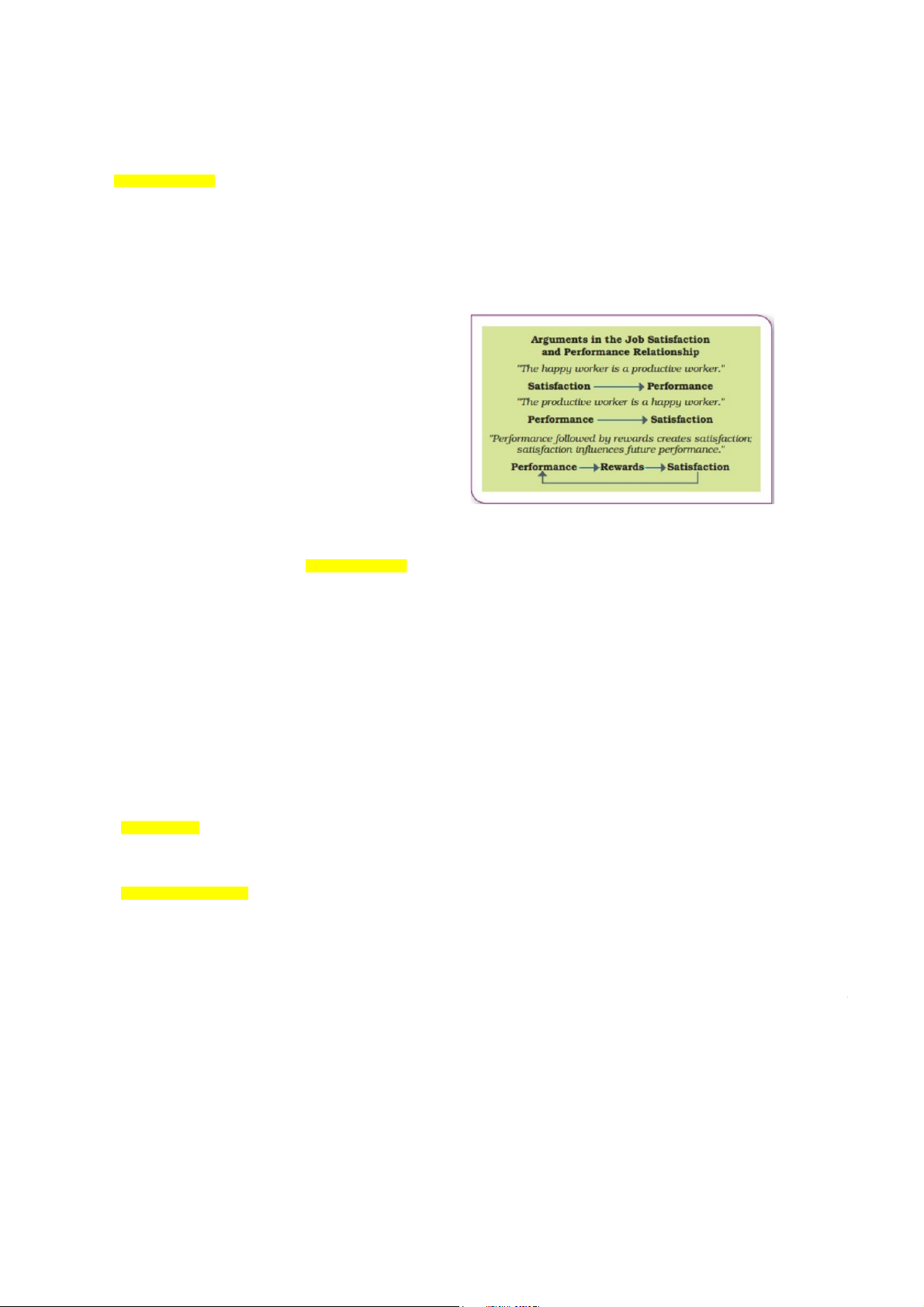
The job satisfaction and job performance relationship is to improve performance
complicated. 3 plausible arguments are:
- feeling and speaking positively about the organization.
- A modest link between job satisfaction and performance:
+ Making people happy is not really a surefire way to improve their job performance.
Reason: believing they had the opportunity to do the best every day,
believing their opinions count, believing fellow workers are
committed to quality, and believing there is a direct connection
+ “Happy worker is a productive worker” -> When employees are
between the work and the company’s mission.
happy, they feel invested in the organisation's goals and are more
compelled to work. Happiness increases productivity because it
leads to higher engagement so happy employees are also more
Employee engagement: links with two other attitudes that influence present. individual behavior at work.
+ The reality: some people will like their jobs, be very satisfied, and
- Job involvement is the extent to which an individual feels
still will not perform very well (Depends on the complexity
dedicated to a job.
regarding individual differences)
➔ Someone with high job involvement psychologically identifies
with her or his job, and, would be expected to work beyond
expectations to complete a special project.
- A link between performance and job satisfaction:
- Organizational commitment: reflects the degree of loyalty an
individual feels toward the organization
+ High-performing workers are likely to feel satisfied.
➔ Individuals with a high organizational commitment identify
Highly productive employees help a company achieve its
strongly with the organization and take pride in considering
goals. Productivity boosts morale and creates a company themselves a member.
culture of excellence, resulting in an improved workplace
=> strong emotional commitments to the organization (based on environment
values and interests of others) are much more powerful in positively
influencing performance than are rational commitments (based
primarily on pay and self- interests)
+ “Productive worker is a happy worker”
c) Job Satisfaction and Organizational Citizenship
+ The reality: Not everyone is likely to fit the model: Some may get
Organizational citizenship: a willingness to “go beyond the call of
their jobs done and meet high performance expectations while still
duty” or “go the extra mile” in one’s work not feeling satisfied.
➔ linked with job satisfaction: A person who is a good
organizational citizen does things that, although not required, help
➔ managers might be well advised to worry about losing “highly
productive but unhappy” workers unless changes are made to
advance the performance of the organization.
increase their job satisfaction (Given that job satisfaction is a good
predictor of absenteeism and turnover)
Eg: a service worker goes to extraordinary lengths to take care of a
- Job satisfaction and job performance most likely influence one
customer/ a team member who is always willing to take on extra another:
tasks/ an employee who always volunteers to stay late at no pay just
to make sure a key job gets done right.
+ the relationship is also most likely to hold under certain
“conditions,” particularly those related to rewards.
d) Job Satisfaction and Job Performance
+ “job performance followed by rewards (that are valued and
perceived as fair) create job satisfaction -> influence us to increase
motivation to work hard and achieve high performance in the future”
Do reward for productivity create satisfaction, influencing future performance
It's essential to recognize and reward staff for exceptional work if
+ Positive and negative emotions can be “contagious,” causing
you want to keep top talent. Employees are likely to become more
others to display similarly positive and negative moods
devoted and effective when they receive rewards for their work. The
organization's overall productivity and output may increase as a
+ easily extend to one’s follower ( coworkers, teammates, family,
result. In this post, we'll talk about the advantages of rewarding friends)
employees for exceptional work and how to do it.
Eg: When a leader’s mood contagion is positive, followers display
IV- Emotions, Moods, and Stress 1. Emotions
more positive moods, report being more attracted to their leaders,
and rate their leaders more highly Emotional intelligence (EI)
3. Stress Stress: a state of tension caused by extraordinary demands,
- an important human skill for managers and an essential leadership
constraints, or opportunities. capability
4. Sources of stress Stressors: things that cause stress.
- an ability to understand emotions in ourselves and in others, and to
use this understanding to manage relationships effectively.
- can influence our attitudes, emotions and moods, behavior, job performance, and even health. - we perform best when: - Are from:
+ recognize and deal with emotions = avoid letting our emotions
“get the better of us.’’ + Non-Work situations:
+ show restraint when the emotions of others are getting the better
family events (the birth of a new child) of them.”
economics (a sudden loss of extra income)
personal affairs (a preoccupation with a bad An emotion: relationship).
+ a strong feeling directed toward someone or something. + Work situations:
+ Linked with a specific cause/ clearly targeted
long hours of work, excessive e-mails, unrealistic
work deadlines, difficult bosses or coworkers,
+ Tends to be brief or episodic/ short term
unwelcome or unfamiliar work, and unrelenting change
+ Specific effect on attitude, behavior
excessively high or low task demands, role conflicts + Might turn into a mood
or ambiguities, poor interpersonal relations, and
Eg: positive emotion when an instructor congratulates on a fine
presentation; But negative emotion when an instructor criticizes in
too slow or too fast career progress. front of the class.
➔ stressors from one space—work or nonwork—can spill over to
+ Object of your emotion is the instructor
affect the other. + Personality: type A
+ impact of the instructor’s behavior on your feelings and your Work-related stress syndrome:
response is quite different (breaking into a wide smile with the
compliment, or making a nasty side comment after the criticism)
- set up to fail—where the performance expectations are impossible
or the support is totally inadequate to the task.
2. Moods :Moods: more generalized positive and negative feelings
or states of mind that may persist for some time.
- mistaken identity—where the individual ends up in a job that
doesn’t at all match talents, or that he simply doesn’t like. + Hard to identify cause
a. Constructive and Destructive Stress
+ Tends to linger, be long-lasting
Achieving the right balance of stress for each person and situation is
+ General effect on attitude, behavior difficult:
+ Can be “negative” or “positive”
- Constructive stress (eustress): Stress tIch cực
Eg: “I just feel lousy today and don’t have any energy. I’ve been
+ personally energizing and performance-enhancing.
down all week.” . Mood contagion (tâm trCng lây lan):
+ encourages increased effort, stimulates creativity, and enhances
diligence, while still not overwhelming the individual and causing
+ Is the spillover of one’s positive or negative moods onto others. negative outcomes. (giận cá chém thớt)
+ Eg: Individuals with a Type A personality work long hours and is
less satisfied with poor performance. -> Challenging task demands
move them toward ever-higher levels of task accomplishment.
+ by role clarification through frank and open communication
onwork stressors may cause them to work harder in anticipation of between bosses and coworkers. greater financial rewards.
+ By redesigned jobs to eliminate poor fits between individual
- Destructive stress (distress): Stress tiêu cực abilities and job demands. + dysfunctional.
+ occurs when intense or longterm stress overloads and breaks
down a person’s physical, mental systems.
+ lead to job burnout—a form of physical and mental exhaustion
that can be personally incapacitating.
+ Lead to workplace rage —aggressive behavior toward coworkers and the work setting
+ Eg: Lost temper -> the unfortunate extremes are tragedies that
result in physical harm to others.
Too much stress of destructive -> causes poor health:
+ reduces resistance to disease and increases the likelihood of
physical and/or mental illness.
+ possible stressrelated health problems: hypertension, ulcers,
substance abuse, overeating, depression, and muscle aches b. Stress Management
The best stress management strategy: prevent it from reaching
excessive levels in the first place.
A top priority: personal wellness - the pursuit of one’s full potential
through a personal health-promotion program.
+ [As an individual] taking personal responsibility for your physical
and mental health through a disciplined approach to such things as
smoking, alcohol use, diet, exercise, and physical fitness.
+ [As an employer] setting up wellness programs and assistance
plans to help employees follow through with wellness commitments to healthy living.
Stress can also be managed by taking actions to cope with and minimize the impact:
- personal and nonwork stressors:
+ Family difficulties may be relieved by a change in work Schedule
+ the anxiety they cause may be reduced by an understanding supervisor. - Work stress stressor:
Tài liệu liên quan:
-

CHAP 1: Introduction to Management Concepts and Functions môn Principles of Management | Trường Đại học Quốc tế, Đại học Quốc gia Thành phố Hồ Chí Minh
1 1 -
Guidelines for group’s assignments: Analysing management issues of a FDI company based inVietnam môn Principles of Management | Trường Đại học Quốc tế, Đại học Quốc gia Thành phố Hồ Chí Minh
1 1 -
Financial Planning to Achieve 300m VND Goal in 3 Years môn Principles of Management | Trường Đại học Quốc tế, Đại học Quốc gia Thành phố Hồ Chí Minh
1 1 -

A Case Study in Fast Fashion Success môn Principles of Management | Trường Đại học Quốc tế, Đại học Quốc gia Thành phố Hồ Chí Minh
1 1 -
Chap 16 Hierarchy of Needs Theory and Applications môn Principles of Management | Trường Đại học Quốc tế, Đại học Quốc gia Thành phố Hồ Chí Minh
1 1