Organizational Structures Explained: Types & Benefits môn Principle of Management | Trường Đại học Quốc tế, Đại học Quốc gia Thành phố Hồ Chí Minh
An organizational structure outlines how responsibilities and roles are assigned and grouped throughout an organization. Tài liệu giúp bạn tham khảo, ôn tập và đạt kết quả cao. Mời đọc đón xem!
Môn: Principles of Management 314 tài liệu
Trường: Trường Đại học Quốc tế, Đại học Quốc gia Thành phố Hồ Chí Minh 2 K tài liệu
Tác giả:















Preview text:
What is an organizational structure?
An organizational structure outlines how responsibilities and roles are assigned and grouped throughout an organization.
At some point, you have likely seen an organizational chart for your company. And we can pro guess what it looked like.
The typical org chart looks like a pyramid, your C-level executives at the top with lines stret
down to middle management and finally staff-level employees.
But not every company functions best with a hierarchical organizational structure. Many types
organizational charts exist because many types of organizational structures exist.
In this post, we go through the 10 common types of org structures and reasons why you consider each of them.
1. Hierarchical org structure
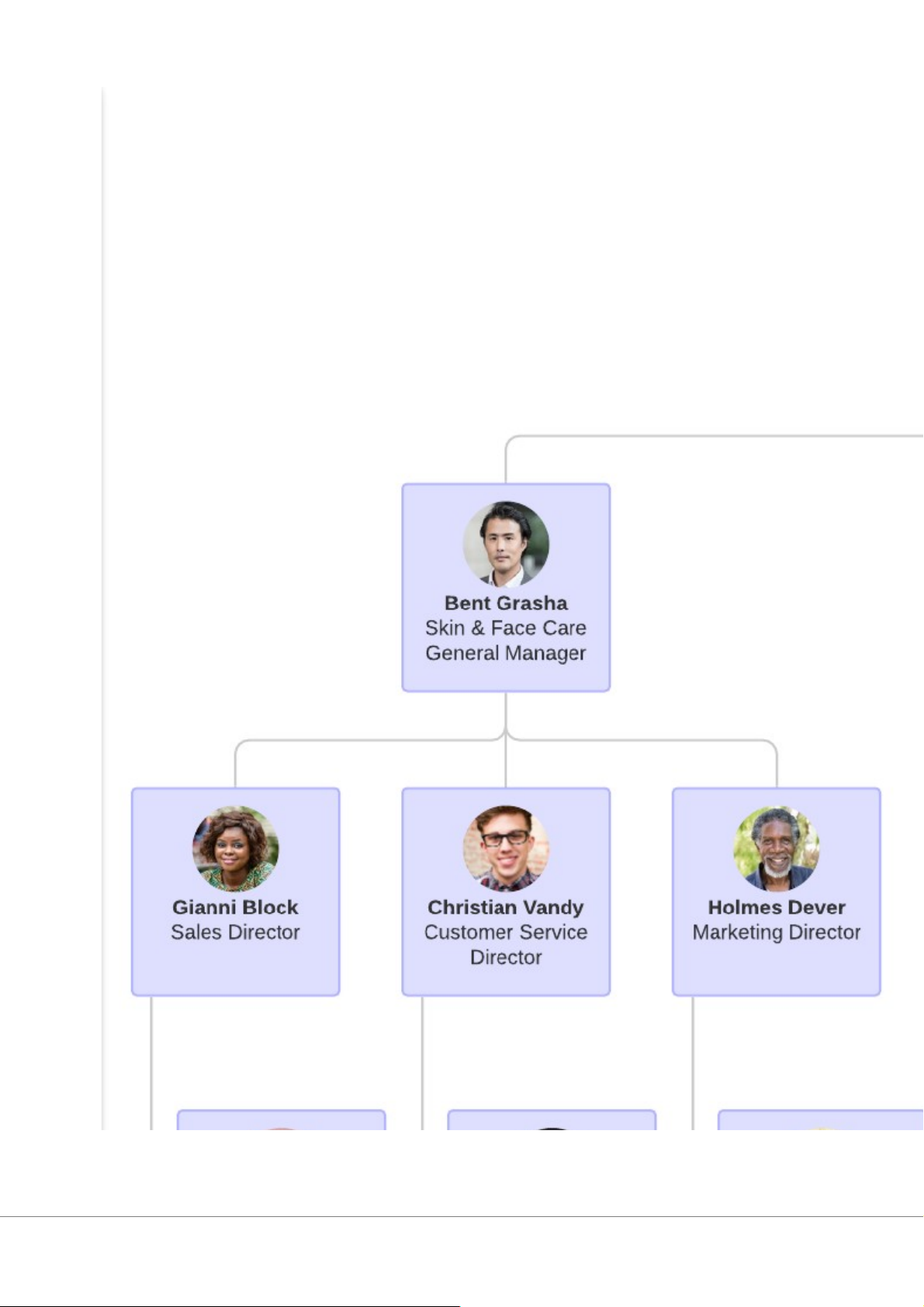
Hierarchical org chart example (click on image to modify online)
The pyramid-shaped organizational chart we referred to earlier is known as a hierarchical org ch
It’s the most common type of organizational structure—the chain of command goes from the
(e.g., the CEO or manager) down (e.g., entry-level and lower-level employees), and each employ has a supervisor. Pros
Better defines levels of authority and responsibility
Shows who each person reports to or who to talk to about specific projects
Motivates employees with clear career paths and chances for promotion
Gives each employee a specialty
Creates camaraderie between employees within the same department Cons
Can slow down innovation or important changes due to increased bureaucracy
Can cause employees to act in the interest of their department instead of the company as a who
Can make lower-level employees feel like they have less ownership and can’t express their ideas for the company
2. Functional org structure
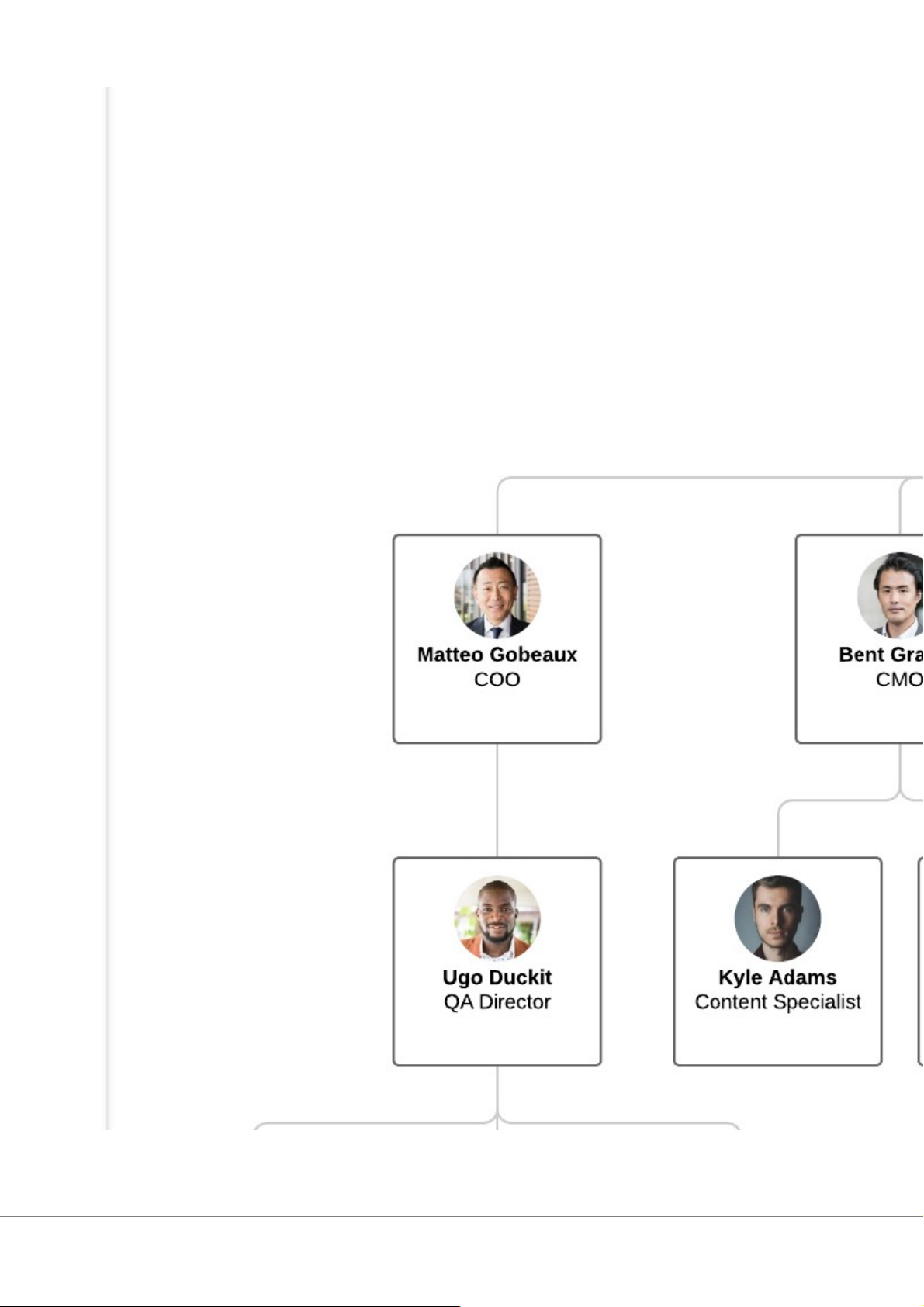
Functional org chart example (click on image to modify online)
Similar to a hierarchical organizational structure, a functional org structure starts with positions w
the highest levels of responsibility at the top and goes down from there. Primarily, thou
employees are organized according to their specific skills and their corresponding function in t
company. Each separate department is managed independently. Pros
Allows employees to focus on their role Encourages specialization
Help teams and departments feel self-determined
Is easily scalable in any sized company Cons
Can create silos within an organization
Hampers interdepartmental communication
Obscures processes and strategies for different markets or products in a company
3. Horizontal or flat org structure
Horizontal or flat org chart example (click on image to modify online)
A horizontal or flat organizational structure fits companies with few levels between uppe
management and staff-level employees. Many startup businesses use a horizontal org structure
before they grow large enough to build out different departments, but some organizations mainta
this structure since it encourages less supervision and more involvement from all employees. Pros
Gives employees more responsibility
Fosters more open communication
Improves coordination and speed of implementing new ideas Cons
Can create confusion since employees do not have a clear supervisor to report to
Can produce employees with more generalized skills and knowledge
Can be difficult to maintain once the company grows beyond startup status
4. Divisional org structure
In divisional organizational structures, a company’s divisions have control over their own resource
essentially operating like their own company within the larger organization. Each division can ha
its own marketing team, sales team, IT team, etc. This structure works well for large companies
empowers the various divisions to make decisions without everyone having to report to just a executives.
Depending on your organization’s focus, there are a few variations to consider.
Market-based divisional org structure
Divisions are separated by market, industry, or customer type. A large consumer goods compan
like Target or Walmart, might separate its durable goods (clothing, electronics, furniture, etc.) fro
its food or logistics divisions.
Market-based divisional org chart example (click on image to modify online)
Product-based divisional org structure
Divisions are separated by product line. For example, a tech company might have a divis
dedicated to its cloud offerings, while the rest of the divisions focus on the different softw
offerings—e.g., Adobe and its creative suite of Illustrator, Photoshop, InDesign, etc.
Product-based divisional org chart example (click on image to modify online)
Geographic divisional org structure
Divisions are separated by region, territories, or districts, offering more effective localization an
logistics. Companies might establish satellite offices across the country or the globe in order to close to their customers.
Geographical divisional org chart example (Click on image to modify online) Pros
Helps large companies stay flexible
Allows for a quicker response to industry changes or customer needs
Promotes independence, autonomy, and a customized approach Cons
Can easily lead to duplicate resources
Can mean muddled or insufficient communication between the headquarters and its divisions
Can result in a company competing with itself
5. Matrix org structure
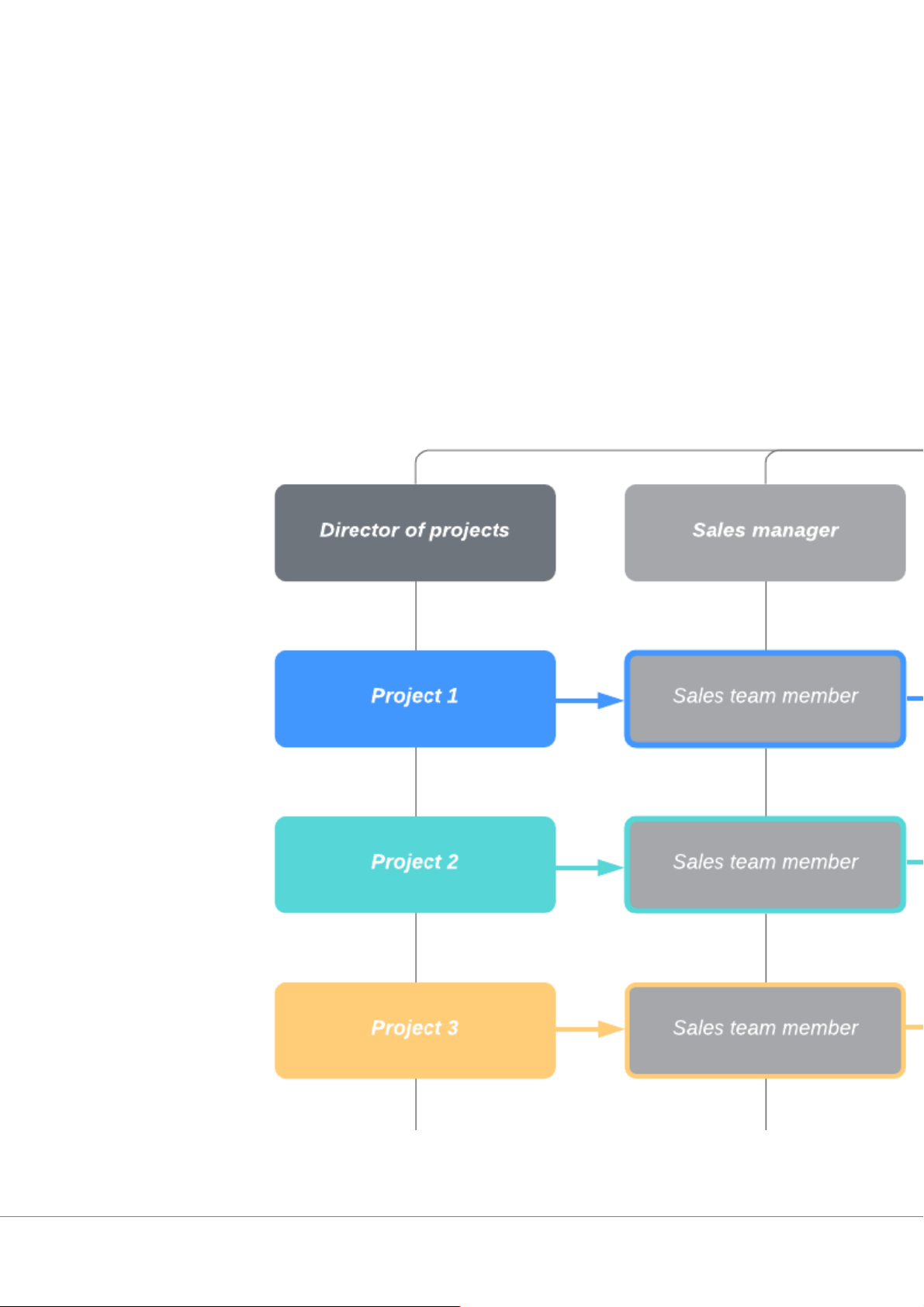
Matrix org chart example (click on image to modify online)
A matrix organizational chart looks like a grid, and it shows cross-functional teams that form
special projects. For example, an engineer may regularly belong to the engineering department (l
by an engineering director) but work on a temporary project (led by a project manager). The m
org chart accounts for both of these roles and reporting relationships. Pros
Allows supervisors to easily choose individuals by the needs of a project
Gives a more dynamic view of the organization
Encourages employees to use their skills in various capacities aside from their original roles Cons
Presents a conflict between department managers and project managers
Can change more frequently than other organizational chart types
6. Team-based org structure
Team-based org chart example (click on image to modify online)
It’ll come as no surprise that a team-based organizational structure groups employees according
teams—think Scrum teams or tiger teams. A team organizational structure is meant to disrupt
traditional hierarchy, focusing more on problem-solving, cooperation, and giving employees more control. Pros
Increases productivity, performance, and transparency by breaking down silo mentality Promotes a growth mindset
Changes the traditional career models by getting people to move laterally
Values experience rather than seniority Requires minimal management
Fits well with agile companies with Scrum or tiger teams Cons
Goes against many companies’ natural inclination of a purely hierarchical structure
Might make promotional paths less clear for employees
See why forming tiger teams is a smart move for your organization. Learn more
7. Network org structure
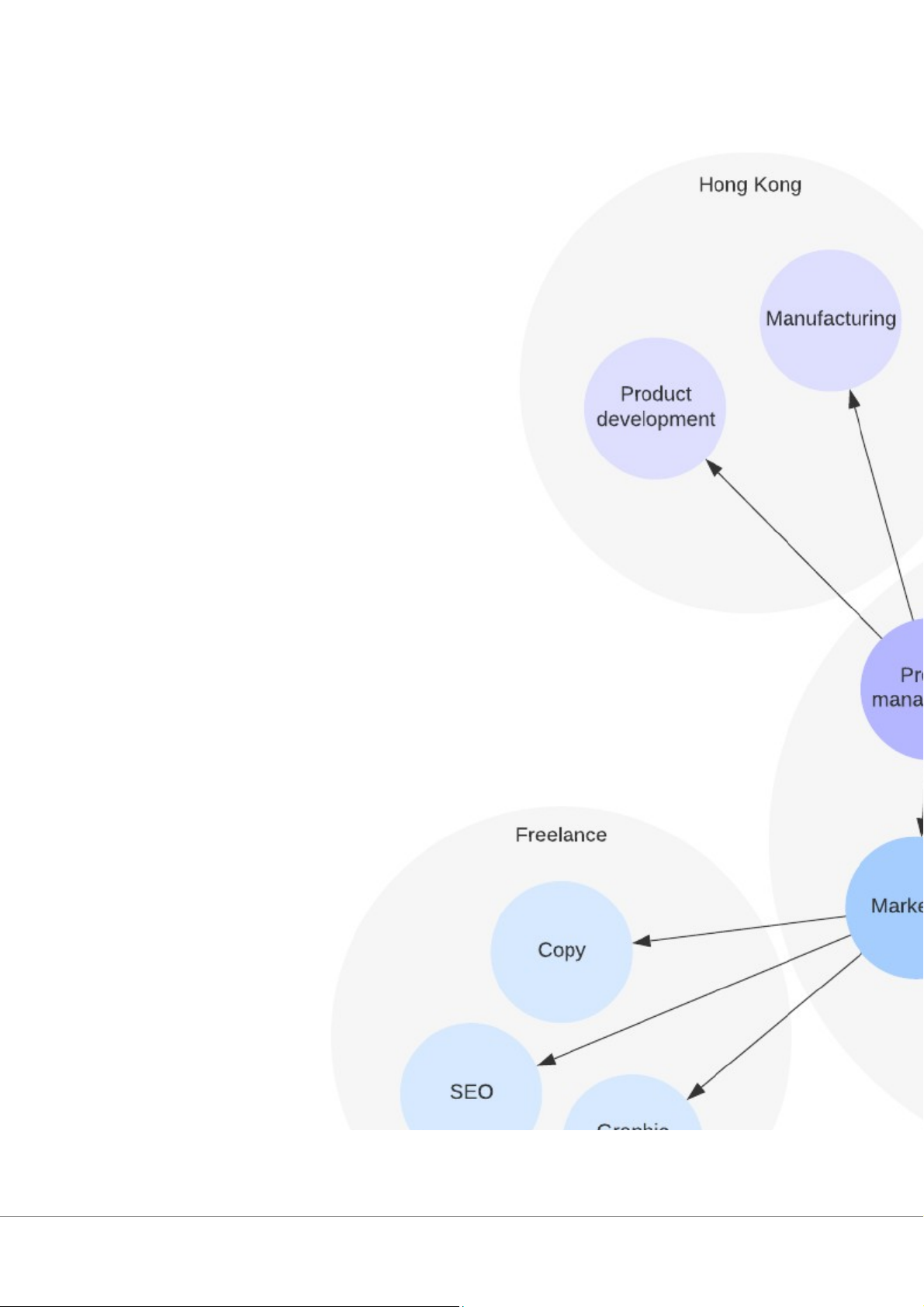
Network org structure example (click on image to modify online)
These days, few businesses have all their services under one roof, and juggling the multitudes
vendors, subcontractors, freelancers, offsite locations, and satellite offices can get confusing. A
network organizational structure makes sense of the spread of resources. It can also describe
internal structure that focuses more on open communication and relationships rather than hierarchy Pros
Visualizes the complex web of onsite and offsite relationships in companies
Allows companies to be more flexible and agile
Give more power to all employees to collaborate, take initiative, and make decisions
Helps employees and stakeholders understand workflows and processes Cons
Can quickly become overly complex when dealing with lots of offsite processes
Can make it more difficult for employees to know who has final say
Consider the needs of your organization, including the company culture that you want to deve
and choose one of these organizational structures.
8. Process-based structure
Process-based structure example (click to use template)
A process-based structure organizes employees into groups or departments based on steps of
process. The leader of the company is listed at the top, as they oversee all processes. Each
the process has a supervisor and employees who do work in that process. The chart reads fro
to right. One process can not begin until the process before it is completed. Pros
Can lead to faster and more efficient processes
Promotes teamwork within departments and across departments Cons
Can lead to barriers between departments
Can lead to miscommunication between departments, especially during handoffs
9. Circular structure
Circular org chart example (click to use template)
A circular organizational structure puts leaders of the organization at the center rather than the
so they can share information outward rather than pass it down a chain of command. Employe
different departments are also seen as part of a larger whole rather than siloed off by departmen Pros
Promotes the flow of information across the organization
Promotes communication and collaboration between employees and departments Cons
Can cause confusion around who to report to, especially for new employees
Can take longer to make decisions
10. Line structure
A line structure is one of the simplest organizational structures as authority flows from top
bottom. Each department is ran by a manager and works toward a common organizational goal. Pros Reporting structure is clear Stable environment Cons Can be inflexible
Can limit innovation and specialization
Can lead to managers having a lot of power
Once you've chosen the right org
Tài liệu liên quan:
-
CHAP 1: Introduction to Management Concepts and Functions môn Principles of Management | Trường Đại học Quốc tế, Đại học Quốc gia Thành phố Hồ Chí Minh
8 4 -
Guidelines for group’s assignments: Analysing management issues of a FDI company based inVietnam môn Principles of Management | Trường Đại học Quốc tế, Đại học Quốc gia Thành phố Hồ Chí Minh
8 4 -
Financial Planning to Achieve 300m VND Goal in 3 Years môn Principles of Management | Trường Đại học Quốc tế, Đại học Quốc gia Thành phố Hồ Chí Minh
9 5 -

A Case Study in Fast Fashion Success môn Principles of Management | Trường Đại học Quốc tế, Đại học Quốc gia Thành phố Hồ Chí Minh
9 5 -
Chap 16 Hierarchy of Needs Theory and Applications môn Principles of Management | Trường Đại học Quốc tế, Đại học Quốc gia Thành phố Hồ Chí Minh
10 5