Outcomes Beginner Unit 8





Preview text:
8 HERE AND THERE 2 1 4 6 7 11 12 13 68 30004_OUT_BEG_SB.indb 68 13/09/2018 09:41
IN THIS UNIT YOU LEARN HOW TO:
• talk about what people are doing
• explain why someone isn’t there
• talk about houses and rooms
• ask about things you can’t find • talk about working at home 3 WORDS FOR UNIT 8
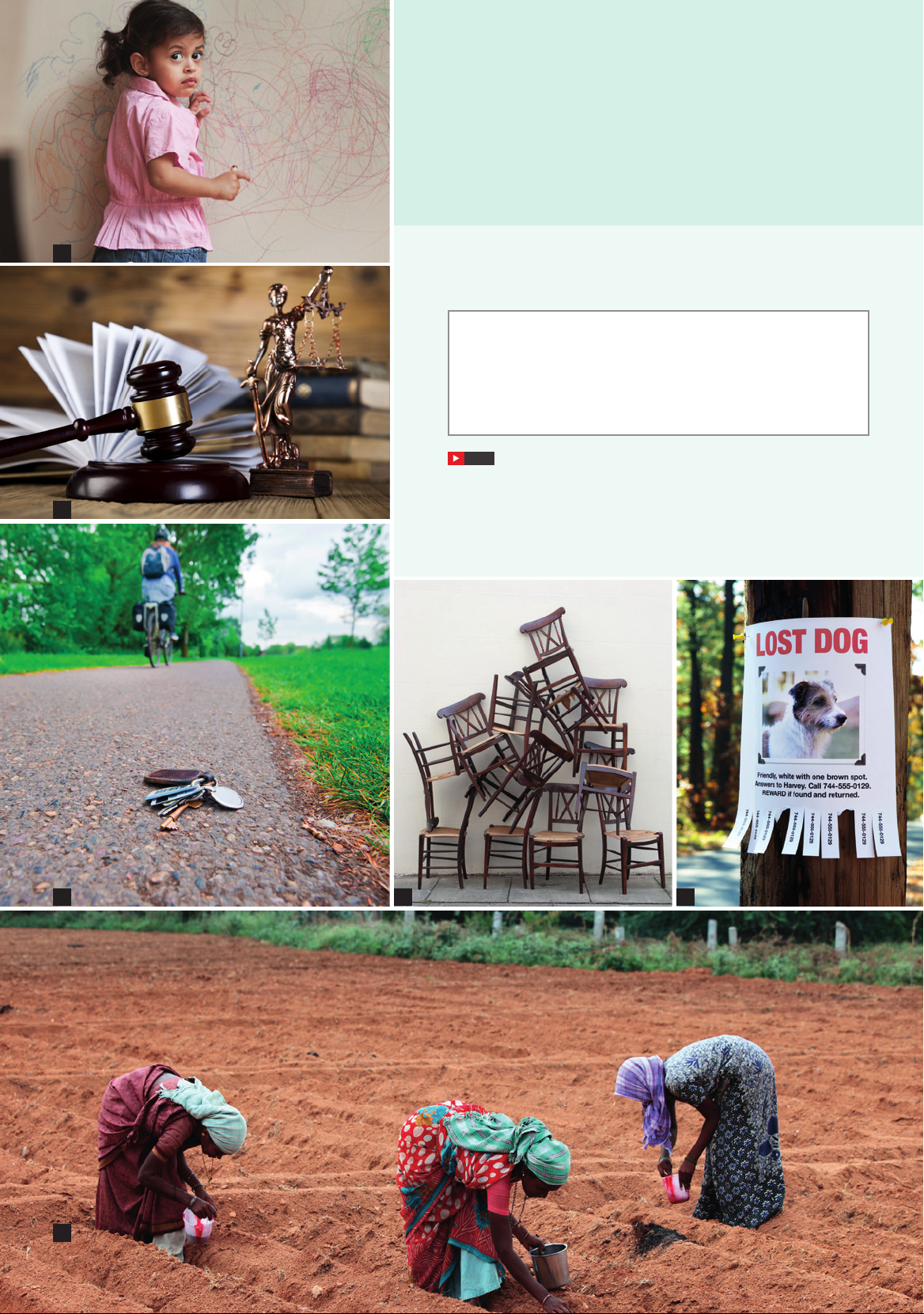
1 Look at the words and photos. 1 carpets 8
leave my keys in the park 2 it’s not working 9 chairs
3 draw a picture 10 lost 4 wear glasses
11 leave the dishes in the sink 5 law 12 I can’t remember 6 they look similar 13 an old factory
7 look in the fridge 14 work hard 2
128 Listen and repeat the words.
3 Work in pairs. Don’t look at the words. 5 Student A: say the number. Student B: say the words. 8 9 10 14
Unit 8 Here and there 69 30004_OUT_BEG_SB.indb 69 13/09/2018 09:41 WHERE IS EVERYONE? 6 a client / someone / in VOCABULARY Collocations a café 7
a coff ee / a new job / something to eat
Collocations are words that usually go together. 2
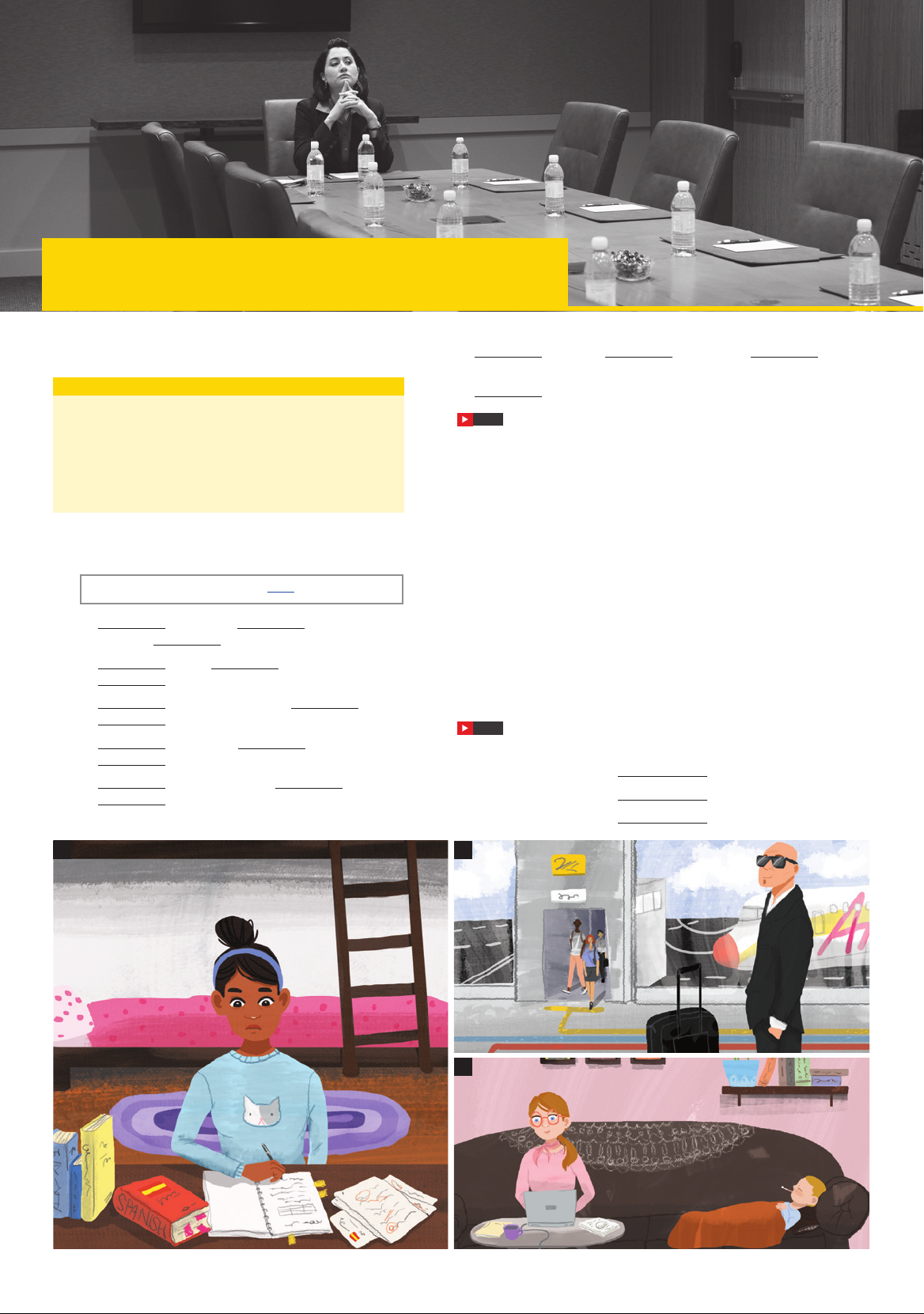
129 Listen to the seven sentences. Tick (✓) the
In English, take goes together with the bus, a
collocations you hear from Exercise 1.
photo or a break. In your language, maybe you
can use the same verb with these three nouns, or
3 Work in pairs. Make one more collocation with each
maybe you can’t. Diff erent languages often have
verb in the box from Exercise 1. diff erent collocations.
4 Use collocations from Exercise 1 to make true
1 Match the verbs in the box with the words sentences: and phrases 1–7.
a about you. b about friends. c about your family.
get make meet study take travel work
5 Work in groups. Say your sentences.
I studied Law at Warsaw University. I fi nished in 2012. 1 take an exam / take a friend to the
My friend Almir travels to lots of countries. He plays in a band. airport / take a coat with me
My mum’s a nurse. She works hard. 2 hard / in a factory / at home. 3 Law at university / hard / LISTENING for an exam 6
130 Listen to three conversations. Match who they 4 to Japan / a long way /
talk about in conversations 1–3 with pictures a–c. a lot for work
Conversation 1: Picture 5 a lot of money / a list /
Conversation 2: Picture something to eat
Conversation 3: Picture a b c 70 30004_OUT_BEG_SB.indb 70 13/09/2018 09:41 7
130 Listen again. Tick (✓) the sentences that
4 They’re studying hard at the moment.
are true. Change the sentences that are not. 5 He’s not working today. Conversation 1 6 She’s not feeling well.
a They are waiting to start a meeting. ✓ 11
131 Work in pairs. Practise the sentences.
b Jaime is getting a coffee and Ulla is visiting a client. ✗
For more practice, see Exercises 1–3 on page 129. Ulla is talking to a client
c Katya’s going to be late for the meeting.
12 Work in pairs. Practise the conversation.
d Katya’s not feeling well today. A: OK. Are we ready? Conversation 2 B: Yes. Sure.
a Emma is studying Chinese at university.
A: Wait a minute. Where’s Ken?
b She is going to take some exams. WHERE IS EVERYONE?
B: Oh, he’s not coming today. He’s taking his son to the Conversation 3 airport. a The father is in Dubai. A: Ah, OK. b He travels a lot for work. 13
132 Listen to the conversation. Which words 8
130 Check your answers. Listen again and are different? read on page 157.
14 Work in pairs. Have similar conversations. Make changes each time. GRAMMAR
DEVELOPING CONVERSATIONS Present continuous: all forms Questions Sending messages
What’s he studying? What are you reading?
A: I’m going to call her later.
Is it raining? Are they waiting?
B: Oh, OK. Say hello/hi. Positive
A: Her son’s not feeling well.
She’s working at home today. I’m going.
B: Oh, really? Say I’m sorry.
He’s travelling to Dubai today.
They’re coming. A: This is from my mother. Negative
B: Really? Say thank you.
Her son’s not feeling well. The machine’s not working.
15 Read the sentences. Choose the best message to
9 Complete the conversations. Use the right form send. of the verbs in brackets.
1 This money is for you – from my brother. 1 A: Is Nick working at home today? (work)
2 Her father is in hospital at the moment. B: No, he’s not. He a client in Moscow.
3 I’m going to meet James tonight. (meet) 4 My son made a cake for us.
2 A: How’s the weather there? Is it bad?
5 I’m going to visit my parents this weekend. B: Well, it
, but it’s very cold. (not / rain)
6 He lost his job and he can’t get a new one. 3 A: What your sister in
16 Work in pairs. Take turns to say the sentences in Greece? (do) Exercise 15 and send messages. B: She at a university there. She travels a lot! (teach) 4 A: they for lunch now? (go) CONVERSATION PRACTICE B: Yes, but I here. I need to finish this.
17 Write the names of five friends or people in your (stay)
family on a piece of paper. Give it to your partner. 5 A: We can start. Ilia . (not / come)
18 Have conversations that start like this: B: Oh, OK. Why? Student A Student B A: He well. (not / feel) 6 A: Why she the bus How’s X?
today? She normally drives. (take) [Answer] What’s he/she doing at B: Her car has a problem. the moment? [Answer] 10
131 Listen to the sentences. They are fast then slow.
Ask more questions to continue. 1 What’s she studying?
133 For more practice, listen to another example. 2 What are you doing here? 3 I’m meeting a customer.
Unit 8 Here and there 71 30004_OUT_BEG_SB.indb 71 13/09/2018 09:41 I CAN’T FIND MY KEYS REVIEW AND SPEAKING
1 Work in pairs. Choose two.
• Test each other on the words on pages 69 and 70.
• Say three more words that go with each of the verbs from page 70.
meet my brother, meet some friends …
• Have conversations. Start with this question.
Continue it in six different ways.
Where’s Su? Is she coming with us now?
A: No. She’s doing some work.
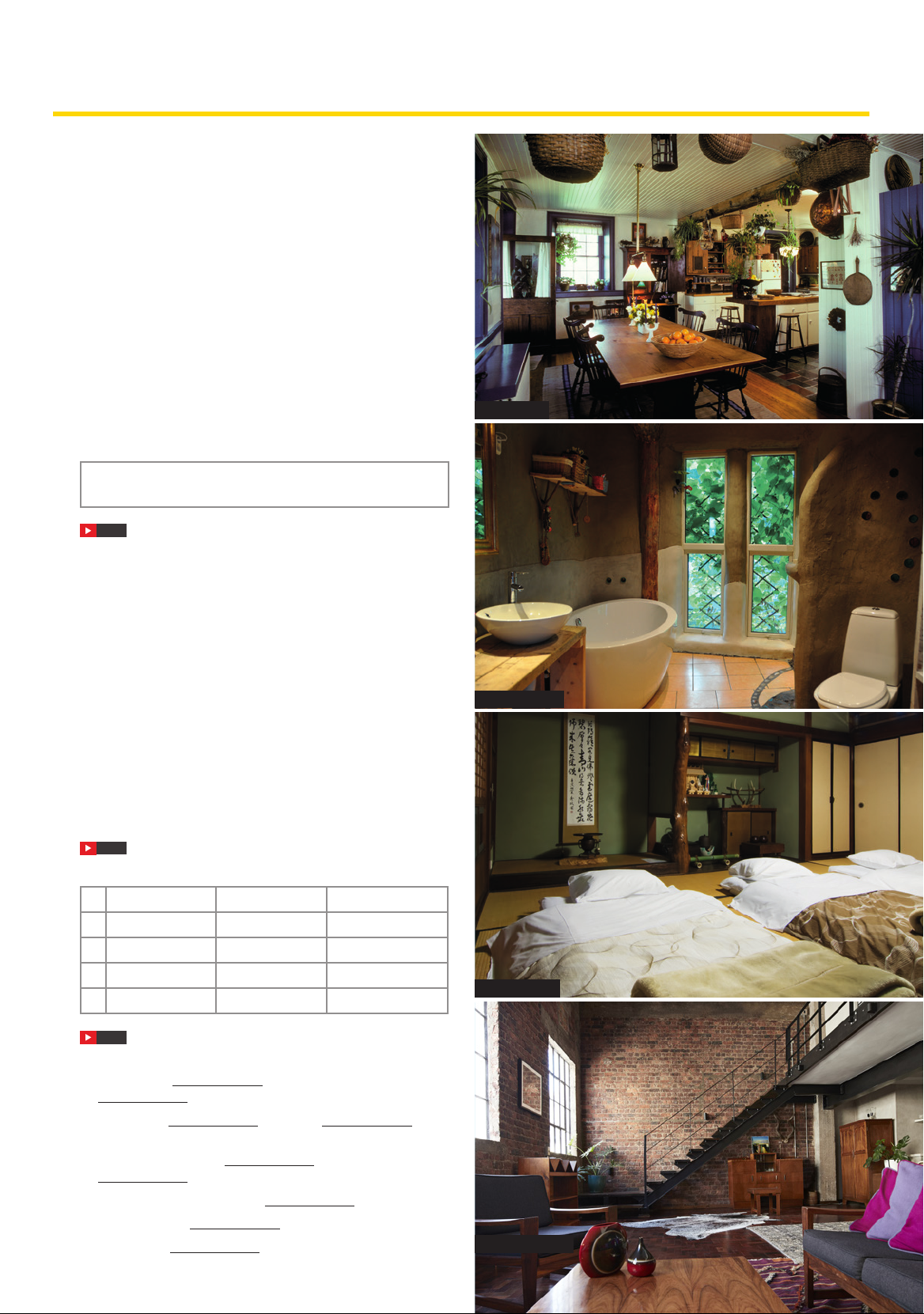
B: Yes. She’s just having a shower. VOCABULARY In the house a kitchen
2 Which of these things can you see in the photos? a bed a chair a fridge a shower a sofa a carpet a cupboard a shelf a sink a table 3
134 Listen and repeat the names of the rooms and furniture.
4 Work in pairs. Say one more thing in each room.
5 Work in pairs. Ask and answer what you think of
the rooms and furniture in the photos.
A: What do you think of the kitchen?
B: It’s nice / It’s OK. It’s a bit …
A: What do you think of the sofa? a bathroom
B: I like / don’t like the design. It looks …
6 Change partner. Discuss the questions.
• Which room in the photos do you like best? Why?
• Are any of the rooms in your home similar to these?
• What’s your favourite room in your home? Why? 7
135 Listen to four conversations. Complete the table. I can’t find… Which room? Where in room? 1 my glasses bathroom 2 carpet 3 keys a bedroom 4 8
135 Listen again. Complete the sentences with the prepositions. 1 I saw them the bathroom – the sink. 2 Maybe it’s the shelf the living room. I saw it there. 3 Oh, look. It’s there. the carpet the bed. 4 Oh, look. There they are. the sofa. 5 Maybe I left it the kitchen. 6 Yes, it was the table. a living room 72 30004_OUT_BEG_SB.indb 72 13/09/2018 09:41
9 Work in pairs. Answer the questions.
17 Work in pairs. Talk about the things you lost. Ask
and answer another question. Use one of these:
• Do you know the present form of the verbs in red from Exercise 8? • Did you find it?
• Where do you usually put these things when you’re • What did you do?
not using them? Use a dictionary if you need to. • Was it expensive? bag keys passport shoes coat money and cards phone GRAMMAR
18 Complete the information in the Grammar box.
DEVELOPING CONVERSATIONS Personal pronouns Maybe Subject pronoun Object pronoun
We use maybe when we’re not sure.
I left my bag on the bus. Can you help ?
Maybe it’s on the shelf in the living room. You’re late. Can I talk to .
Maybe I left it in my bedroom. It’s in the bathroom. When did you last have ?
10 Look at the questions. Change any words in red ’s nice. I really like him.
to make questions to ask your partner.
lives here. I didn’t see her there.
1 Where did you last use your phone? went to He took us there.
2 When did you last see your parents? the park.
3 How far is your work from here? They’re on the table. When did you last have
4 How long does it normally take to make your dinner? ? 5 Where’s Peter today?
6 How often do you go swimming?
19 Choose the correct words.
11 Work in pairs. Ask and answer the questions.
1 I can’t find my ticket. Maybe I left him / it in the
A: Where did you last use your phone? bathroom.
B: I can’t remember. Maybe on the bus.
2 A: Hi. I’m here to get my phone.
B: Can you see the young woman in the office? Talk LISTENING to him / her. She has it.
3 My name’s Juan Martínez. When you come to the 12
136 Listen to Ella and Lucian. Choose the shop, ask for her / me. correct word or phrase.
4 A: I can’t find my new trainers.
1 He’s looking for his keys / glasses / phone.
B: Well, where did you last have it / them?
2 Maybe he left something in a restaurant / in the kitchen / in a taxi.
5 I wasn’t here yesterday. David was. He’s there. You need to ask him / her.
3 He’s going to visit / email / phone.
6 Hello. How can I help you / them? 13
137 Listen to the first part of Lucian’s
For more practice, see Exercises 1 and 2 on page 130.
conversation with the restaurant. Put the
questions (a–e) in the order you hear them (1–5). a Can you wait one minute? SPEAKING
b And what time were you here?
20 Work in pairs. Student A: you work in a hotel. c How can I help you?
Student B: you left something there. Take turns.
d Where did you sit? Can you remember? Have conversations like this: e What colour are they? Student A Student B 14
137 Listen again. Write the answers to the Hello. Hotel [name]. How questions from Exercise 13. can I help you? [Explain what you left there. Say when. ] 15
138 Listen to the second part of the What colour …?
conversation. Answer the questions. [Answer] What time were you 1 Do they find them? Where? here? [Answer. Use I don’t 2 What’s the last problem? know.] Maybe … Where do you think …?
16 Write true sentences about things you lost. [Answer. Use I’m not Say if you find the
I lost my phone once. I left it on the table in a café. sure.] Maybe … thing(s) or not.
I lost my passport once. I don’t know how. Maybe I left it [Respond] in the hotel room.
Unit 8 Here and there 73 30004_OUT_BEG_SB.indb 73 13/09/2018 09:41 WORKING AT HOME SPEAKING
5 Complete the sentences with the words in red from the text.
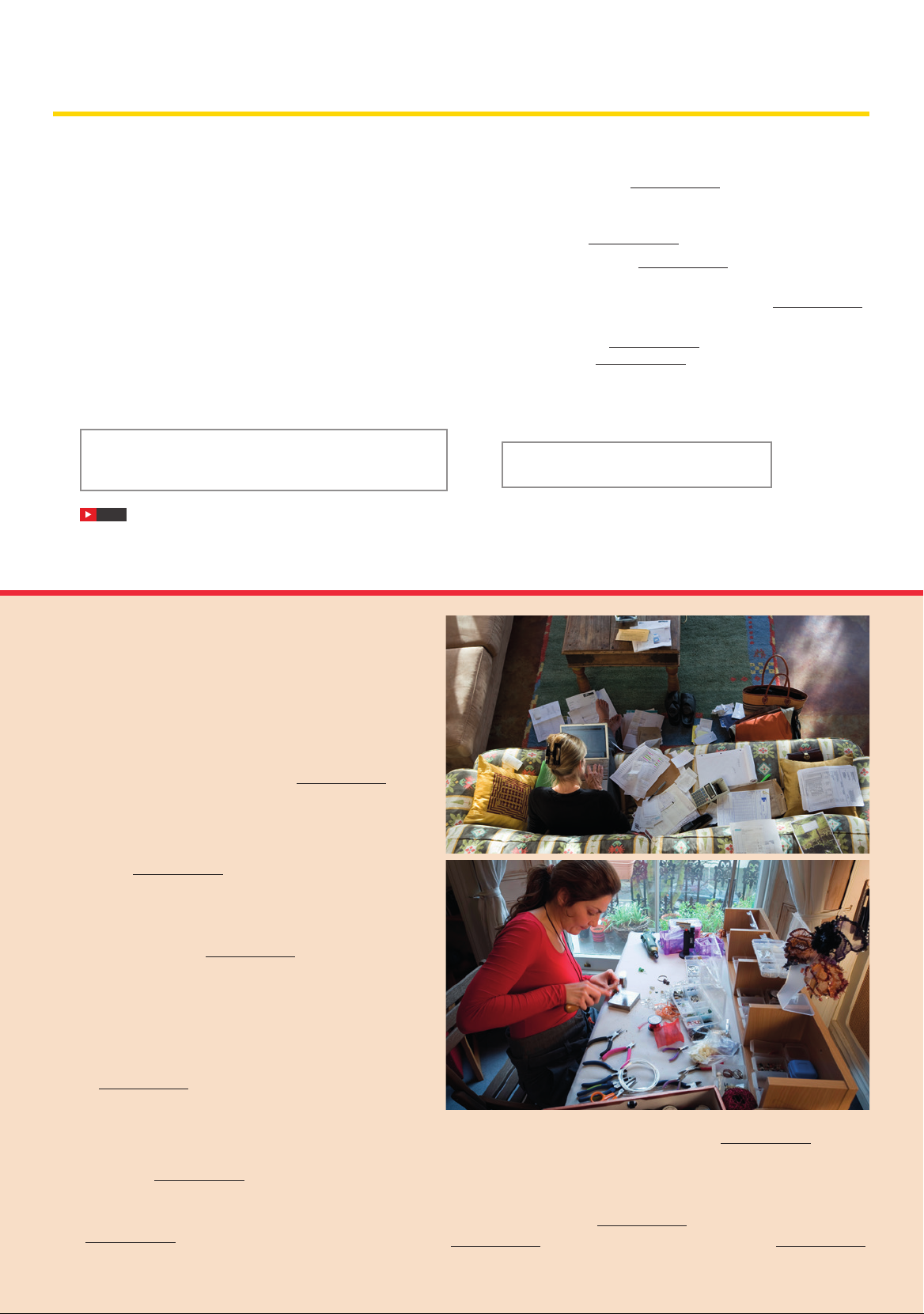
1 Work in pairs. Look at the photos of
homeworkers. Discuss the questions. 1 I want a new flat we have two children now and we need another room.
• Where are the people? Where are they from?
2 7% of people don’t have jobs at the moment and the • What are they doing? number is . • What are their jobs? 3 We have our own . It’s
She’s in the living room. I think she’s American or www.eltoutcomes.com. maybe she’s British.
4 I have a lot of clothes, but I don’t have
for them. I only have one cupboard in my bedroom. READING 5 There are 29 people in Saudi Arabia and almost the people are 25 years
2 Work in pairs. Read about homeworkers old or under.
together. Try to complete the text with these words and phrases.
6 Work in pairs. Don’t look at the text. What can
you remember about these numbers? 45% the bathroom the living room travel 10% good make clothes 39 million 13% 25% bad listening to music teachers 45% 13 million 36% 3
139 Listen and check your answers. 7 Read again and check.
4 Look at the words in red. Guess what they mean.
8 What things in the text do you think are similar Check in a dictionary. or different in your country? HOMEWORKERS
Work is changing. Lots of people travel to an office
or factory every day, but more people now work at
home – and the number of homeworkers is growing
fast. There are maybe 39 million in India and
4.2 million in the UK. In Argentina, 1 of
people work at home one day a week or more.
There are two kinds of homeworkers. Some people
make things. Most homeworkers in India and Cambodia 2 . Other people work for a
company, but sometimes work at home and use
the internet or phone. In Europe, there is a law that
anyone can work at home for half a day a week. And homeworking is 3 for companies.
Stanford University studied a Chinese company
called Ctrip. The homeworkers at Ctrip did 13% more work!
Other people, called freelancers, do work for lots of
different clients and companies. These people are often 4
, website designers, or project
managers. There are around 13 million freelancers in Mexico.
Some people think working at home is 7
Most people like working at home because they
because you don’t see anyone all day. Also, sometimes don’t need to 5 to work, because it’s
people don’t have space in their home – they need to work
good for family life, and because they can work
in a café. In the UK, only 26% of home workers have an office.
when and how they like. 25% of UK home workers 36% do their work in 8 , 13% work in the kitchen, like 6 when they work. 9
work in bed – and a few work in 10 ! 74 30004_OUT_BEG_SB.indb 74 13/09/2018 09:41
14 Work in groups. Discuss the questions.
VOCABULARY Verbs and people
• Do you know anyone who works at home? What do
9 Look at how we often make the word for a they do? Do they like it?
person or job. Complete the table.
• Would you like to work at home? Why? / Why not? Verb Person / Job clean cleaner WRITING dance dancer
15 Use the questions in Exercise 12 to write a short design designer
text about someone you know. Write a sentence for each question. drive driver manage play
PRONUNCIATION AND REVIEW teach 1 16
140 Listen to the sentences. They are fast. work
Complete the sentences with two words. write 1 I’m working this week. 2 She’s travelling today.
10 Complete 1–6 with the person and the correct
form of the verb from Exercise 9. 3 He’s in the kitchen . 1 My father is a teacher at a university. He 4 She’s talking . teaches Business and Law. 5 I can’t find . 2 My sister basketball in a professional 6 When did you last ? team. She is a very good . 7 They make a lot . 3 My mum is a . She for 8 He’s a very . different magazines. 4 My brother
very fast. I don’t like it.
17 Work in pairs. Say the sentences but change He is a bad . the two words. 5 My friend, Ashok, is a website
18 Work in pairs. In one minute say:
for me at the moment. He’s a professional web . • rooms 6 My brother is a in a car company. He’s • furniture a big project at the moment. • jobs
11 Work in pairs. Choose six words from the box.
Tell your partner about someone you know who
For more revision and pronunciation, see Exercises 1 and 2 on page 130.
is a good/bad driver, etc. Try to say why they are good or bad. cleaner driver reader teacher dancer [football] player runner worker Agata designer manager singer writer
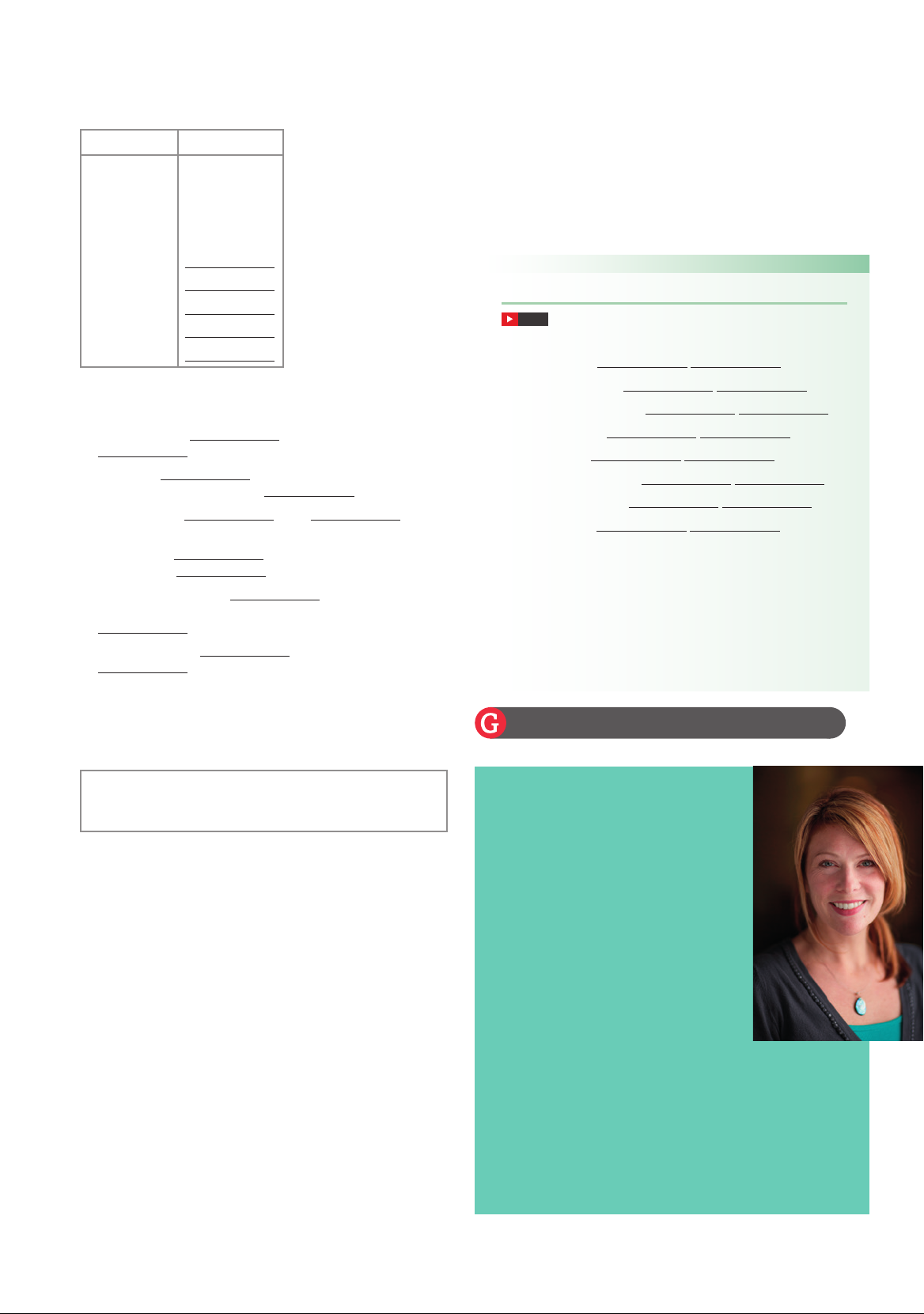
I’m from Krakow in Poland, but
ten years ago I moved to Berlin READING AND SPEAKING
in Germany. I draw pictures for
children’s books. I normally work
12 Work in pairs. Student A: read the text on this
in the kitchen at home, but my
page. Student B: read the text in File 2 on page
husband sometimes works there,
144. Answer these questions about the person in
too. He’s a designer. Our flat is your text. very small. When he works at 1 What’s his/her name?
home, I go to a café and work 2 Where does he/she live? there. It’s nice. 3 What does he/she do?
I really like my job. I don’t make
a lot of money, but I have a lot of 4 Where does he/she work?
free time – and I love children. 5 Does he/she like it?
Every Friday, I go to my son’s school and tell stories 6 Does he/she have an office?
to the children. It helps my work.
7 How’s his/her work at the moment?
At the moment, I’m writing my own book and
13 Work in pairs. Tell each other about your text.
drawing all the pictures. My husband and I are
Use your answers to Exercise 12.
going to make the book and sell it. Maybe we can
make some more money and move to a new flat!
Unit 8 Here and there 75 30004_OUT_BEG_SB.indb 75 13/09/2018 09:41 VIDEO 4 BIKE RIDING IN UTAH
1 Work in pairs. Look at the photo. Discuss the
5 Decide what the words in red mean. Then check questions: in a dictionary. • Do you like the photo?
6 Match the verbs (1–6) with the words and
• Do you think it is a good place for a holiday?
phrases (a–f) to make phrases from the video.
• Can you do what they’re doing in the photo? Why? / 1 go a ready for the journey Why not? 2 get b fast 2
4 Watch the video. Which sentence is true 3 get up c home for you? 4 talk about d with the sun
1 It looks fun. I want to do this one day. 5 ride down e early
2 It looks fun, but I can’t do this. 6 wake up f what we’re going to do
3 The place looks great, but I don’t like this kind of trip. 7
4 Watch the video again to check your
4 It’s not for me. I don’t like the place, the activity – or answers. the weather!
3 Work in pairs. Tell your partner what you think SPEAKING of the video. 8 Which do you prefer:
4 Work in pairs. Put these sentences from the video in the correct order.
• walking, cycling or driving? • going fast or slow? a We fly! • getting up early or late? b We have a coffee.
• the city or the countryside? c We’re going home.
• a hot place or a cold place? d But then suddenly – rain. • camping or a hotel?
e Pretty amazing place to wake up.
• talking about the past or the future?
f We take photos. It’s beautiful. g And the sun comes out again.
h The next day we wake up with the sun. i We
push our bikes up the mountain. Three hundred metres. 76 30004_OUT_BEG_SB.indb 76 13/09/2018 09:41 REVIEW 4 VOCABULARY
6 Match the verbs in the box with the correct groups of words (1–8). GRAMMAR go make study travel leave meet take wear
1 Choose the correct word(s).
1 I love watch / watching football. 1 a T-shirt / glasses
2 These jeans is / are very small. 2 a lot for work / a long way
3 The ticket machine don’t work / isn’t working at the 3
a friend for dinner / a client moment. 4
my bag on the bed / the dishes in the sink
4 I don’t like the yellow one. The white one look / looks 5
an exam / a friend to the airport better. 6 dancing / running
5 I don’t like this / these shoes. I prefer the brown one / ones. 7
for an exam / French at university
6 I can’t find my keys. Can you see they / them / it 8 a cake / a lot of money anywhere?
7 Put the words into three groups: in the house,
7 I’m not talking to you. I’m talking to he / him / his.
buying clothes or free-time activities.
8 He work / is working / working at home today. carpet extra large jumper shelf
9 Do you read / You are reading / Are you reading concert fridge kitchen story anything good at the moment? cupboard half price programme writer
10 What he’s studying / he is studying / is he studying at design jeans series university?
2 Complete the sentences with one word in each
8 Complete the missing words. You have the first space. two letters. 1 I lo
my bag last night. Maybe I left it on 1 My boss working at home today. the bus. 2
she coming to the meeting today? 2 You can sleep on the so in the living room 3 Can I try on jeans, please? tonight.
4 I have a car, but I don’t like . There’s a lot 3 My brother is a website de . He makes a lot of traffic. of money. 5 These shoes nice. They feel very 4 I like reading about po . I’m reading a book comfortable.
about the government at the moment. 6 He went home. He’s feeling well. 5 My favourite football te is Juventus. 7 She’s nice. I really like . 6 My favourite basketball pl is LeBron James 8 I
reading a great book at the moment. from the Los Angeles Lakers.
7 I’m going to take an exam next week. I need to study
3 Correct the mistake in each sentence. ha 1 Do it raining outside? 8 Look in the fr . The milk is in there.
2 My husband don’t like doing exercise.
9 It doesn’t feel very comfortable. Can I try the
3 I love your shoes. Where did you buy they? ex large one? 4 What you are watching? 10 Can I tr on this jacket?
5 She’s meet a client in Athens today.
9 Complete the text with these words.
6 I need some glasses. Can I try this ones, please? concerts draw music read 7 This chicken very nice. cook free programmes sing
8 He’s very nice. I really like he. 4 In my 1 time, I listen to a lot of 2 , I go
141 Listen and complete the sentences. to a lot of 3 and I 4 in a band. We’re
1 I don’t like the red tops. I prefer blue
called Chill. I like watching TV too. I love 5 .
about travel and different countries. I 6 a 2 your father in Peru?
lot – magazines, short stories and books. I 7 3 I a great series at
pictures of my friends and places I visit. Oh, and I . 8
a lot. I make very good cakes! 4 My friends to the gym, but I . 5 When you last .? Maybe you at home. 5
141 Work in pairs. Compare your answers. Listen again to check. Review 4 77 30004_OUT_BEG_SB.indb 77 13/09/2018 09:41