Overview and Insights môn Principles of Management | Trường Đại học Quốc tế, Đại học Quốc gia Thành phố Hồ Chí Minh
Discrimination: when minority members are unfairly treated and denied the full benefits of organizational membership. Tài liệu giúp bạn tham khảo, ôn tập và đạt kết quả cao. Mời đọc đón xem!
Môn: Principles of Management 314 tài liệu
Trường: Trường Đại học Quốc tế, Đại học Quốc gia Thành phố Hồ Chí Minh 2 K tài liệu
Tác giả:
















Preview text:
PRICIPLES OF MANAGEMENT – MID S1 2425
CHAPTER 1: INTRODUCING MANAGEMENT • Talent
– People and their talents are the ultimate foundations of organizational performance
– Intellectual capital is the collective brainpower or shared knowledge of a workforce that can be used to create value
– A knowledge worker’s mind is a critical asset to employers and adds to the intellectual capital of an organization • Technology
– Tech IQ is a person’s ability to use technology to stay informed:
• Checking inventory, making a sales transaction, ordering supplies • Telecommuting • Virtual teams
• Effective use of online resources – Databases – Job searches – Recruiting – Social Media • Globalization
– The worldwide interdependence of resource flows, product markets, and business competition that characterize our economy
– Job migration occurs when firms shift jobs from one country to another • Ethics
– Code of moral principles that set standards of conduct of what is “good” and “right” in one’s behavior
Ethical expectations for modern businesses:
– Integrity and ethical leadership at all levels
– Social responsibility – Sustainability • Diversity
– Workforce diversity reflects differences with respect to gender, age, race, ethnicity, religion, sexual
orientation, and able-bodiedness
– A diverse and multicultural workforce both challenges and offers opportunities to employers
How diversity bias can occur in the workplace:
– Prejudice: the holding of negative, irrational opinions and atÝtudes regarding members of diverse populations.
– Discrimination: when minority members are unfairly treated and denied the full benefits of organizational membership.
– Glass ceiling effect: an invisible barrier or “ceiling” that prevents women and minorities from rising above
a certain level of organizational responsibility. • Careers
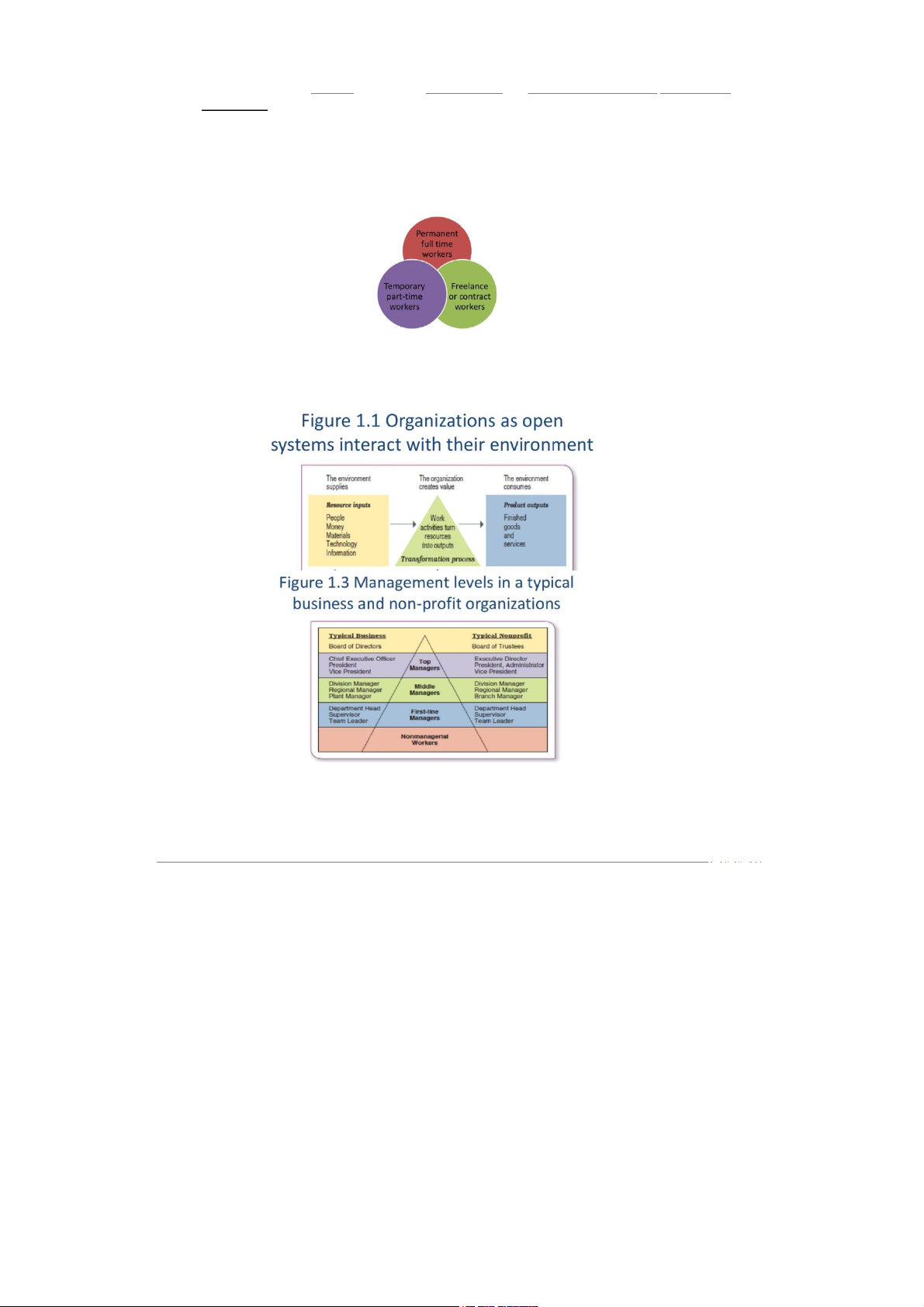
– Organizations consist of three types of workers, sometimes referred to as a shamrock organization: • Organization
– A collection of people working together to achieve a common purpose
– Organizations provide useful goods and/or services that return value to society and satisfy customer needs
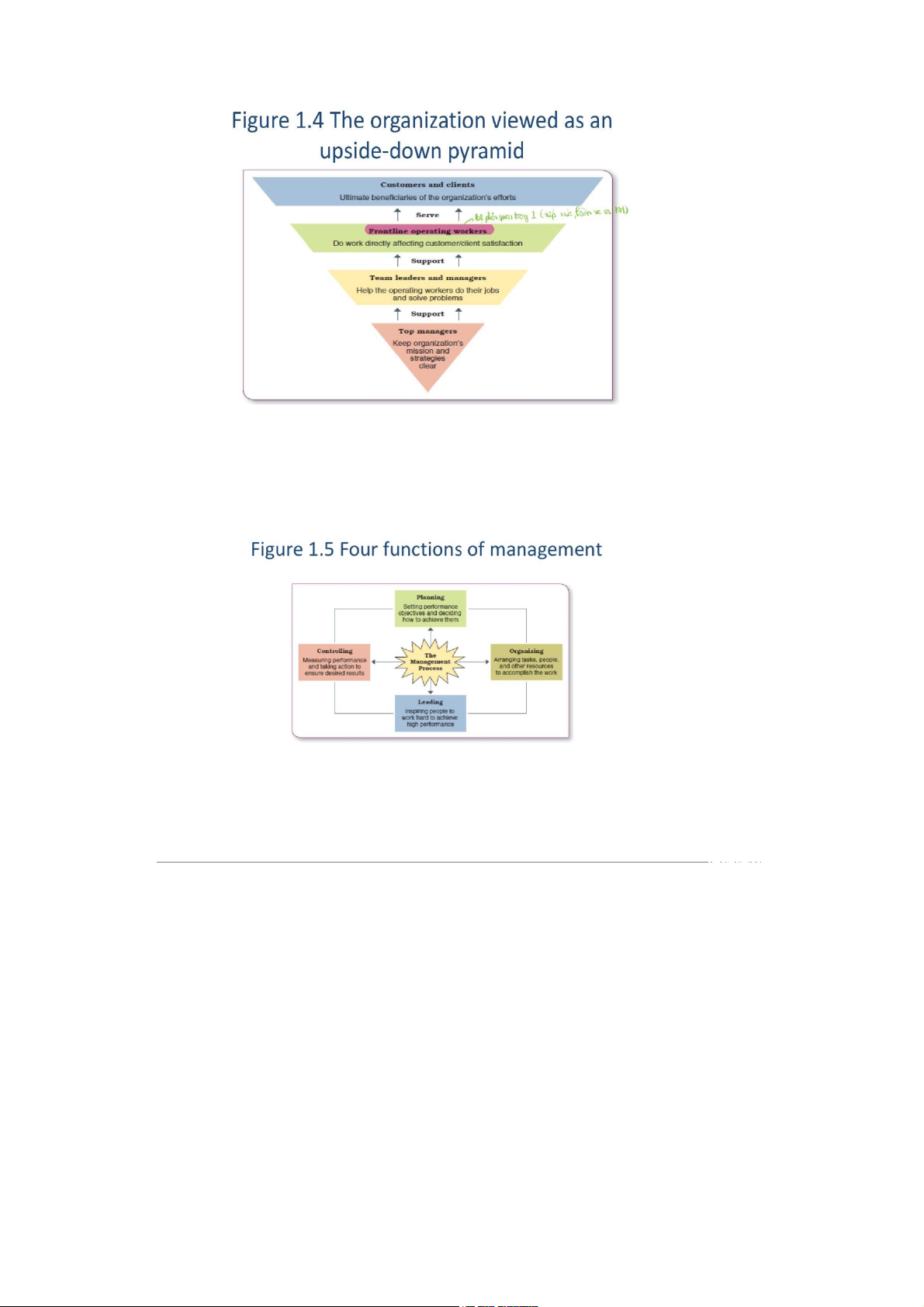
The organization as an upside-down pyramid
– Each individual is a value-added worker
– A manager’s job is to support workers’ efforts
– The best managers are known for helping and supporting
– Customers at the top served by workers who are supported by managers
• Managers achieve high performance for their organizations by best utilizing its human and material resources
• Management is the process of planning, organizing, leading, and controlling the use of resources to accomplish performance goals
• All managers are responsible for the four functions
• The functions are carried on continually
TAKEAWAY QUESTION 1 What are the challenges of working in the new economy?
• Work in the new economy is increasingly knowledge based, and intellectual capital is the foundation of organizational performance.
• Organizations must value the talents of a workforce whose members are increasingly diverse with respect
to gender, age, race and ethnicity, able-bodiedness, and lifestyles.
• The forces of globalization are bringing increased interdependencies among nations and economies, as
customer markets and resource flows create intense business competition.
• Ever-present developments in information technology are reshaping organizations, changing the nature of
work, and increasing the value of knowledge workers.
• Society has high expectations for organizations and their members to perform with commitment to high
ethical standards and in socially responsible ways.
• Careers in the new economy require great personal initiative to build and maintain skill “portfolios” that
are always up-to-date and valuable in a free agent economy.
For Discussion How is globalization creating career risks and opportunities for today’s college graduates?
TAKEAWAY QUESTION 2 What are organizations like in the new workplace?
• Organizations are collections of people working together to achieve a common purpose.
• As open systems, organizations interact with their environments in the process of transforming resource
inputs into product and service outputs.
• Productivity is a measure of the quantity and quality of work performance, with resource costs taken into account.
• High-performing organizations achieve both perfor- mance effectiveness in terms of goal accomplishment,
and performance efÏciency in terms of resource utilization.
For Discussion Is it ever acceptable to sacrifice performance efÏciency for performance effectiveness?
TAKEAWAY QUESTION 3 Who are the managers and what do they do?
• Managers directly support and facilitate the work ef- forts of other people in organizations.
• Top managers scan the environment, create strategies, and emphasize long-term goals; middle managers
coordinate activities in large departments or divisions; team leaders and supervisors support performance
of front-line workers at the team or work-unit level.
• Functional managers work in specific areas such as finance or marketing; general managers are respon-
sible for larger multifunctional units; administrators are managers in public or nonprofit organizations.
• The upside-down pyramid view of organizations shows operating workers at the top, serving customer
needs while being supported from below by various levels of management.
• The changing nature of managerial work emphasizes being good at “coaching” and “supporting” others,
rather than simply “directing” and “order-giving.”
For Discussion In what ways could we expect the work of a top manager to differ from that of a team leader?
TAKEAWAY QUESTION 4 What is the management process?
• The management process consists of the four functions of planning, organizing, leading, and controlling.
• Planning sets the direction; organizing assembles the human and material resources; leading provides the
enthusiasm and direction; controlling ensures results.
• Managers implement the four functions in daily work that is often intense and stressful, involving long hours
and continuous performance pressures.
• Managerial success requires the ability to perform well in interpersonal, informational, and decisionmaking roles.
• Managerial success also requires the ability to build interpersonal networks and use them to accomplish well-selected task agendas.
For Discussion How might the upside-down pyramid view of organizations affect a manager’s approach to
planning, organizing, leading, and controlling?
TAKEAWAY QUESTION 5 How do you learn essential managerial skills and competencies?
• Careers in the new economy demand continual atten- tion to lifelong learning from all aspects of daily
experi- ence and job opportunities.
• Skills considered essential for managers are broadly de- scribed as technical—ability to use expertise;
human— ability to work well with other people; and conceptual— ability to analyze and solve complex problems.
• Human skills are equally important for all management levels, whereas conceptual skills gain importance
at higher levels and technical skills gain importance at lower levels.
For Discussion Among the various managerial skills and competencies, which do you consider the most
difÏcult to develop, and why?
16. Discuss the importance of ethics in the relationship between managers and those they supervise.
• Ethics in management builds trust, respect, and transparency between supervisors and employees. Ethical
behavior promotes a healthy workplace, promotes accountability, and helps prevent conflict. By adhering to
ethical principles, managers set a positive example, encouraging fair treatment, honesty, and open
communication within the team.
17. Explain how “accountability” works in the relationship between (a) a team leader and her team members
and (b) the same team leader and her boss.
• (a) Accountability between a team leader and team members means that the leader ensures that each
member understands his or her responsibilities and holds them accountable for their tasks. This promotes
trust and a strong work ethic.
• (b) Accountability between a team leader and her boss involves the leader being accountable for the team’s
performance and reporting progress or problems in a transparent manner. This ensures alignment with
organizational goals and builds trust with senior management.
18. Explain how the “glass ceiling effect” can be detrimental to recent African American college graduates in a large corporation.
• The glass ceiling effect refers to an invisible barrier that limits the advancement of minorities in
organizations. For recent African American college graduates, this can mean fewer opportunities for
advancement, limited access to leadership roles, and bias in evaluations. This limits their career growth and
can lead to job dissatisfaction and lower employee retention.
19. What is globalization and what does it mean for jobs in the new economy?
• Globalization is the integration of economies, cultures, and societies around the world, driven by
international trade, technology, and communications. For the new economy, this means a more competitive,
more interconnected job market where workers need to be culturally aware, adaptable, and able to
collaborate with global teams. Foreign language skills, technological literacy, and cultural sensitivity are
becoming more important in a globalized workforce. 20.
• Scenario: As the new head of an audit team at a national accounting firm, you face challenges due to the
team's diverse backgrounds and experience levels, high workloads, and pressure to perform. • Answer Guide:
• Management Skills: Emphasizes the need for communication, conflict resolution, and leadership skills to
handle the team's diversity and differences in experience.
• Competencies: Discuss the importance of time management, decision making, and adaptability to manage
a large workload and meet performance expectations.
• Team Building: Emphasize fostering an inclusive environment, encouraging collaboration, and supporting
team members to reach their full potential.
• Outcomes: Conclude by outlining how these skills and competencies can help you lead a high-performing
team, enhancing both individual and team success.
CHAPTER 2: MANAGEMENT LEARNING PAST TO PRESENT
Takeaway 1: Classical Management Approaches
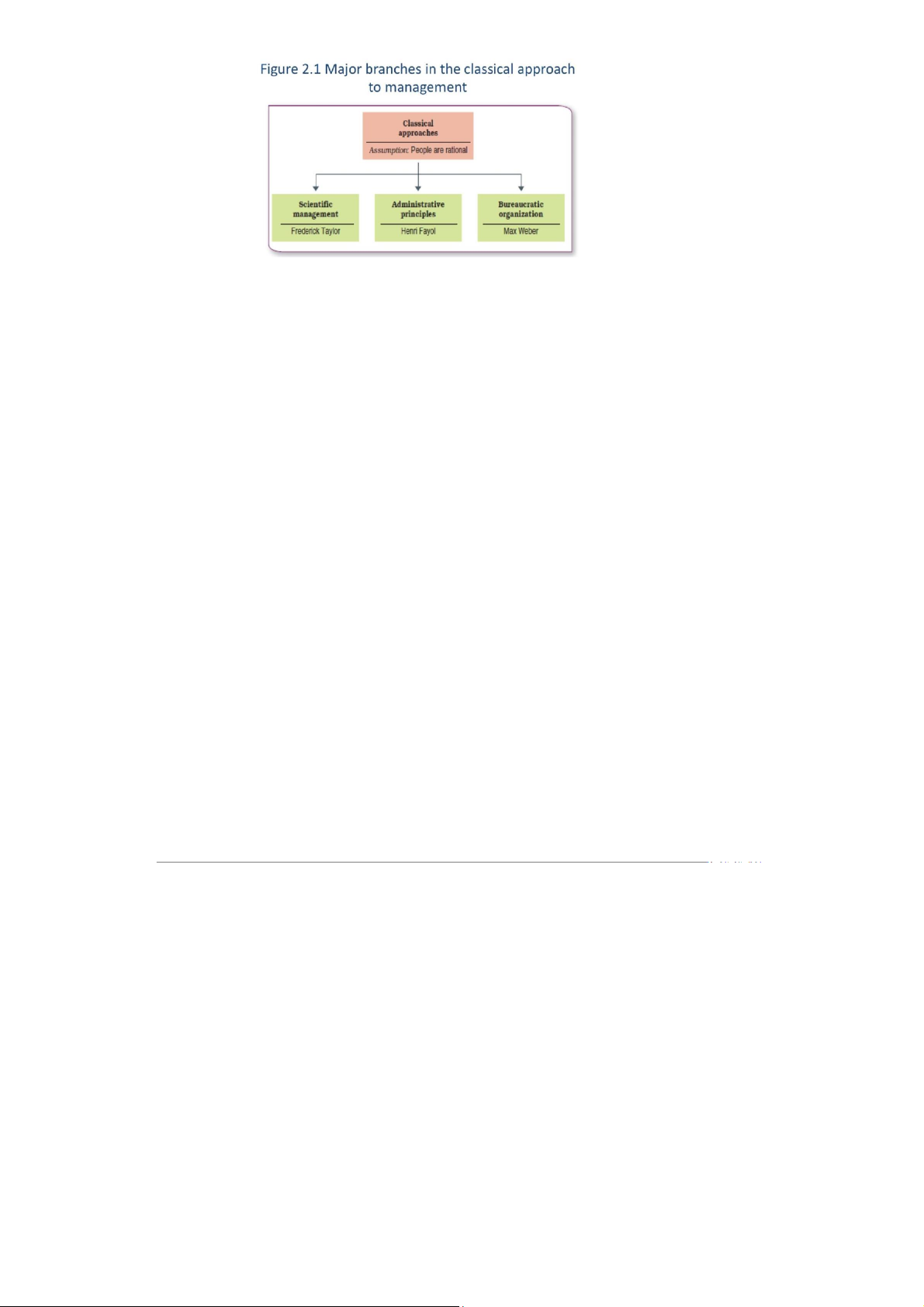
- Scientific management emphasizes careful selection, training of workers, and supervisory support.
• Four guiding principles of scientific management (Frederick Taylor)
1. Develop for every job a “science” that includes rules of motion, standardized work implements, and proper working conditions.
2. Carefully select workers with the right abilities for the job.
3. Carefully train workers to do the job and give them the proper incentives to cooperate with the job “science.”
4. Support workers by carefully planning their work and by smoothing the way as they go about their jobs.
Administrative principles (Henri Fayol) 5 “rules” of management:
(1) Foresight - to complete a plan of action for the future.
(2) Organization - to provide & mobilize resources to implement the plan
(3) Command - to lead, select, & evaluate workers to get the best work toward the plan.
(4) Coordinate - to fit diverse efforts together & to ensure information is shared & problems solved.
(5) Control - to make sure things happen according to plan & to plan necessary corrective action.
• Practical lessons from scientific management
– Make results-based compensation a performance incentive
– Carefully design jobs with efÏcient work methods
– Carefully select workers with the abilities to do these jobs
– Train workers to perform jobs to the best of their abilities
– Train supervisors to support workers so they can perform jobs to the best of their abilities
• Bureaucratic organization (Max Weber) – Bureaucracy
An ideal, intentionally rational, and very efÏcient form of organization
Based on principles of logic, order, and legitimate authority
• Characteristics of bureaucratic organizations:
– Clear division of labor - Jobs are well defined, & workers become highly skilled at performing them.
– Clear hierarchy of authority - Authority & responsibility are well defined for each position, & each position
reports to a higher-level one.
– Formal rules and procedures - Written guidelines direct behavior & decisions in jobs, & written files are kept for historical record.
– Impersonality - Rules & procedures are impartially & uniformly applied, with no one receiving preferential treatment.
– Careers based on merit - Workers are selected & promoted on ability, competency, & performance, &
managers are career employees of the organization.
• Possible disadvantages of bureaucracy:
– Excessive paperwork or “red tape”
– Slowness in handling problems
– Rigidity in the face of shifting needs – Resistance to change – Employee apathy
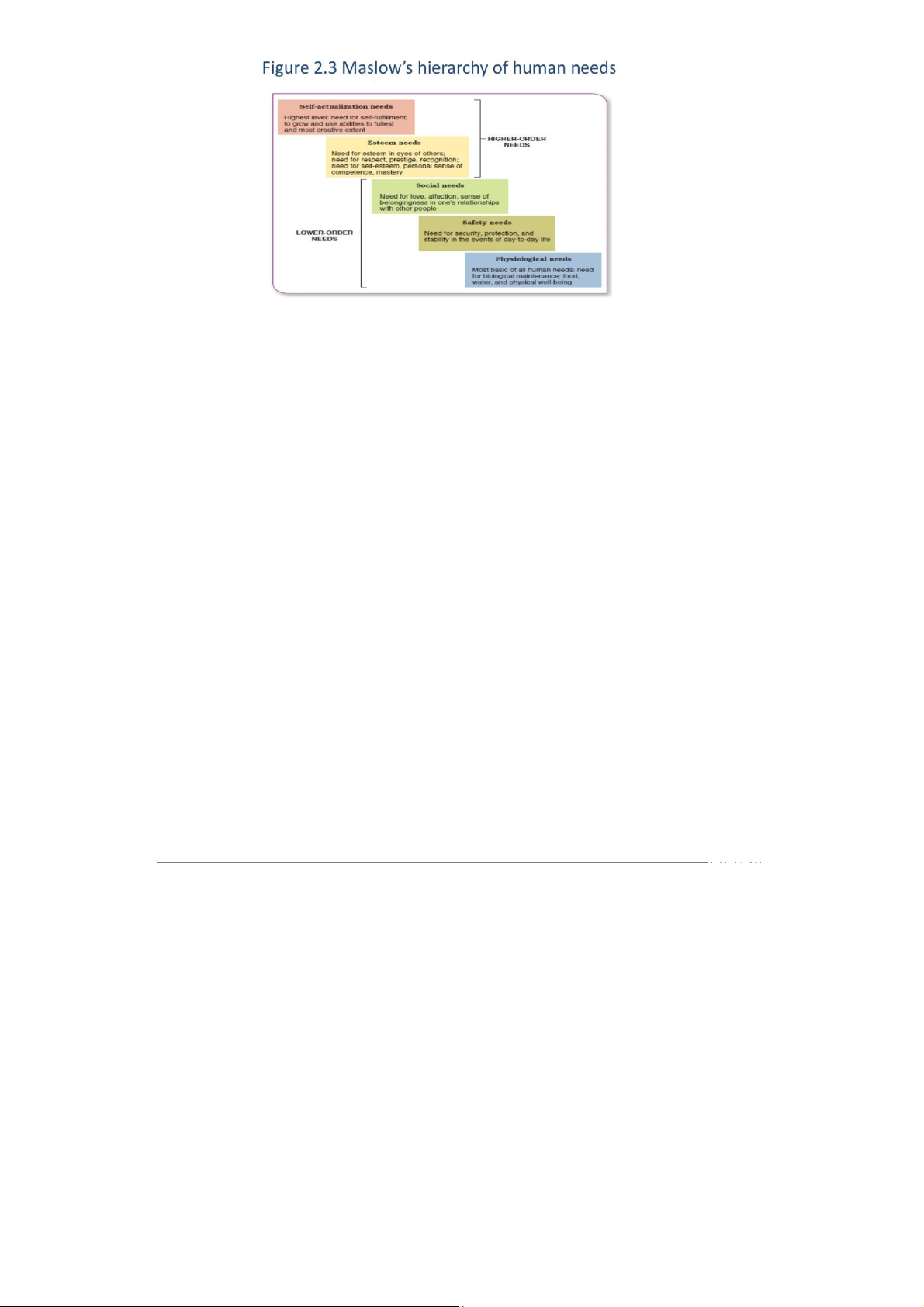
• Maslow’s theory of human needs
– A need is a physiological or psychological deficiency a person feels compelled to satisfy – Need levels: • Physiological • Safety • Social • Esteem • Self-actualization
• Maslow’s theory of human needs – Deficit principle
• A satisfied need is not a motivator of behavior – Progression principle
• A need becomes a motivator once the preceding lower-level need is satisfied – Both principles
cease to operate at self-actualization level
• McGregor’s Theory X assumes that workers: – Dislike work – Lack ambition – Are irresponsible – Resist change – Prefer to be led
Organizations as communities - Mary Parker Follett Hawthorn studies - Elton Mayo
Theory of human needs - Abraham Maslow
Theory X and Theory Y - Douglas McGregor
Personality and Organization - Chris Argyris
TAKEAWAYQUESTION1 What can be learned from classical management thinking?
• Frederick Taylor’s four principles of scientific management focused on the need to carefully select, train,
and support workers for individual task performance.
• Henri Fayol suggested that managers should learn what are now known as the management functions of
planning, organizing, leading, and controlling.
• Max Weber described bureaucracy with its clear hierarchy, formal rules, and well-defined jobs as an ideal form of organization.
For Discussion Should Weber’s notion of the ideal bureaucracy be scrapped altogether, or is it still relevant today?
Weber’s ideal bureaucracy, with its emphasis on clear roles, hierarchical authority, formal rules, and merit-
based promotion, is still relevant in many areas, especially in large, complex, and regulated organizations. It
ensures efÏciency, fairness, and consistency, especially in areas such as government, health care, and finance.
However, Weber’s model also has limitations. Its rigidity can hinder innovation and the ability to respond to
rapidly changing environments. Modern organizations, especially in the technology or startup sectors, often
prioritize flexibility, decentralized decision-making, and employee autonomy, which can conflict with the rigid
structure of traditional bureaucracies.
Rather than discarding Weber’s model, it should be adapted. A hybrid approach, combining elements of
bureaucracy with more agile, flexible, and decentralized operations, will be effective in today’s fast-paced,
dynamic business environment. Automation, digital tools, and more flexible structures can help organizations
maintain efÏciency while fostering creativity and innovation.
In short, Weberian bureaucracy is not obsolete, but its implementation needs to be modernized to balance
structure and flexibility.
TAKEAWAYQUESTION2 What insights come from the behavioral management approaches?
• The behavioral approaches shifted management attention toward the human factor as a key element in organizational performance.
• Mary Parker Follett describes organizations as communities within which people combine talents to work for a greater good.
• The Hawthorne studies suggested that work behavior is influenced by social and psychological forces and
that work performance may be improved by better “human relations.”
• Abraham Maslow’s hierarchy of human needs introduced the concept of self-actualization and the potential
for people to experience self-fulfillment in their work.
• Douglas McGregor urged managers to shift away from Theory X and toward Theory Y thinking, which views
people as independent, responsible, and capable of self-direction in their work.
• Chris Argyris pointed out that people in the workplace.
are adults and may react negatively when constrained by strict management practices and rigid organizational structures.
For Discussion How can a manager still benefit by using insights from Maslow’s hierarchy of needs theory?
Maslow’s Hierarchy of Needs is a psychological theory that suggests that individuals are motivated by a
series of hierarchical needs, ranging from basic physiological needs to self-actualization. Although
developed in the mid-20th century, its insights are still relevant to managers today, helping them
understand employee motivation, improve engagement, and create a more productive workplace. Here’s
how managers can still benefit from applying Maslow’s theory:
1. Understanding Employee Motivation
Maslow’s hierarchy suggests that people are motivated by unmet needs. Managers can use this framework
to identify where employees are in their personal and professional development and address their specific needs:
• Basic Needs: Ensure employees’ salary, job security, and working conditions meet their basic needs.
• Safety Needs: Provide a stable work environment, clear policies, and a supportive atmosphere that
reduces stress and anxiety.
• Social Needs: Foster team collaboration, create opportunities for social interaction, and encourage
a sense of belonging within the workplace.
• Esteem Needs: Offer recognition, responsibility, and opportunities for career advancement to
enhance employees’ self-esteem.
• Self-Actualization: Support employees in reaching their full potential by offering growth
opportunities, learning experiences, and challenging work.
2. Tailoring Leadership and Motivation Strategies
By understanding where employees fall within Maslow’s hierarchy, managers can tailor their leadership style:
• For employees focused on lower-level needs (e.g., security or social belonging), emphasize job
stability, work-life balance, and team support.
• For employees aiming for higher-level needs (e.g., esteem or self-actualization), provide leadership
opportunities, creative challenges, and personal development programs.
3. Enhancing Employee Engagement and Retention
When managers address employees’ needs systematically, they create a work environment where
individuals feel valued at every level. This holistic approach can:
• Improve job satisfaction, as employees feel their needs are understood and met.
• Increase employee loyalty and retention, as meeting their needs leads to a more engaged workforce.
• Foster long-term productivity, as employees motivated by higher-level needs tend to perform better and stay committed.
4. Creating a Supportive Organizational Culture
Maslow’s theory can also help in shaping an organizational culture:
• Encourage a culture of respect where everyone feels safe and included.
• Support open communication, which helps in addressing social and esteem needs.
• Develop mentorship programs or opportunities for career progression, helping employees fulfill
their self-actualization needs.
5. Adapting to Different Employee Profiles
Not every employee will be motivated by the same things at the same time. Maslow’s hierarchy helps
managers understand that:
• Some employees may prioritize basic needs (e.g., new hires or those in financially unstable situations). • Others self-actualiz may be more focused on
ation (e.g., senior employees or those seeking professional growth).
By recognizing these differences, managers can better cater to individual aspirations, creating personalized
development plans and maintaining a balance between meeting basic needs and promoting higher-level goals.
6. Guiding Organizational Change
During periods of organizational change or uncertainty, Maslow’s theory can help managers prioritize employee needs:
• When introducing new policies, products, or structures, ensure basic needs (job security, fair
compensation) are not overlooked.
• For employees facing stress, emphasize security and clear communication.
• During transitions, offer opportunities for employees to grow, which can address higher-level needs
and help them cope with change. Conclusion
Maslow’s hierarchy of needs theory remains a valuable tool for managers to understand and address the
different motivations of their employees. By recognizing where employees are in the hierarchy, managers can:
• Tailor their leadership strategies to meet employees’ needs.
• Boost engagement, job satisfaction, and productivity.
• Create an environment conducive to personal growth and organizational success.
Ultimately, using Maslow’s insights can lead to a more motivated, loyal, and productive workforce. OR
Maslow’s Hierarchy of Needs remains a valuable framework for managers to understand and motivate
employees. Here’s how it can be applied:
1. Understanding Motivation
Managers can identify where employees are on the hierarchy and address their specific needs:
• Basic Needs: Ensure fair compensation and job security.
• Safety Needs: Provide a stable and supportive work environment.
• Social Needs: Foster team collaboration and a sense of belonging.
• Esteem Needs: Offer recognition, responsibility, and opportunities for advancement.
• Self-Actualization: Encourage personal growth and challenging work.
2. Tailored Leadership
Managers can adjust their leadership styles based on employees’ needs:
• For lower-level needs, focus on stability and team support.
• For higher-level needs, offer career development and autonomy.
3. Employee Engagement & Retention
Meeting employees’ needs boosts job satisfaction, engagement, and loyalty, leading to higher retention and productivity.
4. Supportive Organizational Culture
Create a culture that promotes respect, communication, and growth opportunities, addressing employees'
social, esteem, and self-actualization needs.
5. Adapting to Individual Profiles
Recognize that different employees prioritize different needs at different times, and tailor motivation
strategies accordingly.
6. Managing Organizational Change
During change, prioritize job security and clear communication to address lower-level needs, while offering
growth opportunities to help employees cope with transitions.
TAKEAWAYQUESTION3 What are the foundations of modern management thinking?
• Analytics that use advanced quantitative analysis techniques in decision sciences and operations
management can help managers solve complex problems.
• Organizations are open systems that interact with their external environments, while consisting of many
internal subsystems that must work together in a coordinated way to support the organization’s overall success.
• Contingency thinking avoids “one best way” arguments, instead recognizing the need to understand
situational differences and respond appropriately to them.
• Quality management focuses on making a total commitment to product and service quality throughout an
organization, maintaining continuous improvement and meeting worldwide quality standards such as ISO certification.
• Knowledge management is a process for developing, organizing, sharing, and using knowledge to facilitate
organizational performance and create an environment for ongoing organizational learning.
• Evidence-based management uses findings from rigor- ous scientific research to identify management prac- tices for high performance.
For Discussion Can system and subsystem dynamics help describe and explain performance problems for an
organization in your community?
Yes, system and subsystem dynamics can be very useful in describing and explaining performance problems
within an organization, including those in your community. These approaches focus on understanding the
interrelationships and feedback loops that shape the behavior and performance of an organization over
time. Here's how system dynamics can help:
1. Identifying Systemic Issues
System dynamics looks at organizations as complex systems made up of multiple interconnected parts
(subsystems). For example, if an organization is facing performance issues like low productivity, high
turnover, or poor customer satisfaction, system dynamics can help identify whether these problems are caused by:
• Structural issues (e.g., inefÏcient processes, lack of coordination).
• Behavioral issues (e.g., employee frustration, ineffective leadership).
• External factors (e.g., market changes, regulatory pressures).
By viewing the organization holistically, system dynamics can uncover how issues in one area (e.g., poor
communication between departments) can create ripple effects that lead to broader performance problems.
2. Mapping Feedback Loops
System dynamics focuses on feedback loops that can either reinforce or balance behaviors within an
organization. For example:
• A reinforcing loop might occur when poor communication leads to mistakes, which increase
workloads, further decreasing communication and exacerbating the problem.
• A balancing loop could be when the introduction of new management techniques or training reduces
inefÏciency over time, stabilizing performance.
By analyzing these feedback loops, managers can see how small problems grow into larger issues or how
interventions can gradually improve performance.
3. Understanding Delays
System dynamics also emphasizes delays—the time between actions and their effects. For example, a
company might invest in employee training, but the improvement in performance may not be visible until
months later. This delay can sometimes make it difÏcult to connect actions to outcomes and may lead to
misinterpretations of strategies or efforts that seem ineffective in the short term.
4. Explaining Subsystem Interactions
In an organization, different subsystems (e.g., HR, operations, marketing) often have a significant influence
on one another. If the HR subsystem is not effectively recruiting or training employees, this will affect the
operations subsystem by reducing performance or increasing turnover, which in turn affects customer
satisfaction in the marketing subsystem. System dynamics helps map out how these subsystems interact and
how problems in one area can cascade through the whole organization.
5. Testing Solutions and Scenarios
System dynamics allows managers to simulate different interventions and strategies to predict their impact
on the organization’s performance. For example, a simulation could show how changing the workload
distribution, implementing a new feedback system, or adjusting incentives will affect employee morale,
productivity, and overall performance.
Example in a Community Organization:
In a local healthcare clinic, system dynamics might help explain performance problems like long patient wait
times. A feedback loop could show that:
• Increased wait times lead to decreased patient satisfaction.
• This dissatisfaction causes patients to leave the clinic, leading to fewer patients and reduced revenue.
• Reduced resources (e.g., fewer staff or outdated technology) exacerbate the issue, leading to even longer wait times.
By analyzing these dynamics, managers can see that simply hiring more staff (a potential quick fix) may not
be enough without addressing deeper issues like resource allocation, patient flow management, and staff training. Conclusion:
System and subsystem dynamics are powerful tools for analyzing complex organizational issues in any
community. They can help identify root causes, explain performance problems, and suggest long-term
solutions by considering the full scope of interrelated factors, feedback loops, and delays within the system.
In turn, this leads to more effective problem-solving and decision-making in organizations. OR
Yes, system and subsystem dynamics can effectively describe and explain performance problems in an
organization, even within your community. Here's how:
1. Identifying Systemic Issues
System dynamics views an organization as a whole, helping identify how problems in one area (e.g., poor
communication) can affect other areas (e.g., low productivity, high turnover).
2. Feedback Loops
It shows how feedback loops—both reinforcing (e.g., mistakes leading to more mistakes) and balancing (e.g.,
training improving performance over time)—affect performance. Understanding these loops helps pinpoint
the root causes of issues. 3. Delays
System dynamics highlights the delays in how actions lead to results, such as how employee training may
take months to show improvement, helping avoid misinterpretation of short-term results.
4. Subsystem Interactions
It explains how different subsystems (HR, operations, marketing) influence each other. For example, poor
recruitment can affect operations and, in turn, customer satisfaction.
5. Scenario Testing
System dynamics allows managers to simulate different interventions, showing how changes (e.g., adjusting
workloads, adding incentives) can improve performance over time. Example:
In a local healthcare clinic, long wait times could be a result of poor resource management or inefÏcient
patient flow, affecting patient satisfaction and revenue. System dynamics helps identify these issues and test solutions. Conclusion:
By mapping interconnected factors, feedback loops, and delays, system dynamics helps explain performance
problems and supports better decision-making, leading to more effective solutions. 16. Answer:
McGregor's Theory Y assumes that employees are inherently motivated, responsible, and capable of self-
direction. When managers apply the assumptions of Theory Y, they create a workplace culture that
empowers and trusts employees, making them feel valued and motivated. This can lead to a self-fulfilling
prophecy in which employees become more engaged and productive because they are given more
autonomy and opportunities to participate. This is consistent with modern management's emphasis on
participation and engagement, promoting a positive work environment. 17. Answer:
In Maslow's hierarchy of needs, the deficit principle states that people are motivated by unmet needs. Once
a need is satisfied, it no longer motivates behavior and individuals then seek to satisfy higher-level needs
(the principle of progression). Starting from basic physiological needs, people progress to higher-level needs
such as safety, social belonging, self-esteem, and finally self-actualization. Progression moves from lower to
higher needs as each previous level is met. 18. Answer:
Contingency thinking in management suggests that there is no one-size-fits-all solution; instead, the best
approach depends on the specific situation. Managers must consider a variety of external and internal
factors and adjust their strategies accordingly. For example, in a stable environment, managers may adopt a
structured, bureaucratic approach, whereas in a dynamic, rapidly changing environment, they may adopt a
more flexible and adaptive approach. 19. Answer:
The open systems view posits that organizations are influenced by and interact with their external
environments, including economic, social, technological, and political factors. This perspective emphasizes
that organizations rely on inputs from the environment (such as resources and information) and impact the
environment through outputs (such as products and services). Therefore, understanding and responding to
the external environment is critical to an organization's success and adaptability. 20. Answer:
Weberian bureaucracy involves clear hierarchical structures, formal rules, and specialized roles aimed at
achieving efÏciency and predictability. Characteristics of bureaucracy include a defined chain of command,
division of labor, formal procedures, and a focus on impersonal decision making.
Advantages for Enrique:
Following a bureaucratic approach can help Enrique ensure that tasks are organized systematically, which
can lead to efÏcient operations and consistent service. Formal rules and procedures can reduce ambiguity
and help employees understand their responsibilities. Disadvantages:
However, bureaucracy can also be rigid and stifle creativity and flexibility. It can discourage employee
engagement and motivation if it is too focused on rules and hierarchy. This approach can make it difÏcult to
respond quickly to changes in customer needs or market trends.
Implications for human resource management:
In a bookstore environment where customer service and adaptability are important, Enrique may find that a
strict bureaucratic approach can limit employee engagement. Balancing bureaucratic elements with
flexibility and encouraging employee contribution can help Enrique manage people more effectively,
treating them as valuable assets rather than just task performers.
CHAPTER 5: GLOBAL MANAGEMENT AND CULTURAL DIVERSITY
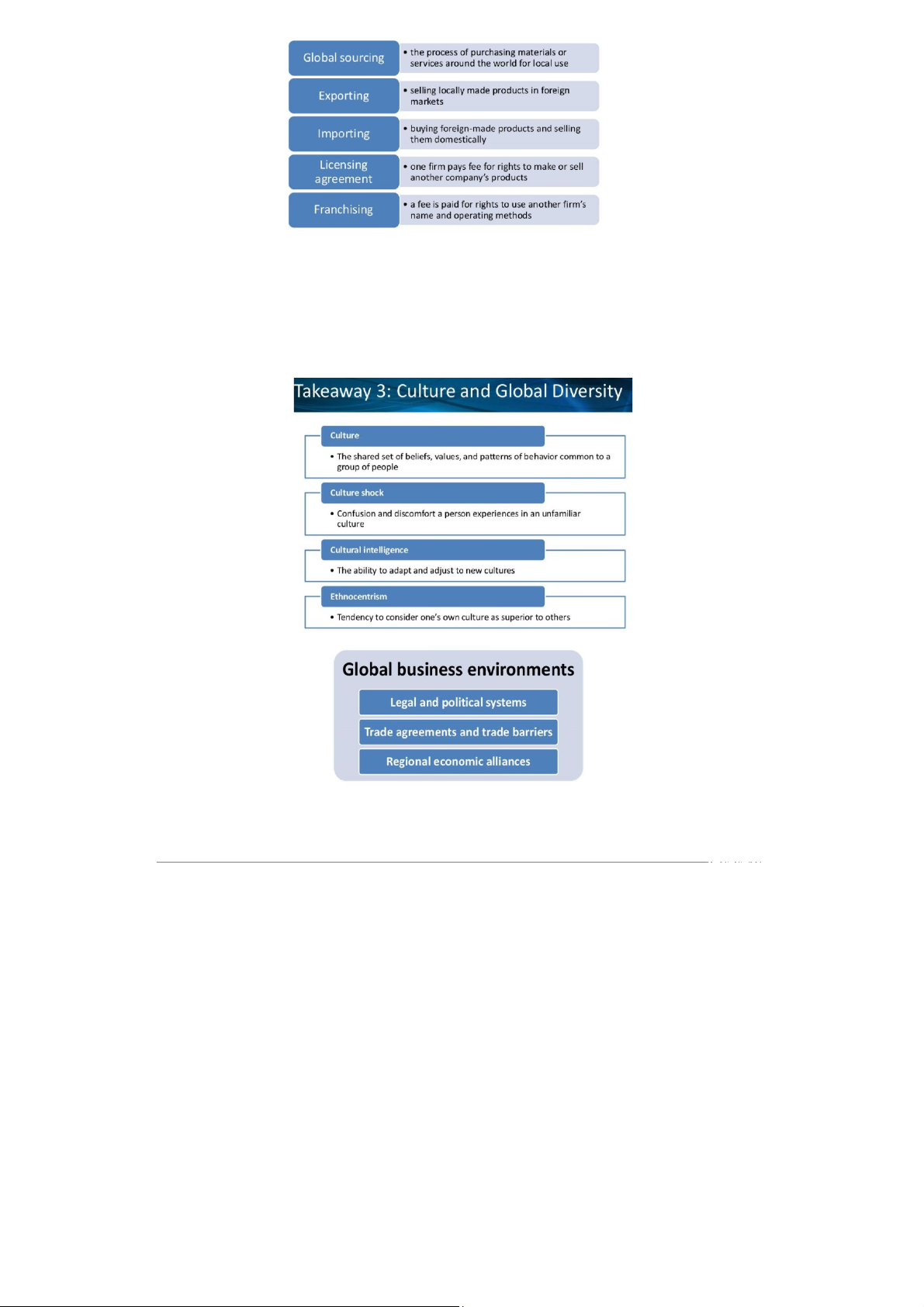
Globalization: The growing interdependence of the world's economies, cultures, and populations, brought
about by cross-border trade in goods and services, technology and flows of investment, people, and information. • Global management
– Managing in organizations with business interests in more than one country • Global manager
– Is culturally aware and informed on international affairs • International businesses
– Conducting for-profit transactions of goods and services across national boundaries • Market entry strategies
– Involve the sale of goods or services to foreign markets but do not require expensive investments (don’t
need to install, to set up a factory / a new company in a foreign industry) → it just sell or buy goods and services with foreign coutry
• Types of market entry strategies:
– Global sourcing: the process of purchasing materials or services around the world for local use/domestic use (VD: VinFast)
– Exporting: selling locally made products in foreign markets (VD: VN exports rice)
– Importing: elling foreign-made product and selling them domestically (VD: electronic devices used in Vietnam are imported)
– Licensing agreement: one firm pays fee for rights to make or sell another company’s products (VD: Bitis, An Phuoc)
– Franchising: a fee is paid for rights to use another firm’s name and operating methods (VD: Lotteria, KFC) Frachising Licensing
Chuẩn qui trình thống nhất được áp dụng để đảm Chỉ chú trọng đến việc bán được càng nhiều sản
bảo chất lượng đầu ra đồng đều → Hướng đến kiểm phẩm càng tốt soát chất lượng
→ Không chú trọng chất lượng
- Insourcing refers to local job creation that results from foreign direct investment (FDI)
• Types of direct investment strategies:
– Joint venture (công ty liên doanh): operate in a foreign country through coownership by foreign and local
partners → a foreign organization and a local organization combine together, they set up a new business
– Strategic alliance (liên minh chiến lược): a partnership in which foreign and domestic firms share resources
and knowledge for mutual gains → a form of combination
– Foreign subsidiary: local operation completely owned by a foreign firm → is an opposite to joint ventures
(VD: Unilever is a foreign subsidiary)
Tài liệu liên quan:
-
CHAP 1: Introduction to Management Concepts and Functions môn Principles of Management | Trường Đại học Quốc tế, Đại học Quốc gia Thành phố Hồ Chí Minh
14 7 -
Guidelines for group’s assignments: Analysing management issues of a FDI company based inVietnam môn Principles of Management | Trường Đại học Quốc tế, Đại học Quốc gia Thành phố Hồ Chí Minh
14 7 -
Financial Planning to Achieve 300m VND Goal in 3 Years môn Principles of Management | Trường Đại học Quốc tế, Đại học Quốc gia Thành phố Hồ Chí Minh
12 6 -

A Case Study in Fast Fashion Success môn Principles of Management | Trường Đại học Quốc tế, Đại học Quốc gia Thành phố Hồ Chí Minh
13 7 -
Chap 16 Hierarchy of Needs Theory and Applications môn Principles of Management | Trường Đại học Quốc tế, Đại học Quốc gia Thành phố Hồ Chí Minh
15 8