Tài liệu kinh tế vi mô- Principles Of Microeconomics 4th Edition
Giáo trình môn kinh tế vi mô- Principles Of Microeconomics 4th Edition. Tài liệu tổng hợp được sưu tầm gồm 276 trang . Mời các bạn tham khảo
Môn: Kinh tế vi mô ( NEU ) 761 tài liệu
Trường: Trường Đại học Kinh Tế Quốc Dân 7.3 K tài liệu
Tác giả:















Preview text:
I N T H I S C H A P T E R Y O U W I L L . . . 1 L e a r n t h a t
e c o n o m i c s i s a b o u t
t h e a l l o c a t i o n o f
s c a r c e r e s o u r c e s
E x a m i n e s o m e o f t h e
t r a d e o f f s t h a t p e o p l e f a c e
L e a r n t h e m e a n i n g o f
o p p o r t u n i t y c o s t S e e h o w t o u s e
m a r g i n a l r e a s o n i n g w h e n m a k i n g d e c i s i o n s D i s c u s s h o w
i n c e n t i v e s a f f e c t T E N P R I N C I P L E S
p e o p l e ’ s b e h a v i o r O F E C O N O M I C S
C o n s i d e r w h y t r a d e
a m o n g p e o p l e o r
The word economy comes from the Greek word for “one who manages a house-
n a t i o n s c a n b e g o o d
hold.” At first, this origin might seem peculiar. But, in fact, households and f o r e v e r y o n e economies have much in common.
A household faces many decisions. It must decide which members of the
household do which tasks and what each member gets in return: Who cooks din-
ner? Who does the laundry? Who gets the extra dessert at dinner? Who gets to
D i s c u s s w h y m a r k e t s
choose what TV show to watch? In short, the household must allocate its scarce re-
a r e a g o o d , b u t n o t
sources among its various members, taking into account each member’s abilities,
p e r f e c t , w a y t o efforts, and desires.
a l l o c a t e r e s o u r c e s
Like a household, a society faces many decisions. A society must decide what
jobs will be done and who will do them. It needs some people to grow food, other
people to make clothing, and still others to design computer software. Once soci- L e a r n w h a t
ety has allocated people (as well as land, buildings, and machines) to various jobs,
d e t e r m i n e s s o m e
t r e n d s i n t h e o v e r a l l e c o n o m y 3 1 TLFeBOOK 2
Ten Principles of Economics 4 PA R T O N E I N T R O D U C T I O N
it must also allocate the output of goods and services that they produce. It must
decide who will eat caviar and who will eat potatoes. It must decide who will
drive a Porsche and who will take the bus.
The management of society’s resources is important because resources are s c a r c i t y
scarce. Scarcity means that society has limited resources and therefore cannot pro-
the limited nature of society’s
duce all the goods and services people wish to have. Just as a household cannot resources
give every member everything he or she wants, a society cannot give every indi-
vidual the highest standard of living to which he or she might aspire. e c o n o m i c s
Economics is the study of how society manages its scarce resources. In most
the study of how society manages its
societies, resources are allocated not by a single central planner but through the scarce resources
combined actions of millions of households and firms. Economists therefore study
how people make decisions: how much they work, what they buy, how much they
save, and how they invest their savings. Economists also study how people inter-
act with one another. For instance, they examine how the multitude of buyers and
sellers of a good together determine the price at which the good is sold and the
quantity that is sold. Finally, economists analyze forces and trends that affect
the economy as a whole, including the growth in average income, the fraction of
the population that cannot find work, and the rate at which prices are rising.
Although the study of economics has many facets, the field is unified by sev-
eral central ideas. In the rest of this chapter, we look at Ten Principles of Economics.
These principles recur throughout this book and are introduced here to give you
an overview of what economics is all about. You can think of this chapter as a “pre- view of coming attractions.”
H O W P E O P L E M A K E D E C I S I O N S
There is no mystery to what an “economy” is. Whether we are talking about the
economy of Los Angeles, of the United States, or of the whole world, an economy
is just a group of people interacting with one another as they go about their lives.
Because the behavior of an economy reflects the behavior of the individuals who
make up the economy, we start our study of economics with four principles of in- dividual decisionmaking.
P R I N C I P L E # 1 : P E O P L E FA C E T R A D E O F F S
The first lesson about making decisions is summarized in the adage: “There is no
such thing as a free lunch.” To get one thing that we like, we usually have to give
up another thing that we like. Making decisions requires trading off one goal against another.
Consider a student who must decide how to allocate her most valuable re-
source—her time. She can spend all of her time studying economics; she can spend
all of her time studying psychology; or she can divide her time between the two
fields. For every hour she studies one subject, she gives up an hour she could have
used studying the other. And for every hour she spends studying, she gives up an
hour that she could have spent napping, bike riding, watching TV, or working at
her part-time job for some extra spending money. TLFeBOOK Ten Principles of Economics 3 C H A P T E R 1
T E N P R I N C I P L E S O F E C O N O M I C S 5
Or consider parents deciding how to spend their family income. They can buy
food, clothing, or a family vacation. Or they can save some of the family income
for retirement or the children’s college education. When they choose to spend an
extra dollar on one of these goods, they have one less dollar to spend on some other good.
When people are grouped into societies, they face different kinds of tradeoffs.
The classic tradeoff is between “guns and butter.” The more we spend on national
defense to protect our shores from foreign aggressors (guns), the less we can spend
on consumer goods to raise our standard of living at home (butter). Also important
in modern society is the tradeoff between a clean environment and a high level of
income. Laws that require firms to reduce pollution raise the cost of producing
goods and services. Because of the higher costs, these firms end up earning smaller
profits, paying lower wages, charging higher prices, or some combination of these
three. Thus, while pollution regulations give us the benefit of a cleaner environ-
ment and the improved health that comes with it, they have the cost of reducing
the incomes of the firms’ owners, workers, and customers.
Another tradeoff society faces is between efficiency and equity. Efficiency e f f i c i e n c y
means that society is getting the most it can from its scarce resources. Equity
the property of society getting the
means that the benefits of those resources are distributed fairly among society’s
most it can from its scarce resources
members. In other words, efficiency refers to the size of the economic pie, and e q u i t y
equity refers to how the pie is divided. Often, when government policies are being
the property of distributing economic
designed, these two goals conflict.
prosperity fairly among the members
Consider, for instance, policies aimed at achieving a more equal distribution of of society
economic well-being. Some of these policies, such as the welfare system or unem-
ployment insurance, try to help those members of society who are most in need.
Others, such as the individual income tax, ask the financially successful to con-
tribute more than others to support the government. Although these policies have
the benefit of achieving greater equity, they have a cost in terms of reduced effi-
ciency. When the government redistributes income from the rich to the poor, it re-
duces the reward for working hard; as a result, people work less and produce
fewer goods and services. In other words, when the government tries to cut the
economic pie into more equal slices, the pie gets smaller.
Recognizing that people face tradeoffs does not by itself tell us what decisions
they will or should make. A student should not abandon the study of psychology
just because doing so would increase the time available for the study of econom-
ics. Society should not stop protecting the environment just because environmen-
tal regulations reduce our material standard of living. The poor should not be
ignored just because helping them distorts work incentives. Nonetheless, ac-
knowledging life’s tradeoffs is important because people are likely to make good
decisions only if they understand the options that they have available.
P R I N C I P L E # 2 : T H E C O S T O F S O M E T H I N G I S
W H AT Y O U G I V E U P T O G E T I T
Because people face tradeoffs, making decisions requires comparing the costs and
benefits of alternative courses of action. In many cases, however, the cost of some
action is not as obvious as it might first appear.
Consider, for example, the decision whether to go to college. The benefit is in-
tellectual enrichment and a lifetime of better job opportunities. But what is the
cost? To answer this question, you might be tempted to add up the money you TLFeBOOK 4
Ten Principles of Economics 6 PA R T O N E I N T R O D U C T I O N
spend on tuition, books, room, and board. Yet this total does not truly represent
what you give up to spend a year in college.
The first problem with this answer is that it includes some things that are not
really costs of going to college. Even if you quit school, you would need a place to
sleep and food to eat. Room and board are costs of going to college only to the ex-
tent that they are more expensive at college than elsewhere. Indeed, the cost of
room and board at your school might be less than the rent and food expenses that
you would pay living on your own. In this case, the savings on room and board
are a benefit of going to college.
The second problem with this calculation of costs is that it ignores the largest
cost of going to college—your time. When you spend a year listening to lectures,
reading textbooks, and writing papers, you cannot spend that time working at a
job. For most students, the wages given up to attend school are the largest single cost of their education. o p p o r t u n i t y c o s t
The opportunity cost of an item is what you give up to get that item. When
whatever must be given up to obtain
making any decision, such as whether to attend college, decisionmakers should be some item
aware of the opportunity costs that accompany each possible action. In fact, they
usually are. College-age athletes who can earn millions if they drop out of school
and play professional sports are well aware that their opportunity cost of college
is very high. It is not surprising that they often decide that the benefit is not worth the cost.
P R I N C I P L E # 3 : R AT I O N A L P E O P L E T H I N K AT T H E M A R G I N
Decisions in life are rarely black and white but usually involve shades of gray.
When it’s time for dinner, the decision you face is not between fasting or eating
like a pig, but whether to take that extra spoonful of mashed potatoes. When ex-
ams roll around, your decision is not between blowing them off or studying 24
hours a day, but whether to spend an extra hour reviewing your notes instead of m a r g i n a l c h a n g e s
watching TV. Economists use the term marginal changes to describe small incre-
small incremental adjustments to a
mental adjustments to an existing plan of action. Keep in mind that “margin” plan of action
means “edge,” so marginal changes are adjustments around the edges of what you are doing.
In many situations, people make the best decisions by thinking at the margin.
Suppose, for instance, that you asked a friend for advice about how many years to
stay in school. If he were to compare for you the lifestyle of a person with a Ph.D.
to that of a grade school dropout, you might complain that this comparison is not
helpful for your decision. You have some education already and most likely are
deciding whether to spend an extra year or two in school. To make this decision,
you need to know the additional benefits that an extra year in school would offer
(higher wages throughout life and the sheer joy of learning) and the additional
costs that you would incur (tuition and the forgone wages while you’re in school).
By comparing these marginal benefits and marginal costs, you can evaluate whether the extra year is worthwhile.
As another example, consider an airline deciding how much to charge passen-
gers who fly standby. Suppose that flying a 200-seat plane across the country costs
the airline $100,000. In this case, the average cost of each seat is $100,000/200,
which is $500. One might be tempted to conclude that the airline should never
sell a ticket for less than $500. In fact, however, the airline can raise its profits by TLFeBOOK Ten Principles of Economics 5 C H A P T E R 1
T E N P R I N C I P L E S O F E C O N O M I C S 7
thinking at the margin. Imagine that a plane is about to take off with ten empty
seats, and a standby passenger is waiting at the gate willing to pay $300 for a seat.
Should the airline sell it to him? Of course it should. If the plane has empty seats,
the cost of adding one more passenger is minuscule. Although the average cost of
flying a passenger is $500, the marginal cost is merely the cost of the bag of peanuts
and can of soda that the extra passenger will consume. As long as the standby pas-
senger pays more than the marginal cost, selling him a ticket is profitable.
As these examples show, individuals and firms can make better decisions by
thinking at the margin. A rational decisionmaker takes an action if and only if the
marginal benefit of the action exceeds the marginal cost.
P R I N C I P L E # 4 : P E O P L E R E S P O N D T O I N C E N T I V E S
Because people make decisions by comparing costs and benefits, their behavior
may change when the costs or benefits change. That is, people respond to incen-
tives. When the price of an apple rises, for instance, people decide to eat more
pears and fewer apples, because the cost of buying an apple is higher. At the same
time, apple orchards decide to hire more workers and harvest more apples, be-
cause the benefit of selling an apple is also higher. As we will see, the effect of price
on the behavior of buyers and sellers in a market—in this case, the market for
apples—is crucial for understanding how the economy works.
Public policymakers should never forget about incentives, for many policies
change the costs or benefits that people face and, therefore, alter behavior. A tax on
gasoline, for instance, encourages people to drive smaller, more fuel-efficient cars.
It also encourages people to take public transportation rather than drive and to
live closer to where they work. If the tax were large enough, people would start driving electric cars.
When policymakers fail to consider how their policies affect incentives, they
can end up with results that they did not intend. For example, consider public pol-
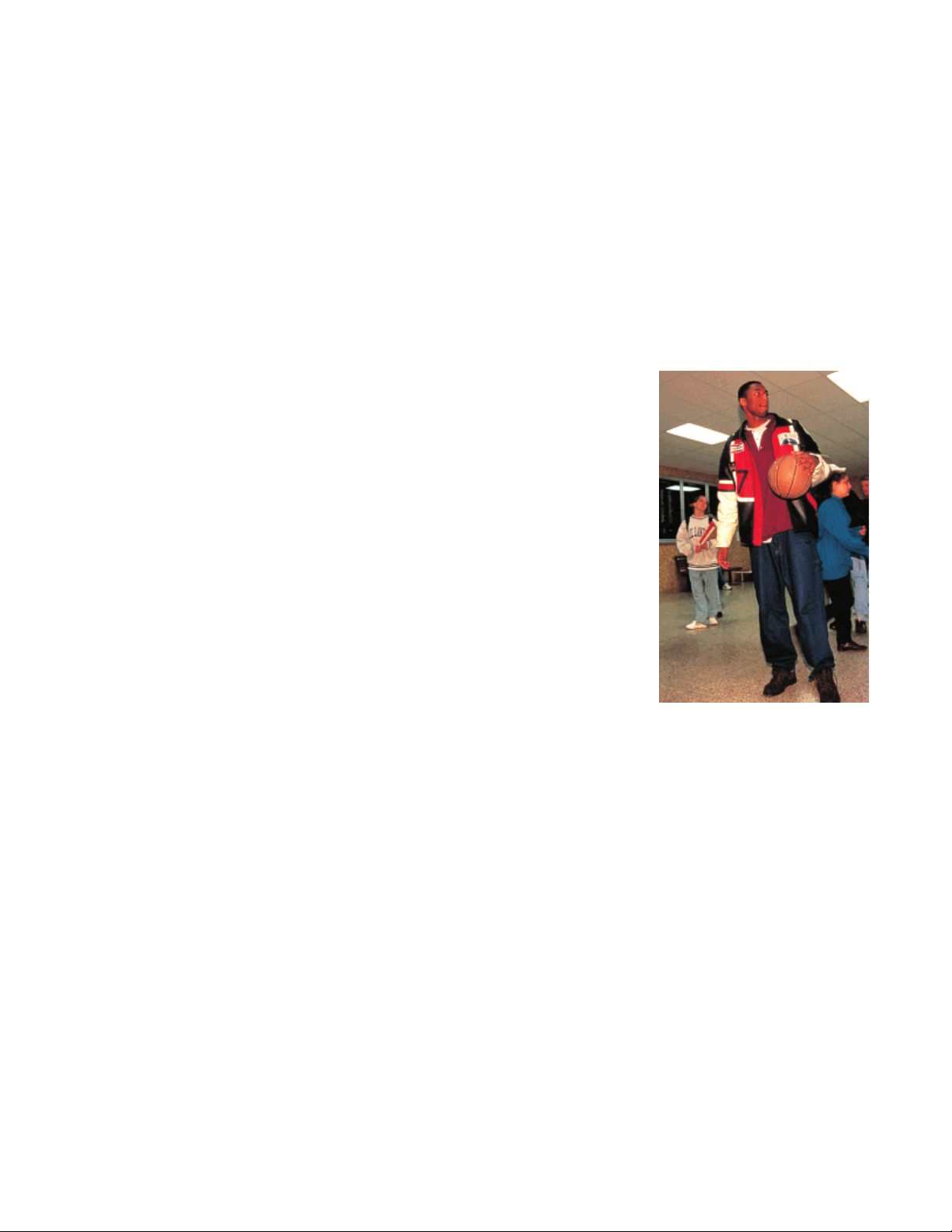
icy regarding auto safety. Today all cars have seat belts, but that was not true 40 BASKETBALL STAR KOBE BRYANT
years ago. In the late 1960s, Ralph Nader’s book Unsafe at Any Speed generated
UNDERSTANDS OPPORTUNITY COST AND
much public concern over auto safety. Congress responded with laws requiring car
INCENTIVES. DESPITE GOOD HIGH SCHOOL
companies to make various safety features, including seat belts, standard equip-
GRADES AND SAT SCORES, HE DECIDED ment on all new cars.
TO SKIP COLLEGE AND GO STRAIGHT TO THE NBA, WHERE HE EARNED ABOUT
How does a seat belt law affect auto safety? The direct effect is obvious. With $10 MILLION OVER FOUR YEARS.
seat belts in all cars, more people wear seat belts, and the probability of surviving
a major auto accident rises. In this sense, seat belts save lives.
But that’s not the end of the story. To fully understand the effects of this law,
we must recognize that people change their behavior in response to the incentives
they face. The relevant behavior here is the speed and care with which drivers op-
erate their cars. Driving slowly and carefully is costly because it uses the driver’s
time and energy. When deciding how safely to drive, rational people compare the
marginal benefit from safer driving to the marginal cost. They drive more slowly
and carefully when the benefit of increased safety is high. This explains why peo-
ple drive more slowly and carefully when roads are icy than when roads are clear.
Now consider how a seat belt law alters the cost–benefit calculation of a ratio-
nal driver. Seat belts make accidents less costly for a driver because they reduce
the probability of injury or death. Thus, a seat belt law reduces the benefits to slow
and careful driving. People respond to seat belts as they would to an improvement TLFeBOOK 6
Ten Principles of Economics 8 PA R T O N E I N T R O D U C T I O N
in road conditions—by faster and less careful driving. The end result of a seat belt
law, therefore, is a larger number of accidents.
How does the law affect the number of deaths from driving? Drivers who
wear their seat belts are more likely to survive any given accident, but they are also
more likely to find themselves in an accident. The net effect is ambiguous. More-
over, the reduction in safe driving has an adverse impact on pedestrians (and on
drivers who do not wear their seat belts). They are put in jeopardy by the law be-
cause they are more likely to find themselves in an accident but are not protected
by a seat belt. Thus, a seat belt law tends to increase the number of pedestrian deaths.
At first, this discussion of incentives and seat belts might seem like idle spec-
ulation. Yet, in a 1975 study, economist Sam Peltzman showed that the auto-safety
laws have, in fact, had many of these effects. According to Peltzman’s evidence,
these laws produce both fewer deaths per accident and more accidents. The net re-
sult is little change in the number of driver deaths and an increase in the number of pedestrian deaths.
Peltzman’s analysis of auto safety is an example of the general principle that
people respond to incentives. Many incentives that economists study are more
straightforward than those of the auto-safety laws. No one is surprised that people
drive smaller cars in Europe, where gasoline taxes are high, than in the United
States, where gasoline taxes are low. Yet, as the seat belt example shows, policies
can have effects that are not obvious in advance. When analyzing any policy, we
must consider not only the direct effects but also the indirect effects that work
through incentives. If the policy changes incentives, it will cause people to alter their behavior. Q U I C K Q U I Z :
List and briefly explain the four principles of individual decisionmaking.
H O W P E O P L E I N T E R A C T
The first four principles discussed how individuals make decisions. As we
go about our lives, many of our decisions affect not only ourselves but other
people as well. The next three principles concern how people interact with one another.
P R I N C I P L E # 5 : T R A D E C A N M A K E E V E R Y O N E B E T T E R O F F
You have probably heard on the news that the Japanese are our competitors in the
world economy. In some ways, this is true, for American and Japanese firms do
produce many of the same goods. Ford and Toyota compete for the same cus-
tomers in the market for automobiles. Compaq and Toshiba compete for the same
customers in the market for personal computers.
Yet it is easy to be misled when thinking about competition among countries.
Trade between the United States and Japan is not like a sports contest, where one TLFeBOOK Ten Principles of Economics 7 C H A P T E R 1
T E N P R I N C I P L E S O F E C O N O M I C S 9
side wins and the other side loses. In fact, the opposite is true: Trade between two
countries can make each country better off.
To see why, consider how trade affects your family. When a member of your
family looks for a job, he or she competes against members of other families who
are looking for jobs. Families also compete against one another when they go
shopping, because each family wants to buy the best goods at the lowest prices. So,
in a sense, each family in the economy is competing with all other families.
Despite this competition, your family would not be better off isolating itself
from all other families. If it did, your family would need to grow its own food,
make its own clothes, and build its own home. Clearly, your family gains much
from its ability to trade with others. Trade allows each person to specialize in the
activities he or she does best, whether it is farming, sewing, or home building. By
trading with others, people can buy a greater variety of goods and services at lower cost.
Countries as well as families benefit from the ability to trade with one another.
Trade allows countries to specialize in what they do best and to enjoy a greater va-
riety of goods and services. The Japanese, as well as the French and the Egyptians
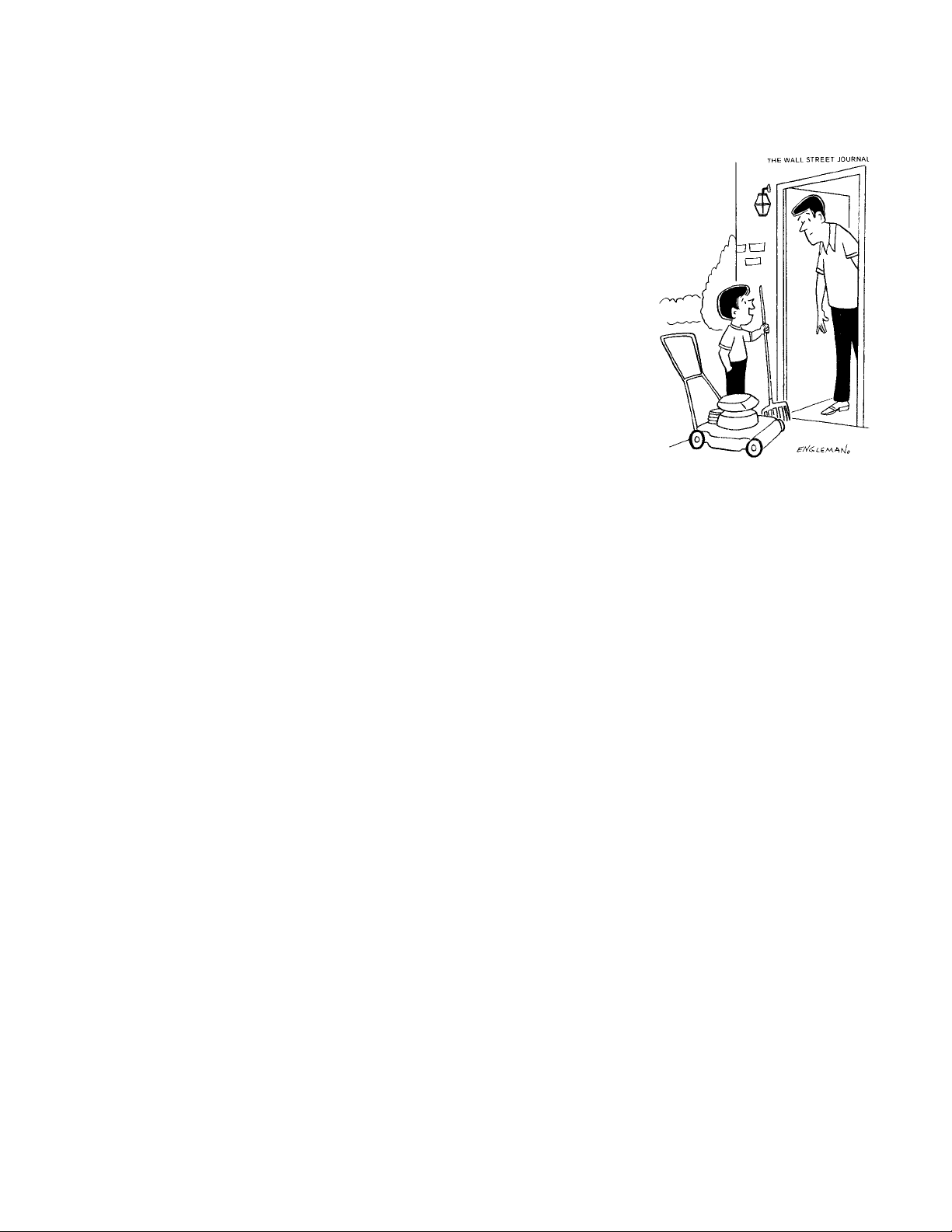
and the Brazilians, are as much our partners in the world economy as they are our “For $5 a week you can watch competitors.
baseball without being nagged to cut the grass!”
P R I N C I P L E # 6 : M A R K E T S A R E U S U A L LY A G O O D WAY
T O O R G A N I Z E E C O N O M I C A C T I V I T Y
The collapse of communism in the Soviet Union and Eastern Europe may be the
most important change in the world during the past half century. Communist
countries worked on the premise that central planners in the government were in
the best position to guide economic activity. These planners decided what goods
and services were produced, how much was produced, and who produced and
consumed these goods and services. The theory behind central planning was that
only the government could organize economic activity in a way that promoted
economic well-being for the country as a whole.
Today, most countries that once had centrally planned economies have aban-
doned this system and are trying to develop market economies. In a market econ- m a r k e t e c o n o m y
omy, the decisions of a central planner are replaced by the decisions of millions of
an economy that allocates resources
firms and households. Firms decide whom to hire and what to make. Households
through the decentralized decisions
decide which firms to work for and what to buy with their incomes. These firms
of many firms and households as
and households interact in the marketplace, where prices and self-interest guide
they interact in markets for goods their decisions. and services
At first glance, the success of market economies is puzzling. After all, in a mar-
ket economy, no one is looking out for the economic well-being of society as
a whole. Free markets contain many buyers and sellers of numerous goods and
services, and all of them are interested primarily in their own well-being. Yet,
despite decentralized decisionmaking and self-interested decisionmakers, market
economies have proven remarkably successful in organizing economic activity in
a way that promotes overall economic well-being.
In his 1776 book An Inquiry into the Nature and Causes of the Wealth of Nations,
economist Adam Smith made the most famous observation in all of economics:
Households and firms interacting in markets act as if they are guided by an “in-
visible hand” that leads them to desirable market outcomes. One of our goals in TLFeBOOK 8
Ten Principles of Economics 1 0 PA R T O N E I N T R O D U C T I O N F Y I It may be only a coincidence the butcher, the brewer, or Adam Smith
that Adam Smith’s great book, the baker that we expect our and the
An Inquir y into the Nature and dinner, but from their regard
Causes of the Wealth of Na- to their own interest. . . . Invisible Hand
tions, was published in 1776, Ever y individual . . .
the exact year American revolu- neither intends to promote tionaries signed the Declara- the public interest, nor knows tion of Independence. But the how much he is promoting two documents do share a it. . . . He intends only his point of view that was preva-
own gain, and he is in this, as
lent at the time—that individu- in many other cases, led by
als are usually best left to their an invisible hand to promote own devices, without the heavy an end which was no par t of ADAM SMITH
hand of government guiding their actions. This political phi-
his intention. Nor is it always
losophy provides the intellectual basis for the market econ- the worse for the society that
omy, and for free society more generally.
it was no par t of it. By pursuing his own interest he
Why do decentralized market economies work so
frequently promotes that of the society more effectually
well? Is it because people can be counted on to treat one
than when he really intends to promote it.
another with love and kindness? Not at all. Here is Adam
Smith’s description of how people interact in a market
Smith is saying that par ticipants in the economy are moti- economy:
vated by self-interest and that the “invisible hand” of the
marketplace guides this self-interest into promoting general
Man has almost constant occasion for the help of his economic well-being.
brethren, and it is vain for him to expect it from their
Many of Smith’s insights remain at the center of mod-
benevolence only. He will be more likely to prevail if he
ern economics. Our analysis in the coming chapters will al-
can interest their self-love in his favor, and show them
low us to express Smith’s conclusions more precisely and
that it is for their own advantage to do for him what he
to analyze fully the strengths and weaknesses of the mar-
requires of them. . . . It is not from the benevolence of ket’s invisible hand.
this book is to understand how this invisible hand works its magic. As you study
economics, you will learn that prices are the instrument with which the invisible
hand directs economic activity. Prices reflect both the value of a good to society
and the cost to society of making the good. Because households and firms look at
prices when deciding what to buy and sell, they unknowingly take into account
the social benefits and costs of their actions. As a result, prices guide these indi-
vidual decisionmakers to reach outcomes that, in many cases, maximize the wel- fare of society as a whole.
There is an important corollary to the skill of the invisible hand in guiding eco-
nomic activity: When the government prevents prices from adjusting naturally to
supply and demand, it impedes the invisible hand’s ability to coordinate the mil-
lions of households and firms that make up the economy. This corollary explains
why taxes adversely affect the allocation of resources: Taxes distort prices and thus
the decisions of households and firms. It also explains the even greater harm
caused by policies that directly control prices, such as rent control. And it explains
the failure of communism. In communist countries, prices were not determined in
the marketplace but were dictated by central planners. These planners lacked the
information that gets reflected in prices when prices are free to respond to market TLFeBOOK Ten Principles of Economics 9 C H A P T E R 1
T E N P R I N C I P L E S O F E C O N O M I C S 1 1
forces. Central planners failed because they tried to run the economy with one
hand tied behind their backs—the invisible hand of the marketplace.
P R I N C I P L E # 7 : G O V E R N M E N T S C A N S O M E T I M E S
I M P R O V E M A R K E T O U T C O M E S
Although markets are usually a good way to organize economic activity, this rule
has some important exceptions. There are two broad reasons for a government to
intervene in the economy: to promote efficiency and to promote equity. That is,
most policies aim either to enlarge the economic pie or to change how the pie is divided.
The invisible hand usually leads markets to allocate resources efficiently.
Nonetheless, for various reasons, the invisible hand sometimes does not work.
Economists use the term market failure to refer to a situation in which the market m a r k e t f a i l u r e
on its own fails to allocate resources efficiently.
a situation in which a market left on
One possible cause of market failure is an externality. An externality is the im-
its own fails to allocate resources
pact of one person’s actions on the well-being of a bystander. The classic example efficiently
of an external cost is pollution. If a chemical factory does not bear the entire cost of e x t e r n a l i t y
the smoke it emits, it will likely emit too much. Here, the government can raise
the impact of one person’s actions on
economic well-being through environmental regulation. The classic example of an
the well-being of a bystander
external benefit is the creation of knowledge. When a scientist makes an important
discovery, he produces a valuable resource that other people can use. In this case,
the government can raise economic well-being by subsidizing basic research, as in fact it does.
Another possible cause of market failure is market power. Market power m a r k e t p o w e r
refers to the ability of a single person (or small group of people) to unduly influ-
the ability of a single economic actor
ence market prices. For example, suppose that everyone in town needs water but
(or small group of actors) to have a
there is only one well. The owner of the well has market power—in this case a
substantial influence on market
monopoly—over the sale of water. The well owner is not subject to the rigorous prices
competition with which the invisible hand normally keeps self-interest in check.
You will learn that, in this case, regulating the price that the monopolist charges
can potentially enhance economic efficiency.
The invisible hand is even less able to ensure that economic prosperity is dis-
tributed fairly. A market economy rewards people according to their ability to pro-
duce things that other people are willing to pay for. The world’s best basketball
player earns more than the world’s best chess player simply because people are
willing to pay more to watch basketball than chess. The invisible hand does not en-
sure that everyone has sufficient food, decent clothing, and adequate health care.
A goal of many public policies, such as the income tax and the welfare system, is
to achieve a more equitable distribution of economic well-being.
To say that the government can improve on markets outcomes at times does
not mean that it always will. Public policy is made not by angels but by a political
process that is far from perfect. Sometimes policies are designed simply to reward
the politically powerful. Sometimes they are made by well-intentioned leaders
who are not fully informed. One goal of the study of economics is to help you
judge when a government policy is justifiable to promote efficiency or equity and when it is not. Q U I C K Q U I Z :
List and briefly explain the three principles concerning economic interactions. TLFeBOOK 10
Ten Principles of Economics 1 2 PA R T O N E I N T R O D U C T I O N
H O W T H E E C O N O M Y A S A W H O L E W O R K S
We started by discussing how individuals make decisions and then looked at how
people interact with one another. All these decisions and interactions together
make up “the economy.” The last three principles concern the workings of the economy as a whole.
P R I N C I P L E # 8 : A C O U N T R Y ’ S S TA N D A R D O F
L I V I N G D E P E N D S O N I T S A B I L I T Y T O
P R O D U C E G O O D S A N D S E R V I C E S
The differences in living standards around the world are staggering. In 1997 the
average American had an income of about $29,000. In the same year, the average
Mexican earned $8,000, and the average Nigerian earned $900. Not surprisingly,
this large variation in average income is reflected in various measures of the qual-
ity of life. Citizens of high-income countries have more TV sets, more cars, better
nutrition, better health care, and longer life expectancy than citizens of low-income countries.
Changes in living standards over time are also large. In the United States,
incomes have historically grown about 2 percent per year (after adjusting for
changes in the cost of living). At this rate, average income doubles every 35 years.
Over the past century, average income has risen about eightfold.
What explains these large differences in living standards among countries and
over time? The answer is surprisingly simple. Almost all variation in living stan- p r o d u c t i v i t y
dards is attributable to differences in countries’ productivity—that is, the amount
the amount of goods and services
of goods and services produced from each hour of a worker’s time. In nations
produced from each hour of a
where workers can produce a large quantity of goods and services per unit of time, worker’s time
most people enjoy a high standard of living; in nations where workers are less
productive, most people must endure a more meager existence. Similarly, the
growth rate of a nation’s productivity determines the growth rate of its average income.
The fundamental relationship between productivity and living standards is
simple, but its implications are far-reaching. If productivity is the primary deter-
minant of living standards, other explanations must be of secondary importance.
For example, it might be tempting to credit labor unions or minimum-wage laws
for the rise in living standards of American workers over the past century. Yet the
real hero of American workers is their rising productivity. As another example,
some commentators have claimed that increased competition from Japan and
other countries explains the slow growth in U.S. incomes over the past 30 years.
Yet the real villain is not competition from abroad but flagging productivity growth in the United States.
The relationship between productivity and living standards also has profound
implications for public policy. When thinking about how any policy will affect liv-
ing standards, the key question is how it will affect our ability to produce goods
and services. To boost living standards, policymakers need to raise productivity by
ensuring that workers are well educated, have the tools needed to produce goods
and services, and have access to the best available technology. TLFeBOOK Ten Principles of Economics 11 C H A P T E R 1
T E N P R I N C I P L E S O F E C O N O M I C S 1 3
In the 1980s and 1990s, for example, much debate in the United States centered
on the government’s budget deficit—the excess of government spending over gov-
ernment revenue. As we will see, concern over the budget deficit was based
largely on its adverse impact on productivity. When the government needs to
finance a budget deficit, it does so by borrowing in financial markets, much as a
student might borrow to finance a college education or a firm might borrow to
finance a new factory. As the government borrows to finance its deficit, therefore,
it reduces the quantity of funds available for other borrowers. The budget deficit
thereby reduces investment both in human capital (the student’s education) and
physical capital (the firm’s factory). Because lower investment today means lower
productivity in the future, government budget deficits are generally thought to de-
press growth in living standards.
P R I N C I P L E # 9 : P R I C E S R I S E W H E N T H E
G O V E R N M E N T P R I N T S T O O M U C H M O N E Y
In Germany in January 1921, a daily newspaper cost 0.30 marks. Less than two
years later, in November 1922, the same newspaper cost 70,000,000 marks. All
other prices in the economy rose by similar amounts. This episode is one of his-
tory’s most spectacular examples of inflation, an increase in the overall level of i n f l a t i o n prices in the economy.
an increase in the overall level of
Although the United States has never experienced inflation even close to that prices in the economy
in Germany in the 1920s, inflation has at times been an economic problem. During
the 1970s, for instance, the overall level of prices more than doubled, and President
Gerald Ford called inflation “public enemy number one.” By contrast, inflation in
the 1990s was about 3 percent per year; at this rate it would take more than
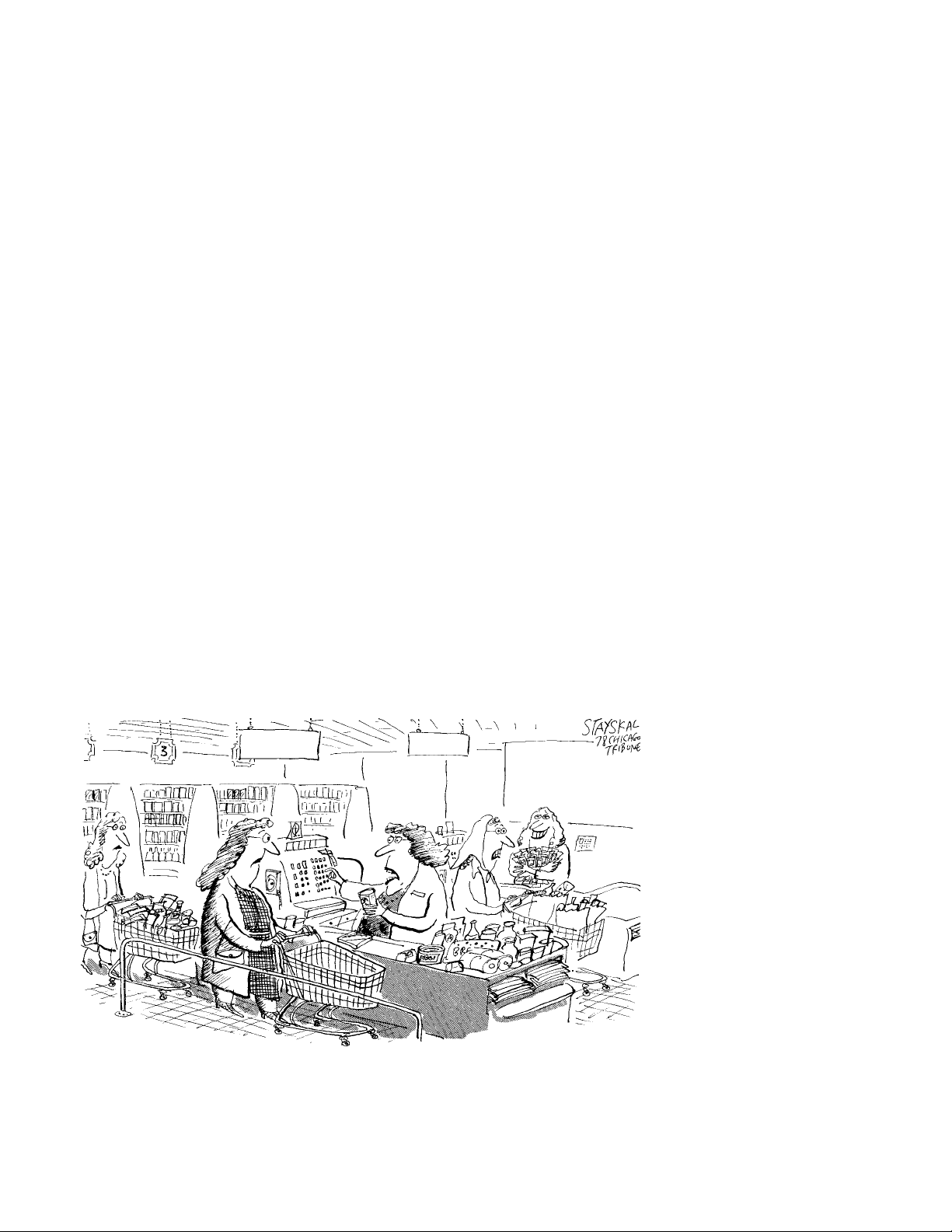
“Well it may have been 68 cents when you got in line, but it’s 74 cents now!” TLFeBOOK 12
Ten Principles of Economics 1 4 PA R T O N E I N T R O D U C T I O N
20 years for prices to double. Because high inflation imposes various costs on soci-
ety, keeping inflation at a low level is a goal of economic policymakers around the world.
What causes inflation? In almost all cases of large or persistent inflation, the
culprit turns out to be the same—growth in the quantity of money. When a gov-
ernment creates large quantities of the nation’s money, the value of the money
falls. In Germany in the early 1920s, when prices were on average tripling every
month, the quantity of money was also tripling every month. Although less dra-
matic, the economic history of the United States points to a similar conclusion: The
high inflation of the 1970s was associated with rapid growth in the quantity of
money, and the low inflation of the 1990s was associated with slow growth in the quantity of money.
P R I N C I P L E # 1 0 : S O C I E T Y FA C E S A S H O R T - R U N T R A D E O F F
B E T W E E N I N F L AT I O N A N D U N E M P L O Y M E N T
If inflation is so easy to explain, why do policymakers sometimes have trouble rid-
ding the economy of it? One reason is that reducing inflation is often thought to
cause a temporary rise in unemployment. The curve that illustrates this tradeoff P h i l l i p s c u r v e
between inflation and unemployment is called the Phillips curve, after the econo-
a curve that shows the short-run
mist who first examined this relationship.
tradeoff between inflation and
The Phillips curve remains a controversial topic among economists, but most unemployment
economists today accept the idea that there is a short-run tradeoff between infla-
tion and unemployment. This simply means that, over a period of a year or two,
many economic policies push inflation and unemployment in opposite directions.
Policymakers face this tradeoff regardless of whether inflation and unemployment
both start out at high levels (as they were in the early 1980s), at low levels (as they
were in the late 1990s), or someplace in between.
Why do we face this short-run tradeoff? According to a common explanation,
it arises because some prices are slow to adjust. Suppose, for example, that the
government reduces the quantity of money in the economy. In the long run, the
only result of this policy change will be a fall in the overall level of prices. Yet not
all prices will adjust immediately. It may take several years before all firms issue
new catalogs, all unions make wage concessions, and all restaurants print new
menus. That is, prices are said to be sticky in the short run.
Because prices are sticky, various types of government policy have short-run
effects that differ from their long-run effects. When the government reduces the
quantity of money, for instance, it reduces the amount that people spend. Lower
spending, together with prices that are stuck too high, reduces the quantity of
goods and services that firms sell. Lower sales, in turn, cause firms to lay off work-
ers. Thus, the reduction in the quantity of money raises unemployment temporar-
ily until prices have fully adjusted to the change.
The tradeoff between inflation and unemployment is only temporary, but it
can last for several years. The Phillips curve is, therefore, crucial for understand-
ing many developments in the economy. In particular, policymakers can exploit
this tradeoff using various policy instruments. By changing the amount that the
government spends, the amount it taxes, and the amount of money it prints,
policymakers can, in the short run, influence the combination of inflation and
unemployment that the economy experiences. Because these instruments of TLFeBOOK Ten Principles of Economics 13 C H A P T E R 1
T E N P R I N C I P L E S O F E C O N O M I C S 1 5
monetary and fiscal policy are potentially so powerful, how policymakers should
use these instruments to control the economy, if at all, is a subject of continuing debate. Q U I C K Q U I Z :
List and briefly explain the three principles that describe
how the economy as a whole works. C O N C L U S I O N
You now have a taste of what economics is all about. In the coming chapters we
will develop many specific insights about people, markets, and economies. Mas-
tering these insights will take some effort, but it is not an overwhelming task. The
field of economics is based on a few basic ideas that can be applied in many dif- ferent situations.
Throughout this book we will refer back to the Ten Principles of Economics
highlighted in this chapter and summarized in Table 1-1. Whenever we do so,
a building-blocks icon will be displayed in the margin, as it is now. But even
when that icon is absent, you should keep these building blocks in mind. Even the
most sophisticated economic analysis is built using the ten principles introduced here. Ta b l e 1 - 1 HOW PEOPLE #1: People Face Tradeoffs TEN PRINCIPLES OF ECONOMICS MAKE DECISIONS
#2: The Cost of Something Is What You Give Up to Get It
#3: Rational People Think at the Margin
#4: People Respond to Incentives HOW PEOPLE INTERACT
#5: Trade Can Make Everyone Better Off
#6: Markets Are Usually a Good Way to Organize Economic Activity
#7: Governments Can Sometimes Improve Market Outcomes HOW THE ECONOMY
#8: A Country’s Standard of Living Depends on Its AS A WHOLE WORKS
Ability to Produce Goods and Services
#9: Prices Rise When the Government Prints Too Much Money
#10: Society Faces a Short-Run Tradeoff between Inflation and Unemployment TLFeBOOK 14
Ten Principles of Economics 1 6 PA R T O N E I N T R O D U C T I O N S u m m a r y
◆ The fundamental lessons about individual
markets are usually a good way of coordinating trade
decisionmaking are that people face tradeoffs among
among people, and that the government can potentially
alternative goals, that the cost of any action is measured
improve market outcomes if there is some market
in terms of forgone opportunities, that rational people
failure or if the market outcome is inequitable.
make decisions by comparing marginal costs and
◆ The fundamental lessons about the economy as a whole
marginal benefits, and that people change their behavior
are that productivity is the ultimate source of living
in response to the incentives they face.
standards, that money growth is the ultimate source of
◆ The fundamental lessons about interactions among
inflation, and that society faces a short-run tradeoff
people are that trade can be mutually beneficial, that
between inflation and unemployment. K e y C o n c e p t s scarcity, p. 4 marginal changes, p. 6 productivity, p. 12 economics, p. 4 market economy, p. 9 inflation, p. 13 efficiency, p. 5 market failure, p. 11 Phillips curve, p. 14 equity, p. 5 externality, p. 11 opportunity cost, p. 6 market power, p. 11
Q u e s t i o n s f o r R e v i e w
1. Give three examples of important tradeoffs that you face
6. What does the “invisible hand” of the marketplace do? in your life.
7. Explain the two main causes of market failure and give
2. What is the opportunity cost of seeing a movie? an example of each.
3. Water is necessary for life. Is the marginal benefit of a
8. Why is productivity important? glass of water large or small?
9. What is inflation, and what causes it?
4. Why should policymakers think about incentives?
10. How are inflation and unemployment related in the
5. Why isn’t trade among countries like a game with some short run? winners and some losers?
P r o b l e m s a n d A p p l i c a t i o n s
1. Describe some of the tradeoffs faced by the following:
is the true cost of going skiing? Now suppose that you a.
a family deciding whether to buy a new car
had been planning to spend the day studying at the b.
a member of Congress deciding how much to
library. What is the cost of going skiing in this case? spend on national parks Explain. c.
a company president deciding whether to open a
4. You win $100 in a basketball pool. You have a choice new factory
between spending the money now or putting it away d.
a professor deciding how much to prepare for class
for a year in a bank account that pays 5 percent interest.
2. You are trying to decide whether to take a vacation.
What is the opportunity cost of spending the $100 now?
Most of the costs of the vacation (airfare, hotel, forgone
5. The company that you manage has invested $5 million
wages) are measured in dollars, but the benefits of the
in developing a new product, but the development is
vacation are psychological. How can you compare the
not quite finished. At a recent meeting, your salespeople benefits to the costs?
report that the introduction of competing products has
3. You were planning to spend Saturday working at your
reduced the expected sales of your new product to
part-time job, but a friend asks you to go skiing. What
$3 million. If it would cost $1 million to finish TLFeBOOK Ten Principles of Economics 15 C H A P T E R 1
T E N P R I N C I P L E S O F E C O N O M I C S 1 7
development and make the product, should you go b.
How would your decisions about CDs affect some
ahead and do so? What is the most that you should pay
of your other decisions, such as how many CD to complete development?
players to make or cassette tapes to produce? How
6. Three managers of the Magic Potion Company are
might some of your other decisions about the
discussing a possible increase in production. Each
economy change your views about CDs?
suggests a way to make this decision.
11. Explain whether each of the following government
activities is motivated by a concern about equity or a HARRY: We should examine whether our
concern about efficiency. In the case of efficiency, discuss
company’s productivity—gallons of
the type of market failure involved.
potion per worker—would rise or fall. a. regulating cable-TV prices R b.
providing some poor people with vouchers that can ON:
We should examine whether our average
cost—cost per worker—would rise or fall. be used to buy food c.
prohibiting smoking in public places
HERMIONE: We should examine whether the extra d.
breaking up Standard Oil (which once owned
revenue from selling the additional potion
90 percent of all oil refineries) into several smaller
would be greater or smaller than the extra companies costs. e.
imposing higher personal income tax rates on people with higher incomes
Who do you think is right? Why? f.
instituting laws against driving while intoxicated
7. The Social Security system provides income for people
12. Discuss each of the following statements from the
over age 65. If a recipient of Social Security decides to
standpoints of equity and efficiency.
work and earn some income, the amount he or she a.
“Everyone in society should be guaranteed the best
receives in Social Security benefits is typically reduced. health care possible.” a.
How does the provision of Social Security affect b.
“When workers are laid off, they should be able to
people’s incentive to save while working?
collect unemployment benefits until they find a b.
How does the reduction in benefits associated with new job.”
higher earnings affect people’s incentive to work
13. In what ways is your standard of living different from past age 65?
that of your parents or grandparents when they were
8. A recent bill reforming the government’s antipoverty
your age? Why have these changes occurred?
programs limited many welfare recipients to only two
14. Suppose Americans decide to save more of their years of benefits.
incomes. If banks lend this extra saving to businesses, a.
How does this change affect the incentives for
which use the funds to build new factories, how might working?
this lead to faster growth in productivity? Who do you b.
How might this change represent a tradeoff
suppose benefits from the higher productivity? Is between equity and efficiency? society getting a free lunch?
9. Your roommate is a better cook than you are, but you
15. Suppose that when everyone wakes up tomorrow, they
can clean more quickly than your roommate can. If your
discover that the government has given them an
roommate did all of the cooking and you did all of the
additional amount of money equal to the amount they
cleaning, would your chores take you more or less time
already had. Explain what effect this doubling of the
than if you divided each task evenly? Give a similar
money supply will likely have on the following:
example of how specialization and trade can make two a.
the total amount spent on goods and services countries both better off. b.
the quantity of goods and services purchased if
10. Suppose the United States adopted central planning for prices are sticky
its economy, and you became the chief planner. Among c.
the prices of goods and services if prices can adjust
the millions of decisions that you need to make for next
16. Imagine that you are a policymaker trying to decide
year are how many compact discs to produce, what
whether to reduce the rate of inflation. To make an
artists to record, and who should receive the discs.
intelligent decision, what would you need to know a.
To make these decisions intelligently, what
about inflation, unemployment, and the tradeoff
information would you need about the compact between them?
disc industry? What information would you need
about each of the people in the United States? TLFeBOOK TLFeBOOK I N T H I S C H A P T E R Y O U W I L L . . . 2
S e e h o w e c o n o m i s t s
a p p l y t h e m e t h o d s o f s c i e n c e C o n s i d e r h o w a s s u m p t i o n s a n d m o d e l s c a n s h e d
l i g h t o n t h e w o r l d
L e a r n t w o s i m p l e
m o d e l s — t h e c i r c u l a r f l o w a n d t h e p r o d u c t i o n
p o s s i b i l i t i e s f r o n t i e r
D i s t i n g u i s h b e t w e e n
m i c r o e c o n o m i c s a n d
m a c r o e c o n o m i c s T H I N K I N G L I K E A N E C O N O M I S T
L e a r n t h e d i f f e r e n c e
b e t w e e n p o s i t i v e a n d
n o r m a t i v e s t a t e m e n t s
Every field of study has its own language and its own way of thinking. Mathe-
maticians talk about axioms, integrals, and vector spaces. Psychologists talk about
ego, id, and cognitive dissonance. Lawyers talk about venue, torts, and promissory estoppel.
Economics is no different. Supply, demand, elasticity, comparative advantage,
E x a m i n e t h e r o l e o f
consumer surplus, deadweight loss—these terms are part of the economist’s lan- e c o n o m i s t s i n
guage. In the coming chapters, you will encounter many new terms and some fa- m a k i n g p o l i c y
miliar words that economists use in specialized ways. At first, this new language
may seem needlessly arcane. But, as you will see, its value lies in its ability to pro-
vide you a new and useful way of thinking about the world in which you live.
The single most important purpose of this book is to help you learn the econ-
omist’s way of thinking. Of course, just as you cannot become a mathematician, C o n s i d e r w h y
psychologist, or lawyer overnight, learning to think like an economist will take e c o n o m i s t s
s o m e t i m e s d i s a g r e e
w i t h o n e a n o t h e r 1 9 17 TLFeBOOK 18
Thinking Like an Economist 2 0 PA R T O N E I N T R O D U C T I O N
some time. Yet with a combination of theory, case studies, and examples of eco-
nomics in the news, this book will give you ample opportunity to develop and practice this skill.
Before delving into the substance and details of economics, it is helpful to have
an overview of how economists approach the world. This chapter, therefore, dis-
cusses the field’s methodology. What is distinctive about how economists confront
a question? What does it mean to think like an economist?
T H E E C O N O M I S T A S S C I E N T I S T
Economists try to address their subject with a scientist’s objectivity. They approach
the study of the economy in much the same way as a physicist approaches the
study of matter and a biologist approaches the study of life: They devise theories,
collect data, and then analyze these data in an attempt to verify or refute their theories.
To beginners, it can seem odd to claim that economics is a science. After
all, economists do not work with test tubes or telescopes. The essence of science,
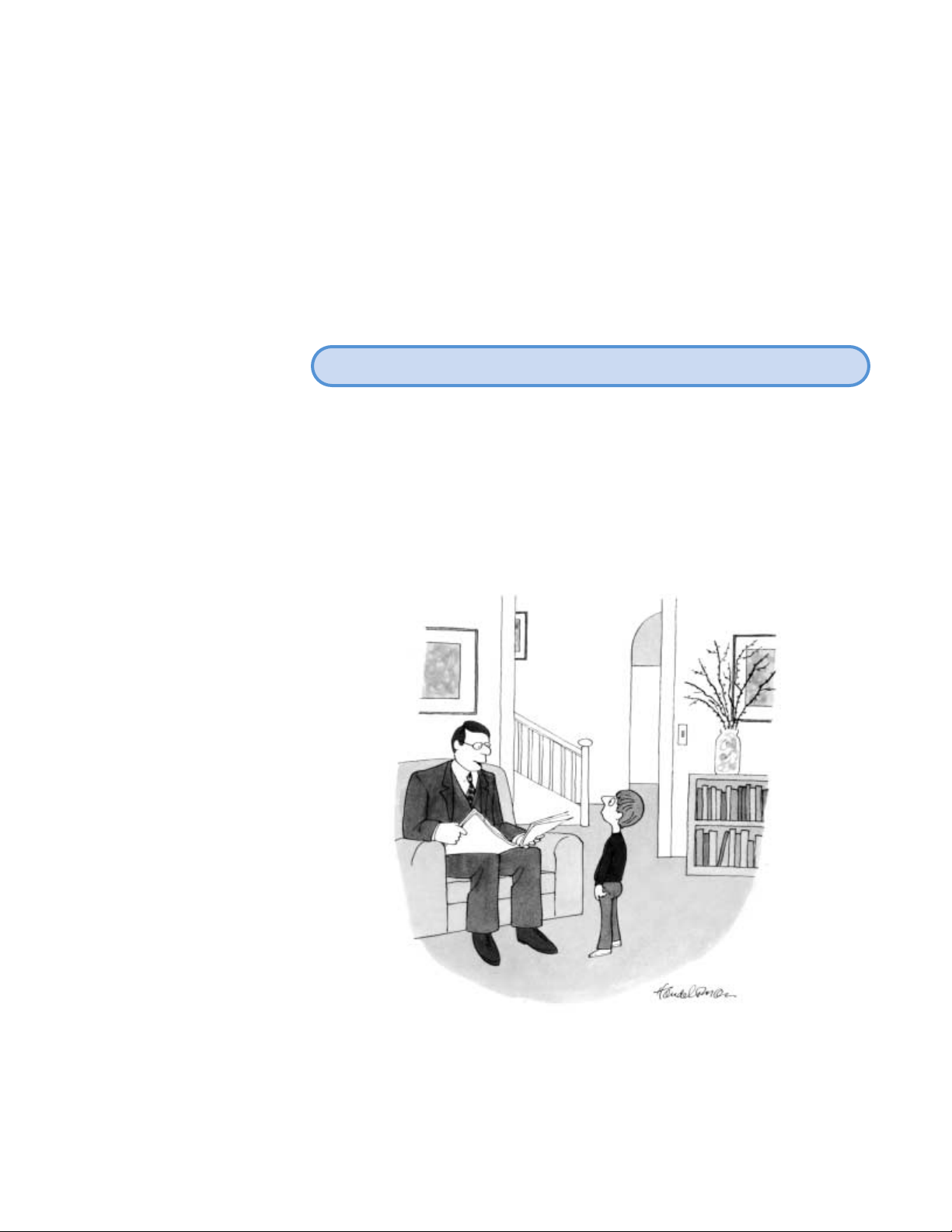
“I’m a social scientist, Michael. That means I can’t explain
electricity or anything like that, but if you ever want to know
about people I’m your man.” TLFeBOOK Thinking Like an Economist 19 C H A P T E R 2
T H I N K I N G L I K E A N E C O N O M I S T 2 1
however, is the scientific method—the dispassionate development and testing of
theories about how the world works. This method of inquiry is as applicable to
studying a nation’s economy as it is to studying the earth’s gravity or a species’
evolution. As Albert Einstein once put it, “The whole of science is nothing more
than the refinement of everyday thinking.”
Although Einstein’s comment is as true for social sciences such as economics
as it is for natural sciences such as physics, most people are not accustomed to
looking at society through the eyes of a scientist. Let’s therefore discuss some of
the ways in which economists apply the logic of science to examine how an econ- omy works.
T H E S C I E N T I F I C M E T H O D : O B S E R VAT I O N ,
T H E O R Y, A N D M O R E O B S E R VAT I O N
Isaac Newton, the famous seventeenth-century scientist and mathematician, al-
legedly became intrigued one day when he saw an apple fall from an apple tree.
This observation motivated Newton to develop a theory of gravity that applies not
only to an apple falling to the earth but to any two objects in the universe. Subse-
quent testing of Newton’s theory has shown that it works well in many circum-
stances (although, as Einstein would later emphasize, not in all circumstances).
Because Newton’s theory has been so successful at explaining observation, it is
still taught today in undergraduate physics courses around the world.
This interplay between theory and observation also occurs in the field of eco-
nomics. An economist might live in a country experiencing rapid increases in
prices and be moved by this observation to develop a theory of inflation. The
theory might assert that high inflation arises when the government prints too
much money. (As you may recall, this was one of the Ten Principles of Economics in
Chapter 1.) To test this theory, the economist could collect and analyze data on
prices and money from many different countries. If growth in the quantity of
money were not at all related to the rate at which prices are rising, the economist
would start to doubt the validity of his theory of inflation. If money growth and in-
flation were strongly correlated in international data, as in fact they are, the econ-
omist would become more confident in his theory.
Although economists use theory and observation like other scientists, they do
face an obstacle that makes their task especially challenging: Experiments are often
difficult in economics. Physicists studying gravity can drop many objects in their
laboratories to generate data to test their theories. By contrast, economists study-
ing inflation are not allowed to manipulate a nation’s monetary policy simply to
generate useful data. Economists, like astronomers and evolutionary biologists,
usually have to make do with whatever data the world happens to give them.
To find a substitute for laboratory experiments, economists pay close attention
to the natural experiments offered by history. When a war in the Middle East in-
terrupts the flow of crude oil, for instance, oil prices skyrocket around the world.
For consumers of oil and oil products, such an event depresses living standards.
For economic policymakers, it poses a difficult choice about how best to respond.
But for economic scientists, it provides an opportunity to study the effects of a key
natural resource on the world’s economies, and this opportunity persists long after
the wartime increase in oil prices is over. Throughout this book, therefore, we con-
sider many historical episodes. These episodes are valuable to study because they TLFeBOOK
Tài liệu liên quan:
-

Sách Bài Tập Vi Mô - Hướng Dẫn và Lời Giải Chi Tiết
10 5 -

Nguyên lý chiến lược kinh doanh - Bài giảng môn Kinh tế vi mô | Trường Đại học Kinh Tế Quốc Dân
11 6 -

Chương 7 các kỹ thuật lựa chọn chiến lược - Bài giảng môn Kinh tế vi mô | Trường Đại học Kinh Tế Quốc Dân
12 6 -

Tổng hợp câu hỏi trắc nghiệm theo chương ôn tập môn Kinh tế vi mô | Trường Đại học Kinh Tế Quốc Dân
17 9 -
Lý thuyết ngang giá sức mua môn Kinh tế vi mô | Trường Đại học Kinh Tế Quốc Dân
10 5