Review of Midterm Management Concepts for Exam Preparation môn Principle of Management | Trường Đại học Quốc tế, Đại học Quốc gia Thành phố Hồ Chí Minh
Hawthorne--owner not hor, he isElton Mayo…,tanggiam dk chieu sang khong anh huong den productivity, luc nao cung tang, vicong nhan nhan thay ho dang bi theo doi, anh huong boi supervisor. Tài liệu giúp bạn tham khảo, ôn tập và đạt kết quả cao. Mời đọc đón xem!
Môn: Principles of Management 314 tài liệu
Trường: Trường Đại học Quốc tế, Đại học Quốc gia Thành phố Hồ Chí Minh 2 K tài liệu
Tác giả:





Preview text:
CHAPTER 1: 5 main points: 1. Working today -Talent :
Intellectual capital = commitment * competency Knowledge
competency: talents, job-relevant capacity
commitment: willingness, discipline - Technology: ability to use technology
Effective use of online resources: Database, Job researches, Recruiting, Social Media. - Globalization Worldwide interdependence Job migration - Ethics
Integrity and ethical leadership at all levels Social responsibility Sustainable
Moral Standards of conduct: “good” or “right” - Diversity Workforce diversity Multicultural workforce: - opportunities - challenges (bias) - prejudice: định kiến - discrimination: phân biệt -
glass ceiling effect: rào cản vô hình ngăn cản sự thăng tiến của phụ nữ
-Careers: shamrock organization ( permanent full time workers, temporary part-time
workers, freelance or contract workers) Free agent economy Self management 2. Organization
-Definition: group of people in common purpose.
-Organizations provide useful goods and/or services that return value to society and satisfy customer needs. -
Organizational performance
“Value creation” is a very important notion for organizations
Value is created when an organization’s operations adds value to the original cost of resource inputs When value creation occurs: • Businesses earn a profit
• Nonprofit organizations add wealth to society 3. Managers -
Importance of human resources and managers
People are not ‘costs to be controlled ’
High performing organizations treat people as valuable strategic assets
Managers must ensure that people are treated as strategic assets -
Manager : Directly supports, activates, responsible for the work of others, and represents the tasks. -
Levels: Board, top managers, middle managers, team leaders. - Types:
Line managers: work activities that directly affect organization’s outputs
Staff managers: use technical expertise to advise and support the efforts of line workers
-Functional managers are responsible for a single area of activity
General managers are responsible for more complex units that include many functional areas
Administrators work in public and nonprofit organizations 4. The management process -
Function: planning, organizing, controlling, leading -
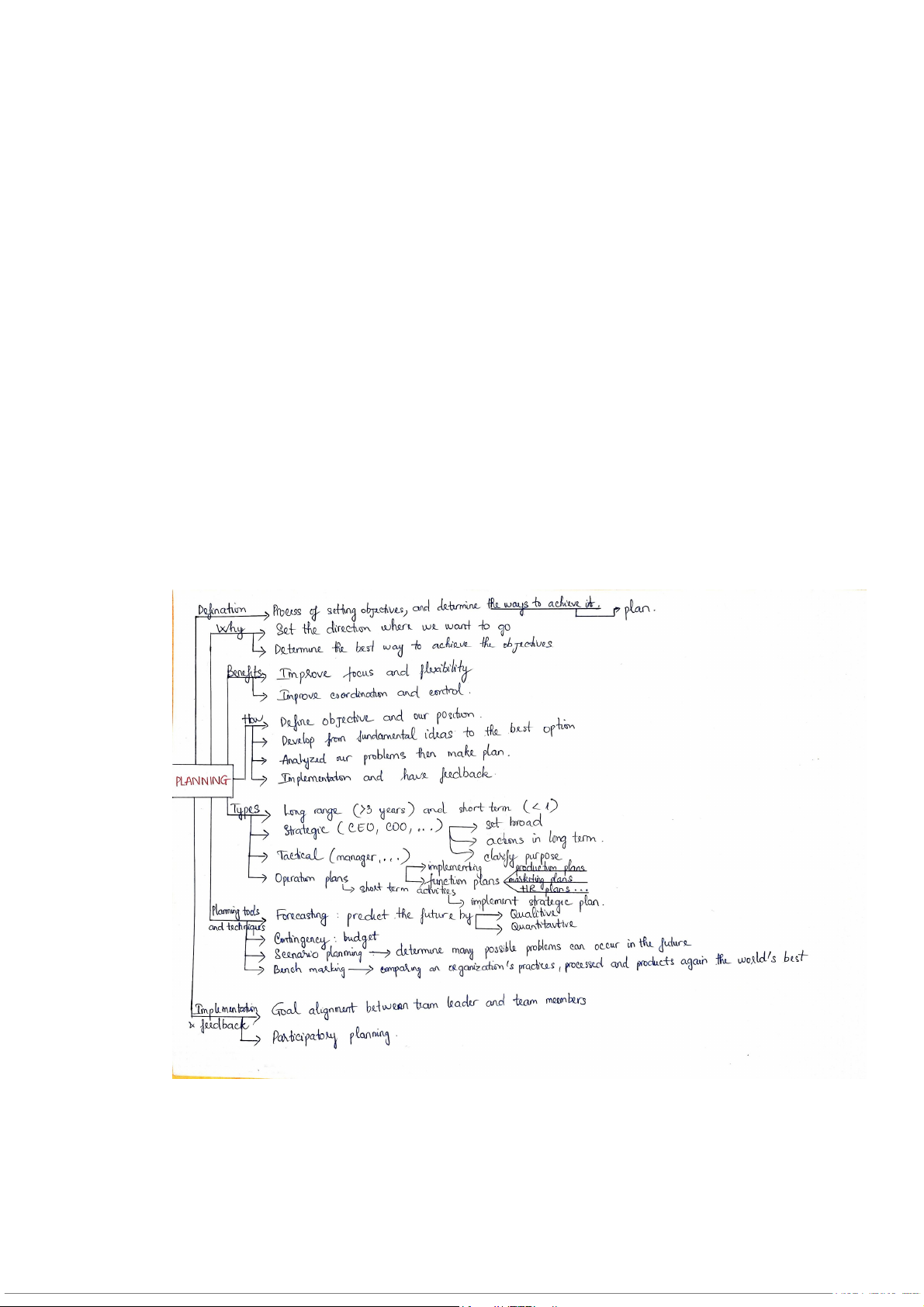
Planning • The process of setting objectives and determining what actions should be
taken to accomplish them (CHAPTER 8) -
Organizing • The process of assigning tasks, allocating resources, and coordinating work activities -
Leading • The process of arousing people’s enthusiasm to work hard and direct their efforts to achieve goals -
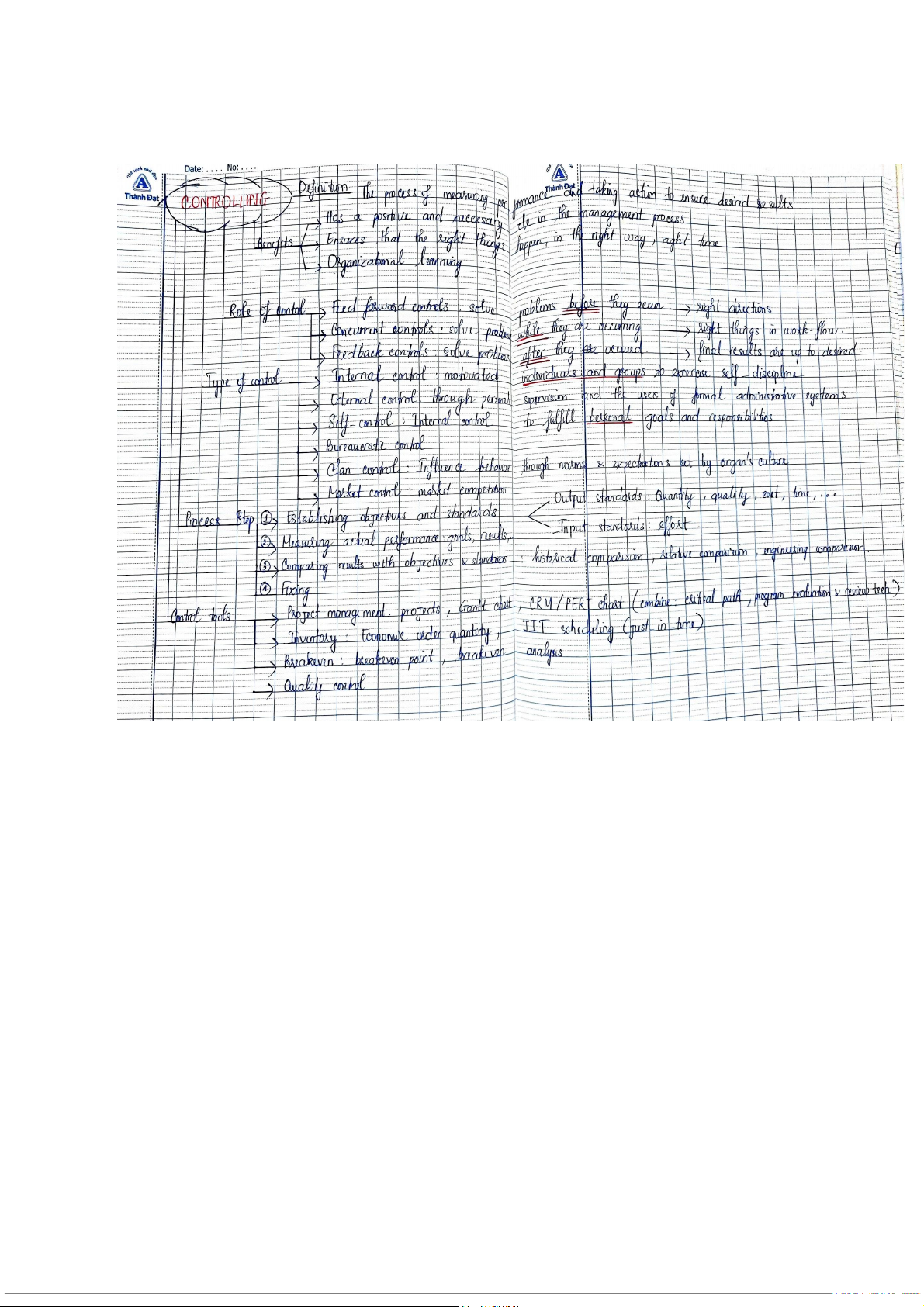
Controlling • The process of measuring work performance and taking action to
ensure desired results (CHAPTER 9) 5. Learning to to manage - Experiences - Opportunities CHAPTER 2: MANAGEMENT
-Taylor-- scientific mana
-Gilbreths-- scientific mana, motion study, reduce tasks and promote efficiency
-Hawthorne-- owner not hor, he is Elton Mayo…, tang giam dk chieu sang khong
anh huong den productivity, luc nao cung tang, vi cong nhan nhan thay ho dang bi
theo doi, anh huong boi supervisor -> laf cha de cua viec can quan tam den
psychology, xem xet ho nhu 1 con nguoi.
-Maslow’s hierarchy-- 5 levels: Physiological needs (basic)
Safety needs ( security and protection => low order needs
Social needs ( love, affection, relationships)
Esteem needs ( respect, prestige, recognition)
Self actualized needs ( self fulfillment, grow creative extent)
-McGregor-- (*) suppose 2 type: X&Y -> theory X (strictly) & theory Y (empower)
+Theory X: dislike work, must be forced or threatened, directed & avoid
responsibility, motivators are fear & money.
+Theory Y: like work, seek goals, perceived rewards, creativity, motivated by rewards.
-Max Weber : Bureaucracy
+ Ideal, intentionally rational and very efficient form of organization
+ Based on principles of logic and legitimate authority l
+ Characteristics of bureaucracy: . Clear division of labour . Clear hierarchy of authority . Formal rules and procedures . Impersonality . Careers based on merit + Disadvantages . Red tape: quan liêu . Slowly handle . Rigidity: cung nhac . Resistance to change . Employee apathy
-Argyris’s theory of adult personality
– Classical management principles and practices inhibit worker maturation and are
inconsistent with the mature adult personality
– Psychological success occurs when people define own goals
– Management practices should accommodate the mature personality by: Increasing
task responsibility, increasing task variety, using participative decision making
CHAPTER 4: Environment, Innovation, and Sustainability
The General or Macro Environment 1. Economic conditions -
overall health of economy in terms of financial markets, inflation, income levels, and job outlook -
Offshoring – outsourcing of jobs to foreign locations -
Reshoring – return of jobs from foreign locations
2. Legal-political conditions: Laws and regulations, government policies, and the
objectives of political parties
3. Sociocultural conditions: norms, customs, demographic,...
4. Technological conditions: social media,...
5. Natural environment conditions
The Specific or Task Environment
1. Stakeholders and value creation 2. Competitive advantage
3. Uncertainty, complexity, and change
Two dimensions of environmental uncertainty: – Degree of complexity – Rate of change
Environmental and Innovation: - process of putting new ideas into practice 1. Types of innovations ● Product innovation ● Process innovation ● Business model innovation 2. The innovation process Step 1: Imagining Step 2: Designing Step 3: Experimenting Step 4: Assessing Step 5: Scaling
3. Disruptive innovation and technology: creates products/services that become so
widely used that they largely replace prior practices and competitors
Environment and Sustainability 1. Sustainable development 2. Sustainable business 3. Human sustainability CHAPTER 5:
Tài liệu liên quan:
-
CHAP 1: Introduction to Management Concepts and Functions môn Principles of Management | Trường Đại học Quốc tế, Đại học Quốc gia Thành phố Hồ Chí Minh
1 1 -
Guidelines for group’s assignments: Analysing management issues of a FDI company based inVietnam môn Principles of Management | Trường Đại học Quốc tế, Đại học Quốc gia Thành phố Hồ Chí Minh
1 1 -
Financial Planning to Achieve 300m VND Goal in 3 Years môn Principles of Management | Trường Đại học Quốc tế, Đại học Quốc gia Thành phố Hồ Chí Minh
1 1 -
A Case Study in Fast Fashion Success môn Principles of Management | Trường Đại học Quốc tế, Đại học Quốc gia Thành phố Hồ Chí Minh
1 1 -
Chap 16 Hierarchy of Needs Theory and Applications môn Principles of Management | Trường Đại học Quốc tế, Đại học Quốc gia Thành phố Hồ Chí Minh
1 1