Stress Management and Workplace Diversity Strategies môn Principle of Management | Trường Đại học Quốc tế, Đại học Quốc gia Thành phố Hồ Chí Minh
Stressisacommonproblememerginginworkplaces.Stresscanbecausedby2 factorsincludingpersonalfactorsandjob-relatedfactors. Tài liệu giúp bạn tham khảo, ôn tập và đạt kết quả cao. Mời đọc đón xem!
Môn: Principles of Management 314 tài liệu
Trường: Trường Đại học Quốc tế, Đại học Quốc gia Thành phố Hồ Chí Minh 2 K tài liệu
Tác giả:















Preview text:
Write a short essay on stress, particularly as it relates to the workplace.
Stress is a common problem emerging in workplaces. Stress can be caused by 2
factors including personal factors and job-related factors. In terms of personal factors,
employees may feel stress due to family, intensive life, and so forth. Besides, there are
five categories of organizational stressors: task demands (job design, working
conditions, and the physical work layout), role demands (created by other employees),
interpersonal demands, organizational structure, and organizational leadership (created
by the supervisory style of the leader). Managers should be sensitive to their employees
and recognize where employees are being stressed to help them go over it. Because
stress negatively affects employees’ productivity which consequently affects the
organization’s performance. Managers can provide some management systems such
as time management system to handle employers’ stress problems in the workplace.
How is workplace diversity beneficial to organizations from a strategic perspective?
Firstly, in terms of strategic perspective, by diversifying the workforce, an organization
can increase its understanding of the marketplace, which improves its ability to develop
products and services that satisfy diverse consumers’ needs. Next, a diversified
workplace helps the company to improve sales growth and increase market share.
Because the company can serve more customers accordingly the sales volume and
profit increase dramatically. In addition, there is apotential source of competitive
advantage because of improved innovation efforts. Many kinds of people can generate
many different ideas and the company can use these as a competitive tool to innovate
its products and create real through-breaking in its field. Finally, diversifying the
workplace is viewed as moral and ethical; the “right” thing to do. Managers should not
discriminate and only select those who managers think are talented based on their
races, colors, shapes, and so on.
Give a brief description of diversity skills training in workplaces.
Diversity training is understood as intentional professional training designed to develop
skills needed to facilitate working and interacting with people from diverse cultural
backgrounds. A diversity training program aims to boost participants' awareness about
different types of diversity, appreciate differences among co-workers, and provide
knowledge and strategies to enhance employees' interpersonal and communication
skills across diversity to help build a positive work environment. At the organization
level, diversity training helps prevent civil rights violations, increases the inclusion of
different identity groups, promotes better teamwork (communication, interaction, and
sympathy), and creates a more inclusive work environment.
Who are whistle-blowers? What can managers do to protect them?
In a business context, whistle-blowers are those who raise ethical concerns or issues in
an organization to managers such as fraud, theft, intentionally disclosing the company’s
secrets and information, and so on. It is important for managers to assure employees
who raise ethical concerns that they will face no personal or career risks. By doing that,
managers can implement strong policies and punishments for any behavior that is
considered as violate or menace. Or the organization creates a secret box where the
employees can freely report problems to managers anonymously. Managers can keep
100% secret and avoid mentioning anything related to the whistle-blowers because if
managers do so, co-workers can easily guest who the whistle-blowers are. On the other
hand, a company must create a culture of “speaking up” and frequently emphasize the
importance of ethics in businesses.
Explain why large organizations are less likely to create disruptive innovations.
Large organizations have sustained revenue and profits. And disruptive innovations
do not always succeed, therefore, large companies tend to maintain their existing
market share and avoid taking risks like that. The markets and customers are
familiar with them in an old function and structure. And if large organizations choose
to create disruptive innovations, it may cause confusion among customers about the
available brand or products and consequently affect the bottom line of the
organization. New products must be costed a lot and take companies many efforts
to develop products into a real “printed-cash machine”, and if the companies do not
handle them well, they can destroy the relationship between the company and
current customers. Moreover, large companies usually have a strong culture, strict
policies, and norms, and such innovations only come in dynamic and borderless
companies (small companies or star-up). Even if large companies try to set up a
team to work in startup mode to create disruptive innovations, their current
organizational structure and culture become a bottleneck for the team members to work effectively.
In a short essay, describe the different classifications of plans.
Organizational plans are often classified into 4 categories: breadth, time frame,
specificity, and frequency of use; and they are connected which each other.In
breadth, the first type of plans are strategic plans, which are followed by everyone in
the organization and stand for the overall goals of the organization; and the second
type is operational plans, which focus on specific departments or areas in the
company. In time frame, long-term plans indicate plans that last longer than 3 years;
while short-term plans last about 1 year or less. In specificity, specific plans stand
for plans that are fixed and cannot be changed or discussed; while directional plans
are flexible with general guidelines and depend on specific situations. In the
frequency of use, a single plan is designed one time to fit with a particular situation;
while standing plans are established to deal with repetitive performances.
For instance, a strategic plan is the company’s big picture. It defines the company’s
goals for a set period of time, whether that’sone year or ten, and ensures that those
goals align with the company’s mission, vision, and values. Therefore, strategic
plans are long-term, directional, and single-use plans. Meanwhile, operational plans
encompass what needs to happen continually, on a day-to-day basis, in order to
execute tactical plans. Operational plans could include work schedules, policies,
rules, or regulations that set standards for employees, as well as specific task
assignments that relate to goals within the tactical strategy, such as a protocol for
documenting and addressing work absences. Accordingly, operational plans are
short-term, specific, and standing.
In ashort essay,discuss the three planning contingency factors that influence
the choice of plans and illustrate how these factors influence planning.
Three contingency factors affect the planning process including the level of the
organization, degree of environmental uncertainty, and length of future commitments.
The planner's level in the organization is likely to determine whether the plan is more
strategic versus more operational. For the most part, operational planning dominates
managers' planning at lower levels of the organization, while at upper levels, planning is
more strategy-oriented. Environmental uncertainty is the second contingency factor.
When uncertainty is high, plans should be specific, but more flexible. Under these
conditions, managers may sometimes need to abandon an existing plan in favor of a
new one. Under low uncertainty, management is more likely to adhere to existing plans.
Lastly, the time frame of existing plans is likely to influence new and emerging plans.
The longer the time frame for which managers must plan, the more current plans affect future commitments.
Is franchising or licensing riskier as an approach when acompany goes international? Why?
Franchising is a strategy where an organization gives another organization the right to
use its name and operating methods, while, listening refers to an organization giving
another organization the right to make or sell its products using its technology or
product specifications. When considering strategic entry into an international market,
licensing is a low-risk and relatively fast foreign market entry. The first reason is certain
nations may not recognize the franchising agreement, which can provide an issue in
terms of protecting and enforcing the agreement. Additionally, licensing agreements are
limited to the shared use of a single technology, brand element, or system, whereas,
franchise agreements involve the complete duplication of a business model, brand, and
system. Thirdly, licensing is low risk in terms of assets and capital investment. The
license will provide the majority of the infrastructure in most situations. Culture and
linguistic barriers are also significant challenges for international entries. Licensing
provides critical resources in this regard, as the licensee has local contacts, mastery of
the local language, and adeep understanding of the local market which effectively drive
the organization to success in international countries in the short run.
Anchoring effect (a decision-making bias) happens very often when we go
shopping, especially when we see a ‘discount’ or ‘sale’. Give and explain an
example to demonstrate anchoring effect. Be specific with numbers.
The anchoring effect is a cognitive bias that describes the common human tendency to
rely too heavily on the first piece of information offered (the “anchor”) when making
decisions. During decision making, anchoring occurs when individuals use an initial
piece of information to make subsequent judgments.
For example, in Starbucks souvenir stores on e-commerce, they apply the anchoring
effect. At first, they will sell a mug with the price of $10 before the flash sale to attract
customers to wait for the discount or choose another of their products with cheaper
prices. However, when the flash sale starts, they sell that mug at half of the previous
price and remain it until 1week before the next flash sale. This effect makes customers
feel that they gain profit because they can acquire a mug with a major discounted price
even though the mug is actually not that much. Therefore, Starbucks can gain profits
from other products and not wait for their customers in the flash sale.
What is feedforward control? Give two potential feedforward controls when you
plan to take your employees on a trip to the beach, and explain why each is necessary.
Feedforward controls involve identifying and preventing anticipated problems in an
organization before they become actual problems. Feedforward controls are proactive
and preventative. Feedforward controls are helpful to managers because they allow a
manager to plan work effectively. In a feed-forward system, the control variable
adjustment is not error-based. Instead, it is based on knowledge about the process in
the form of a mathematical model of the process and knowledge about, or
measurements of, the process disturbances. When the company plan to take
employees on a trip to the beach, managers can apply feedforward by dividing
employees by which bus they are on and arranging rooms in the hotels for each
employee in advance, which can reduce the chaos or unnecessary conflicts when
employees arrive. Moreover, managers should implement rules, and norms to keep a
comfortable environment during the trip.
One characteristic of an innovative organizational culture is that it focuses on
ends rather than means. What does this mean? What can you say to your
employees to show them that you care about ends more than means? Be
specific, write down three things you might actually say (e.g. Let’s do this guys!).
When an organization pursues outcome orientation (focus on ends rather than means),
the managers will focus on the goasl and the results (ends) rather than how their
employees achieve the goals (means). To show the employees that the manager only
cares about ends, the conversation includes some phrases such as “I hope that we can
reach the target by any means”, “I want to tell you that what you’re doing aligns with our
company’s objective.”, and W “ ork smart not hard”.
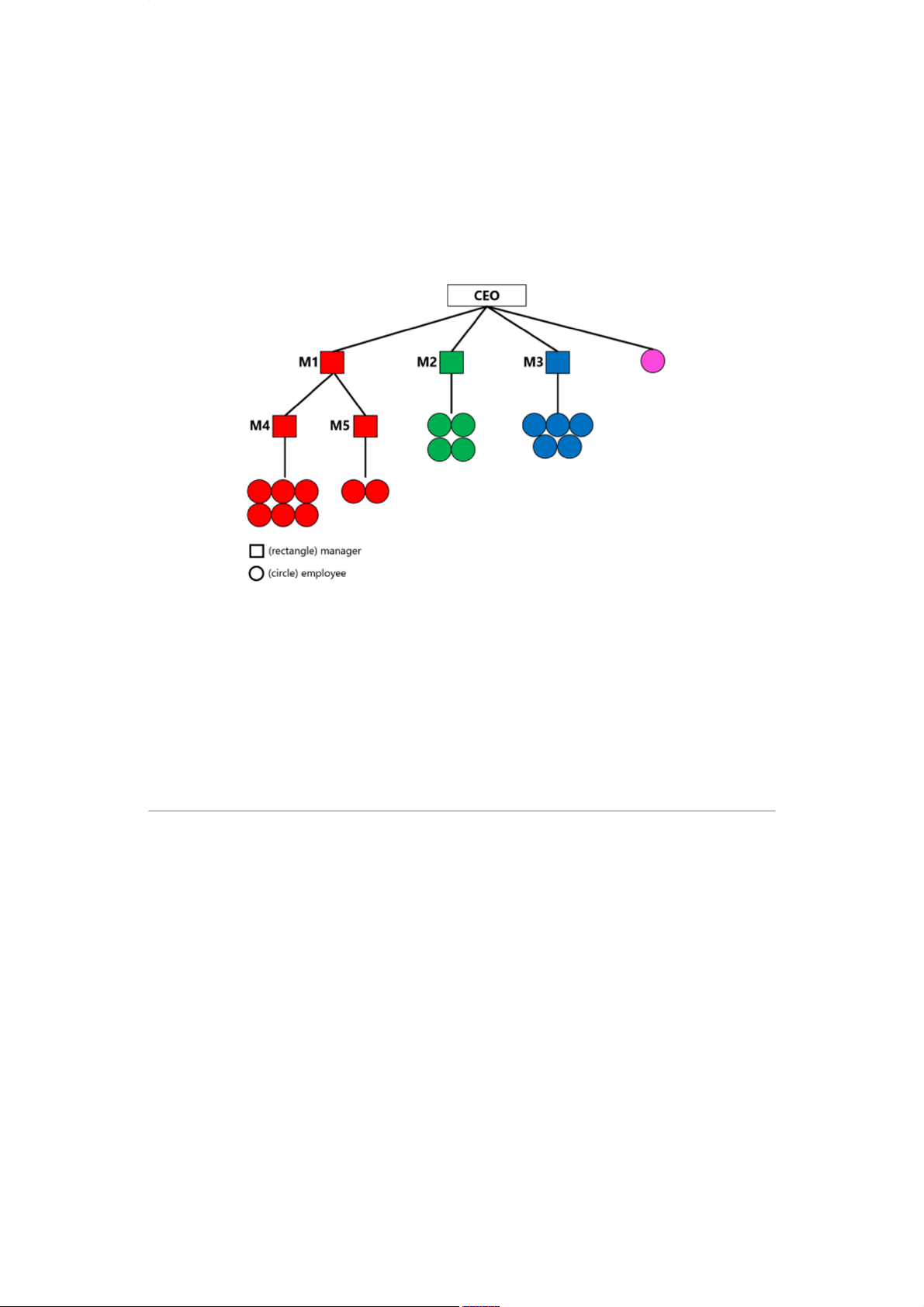
Answer the questions, based on the chart below.The chart illustrates the
structure of avery simple company with three different departments: Red, Green, Blue.
a. In which part(s) of the company is the chain of command shortest? In which
part(s) of the company is the chain of command longest? -
The shortest chain of command: Pink -
The longest chain of command: Red
b. Which manager(s) has the narrowest span of control? Which manager(s) has
the widest span of control? Which manager(s) has aspan of 4. Be careful! Look closely. -
The manager with the narrowest span of control: M5 -
The manager with the widest span of control: CEO -
Which manager(s) has a span of 4: CEO; M2
c. The employee(s) under which manager might have the most trouble talking to
the CEO – assuming they cannot talk to the CEO directly, but rather information
has to be passed through each management level. Why?
The employee(s) under managers M4 and M5 might have the most trouble talking to the
CEO. Because their information has to be passed through 2 managers (M1 and M4 or
M5) to finally reach the CEO. Therefore, the information might be distorted by personal
bias and understandings, or it can not be transferred enough and exactly as the original
one. Moreover, in some cases, the information of employees under managers M4 or
M5 can not be delivered to the CEO due to the disapprovement of either manager (M1
and M4 or M5). For example, the promotional idea following the social trend can
become ineffective if it is not communicated fully and effectively or applied too late to the markets.
d. How would you redesign the structure so that the employee(s) identified in
question (c) above can talk to the CEO more easily? Explain your decision. You
are not allowed to move employees across departments, or promote, or demote, or fire anyone.
To avoid procrastination in transferring information and manage urgent situations well,
the organization should be constructed as an organic structure. The company should
develop cross-functional teams and cross-hierarchical teams in order to stimulate the
exchange of ideas and knowledge among employees and employers. The organic
structure facilitates the free flow of information which minimize the distortion of
information and personal bias which accordingly prevent conflicts. Only if there are
essential problems that significantly affect the company as awhole, employees should
report them before making decisions, otherwise, the company should decentralize the
power and be flexible in solving problems. The company should also create an
all-channel network that allows communication to flow freely among all members of a
work team. So, the information can be shared quickly and accurately.
You own asmall and cozy diner where you also work as the main cook. You need
around 5-7 people to help you run the place.
1. Draw the organizational chart for this restaurant in your own view.
2. In no more than 100 words, explain your chart mentioning at least ONE key
element of organizational structures.
Because my restaurant is small so I choose the organic structure to run my
business. There are 6 positions and 8 staff and they can exchange their work when
necessary. For example, sometimes a dishwasher can be awaiter or waitress. It
seems like there is some formalization here because we have a supervisor,
however, the supervisor is one who makes sure that the customers are served and
food is delivered to the right table. The supervisor can also help the chef or other
employees. Uniform is not necessary for my business. However, to make sure that
the restaurant is working well, employees must be on time (being late about 15-30
minutes is fine because employees can exchange their tasks). Because the
business is small so I highly recommend the flexible environment and work tasks.
You dream of opening asmall, cozy, family-owned diner where you also work as
the main cook. You need around 5-7 people to help you run the place.
1. What type of organizational structure should your restaurant adopt, mechanistic or organic?
2. In no more than 150 words, explain your choice with 3 specific examples
relevant to the restaurant situation.
Because the business is small so I highly recommend the flexible environment and
work tasks (organic structure). Human resource is scarce so work flexibility can
exploit the resource and minimize the expense. It seems like there is some
formalization here because we have a supervisor, however, the supervisor is one
who makes sure that the customers are served and food is delivered to the right
table. The supervisor can also help the chef or other positions. Next, employees
have the power to decide how to solve problems if customers are dissatisfied with
anything in the restaurant such as service and food. Only if necessary and serious,
employees will consult the supervisor or CEO. Finally,the uniform is not necessary
in my business. However, to make sure that the restaurant is working well,
employees must be on time but being late about 15-30 minutes is fine because
employees can exchange their tasks. For example, sometimes a dishwasher can be
a waiter or waitress. In brief, my restaurant structure is organic.
In your own words, explain the concepts of ‘validity’ and ‘reliability’.
1. Give ONE real-life example to demonstrate your understanding of ‘validity’ and ‘reliability’
2. In which function(s) of management do these notions apply?
Note: Examples taken from textbook or lecturers will give 0 pt. Answer should be no more than 100 words.
Reliability and validity are concepts used to evaluate the quality of research. They
indicate how well a method, technique or test measures something. Reliability is the
extent to which the results can be reproduced when the research is repeated under the
same conditions. For example, differing levels of anxiety, fatigue, or motivation may
affect the applicant's test results. Validity is the extent to which the scores from a
measure represent the variable they are intended to. For example, students who have a
GPAof around 3.5-4.0, are defined as outstanding students and smart. While reliability
is about the consistency of a measure, validity is about the accuracy of a measure. The
validity and the reliability are applied in the controlling function of management.
You just started a new term at WSU VN with a class full of new people. You
recently acquainted a few mates over lunch and decided to form a group with
them for most classes projects.
1. What are the potential kinds of conflicts that may arise for this group? Are they all bad?
2. In your own words, define and give a specific example for each of these
types of conflict in this situation.
When forming a group randomly like that, the potential kinds of conflicts that may
happen are task conflicts, relationship conflicts, and process conflicts. First, task conflict
can be understood as every conflict that emerges when team members disagree with
the content and the goals of their work. This type of conflict is not always bad,
sometimes task conflicts can generate more ideas for the team and the best picture that
satisfies all members’ needs (Win-Win). For example, some members may have
different viewpoints and they do not share the same goals on the final outcomes of each
course: some people who have the score at ahigh distinction will be more strict in the
assignment, while someone just wants to pass the course and tend to work with less effort and preparation.
Next, is relationship conflict. It refers to conflicts that are linked with interpersonal
relationships. Because we have not researched or worked together before, so we do not
know whether we get on with teammates. However, no one is perfect, if relationship
conflicts are handled well, they can teammates know each other more and accordingly,
being effective in later assignments. For example, I am an extrovert person and I love to
work with those who are passionate and energetic. And if one of my teammates is
introverted and they rarely share their thoughts, then Iwill be uncomfortable with them
because I think they do not put their effort into projects at all as well as I cannot work
with them because of a major gap in personality.
Finally, process conflict - conflict over which procedures or methods the group should
use to complete the tasks. To me, this is a normal conflict, because everyone has a
different perspective therefore, our points of view also vary significantly. Recognizing
this, the team can turn these conflicts into opportunities to create the best performance
by using diverse ideas and methods. For example, the lecturer gives an essay
assignment and requires teams to deeply research a brand. Some members have
agreed that everyone has to research everything about the brand and in the next
meeting team members will raise ideas and knowledge together and choose which one
is used in the essay. However, some members assume that the research should be
divided into small parts and each member is responsible for each part is the best method.
As a team leader,if you have to give up one of the two following factors: Mutual
trust or relevant skills, what would you choose? In no more than 150 words,
justify your choice with specific exemplary situations.
If I have to give up one of the two following factors: mutual trust or relevant skills, I
would choose relevant skills. Because a leader is not required to be an expert in a
specific field, rather than that, aleader is who can coordinate team members together
and communicate effectively to persuade the members strongly commit to the team.
Mutual trust is a critical factor that contributes to the team's effectiveness. To be more
specific, without mutual trust, members will be hesitant to share information, knowledge,
and innovative ideas with each other. Consequently, the work process will be slowed
down and inefficient. Moreover, mutual trust can help the leader know what is going on
among team members and solve interpersonal conflicts as quickly as possible to
maintain harmonious relationships and interactions which positively affect the team’s
performance. For example, in the manufacturing industry, when a manager decides to
add more features to the existing products to attract consumers, and if employees do
not trust their manager, they will hardly accept the idea and change to innovate.
Consequently, the company will be driven out of the market due to obsolete and does not satisfy customers much.
Tài liệu liên quan:
-
CHAP 1: Introduction to Management Concepts and Functions môn Principles of Management | Trường Đại học Quốc tế, Đại học Quốc gia Thành phố Hồ Chí Minh
8 4 -
Guidelines for group’s assignments: Analysing management issues of a FDI company based inVietnam môn Principles of Management | Trường Đại học Quốc tế, Đại học Quốc gia Thành phố Hồ Chí Minh
8 4 -
Financial Planning to Achieve 300m VND Goal in 3 Years môn Principles of Management | Trường Đại học Quốc tế, Đại học Quốc gia Thành phố Hồ Chí Minh
9 5 -

A Case Study in Fast Fashion Success môn Principles of Management | Trường Đại học Quốc tế, Đại học Quốc gia Thành phố Hồ Chí Minh
9 5 -
Chap 16 Hierarchy of Needs Theory and Applications môn Principles of Management | Trường Đại học Quốc tế, Đại học Quốc gia Thành phố Hồ Chí Minh
10 5