Understanding the Planning Process and Its Benefits môn Principle of Management | Trường Đại học Quốc tế, Đại học Quốc gia Thành phố Hồ Chí Minh
Planning is the process of setÝng performance objectives and determining what should be done to accomplish them. The benefits of planning include better focus and flexibility, action orientation, coordination, control, and time management. Tài liệu giúp bạn tham khảo, ôn tập và đạt kết quả cao. Mời đọc đón xem!
Môn: Principles of Management 314 tài liệu
Trường: Trường Đại học Quốc tế, Đại học Quốc gia Thành phố Hồ Chí Minh 2 K tài liệu
Tác giả:






Preview text:
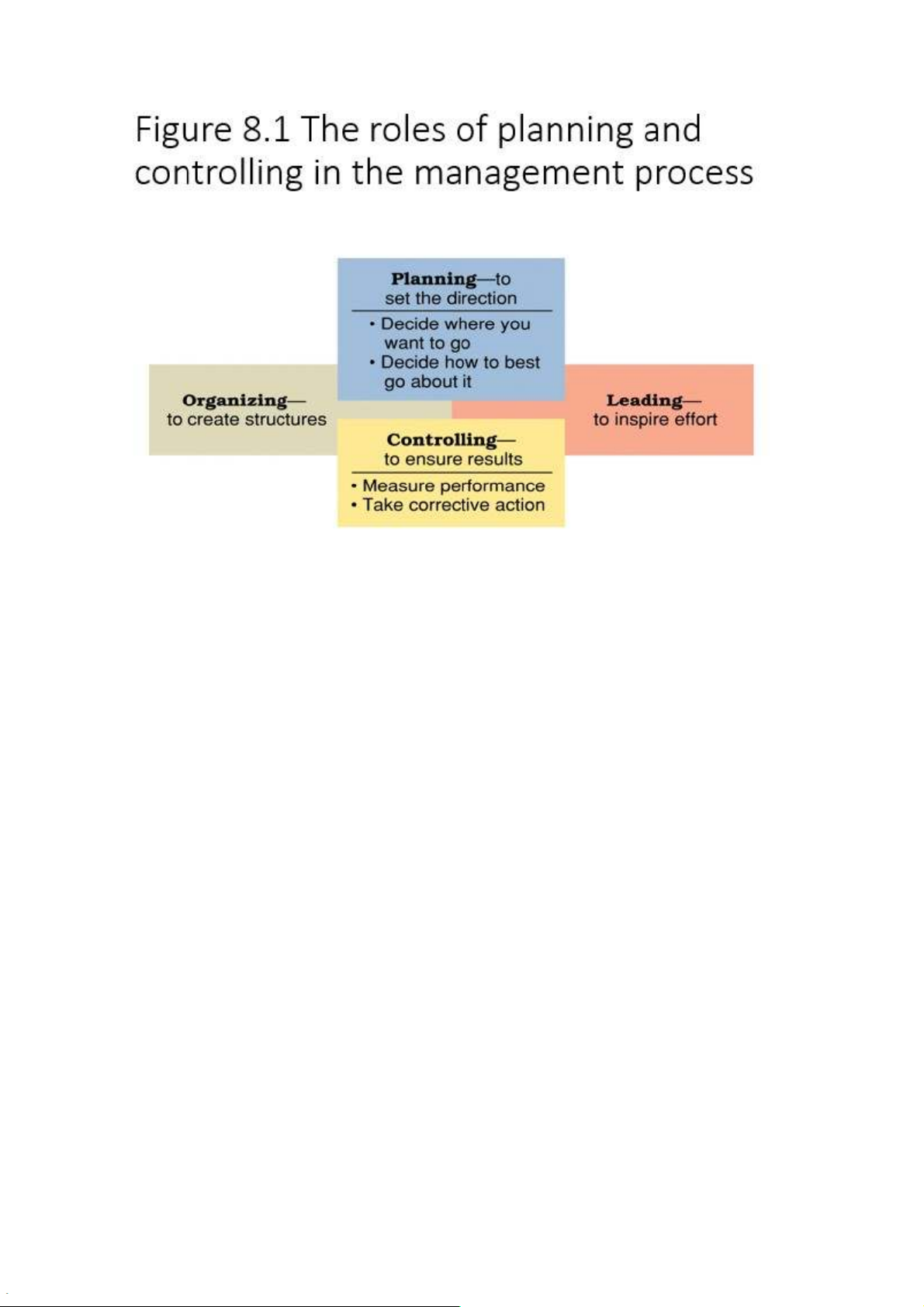
Understand the roles and benefits of planning
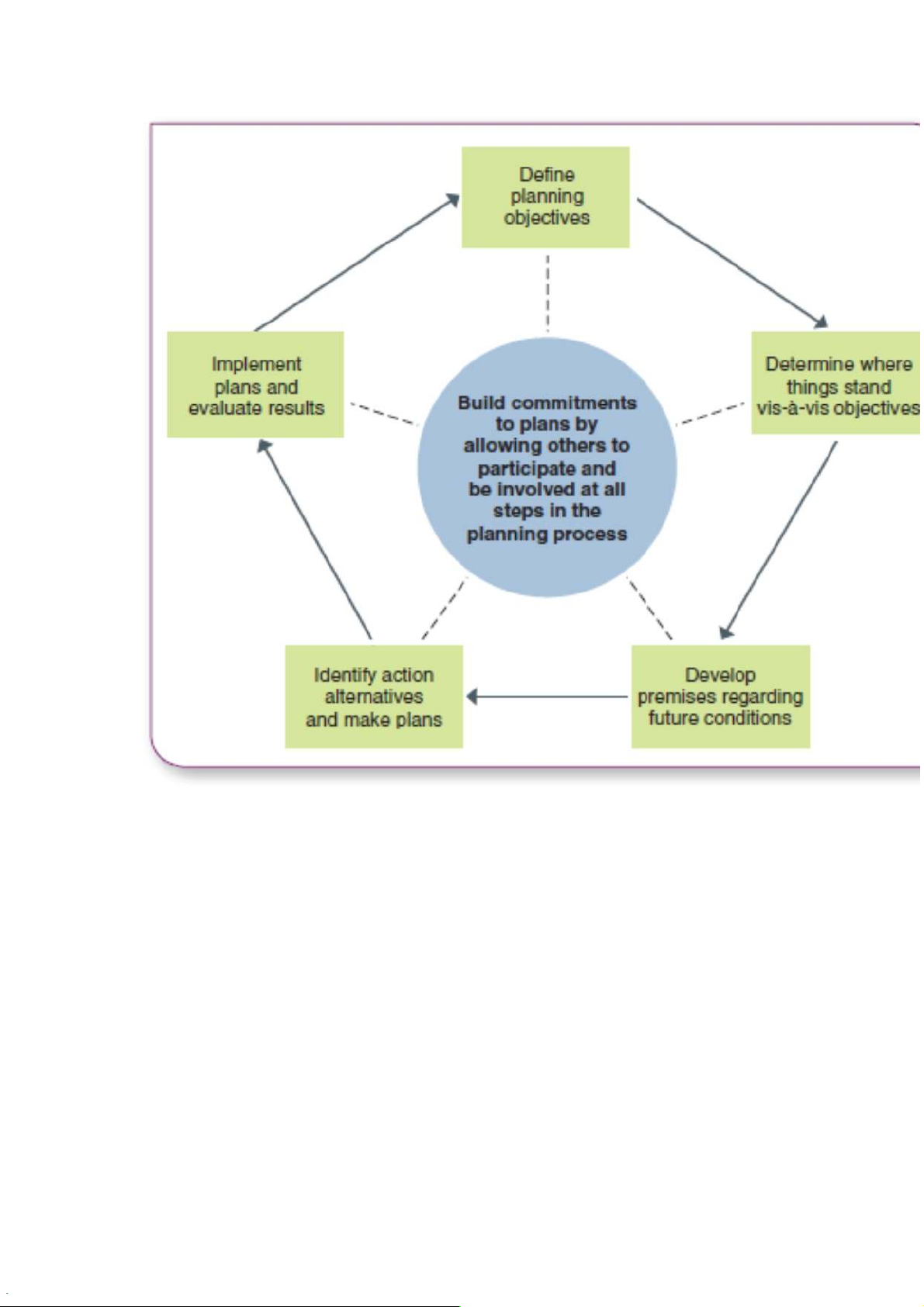
Understand planning process
Identify types of plans managers use
Understand planning tools and techniques
Understand the implementation of plans to achieve results SUMMARY
-Planning is the process of setÝng performance objectives and determining what
should be done to accomplish them. The benefits of planning include better focus and
flexibility, action orientation, coordination, control, and time management.
-Short-range plans tend to cover a year or less; long-range plans extend up to three
years or more. Types of plans managers used include strategic plans, policies,
procedures, and budgets.
-The useful tools and techniques for planning include forecasting, contingency plans,
scenario planning, benchmarking, and staff planners.
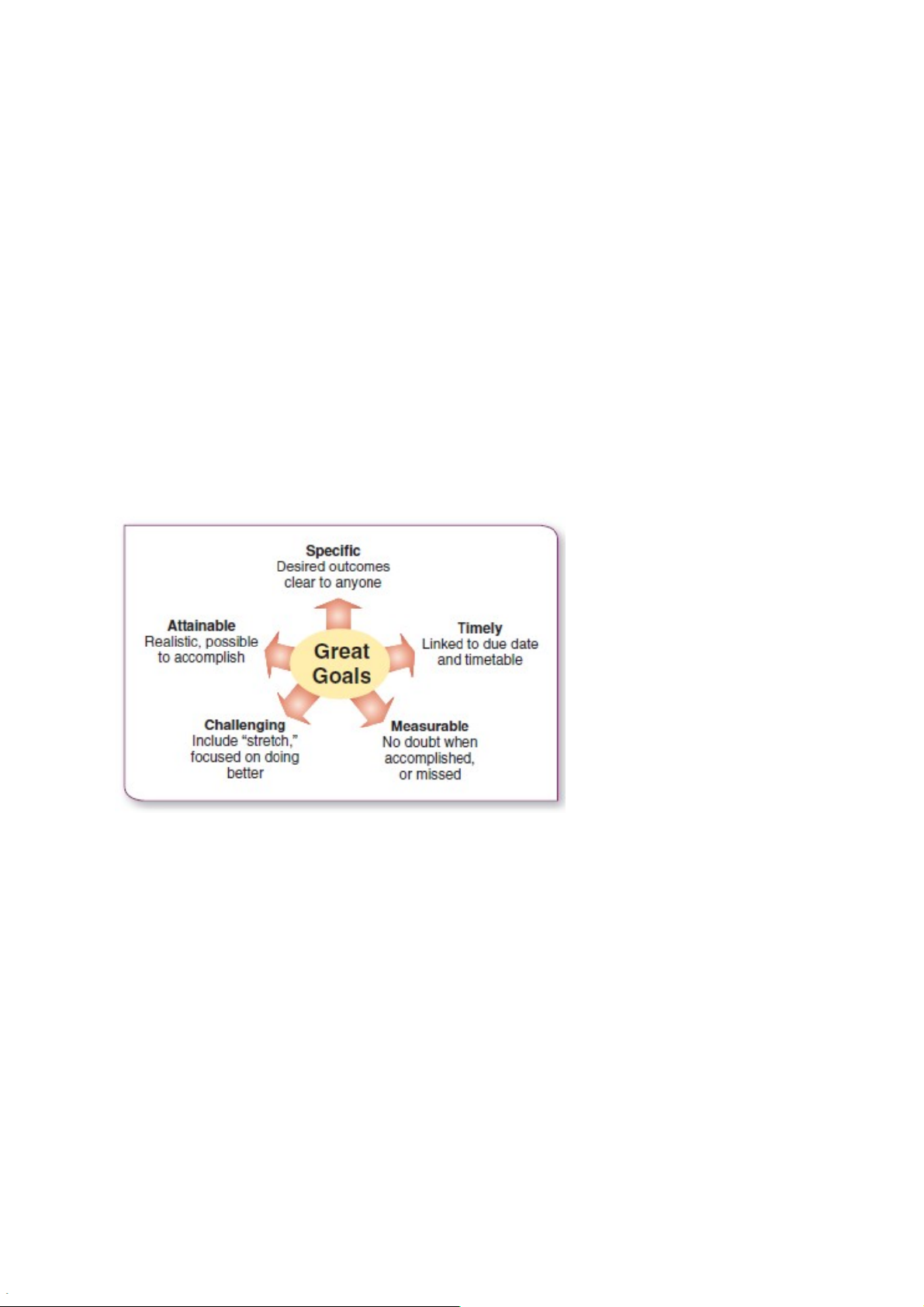
-The plans will be well implemented by setÝng great goals, having goals alignment,
and increasing workers’ participation and involvement.
KEY CONCEPTS – CÁC KHÁI NIỆM CHÍNH
OBJECTIVES AND GOALS - Kết quả cụ thể cần đạt được - Identify the specific results
or desired outcomes that one intends to achieve.
PLAN - Tập hợp các bước hành động để hoàn thành mục tiêu - a statement of action
steps to be taken in order to accomplish the objectives.
PLANNING - Quá trình xác định mục tiêu và cách thực hiện chúng - The process of
setÝng objectives and determining how to accomplish them. PLANNING PROCESS
-Define your objectives (Xác định mục tiêu) – Đặt ra các kết quả cụ thể hoặc kết quả mong muốn đạt được.
-Determine where you stand vis-à-vis objectives (Xác định vị trí hiện tại so với mục
tiêu) – Đánh giá tình hình hiện tại, bao gồm điểm mạnh, điểm yếu, cơ hội và thách thức.
-Develop premises regarding future conditions (Phát triển các giả định về điều kiện
tương lai) – Xây dựng các kịch bản và giả định để dự đoán tương lai.
-Analyze alternatives and make a plan (Phân tích các phương án và lập kế hoạch) –
Xem xét các lựa chọn khác nhau, so sánh lợi ích và rủi ro, sau đó xây dựng kế hoạch phù hợp.
-Implement the plan and evaluate results (Thực hiện kế hoạch và đánh giá kết quả) –
Triển khai kế hoạch, theo dõi tiến độ và điều chỉnh nếu cần thiế BENEFITS OF PLANNING Improve focus and flexibility Improves action orientation
Improves coordination and control Improves time management PERSONAL TIME MANAGEMENT TIPS
Do say “no” to requests that distract from what you should be doing – nói ko vs yêu cầu làm phân tâm
Don’t get bogged down in details that can be addressed later – ko sa đà vào tiểu tiết ko qtrong
Do screen telephone calls, emails, and meetig requests. – lọc cuộc goi,..
Don’t let drop-in visitors instant messaging use up your time - Không để khách ghé
thăm hoặc tin nhắn làm mất thời gian
Do prioritize your important and urgent work - Ưu tiên công việc quan trọng và cấp bách
DO follow priorities; do most important and urgent work first - Tuân thủ theo thứ tự
ưu tiên, làm việc quan trọng trước TYPES OF PLAN USED BY MANAGERS a) Theo thời gian
-Long-term plans look three or more years into the future
-Short-term plans typically cover one year or less b) Theo phạm vi áp dụng
-Strategic plans — set broad, comprehensive, and longer-term action directions for
the entire organization. hướng đi dài hạn
-Tactical plan – helps to implement all or parts of the strategic plan triển khai một phần hoặc toàn bộ
-Functional plans – indicate how different operations within the organization will help
accomplish the overall strategy các bộ phận cụ thể đóng góp + Production plans + Financial plans + Facilities plans + Logistic plans + Marketing plans + Human resource plans
c) Theo cách thức thực hiện
+ Operational plans – identify short-term activities to implement strategic plans
oPolicies are standing plans the communicate duidelines for decisions
oProcedures are rules that describe actions to be taken in specific situations
oBudgets are plans the commit resources to projects or activities.
-Vision – clarifies purpose of the organization and what it hopes to be in the future.
JAQUES’S FINDINGS ON PLANNING HORIZONS - Phát hiện của Jaques về thời gian lập kế hoạch
Most of us : 3-month time frame
A few of us : 1 year time frame
Very few of us : 20-year time frame PLANNING TOOLS AND TECNICHQUES -Forecasting (dự báo)
oAttempts to predict the future
oQualitative forecasting uses expert opinions
oQuantitative forecasting uses mathematical models and statistical analysis of historical data and surveys
-Contingency planning (kế hoạch dự phòng)
oIdentyfing alternative courses of action to take when things go wrong
oContingency plans anticipate changing conditions
oContingency plans contain trigger points (điểm kích hoạt để quyết định khi
nào chuyển sang phương án dự phòng)
-Scenario planning (lập kế hoạch theo kịch bản)
oA long-term version of contingency planning
oIdentifying alternative future scenarios
oPlans made for each future scenario
oIncreases organization’s flexibility and preparation for future shocks
-Benchmarking (đối chiếu chuẩn mực)
oUse of external and internal comparisons to plan for future improvements
oAdopting best practices: things people and organizations do that lead to superior performance
oStaff planners assist in all steps of the planning process
IMPLEMENTING PLAN TO ACHIEVE RESULTS 1. Goal setÝng
2. Goal alignment – căn chỉnh mục tiêu
•Goals and plans are well integrated across the many people, work units, and levels of an organization as a whole
•Goals set everywhere in the organization should ideally help advance its overall mission or purpose
•In a hierarchy of goals or hierarchy of objectives, lower-level goals and objectives are
means to accomplishing higher-level ones. Mục tiêu thấp hỗ trợ đạt mục tiêu cao
Goal Alignment Between Team Leader and Team Member
Jointly plan (lập kế hoạch chung): set objectives, set standards, choose actions
Individually set (thực hiện nhiệm vụ cá nhân) perform tasks (member), provide support (leader)
Jointly control (kiểm soát chung) review results, discuss implications, renew cycle
3. Participation and involvement – tham gia và gắn kết
Unlocks the motivational potential of goal setÝng
Management by objectives (MBO) promotes participation
When participation is not possible, workers will respond positively if supervisory trust and support exist
-Khi nhân viên được tham gia vào quá trình lập mục tiêu, họ có động lực hơn để hoàn thành công việc.
-Quản lý theo mục tiêu (Management by Objectives - MBO) giúp thúc đẩy sự tham gia và tăng trách nhiệm.
-Nếu không thể cho nhân viên tham gia trực tiếp vào việc đặt mục tiêu, sự tin tưởng
và hỗ trợ từ cấp trên sẽ giúp họ chấp nhận và thực hiện tốt hơn. Ví dụ:
🔹 Nếu một công ty yêu cầu nhân viên làm thêm giờ nhưng không có sự giải thích rõ ràng,
nhân viên có thể phản ứng tiêu cực. Nhưng nếu cấp quản lý chân thành giao tiếp và hỗ trợ,
nhân viên sẽ dễ dàng chấp nhận thử thách hơn.
Tài liệu liên quan:
-
CHAP 1: Introduction to Management Concepts and Functions môn Principles of Management | Trường Đại học Quốc tế, Đại học Quốc gia Thành phố Hồ Chí Minh
6 3 -
Guidelines for group’s assignments: Analysing management issues of a FDI company based inVietnam môn Principles of Management | Trường Đại học Quốc tế, Đại học Quốc gia Thành phố Hồ Chí Minh
6 3 -
Financial Planning to Achieve 300m VND Goal in 3 Years môn Principles of Management | Trường Đại học Quốc tế, Đại học Quốc gia Thành phố Hồ Chí Minh
6 3 -

A Case Study in Fast Fashion Success môn Principles of Management | Trường Đại học Quốc tế, Đại học Quốc gia Thành phố Hồ Chí Minh
6 3 -
Chap 16 Hierarchy of Needs Theory and Applications môn Principles of Management | Trường Đại học Quốc tế, Đại học Quốc gia Thành phố Hồ Chí Minh
7 4