Unilever Organizational Structure Analysis - POM Course môn Principles of Management | Trường Đại học Quốc tế, Đại học Quốc gia Thành phố Hồ Chí Minh
Unilever, a worldwide consumer goods company, employs a sophisticated and adaptable organizational structure to effectively manage its global operations. The corporation has a matrix organization that combines functional units and product divisions, allowing for specialization and effective management of a diverse product portfolio. Tài liệu giúp bạn tham khảo, ôn tập và đạt kết quả cao. Mời đọc đón xem!
Môn: Principles of Management 314 tài liệu
Trường: Trường Đại học Quốc tế, Đại học Quốc gia Thành phố Hồ Chí Minh 2 K tài liệu
Tác giả:



Preview text:
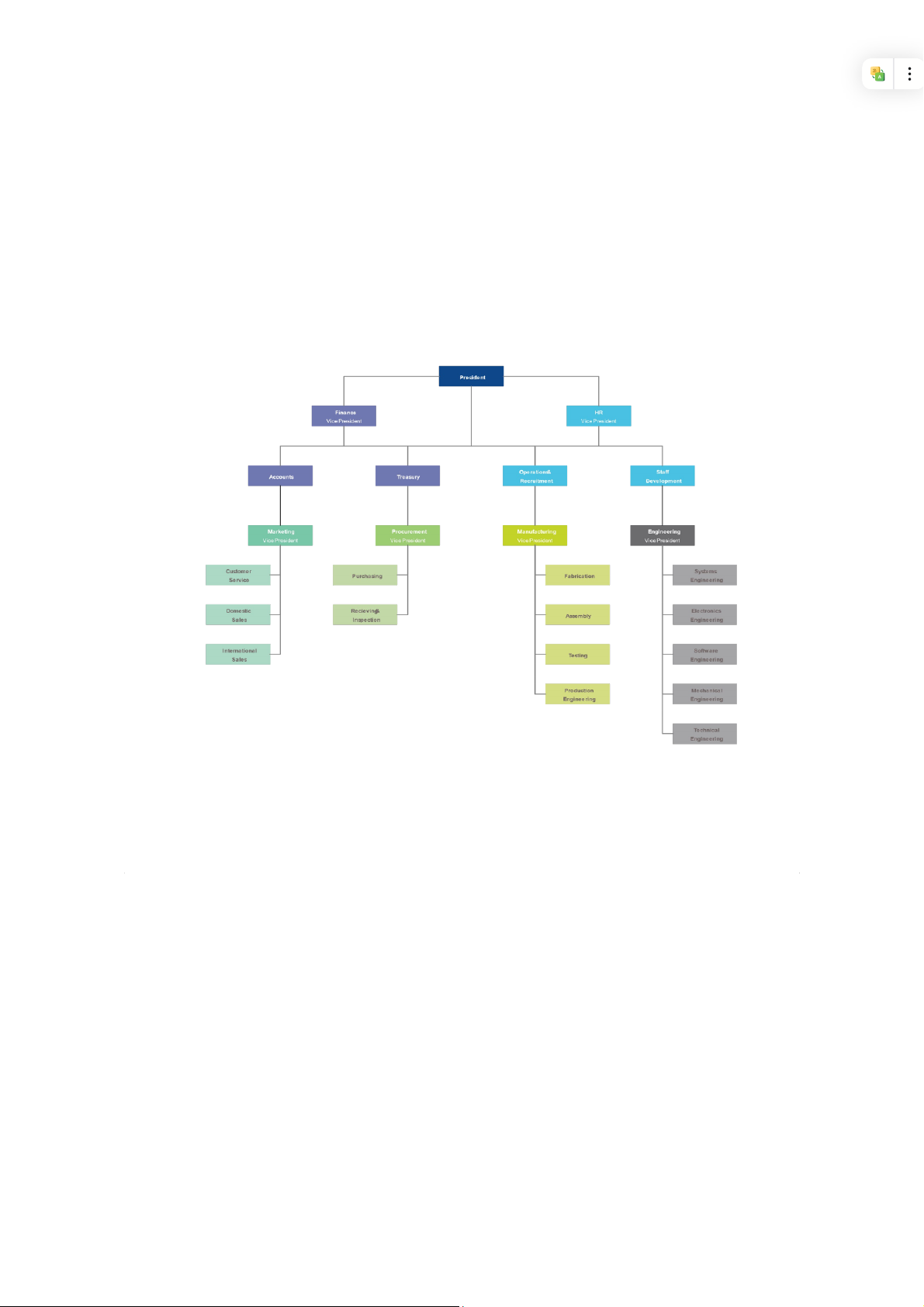
Unilever, a worldwide consumer goods company, employs a sophisticated and adaptable
organizational structure to effectively manage its global operations. The corporation has a matrix
organization that combines functional units and product divisions, allowing for specialization
and effective management of a diverse product portfolio. Unilever's products are organized into
three categories: beauty and personal care, food and refreshments, and home care. Each division
is in charge of creating, manufacturing, and selling its products. Furthermore, the corporation
splits its activities into geographic regions such as North America, Europe, Asia/AMET/RUB,
and Latin America, with separate regional management teams to react to the needs and features
of each local market. Product and regional departments are supported by functional departments
such as marketing, sales, supply chain, finance, human resources, and research and development.
This structure enables Unilever to strike a balance between global operational efficiency and the
flexibility to respond to local markets, all while ensuring transparency and accountability in corporate governance.
Unilever's structure is designed to successfully manage large-scale operations while combining
global efficiency and local responsiveness. The matrix structure simplifies operations and
ensures that each product division and regional segment may operate efficiently while relying on
core corporate functions for support. This structure allows Unilever to remain a major participant
in the fast-moving consumer goods (FMCG) business.
Unilever's organizational structure has numerous benefits, but it also has certain drawbacks. In
terms of benefits, Unilever's matrix structure enables specialization and effective management
across several products and markets. This allows the corporation to make the best use of its
resources and specialization while also responding promptly to local demands through regional
management teams. This adaptability enables Unilever to maintain a strong competitive position
and consistently innovate in the fast-paced consumer goods market. However, this structure has
negative consequences, such as increased complexity and the possibility of disputes between
functional departments and products. Complexity can contribute to slower decision-making and
higher management costs. Furthermore, coordination across units can be challenging, resulting in
disagreements over priorities and resources. In conclusion, while Unilever's organizational
structure has numerous advantages in terms of efficiency and flexibility, it also necessitates tight
supervision to avoid potential risks.
Tài liệu liên quan:
-
CHAP 1: Introduction to Management Concepts and Functions môn Principles of Management | Trường Đại học Quốc tế, Đại học Quốc gia Thành phố Hồ Chí Minh
15 8 -
Guidelines for group’s assignments: Analysing management issues of a FDI company based inVietnam môn Principles of Management | Trường Đại học Quốc tế, Đại học Quốc gia Thành phố Hồ Chí Minh
15 8 -
Financial Planning to Achieve 300m VND Goal in 3 Years môn Principles of Management | Trường Đại học Quốc tế, Đại học Quốc gia Thành phố Hồ Chí Minh
12 6 -
A Case Study in Fast Fashion Success môn Principles of Management | Trường Đại học Quốc tế, Đại học Quốc gia Thành phố Hồ Chí Minh
15 8 -
Chap 16 Hierarchy of Needs Theory and Applications môn Principles of Management | Trường Đại học Quốc tế, Đại học Quốc gia Thành phố Hồ Chí Minh
15 8