Warehouse Management: Procedures & Methods | Logistics | Trường Đại học Kinh tế, Đại học Quốc gia Hà Nội
Tài liệu được sưu tầm và soạn thảo dưới dạng file PDF với mục đích hỗ trợ học tập và tham khảo. Nội dung tài liệu được trình bày rõ ràng, dễ tiếp cận, phù hợp cho việc ôn tập và củng cố kiến thức trong quá trình học đại học. Đây sẽ là nguồn tư liệu hữu ích giúp các bạn sinh viên chuẩn bị tốt hơn cho các buổi học, đồng thời mở rộng thêm hiểu biết về môn học. Hy vọng tài liệu này sẽ mang lại nhiều giá trị và hỗ trợ các bạn trong hành trình học tập. Mời bạn đọc cùng tham khảo!
Môn: Logistics 61 tài liệu
Trường: Trường Đại học Kinh tế, Đại học Quốc gia Hà Nội 491 tài liệu
Tác giả:



Preview text:
46
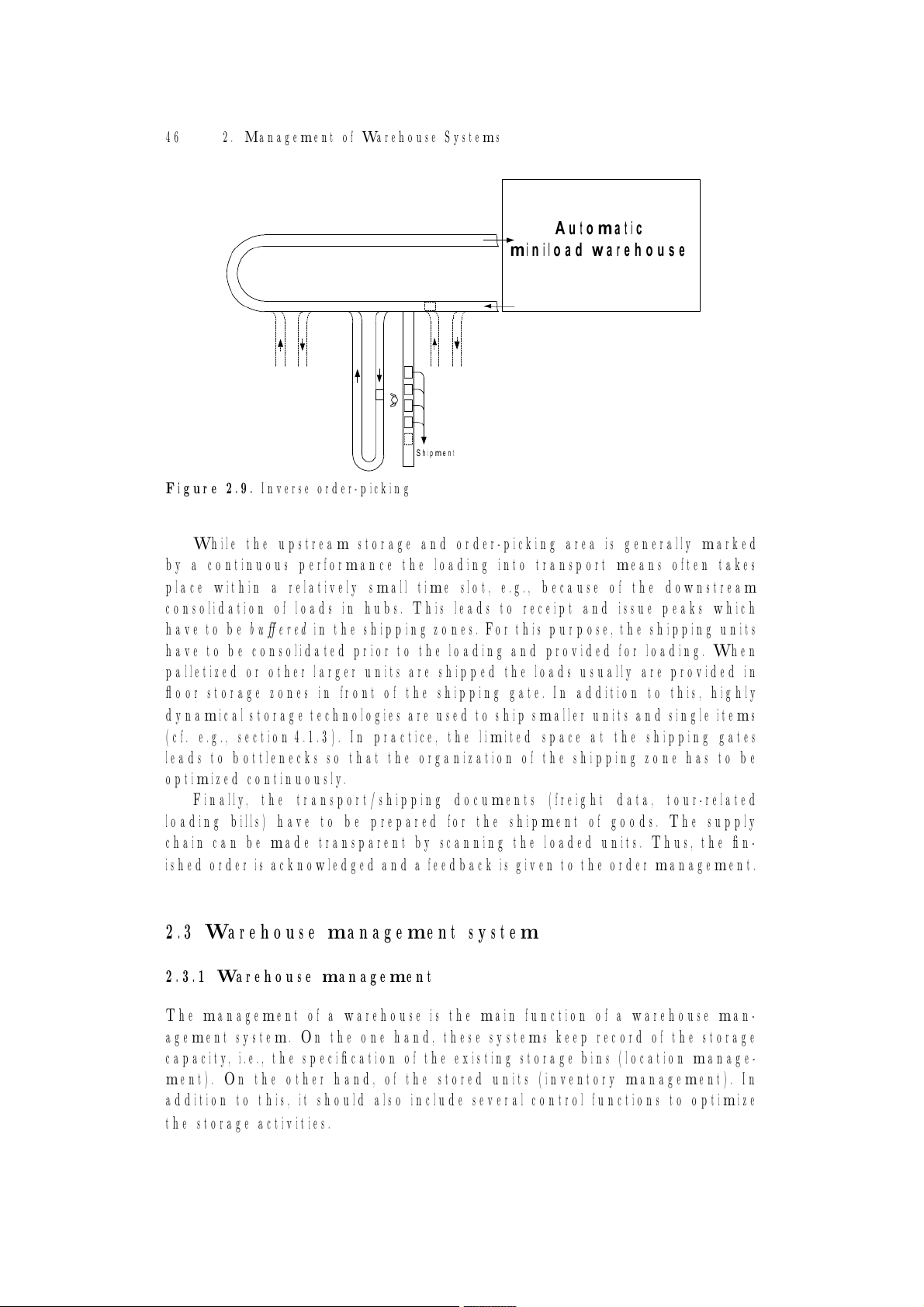
2. Management of Warehouse Systems Automatic miniload warehouse Shipment
Figure 2.9. Inverse order-picking
While the upstream storage and order-picking area is generally marked
by a continuous performance the loading into transport means often takes
place within a relatively small time slot, e.g., because of the downstream
consolidation of loads in hubs. This leads to receipt and issue peaks which
have to be buffered in the shipping zones. For this purpose, the shipping units
have to be consolidated prior to the loading and provided for loading. When
palletized or other larger units are shipped the loads usually are provided in
floor storage zones in front of the shipping gate. In addition to this, highly
dynamical storage technologies are used to ship smaller units and single items
(cf. e.g., section 4.1.3). In practice, the limited space at the shipping gates
leads to bottlenecks so that the organization of the shipping zone has to be optimized continuously.
Finally, the transport/shipping documents (freight data, tour-related
loading bills) have to be prepared for the shipment of goods. The supply
chain can be made transparent by scanning the loaded units. Thus, the fin-
ished order is acknowledged and a feedback is given to the order management.
2.3 Warehouse management system 2.3.1 Warehouse management
The management of a warehouse is the main function of a warehouse man-
agement system. On the one hand, these systems keep record of the storage
capacity, i.e., the specification of the existing storage bins (location manage-
ment). On the other hand, of the stored units (inventory management). In
addition to this, it should also include several control functions to optimize the storage activities.
2.3 Warehouse management system 47
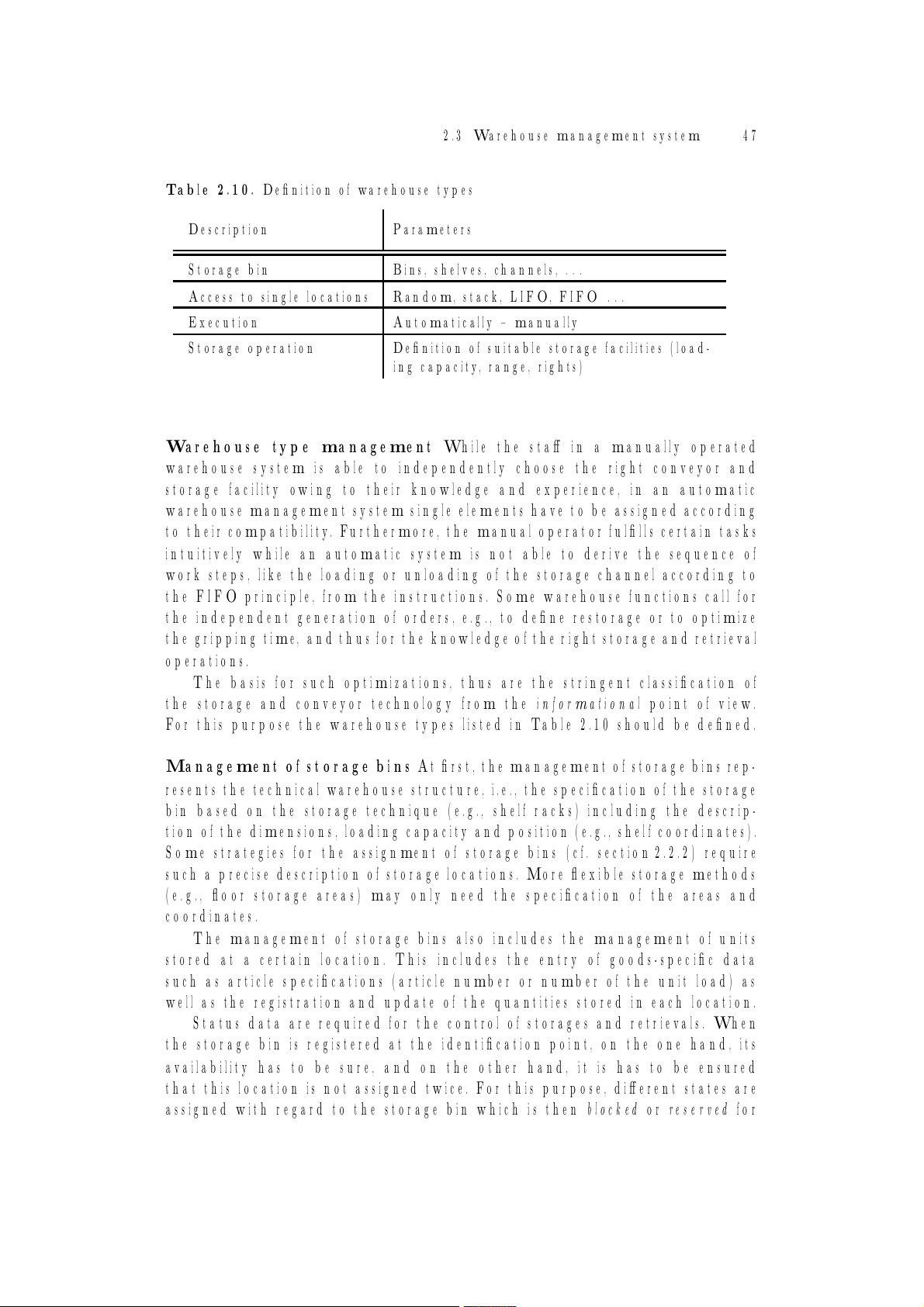
Table 2.10. Definition of warehouse types Description Parameters Storage bin Bins, shelves, channels, . . . Access to single locations
Random, stack, LIFO, FIFO . . . Execution Automatically – manually Storage operation
Definition of suitable storage facilities (load- ing capacity, range, rights)
Warehouse type management While the staff in a manually operated
warehouse system is able to independently choose the right conveyor and
storage facility owing to their knowledge and experience, in an automatic
warehouse management system single elements have to be assigned according
to their compatibility. Furthermore, the manual operator fulfills certain tasks
intuitively while an automatic system is not able to derive the sequence of
work steps, like the loading or unloading of the storage channel according to
the FIFO principle, from the instructions. Some warehouse functions call for
the independent generation of orders, e.g., to define restorage or to optimize
the gripping time, and thus for the knowledge of the right storage and retrieval operations.
The basis for such optimizations, thus are the stringent classification of
the storage and conveyor technology from the informational point of view.
For this purpose the warehouse types listed in Table 2.10 should be defined.
Management of storage bins At first, the management of storage bins rep-
resents the technical warehouse structure, i.e., the specification of the storage
bin based on the storage technique (e.g., shelf racks) including the descrip-
tion of the dimensions, loading capacity and position (e.g., shelf coordinates).
Some strategies for the assignment of storage bins (cf. section 2.2.2) require
such a precise description of storage locations. More flexible storage methods
(e.g., floor storage areas) may only need the specification of the areas and coordinates.
The management of storage bins also includes the management of units
stored at a certain location. This includes the entry of goods-specific data
such as article specifications (article number or number of the unit load) as
well as the registration and update of the quantities stored in each location.
Status data are required for the control of storages and retrievals. When
the storage bin is registered at the identification point, on the one hand, its
availability has to be sure, and on the other hand, it is has to be ensured
that this location is not assigned twice. For this purpose, different states are
assigned with regard to the storage bin which is then blocked or reserved for 48
2. Management of Warehouse Systems
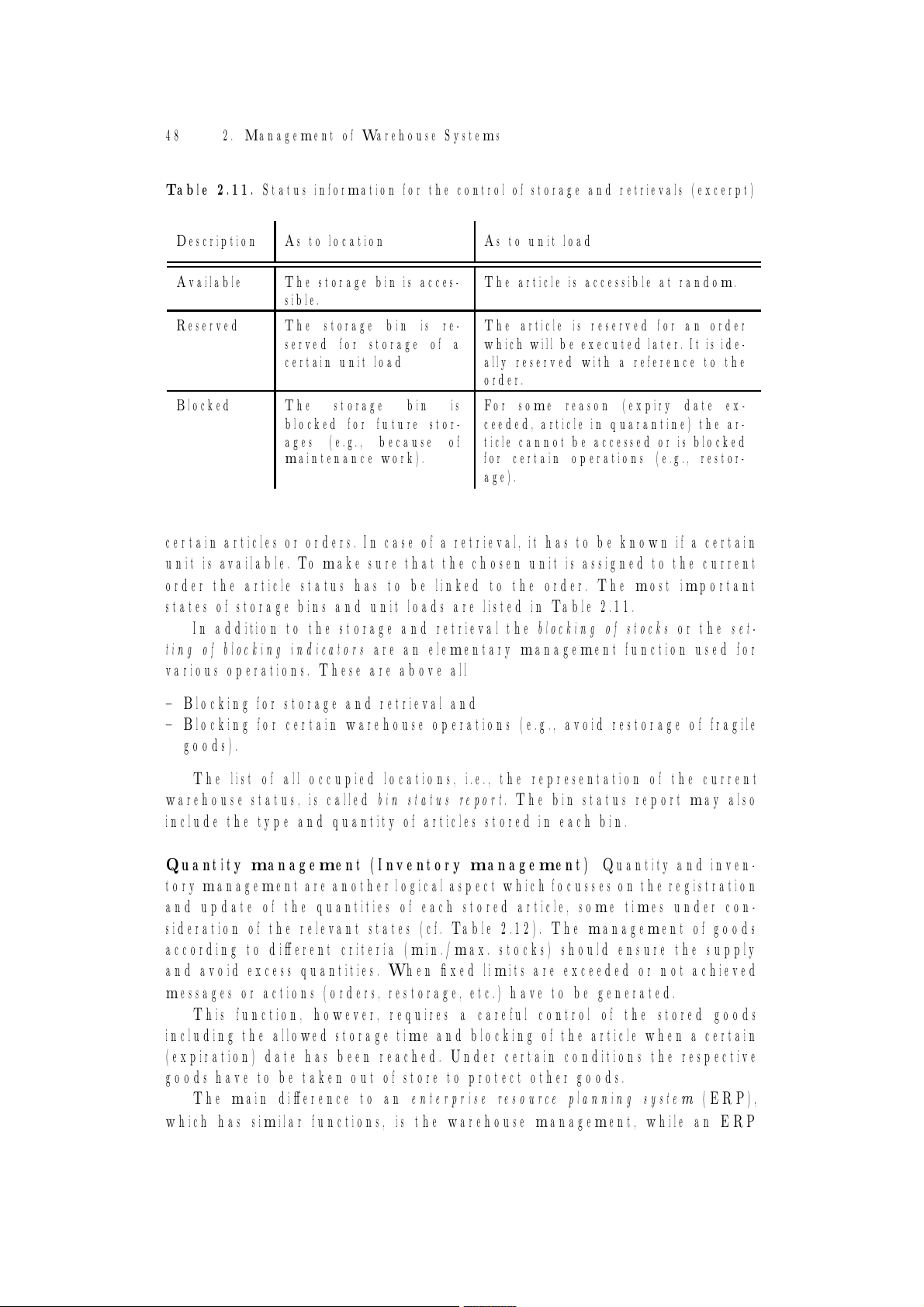
Table 2.11. Status information for the control of storage and retrievals (excerpt) Description As to location As to unit load Available The storage bin is acces-
The article is accessible at random. sible. Reserved The storage bin is re-
The article is reserved for an order served for storage of a
which will be executed later. It is ide- certain unit load
ally reserved with a reference to the order. Blocked The storage bin is
For some reason (expiry date ex- blocked for future stor-
ceeded, article in quarantine) the ar- ages (e.g., because of
ticle cannot be accessed or is blocked maintenance work).
for certain operations (e.g., restor- age).
certain articles or orders. In case of a retrieval, it has to be known if a certain
unit is available. To make sure that the chosen unit is assigned to the current
order the article status has to be linked to the order. The most important
states of storage bins and unit loads are listed in Table 2.11.
In addition to the storage and retrieval the blocking of stocks or the set-
ting of blocking indicators are an elementary management function used for
various operations. These are above all
– Blocking for storage and retrieval and
– Blocking for certain warehouse operations (e.g., avoid restorage of fragile goods).
The list of all occupied locations, i.e., the representation of the current
warehouse status, is called bin status report. The bin status report may also
include the type and quantity of articles stored in each bin.
Quantity management (Inventory management) Quantity and inven-
tory management are another logical aspect which focusses on the registration
and update of the quantities of each stored article, some times under con-
sideration of the relevant states (cf. Table 2.12). The management of goods
according to different criteria (min./max. stocks) should ensure the supply
and avoid excess quantities. When fixed limits are exceeded or not achieved
messages or actions (orders, restorage, etc.) have to be generated.
This function, however, requires a careful control of the stored goods
including the allowed storage time and blocking of the article when a certain
(expiration) date has been reached. Under certain conditions the respective
goods have to be taken out of store to protect other goods.
The main difference to an enterprise resource planning system (ERP),
which has similar functions, is the warehouse management, while an ERP
2.3 Warehouse management system 49
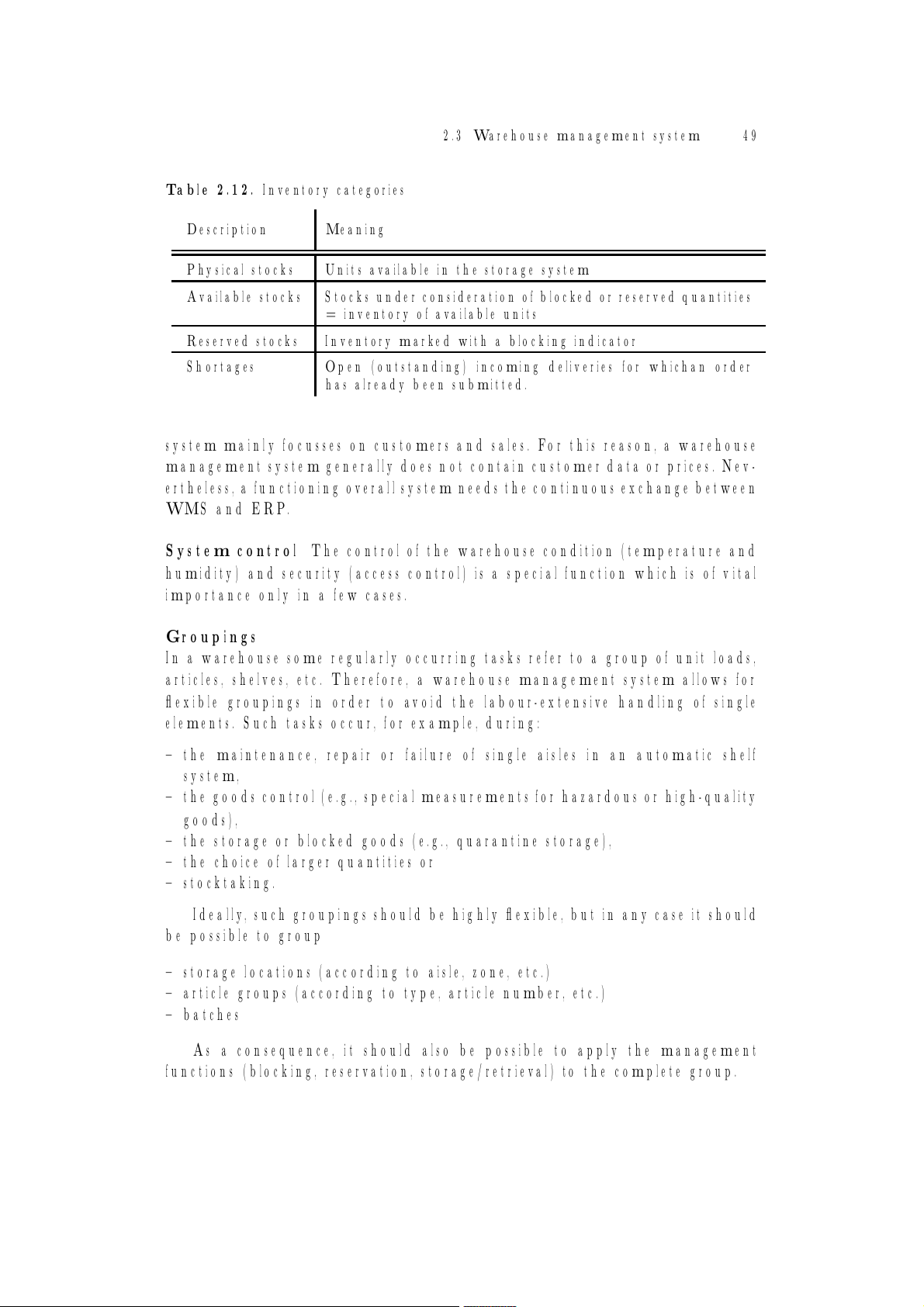
Table 2.12. Inventory categories Description Meaning Physical stocks
Units available in the storage system Available stocks
Stocks under consideration of blocked or reserved quantities = inventory of available units Reserved stocks
Inventory marked with a blocking indicator Shortages
Open (outstanding) incoming deliveries for whichan order has already been submitted.
system mainly focusses on customers and sales. For this reason, a warehouse
management system generally does not contain customer data or prices. Nev-
ertheless, a functioning overall system needs the continuous exchange between WMS and ERP.
System control The control of the warehouse condition (temperature and
humidity) and security (access control) is a special function which is of vital
importance only in a few cases. Groupings
In a warehouse some regularly occurring tasks refer to a group of unit loads,
articles, shelves, etc. Therefore, a warehouse management system allows for
flexible groupings in order to avoid the labour-extensive handling of single
elements. Such tasks occur, for example, during:
– the maintenance, repair or failure of single aisles in an automatic shelf system,
– the goods control (e.g., special measurements for hazardous or high-quality goods),
– the storage or blocked goods (e.g., quarantine storage),
– the choice of larger quantities or – stocktaking.
Ideally, such groupings should be highly flexible, but in any case it should be possible to group
– storage locations (according to aisle, zone, etc.)
– article groups (according to type, article number, etc.) – batches
As a consequence, it should also be possible to apply the management
functions (blocking, reservation, storage/retrieval) to the complete group. 50
2. Management of Warehouse Systems 2.3.2 Reorganization
An active warehouse and distribution system should be checked regularly with
regard to its efficiency and suitable steps should be taken for its optimization.
This is called warehouse reorganization. This action can be initiated by:
– changed retrievals of certain articles, e.g., lower throughput or change of of the typical pick-up unit
– beginning or terminated campaigns – changed product range
– growing number of partial storage units
As a result, storage areas are occupied faultily (e.g., wrong zone), the
average transport routes increase and the utilization of space is reduced. For
this reason, the corresponding parameter should be analyzed and controlled
continuously. The suitable system control method is described in section 2.3.4.
The resulting optimization of the system is achieved by some measures
which logically should be supported by the warehouse management system:
– rebooking, i.e., reassignment of articles to suitable retrieval categories and storage zones
– restorage of already existing units in times with low retrieval rates (e.g., to reestablish an ABC zoning)
– densification of partial units or badly utilized mixed pallets (retrieval of
relevant units, repackaging of units and restorage according to specifica- tions)
2.3.3 Conveyor management and control systems
While automatic conveyors are controlled and supervised by a corresponding
control (material flow controller, MFC), manual unsteady conveyors (stack-
ers, etc.) are controlled by different systems from the manual management
to the fully automatic system control.
Computer-aided control systems for the in-house transport are used in
warehouse management for different reasons:
– To optimize the system performance (reduction of empty trips, larger hand-
ling volumes, higher system load)
– Flexibility of the system in case of short-term changes (quick reaction to transport requirements)
– Control of the system status (runtime of vehicles, operational costs per vehicle, etc.)
Systems for the deployment and control of vehicles are called stacker
control systems or transport control systems [90]. These systems consist of
a computer-aided control station or master computer, a wireless transfer
2.3 Warehouse management system 51
medium (radio or infrared) and mobile terminals on the vehicles. Incom-
ing transport orders or requests are handled, completed by relevant data
(e.g., completion of article number or description, storage location (source),
destination (sink)) and transmitted to the driver by certain procedures and strategies.
In all control systems first of all it has to be decided which conveyor has to
be assigned to a certain kind of order because of its loading capacity, lifting
height or other specifications. For this purpose, a classification of the existing
conveyors has to be available in addition to the management of warehouse
types (cf. section 2.10). Furthermore, the restrictions of other facilities like
transfer points have to be recorded. There are two principle methods for the vehicle deployment:
Dispatching In dispatching a suitable vehicle is assigned to the current
order according to different criteria and strategies. This may be, for ex- ample, – the next free conveyor – the nearest conveyor
– the conveyor with the shortest connection trip
Since the dispatching handles the currently incoming order the system
reacts quickly and flexibly and the system can, thus, be used in dynamical environments.
Scheduling In scheduling, on the other hand, several orders and/or con-
veyors are assigned to an “ideal” schedule. This method thus aims at
an optimal order sequence and system performance. The main condition
for a scheduling is the collection of queued orders in an order pool from
where they can be assigned optimally. In contrast to a manual schedul-
ing, which can seldom be used in a warehouse, the scheduling is repeated in relatively short intervals.
In practice, mostly a mixed form of both methods is used where the most
important requirements can be considered at any time. In addition to these
extensive dispatching control systems there are simple conveyor management
systems which focus on the recording of the system status and where no orders
are assigned. This includes the recording of operating times or repair costs
per vehicle, the supervision of the battery status and control of maintenance
intervals for each vehicle. In systems where the vehicles are used by a large
number of people it may be reasonable to also record and document the driver identification.
2.3.4 Data collection, processing and visualization
As already described in section 2.4 a warehouse and distribution system in-
cludes a variety of different data and key values for different purposes: 52
2. Management of Warehouse Systems – Activity recording – Customer service
– Documentation of shortages from stocktaking
– Recording of picking errors, deviations at dispatch control
– Efficiency of the staff (e.g., picks or orders per picker; storages per stacker
driver; waiting times per vehicle) – Overview
– Bin status report (sorting according to storage bin, free/occupied, ...) – Stocks
– Warehouse statistics (transshipping frequency, error times, filling level, ...) – Utilization of space – Operating means statistics – Runtimes – Idle times
– Maintenance and repair costs per unit – and much more.
While the personal activity recording is not without legal problems and
generally requires the admission of the works council it sometimes is the
indispensable basis for the activity-based accounting especially with regard to
– the recording of piece rates
– the recording of contracted logistic services
The recording of significant status information is the elementary prereq-
uisite for the control and optimization of the distribution system. Based on
these data manpower requirements (e.g. in order-picking) or other resource
requirements have to be determined and scheduled in the system control. The
loading levels of conveyors show if parallel arranged systems are balanced.
Waiting times at certain points may indicate bottlenecks and initiate a check
of the operating strategies, system performances or personnel deployment.
The recording method is decisive for the use and successful evaluation of
the data. There are two principle methods to record significant data and key values:
Online recording The database which is necessary to generate the required
data is recorded in the process and automatically converted into the de-
sired key value. Thus, the key values are directly available. The record-
ing and evaluation focusses on the predefined problems. Other or similar
data and key values cannot always be evaluated afterwards. The record-
ing time is almost fixed and cannot be reset, for example to block out
certain events or periods, because the results just are aggregated key
values. Thus, this method represents a statical system.
2.3 Warehouse management system 53
Time series recording At first, only a log file is made out containing the
events and the time of occurrence (time series). Here, it has to be en-
sured that the input data are determined purposefully. The required key
values are then extracted from the database via a corresponding request.
This method clearly offers much more possibilities and a better basis for
the system planning and optimization. However, the data volume may
increase continuously. It is advisable to book the following data:
– Documentation of requested and completed orders – Requests: • Request ID/demand ID • Source/sink • Date/time • Status (express-normal) – Fulfillment: • Person or operating means ID • Date/time • Termination – Operating protocol – Start/end of operation – Error message and times – Warehouse movements – Single information
– article-related data (article no. stocks,...)
– order-related data (order no., order item, dates...)
– unit data (storage bin no., free/occupied, quantity ...)
In addition to this, delivery notes and goods issue protocols have to be
recorded and documented for legal reasons. 2.3.5 Stocktaking
In most countries stocktaking is a legal obligation which has to be carried
out by each businessman for each business year. For fixed assets and supplies,
i.e., stocks, a physical stocktaking has to be made. This has the aim to check
the inventories (booked stocks) and the reliability of the inventory manage-
ment (warehouse accounting). All objects (storage units) have to be identified
and classified by counting or measuring. The data have to be recorded in a
protocol showing the following information:
– Voucher no. (check of completeness)
– Storage location and position – Description of the object
– Recorded quantity and quantity unit – Unit price and total value
– Optionally information about value-related influences (age, storage time) 54
2. Management of Warehouse Systems
– Date of recording and signature (or recording person)
This procedure is immensely labour-intensive and nearly impossible in
very large warehouses. Furthermore, certain automatic warehouse techniques
do not allow for direct personal checks and for the retrieval of all units for
process-related or economical reasons. For this reason, different stocktaking
methods have been developed which have to be cleared, however, with the
respective auditors and financial authorities.
Annual stocktaking The classical form of stocktaking requires the physical
check of all stocks at the accounting date. Since there is no business at
this day there are no changes of the “assets”. Such a method is only
suitable for smaller systems. It is not necessary to finish the stocktaking
within one day but as close to the accounting day as possible, i.e., 10
days prior or after the date, as far as inventory changes are recorded and considered in the stocktaking.
In a forward or subsequent stocktaking stocks can be taken at one day,
three months prior to or two months after the accounting day and recal-
culated by a special stock . This requires the use of an updating or back-
ward projection according to the Generally Accepted Accounting Princi- ples GAAP.
Permanent stocktaking The permanent stocktaking is a suitable method
in times of little business or low stocks. Stocks can be physically taken
throughout the year if all inventories are booked continuously and all
receipts and issues are booked separately mentioning the day, type and
quantity. At the accounting day a (quantitative) inventory update is made
— a so-called book inventory.
The counting may be related to the articles or the storage bins. For this
purpose, all movements of the respective article or storage bin must be
stopped. For an article-related stocktaking all free storage bins have to
be checked separately. For this method the EDP-aided warehouse mana-
gement system has to be able to assign article or bin-related counters.
Since in automatic warehouses the stocktaking cannot be performed at
the storage bin for technical reasons the most suitable methods are the
warehouse stocktaking and the zero-crossing stocktaking. During a ware-
house stocktaking the items are counted at another location (usually at
the identification point prior to the storage) where they are marked with
the counter. In a zero-crossing stocktaking all storage bins are recorded
at a zero-crossing (the stocks in the bins are completely removed). Dif-
ferences are entered directly and the counter is updated5.
Inventory sampling If an EDP-based warehouse management system is
used and the Generally Accepted Accounting Principles are met an in-
5 If shortages are recognized the warehouse management system has to initiate
a replenishment independent of the requirement (inventory) or has to consider
other retrieval points to fulfill the customer order correctly.
2.3 Warehouse management system 55
ventory sampling may also be used which requires considerably less ex-
penditure. Samples are taken physically which are evaluated by means of
proven mathematical statistical procedures, i.e., above all:
Sequential test The number of samples is unknown at the beginning and
results from the repeated check of the test criterion. The test is re-
peated until the acceptance criterion is fulfilled (fall short of min-
imum error rate) or rejected (exceeding maximum error rate). To
limit the testing period a stop criterion may be defined.
Estimation The basic total is estimated based on the frequency ratio of
a sample. In case of layered estimations the basic total is splitted
from which a sample each has to be taken. Bound estimations also
use an auxiliary parameter, e.g., the booked inventory value, for the projection.
As already mentioned above, the chosen method has to be accepted by
the auditor or financial authorities. The following parameters influence the suitability of a method:
– Use or existence of an EDP-aided inventory management system
– Accessibility of the shelves (freely accessible warehouse or closed area of an automatic warehouse)
– Value of the goods (The more valuable the goods the more exact the stock-
taking. Sampling is unsuitable for “high-value goods”)
Warehouse management systems should have at least the following stock- taking functions:
– Counting date for storage units and shelves
– Blocking of article groups or shelf areas for stocktaking purposes
– Permanent updating of counters considering the recording person, date and time – Zero-crossing stocktaking
The rigid stocktaking requirements do not come up to the possibilities
of modern warehouse management systems. A continuous counter booking
and zero-crossing comparison allows for an extremely detailed stocktaking.
And it should not be ignored that errors during the stocktaking process can hardly be avoided.
On the other hand, an exact inventory management offering safe data
is of vital importance for the readiness to operate. The combination of a
regular data update and a correct data management set the basis for a high
readiness to deliver and short response times. Furthermore, negligence or
thefts are detected only by a reliable stocktaking. 56
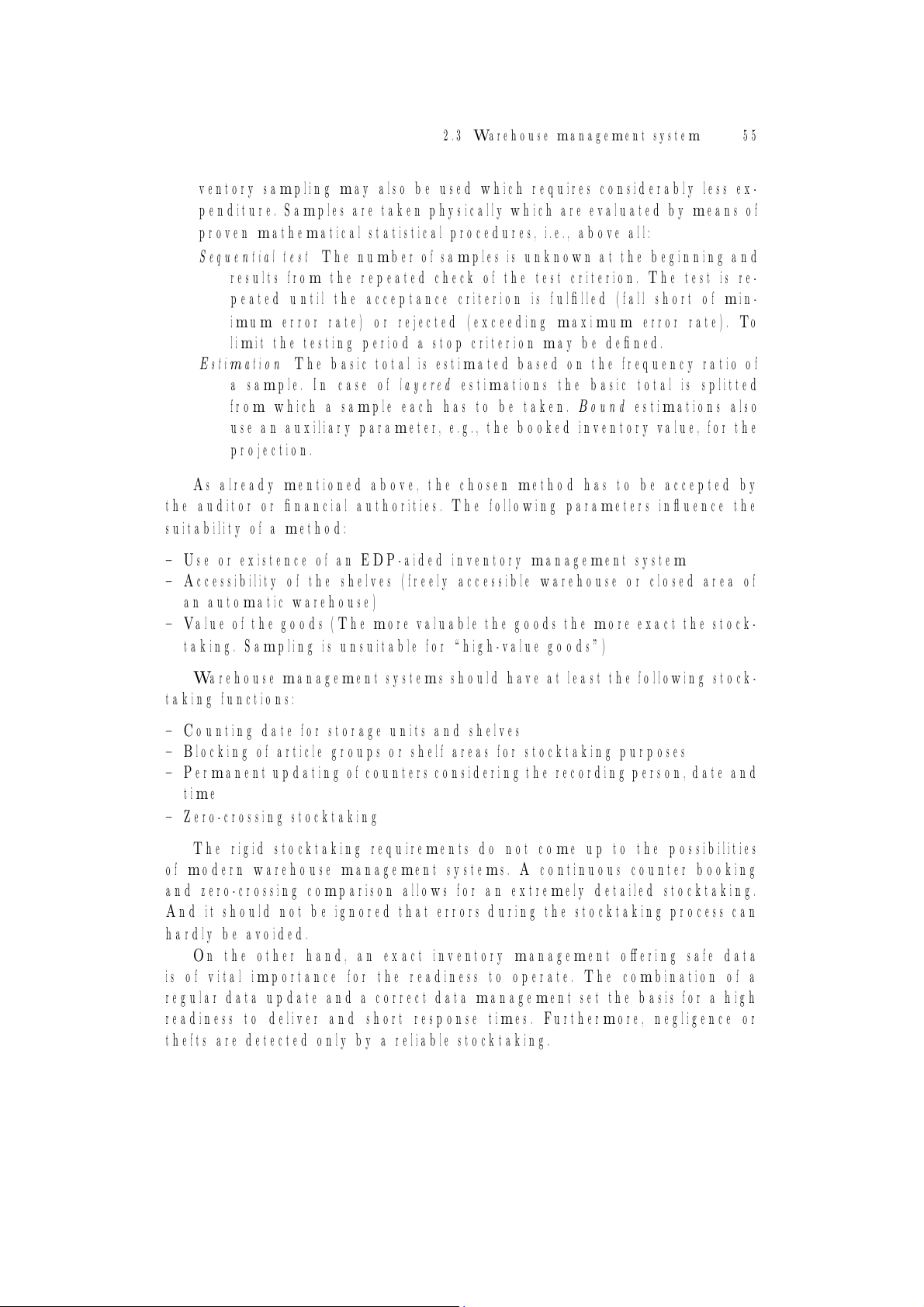
2. Management of Warehouse Systems
2.4 Basic data and key performance indicators of warehouse systems
The planning and design of warehouse and distribution systems is highly
complex so that it is nearly impossible to describe all relevant system-related
parameters. The major part of such key values has to be defined for a given
problem. In the following the most elementary key values which are used in
quite a number of systems are described. They are classified into basic data and key values
Basic data are also called absolute numbers and directly result from mea-
surements, counts, summations or differences of certain units or they
are recorded as master data. At the same time, they also represent the
requirements and basic information to be provided by a system.
Key values should provide significant and densified information to evaluate
and compare the efficiency of processes and systems. Here, absolute as
well as relative numbers, i.e., proportionate values or data are used. 2.4.1 Basic data Master data
Master data are statical data which are not changed over a longer period
of time. The master data contain all important information about the basic
characteristics of an article, loading aid, etc. The most important master
data in a warehouse are the article master data because all main warehouse
functions and control mechanisms are based thereon.
The article master contains a description of all articles independent of
their current stock. The total number of articles represents the assortment
although discontinued or dead articles result in differences to the actual stock.
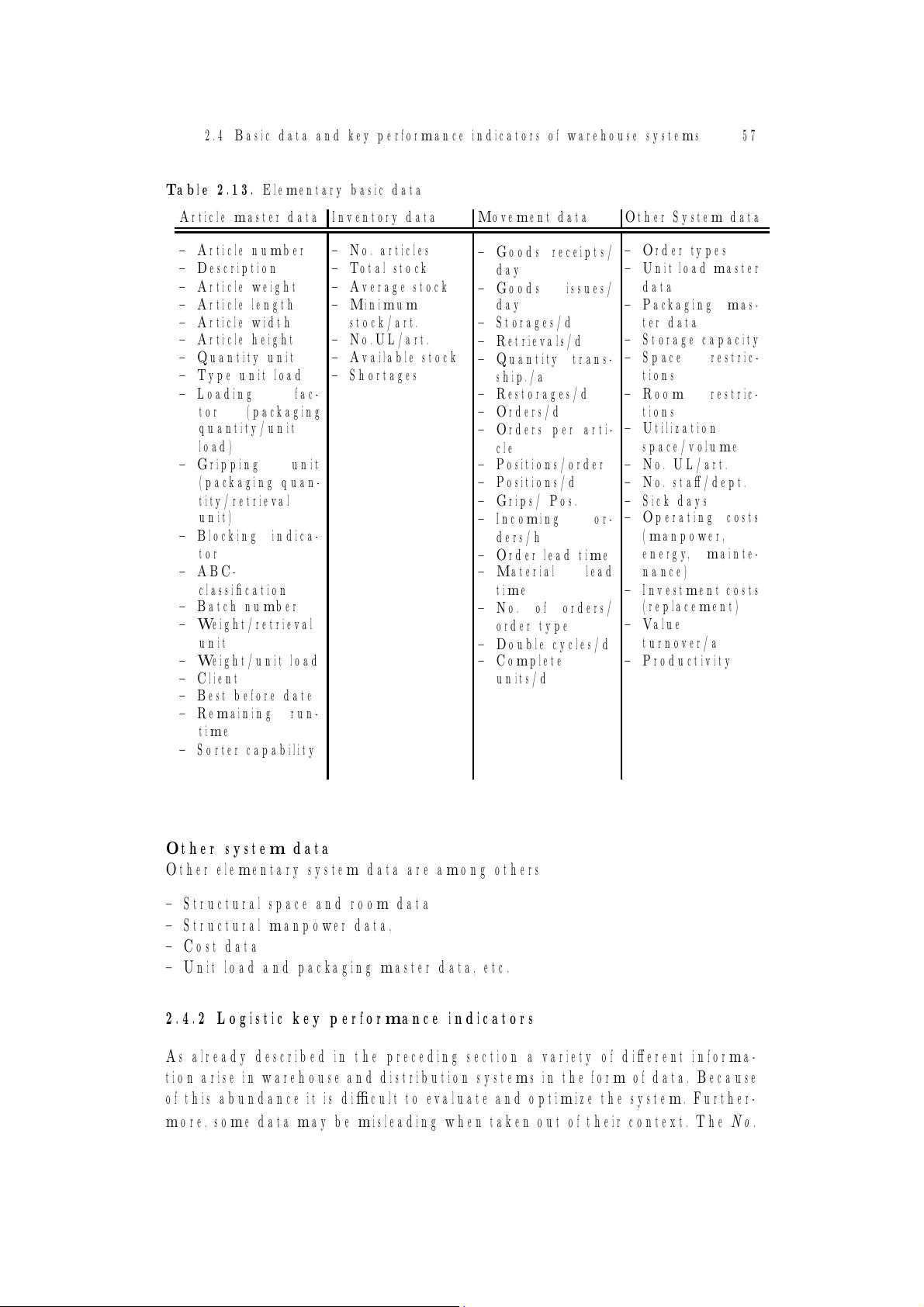
Table 2.13 gives an example of the most important elements of the article master data. Inventory data
This data group informs about the quantities of articles stored or provided
over a longer period of time. The up-to-dateness and accuracy of this kind of
data collection is of special importance to ensure the readiness to deliver and
to dimension the warehouse system. Since these data change continuously
they are also called dynamical data. Movement data
The second group of dynamical data are the movement data which represent
all main physical warehouse processes. These are basic processes like goods
receipt and issue and warehouse operations as well as order-picking processes and order execution.
2.4 Basic data and key performance indicators of warehouse systems 57
Table 2.13. Elementary basic data
Article master data Inventory data Movement data Other System data – Article number – No. articles
– Goods receipts/ – Order types – Description – Total stock day – Unit load master – Article weight – Average stock – Goods issues/ data – Article length – Minimum day – Packaging mas- – Article width stock/art. – Storages/d ter data – Article height – No.UL/art. – Retrievals/d – Storage capacity – Quantity unit – Available stock – Quantity trans- – Space restric- – Type unit load – Shortages ship./a tions – Loading fac- – Restorages/d – Room restric- tor (packaging – Orders/d tions quantity/unit
– Orders per arti- – Utilization load) cle space/volume – Gripping unit – Positions/order – No. UL/art. (packaging quan- – Positions/d – No. staff/dept. tity/retrieval – Grips/ Pos. – Sick days unit) – Incoming or- – Operating costs – Blocking indica- ders/h (manpower, tor – Order lead time energy, mainte- – ABC- – Material lead nance) classification time – Investment costs – Batch number – No. of orders/ (replacement) – Weight/retrieval order type – Value unit – Double cycles/d turnover/a – Weight/unit load – Complete – Productivity – Client units/d – Best before date – Remaining run- time – Sorter capability Other system data
Other elementary system data are among others
– Structural space and room data – Structural manpower data, – Cost data
– Unit load and packaging master data, etc.
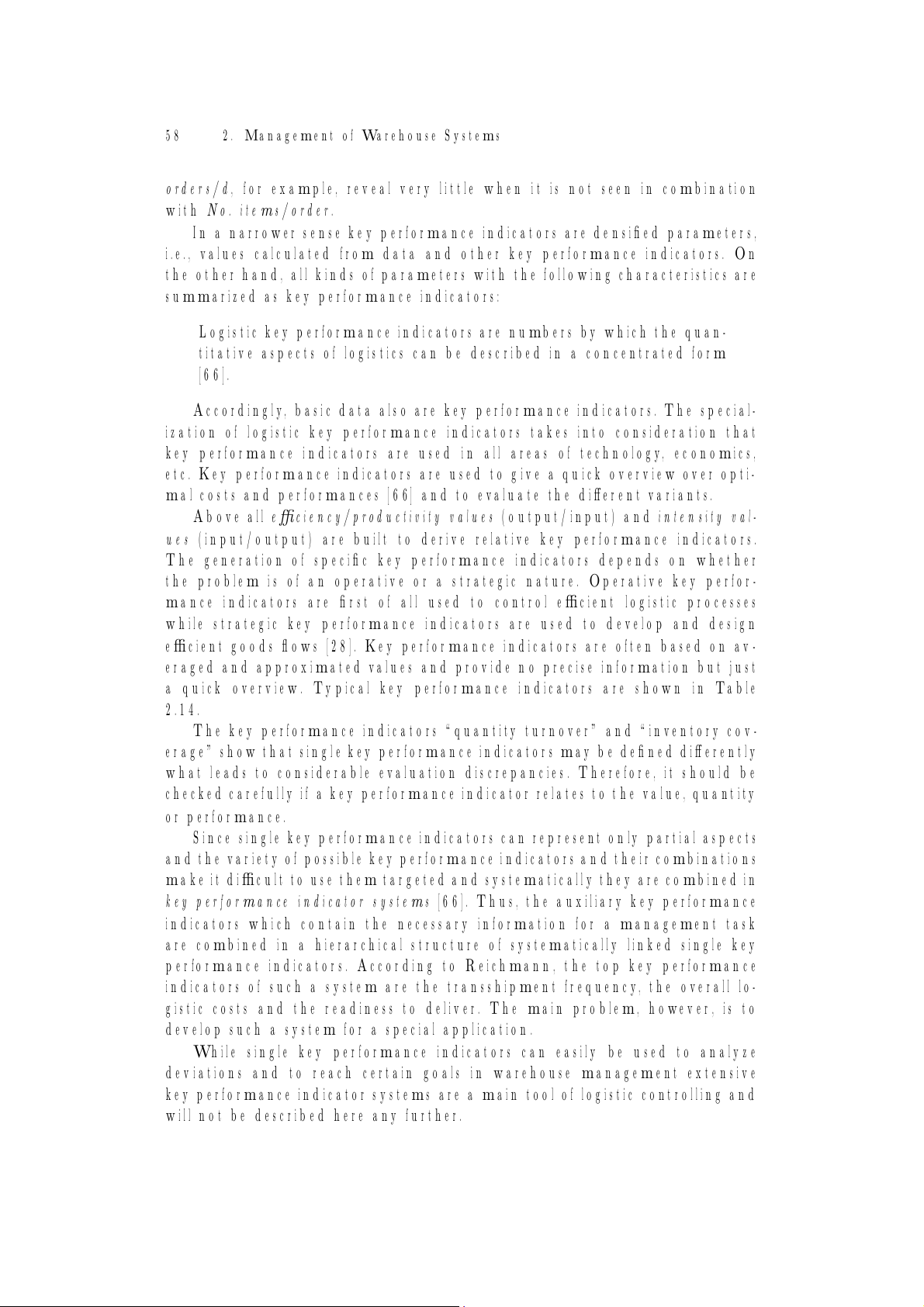
2.4.2 Logistic key performance indicators
As already described in the preceding section a variety of different informa-
tion arise in warehouse and distribution systems in the form of data. Because
of this abundance it is difficult to evaluate and optimize the system. Further-
more, some data may be misleading when taken out of their context. The No. 58
2. Management of Warehouse Systems
orders/d, for example, reveal very little when it is not seen in combination with No. items/order.
In a narrower sense key performance indicators are densified parameters,
i.e., values calculated from data and other key performance indicators. On
the other hand, all kinds of parameters with the following characteristics are
summarized as key performance indicators:
Logistic key performance indicators are numbers by which the quan-
titative aspects of logistics can be described in a concentrated form [66].
Accordingly, basic data also are key performance indicators. The special-
ization of logistic key performance indicators takes into consideration that
key performance indicators are used in all areas of technology, economics,
etc. Key performance indicators are used to give a quick overview over opti-
mal costs and performances [66] and to evaluate the different variants.
Above all efficiency/productivity values (output/input) and intensity val-
ues (input/output) are built to derive relative key performance indicators.
The generation of specific key performance indicators depends on whether
the problem is of an operative or a strategic nature. Operative key perfor-
mance indicators are first of all used to control efficient logistic processes
while strategic key performance indicators are used to develop and design
efficient goods flows [28]. Key performance indicators are often based on av-
eraged and approximated values and provide no precise information but just
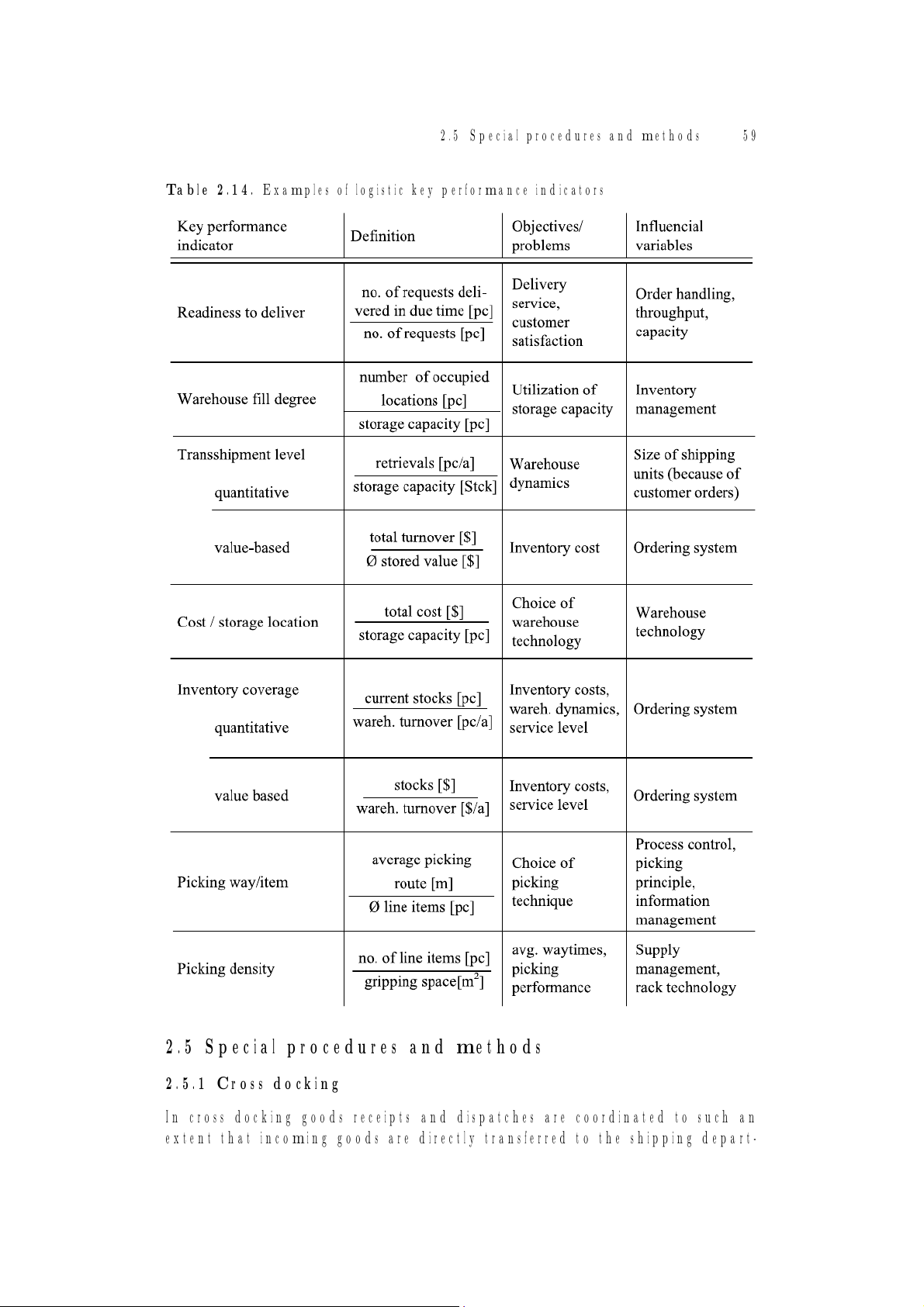
a quick overview. Typical key performance indicators are shown in Table 2.14.
The key performance indicators “quantity turnover” and “inventory cov-
erage” show that single key performance indicators may be defined differently
what leads to considerable evaluation discrepancies. Therefore, it should be
checked carefully if a key performance indicator relates to the value, quantity or performance.
Since single key performance indicators can represent only partial aspects
and the variety of possible key performance indicators and their combinations
make it difficult to use them targeted and systematically they are combined in
key performance indicator systems [66]. Thus, the auxiliary key performance
indicators which contain the necessary information for a management task
are combined in a hierarchical structure of systematically linked single key
performance indicators. According to Reichmann, the top key performance
indicators of such a system are the transshipment frequency, the overall lo-
gistic costs and the readiness to deliver. The main problem, however, is to
develop such a system for a special application.
While single key performance indicators can easily be used to analyze
deviations and to reach certain goals in warehouse management extensive
key performance indicator systems are a main tool of logistic controlling and
will not be described here any further.
2.5 Special procedures and methods 59
Table 2.14. Examples of logistic key performance indicators
2.5 Special procedures and methods 2.5.1 Cross docking
In cross docking goods receipts and dispatches are coordinated to such an
extent that incoming goods are directly transferred to the shipping depart- 60
2. Management of Warehouse Systems
ment without being put away. Thus, they are not entered into the warehouse
system which is a pure transshipping system with the aim to:
– reduce stocks at certain points along the supply chain
– increase the efficiency by avoiding process steps
– reduce the throughput times of articles in the system
– improve the services by more frequent deliveries
– sort articles effectively according to destinations, e.g., for CEP
This method should not only minimize the stocks in the distribution sys-
tem or at the cross docking point but also at the POS. This requires frequent
deliveries what improves the services. There are two principle cross docking methods:
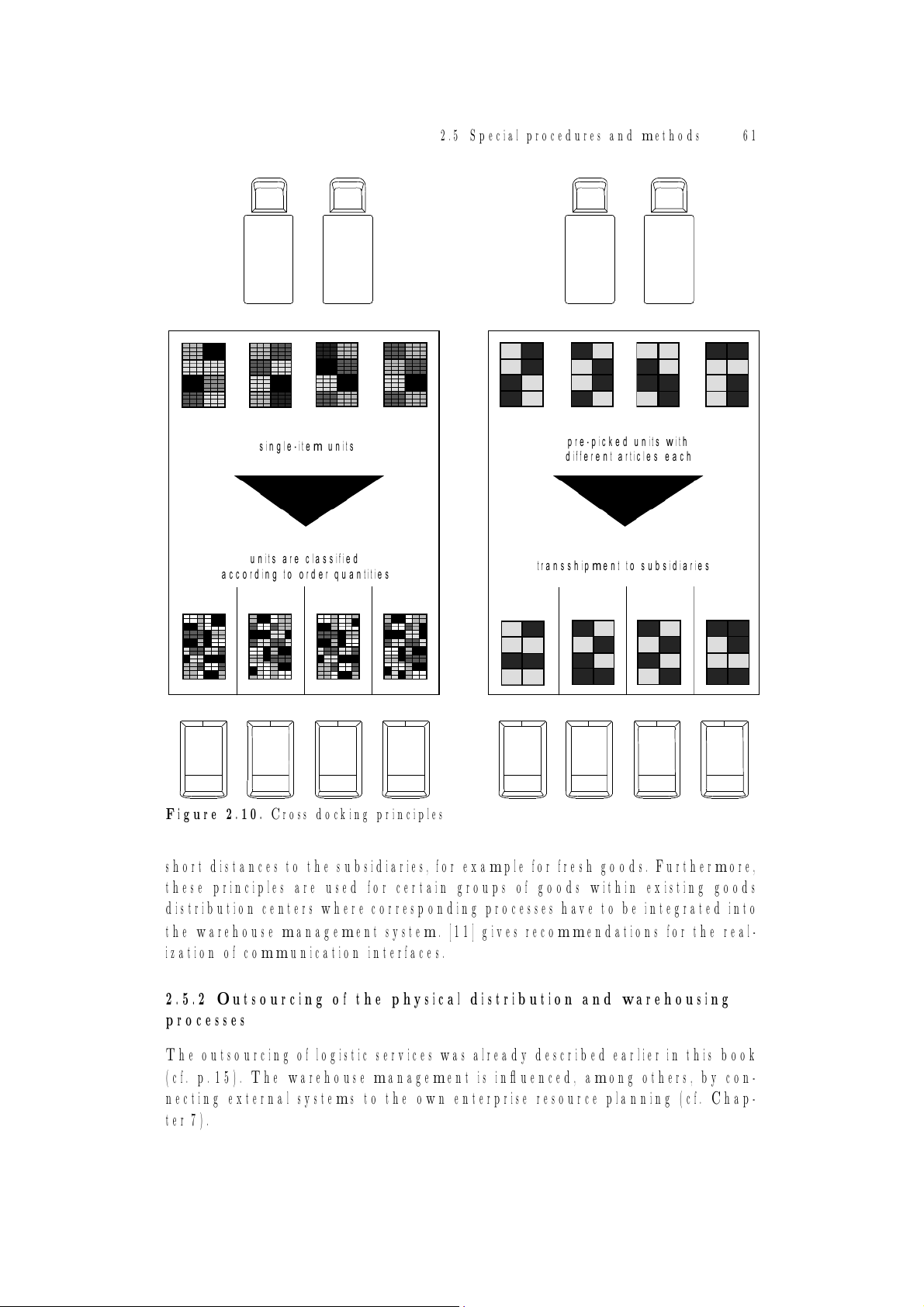
1. Cross docking with broken pallets
2. Cross docking as flow system
Cross docking with broken pallets
The incoming units are quasi single-item units and have to be distributed
or picked according to the orders of the single subsidiaries. Palletized units
are typically transshipped in roller containers, a principle which is also called
two-level or container cross docking. A main feature of this method is an order-picking process. Cross docking as flow system
Here, the supplier pre-sorts the incoming units according to the orders of the
subsidiaries in such a way that the single units do not have to be broken
and distributed but only have to be consolidated, i.e., combined with other
single-order units. This principle is also called one-level cross docking. If only
complete transport units (e.g., pallets) are handled this method is called
pallet cross docking. If the pallets hold pre-sorted containers which have to
be assigned to the single subsidiaries or tours this principle is called pre-sorted
store order. In this case the goods are only transshipped without counting or direct picking processes.
Prerequisites and fields of application Many requirements have to be
met before the cross docking principle can be used. One efficient way is to di-
rectly transfer incoming goods. However, this requires that the desired quan-
tity is available on short notice so that the risk of shortages is very high due
to lacking stocks. It is practically impossible to restore articles in case of an
order cancellation. If the subsidiaries have similar order structures the tours
are scheduled almost simultaneously. This may lead to bottlenecks at the
goods issue and thus to several deliveries of single subsidiaries a day.
In practice this method is only suitable for systems with a relatively con-
stant demand, similar quantities and articles, short replenishment times and
2.5 Special procedures and methods 61 single-item units pre-picked units with different articles each units are classified transshipment to subsidiaries according to order quantities
Figure 2.10. Cross docking principles
short distances to the subsidiaries, for example for fresh goods. Furthermore,
these principles are used for certain groups of goods within existing goods
distribution centers where corresponding processes have to be integrated into
the warehouse management system. [11] gives recommendations for the real-
ization of communication interfaces.
2.5.2 Outsourcing of the physical distribution and warehousing processes
The outsourcing of logistic services was already described earlier in this book
(cf. p. 15). The warehouse management is influenced, among others, by con-
necting external systems to the own enterprise resource planning (cf. Chap- ter 7). 62
2. Management of Warehouse Systems
To be able to adjust the processes in multi-client outsourcing warehouses
to the special requirements of the customers the processes, procedures and
strategies have to consider not only the goods and customers but also the
client. This feature has to be integrated into the WMS which is then called multi-client enabled.
Since provided services are often settled on the basis of performed activ-
ities single client-related services (e.g., stacker trips, picking positions) have to be recorded separately.
2.5.3 Application Service Providing
Similar to the outsourcing of physical warehouse processes to an external
service provider in Application Service Providing (ASP) IT services and
computer-aided control functions are outsourced to a service provider who
controls the processes from a central computer center where he also carries
out the necessary evaluations, processing, etc. Such services are successfully
used in wage and financial accounting.
An advantage are not only direct cost savings, e.g., by a reduced EDP
staff on the site, but above all the data security. A central service provider
can afford other better possibilities than many companies at decentralized locations.
In logistics such solutions are used in the form of shop systems in e-
commerce and ERP but also on WMS superordinate levels. An ASP solution
where time-critical processes in a large distribution system are controlled from
a central computer center is still unknown because the transmission security
cannot be guaranteed and the response times may be too long. Breakdowns
and failures would inevitably lead to process interruptions.
With regard to current developments in the information and communi-
cation technology such solutions are quite conceivable above all for smaller
applications. The basic functions remain unchanged so that the special pro-
cedures will not be described here.
Tài liệu liên quan:
-
Giáo trình logistic về quản trị logistics
7 4 -

Chương 3 Đóng gói và vân chuyển - Mối quan hệ giữa đóng gói và vận chuyển trong logistics môn Logistics | Trường Đại học Kinh tế, Đại học Quốc gia Hà Nội
31 16 -
Yếu Tố: Các Quy Định Mà Tổ Chức Tuân Thủ môn logistics | Trường Đại học Kinh tế, Đại học Quốc gia Hà Nội
27 14 -
Mối liên hệ giữa Logistics và Vận tải đa phương thức môn Logistics | Trường Đại học Kinh tế, Đại học Quốc gia Hà Nội
38 19 -
E-Business & E-Commerce: Managing eCustomer Relationships | Logistics | Trường Đại học Kinh tế, Đại học Quốc gia Hà Nội
38 19