Asian Financial Crisis: Causes, Impact & Lessons Learned | Tài chính quốc tế | Trường Học Viện nông nghiệp Việt Nam
Rapid currency depreciation resulted in stock market falls, decreased import receipts, and political unrest in East Asia. The nations most impacted by this crisis include Thailand, South Korea, and Indonesia. The unexpected decline in prices had a significant impact on Hong Kong, Malaysia, Laos, and the Philippines as well. Although not significantly, China, Taiwan, Singapore, and Vietnam are also impacted. Despite being known as the "East Asian " crisis because it started in that region, its repercussions were worldwide in scope and had a significant impact on the rest of the world. Tài liệu được sưu tầm và soạn thảo dưới dạng file PDF để gửi tới các bạn cùng tham khảo, ôn tập đầy đủ kiến thức, chuẩn bị cho các buổi học thật tốt. Mời bạn đọc đón xem!
Môn: Tài chính quốc tế (hvnn) 130 tài liệu
Trường: Học viện Nông nghiệp Việt Nam 2.4 K tài liệu
Tác giả:







Preview text:
H O C H I M I N H U N I V E R S I T Y O F B A N K I N G
S A I G O N I N T E R N A T I O N A L S C H O O L O F B U S I N E S S ASIAN FINANCIAL CRISIS
A N E V E N T T H A T B R I N G S U S B A C K T O #6 FULL NAME STUDENT ID Phung Hai Danh 050608200270 Nguyen Thuy Hai Giang 110302200008 Truong Bao Linh 050608200426 Dau Vu Thao Nhi 030736200179 Pham Ngoc Quynh Nhu 110302200017 Hoang Gia Thy 110302200028 Nguyen Bao Tran 110302200033 TABLE OF CONTENTS
THE CONCEPT OF THE 1997 MONETARY CRISIS - THE 1
BACKGROUND OF SOUTHEAST ASIA COUNTRIES 1 Definitions 2 Relative background in Asia 7
Why did East Asia attract so much capital before the crisis? 8
DEVELOPMENT - EFFECTS - LESSONS OF THE 1997 CURRENCY 9 Crisis developments
10 The causes of the East Asian currency crisis
12 How to deal with the crisis? 13 Lessons for countries
14 COMPARISON WITH THE 1997 CURRENCY THE CONCEPT O& F THE 1997 MONETARY
CRISIS SOUTHEAST ASIA'S BACKGROUND Financial crisis definition
In a financial crisis, asset prices Rapid currency depreciation see a sharp decrease in value,
resulted in stock market falls,
firms, and individuals are unable decreased import receipts, and
to pay their loans, and financial political unrest in East Asia.
institutions face a shortage of
The nations most impacted by this
liquidity. During a panic or bank crisis include Thailand, South
run, investors sell off their assets Korea, and Indonesia. The or withdraw cash from savings
unexpected decline in prices had a
accounts out of fear that their
significant impact on Hong Kong,
value will decline if they keep Malaysia, Laos, and the
them in a financial institution.
Philippines as well. Although not This is a common feature of significantly, China, Taiwan, financial crises.
Singapore, and Vietnam are also Moreover, the deflation of a impacted.
financial bubble, a stock market
Despite being known as the "East
crash, a sovereign default, or a
Asian" crisis because it started in currency crisis is further
that region, its repercussions were circumstances that could be worldwide in scope and had a
classified as a financial crisis. A
significant impact on the rest of
financial crisis might only affect
the world. nations including the
certain banks, or it might affect US, Brazil, and Russia.
the entire global economy or just
In order to stabilize the Asian one particular economy. economies, the International Monetary Fund (IMF) stepped in
Asian financial crisis definition and provided several bailouts
(rescue packages). Roughly $110
The Asian financial crisis, also
billion in short-term loans were
known as the "Asian Contagion,"
advanced to Thailand, Indonesia,
was a series of devaluations of and South Korea to help them
currencies and other occurrences
stabilize their economies. They
that started in the summer of 1997
thus had to adhere to stringent and spread throughout various requirements such as greater Asian economies. The
taxes, higher interest rates, and
government's decision to no longer less public spending.
tie the local currency to the dollar caused the currency markets to
first crash in Thailand (in the USD form of currency). 1
R E L A T I V E B A C KG R O U N D
Ro o t c au s e s : Ec o n o m i c m o d e ls o f S ou t h e a st A s i an c o u n tr i e s .
Production only focuses on exporting to foreign countries, leading to a balance trade deficit.
Attach your Southeast Asia currency to the USD Dollar.
The exchange rates are not flexible.
The demand for domestic goods from international consumers drives
domestic manufacturing. Meanwhile, the demand of the domestic market
for its own goods is almost forgotten, in the long run, the national
currency of Southeast Asia is compelled to fluctuate against the US dollar.
The unstable economic model in Southeast Asian countries was the first
step that pushed Southeast Asian countries into the 1997 financial crisis.
19 9 7 A S I AN F I NA N C IA L CR I S I S
Foreign investors are rushing to invest money in Thailand in order to benefit from
this country's growth potential. But over time, these funds have become more and
more concentrated on speculative sectors like the real estate market. By 1997, Thai
banks held $15 billion in bad loans from real estate investors.
In the middle of the 1990s, the Fed initiated a policy of raising the dollar's credit
interest rates to reduce the risk of inflation in the US. The US gradually received
money from regions that used to have high-interest rates, and Southeast Asian
nations then increased interest rates to attract investors. The increase in interest
rates leads to the appreciation of the currencies of Southeast Asian countries, which
makes most of these countries start to face a decline in export growth. Additionally,
Thai companies were less able to pay back their debts due to the decrease in exports
throughout 1997, hence raising the possibility of baht depreciation.
When the currency depreciates, the external debt burden suddenly increases greatly
(paid in USD Dollars and there is no precaution when the currency depreciates).
Furthermore, the investments are no longer able to generate commensurate returns
to repay the loans. It eventually led to a large-scale capital run. 2
Direct causes: Speculative attacks and mass capital outflows from Asian countries.
At that time, there was a lot of credit available, which led to a highly
leveraged economic climate and unsustainable asset price levels,
particularly in the case of real estate. When the value of this asset
inevitably drops, people and businesses default.
It also leads to the withdrawal of a sizable quantity of credit from the
crisis countries at the time, causing a credit crisis and ongoing bankruptcy.
To prevent a collapse in currency values, the governments of these
crisis countries raised domestic interest rates to extremely high levels
and bought any excess local currencies at the fixed exchange rate
(intervened in the exchange market).
However, neither of these policies can be sustained for long, because:
Some countries do not have enough foreign exchange reserves.
Excessively high-interest rates can be extremely damaging to an
economy in recession with limited foreign exchange reserves.
The administrations ceased defending the fixed exchange rate and
allowed these countries' currencies to float once it became evident that
the capital leaving these countries was inexorable. More bankruptcies
and a worsening of the crisis are the results. Another cause: Moral hazard.
Definition: A situation in which people or organizations do not suffer
from the results of their bad decisions, so may increase the risks they take. Description:
MH circumstances are commonplace in the economy. The idea has so
been used in a variety of situations. Last but not least, it was utilized to
explain financial crises by connecting them to the "irresponsible" actions
of lenders, creditors, depositors, investors, businesses, banks, etc. The
presence of "insurers" like governments and even IFIs, such as the
International Monetary Fund (IMF), as a global "lender of last resort,"
undoubtedly had an impact on these actors' conduct (LLR).
As a result, MH was used as evidence to support the theory that very
significant capital flows contributed to the construction of massive
financial bubbles in emerging markets, notably in East Asia. The new
"capital account" crises of the twenty-first century were distinct from the
previous debt crises, which mostly affected current accounts (e.g.,
commodity-price shocks, interest-rate shocks, etc.).
MH "explains" why the private sector engaged in excessive borrowing
and lending in the years leading up to the Asian crises and why this
contributed to the development of financial vulnerabilities. 3 THAILAND
Thailand maintained the value of the baht at
a consistent level from the 1980s through
the 1990s, and this, combined with low
inflation and steady GDP development,
made Thailand a very attractive investment market. Thailand received investments
totaling more than USD 100 billion in just ten years, from 1987 to 1996.
Unstable economic model: To start, the
demand for imports rose faster than the
demand for exports, resulting in a current
interest deficit of (-8%) in Thailand. Second,
with roughly 45% of total debt being short-
term, Thailand is no longer concentrating
on economic development and instead uses
the majority of its income to pay off debt as
quickly as possible. Third, while the foreign
debt is high, the dollar reserve is steadily
declining and is insufficient to make a
difference in the country's monetary status
(the Dollar reserve decreased from 31.6% in
1994 to 29.5% in 1995 to 26.6% in 1996).
Fourth, at this point, foreign investment
funding flows are utilized for speculative
rather than production-related investments (Real Estate). Thailand and some Southeast Asian
countries have tried to conduct the policy
called the “Impossible trinity”, including
free capital flow, fixed exchange rate, and sovereign monetary policy.
Thailand has allowed for the free flow of
capital while fixing the value of its currency
to the US dollar. Southeast Asia's swift
economic development during the 1980s
and the early part of the 1990s put pressure
on the local currency to increase in value. The Southeast Asian central banks
implemented an easy monetary policy to
safeguard the fixed exchange rate. In turn,
this results in inflationary pressure when
the money supply is increased. In order to
counteract hidden inflation and encourage capital inflows into the economy, a
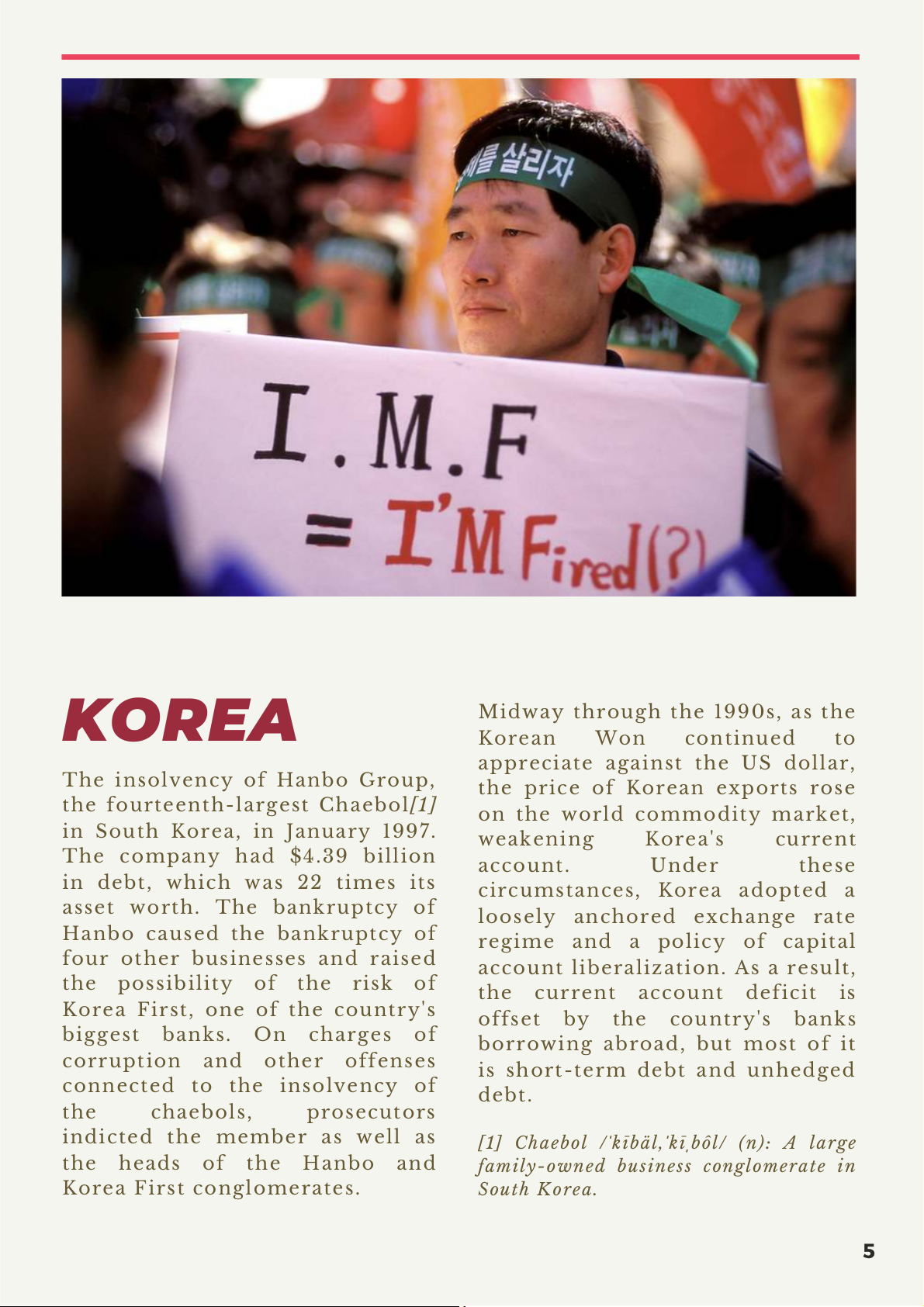
sterilization policy has been implemented. 4 KOREA
Midway through the 1990s, as the Korean Won continued to
appreciate against the US dollar, The insolvency of Hanbo Group,
the price of Korean exports rose
the fourteenth-largest Chaebol[1] on the world commodity market,
in South Korea, in January 1997. weakening Korea's current The company had $4.39 billion account. Under these
in debt, which was 22 times its circumstances, Korea adopted a asset worth. The bankruptcy of loosely anchored exchange rate Hanbo caused the bankruptcy of regime and a policy of capital
four other businesses and raised
account liberalization. As a result, the possibility of the risk of the current account deficit is
Korea First, one of the country's offset by the country's banks biggest banks. On charges of
borrowing abroad, but most of it corruption and other offenses
is short-term debt and unhedged connected to the insolvency of debt. the chaebols, prosecutors indicted the member as well as
[1] Chaebol /ˈkībäl,ˈkīˌbôl/ (n): A large the heads of the Hanbo and
family-owned business conglomerate in Korea First conglomerates. South Korea. 5 I N D O N E S I A E C O N O M I C
GDP growth climbed from 6.1% yearly in 1980-1990 to 7.6% in 1990-1995 and 7.8%
in 1996. This steady rate of expansion is linked to a dramatic diversification of the economy.
Between 1985 and 1995, the manufacturing sector's activity increased at a 10%
annual pace and contributed 25% of the country's GDP. Textiles and clothes, wood
products, and petrochemicals are only a few of the many things that are exported.
Commodity export growth averaged 15% from 1986 to 1993. In 1997, the growth of
the GDP started to decline to 5%.
Indonesia now accounts for 32% of global investments. Additionally, domestic
savings rose (31% in 1996) and continued to provide funding for around 90% of domestic investment.
Performance in terms of employment is less outstanding. The structure of
employment by industry has changed significantly, yet the rate of job growth is
slower than the rate of labor force growth. E M P L O Y M E N T
Throughout the years 1985 to 1995, the growth rate of employment gradually
climbed. However, due to the crisis, during the years 1985 to 1989, this rate
gradually dropped. The open unemployment rate has been rising over time.
Urban areas and educated persons are more likely to have unemployment issues,
with jobless rates among those with a university degree growing from 6.7% in 1990
to 11.5% in 1995. Almost two-thirds of all employment is still in the informal
sector, and nearly one-third of all workers are underemployed, meaning they
work fewer than 35 hours per week. The informal sector still dominates the job
market and there is a significant percentage of underemployment. S O C I A L S E C U R I T Y
Indonesia has performed admirably in terms of reducing poverty. Although they
did so to differing degrees and from different starting points, all provinces have
seen a gain in income, consumption, and employment, suggesting that the
benefits of growth have been fairly evenly spreading at various intensities.
Due to the year's severe drought, rice production — a staple of Indonesia's food—
is 4% lower than it was in 1996. As a result, after many years of self-sufficiency, the
nation must begin importing food. A consequence of the worst wildfire in almost
ten years on the agriculture and tourism industries.
The financial crisis has had an impact on Indonesia's economy at a time when
the nation is dealing with declining exports, slowing overall growth, and a
significant decline in rice production that has led to an increase in rice imports and food price forecasts. 6 WHY DID EAST ASIA ATTRACT SO MUCH CAPITAL BEFORE THE CRISIS? Singapore, Korea, Thailand, Malaysia, Indonesia, and the
Philippines, among others. They
were regarded as the world's best
investment locations at the time because: Average economic growth is between 8% and 10%.
The attractive interest rate for
investments and a thriving stock market.
Low inflation and a surplus in the budget. This fuels a drive to seize development possibilities, particularly those in Thailand,
where foreign investors are rushing
to pour cash into the economy. To
put it another way, Southeast Asian
nations are particularly attractive to
foreign fund inflows for short-term financial investment. 7
DEVELOPMENT - EFFECTS & LESSONS OF THE 1997 CURRENCY
Between 1985 and 1996, the Thai economy expanded by an
average of more than 9% per year, which was the highest
economic growth rate of any country at that time. Inflation was
kept in a manageable range of 3.4 - 5.7%. The USD/Baht exchange rate was 25.
Until June 14 - 15th, 1997, Thailand's currency market was full of
orders to sell baht. Thailand was ultimately compelled to float the
baht on July 2, 1997, enabling the money market to determine the
value of the currency because Thailand lacked foreign exchange
reserves to support the USD-Baht exchange rate. As a result, the
Baht swiftly declined in value and lost more than half of its
worth; in particular, in January 1998, when the exchange rate was USD/Baht 56. 8 NEGATIVE EFFECTS
Thailand's economy stagnated as a
result of widespread layoffs in the financial, real estate, and construction sectors, which
resulted in the return of 600,000 foreign employees. The market
capitalization of Thailand's stock
market decreased by 75%, from $141
billion to $23.5 billion. At the time,
Finance One, Thailand's largest
financial institution, failed. As a
result of the crisis, poverty and
inequality rose as social welfare, wages, and employment all declined. IMF RESCUE PLAN On August 11, 1997, the IMF
unveiled a rescue plan for Thailand
that included more than 17 billion USD and mandatory terms. On
August 20, 1997, there was also another rescue totaling $2.9 billion. RESULTS The Thai economy expanded in
2001. In 2003, the country's tax
collection increased, allowing it to
balance its budget and pay back the IMF. In October 2010, the Thai
baht strengthened more against the dollar, reaching 29 baht. 9 W I T H I N A S I A
Significant macro repercussions of the crisis included
asset price declines in various Asian nations, stock
market collapse, and currency devaluations. In 1997–
1998, a large number of enterprises failed, which
caused millions of individuals to fall below the poverty line.
Some countries did not face a crisis economically
because of the decline in exports and FDI inflows, but
the economy was nonetheless negatively impacted. The
decline in GDP and GNP per capita in USD caused by
the local currency's depreciation was one major and long-lasting effect.
Thailand's GDP per capita decreased from $8,800 in
1997 to $8,300 in 2005, Indonesia's from $4,600 to
$3,700, and Malaysia's from $11,100 to $10,400,
according to the CIA World Fact Book.
Large US investment in Thailand ceased, being
replaced largely by European investment, although Japanese investment remained. Politically:
The economic crisis sparked a political upheaval that
culminated in the resignations of Prime Minister
Chavalit Yongchaiyudh in Thailand and President Suharto in Indonesia. 10 OUTSIDE ASIA
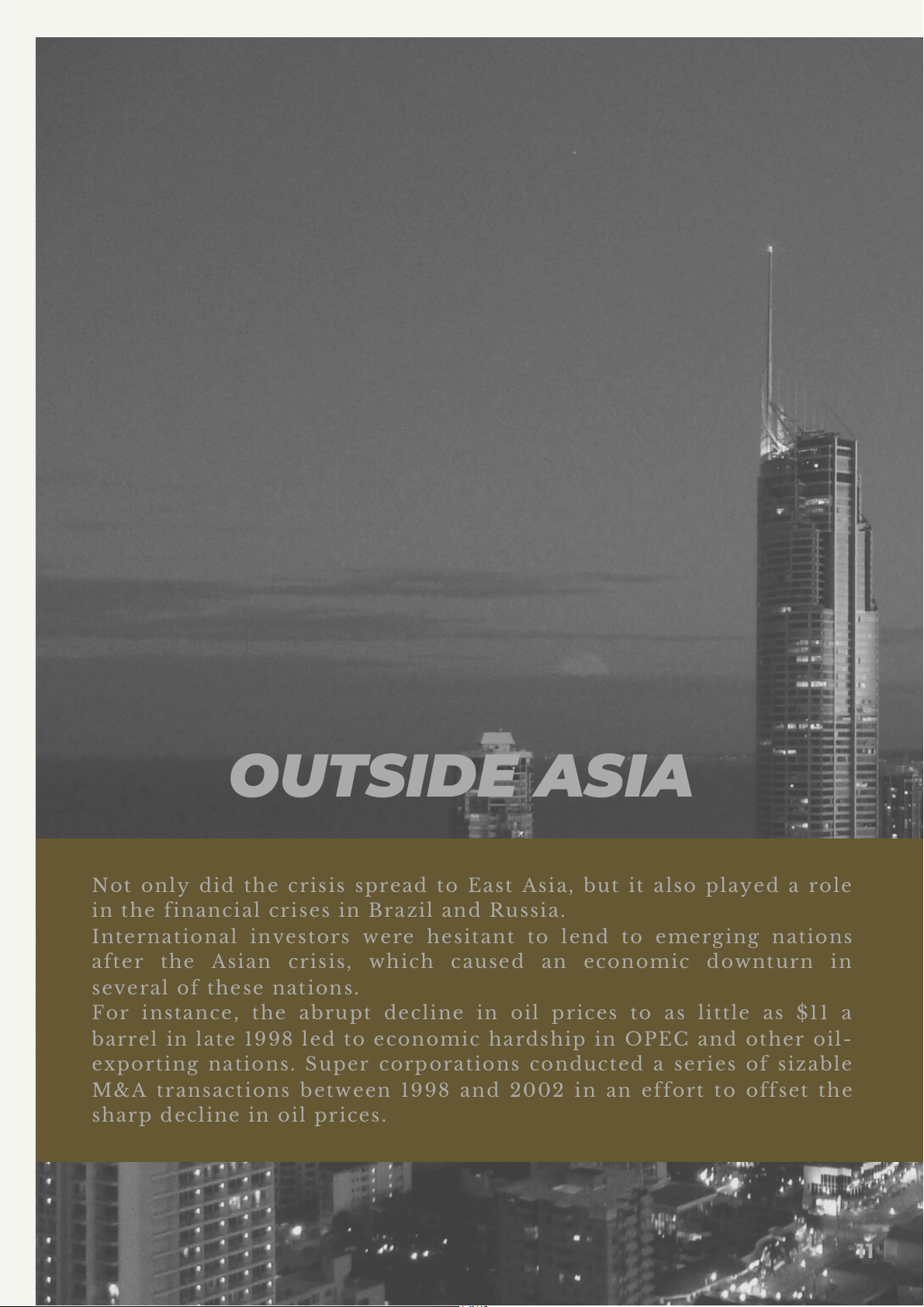
Not only did the crisis spread to East Asia, but it also played a role
in the financial crises in Brazil and Russia.
International investors were hesitant to lend to emerging nations
after the Asian crisis, which caused an economic downturn in several of these nations.
For instance, the abrupt decline in oil prices to as little as $11 a
barrel in late 1998 led to economic hardship in OPEC and other oil-
exporting nations. Super corporations conducted a series of sizable
M&A transactions between 1998 and 2002 in an effort to offset the sharp decline in oil prices. 11 HOW TO DEAL WITH THE CRISIS?
The international world organized
significant loans totaling $118 billion to
Thailand, Indonesia, and South Korea in
reaction to the crisis's spreading.
Particularly, the IMF, the World Bank, the
Asian Development Bank, and governments
in the Asia-Pacific region, Europe, and the
United States provided financial support.
The fundamental plan was to assist crisis-
affected nations in replenishing reserve
buffers and making necessary policy
changes to boost confidence and stabilize the economy. People are now more conscious
of the need for a robust and open financial-banking system as a
result of the East Asian financial
crisis. Additionally, it sparked much-needed changes in the
financial and political systems of nations like Thailand, South Korea, Japan, and Indonesia. Today, economists may learn a
lot from the Asian crisis by using it as a case study, especially when it comes to managing national accounts and trading currencies.
Foreign bank loans and indirect foreign investment inflows may
hurt those countries economies. Many of the lessons from the
Asian financial crisis are still
relevant to today's situations and
can be utilized to prevent issues in the future. 12 LESSONS FOR COUNTRIES
First, investors need to be cautious of asset bubbles
because some of them can bust, leaving investors stranded.
Second, governments should monitor spending as another possible lesson. Third, any government-mandated infrastructure
expenditure might have fueled the asset bubbles that
sparked this crisis, and the same is true of any potential future occurrences.
Fourth, the best transparency and disclosure against
speculative attacks, especially in the banking and financial sector.
Fifth, there is a shift from fixed to floating exchange rates with management and regulation by the
government through the central bank.
Last but not least, effectively examine economic actors'
excessive risk-taking (which is fueled by vanity, greed
and moral hazard) through implicit guarantees and bailouts clear. 13 es g chan rs. cy crisis. isis, cr yea rren cy t 20 cu ex rren cu e n icy to a er th 1997 ov ys pol a ce d the a a pl fter Now A took ACTUAL CONTACT
First, the countries in crisis have now
Asia's nations are now, at long last,
lowered their investment and growth
cooperating to safeguard the area.
expectations to a level that can be
When the crisis was over in 2000,
sustained. Asian governments still
they established the Chiang Mai
emphasize growth, but not at all costs.
Initiative, a localized network of
Second, Southeast Asian countries
financial loans and currency swaps. In
now have more flexible exchange
order to regionalize the funding of
rates. No country has a fully flexible
infrastructure development, they now
exchange rate, and governments in have the Asian Infrastructure
the region have at least abandoned Investment Bank.
their dependence on the dollar, the Since 1997, China has seen
root cause of vulnerability in 1997. tremendous growth, and its
Third, countries like Thailand now
expanding leadership position has
run a surplus. The trade surplus
paved the door for institutional helped them accumulate foreign development and regional
exchange reserves, which acted as a
collaboration. Since the crisis, this is form of insurance.
the biggest development to have an impact on Asia. 14
Ba, A. D. (2022, 09 28). Asian financial crisis. Retrieved from Britannica:
https://www.britannica.com/event/Asian-financial- crisis
Le Phan Dieu Thao and Nguyen Tran Phuc. (2015). TAI
CHINH QUOC TE. Ho Chi Minh: NXB Phuong Dong. R
Luiz A. Pereira da Silva and Masaru Yoshitomi. (2001).
Can “Moral Hazard” Explain the Asian Crises? Asian E Development Bank Institute. FE
Singh, A. (1998). FINANCIAL CRISIS IN EAST ASIA:
"The End of the Asian Model?”. Development Policies
Department. ISBN 92-2-111037-0. N
THE INVESTOPEDIA TEAM. (2021, 04 28). Asian CE Financial Crisis. Retrieved from Investopedia:
https://www.investopedia.com/terms/a/asian- financial-crisis.asp S THIS PRODUCT BELONGS TO Group 6: SV5T
39 Ham Nghi St., Dist. 1, Ho Chi Minh City, Vietnam DH36DD01 INE307_221_K2D1 sv5thhhb@gmail.com GROUP 6: SV5T
Tài liệu liên quan:
-

Hoạt động Tài chính của Doanh nghiệp Đa Quốc Gia (DN) - Chương 6 | Tài chính quốc tế | Trường Học Viện nông nghiệp Việt Nam
19 10 -

Hệ Thống Tiền Tệ Quốc Tế: Khái Niệm và Các Chế Độ Tỷ Giá | Tài chính quốc tế | Trường Học Viện nông nghiệp Việt Nam
24 12 -

Bài giảng Chương 1: Các Quan Hệ Cân Bằng Quốc Tế và LOP | Tài chính quốc tế | Trường Học Viện nông nghiệp Việt Nam
21 11 -
Cách Tính Lạm Phát và CPI: So Sánh Việt Nam và Mỹ | Tài chính quốc tế | Trường Học Viện nông nghiệp Việt Nam
23 12 -
Detailed Report and Analysis on Submission Trends | Tài chính quốc tế | Trường Học Viện nông nghiệp Việt Nam
23 12