Basic Concepts in Medicinal Chemistry (2023) - Sách Hoá dược | Trường Đại học Y dược - Đại học Huế
Basic Concepts in Medicinal Chemistry (2023) - Sách Hoá dược | Trường Đại học Y dược - Đại học Huế. Tài liệu được sưu tầm giúp bạn tham khảo, ôn tập và đạt kết quả cao. Mời bạn đọc đón xem.
Môn: Hóa dược 1 7 tài liệu
Trường: Trường Đại học Y dược - Đại học Huế 361 tài liệu
Tác giả:




















Preview text:
BASIC CONCEPTS IN MEDICINAL CHEMISTRY BASIC CONCEPTS IN MEDICINAL CHEMISTRY 3rd Edition
MARC W. HARROLD, BS Pharm, PhD
Professor of Medicinal Chemistry Duquesne University School of Pharmacy Pittsburgh, Pennsylvania ROBIN M. ZAVOD, PhD, FAPhA
Editor-in-Chief, Currents in Pharmacy Teaching and Learning
Professor of Pharmaceutical Sciences
Midwestern University College of Pharmacy Downers Grove, Illinois
Any correspondence regarding this publication should be sent to the publisher, American Society of Health-
System Pharmacists, 4500 East-West Highway, suite 900, Bethesda, MD 20814, attention: Special Publishing.
The information presented herein reflects the opinions of the contributors and advisors. It should not be inter-
preted as an official policy of ASHP or as an endorsement of any product.
Because of ongoing research and improvements in technology, the information and its applications contained
in this text are constantly evolving and are subject to the professional judgment and interpretation of the
practitioner due to the uniqueness of a clinical situation. The editors and ASHP have made reasonable efforts
to ensure the accuracy and appropriateness of the information presented in this document. However, any user
of this information is advised that the editors and ASHP are not responsible for the continued currency of the
information, for any errors or omissions, and/or for any consequences arising from the use of the information
in the document in any and all practice settings. Any reader of this document is cautioned that ASHP makes no
representation, guarantee, or warranty, express or implied, as to the accuracy and appropriateness of the infor-
mation contained in this document and specifically disclaims any liability to any party for the accuracy and/or
completeness of the material or for any damages arising out of the use or non-use of any of the information contained in this document.
Vice President, Publishing Office: Daniel J. Cobaugh, PharmD, DABAT, FAACT
Editorial Director, Special Publishing: Ryan E. Owens, PharmD, BCPS
Editorial Coordinator, Special Publishing: Elaine Jimenez
Director, Production and Platform Services, Publishing Operations: Johnna M. Hershey, BA
Production Services/Printing: Sheridan
Cover Design: DeVall Advertising
Cover Art: Sergey Nivens - stock.adobe.com Page Design: David Wade
Library of Congress Cataloging-in-Publication Data
Names: Harrold, Marc W., author. | Zavod, Robin M., author. | American Society of Health-System Pharmacists, issuing body.
Title: Basic concepts in medicinal chemistry / Marc W. Harrold, Robin M. Zavod.
Description: 3rd edition. | Bethesda, MD : ASHP, [2023] | Includes bibliographical references and index. |
Summary: “This text will focus upon the basic, fundamental concepts that govern the discipline of medicinal
chemistry as well as how and why these concepts are essential to therapeutic decisions. The text will include
numerous examples of each concept as well as review questions designed to help readers assess their
understanding of these concepts. Each chapter will also include a section that focuses upon the application
of the pertinent concepts to therapeutic decisions. The text is meant to be comprehensive in regards to the
fundamental chemical concepts that govern drug action; however, it will not discuss every drug or drug class.
Through conceptual discussions, examples, and applications, the text should provider with the knowledge
and skills to discuss the pertinent chemistry of drug molecules”—Provided by publisher.
Identifiers: LCCN 2022045379 (print) | LCCN 2022045380 (ebook) | ISBN 9781585286942 (paperback) | ISBN
9781585286959 (adobe pdf) | ISBN 9781585286966 (epub)
Subjects: MESH: Chemistry, Pharmaceutical | Drug Interactions | Examination Questions
Classification: LCC RS403 (print) | LCC RS403 (ebook) | NLM QV 18.2 | DDC 615.1/90076—dc23/eng/20221019
LC record available at https://lccn.loc.gov/2022045379
LC ebook record available at https://lccn.loc.gov/2022045380
© 2023, American Society of Health-System Pharmacists, Inc. All rights reserved.
No part of this publication may be reproduced or transmitted in any form or by any means, electronic or
mechanical, including photocopying, microfilming, and recording, or by any information storage and retrieval
system, without written permission from the American Society of Health-System Pharmacists.
ASHP is a service mark of the American Society of Health-System Pharmacists, Inc.; registered in the U.S. Patent and Trademark Office.
ISBN: 978-1-58528-694-2 (paperback)
ISBN: 978-1-58528-695-9 (adobe pdf) ISBN: 978-1-58528-696-6 (ePub) DOI: 10.37573/9781585286959 10 9 8 7 6 5 4 3 2 1 DEDICATION
To our students who blessed us with their joy, presented
us with their challenges, and made us better educators.
To our colleagues who provided us with their
encouragement and inspiration, and who have served as our role models.
BASIC CONCEPTS IN MEDICINAL CHEMISTRY vii TABLE OF CONTENTS
Acknowledgments .........................................................................................................ix
Preface ...........................................................................................................................xi
Abbreviations Used in This Text ...................................................................................xiii
Chapter 1: Introduction ................................................................................................................1
Chapter 2: Functional Group Characteristics and Roles ........................................................ 15
Chapter 3: Identifying Acidic and Basic Functional Groups .................................................. 51
Chapter 4: Solving pH and pK Problems ................................................................................85 a
Chapter 5: Salts and Solubility ............................................................................................... 127
Chapter 6: Drug Binding Interactions .................................................................................... 165
Chapter 7: Stereochemistry and Drug Action ......................................................................209
Chapter 8: Drug Metabolism ..................................................................................................243
Chapter 9: Structure Activity Relationships and Basic Concepts in Drug Design ..............311
Chapter 10: Whole Molecule Drug Evaluation .....................................................................359
Appendix: Answers to Chapter Questions ............................................................................ 391
Index ........................................................................................................................................509 DOI 10.37573/9781585286959.FM
BASIC CONCEPTS IN MEDICINAL CHEMISTRY ix ACKNOWLEDGMENTS
The writing and publishing of this text could not have been accomplished without the hard work and
the support of others. Marc and Robin would first like to thank the following individuals from the
American Society of Health-System Pharmacists: Jack Bruggeman, Elaine Jimenez, Lori Justice, Ryan
Owens, and Johnna Hershey. These individuals provided us with an opportunity to publish this third
edition and were extremely valuable during the revision, submission, and publication processes.
They also granted us a one year extension for the submission of this text due to a phenomenon that
starts with the letter “P!” We would also like to thank Cole Bowman from KnowledgeWorks Global
Ltd. for her work in serving as the coordinator for the production of this text. Finally, we are thankful
to our students and our peers whose comments and suggestions helped us to provide an updated
and improved version of this textbook.
Marc would like to thank the Duquesne University School of Pharmacy for providing the time
and support required for the writing of this third edition; his colleagues who took the time to provide
suggestions for various aspects of this text; his wife Barbara for her love and support and for coining
the phrase “Structure Analysis Checkpoint” introduced in the second edition; and God for His count-
less blessings and constant guidance.
Robin would like to acknowledge the two independent pharmacists who shared their world of
community pharmacy and who gingerly pointed out that Medicinal Chemistry isn’t “spoken” in this
setting. Her experience as a pharmacy technician for these two pharmacists reshaped her teaching
philosophy and as a result, her approach to drug structure evaluation. LAM and BLC constantly
demonstrated the value of questioning students—whether verbally or via practice sets. As a result,
the development of scores of practice sets, as well as a highly interactive teaching style became
central to her teaching philosophy. As always, the unwavering support of my colleagues and family
was truly appreciated, as they watched yet another ball added to an ever-evolving juggling act. DOI 10.37573/9781585286959.FM
BASIC CONCEPTS IN MEDICINAL CHEMISTRY xi PREFACE
Welcome to the third edition of Basic Concepts in Medicinal Chemistry. We are excited to be able
to offer this updated version of our original text. Similar to what we experienced with our second
edition, our students, readers, and peers provided us with challenges to enhance this textbook and
provide additional explanations and examples. In hindsight, and with a critical review, we identified
topic areas that needed additional clarification. While the basic concepts that underlie medicinal
chemistry remain the same, the presentation of some of these concepts can always be improved. In
this edition, we have sought to provide better examples, better explanations, additional summaries,
and additional knowledge links to help those seeking to master these concepts. We are thankful for
the feedback that we have received from both students and peers and have worked to address the
suggestions and questions provided.
The major revisions provided in this edition include y
A revision of all of the figures and structures to allow for a more consistent “look” through- out the text y
A revision of a number of the examples throughout the text to include a wider range of drugs and drug classes y
A clarification of examples that were potentially confusing y
The creation of additional summary tables in Chapters 3 and 6 to help readers better select
the proper drug binding interaction y
The addition of enhanced explanations, discussions, and examples in the following areas:
y resonance, induction, and electron flow (Chapter 2)
y discussion of pK ranges of acidic and basic functional groups with a specific emphasis a
on the differences seen among carboxylic acids, amines, and aromatic nitrogen atoms (Chapter 3)
y specific links that tie together ionization states and possible binding interactions (Chapter 6)
y the importance of properly identifying a drug binding interaction (Chapter 6)
y certain metabolic transformations that can cause confusion (Chapter 8) y
The addition of an expanded discussion of pharmacogenomics (or pharmacogenetics) in
Chapter 8, including a number of specific examples
Similar to previous editions, this text focuses on the basic, fundamental concepts governing the
discipline of medicinal chemistry and emphasizes functional group analysis and the fundamentals of
drug structure evaluation. Every drug that is prescribed and dispensed is a chemical structure that
contains numerous functional groups oriented in a specific manner. These functional groups deter-
mine the interactions of a drug molecule with its biological target, its pharmacological action(s),
the route(s) by which it is administered, the extent to which it is metabolized, and the presence or
absence of specific adverse drug reactions or drug interactions. It thus seemed appropriate to begin
the text with a discussion of the common characteristics and roles of functional groups. Subsequent
chapters were then designed to focus upon specific aspects of these functional groups. These include
the identification of acidic and basic functional groups, the use of the Henderson-Hasselbalch equa-
tion to solve quantitative and qualitative pH and pK problems, the formation of inorganic and a
organic salts of specific functional groups, the roles of water and lipid soluble functional groups and DOI 10.37573/9781585286959.FM
xii BASIC CONCEPTS IN MEDICINAL CHEMISTRY
the need for a proper balance of solubility, the interaction of functional groups with their biologi-
cal targets, the stereochemical orientations of functional groups within a drug molecule, and the
routes of metabolism that are available for specific functional groups. The final two chapters serve
as capstones for the text. Chapter 9 focuses upon structure activity relationships (SARs) and a brief
overview of some of the common strategies employed in rational drug design, while Chapter 10
introduces the concept of Whole Molecule Drug Evaluation, an idea that we first introduced and
published in our Medicinal Chemistry Self Assessment text in 2015.
Several aspects of this text should help students develop a strong foundation in the concepts
that govern the discipline of medicinal chemistry. Chapters 2 through 9 contain specific learning
objectives that coincide with the key concepts discussed in the chapters. The organization of the
subject material was chosen to allow students to incrementally increase their knowledge of the
functional groups that comprise drug molecules and their importance to drug therapy. Each chapter
contains numerous examples to help illustrate each key concept. In choosing these examples, a
conscious effort was made to try to include as many different commercially available drugs as pos-
sible. During the many years that the two of us have taught medicinal chemistry, a question that we
are commonly asked is, “Why is this important to a pharmacist and the practice of pharmacy?” To
address this question, each chapter includes extended discussions that link fundamental medicinal
chemistry concepts to their therapeutic relevance.
We firmly belief that these concepts are difficult to learn and master without multiple forms
of self-assessment. To better meet this need, we introduced Structure Analysis Checkpoint (SAC)
questions in the second edition of our text. These questions “follow” two drugs, venetoclax and
elamipretide, throughout the text. As new concepts and skills are introduced in each chapter,
these drugs are revisited, and readers are asked to apply their newly acquired knowledge to these
two drugs. By the end of the text, readers will have encountered over 30 unique questions for each
of these drugs and will have ultimately completed two whole molecule drug evaluations. It is impor-
tant to note that the SAC questions are based solely on two drugs, whereas the stand-alone end-of-
chapter Review Questions purposely use different drugs for each question. Each set of end-of-chapter
Review Questions was evaluated to determine if question format and/or question drug example
should be retained or changed. Modifications to the review questions (∼50%) were made in nearly
all chapters. Items were added to reflect the new content, and the total number of questions in each
chapter was increased. This provides instructors with an enhanced question bank for every chapter.
Additionally, we introduced four additional Whole Molecule Drug Evaluations in Chapter 10, increas-
ing the content in this chapter by 50%. Each Whole Molecule Drug Evaluation is unique and requires
a specific level of evaluation. The answers for all questions are provided in an appendix; however, it
is strongly suggested that readers attempt to answer the questions prior to consulting the answers.
We are thankful for the opportunity to provide you with what we believe is an updated and
improved version of our initial text, for the invaluable contributions provided by our students and
peers, and for those who have chosen to use this text to further their knowledge in the area of medicinal chemistry. Marc W. Harrold Robin M. Zavod
BASIC CONCEPTS IN MEDICINAL CHEMISTRY xiii
ABBREVIATIONS USED IN THIS TEXT
Many of these are defined in the chapters in which they appear, but a comprehensive list of all
abbreviations used in the text is provided here for your convenience. ACE Angiotensin converting enzyme ADH Alcohol dehydrogenase ADME
Absorption, distribution, metabolism, excretion ADP Adenosine diphosphate ALDH Aldehyde dehydrogenase ALL Acute lymphoblastic leukemia AMP Adenosine monophosphate ARB
Angiotensin II receptor blocker (aka angiotensin II receptor antagonist) ATP Adenosine triphosphate
APS Adenosine-5′-phosphosulfate BID
bis in die (Latin for twice daily) BPH Benign prostatic hyperplasia CIP Cahn-Ingold-Prelog cLog P Calculated log P CoA Coenzyme A CNS Central nervous system
COMT Catechol-O-methyltransferase COPD
Chronic obstructive pulmonary disease COX Cyclooxygenase CYP450 Cytochrome P450 1,4-DHP 1,4-Dihydropyridine DNA Deoxyribonucleic acid E (isomer)
Entgegen (German for opposite) EDTA
Ethylenediaminetetraacetic acid FAD Flavin adenine dinucleotide FDA Food and Drug Administration FMO Flavin monooxygenase GERD
Gastroesophageal reflux disease GI Gastrointestinal GMP Guanosine monophosphate GTP Guanosine triphosphate GSH Glutathione HDL High density lipoprotein HIV Human immunodeficiency virus HIV-1
Human immunodeficiency virus type 1 HMG-CoA
3-Hydroxy-3-methylglutaryl coenzyme A DOI 10.37573/9781585286959.FM
xiv BASIC CONCEPTS IN MEDICINAL CHEMISTRY IM Intramuscular IMP Inosine monophosphate IR Infrared IUP Intrauterine device IV Intravenous LDL Low density lipoprotein Log D
Logarithmic expression of the distribution coefficient Log P
Logarithmic expression of the partition coefficient LTC Leukotriene C 4 4 LTD Leukotriene D 4 4 LTE Leukotriene E 4 4 MMAE Monomethylauristatin E
MTT Methyl-tetrazole-thiomethyl NADH
Nicotinamide adenine dinucleotide (reduced form) NAD+
Nicotinamide adenine dinucleotide (oxidized form) NAPDH
Nicotinamide adenine dinucleotide phosphate (reduced form) NADP+
Nicotinamide adenine dinucleotide phosphate (oxidized form) NAT N-Acetyltransferase NMR Nuclear magnetic resonance NPH insulin
Neutral protamine Hagedorn insulin (aka isophane insulin) NSAID
Nonsteroidal anti-inflammatory drug OTC Over-the-counter P Phosphate (inorganic) i PABA para-Aminobenzoic acid PAH
Pulmonary arterial hypertension 2-PAM
Pralidoxime chloride (aka 2-Pyridine aldoxime methyl chloride)
PAP 3′-Phosphoadenosine-5′-phosphate
PAPS 3′-Phosphoadenosine-5′-phosphosulfate PAR-1 Protease-activated receptor-1 PEG Polyethylene glycol Pen VK Potassium penicillin V PGE Prostaglandin E 2 2 PGI
Prostaglandin I (aka prostacyclin) 2 2 pH
Negative log of the hydrogen ion concentration in a solution pK
Negative log of the K , the dissociation constant for an acid in an aque- a a ous environment PO
per os (Latin for once daily)
POMT Phenol-O-methyltransferase PPARα
Peroxisome proliferator-activated receptor PP Pyrophosphate (inorganic) i PRPP
5-Phosphoribosyl 1-pyrophosphate QID
quater in die (Latin for four times daily)
BASIC CONCEPTS IN MEDICINAL CHEMISTRY xv R (isomer)
Rectus (Latin for right) RNA Ribonucleic acid S (isomer)
Sinister (Latin for left) SAM S-Adenosylmethionine SAR
Structure activity relationship SC Subcutaneous SULT Sulfotransferase T
Liothyronine (aka triiodothyronine) 3 T Levothyroxine 4 TID
ter in die (Latin for three times daily) T-IMP Thioinosine monophosphate tRNA Transfer ribonucleic acid TXA Thromboxane A 2 2 UDP Uridine diphosphate UDPGA UDP-glucuronic acid UGT UDP-glucuronyltransferase VEGF-2
Vascular endothelin growth factor 2 Z (isomer)
Zusammen (German for together) INTRODUCTION 1 LEARNING OBJECTIVES
After completing this chapter, students will be able to
• Discuss the differences among single, double, and triple bonds.
• Correctly number alicyclic and heterocyclic rings, sugars, and steroids.
• Correctly designate `, a, and v positions on drugs and biomolecules.
• Correctly identify ortho, meta, and para positions on an aromatic ring.
• Correctly explain how peptides are constructed from amino acids.
• Correctly identify the components of nucleosides and nucleotides.
This text focuses on the fundamental concepts that govern the discipline of medicinal chemistry as
well as how and why these concepts are essential in therapeutic decision making. In very simplistic
terms, medicinal chemistry can be defined as the chemistry of how drugs work. In other words, it
is the discipline that seeks to identify the specific atoms or functional groups that are responsible
for specific biological/biochemical actions. To illustrate this point, let’s compare the structures and
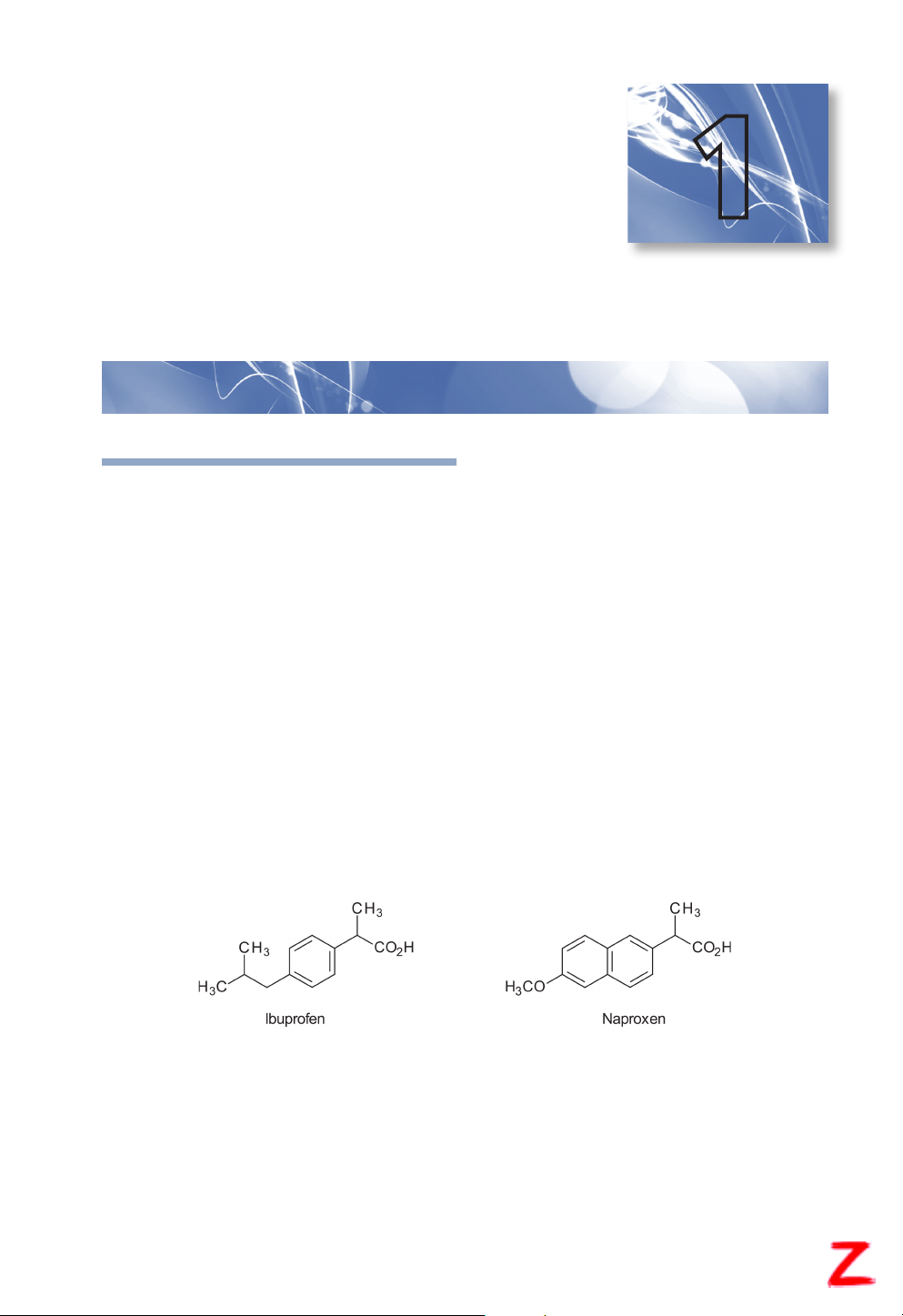
dosing of two commonly used drugs, ibuprofen and naproxen.
Both of these drugs are available without a prescription (i.e., over-the-counter [OTC]) and
produce anti-inflammatory, analgesic, and antipyretic actions. Ibuprofen is a shorter-acting drug
and must be administered every 4 to 6 hours, whereas naproxen is a longer-acting drug that can
be dosed every 12 hours. In evaluating these chemical structures, it is found that there are both
similarities (i.e., carboxylic acid and adjacent methyl group) and differences (i.e., bicyclic ring with
a methoxy group versus monocyclic ring with an alkyl chain). The discipline of medicinal chemistry
seeks to explain how these structural (i.e., chemical) differences result in different durations of DOI 10.37573/9781585286959.001 1
2 BASIC CONCEPTS IN MEDICINAL CHEMISTRY
action. Once this relationship is established, this information can be used to predict the relative
durations of action of other agents within this chemical/pharmacological class.
The primary goal of this text is to help the reader develop a solid foundation in medicinal chem-
istry. Once this foundation has been established, the reader should be able to analyze drug struc-
tures and understand how their composite pieces can contribute to the overall properties and/or
activity of the drug molecules. Every drug that is prescribed and dispensed is a chemical structure
with a specific composition. The atoms and functional groups that comprise these chemical struc-
tures dictate the route of administration, the duration of action, the pharmacological actions, and
the presence or absence of specific adverse drug reactions or drug interactions.
The organization of topics within this text has been carefully selected to allow the reader to pro-
gressively gain knowledge about the chemistry of drug molecules. Each chapter builds on another and,
when applicable, relevant examples are cross-referenced. The authors of this text assume that the
reader has a basic understanding of inorganic chemistry, organic chemistry, and biochemistry. When
applicable, key concepts from these disciplines are reviewed as they apply to medicinal chemistry.
Because every atom within the drug structure is part of a specific functional group, we chose
functional group identification and evaluation as the starting point of our discussion. In Chapter 2,
we focus on the chemical characteristics of functional groups and the roles they can play in drug
action. From there, Chapter 3 examines those functional groups that can be classified as either acidic
or basic. We also explore the reasons why it is important to know the acid/base character of a drug
molecule. In Chapter 4, we continue our examination of acidic and basic functional groups via intro-
duction of the Henderson-Hasselbalch equation and review of several strategies for solving quan-
titative and qualitative pH and pK problems. Numerous examples are provided throughout that a
chapter to help the reader become more proficient in solving these types of problems. Similar to
Chapter 3, we devote the end of Chapter 4 to selected examples designed to help the reader under-
stand the importance of pH, pK , and ionization in drug therapy. In Chapter 5, we discuss how acidic a
and basic functional groups can form inorganic and organic salts. Additionally, we discuss how these
salts influence the water/lipid solubility of a drug molecule and how this relates to various routes of
administration. An emphasis is also placed on the need for a balance between water and lipid solu-
bility and the ability to analyze a drug molecule to discern its water and lipid soluble components.
The chapter ends with strategies to optimize either the water or lipid solubility of a drug molecule
and the associated pharmaceutical and therapeutic advantages.
In some respects, Chapters 2 through 5 share a common thread because they sequentially dis-
cuss the roles and properties of functional groups as a whole, identify those that are acidic or basic,
review a strategy to calculate the extent to which they are ionized in a given environment, and then
examine how all of these characteristics contribute to the overall solubility of a drug molecule. This
is extremely important for ensuring that a drug molecule can be administered to a patient via the
desired route (e.g., orally, via intravenous [IV] injection, or via nasal inhaler).
In Chapter 6, we examine the types of binding interactions that can occur between a drug mol-
ecule and its biological target. Examples of each type of interaction are provided to allow the reader
to become more proficient at analyzing drug molecules and identifying the types of interactions that
can occur with each of its functional groups. In Chapter 7, we discuss how the stereochemistry of a
drug molecule can affect its interaction with biological targets. We review chirality, stereochemical
designations, and the differences between enantiomers, diastereomers, geometric isomers, and con-
formational isomers. A major emphasis is placed on the pharmacological and therapeutic differences
that can occur between enantiomers as well as the specific advantages associated with conforma-
tional restriction of a drug molecule.
In Chapter 8, we discuss the purpose of drug metabolism and explore the metabolic transfor-
mations by which enzymes in the liver and other organs and tissues chemically alter drug molecules.
The chapter includes mechanisms and examples for each type of metabolic transformation and iden-
tifies the functional groups that are susceptible to each type of transformation. Similar to Chapter 6,
the overall objective is to provide sufficient detail to the reader, such that he or she becomes more CH 1 - INTRODUCTION 3
proficient at predicting possible metabolic transformations and understanding known metabolic
pathways for a given drug molecule.
In Chapter 9, we introduce the concept of structure activity relationships (SARs) and relate
this to many examples discussed in previous chapters. Although SARs are an essential component
of the discipline of medicinal chemistry, we intentionally reserved the discussion of this topic until
after the other concepts were discussed. Taken literally, an SAR defines the relationship between
the chemical structure of a drug molecule (or one or more of its component functional groups) and
the physicochemical or pharmacological effects it produces. As such, the text introduces the types
of relationships (e.g., ionization, solubility, drug binding interactions, stereochemistry, and metabo-
lism) prior to discussing SARs. We close the chapter with an overview of some basic concepts of
molecular modification so the reader will understand the common strategies used in the design of
new drug molecules as well as analogs of currently approved drugs.
The final chapter focuses on what we call “Whole Molecule Drug Evaluation,” a process that
requires the reader to use the evaluation skills discussed in the first nine chapters to fully assess spe-
cific attributes of known drug molecules. Unlike the end-of-chapter review questions that focus on
one or two chapter-specific concepts, this final chapter emphasizes an overall analysis of individual drug molecules.
Each chapter includes a variety of examples and review questions chosen to illustrate and
reinforce the concepts discussed. Additionally, Chapters 2 through 9 include Structural Analysis
Checkpoint questions. These questions follow specific drug molecules throughout each of these
chapters and sequentially probe their chemical nature as new concepts are presented. Answers are
provided in the Appendix for all questions so readers can assess their understanding of the con-
cepts that are presented. With perhaps a few exceptions, all examples and review questions are
based on currently available drugs. The text is designed to be comprehensive with regard to the
fundamental chemical concepts that govern drug action. Through conceptual discussions, examples,
and applications, the text is designed to provide readers with the knowledge and skills to predict,
discuss, and understand the pertinent chemistry of any drug molecule or class of drug molecules encountered.
Two resources are provided below. They have been placed in this introductory chapter for easy
access. The first resource is a review of some selected chemical nomenclature and numbering that
are used throughout the text. The second resource is a listing of references used in the writing of this text.
REVIEW OF SELECTED NOMENCLATURE AND NUMBERING
The following topics have been selected due to their relevance in naming and numbering specific
atoms and groups in drug molecules. For a full discussion of organic chemistry and/or biochemistry
nomenclature, please consult the suggested references listed at the end of this chapter.1–17
Orbital Hybridization and Bond Formation
Carbon atoms within the structure of a drug molecule are able to form single, double, or triple bonds
with one another or with other atoms, such as oxygen, nitrogen, sulfur, and halogens. For this to
occur, the 2s and 2p orbitals must form hybrid orbitals consisting of one s orbital and either one,
two, or three p orbitals. Single bonds are comprised of sp3 hybrid orbitals and form a tetrahedral
shape with bond angles of approximately 109.5°. Double bonds are comprised of sp2 hybrid orbitals
and form a planar shape with bond angles of approximately 120°. There are two components to a
double bond: an initial overlap of the two sp2 orbitals and a side-to-side overlap of the unhybrid-
ized p orbitals, known as a π bond. Triple bonds are comprised of sp orbitals and form a linear shape
with bond angles of 180°. Similar to double bonds, there are several components to a triple bond:
4 BASIC CONCEPTS IN MEDICINAL CHEMISTRY
an initial overlap of the two sp orbitals and two orthogonal (i.e., at right angles) π bonds formed by
the two sets of unhybridized p orbitals.
The concept of hybrid orbitals also applies to nitrogen and oxygen atoms; however, due to the
presence of additional electrons, a nitrogen atom contains one lone pair of nonbonding electrons
while oxygen contains two lone pairs of nonbonding electrons. The hybrid orbitals of these atoms
have a similar shape; however, the bond angles are slightly different due to the lone pairs of elec-
trons. Nitrogen is able to form single bonds with carbon, oxygen, nitrogen, and hydrogen; double
bonds with carbon, oxygen, and nitrogen; and triple bonds with carbon. Oxygen is able to form sin-
gle bonds with carbon, nitrogen, and hydrogen or double bonds with carbon and nitrogen.
Numbering of Alicyclic Rings
An alicyclic ring is comprised of hydrocarbon. It may contain double bonds, but it cannot be aro-
matic. The attachment point of an alicyclic ring such as cyclohexane or cyclopentane to a drug
molecule is designated as the C carbon of the ring. When a substituent (i.e., functional group) is 1
attached to the ring, its attachment point is assigned the lowest possible number, as shown below.
This also holds true whenever two or more ring substituents are present.
Designation of Aromatic Ring Positions
The designations ortho, meta, and para are commonly used to indicate the positions of substitution
on an aromatic ring. These designations are relative to the attachment point of the aromatic ring
to the rest of the drug molecule. This attachment point is known as the ipso carbon or the C posi- 1
tion. As shown below, an ortho designation represents a 1,2 substitution pattern on a benzene ring,
a meta designation represents a 1,3 substitution pattern, and a para designation represents a 1,4
substitution pattern. In looking at the 2-methyl, 4-hydroxyl substituted ring, please note that the
2-methyl group is located ortho to the rest of the drug molecule, the 4-hydroxyl group is located
para to the rest of the drug molecule, and the 2-methyl and 4-hydroxyl groups are located meta
to one another (i.e., relative to one another, they are in a 1,3 substitution pattern or meta to one CH 1 - INTRODUCTION 5
another). As seen with this last example, these designations can get more complicated with multi-
ple substituents and multiple aromatic rings. In some cases there may be more than one ipso carbon,
and a functional group could be ortho to one ipso carbon and meta to another. Readers who desire a
more in-depth discussion of this topic are referred to the texts by either Graham Solomons et al9 or
Dewick10 cited at the end of this chapter.
Numbering of Heterocyclic Rings
A heterocyclic ring contains atoms other than just carbon and hydrogen (i.e., heteroatoms). The
three most prominent heteroatoms found in these rings are nitrogen, oxygen, and sulfur. When
there is only one heteroatom present within the ring, it is designated as atom “1” in the ring. Similar
to alicyclic rings, substituents are assigned the lowest possible number. When there are similar het-
eroatoms present within the ring (e.g., two nitrogen atoms), one of these is assigned as atom “1”
and the other is assigned the next lowest number in sequence around the ring. When there are two
different heteroatoms present within the ring, the heteroatom with the highest priority is desig-
nated as atom “1,” and the other is assigned the next lowest number. Priority is determined by
molecular weight; therefore, sulfur has the highest priority, oxygen has the second highest priority,
and nitrogen has the lowest priority. Some examples are shown below. For additional examples of
heterocyclic rings and their numbering, please consult the text by Lemke et al1 referenced at the end of this chapter.
Two common heterocyclic rings are the pyrimidine and purine rings seen in DNA and RNA. The
numbering of these ring systems is shown below. Numbering of Sugars
Sugars are classified as either aldoses or ketoses depending on the presence of an aldehyde or a
ketone, respectively. If the sugar is an aldose, the aldehyde carbon is always designated as carbon
“1,” and the other carbon atoms are sequentially numbered, as shown below with the examples for
glucose and ribose. If the sugar is a ketose, it is numbered beginning at the terminal carbon atom
6 BASIC CONCEPTS IN MEDICINAL CHEMISTRY
that is closest to the ketone. In most instances, the ketone carbon is at the “2” position, as shown below with fructose.
Sugars can readily assume cyclical structures. The hydroxyl groups within a sugar molecule can
react with either the aldehyde or ketone to form a hemiacetal or a hemiketal, respectively, as shown
in Figure 1-1. Although it is possible for any hydroxyl group within the structure of the sugar to form
this cyclical structure, those that form either five or six membered rings are most common. A five-
member ring for a sugar is known as a furanose ring, while a six-member ring is known as a pyranose
ring. The numbering does not change; however, the stereochemistry of the carbon atom used to
make the hemiacetal or hemiketal can be either α or β, as described in the next section. Shown in
Figure 1-1 are the cyclical versions of glucose, ribose, deoxyribose, and fructose.
FIGURE 1-1. Examples of a hemiacetal, a hemiketal, and the cyclical structures of some common sugars.
Alpha (`), Beta (a), and Omega (v) Designations
These designations are used to identify specific carbon atoms within the structure of a drug mol-
ecule. The α designation is used to indicate a carbon atom that is located directly adjacent to a car-
bonyl group (C=O) or a heteroatom, whereas the β designation is used to indicate the next carbon
atom in the chain. Occasionally, γ and δ are used to indicate the third and fourth carbon atoms in a
chain. This represents an alternative way to number carbon atoms. As you progress though different CH 1 - INTRODUCTION 7
classes of drug molecules, you will discover that some drug molecules use conventional Arabic
numerals (e.g., 1, 2, 3) to number carbon atoms, whereas others use these Greek letter designations.
Figure 1-2 provides several examples of drug molecules that use the α/β designation. Both
ibuprofen and naproxen contain a methyl group directly adjacent to a carboxylic acid. This methyl
group is located at an α position, and these drugs are chemically classified as α-methylarylacetic
acids. The carbon atom directly adjacent to the primary amine of dopamine is designated as α, while
the next atom in this ethyl chain is designated as β. The addition of a methyl group directly adjacent
to the primary amine produces α-methyldopamine. As illustrated with penicillin G and ampicillin, a
single molecule can have more than one α designation. Both of these drugs contain a β-lactam ring
and are classified as β-lactam antibiotics. This designation comes from the fact the nitrogen atom
that is involved in the lactam bond is attached to the carbon atom that is β to the carbonyl.
FIGURE 1-2. Examples of ` and a designations.
The α/β designations are also used for cyclical sugars. Whenever an aldehyde or a ketone forms
a hemiacetal or a hemiketal, a new stereochemical center is also formed. This stereochemical center
is unique in that reversible reactions can easily convert linear sugars to cyclical sugars, and vice
versa, allowing the chiral center to easily change. This process is known as mutarotation, and the
chiral carbon atom is known as the anomeric carbon. Isomeric forms of sugars that differ only in
the stereochemistry of the anomeric carbon of hemiacetals and hemiketals are known as anomers.
The α and β designations for the stereochemistry of the anomeric carbon are based on a com-
parison of the stereochemistry of the anomeric carbon to the stereochemistry of the chiral center
that is furthest away from the anomeric carbon. While this can get a little complicated, there is
an easy way to remember these designations with the most commonly encountered sugars (e.g.,
glucose, ribose, deoxyribose, fructose, and galactose). Whenever, the hydroxyl group is “down,”
8 BASIC CONCEPTS IN MEDICINAL CHEMISTRY
it is designated as α, and whenever the hydroxyl group is “up,” it is designated as β. Examples using
glucose and ribose are shown below.
The ω designation is used to identify the carbon atom that is located at the end of an alkyl
chain. Additionally, the designations ω-1, ω-2, and so on are used to designate carbon atoms that
are sequentially positioned one or two atoms (or more) from the end of an alkyl chain. Stereochemical Designations
The following designations are used to identify enantiomers and chiral centers. Please note that the
term enantiomer refers to the drug molecule as a whole, while a chiral center is a single carbon atom.
A complete discussion of these designations can be found in Chapter 7. y
(+)/(-): These designations identify the direction in which an enantiomer rotates plane
polarized light. The (+) designation indicates that the enantiomer rotates plane polarized
light to the right, or clockwise, while the (−) designation indicates that the enantiomer
rotates plane polarized light to the left, or counterclockwise. y
d/l: These designations are similar to the (+)/(−) designations. The d designation is an
abbreviation for dextrorotatory and indicates that the enantiomer rotates plane polarized
light to the right, or clockwise. The l designation is an abbreviation for levorotatory and,
similar to the (−) designation, indicates that the enantiomer rotates plane polarized light
to the left, or counterclockwise. y
d/l: These designations refer to the absolute configuration, or steric arrangement, of the
atoms about a given chiral carbon atom. The d/l designations are linked to the stereo-
chemistry of d- and l-glyceraldehyde, and their use is primarily limited to stereochemical
designations of sugars and amino acids. y
R/S: Similar to d/l designations, R/S designations refer to the absolute configuration of
atoms about a given chiral carbon atom. These designations are preferred over the d/l des-
ignations because they can be assigned via the use of unambiguous sequence rules devel-
oped by Cahn, Ingold, and Prelog. y
`/a: These designations also refer to the absolute configuration of atoms about a chiral
carbon atom; however, their use is primarily limited to steroids and glycosidic bonds. When
used with steroids, the α designation is used for functional groups projected away from the
viewer (represented as dashed lines), while the β designation is used for functional groups
projected toward the viewer (represented as solid lines).