Case Study on Demand Elasticity for Luxury Goods | Microeconomics | Trường Đại học Quốc tế, Đại học Quốc gia Thành phố Hồ Chí Minh
The assumtion was that the demand for the these luxury goods was quite inelastic and the supply is elastic. That is, sellers are very responsive to changes in the price of the good (so the supply curve is relatively flat), whereas buyers are not very responsive (so the demand curve is relatively steep). When a tax is imposed on a market with these elasticities, the price received by sellers does not fall much, so sellers bear only a small burden. Tài liệu được sưu tầm và soạn thảo dưới dạng file PDF để gửi tới các bạn cùng tham khảo, ôn tập đầy đủ kiến thức, chuẩn bị cho các buổi học thật tốt. Mời bạn đọc đón xem!
Môn: Microeconomics 245 tài liệu
Trường: Trường Đại học Quốc tế, Đại học Quốc gia Thành phố Hồ Chí Minh 1.5 K tài liệu
Tác giả:


Preview text:
CASE STUDY ANALYSIS
The Surprising Elasticity of Demand for Luxuries
1. How can you use the theory of “Supply,Demand – and elasticity“ to explain the case (by using graphs) ?
The assumtion was that the demand for the these luxury goods was quite inelastic
and the supply is elastic. That is, sellers are very responsive to changes in the
price of the good (so the supply curve is relatively flat), whereas buyers are not
very responsive (so the demand curve is relatively steep). When a tax is imposed
on a market with these elasticities, the price received by sellers does not fall
much, so sellers bear only a small burden. By contrast, the price paid by buyers
rises substantially, indicating that buyers bear most of the burden of the tax.
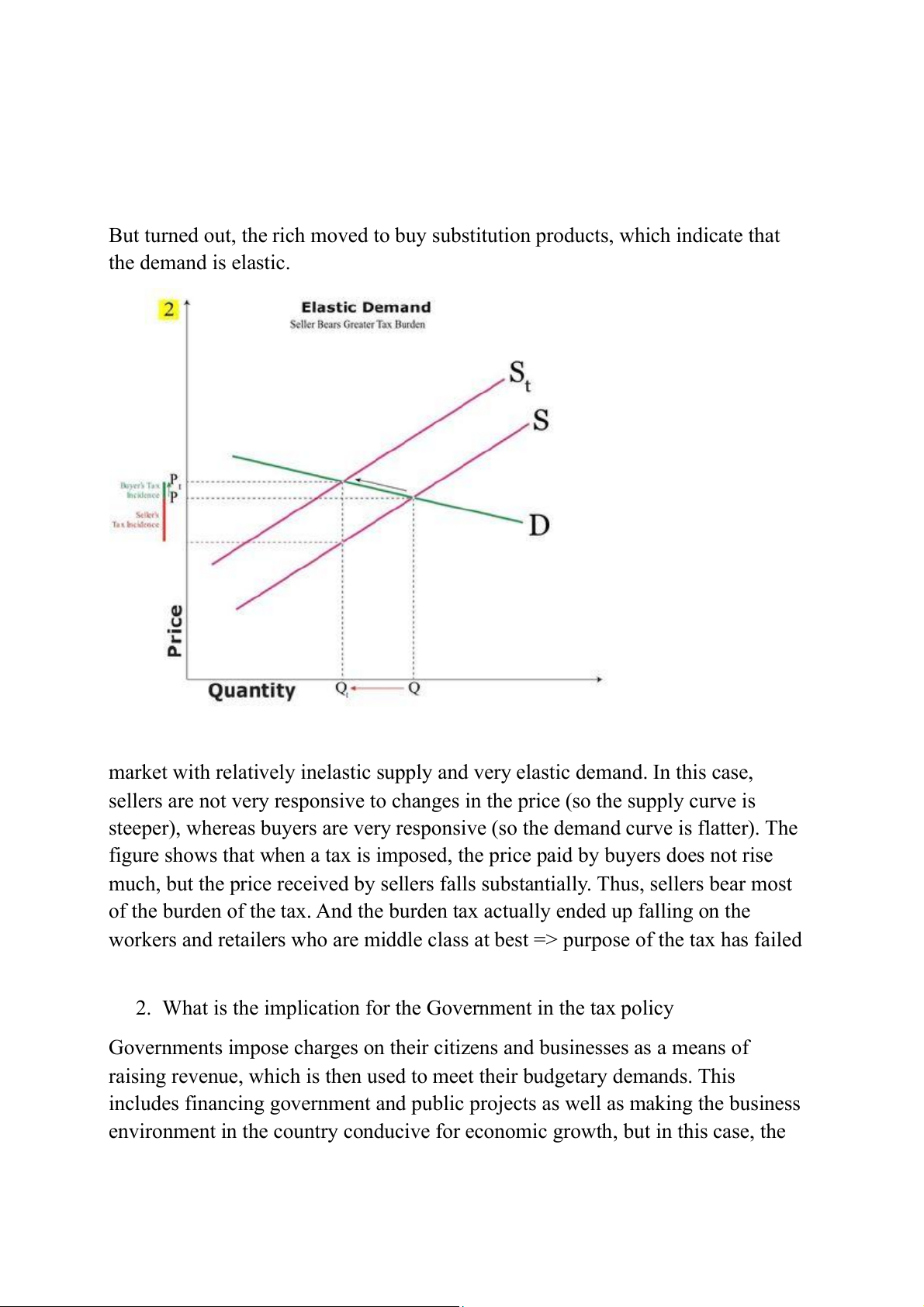
But turned out, the rich moved to buy substitution products, which indicate that the demand is elastic.
market with relatively inelastic supply and very elastic demand. In this case,
sellers are not very responsive to changes in the price (so the supply curve is
steeper), whereas buyers are very responsive (so the demand curve is flatter). The
figure shows that when a tax is imposed, the price paid by buyers does not rise
much, but the price received by sellers falls substantially. Thus, sellers bear most
of the burden of the tax. And the burden tax actually ended up falling on the
workers and retailers who are middle class at best => purpose of the tax has failed
2. What is the implication for the Government in the tax policy
Governments impose charges on their citizens and businesses as a means of
raising revenue, which is then used to meet their budgetary demands. This
includes financing government and public projects as well as making the business
environment in the country conducive for economic growth, but in this case, the
assumption of the elasticity of the demand for these luxury goods is not correct
.The Congress adopted a 10% “luxury tax” which is an inappropriate tax. This
leads to the loss of money in the government and the fall of the supply quantity ->
making this kind of policy detrimental to entire economy.
Tài liệu liên quan:
-
Elasticity Problems and Solutions: Practice Exercises | Microeconomics | Trường Đại học Quốc tế, Đại học Quốc gia Thành phố Hồ Chí Minh
5 3 -
Supply and Demand - ôn tập: Market Equilibrium Effects Analysis | Microeconomics | Trường Đại học Quốc tế, Đại học Quốc gia Thành phố Hồ Chí Minh
3 2 -
Monopoly & Monopolistic Competition | Microeconomics | Trường Đại học Quốc tế, Đại học Quốc gia Thành phố Hồ Chí Minh
4 2 -
Systematic Review of Social Media Marketing in Luxury Brands | Microeconomics | Trường Đại học Quốc tế, Đại học Quốc gia Thành phố Hồ Chí Minh
4 2 -
Seminar-5: Economics | Microeconomics | Trường Đại học Quốc tế, Đại học Quốc gia Thành phố Hồ Chí Minh
4 2