Chap 1. Introducing management môn Principle of Management | Trường Đại học Quốc tế, Đại học Quốc gia Thành phố Hồ Chí Minh
Intellectual capital is the collective brainpower or shared knowledge of a workforce that can be used to create value. Tài liệu giúp bạn tham khảo, ôn tập và đạt kết quả cao. Mời đọc đón xem!
Môn: Principles of Management 187 tài liệu
Trường: Trường Đại học Quốc tế, Đại học Quốc gia Thành phố Hồ Chí Minh 1.5 K tài liệu
Tác giả:

















Preview text:
Chap 1. Introducing management 1. Working today - Talent
+ People and their talents are the ultimate foundations of organizational performance
+ Intellectual capital is the collective brainpower or shared knowledge of a
workforce that can be used to create value
+ A knowledge worker’s mind is a critical asset to employers and adds to the
intellectual capital of an organization - Technology
+ Tech IQ is a person’s ability to use technology to stay informed:
Checking inventory, making a sales transaction, ordering supplies Telecommuting Virtual teams
Effective use of online resources: Databases, Job searches, Recruiting, Social Media - Globalization
+ The worldwide interdependence of resource flows, product markets, and
business competition that characterize our economy
+ Job migration occurs when firms shift jobs from one country to another - Ethics
+ Code of moral principles that set standards of conduct of what is “good” and
“right” in one’s behavior
- Ethical expectations for modern businesses:
+ Integrity and ethical leadership at all levels + Social responsibility + Sustainability - Careers
+ Organizations consist of three types of workers, sometimes referred to as a shamrock organization: - Free-agent economy
+ People change jobs more often, and many work on independent contracts - Self-management
+Ability to understands oneself, exercise initiative, accept responsibility, and learn from experience 2. Organizations - Organization
+ A collection of people working together to achieve a common purpose
+ Organizations provide useful goods and/or services that return value to society and satisfy customer needs - Organizational performance
+ “Value creation” is a very important notion for organizations
+ Value is created when an organization’s operations adds value to the original cost of resource inputs + When value creation occurs: • Businesses earn a profit
• Nonprofit organizations add wealth to society
- Workplace changes that provide a context for studying management …
+ Focus on valuing human capital
+ Demise of “command-and-control” + Emphasis on teamwork + Preeminence of technology + Importance of networking + New workforce expectations + Priorities on sustainability 3. Managers - Manager
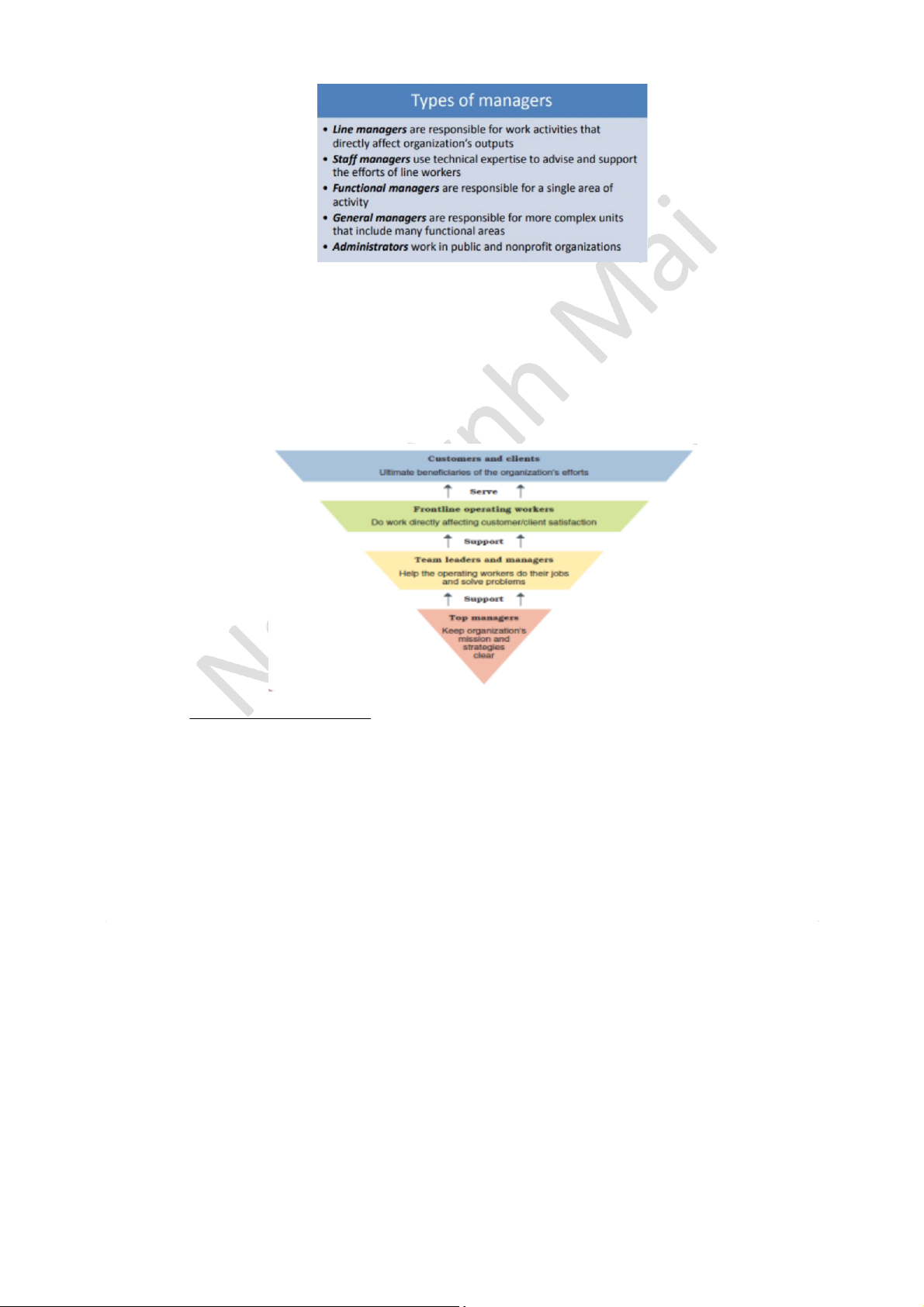
+ Directly supports, activates and is responsible for the work of others
+ The people who managers help are the ones whose tasks represent the real work of the organization -Levels of management
+ Board of directors make sure the organization is run right
+ Top managers are responsible for performance of an organization as a whole or for one of its major parts
+ Middle managers oversee large departments or divisions
+ Team leaders supervise non-managerial workers
-Managerial performance and accountability
+ Accountability is the requirement to show performance results to a supervisor
+ Effective managers help others achieve high performance and satisfaction at work
- The organization as an upside-down pyramid
+ Each individual is a value-added worker
+ A manager’s job is to support workers’ efforts
+ The best managers are known for helping and supporting
+ Customers at the top served by workers who are supported by managers
4. The Management Process
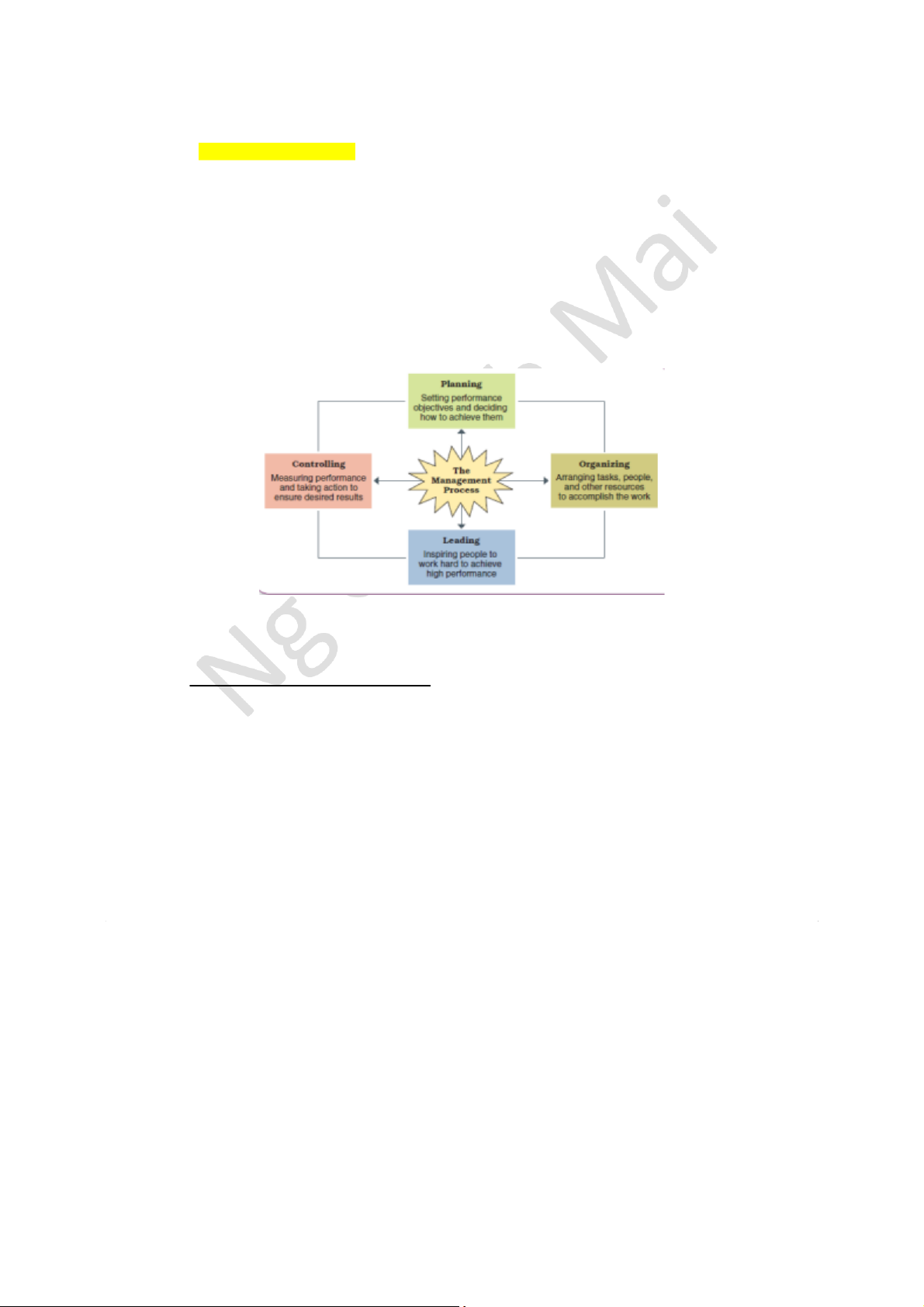
- Managers achieve high performance for their organizations by best utilizing its human and material resources
- Management is the process of planning, organizing, leading, and controlling the use of
resources to accomplish performance goals
- All managers are responsible for the four functions
- The functions are carried on continually - Functions of management
+ Planning - The process of setting objectives and determining what actions should be taken to accomplish them
+ Organizing - The process of assigning tasks, allocating resources, and coordinating work activities
+ Leading - The process of arousing people’s enthusiasm to work hard and direct
their efforts to achieve goals
+ Controlling - The process of measuring work performance and taking action to ensure desired results
Chap 2. Management Learning Past to Present
1. Classical Management Approaches
- Four guiding principles of scientific management (Frederick Taylor)
1. Develop for every job a “science” that includes rules of motion, standardized
work implements, and proper working conditions.
2. Carefully select workers with the right abilities for the job.
3. Carefully train workers to do the job and give them the proper incentives to
cooperate with the job “science.”
4. Support workers by carefully planning their work and by smoothing the way as they go about their jobs.
Taylor’s goal was to improve the productivity of people at work.
+ Scientific management (the Gilbreths)
One of the most enduring legacies of the scientific management approach
grew out of Taylor’s interest in motion study, the science of reducing a job
or task to its basic physical motions
Eliminating wasted motions improves performance
+ Practical lessons from scientific management
Make results-based compensation a performance incentive
Carefully design jobs with efficient work methods
Carefully select workers with the abilities to do these jobs
Train workers to perform jobs to the best of their abilities
Train supervisors to support workers so they can perform jobs to the best of their abilities
Insights from scientific management led to advances in the areas of job design, work
standards, and incentive wage plans—all techniques still used in the modern workplace.
Scientific management emphasizes careful selection and training of workers and supervisory support.
- Administrative Principles ((Henri Fayol)
It identifies the five “rules” or “duties” of management, which are foundations for
the four functions of management—planning, organizing, leading, and controlling - that we talk about today
+ Importantly, Fayol believed that management could be taught. He wanted to
improve the quality of management and set forth a number of “principles” to guide
managers in action. A number of them are still part of the management vocabulary, including:
Scalar chain - there should be a clear and unbroken line of communication
from the top to the bottom of the organization
Unity of command - each person should receive orders from only one boss
Unity of direction - one person should be in charge of all activities with the same performance objective
- Bureaucratic Organization (Max Weber) + Bureaucracy
An ideal, intentionally rational, and very efficient form of organization
Based on principles of logic, order, and legitimate authority
+ Characteristics of bureaucratic organizations:
Clear division of labor: Jobs are well defined, and workers become highly skilled at performing them.
Clear hierarchy of authority: Authority and responsibility are well defined
for each position, and each position reports to a higher-level one.
Formal rules and procedures: Written guidelines direct behavior and
decisions in jobs, and written files are kept for historical record.
Impersonality: Rules and procedures are impartially and uniformly applied,
with no one receiving preferential treatment
Careers based on merit: Workers are selected and promoted on ability,
competency, and performance, and managers are career employees of the organization.
+ Weber believed that bureaucracies would have the advantages of efficiency in
utilizing resources, and of fairness or equity in the treatment of employees and
clients. => Today we recognize that bureaucracy works well sometimes, but not all
the time. In fact, we often hear the terms bureaucracy and bureaucrat used with negative connotations.
+ Possible disadvantages of bureaucracy:
Excessive paperwork or “red tape”
Slowness in handling problems
Rigidity in the face of shifting needs Resistance to change Employee apathy
2. Behavioral Management Approaches
- Organizations as communities (Mary Parker Follett):
+ Groups and human cooperation:
Groups allow individuals to combine their talents for a greater good
Organizations are cooperating “communities” of managers and workers
Manager’s job is to help people cooperate and achieve an integration of interests
+ Forward-looking management insights:
Follett’s emphasis on groups and her commitment to human cooperation are still highly relevant themes today - Hawthorne studies
+ Initial study examined how economic incentives and physical conditions affected worker output
+ No consistent relationship found (the researchers concluded that unforeseen
“psychological factors” somehow interfered with their experiments.)
+ “Psychological factors” influenced results
The initial Hawthorne studies applied a scientific management perspective to
understand how economic incentives and physical conditions of the workplace
affected the output of workers.
+ Social setting and human relations
Manipulated physical work conditions to assess impact on output
Designed to minimize the “psychological factors” of previous experiment
Mayo and colleagues concluded: – New “social setting” led workers to do
good job, Good “human relations” = higher productivity
+ Employee attitudes and group processes
Some things satisfied some workers but not others
People restricted output to adhere to group norms
The researchers concluded that groups can have strong negative, as well as positive,
influences on individual productivity.
+ Lessons from the Hawthorne Studies:
Social and human concerns are keys to productivity
Hawthorne effect — people who are singled out for special attention perform as expected
The studies pointed the attention of managers and researchers toward social and
human factors as keys to productivity.
- Maslow’s theory of human needs
He described a need as a physiological or psychological deficiency a person feels
the compulsion to satisfy, suggesting that needs create tensions that can influence a
person’s work attitudes and behaviors.
They progress step by step from the lowest level in the hierarchy up to the highest. + Deficit principle
• A satisfied need is not a motivator of behavior + Progression principle
• A need becomes a motivator once the preceding lower-level need is satisfied
+ Both principles cease to operate at selfactualization level
Consistent with human relations thinking, Maslow’s theory implies that managers
who understand and help people satisfy their important needs at work will achieve productivity
- McGregor’s Theory X and Theory Y
+ McGregor’s Theory X assumes that workers: Dislike work Lack ambition Are irresponsible Resist change Prefer to be led
+ McGregor’s Theory Y assumes that workers are: Willing to work Capable of self control
Willing to accept responsibility Imaginative and creative Capable of self-direction
+ Implications of Theory X and Theory Y:
Managers create self-fulfilling prophecies
Theory X managers create situations where workers become dependent and reluctant
Managers with Theory X assumptions tend to act in a very directive “command-
and-control” fashion that gives people little personal say over their work
Theory Y managers create situations where workers respond with initiative
and high performance • Central to notions of empowerment and selfmanagement
Managers with Theory Y assumptions tend to behave in engaging ways that allow
subordinates more job involvement, freedom, and responsibility.
- Argyris’s Theory of Adult Personality
+ Classical management principles and practices inhibit worker maturation and are
inconsistent with the mature adult personality
Argyris contrasts the management practices found in traditional and hierarchical
organizations with the needs and capabilities of mature adults.
+ Psychological success occurs when people define own goals
+ Management practices should accommodate the mature personality by:
Increasing task responsibility Increasing task variety
Using participative decision making
the principle of specialization assumes that people will work more efficiently as
tasks become simpler and better defined. Argyris believes that this limits
opportunities for self-actualization. In Weber’s bureaucracy, people work in a clear
hierarchy of authority, with higher levels directing and controlling lower levels.
Argyris worries that this creates dependent, passive workers who feel they have
little control over their work environments. In Fayol’s administrative principles, the
concept of unity of direction assumes that efficiency will increase when a person’s
work is planned and directed by a supervisor. Argyris suggests that this may create
conditions for psychological failure; conversely, psychological success occurs when people define their own goals.
3. Modern Management Foundations
- Quantitative analysis and tools
- Systems view of organizations - Contingency thinking
- Commitment to quality and performance
- Knowledge management and learning organizations - Evidence-based management
+ Management science or operations research
The scientific applications of mathematical techniques to management problems: Value
chain analysis, Supply chain management, Inventory management, Quality control,
Queuing theory, Linear programming, Network models
+ Quantitative Analysis and Tools
Analytics – the use of large data bases and mathematics to solve problems and
make informed decisions using systematic analysis
Typical quantitative approach to managerial problemsolving - Problem
encountered, it is systematically analyzed, appropriate mathematical models and
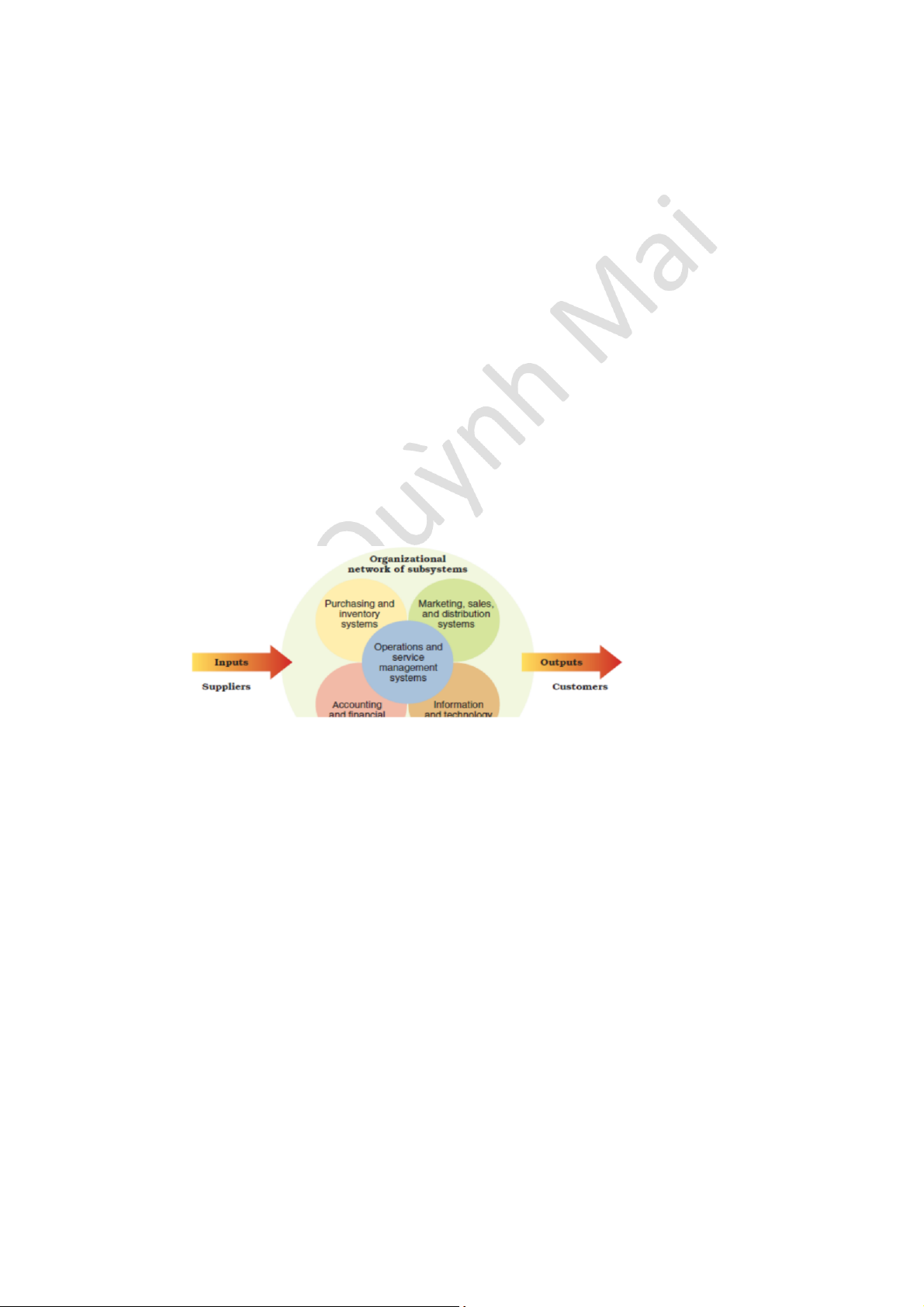
computations applied, optimal solution identified + Organizations as Systems
System - Collection of interrelated parts that function together to achieve a common purpose
Subsystem - A smaller component of a larger system
Open systems - Organizations that interact with their environments in the
continual process of transforming resource inputs into outputs + Contingency thinking
Tries to match managerial responses with problems and opportunities unique to different situations
No “one best way” to manage
Appropriate way to manage depends on the situation + Quality management
Managers and workers in progressive organizations are quality conscious - Quality
and competitive advantage are linked
Total quality management (TQM) - Comprehensive approach to continuous
quality improvement for a total organization
- Creates context for the value chain + Continuous improvement
Continual search for new ways to improve quality
Something always can and should be improved + ISO certification Global quality benchmark
Refine and upgrade quality to meet ISO standards
+ Knowledge Management and Organizational Learning
Knowledge management is the process of using intellectual capital for competitive advantage
Portfolio of intellectual assets include patents, intellectual property rights, trade
secrets, and accumulated knowledge of the entire workforce + Learning organizations
Organizations that are able to continually learn and adapt to new circumstances
Core ingredients include: Encourage learning, Information sharing, Teamwork, Empowerment, Participation + Evidence-Based Management
Making management decisions on “hard facts” about what really works
+ Evidence-Based Positive Human Resource Management Practices Employment security Selective hiring Self-managing teams High pay based on merit Training and development
Reduced status distinctions Shared information
Chap 4. Environment, Innovation, and Sustainability
1. The general or macro economy
- The general or macro environment – all of the background conditions in the external
environment of the organization, including:
Economic: health of the economy
Economic environment: economic growth, unemployment rate, disposable income
Legal-political: philosophy / objectives of political party running the gov
Legal political environment: laws and regulations, business forms, political trends
Socio-cultural: norms, customs, social values
Socio-cultural environment: population demographics, educational system, health/nutrition value
Technological: development and availability of technology
Technological environment: IT systems / infrastructure, broadband internet access
Natural: nature and conditions of environment
Natural environment: “green” values, recycling infrastructure + Economic conditions:
Overal health of economy in terms of financial market, inflation, income levels, and job outlook
Offshoring – outsourcing of jobs to foreign locations
Reshoring – return of job from foreign locations as companies establish new domestic operations + Legal-political conditions:
Laws and regulations, gov policies, and the objecitves of political parties
Vary from 1 country to the next
Internet censorship – deliberate blackage and denial of public access to
information posted on the internet + Sociocultural conditions:
Diversity issues relating to educational opportunity, access to technology, housing / job options
Norms, customs, demographics, and societal values
General cohorts – people born within a few years of another and who experience
somewhat similar life events during their formative years + Technological conditions:
Social media, features and “apps” on smartphones
Brings both opportunities and problems Work-life balance
+ Natural environment conditions:
Nuclear plant failure, oil spill, hurricane
“carbon neural”, “green”, “sustainability”
Sustainable business – meets both the needs of customers and protects the natural environment
2. The specific or task environment
- The specfic (task) environment – actual organizations, groups, and persons with whom
an organization interacts and conducts business: - Competitive advantage:
+ a core competency that clearly sets an organization apart from compertitors and
gives it an advantage over them in the marketplace
+ companies may achieve competitive advantage in many ways, including: costs, quality, delivery, flexibility
4. Environment and Sustainability
- Sustainability – commitment to protect the rights of present and future generations as
co-stakeholers of present-day natural resources
emphasize how we use resources
today influence longer term or other generations in future
- Environmental capital – natural resources used to sustain life and produce goods and
services for society: land, atmosphere, water, minerals
- Triple bottom line: accesses the economic, social and environmental performance of
organizations – 3 P’s of organizational performance Profit PlanetPeople
Chap 5. Global Management and Cultural Diversity
1. Management and Globalization
- Globalization – the growing interdependence of the world’s economics, cultures, and
populations, brought about by cross-border trade in goods and services, technology and
flows of investment, people, and information
- Global management – managing in organizations with business interests in more than 1 country
- Global manager is culturally aware and informed on international affairs (how they
issue opportunities, challenging among countries)
- International business – conducting for-profit transactions of goods and services across national boundaries
- Reasons why business go global: ProfitsSuppliers CustomersCapitalLaborRisk
-Market entry strategies – involve the sale of goods or services to foreign markets but
do not require expensive investment (don’t need to install, to set up a factory / a new
company in a foreign industry)
it just sell or buy goods and services with foreign coutry
-Types of market entry strategies:
+ Global sourcing: the process of purchasing materials or services around the world for local use/domestic use VD: VinFast
+ Exporting: selling locally made products in foreign markets VD: VN exports rice,
+ Importing: buying foreign-made product and selling them domestically
VD: electronic devices used in Vietnam are imported
+ Licensing agreement: one firm pays fee for rights to make or sell another company’s products VD: Bitis, An Phuoc
+ Franchising: a fee is paid for rights to use another firm’s name and operating methods VD: Lotteria, KFC Franchising Licensing
Chuẩn qui trình thống nhất được áp Chỉ chú trọng đến việc bán được càng
dụng để đảm bảo chất lượng đầu ra đồng nhiều sản phẩm càng tốt đều
Không chú trọng chất lượng
Hướng đến kiểm soát chất lượng
-Insourcing refers to local job creation that results from foreign direct investment (FDI) + Types of insourcing:
Joint ventures (công ty liên doanh): operate in a foreign country through co-
ownership by foreign and local partners
a foreign organization and a local
organization combine together, they set up a new business
Strategic alliances (liên minh chiến lược): a partnership in which foreign and
domestic firms share resources and knowledge for mutual gains a form of combination
Foreign subsidiaries: local operation completely owned by a foreign firm is an opposite to joint ventures
VD: Unilever is a foreign subsidiary
+ Criteria for choosing a joint venture partner:
Familiarity with your firm’s major business Strong local workforce
Future expansion possibilities Values its customers
Strong local market for partner’s own products Good profit potential Sound financial standing
-Global business environments: + Legal and political systems:
Differing laws and practices regarding: business ownership, foreign currency
exchange, protection of intellectual property rights Counterfeit merchandise
Political risk – potential loss in value of a foreign investment due to instability
and political changes in the host country
Political risk analysis – forecast political disruptions that threaten the value of a foreign investment
+ Trade agreements and trade barriers:
World trade organization: most favored nation status, tariffs, nontariff barriers, protectionism
because different countries may have agreements that facilitate the business or they
have regulations that oppose or limit the success of a business + regional economic alliances 2. Global business - Types of global business:
+ Global corporation: MNE (multinational enterprise) or MNC (multinational
corporation) with extensive business operations in more than 1 foreign country
+ Transitional corporation: a global corporation that operates worldwide on a borderless basis
-Ethical challenges for global business:
+ Corruption: limits the performance of organization because a foreign company has
to pay under the table for the government, for the rules in that country to do business + Child labor and sweatshops:
Child labor – full time employment of children for work otherwise done by adults some organizations use children because of low cost
Sweatshops – employ workers at very low wages for long hours in poor working conditions
Child labor or sweatshops will emphasize on the profit of the firm but do they
sacrifice the second P – People
3. Culture and Global Diversity
- Culture - is the shared set of beliefs, values, and patterns of behavior common to a group of people.
- Culture shock - is the confusion and discomfort a person experiences when in an unfamiliar culture.
a feeling of confusion that results from suddenly experiencing a culture
with customs that are not familiar to you
-Culture intelligent - The ability to adapt and adjust to new cultures
It means when we run a business internationally, we must be equipped with
knowledge or understanding of how a person from that country, race, religion,
etc. lives and behaves, and how this affects the way we do business:
Cultural intelligence can be understood as the capability to relate and work effectively across cultures.
Through recognizing all peoples cultural intelligence and respecting differences
from an egalitarian basis, egalitarian dialogue encourages individuals to create
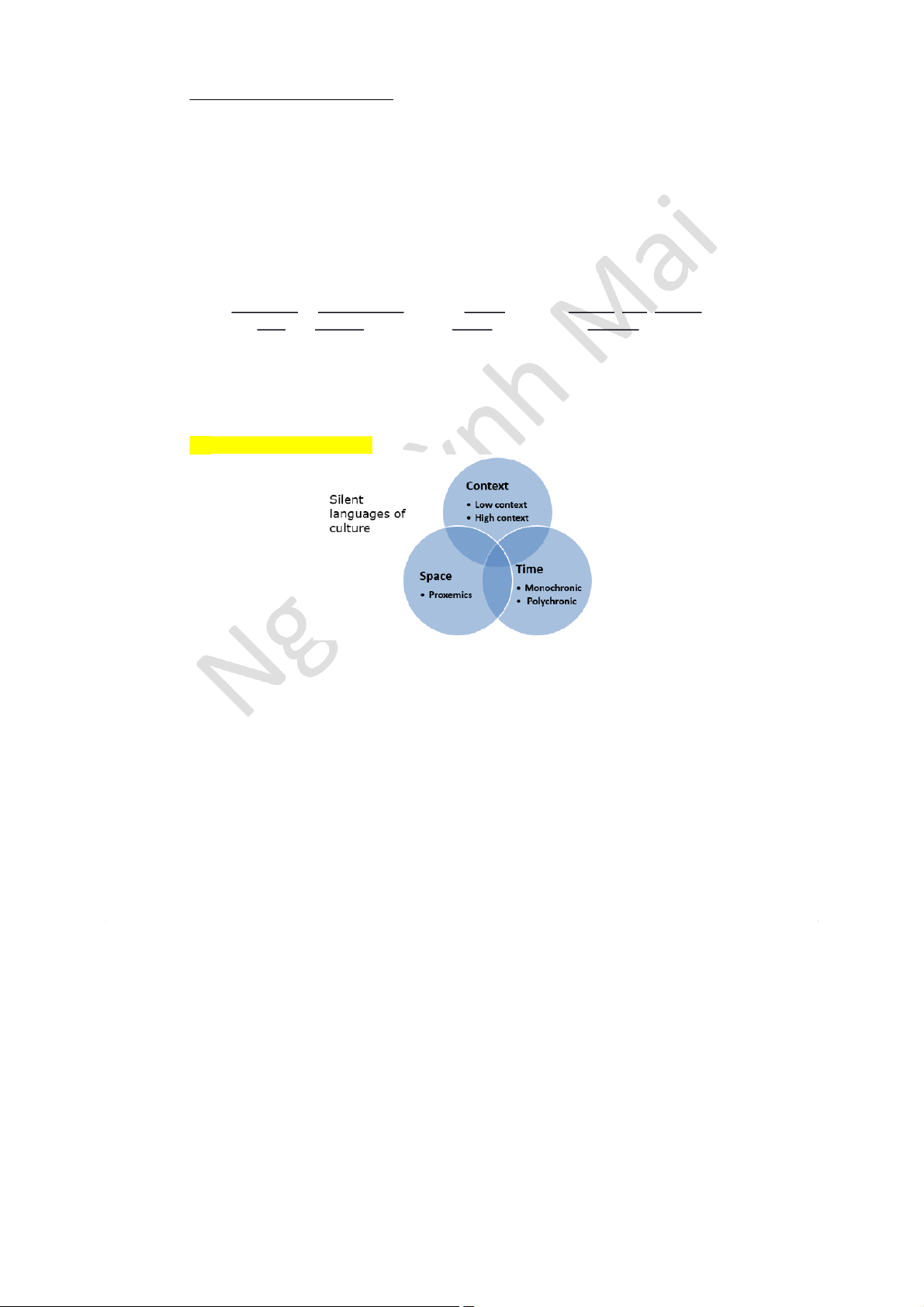
meaning, develop solidarity among different people, and create new instrumental dimensions -Silent languages of culture + Context
Low context cultures - emphasize communication via spoken or written words
VD: Western countries, United States, Canada, Germany. Americans in particular tend to
say or write what they mean and mean what they say. Things aren’t this way in many parts of the world.
High context cultures – rely on nonverbal and situational cues as well as on spoken or written words
Tài liệu liên quan:
-
Leadership Styles Preferred by Generation Z môn Principle of Management | Trường Đại học Quốc tế, Đại học Quốc gia Thành phố Hồ Chí Minh
3 2 -

Chapter 7 Blowing the Whistl môn Principle of Management | Trường Đại học Quốc tế, Đại học Quốc gia Thành phố Hồ Chí Minh
3 2 -
Chapter 11 - Organizational Structures and Their Impacts on Leadership môn Principle of Management | Trường Đại học Quốc tế, Đại học Quốc gia Thành phố Hồ Chí Minh
3 2 -
Lecture 2: Relational Model and Algebra môn Principle of Management | Trường Đại học Quốc tế, Đại học Quốc gia Thành phố Hồ Chí Minh
3 2 -
Lecture 6: ER –Relational Translation môn Principle of Management | Trường Đại học Quốc tế, Đại học Quốc gia Thành phố Hồ Chí Minh
3 2